LUX AETERNA

Mount Auburn Cemetery, Cambridge, Massachusetts

Mount Auburn Cemetery, Cambridge, Massachusetts

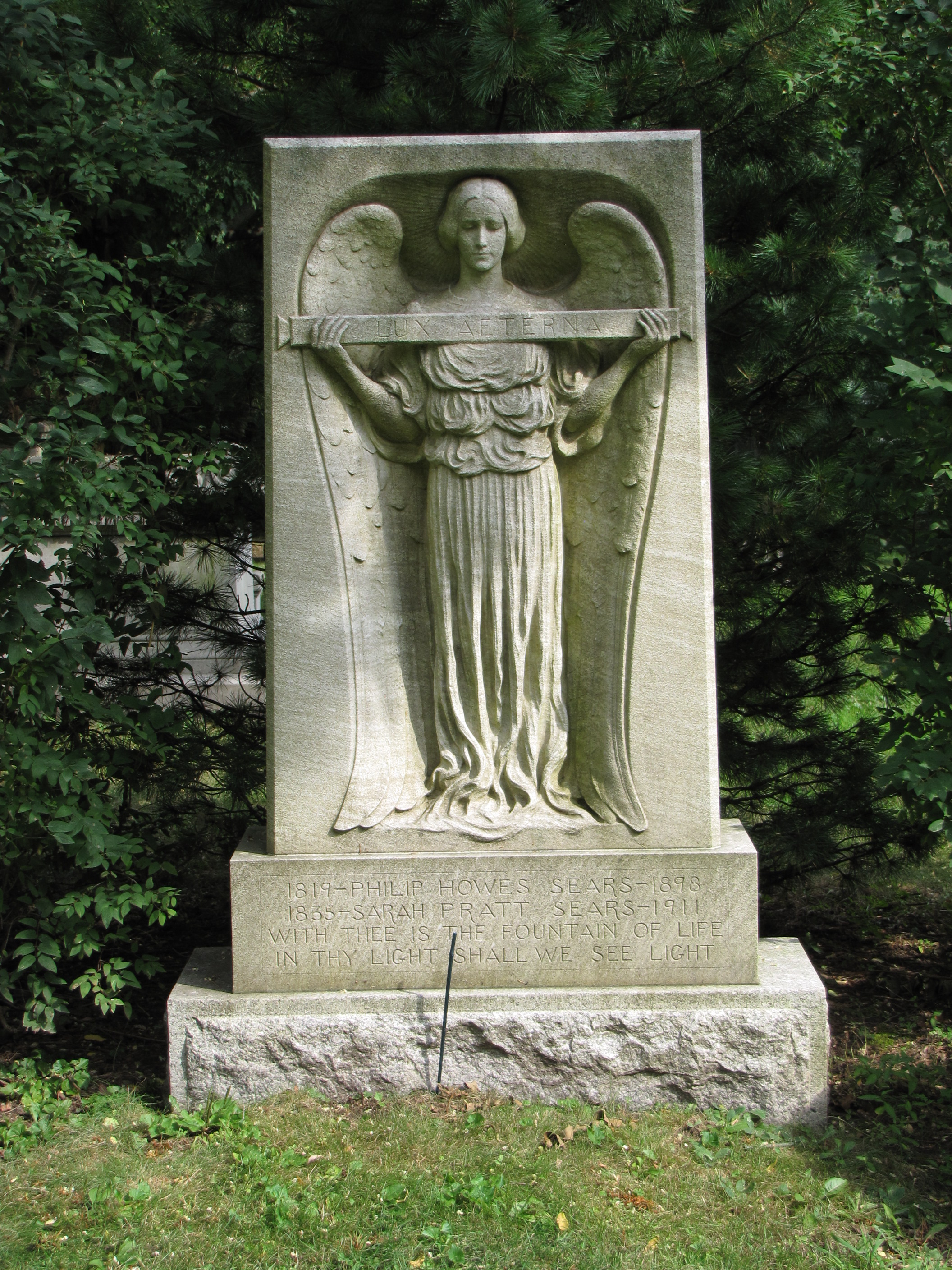
LUX AETERNA

1819 – PHILIP HOWES SEARS – 1898

1835 – SARAH PRATT SEARS – 1911

WITH THEE IS THE FOUNTAIN OF LIFE

IN THY LIGHT SHALL WE SEE LIGHT

When we see a winged figure in a cemetery, we instantly recognize it as an angel–a messenger of God.  However, Christian art did not depict angels with wings until the fourth century.  Before then, angels were represented in several different forms–sometimes in human form, but also represented as a dove, or even just as a hand reaching down to Earth from the Heavens.  Beginning with the reign of Constantine, angels began being depicted with wings, as this angel is portrayed here on the Sears monument in the Mount Auburn Cemetery at Cambridge, Massachusetts.

This angel, dressed in billowing gossamer that forms cloud-like folds on her bodice, holds a ribbon with the words, “LUX AETERNA”, Latin for “Light Eternal.” This is most likely a reference to the Biblical verse John 8:12, Then spake Jesus again unto them, saying, I am the light of the world: he that followeth me shall not walk in darkness, but shall have the light of life.”  The reference is continued in the second line of the epitaph, “IN THY LIGHT SHALL WE SEE LIGHT“.

IMG_5269

Posted in Angels, Symbolism | 1 Comment

Time Takes Flight

Mount Auburn Cemetery, Cambridge, Massachusetts

Mount Auburn Cemetery, Cambridge, Massachusetts

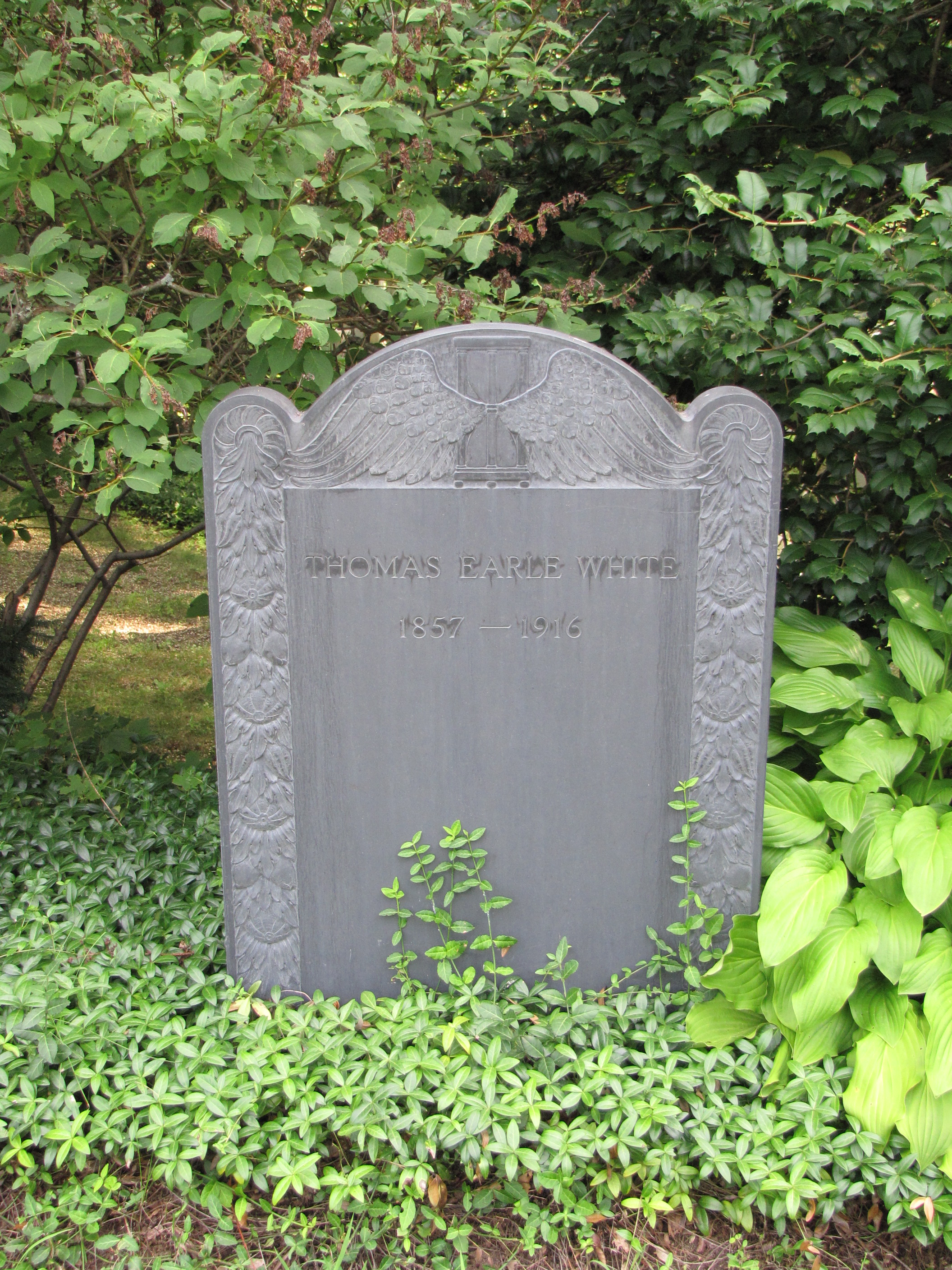
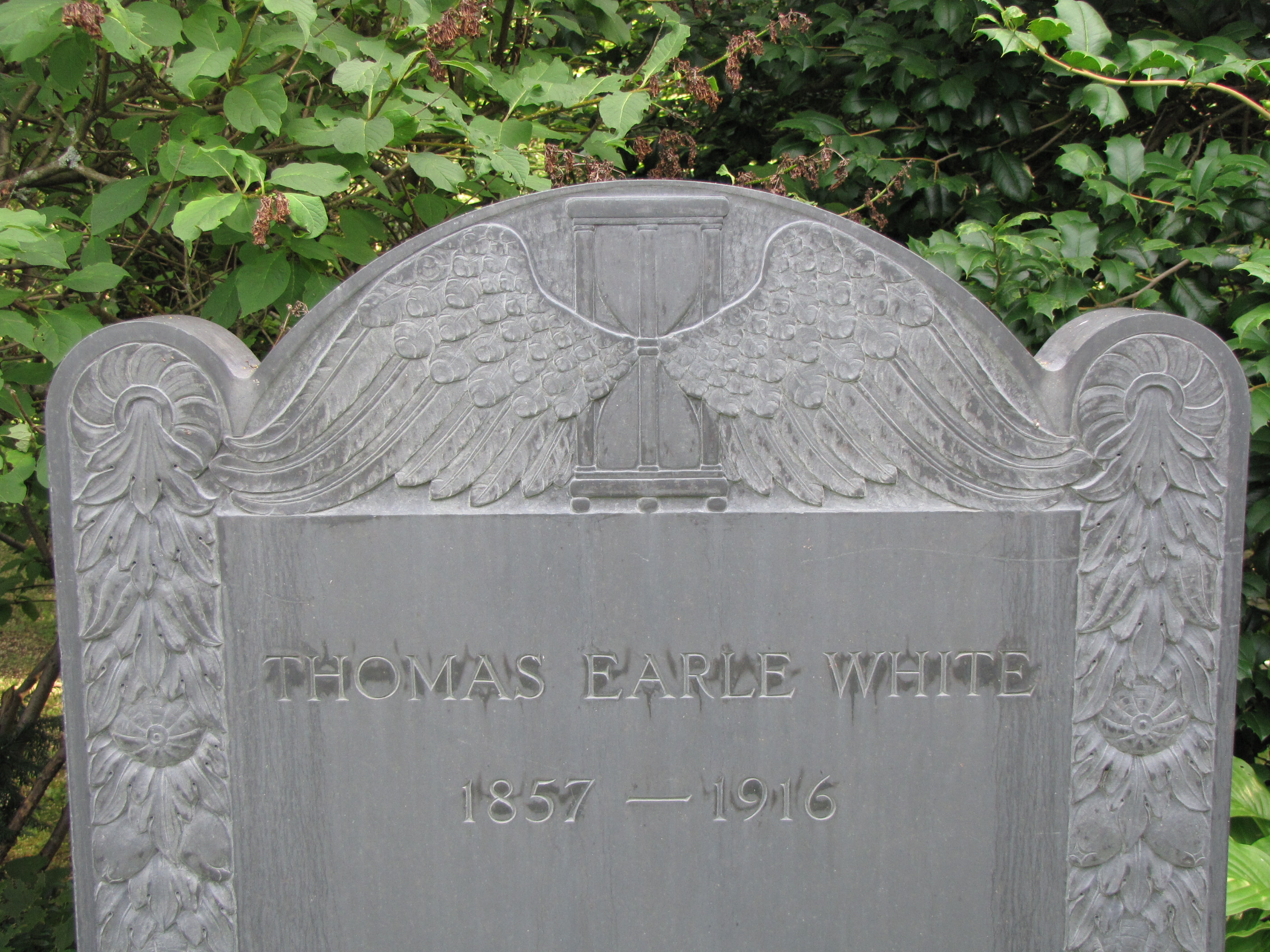
Thomas Earle White

1857 – 1916

There are several expressions in the American lexicon that express how fleeting our time on this Earth is, how this temporal life is short. The grand old soap opera, Days of Our Lives, has as their catchphrase, “Like sands through the hourglass, so are the days of our lives.”  Life measured by the grains of sand slip through one side of the hourglass to the other in a flash.

The hourglass symbol on a gravestone, often shown with wings, as it here, represents the same thought of time fleeting by quickly reminding us of the expression “Time Flies”.  This symbol, a winged hourglass, brings that expression to life, so to speak.

A reminder in stone that life is short and that time is fleeting, every minute of every day brings one closer and closer to death.

It is also an admonition to us NOT to put off making that phone call to an ailing parent, sending that letter to a distant friend, mailing that birthday card even if it’s a day late, getting that present purchased and wrapped to celebrate an anniversary, or the simple act of telling those who you love that you do before it is too late and time has taken flight.

IMG_5534

Posted in Symbolism | 7 Comments

The Chambered Nautilus

Mount Auburn Cemetery, Cambridge, Massachusetts

Mount Auburn Cemetery, Cambridge, Massachusetts

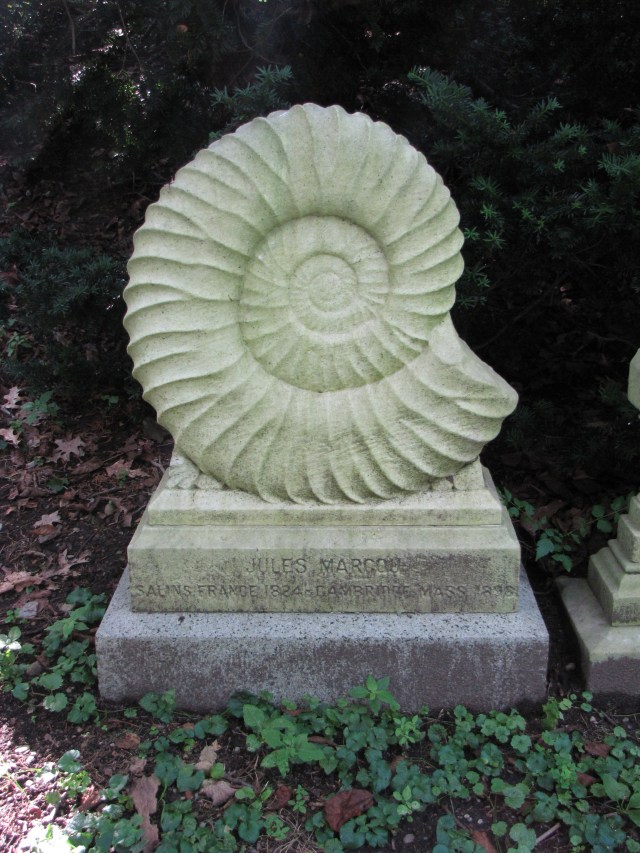
JULES MARCOU

SALINS FRANCE 1824 – CAMBRIDGE MASS 1898

Tucked away in a shaded spot in the Mount Auburn Cemetery in Cambridge, Massachusetts, is the small tombstone of Jules Marcou, born in France on April 20, 1824, and died at Cambridge, Massachusetts, on April 7, 1898, just 3 days short of his 74th birthday. Marcou was a noted geologist who published a series of books and papers, including: Cretaceous formations of the Jura, Dyas (Permian) of Nebraska, Taconic rocks of Vermont and Canada, American Geological Classification and Nomenclature, Geological Map of the World, A Little More Light on the United States Geological Survey, and Geology of North America. Marcou was a protégé of famed natural historian Louis Agassiz and also published Life, letters, and works of Louis Agassiz.

Marcou’s gravestone is delicately carved into a Nautilus—a spiral shaped sea shell, a “lustrous coil”. The Nautilus is intricately comprised of a series of chambers, each abandoned and sealed off as the sea creature grows bigger and needs a larger living space. Once the smaller space is abandoned, it is sealed off completely and cannot be returned to. The Nautilus-shaped gravestone is likely a paean to Marcou’s work in geology but others see the Nautilus as having a deeper meaning.

The poem, The Chambered Nautilus, by Oliver Wendell Homes, Jr., contemplates the Nautilus and the metaphor that can be drawn between it and the changes one goes through in this life. Holmes most clearly draws the metaphor in the last stanza.

Here, in this stanza Holmes hopes that each stage of life will be better than the last as the past is left behind, “Build thee more stately mansions, O my soul.” He calls out to, “Leave thy low-vaulted past!” Out with the old and in with the new and better self, “Let each new temple, nobler than the last, Shut thee from heaven with a dome more vast.”

The Chambered Nautilus

This is the ship of pearl, which, poets feign,

Sails the unshadowed main,—

The venturous bark that flings

On the sweet summer wind its purpled wings

In gulfs enchanted, where the Siren sings,

And coral reefs lie bare,

Where the cold sea-maids rise to sun their streaming hair.


Its webs of living gauze no more unfurl;

Wrecked is the ship of pearl!

And every chambered cell,

Where its dim dreaming life was wont to dwell,

As the frail tenant shaped his growing shell,

Before thee lies revealed,—

Its irised ceiling rent, its sunless crypt unsealed!


Year after year beheld the silent toil

That spread his lustrous coil;

Still, as the spiral grew,

He left the past year’s dwelling for the new,

Stole with soft step its shining archway through,

Built up its idle door,

Stretched in his last-found home, and knew the old no more.


Thanks for the heavenly message brought by thee,

Child of the wandering sea,

Cast from her lap, forlorn!

From thy dead lips a clearer note is born

Than ever Triton blew from wreathèd horn!

While on mine ear it rings,

Through the deep caves of thought I hear a voice that sings:—


Build thee more stately mansions, O my soul,

As the swift seasons roll!

Leave thy low-vaulted past!

Let each new temple, nobler than the last,

Shut thee from heaven with a dome more vast,

Till thou at length art free,

Leaving thine outgrown shell by life’s unresting sea!


Posted in Symbolism | 1 Comment

A variation on “Prepare for Death” epitaph

Trinity Churchyard Cemetery, New York

Trinity Churchyard Cemetery, New York

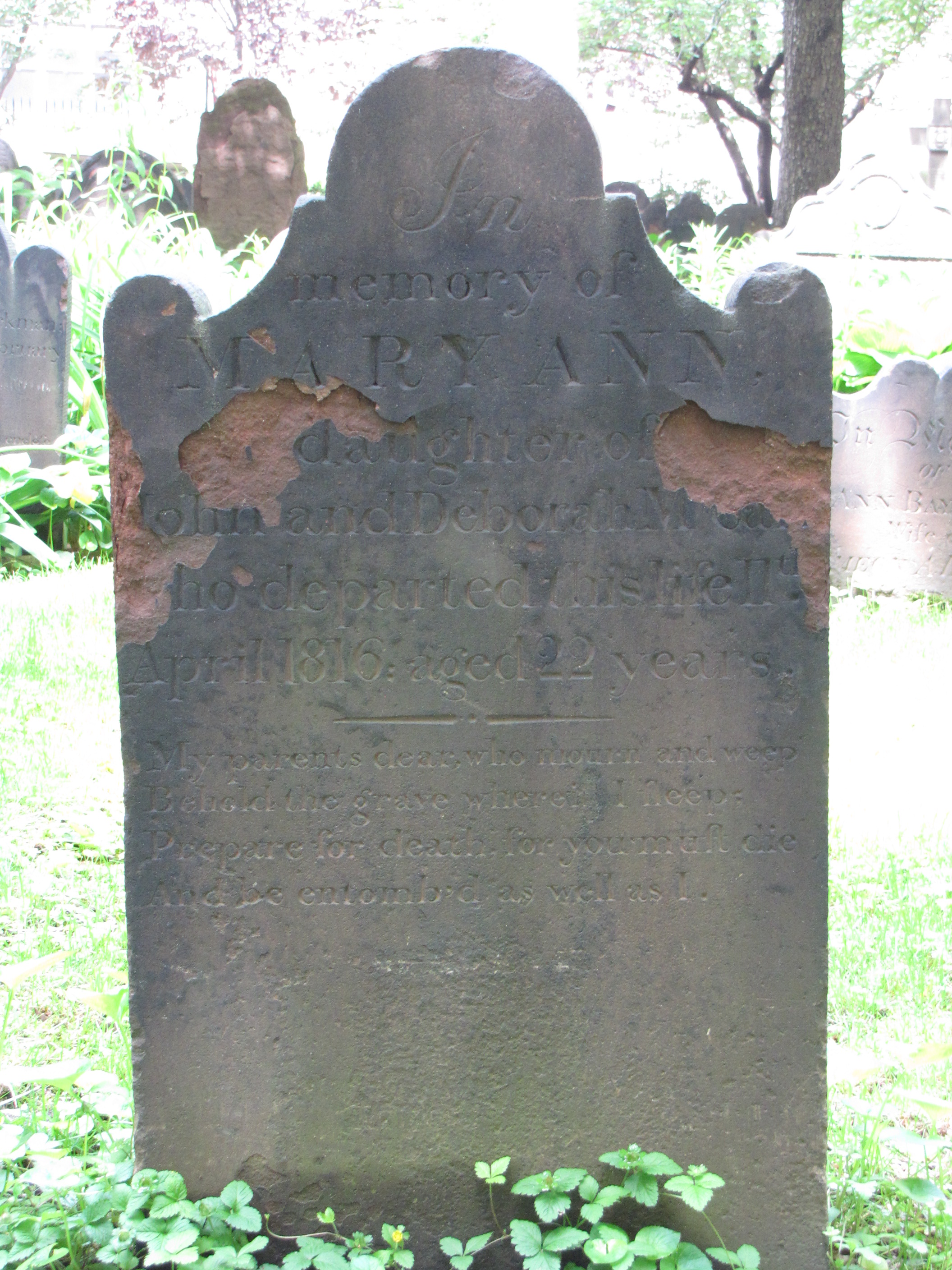
In memory of

Mary Ann

daughter of

Johan and Deborah M…

Who departed this life 11th

April 1816: aged 22 years.

My parents dear, who mourn and weep

Behold the grave where I sleep:

Prepare for death, for you must die

And be entomb’d as well as I.

Posted in Epitaphs | Leave a comment

The Egyptian Revival

Greenwood Cemetery, Phoenix, Arizona

Greenwood Cemetery, Phoenix, Arizona

The Erhardt Family Monument in the Greenwood Cemetery at Phoenix, Arizona, is an example of the influence of the Egyptian revival found in American cemeteries in the 19th century and on into the 20th century. Egyptian ornamentation can be divided into three categories—architectural, geometric, and natural.  The monument has a strong and commanding architectural features. The sides of the monument tilt slightly inward forming a doorway, the cavetto cornice curves into a half circle at the top. The monument is geometrically balanced—two urns on each flank and one in the center.

The natural elements of the monument features two winged globes with uroei above the doorway and on the cornice. In this example, there are three sets of falcon wings that are a symbol of the king, the sun, and the sky. The globe represents the Egyptian god, Horus. The uroei, snakes, are waiting to strike. They symbolize the king’s ability to ward off evil spirits.

Along the sides of the doorway are the long slender stems of the lotus flower, sacred to the Egyptian and Buddhist cultures. The Lotus represents purity and evolution. The lotus is born in the water, the primordial ooze—making it also a symbol of creation and rebirth.

The monument gives one the sense of solemnity and a sense of eternity, reminiscent of the temples of the pharaohs.

Posted in Symbolism | Leave a comment

Follow Me

Greenwood Cemetery, Phoenix, Arizona

Greenwood Cemetery, Phoenix, Arizona

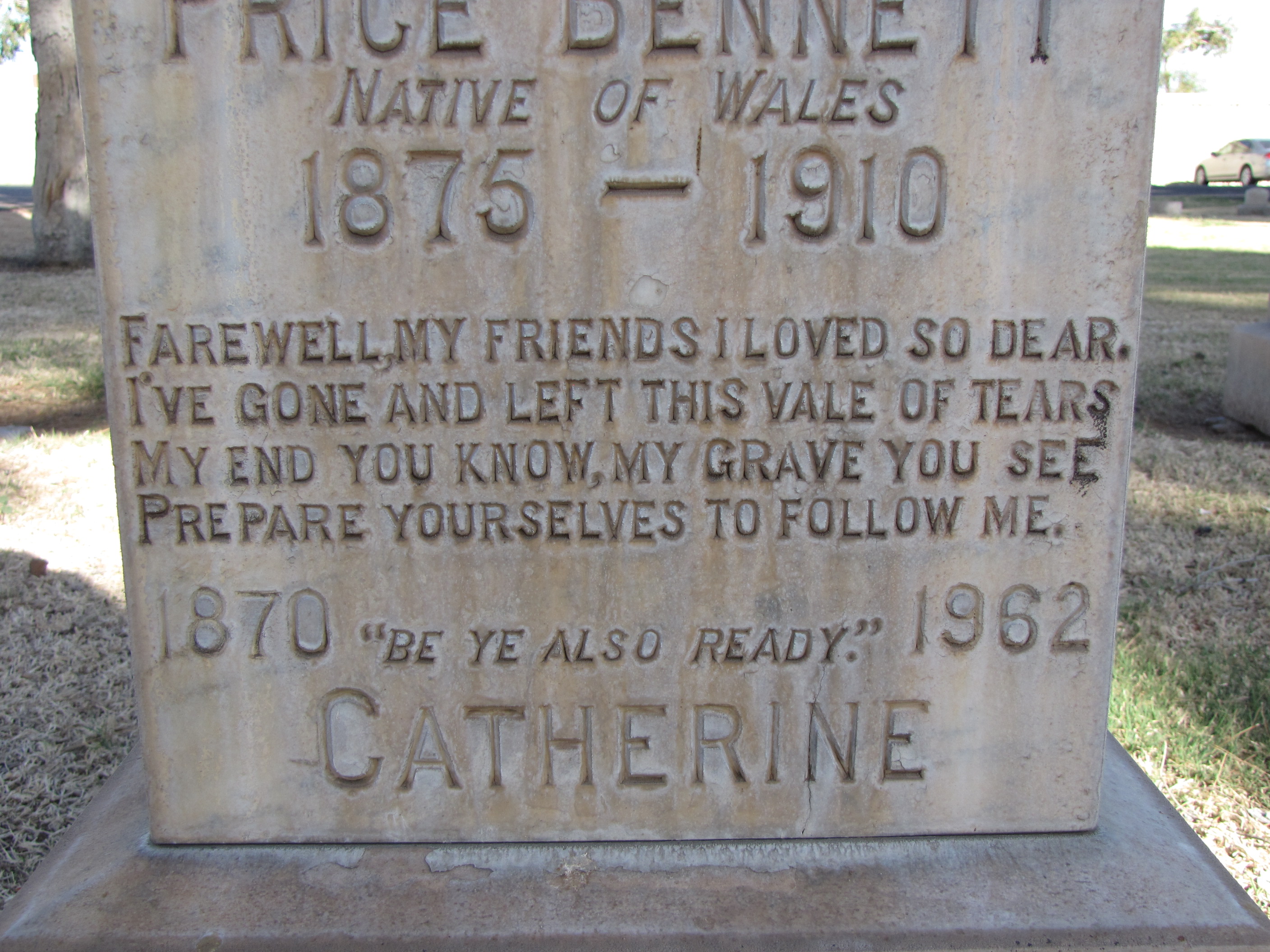
PRICE BENNETT

NATIVE OF WALES

1875 – 1910

FAREWELL MY FRIENDS I LOVED SO DEAR.

I’VE GONE AND LEFT THIS VALE OF TEARS.

MY END YOU KNOW, MY GRAVE YOU SEE

PREPARE YOURSELVES TO FOLLOW ME.


1870 “BE YE ALSO READY.” 1962

CATHERINE


The epitaph on this gravestone from the Greenwood Cemetery at Phoenix, Arizona, sends the haunting message to remember death.  It reminds us that life is short and at the end of that life everyone has the same destination–death.

There are many variations of this epitaph, the most common one being: Remember me as you pass by/As you are now, so once was I/As I am now, so you must be/Prepare for death and follow me.  Below are more examples of this theme:

Death is a debt to nature due/Which I have paid & so must you.

Whilst oe’r my grave you stand and see/Remember you must follow me.

Hark from the tomb a dolful sound/Mine Eare attend the cry/Ye living men come view ye ground/Where you must shortly lie.

Such as thou art, sometime was I/Such as I am, such shalt thou be.

Death is a debt/By nature due/I’ve paid my debt/And so must you.

For sudden death/Prepared be/Resign your breath/And follow me.

Behold my friends, in me you all may see/An emblem of what you e’er must be/Remember you like me was form’d of dust/And with the earth unite again you must.

My friends, ime here the first that come/And in this place for you there’s room.

Passenger stop as you pass by/As you are now. so once was I/I had my share of worldly care/As I was living as you are/But God from all has set me free/Prepare for Death and follow me.

Stop my friend! O take another view!/The dust that molders here/Was once belov’d like you!/No longer then on future time relay/Improve the present and prepare to die!

He that was sweet to my repose/Now is become a stink under my nose/That is said of me/So it will be said of thee.

Now she is dead and cannot stir/Her cheeks are like a faded rose./Which one of us must follow her/The Lord Almighty only knows.

Learn then, ye living! by these mouths be taught/Of all these sepulchers, instruction true/That, soon or late, death also is your lot/And the next opening grave may yawn for you!

Time was i stood as thoust dost now/And viewed the dead as thou dost me/Ere long thoult lie as low as I/And others stand and look at thee.

IMG_8717


Posted in Epitaphs | 5 Comments

Rose Blossom

Greenwood Cemetery, Phoenix, Arizona

Greenwood Cemetery, Phoenix, Arizona

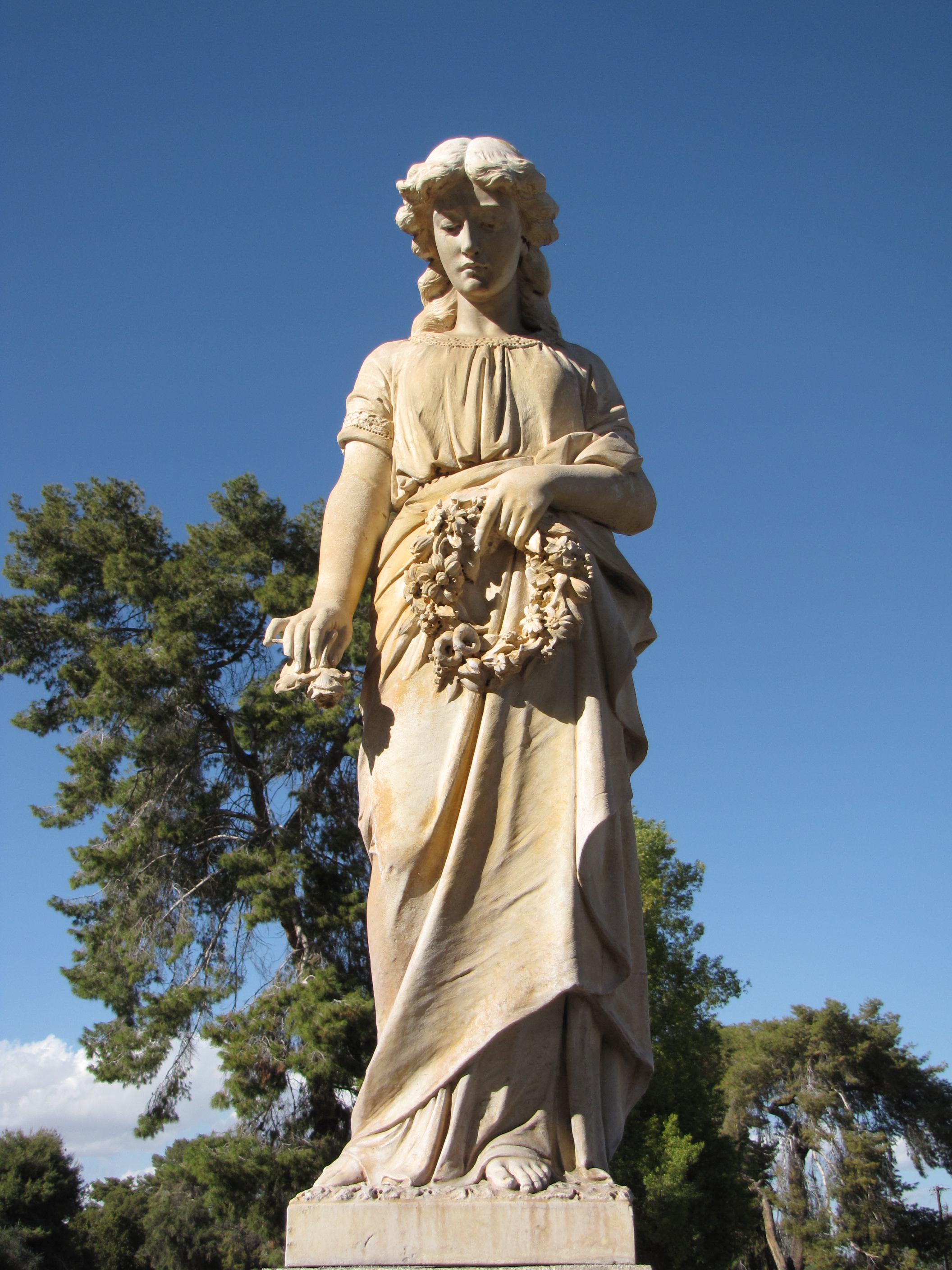
The monument for the Beck family in the Greenwood Cemetery, at Phoenix, Arizona, has atop it a young female figure. Her head is bent forward, she is looking down in reflection and sorrow, while she is holding a rose bloom in one hand and clutching a floral wreath in the other. This is a common Victorian funerary symbol expressing the transitory nature of life.

The rose is a secular symbol for love and beauty but is also associated with the Virgin Mary—the rose without thorns. The rose, however, can also connote age. A rose bud, generally found on a child’s grave, represents the life that has yet to bloom. Often, in that case the bud will be on a broken stem indicating that the life was cut short. A partial bloom on the rose would indicate an older child, such as a teenager, while a full bloom, as we have here indicates the life of someone who has reached maturity. In this case, Mary Beck, who lived from 1825 to 1912, and Ira Beck, who lived from 1861 to 1940, lived long lives indicative of the full blossom on the rose that the statue holds.

IMG_8706

Posted in Symbolism | Leave a comment

Optimism dashed


IMG_1383

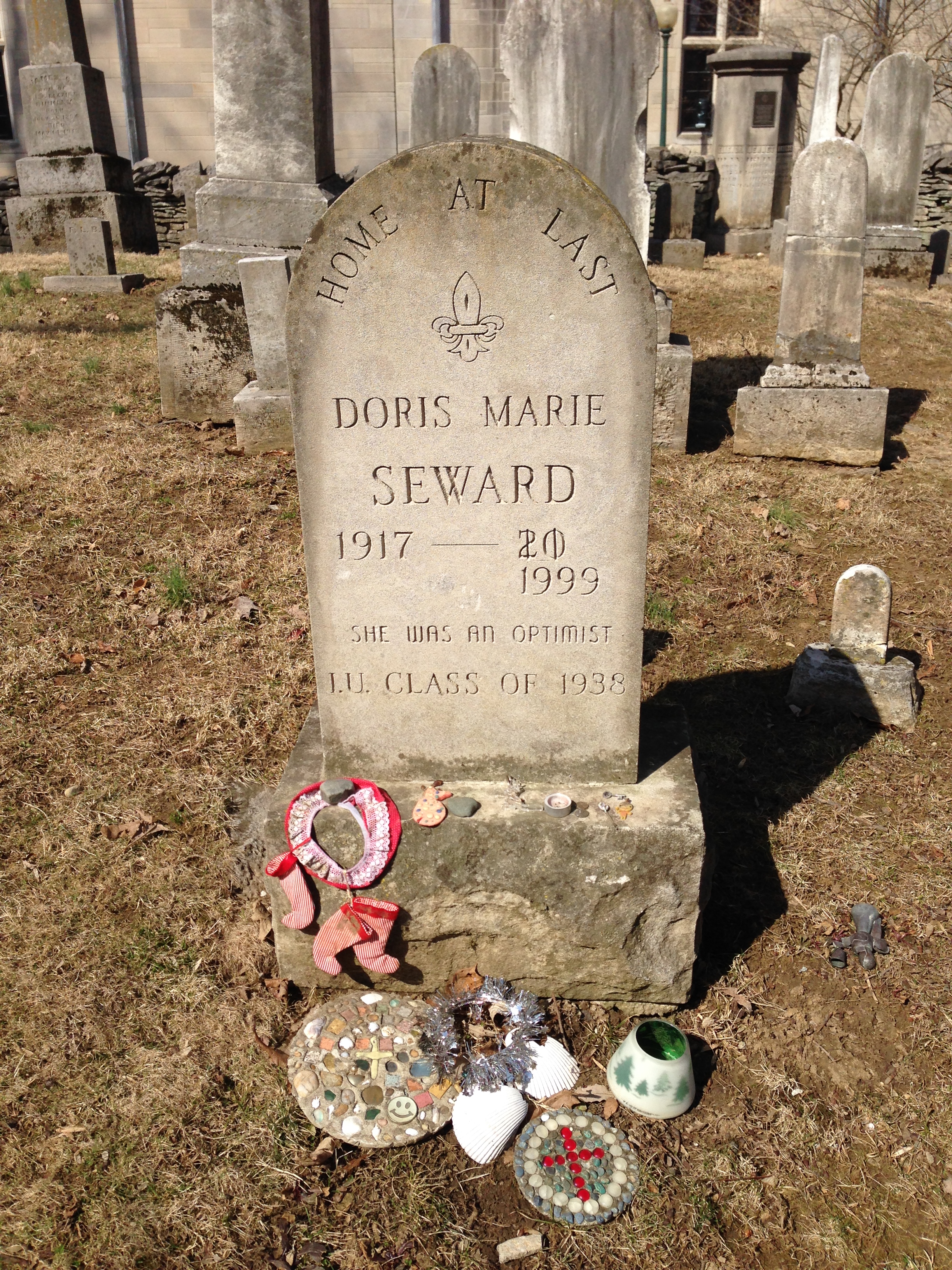
HOME AT LAST

DORIS MARIE

SEWARD

1917 — 20

            1999

SHE WAS AN OPTIMIST

I.U. CLASS OF 1938 

There is a tiny cemetery in the middle of the Indiana University campus next to the Beck Chapel.  Only a couple of dozen people are buried there.  One gravestone of note, is for Doris Marie Seward, whose epitaph describes her as an optimist.  Indeed, her gravestone carver believed she would live into the next millennium, first carving 20, the beginning of 2000 with the death date to be filled in later.  She did not make it and the 20 was crossed out for her death year of 1999.  She almost made it.

Posted in Uncategorized | 5 Comments

Acorn

Greenwood Cemetery, Phoenix, Arizona

Greenwood Cemetery, Phoenix, Arizona

THOMAS K. ELVEY

DEC. 26, 1843

AUG. 13, 1902

AT REST

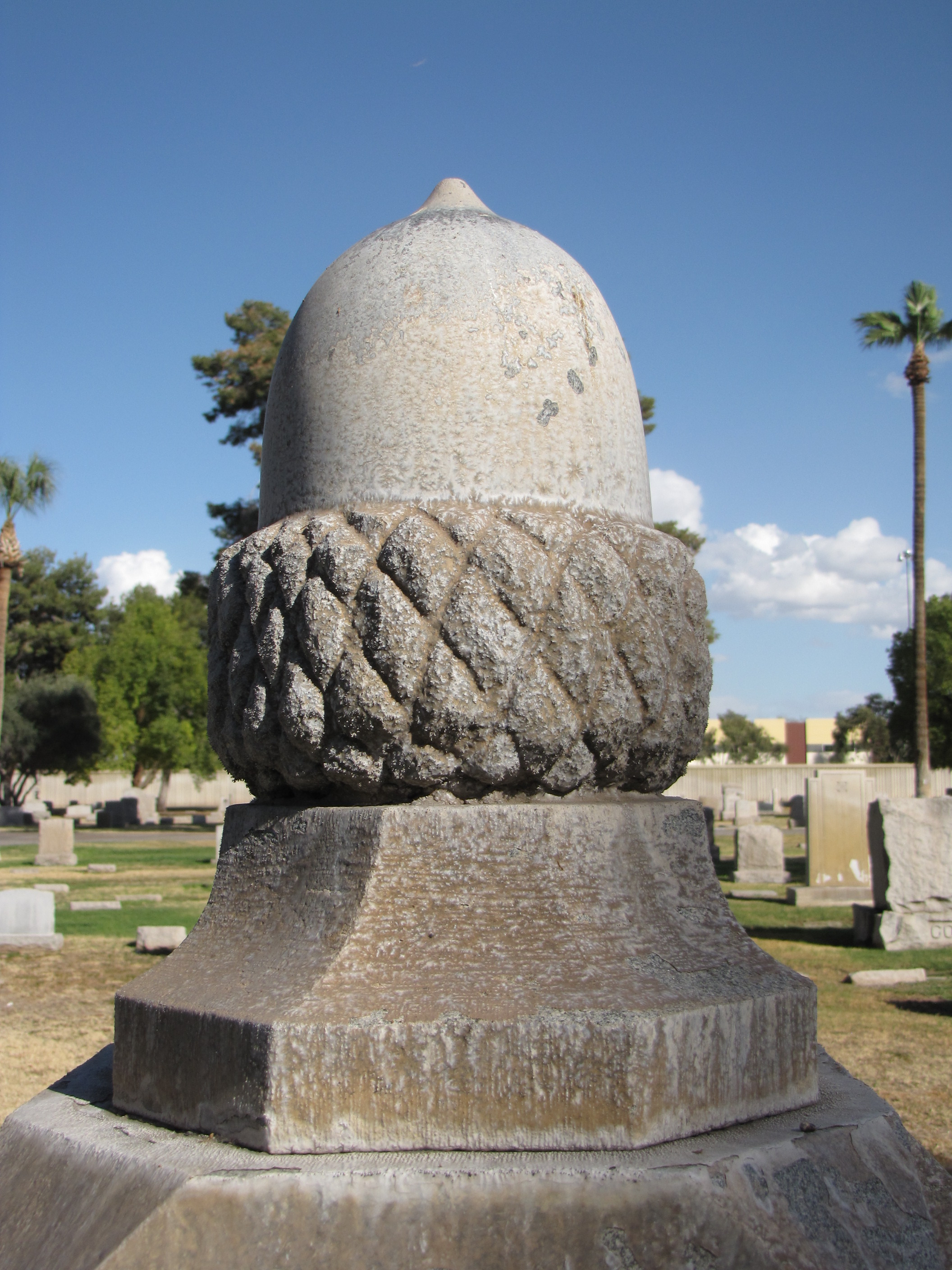
Sitting on top of this gray granite gravestone in the Greenwood Cemetery at Phoenix, Arizona, is a large acorn, turned upside down.  The acorn, seed of the mighty oak, is a symbol of prosperity and fruitfulness.  When the acorn is paired with oak leaves it is seen as a traditional symbol of strength.  The single acorn can represent a kernel of truth born into spiritual growth.  Twin acorns can represent male sexuality.  Two acorns can also represent truth and power of the Holy Spirit. The former is revealed in the Earthly realm and the later after entering the Heavenly realm.

The hex design that is formed at the top of the acorn (here the acorn is upside down so it is seen at the bottom) is used by the Mennonites and Amish artisans.  The design signifies protection and natural abundance.

IMG_8655

Posted in Symbolism | Leave a comment

The Crown

Greenwood Cemetery, Phoenix, Arizona

Greenwood Cemetery, Phoenix, Arizona

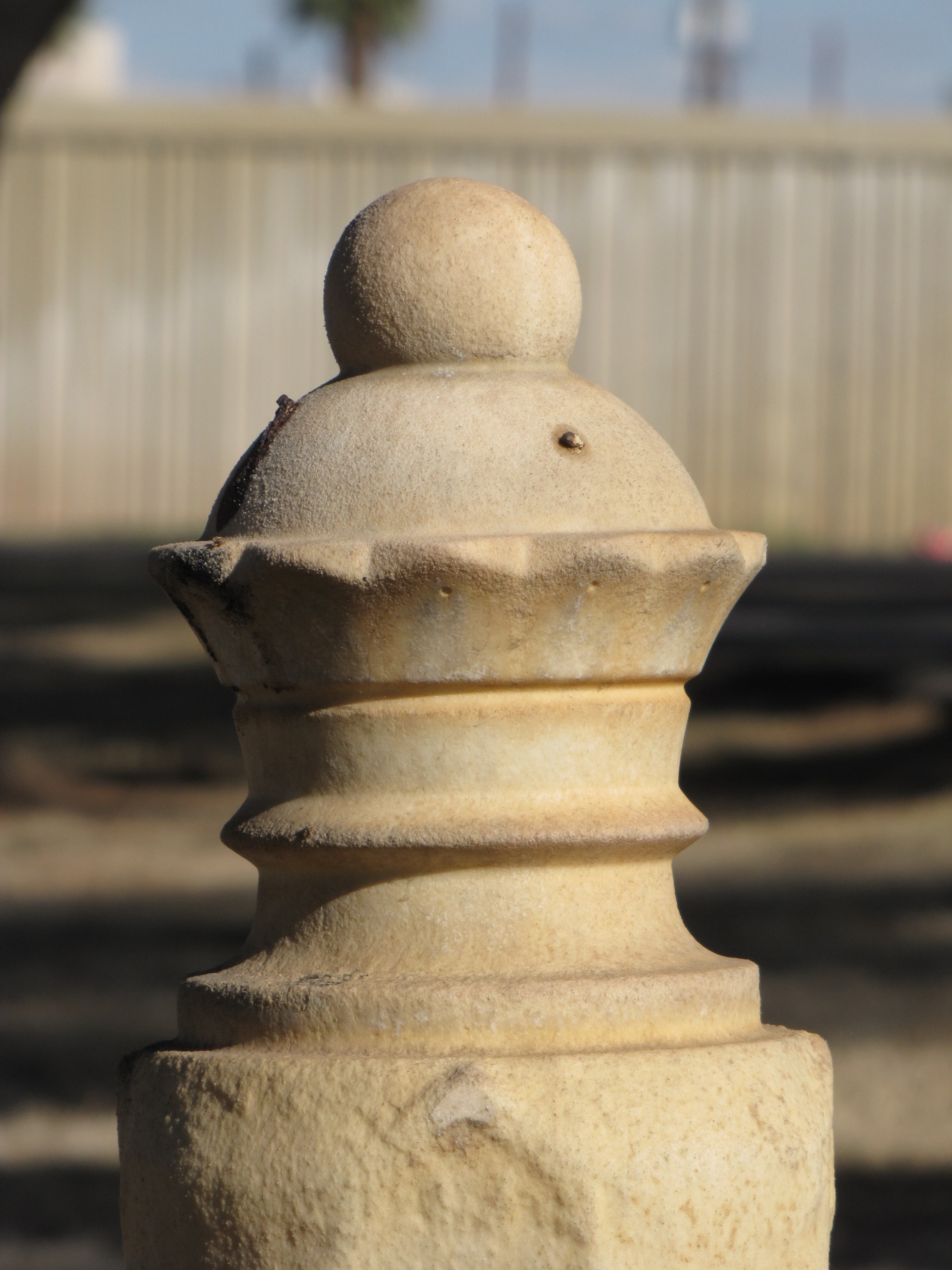
The crown is a fairly common symbol found in American cemeteries.  Sometimes it can be found as an incised carving at the top of the gravestone—often in conjunction with other symbolism such as palm leaves.  Sometimes the crown is made of a completely different material, such as zinc, and anchored on top of a gravestone.

This weathered gravestone, however, in the Greenwood Cemetery at Phoenix, Arizona, has the crown built into the design of the stone, topping the square column.

The crown is a symbol of glory and reward and victory over death.  The reward comes after life and the hard-fought battle on Earth against the wages of sin and the temptations of the flesh.  The reward awaits in Heaven where the victor will receive a crown of victory.  The crown also represents the sovereign authority of the Lord.

IMG_8714

Posted in Symbolism | Leave a comment