It is just a “fair view”

Fair View Cemetery, Red Bank, New Jersey

Fair View Cemetery, Red Bank, New Jersey

The biggest cemetery in Red Bank, New Jersey, is named Fair View which strikes me as funny. The name chosen is damning by faint praise—the view isn’t bad, it isn’t great, it is just “fair”. But what’s in a name? The cemetery is beautiful, set in a neighborhood on gently rolling hills and landscaped in the tradition of some of the first rural cemeteries.

At any rate, Fair View Cemetery has several mausoleums within its gates, including the the Proal Family Mausoleum. The mausoleum is fairly modest, built in a rustic rough-hewn style. The exceptional feature of the crypt is the stained glass window on the back wall.   Adorning the window in shimmering blues, purples, greens, and cocoa is a glass angel depicted holding a crown, as if it is going to be offered to a recently arrived soul to Heaven.

IMG_2652

The crown is a symbol of glory and reward and victory over death.  The reward comes after life and the hard-fought battle on Earth against the wages of sin and the temptations of the flesh.  The reward awaits in Heaven where the victor will receive a crown of victory. The crown also represents the sovereign authority of the Lord.

IMG_2653

In the angels other hand, the angel holds a palm leaf. This symbol is most closely associated with Easter, and Jesus’ spiritual victory over death. The palm frond is also a symbol of eternal peace.

Posted in Symbolism | Leave a comment

Ouroboros Orphis

Glendale Cemetery, Akron, Ohio

Glendale Cemetery, Akron, Ohio

On the massive bronze doors of the Bertram Work Neo-Classical Mausoleum in the Glendale Cemetery, at Akron, Ohio, are several repeating images, one of which is the Ouroboros. The Ouroboros is an ancient symbol depicting a snake eating its tail. The word, Ouroboros, is Greek—oura meaning tail; vora meaning eating, and ophis meaning serpent or snake. In ancient Egypt, the Ouroboros represented the daily passage of the sun.  The snake eating its tail in cemetery symbolism represents the cycle of life—birth and death—and eternity.

IMG_3706

Posted in Symbolism | Leave a comment

Stylized Tulips

IMG_2308

Corneliea Dau

Of John & Mary

Dixon died April

Ye 10 1788 aged

2 Year 6 Months

& 23 Days

Tulips have long been a symbol found in the graveyard, including on the gravestone of two and a half year old, Corneleia Dixon, found in the First Presbyterian Church Cemetery at Trenton, New Jersey. The tulips on this gravestone are highly stylized, yet still recognizable.  Tulips are a symbol of love and passion but since this symbol is on a child’s gravestone it most likely represents eternal life.

IMG_2307

Posted in Symbolism | Leave a comment

Tip Toe through the Tulips

Sleepy Hollow Cemetery, Concord, Massachusetts

Sleepy Hollow Cemetery, Concord, Massachusetts

LIDIAN

Wife of Ralph Waldo Emerson

Daughter of Charles & Lucy (Cotton) Jackson.

Born September 20th 1802, close by

Plymouth Rock as she loved to remember.

Died November 13th 1892 in Concord.

In 1968, in a quivering falsetto, singer musician Tiny Tim released a song titled, “Tip Toe through the Tulips”. Accompanied by his ukulele, the unlikely song by the quirky singer became a hit. Tiny Tim appeared on such shows as Rowan and Martin’s Laugh In and the Tonight Show with Johnny Carson.

The song was written by Al Dubin (lyrics) and Joe Burke (music) in 1929 and had its first burst of popularity that year holding the number one spot on the charts for ten weeks. The song is a plea to meet in a garden of tulips to seal away for a kiss in the moonlight.

Whether the original songwriters or Tiny Tim knew the symbolism of the tulip or not is unclear. But in the Victorian language of flowers and in funerary symbolism, the tulip represents love and passion. What sets this flower apart from the rose as a symbol of love is that it is thornless. It is also unusual in that, after the tender flower is cut, it continues to grow. Because of this, it is often associated with eternal life.

Lakewood Cemetery Mausoleum, Minneapolis, Minnesota

Lakewood Cemetery Mausoleum, Minneapolis, Minnesota

Tiny Tim (Herbert Khaury) died in Minneapolis after a heart attack while giving a performance to a woman’s club. He is buried in the Lakewood Cemetery Mausoleum, Minneapolis, Minnesota, in a plain white-marble crypt. Even the lettering on the face of his crypt belies the flamboyant and eccentric musician who amused and entertained audiences.

KHAURY

HERBERT B

TINY TIM

1932 1996


Posted in Famous graves, Symbolism | Tagged , , | 2 Comments

The Last Ramone

The sculpture of Johnny Ramones on top of his memorial in the Hollywood Memorial Park.

The sculpture of Johnny Ramones on top of his memorial in the Hollywood Memorial Park.

 Joey Ramone/Jeffrey Ross Hyman (May 19, 1951 – April 15, 2001) was the lead vocalist of the punk rock band.   Joey died of lymphatic cancer and was buried at Hillside Cemetery in Lyndhurst, New Jersey.

 Dee Dee Ramone /Douglas Glenn Colvin (September 18, 1951 – June 5, 2002), was a songwriter and bassist for the Ramones. Dee Dee Ramone died of a drug overdose and was buried in Hollywood Memorial Park Cemetery.

 Johnny Ramone/John William Cummings (October 8, 1948 – September 15, 2004), was a guitarist and songwriter for the Ramones.  Johnny died of prostate cancer and was Hollywood Memorial Park Cemetery.

Tommy Ramone /Thomas Erdelyi (born Erdélyi Tamás (January 29, 1949 – July 11, 2014) was the drummer for the Ramones.  Tommy Ramone, 65, the last surviving member of the Ramones, died Friday, July 11, 2014. Arrangements for his funeral and the circumstances of his death have not been announced.

The Ramones’ first album debuted in 1976, and though they never had a top 40 hit, the band toured for 20 years to enthusiastic fans. Though the band was never considered a commercial success, many rockers noted the influence of their music on bands, such as, Green Day and Nirvana, and musicians, such as, Bruce Springsteen.

Dee Dee Ramone's gravestone in the Hollywood Memorial Park Cemetery.

Dee Dee Ramone’s gravestone in the Hollywood Memorial Park Cemetery.

Posted in Famous graves | Leave a comment

Winged Soul Effigy

The Old Hill Burying Ground, Concord, Massachusetts

The Old Hill Burying Ground, Concord, Massachusetts

HERE lies the Body of

Deacon Simon Hunt

who died Decr ye 13th 1790; Aged 87

In private & public, he fought ye honour of God,

The interest of ye Chh. And ye good of his country.

As a Deacon, he conducted with honour & usefulness.

By his knowledge in ye Scriptures, constant devotion,

love for ye Chh. Charity to ye poor, joy in believing & faithful

endeavours to promote ye reformation & salvation of men,

he evinced great progress in religion,

and that he was “steadfast, unmoveable,

abounding in the work of the Lord.”

He met death with entire composure;

and to his last moments, recommended religion,

and encouraged Christians by ye word & promises of God,

He calmly fell asleep in lively hope of future glory,

Mark ye perfect, behold ye upright, his end is peace!

                                                                                                    Psalmist

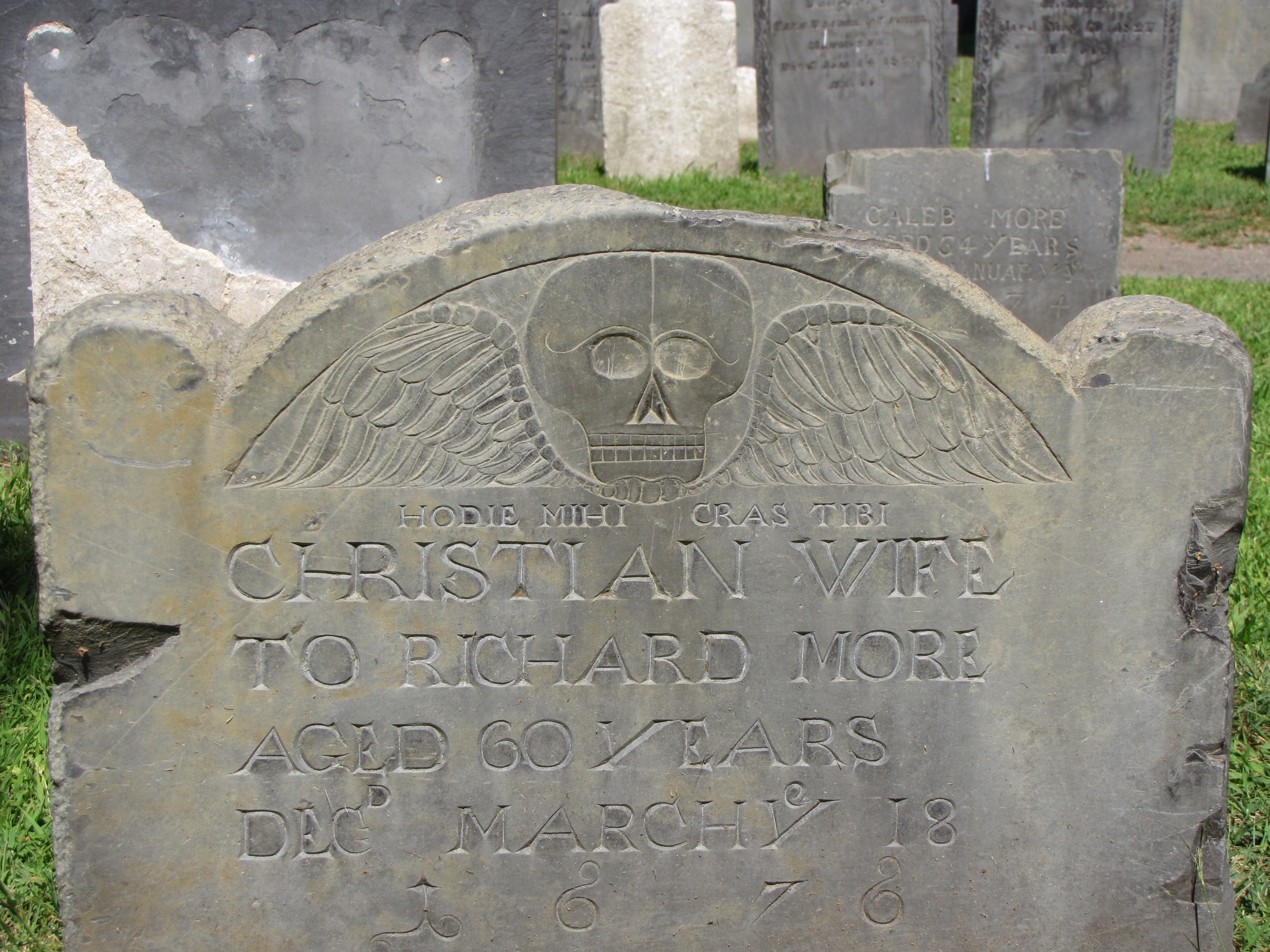
A winged soul effigy is carved into the top of the Deacon Simon Hunt slate grave marker. The gravestone displays the image of a winged head, which is referred to as a “soul effigy.” The soul effigy represents the flight of the soul from one realm to the other—from Earth to Heaven and symbolizes the transition the soul makes on that journey. This iconography represents a change from the harsh Puritan imagery of skulls, crossed bones, winged death’s heads, and the accoutrements of the grave, such as the casket, or coffin, and burial instruments, such as, the pick and axe.

IMG_0762

In this particular case the effigy was probably designed to represent the deceased Deacon—note the collar on the effigy. However, in many cases, the image carved into the stone—sometimes a cherub—was not at all designed to look like the deceased but merely to be a representation of the human soul.

In this particular case, the winged soul effigy is carrying an hour glass tipped on its side, with the words, “My glass is run.” The Deacon’s time has run out, his life is over. This iconography is to remind all who pass by that life is brief.

Posted in Symbolism | 5 Comments

Time takes flight with the soul

Concord, Massachusetts

Concord, Massachusetts

In Memory of

Mrs. Rebeckah Fletcher

Wife of Mr. Samuel

Fletcher She departed

This life Febr ye 2d 1785

In the 77th year of

her age.

The hourglass, a symbol that speaks to the brevity of life, is often shown with wings to turn the metaphor into a striking visual representation. In this case, the hourglass is shown on the head of a winged cherub.

The winged cherub was a symbol that became popular in the 18th Century.  Winged cherubs replaced the stark and morbid flying death’s heads from our Puritan forefathers.  The cherubs often have a childlike countenance of innocence.  The “cherub” on Mrs. Fletcher’s gravestone looks stern and a bit foreboding.  The iconography represents the flight of the soul from the body upward to Heaven and the hope of the resurrection. In this motif the wings give flight not only to the soul but to time.

IMG_0841

Posted in Symbolism | Leave a comment

She slips through the hourglass

Concord, Massachusetts

Concord, Massachusetts

In memory of

MRS. MARTHA PORTER

the wife of

MR. ISRAEL PORTER

Who died 26 June 1795

Aged 49 years.

“Like sands through the hourglass, so are the days of our lives,” is the catchphrase for the long-running soap opera, Days of Our Lives.  The meaning of that catchphrase is clear–life passes by very quickly.

The likeness on the gravestone (pictured above) in the Old Town Cemetery in Concord, Massachusetts, sits atop the hourglass.  Here the life is being measured by the grains of sand slipping through one side to the other.

IMG_0727

Posted in Symbolism | Leave a comment

Chains, broken and unbroken

IMG_2763

UNITED ABOVE

OUR FATHER

DANIEL HALLETT

DIED

April 3, 1856

AE. 61 Y’s. 2 M’s.

Two gravestones from the same cemetery in West Yarmouth, Massachusetts, display a chain in a circle. This symbolism is the combining of two symbols—the circle and the chain. Traditionally the “circle” is a metaphor for life.  The circle represents eternity. The chain as a Christian symbol dates back to medieval times when people believed that the soul could be held to the body by a golden chain. Once the chain was broken, the soul took flight and rose from the body leaving Earth and ascended to Heaven.

IMG_2764

The square-top white marble tablet of Daniel Hallettt above displays a circle of links but shows the chain broken or missing a link. The epitaph on the gravestone is “UNITED ABOVE.” Like much of the funerary art, the broken link of a chain represents the life that was ended. The message being conveyed is that death separates us, the circle of life is broken here on Earth, but we will be re-united in Heaven.

IMG_2874

UNITED ABOVE

BETSEY H. CROWELL

Widow of

Eugene Crowell.

Born Aug. 24, 1823,

Died Dec. 25, 1902.

In the case of the tombstone for Mrs. Betsey Crowell, who died on Christmas day, the circle of chain links is also the symbol displayed on the gravestone, but the circle is unbroken. The epitaph is exactly the same, “UNITED ABOVE.”. In this example, the message is not focused on what happened on Earth, that is the breaking of the chain—death, but instead what happens in Heaven, the uniting of the chain.

IMG_2875

These two gravestones use the same symbolism and the same epitaph but the message of one focuses on death and one focuses on resurrection. The message of the complete circle is one of hope and inspiration while the broken chain emphasizes the death on Earth.

Posted in Symbolism | Leave a comment

The Community of True Inspiration

Main Amana Cemetery, Main Amana, Iowa

Main Amana Cemetery, Main Amana, Iowa

The straight upright rows of same-shaped gravestones look like they are located in a military graveyard—but they are not. These gravestones are in a tiny graveyard at “Main” Amana, Iowa, one of the seven villages founded by a communal German religious group of Pietists known as the Community of True Inspiration. Each person is buried in order of their death–NOT next to their families in family plots.  Each person receives a concrete segmented-top gravestone of the same shape and construction.

In the early 1700s, two religious leaders, Eberhard Gruber and Johann Rock, founded the religion. They followed the teachings of Philipp Spener, who believed that God spoke directly to individuals, just as He had done in Biblical times through the prophets. The Inspirationalists, as they were called, were being persecuted in Germany for disavowing the teachings of the Lutheran Church. Their property was seized and some of the members of the religious group were flogged.

After Gruber and Rock died, Christian Metz and Barbara Heinemann were named instruments, those who could hear the word of God directly. After leasing land in Europe for two different settlements, they decided, in a meeting of elders to move the colony to America. In 1842, the Inspirationalists moved to a settlement in New York, which they called Ebenezer after the Eben-Ezer found in the Book of Samuel. The community prospered and they required more land. It was decided to move west. The purchased a parcel of land in Iowa and, in 1855, established the first village of Amana. Amana is a Biblical name meaning inspirational. Six more villages came after: Homestead (a village the Inspiralistionists purchased for the railway station), Amana vor der Hohe (High Amana), Sud Amana (South Amana), West Amana, Ost Amana (East Amana), and Mittel Amana (Middle Amana). In total the Amana Colonies had 26,000 acres of land in what is some of the best farmland in the breadbasket of America.

IMG_2175

These villages and this land were held in common by the community. Each member of the community was expected to work, go to several of the church services during the week, and eat together in the communal dining rooms. Each of the seven villages had communal kitchen to supply the meals—cooking was not done in individual homes. However, dining together was not considered a social act and talking was discouraged during meals. Men sat on one side of the table and women and children on the other. Likewise, church services were austere—men on one side of the church and women on the other, with small children and women in the back. These services had no music. Marriage was discouraged but allowed if the religious leaders could find no objection to the union. Children were also discouraged.

In 1932, the community went through what is known as the “Great Change.” That is, the community was disbanded and members of the community were awarded shares of stock based on how much they had invested in the community. That year communal life ended. However, the seven villages still remain as does the reputation of one of their best-known products—the Amana refrigerator, which is now owned by the Whirlpool Corporation.

Posted in Uncategorized | Leave a comment