Knights of Pythias

Chesterton Cemetery, Chesterton, Indiana

In 1864, the Knights of Pythias was founded by Justus H. Rathbone, making it the very first fraternal organization to receive a charter under an Act of the United States Congress.  The society is based on the Greek story of friendship from 400 B. C. between Damon and Pythias, members of a school founded by Pythagoras.

According to their Website, Pythians: promote cooperation and friendship between people of good will, find happiness through service to mankind, believe that friendship is essential in life, view home life as a top priority, show an interest in public affairs, enhance their home communities, respect and honor the law of the land, and expand their influence with people of like interests and energy.

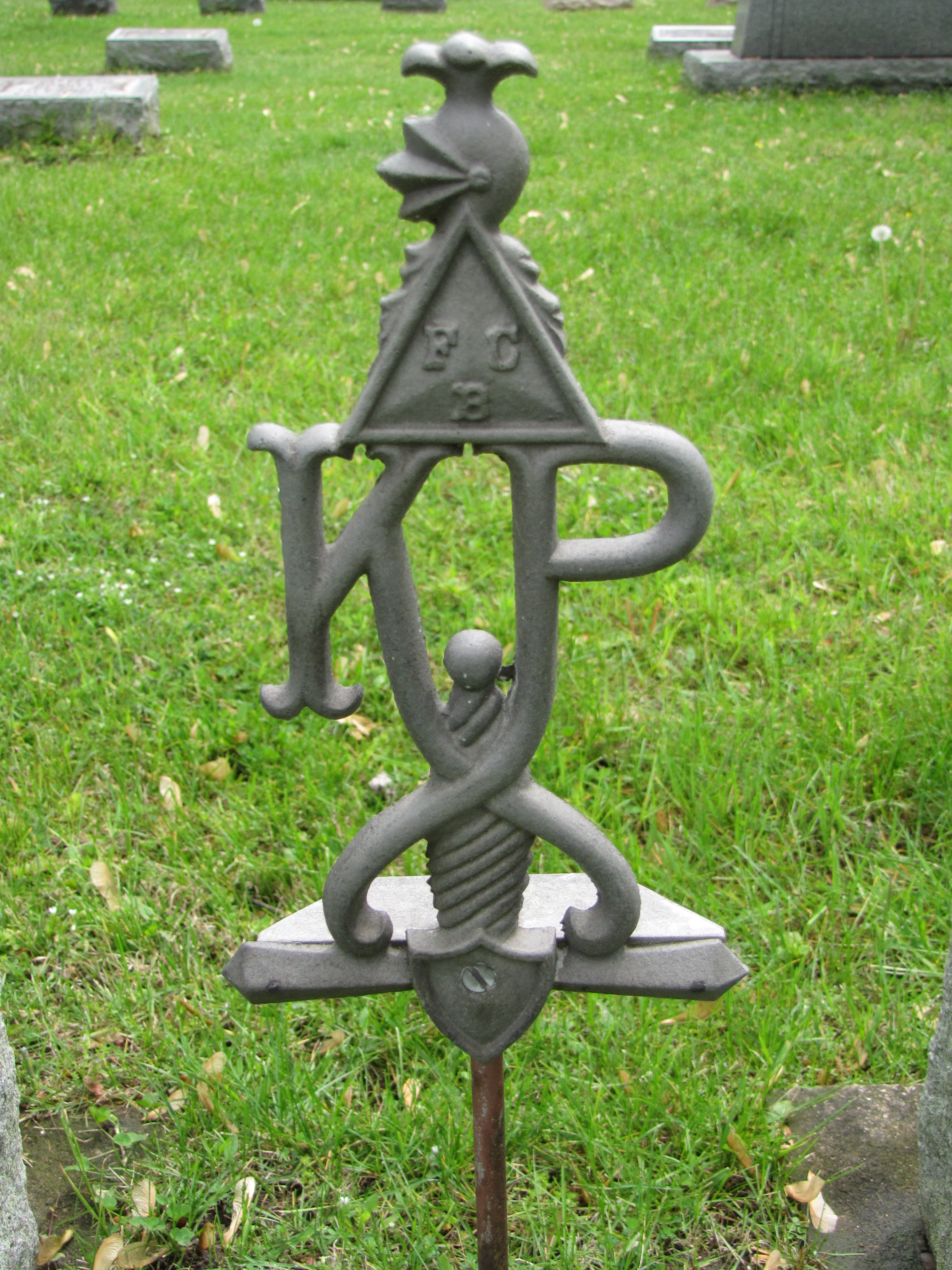
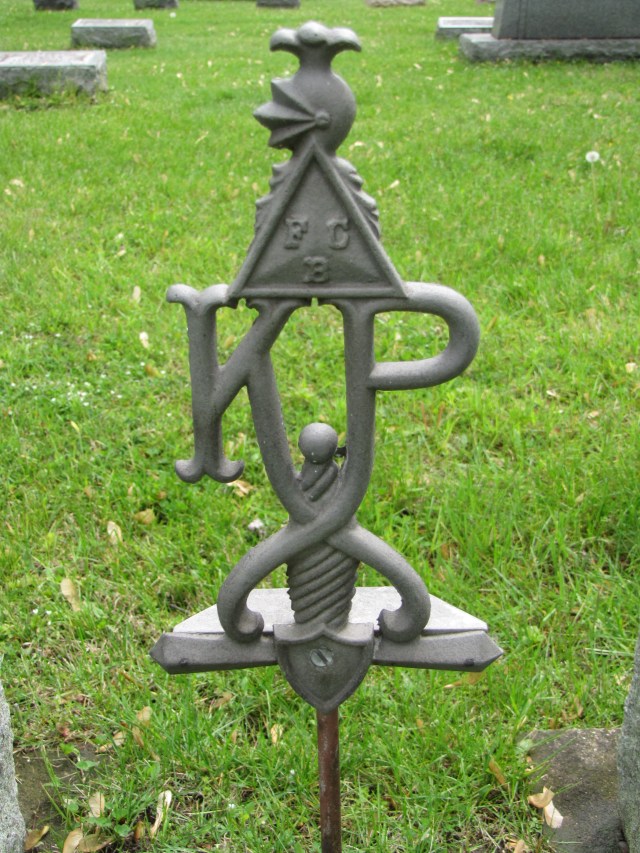
The metal marker above features many of the symbols that are significant to the Knights of Pythias.  A knight’s helmet sits atop a pyramid-shaped shield with three letters, “F”, “C”, and “B”, which stand for their motto, FRIENDSHIP, CHARITY, and BENEVOLENCE.  This sits on the letters “K” and “P” which swirl downward around the pommel and the grip and rests on the cross-guard of the shield-bearing rapier.

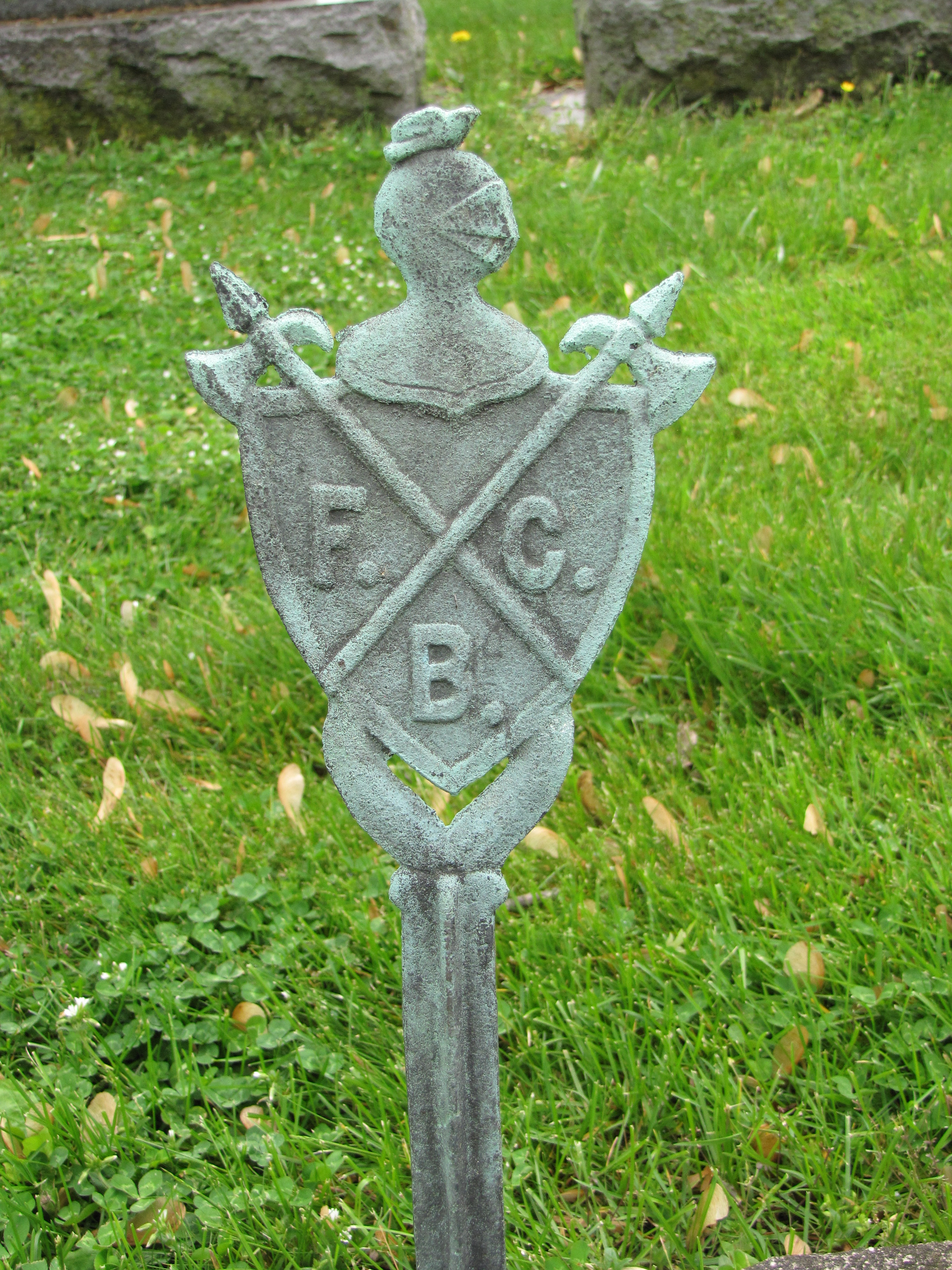
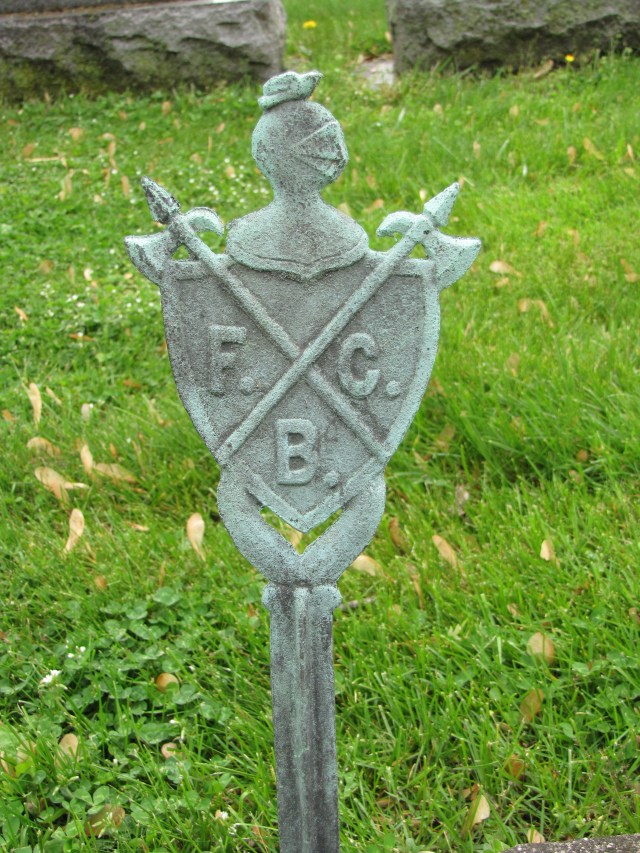
The marker below, slightly pitted, has a light green patina, sporting a few of the Knight’s symbols:

  • a shield with the letters–“F”, “C”, and “B”
  • crossed battle axes
  • a knight’s helmet topped by a falcon (a symbol of vigilance)
Chesterton Cemetery, Chesterton, Indiana

Posted in Metal Markers | Leave a comment

The American Flag


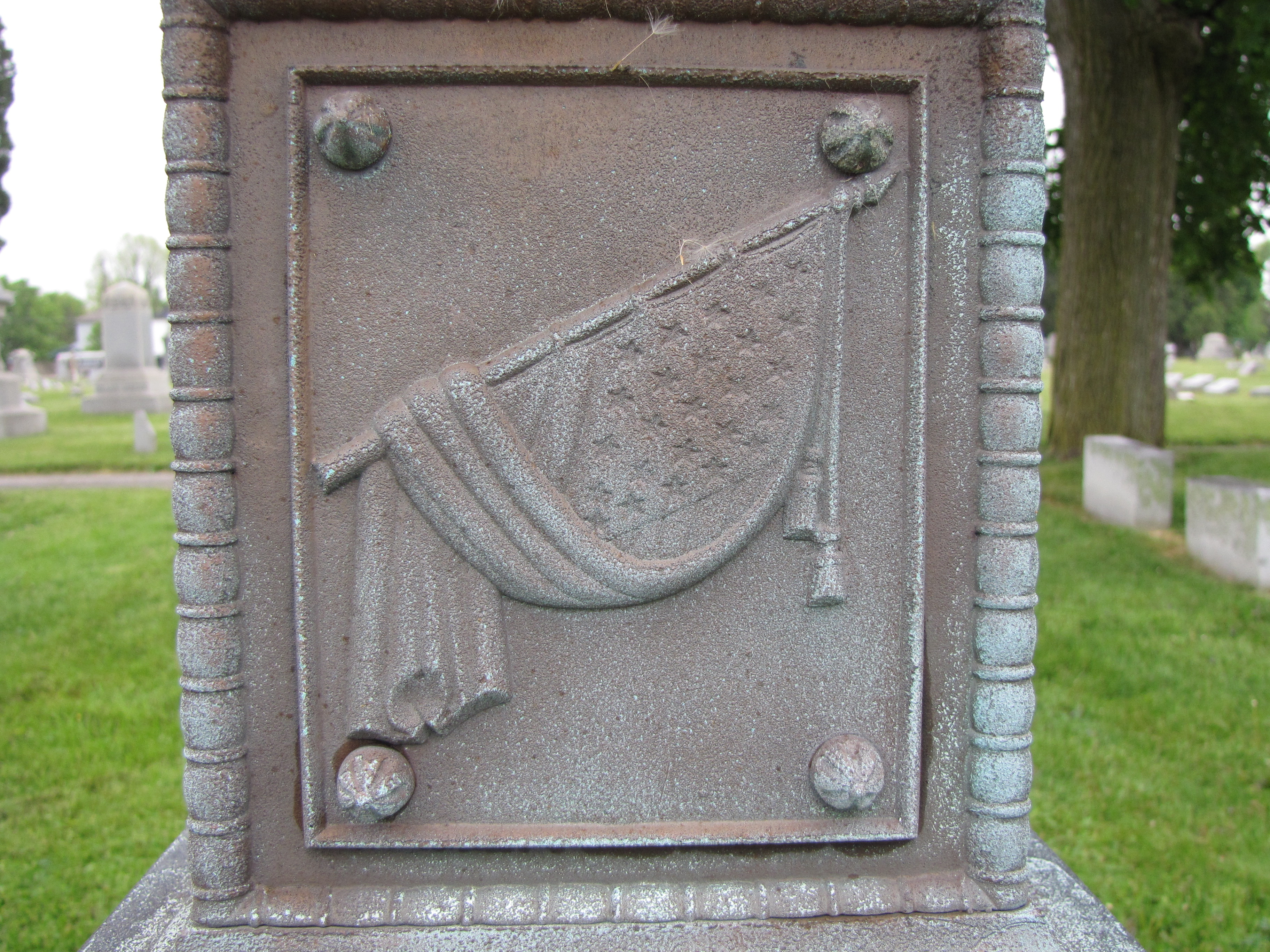
The flag is often found on the graves of soldiers.  In this case, the flag marks the service of English-born immigrant Chaplain Reverend W. B. Linell of Muncie, Indiana, who served during the Civil War in the 10th Illinois Regiment.  Camp life was hard on his constitution and Linell, after a year of service, returned to his home in Indiana, tired, weak, and sick.  Misfortune struck when his wife, who had a long-suffering illness, died.  Linell recovered and served churches in Vevay and Muncie.  The Universalist Register, in Linell’s biography, that he had set out for a convention in Terra Haute when “he was taken sick of typhoid fever, in Indianapolis, and was unable to reach his place of destination. He lay in a stupor, for several days, at the house of a friend, from, which he never awoke, till his eyes beheld the beatific world.”

Beech Grove Cemetery, Muncie, Indiana

Posted in Symbolism | 3 Comments

Dum Tacet Clamat

Beth Israel Cemetery, Portland, Oregon

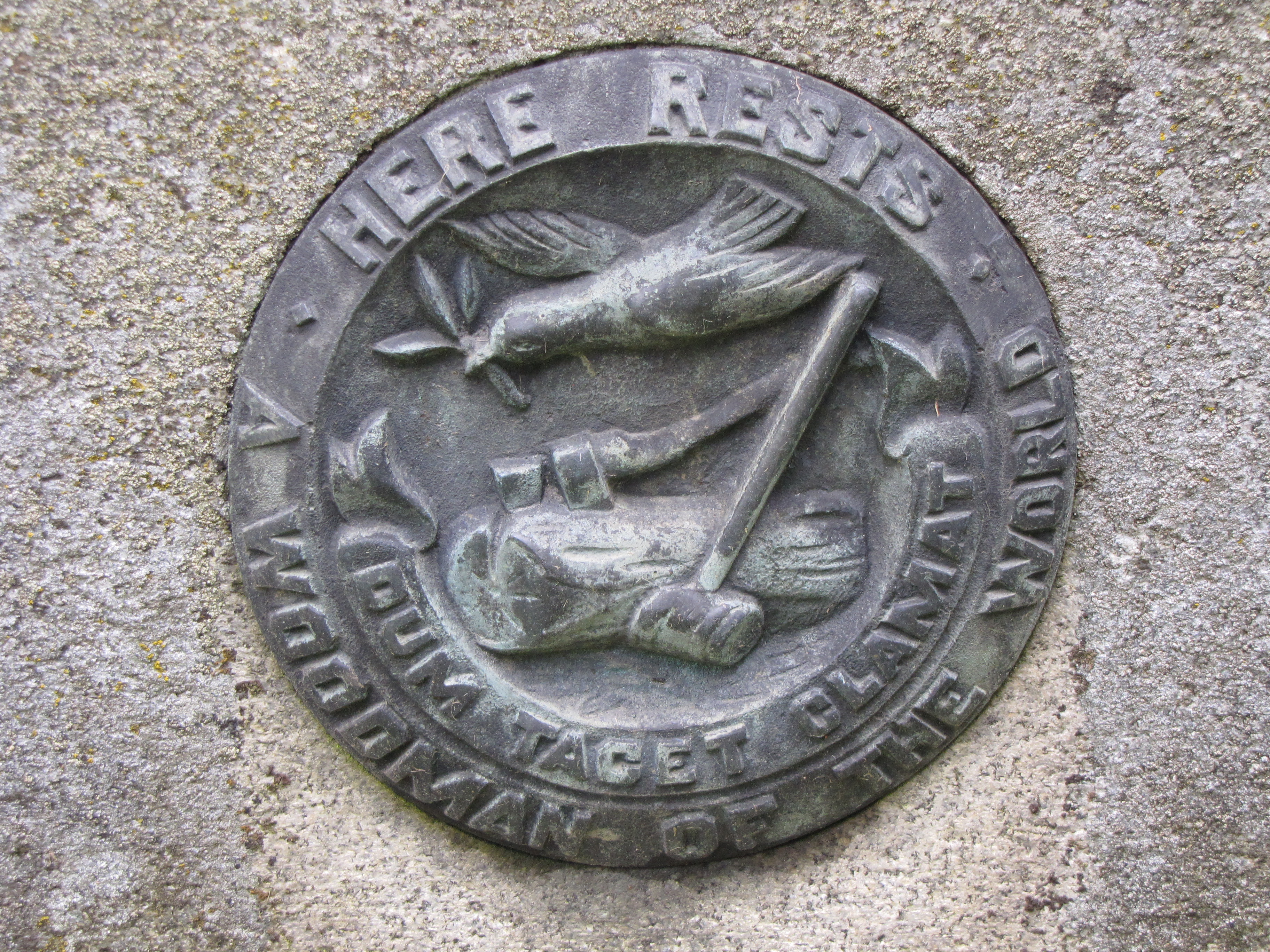
The metal medalion from a gravestone in the Beth Israel Cemetery at Portland, Oregon, marks the grave of a member of the Woodman of the World Organization.

The organization was founded by Joseph Cullen Root.  “During a Sunday sermon in Lyons, Iowa, Root heard the pastor tell a parable about the good that came from woodmen clearing away the forest to build homes, communities, and security for their families. He adopted the term Woodmen.”

The influence of that sermon can also been seen in the metal marker above that has the symbols of the organization – axe, beetle (a sledge hammer or maul) and wedge – symbolizing industry, power and progress.  The Latin phrase DUM TACET CLAMAT which means “though silent, he speaks” adorns the medalion.

Root wanted to make sure that after the death of the breadwinner that the family would be protected through a death benefit payout, which was one of the goals of providing insurance to the members of the society.


Posted in Metal Markers | 9 Comments

Art Deco

Beech Grove Cemetery, Muncie, Indiana

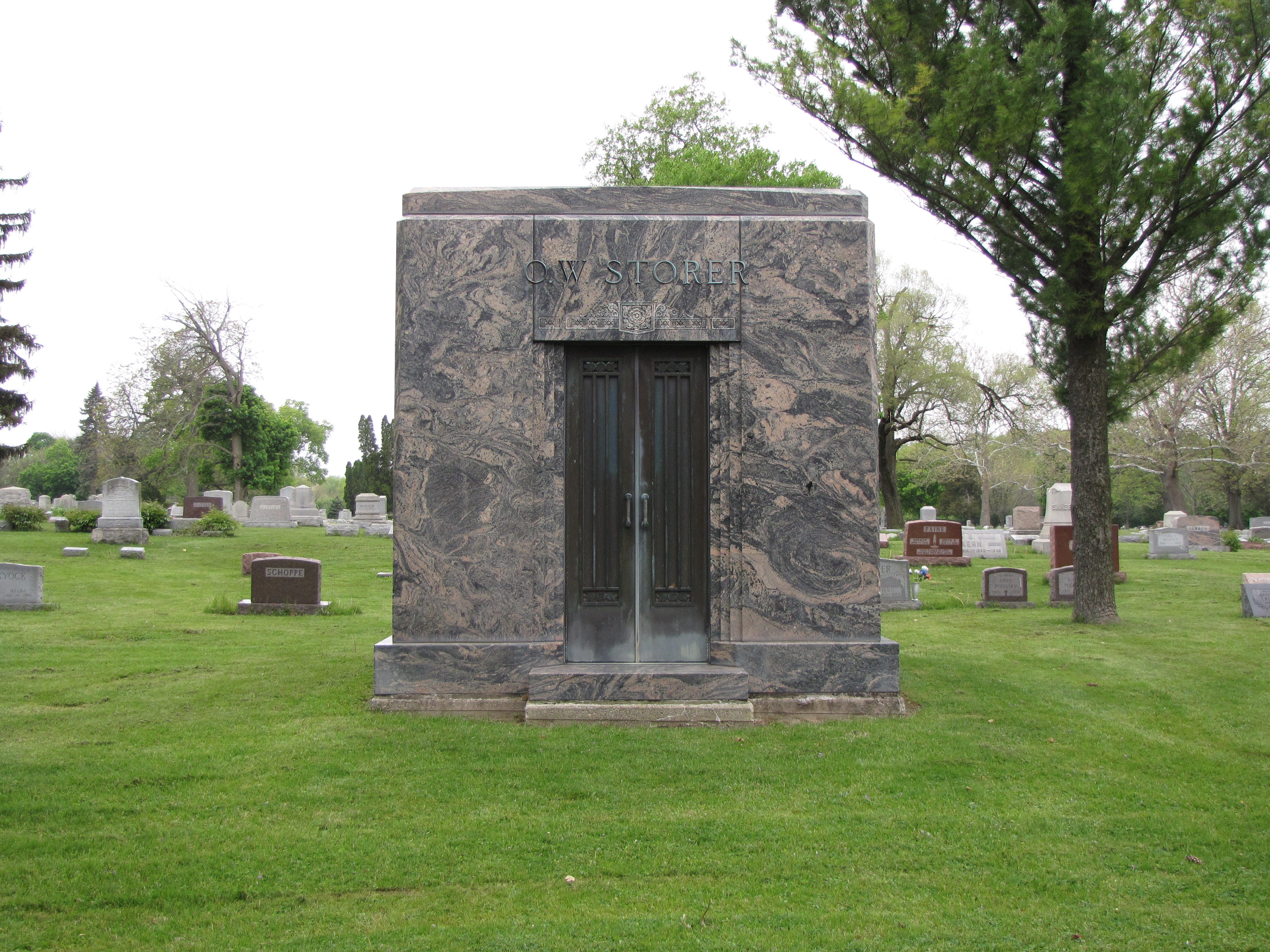
Art Deco is a design movement from the 1920s that marked a break from the fluid and flowing Art Nouveau designs of the 1890s.  The term ‘Art Deco’ is derived from the Exposition Internationale des Arts Décoratifs et Industriels Modernes, an exhibition of artists that showed their work in Paris in 1925.   Arts Décoratifs was eventually truncated to Art Deco. The O. W. Storer Mausoleum, built in 1925, constructed with a highly-polished granite, exhibits the clean, straight lines characteristic of the Art Deco designs from the 1920s.  While this looks much like the Mitchell Anthony Mausoleum, it differs in its orientation.  The lines that frame the doorway of the O. W. Storer Mausoleum are vertical, not the horizontal lines that dominate the Mitchell Anthony Mausoleum.  That difference can also be seen in the lines on the bronze doors of each of the mausoleums.

Posted in Mausoleums | Leave a comment

Art Moderne

Mitchell Anthony Mausoleum, Muncie, Indiana

The Mitchell Anthony Mausoleum in Muncie, Indiana, has long styraight lines characteristic of Art Moderne Architecture popular from the 1920s until the late 1970s.  The design is similar to Art Deco in that they both use straight lines with bare forms and geometric ornamentation.  Art Moderne Architecture  often includes rounded corners like the ones framing the doorway of the Mitchell Anthony Mausoleum.  Art Deco and Art Moderne, however, are different in that Art Deco uses vertical orientation while Art Moderne has a distinctly horizontal orientation.

Posted in Mausoleums | Leave a comment

Lily of the Valley


The lily of the valley is not actually a lily.  It belongs in the family Asparagaceae, not Liliaceae.   In spite of that, the lily of the valley is treated much like other lilies in funerary art as a symbol of innocence.  It also symbolizes happiness, purity, and humility.

Posted in Symbolism | Leave a comment

Home in Heaven

Walnut Grove Cemetery, rural Greene County, Indiana

The epitaph for this 12-year old child speaks to the parent’s grief and the broken “circle” of the family.  There is also a hint that the little girl may have suffered an illness and death brought an end to her pain.

A loved one has gone from

our circle.  On earth we shall

meet her no more.  She has gone

to her home in heaven.  And

all her afflictions are o-er.

Posted in Epitaphs | Leave a comment

A Crown of Victory

River View Cemetery, Portland, Oregon

Nearly obscured by the moss hanging on this tombstone is the  crown in the center of the cross.  The crown is a symbol of glory and reward and victory over death.  The epitaph on this memorial to prebyterian ministers makes it clear the reward comes after life and the hard-fought battle on Earth against the wages of sin and the temptations of the flesh.  The reward awaits in Heaven where the victor will receive a crown of victory.

   I have fought

a good fight.  I

have finished my

course.  I have

kept the faith.

     Henceforth,

there is laid up

for me a crown

of righteousness.

Posted in Symbolism | Leave a comment

The Finger Pointing Upward

The finger pointing upward, indicates the soul traveling to Heaven, sometimes a presumptuous claim, though a hopeful one. The finger pointing upwards can be coupled with other symbols:

  • a willow tree, a traditional symbol of sorrow indicating while the soul of their loved one has gone to Heaven, the family on Earth mourns the loss and grieves for their loved one
  • the crown symbolizing victory. Sometimes the combination of the images represent the flight of the soul from the earthly realm to the Heavenly realm

In this case, the finger pointing upward is pointing to an open book, most likely respresenting the Holy Bible.  On this gravestone, the finger suggests that the Word is the pathway to Heaven.  The finger pointing upward and the open Bible is enveloped in a heart suggesting love for the departed woman.

River View Cemetery, Seattle, Washington

Posted in Symbolism | Leave a comment

Two little lambs

River View Cemetery, Seattle, Washington

CHARLIE            BERTIE

There  like an Eden blos-

soming in gladness

Bloom the fair flowers the

earth too rudly prized.

This gravestone displays twin lambs facing each other over the names of the twin brothers whose graves the tombstone marks.

The lamb is the symbol of the Lord, the Good Shepherd.  It also represents innocence, likely the reason why this motif usually adorns the tombstones of infants and young children, as in this case.  Most often the lamb is lying down, often asleep and sometimes with a cross behind the lamb.

Posted in Symbolism | 1 Comment