Follow Me

Greenwood Cemetery, Phoenix, Arizona

Greenwood Cemetery, Phoenix, Arizona

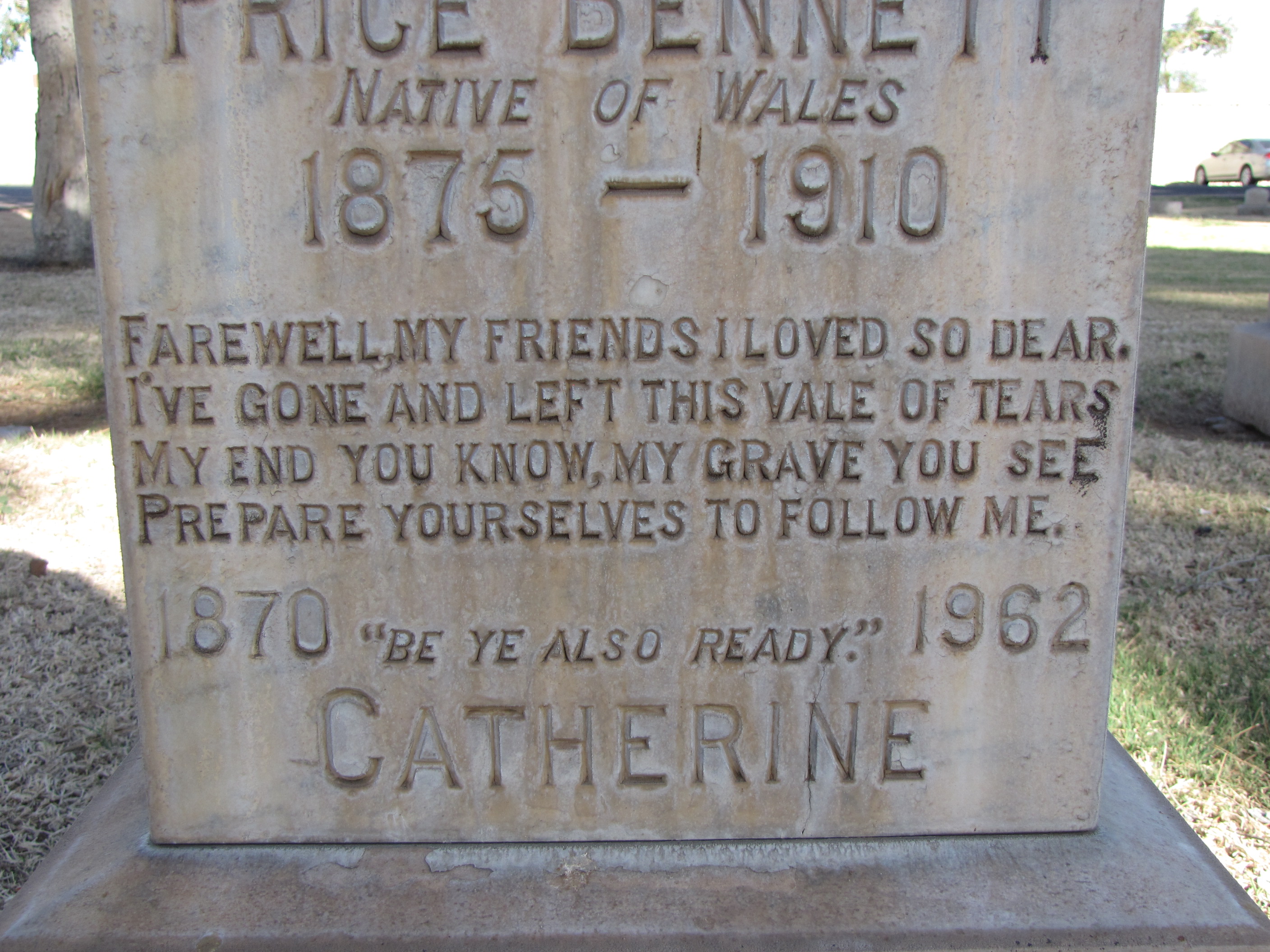
PRICE BENNETT

NATIVE OF WALES

1875 – 1910

FAREWELL MY FRIENDS I LOVED SO DEAR.

I’VE GONE AND LEFT THIS VALE OF TEARS.

MY END YOU KNOW, MY GRAVE YOU SEE

PREPARE YOURSELVES TO FOLLOW ME.


1870 “BE YE ALSO READY.” 1962

CATHERINE


The epitaph on this gravestone from the Greenwood Cemetery at Phoenix, Arizona, sends the haunting message to remember death.  It reminds us that life is short and at the end of that life everyone has the same destination–death.

There are many variations of this epitaph, the most common one being: Remember me as you pass by/As you are now, so once was I/As I am now, so you must be/Prepare for death and follow me.  Below are more examples of this theme:

Death is a debt to nature due/Which I have paid & so must you.

Whilst oe’r my grave you stand and see/Remember you must follow me.

Hark from the tomb a dolful sound/Mine Eare attend the cry/Ye living men come view ye ground/Where you must shortly lie.

Such as thou art, sometime was I/Such as I am, such shalt thou be.

Death is a debt/By nature due/I’ve paid my debt/And so must you.

For sudden death/Prepared be/Resign your breath/And follow me.

Behold my friends, in me you all may see/An emblem of what you e’er must be/Remember you like me was form’d of dust/And with the earth unite again you must.

My friends, ime here the first that come/And in this place for you there’s room.

Passenger stop as you pass by/As you are now. so once was I/I had my share of worldly care/As I was living as you are/But God from all has set me free/Prepare for Death and follow me.

Stop my friend! O take another view!/The dust that molders here/Was once belov’d like you!/No longer then on future time relay/Improve the present and prepare to die!

He that was sweet to my repose/Now is become a stink under my nose/That is said of me/So it will be said of thee.

Now she is dead and cannot stir/Her cheeks are like a faded rose./Which one of us must follow her/The Lord Almighty only knows.

Learn then, ye living! by these mouths be taught/Of all these sepulchers, instruction true/That, soon or late, death also is your lot/And the next opening grave may yawn for you!

Time was i stood as thoust dost now/And viewed the dead as thou dost me/Ere long thoult lie as low as I/And others stand and look at thee.
IMG_8717


Posted in Epitaphs | 5 Comments

Rose Blossom

Greenwood Cemetery, Phoenix, Arizona

Greenwood Cemetery, Phoenix, Arizona

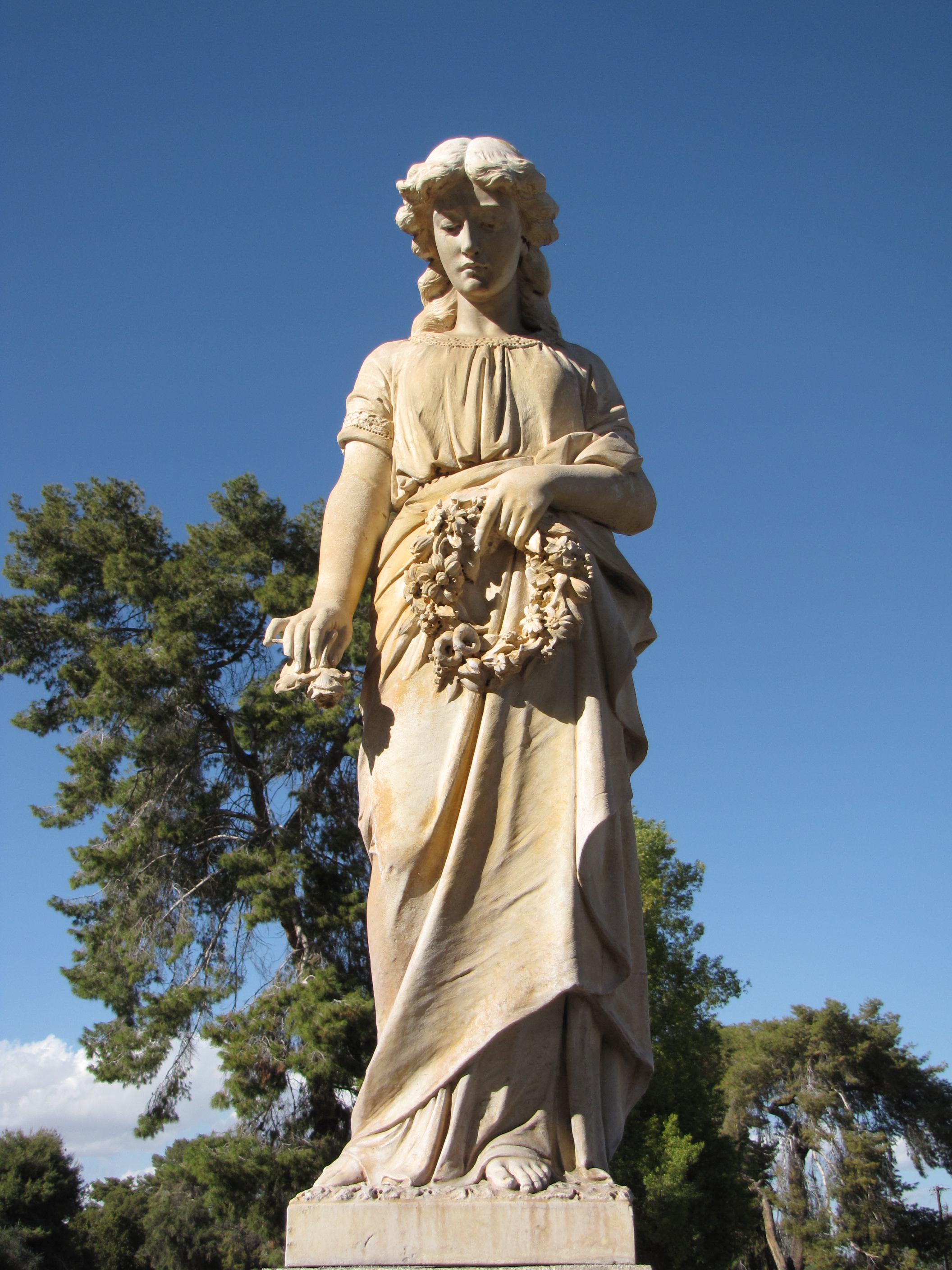
The monument for the Beck family in the Greenwood Cemetery, at Phoenix, Arizona, has atop it a young female figure. Her head is bent forward, she is looking down in reflection and sorrow, while she is holding a rose bloom in one hand and clutching a floral wreath in the other. This is a common Victorian funerary symbol expressing the transitory nature of life.

The rose is a secular symbol for love and beauty but is also associated with the Virgin Mary—the rose without thorns. The rose, however, can also connote age. A rose bud, generally found on a child’s grave, represents the life that has yet to bloom. Often, in that case the bud will be on a broken stem indicating that the life was cut short. A partial bloom on the rose would indicate an older child, such as a teenager, while a full bloom, as we have here indicates the life of someone who has reached maturity. In this case, Mary Beck, who lived from 1825 to 1912, and Ira Beck, who lived from 1861 to 1940, lived long lives indicative of the full blossom on the rose that the statue holds.

IMG_8706

Posted in Symbolism | Leave a comment

Optimism dashed


IMG_1383

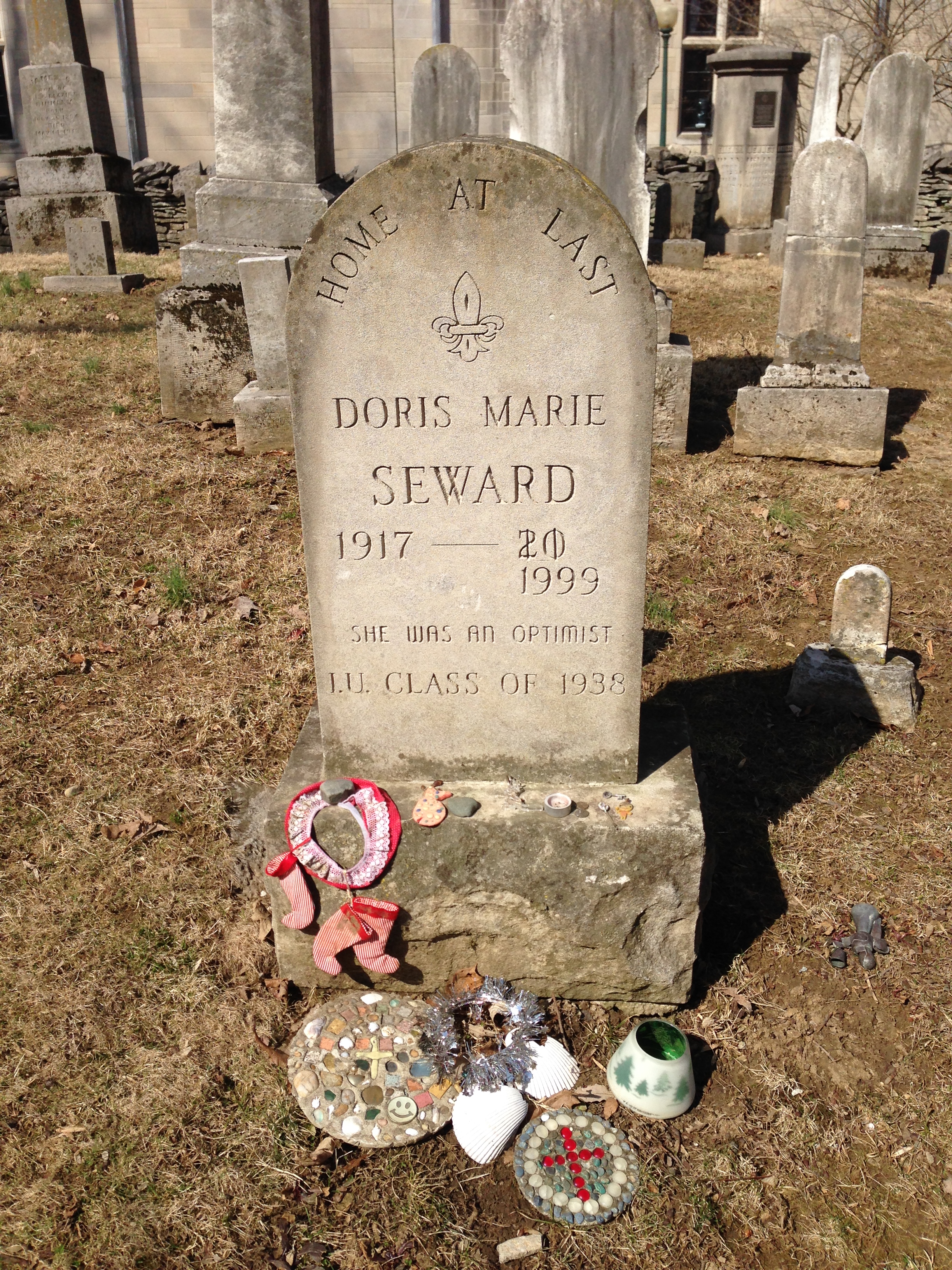
HOME AT LAST

DORIS MARIE

SEWARD

1917 — 20

            1999

SHE WAS AN OPTIMIST

I.U. CLASS OF 1938 

There is a tiny cemetery in the middle of the Indiana University campus next to the Beck Chapel.  Only a couple of dozen people are buried there.  One gravestone of note, is for Doris Marie Seward, whose epitaph describes her as an optimist.  Indeed, her gravestone carver believed she would live into the next millennium, first carving 20, the beginning of 2000 with the death date to be filled in later.  She did not make it and the 20 was crossed out for her death year of 1999.  She almost made it.

Posted in Uncategorized | 5 Comments

Acorn

Greenwood Cemetery, Phoenix, Arizona

Greenwood Cemetery, Phoenix, Arizona

THOMAS K. ELVEY

DEC. 26, 1843

AUG. 13, 1902

AT REST

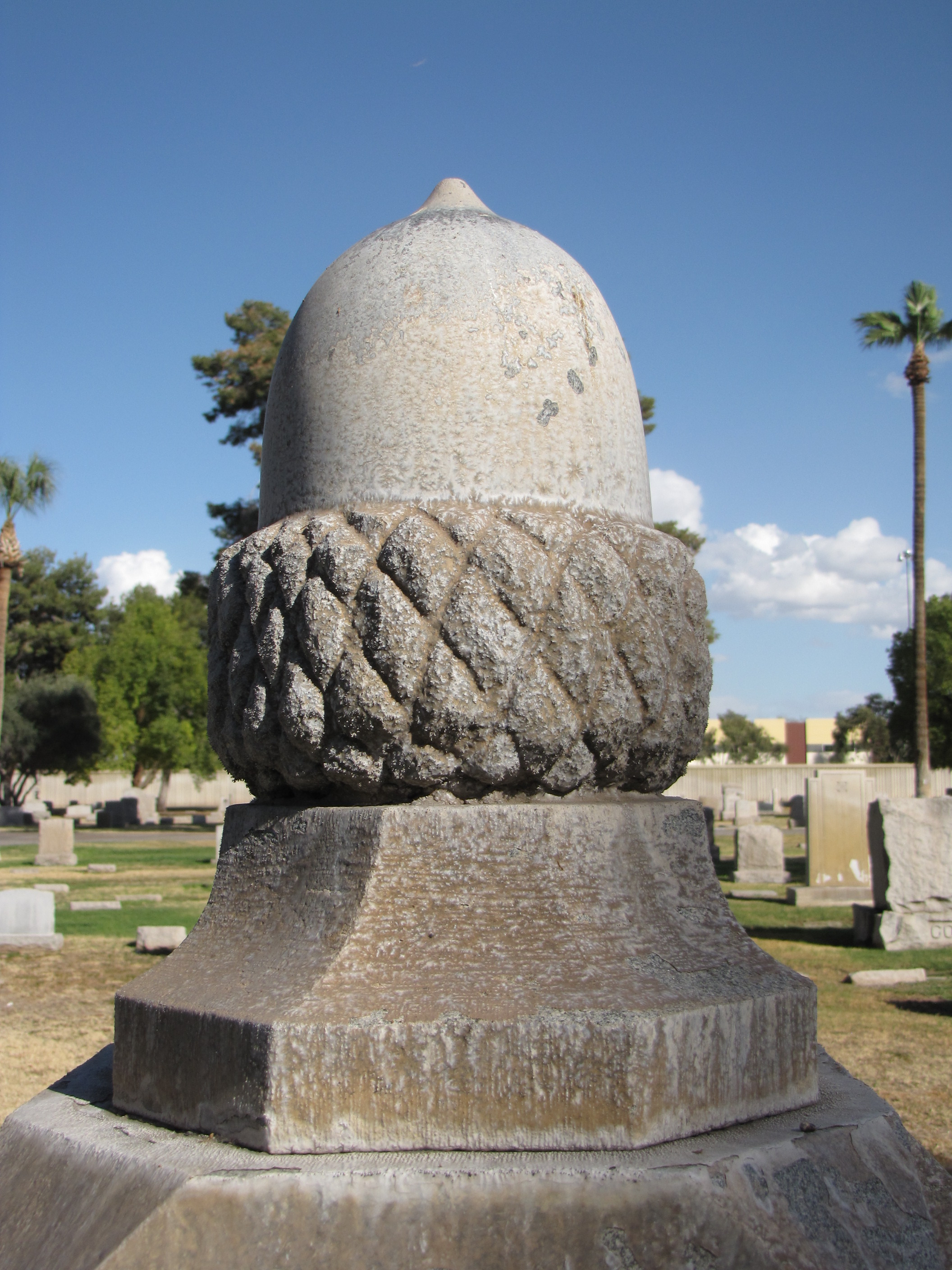
Sitting on top of this gray granite gravestone in the Greenwood Cemetery at Phoenix, Arizona, is a large acorn, turned upside down.  The acorn, seed of the mighty oak, is a symbol of prosperity and fruitfulness.  When the acorn is paired with oak leaves it is seen as a traditional symbol of strength.  The single acorn can represent a kernel of truth born into spiritual growth.  Twin acorns can represent male sexuality.  Two acorns can also represent truth and power of the Holy Spirit. The former is revealed in the Earthly realm and the later after entering the Heavenly realm.

The hex design that is formed at the top of the acorn (here the acorn is upside down so it is seen at the bottom) is used by the Mennonites and Amish artisans.  The design signifies protection and natural abundance.

IMG_8655

Posted in Symbolism | Leave a comment

The Crown

Greenwood Cemetery, Phoenix, Arizona

Greenwood Cemetery, Phoenix, Arizona

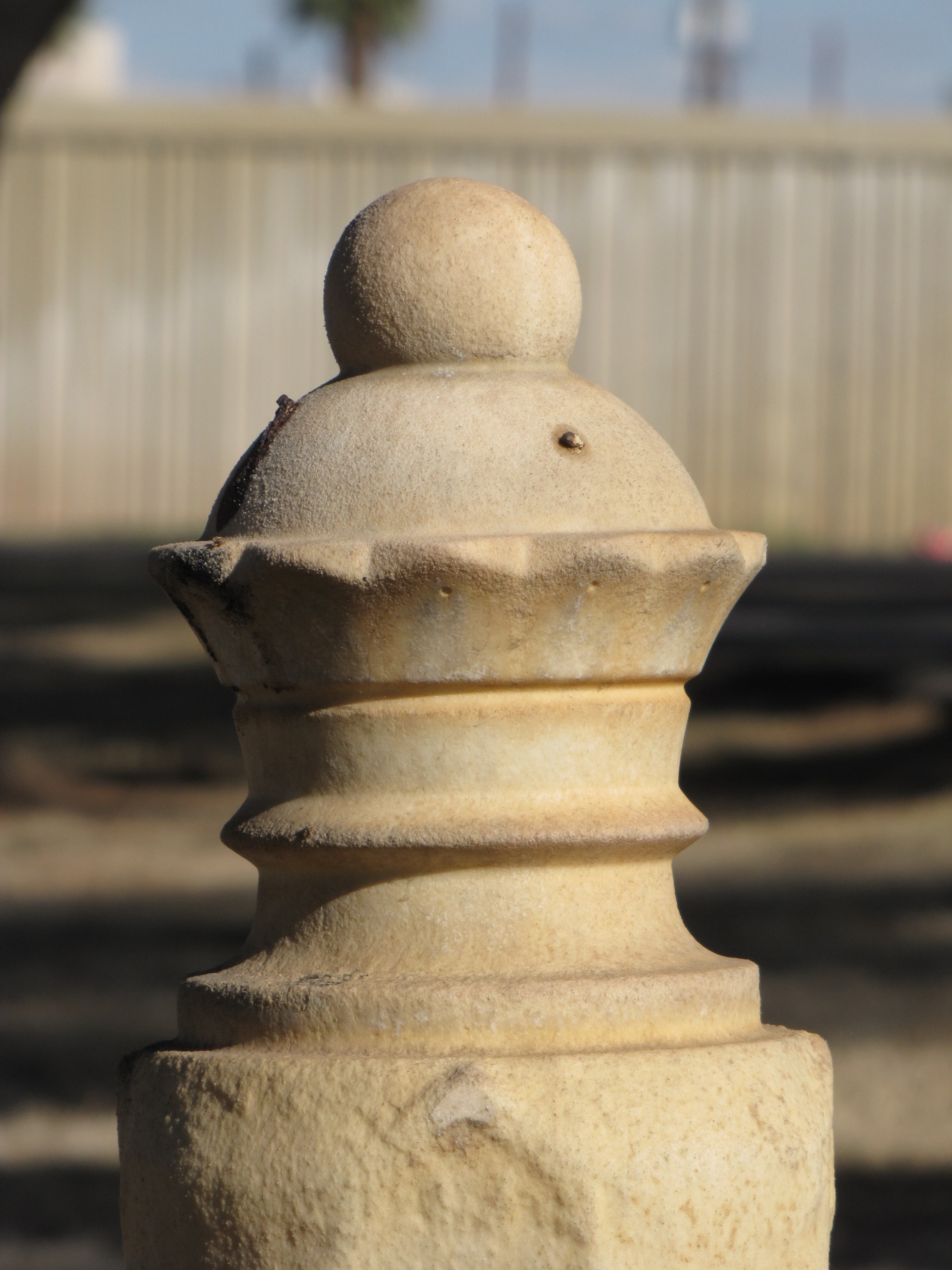
The crown is a fairly common symbol found in American cemeteries.  Sometimes it can be found as an incised carving at the top of the gravestone—often in conjunction with other symbolism such as palm leaves.  Sometimes the crown is made of a completely different material, such as zinc, and anchored on top of a gravestone.

This weathered gravestone, however, in the Greenwood Cemetery at Phoenix, Arizona, has the crown built into the design of the stone, topping the square column.

The crown is a symbol of glory and reward and victory over death.  The reward comes after life and the hard-fought battle on Earth against the wages of sin and the temptations of the flesh.  The reward awaits in Heaven where the victor will receive a crown of victory.  The crown also represents the sovereign authority of the Lord.

IMG_8714

Posted in Symbolism | Leave a comment

The Beehive

Greenwood Cemetery, Phoenix, Arizona

Greenwood Cemetery, Phoenix, Arizona

Wm LOSSING

1848 – 19 8

(It appears as if the “1” on the tombstone has been chiseled off)

The beehive is often found on the graves of members of the Independent Order of Odd Fellows or the Freemasons. To the Masons, the beehive represented a feat that not a single bee could accomplish, but the industry of many bees.  Masons were to work hard when working so they could live with a free conscience on their holidays or non-working days.

The Mormons also adopted the tiny bee and the beehive as a symbol of community.  Again, they could build a tabernacle or an entire community by employing the talents and skills of many that could not be accomplished by a few.  The Great Seal of the State of Utah has at its center, a beehive with the word “INDUSTRY” written above the image of the beehive.

491px-Seal_of_Utah.svg[1]

The beehive, like the great pyramids, represent a hierarchy in society, suggesting an organized community.  The beehive has long been a symbol for human industry. The cliché, busy as a bee, reinforces the idea of the bees being industrious.  It also represents faith, education and domestic virtues.

IMG_8597

Posted in Uncategorized | 4 Comments

Cattails

Greenwood Cemetery, Phoenix, Arizona

Greenwood Cemetery, Phoenix, Arizona

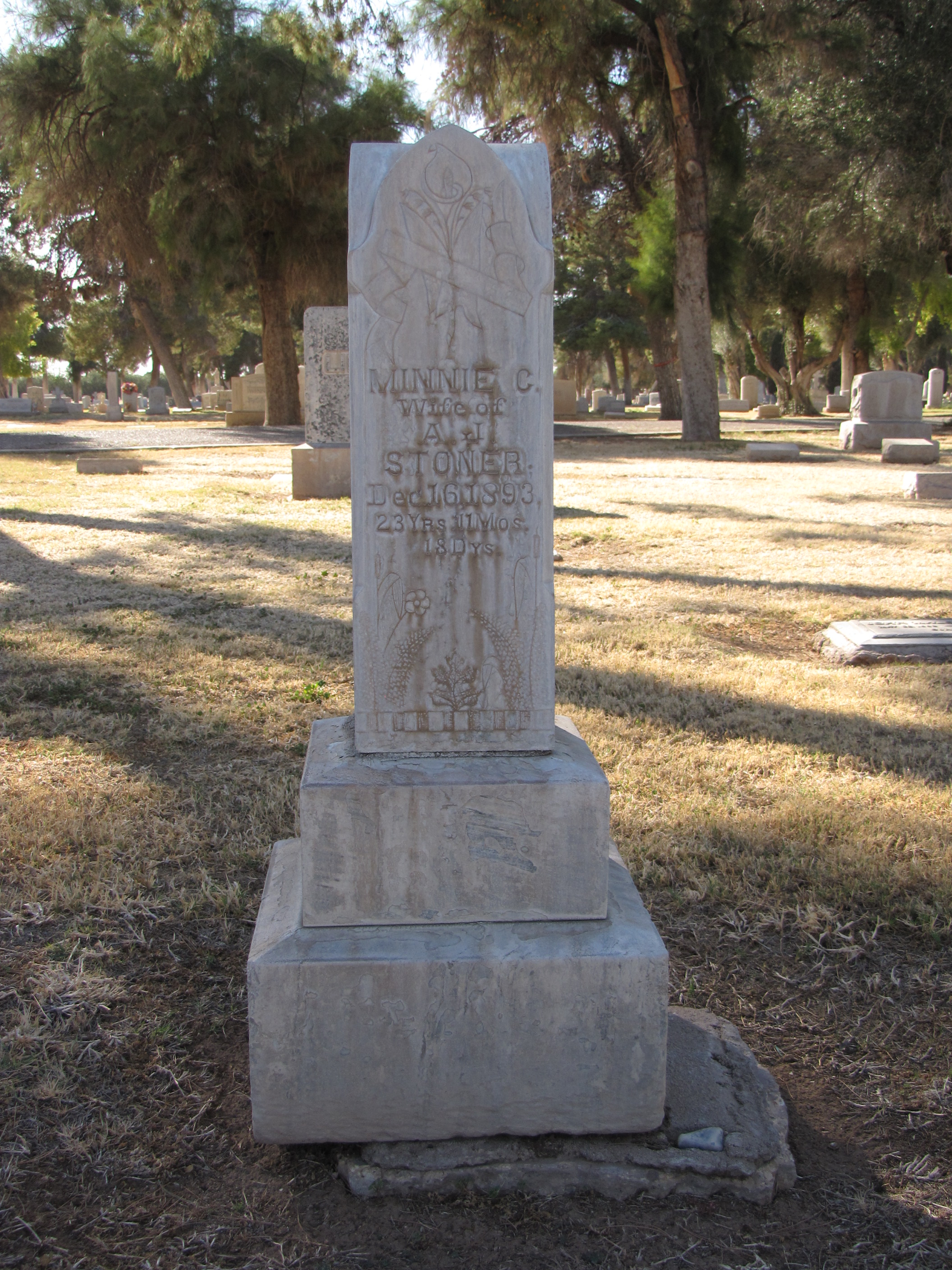
MINNIE C.

Wife of

A. J.

STONER

Dec. 16, 1893

23 Yrs 11 Mos.

18 Dys

The Victorian Era lasted from about 1832 until Queen Victoria’s death in 1903.  The era was an eclectic period in the decorative arts with several styles—Gothic, Tudor, Neoclassical—vying for dominance.  The period was marked by ornamentation.  This was true in architecture, furniture, and funerary arts.  In cemeteries gravestones became taller, ornamented, and sentimental.

In Victorian times, flowers took on significance as a way to send coded messages; this was known as floriography from the Latin combining flora—“goddess of flowers” and graphein—“writing”.  Each flower had a meaning that was conveyed to the viewer or receiver of the flower or bouquet of flowers—the lily of the valley represented humility, the coral rose represented desire and passion, the white lily represented purity, and so on.

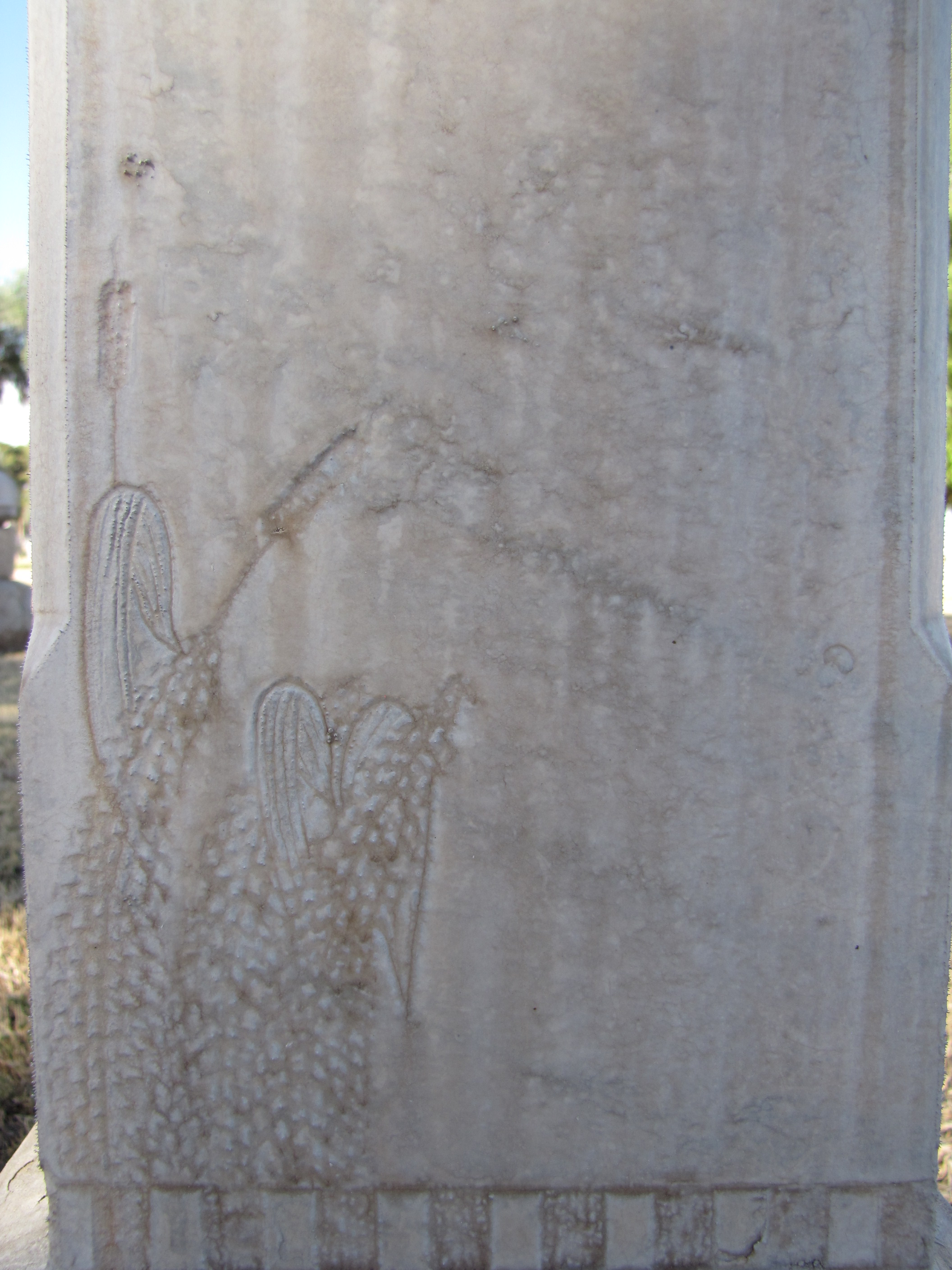
Here on this gravestone in the Greenwood Cemetery at Phoenix, Arizona, lightly incised into the four sides are cattails.  Cattails are found in marshes and at the pond’s edge.  The cattail is a plain plant, a common plant that flourishes next to the water.  In Christianity, the great prophet—the infant Moses—was found floating in a tiny basket woven of bulrushes and among the cattails.  Cattails, therefore became connected to a place of Salvation.  And because cattails only thrive with “wet feet” faithful Christians see it as a plant that is connected to the source of living waters—the teachings of the Church.  Cattails are a metaphor for the humble servants of the Lord who live a life of humble obedience.

A common epitaph found on many gravestones uses the imagery of the water’s edge to describe the place where loved ones will meet in the hereafter, a place of Salvation:

Our darling one

Has gone before

To greet us

On the blissful shore.

IMG_8686


Posted in Uncategorized | Leave a comment

Sunburst

IMG_8735

SCOTT JAMIESON

1878 – 1909

until the morning

of the resurrection.

Occasionally a gravestone is fashioned in a way so that the symbolism is matched to the epitaph, as is the case.  Here, an incised carving shows curtains being drawn to the sides to reveal the sun rising over the clouds–the rising sun, a symbol of the resurrection.  This matches the epitaph on the gravestone and leaves little doubt what message the gravestone is trying to convey.  In addition to that, the open book on the top of the gravestone most likely represents the Bible.  This further the religious message of the marker–God’s Word is the way to Heaven.

IMG_8737

Posted in Uncategorized | Leave a comment

The Trumpet and the Book

Mount Olivet Cemetery, Nashville, Tennessee

Mount Olivet Cemetery, Nashville, Tennessee

DAVID MORAN

BORN

OCT. 14, 1842.

DIED

MAY 28, 1906.

HIS BELOVED WIFE

MARY

BORN MAY 15, 1845.

DIED APR. 4, 1908

MAY THEIR SOULS REST IN PEACE

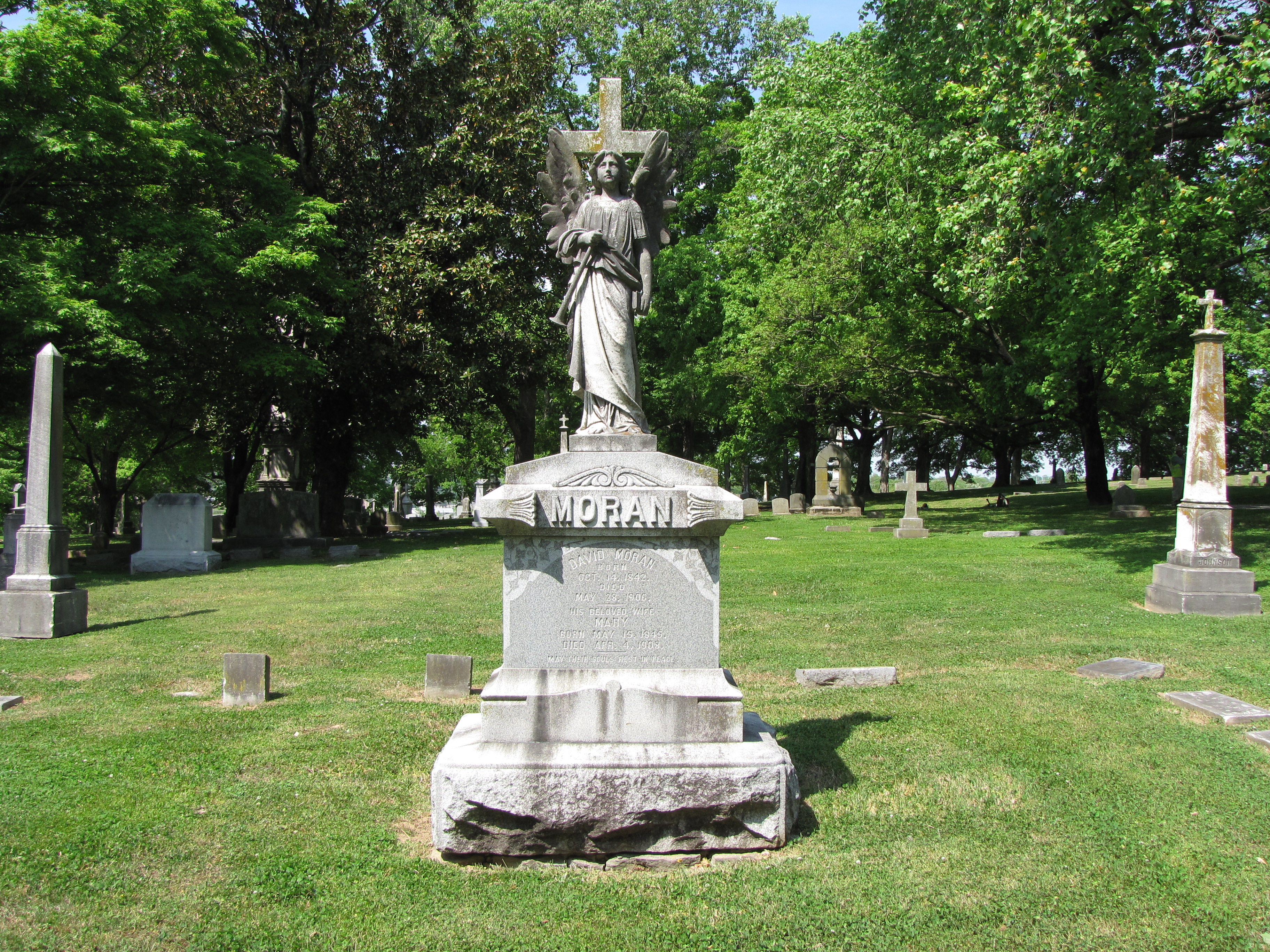
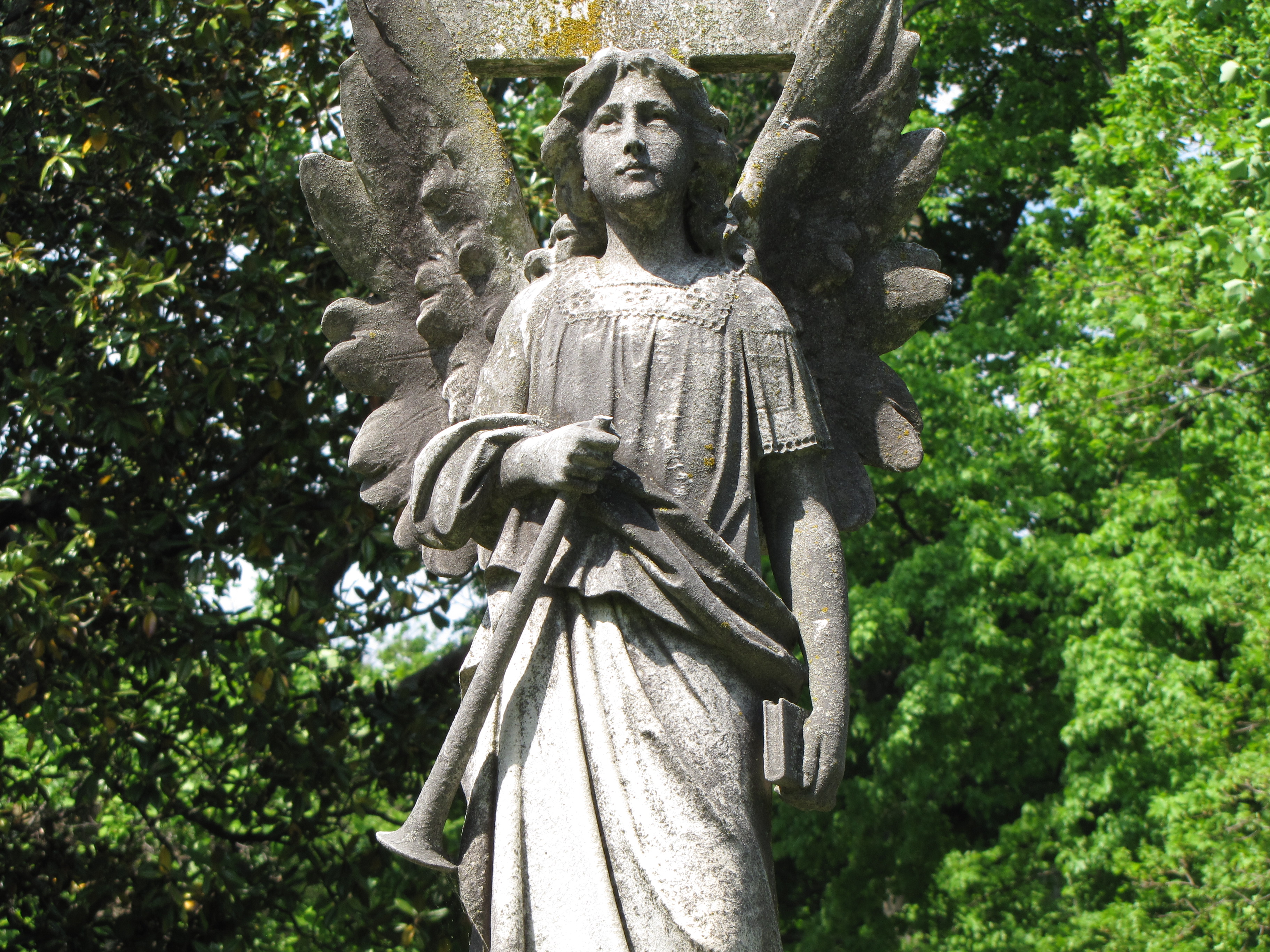
On the top of this gravestone, a youthful angel is looking upward toward the Heavens and clutching a trumpet in one hand and a book in the other.  The trumpet announces the Day of Judgment and the Call to Resurrection.  The closed book is often a metaphor for the end of life, the story has been told and the end of the story has come.  After the book is complete, and the book is closed, the author lay in the grave.

IMG_5452

Posted in Symbolism | Leave a comment

Lyre


Mt. Oliver Cemetery, Nashville, Tennessee

Mt. Olivet Cemetery, Nashville, Tennessee

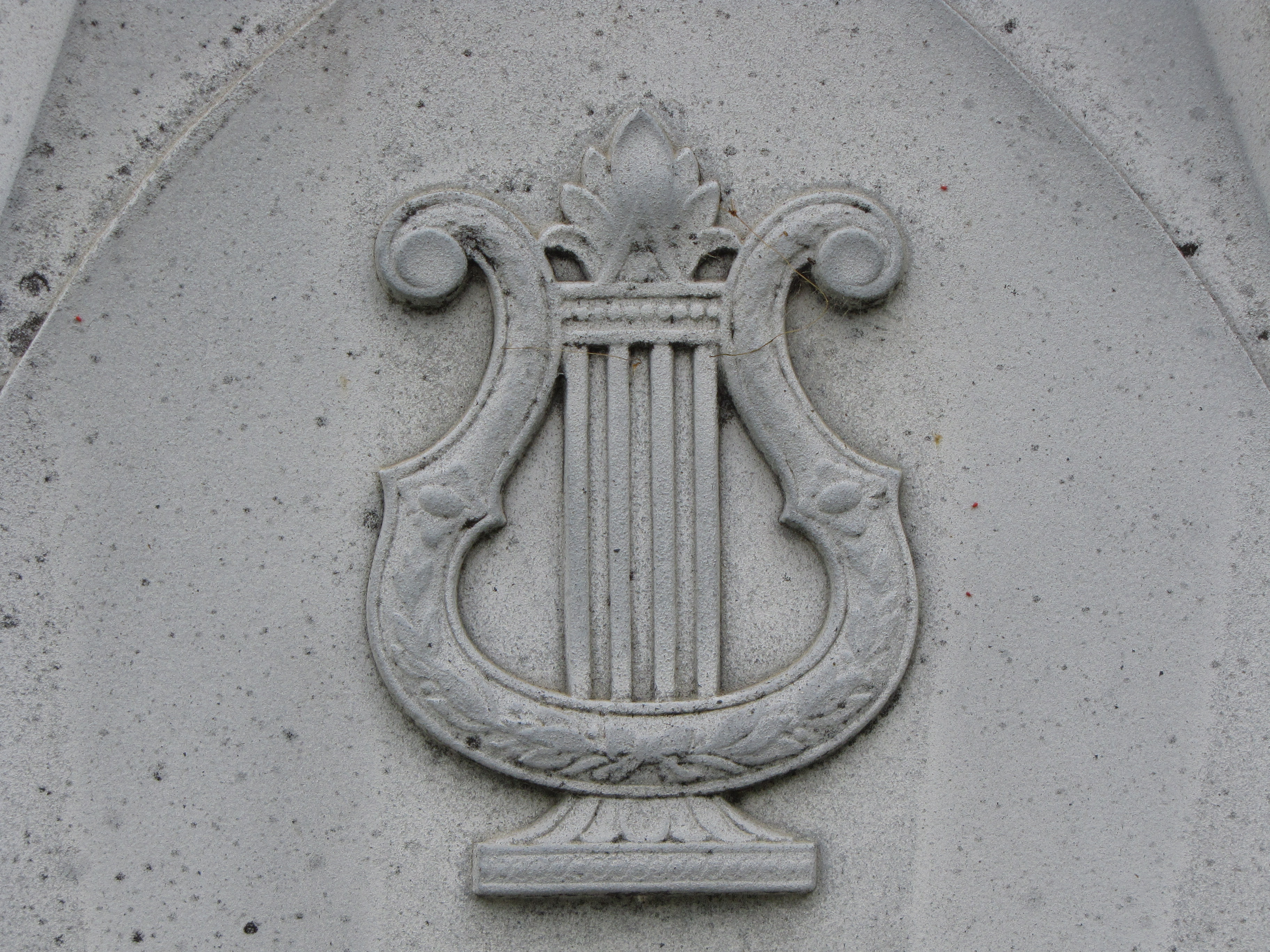
Some of the most clear examples of symbolism can be found on the zinc markers found in nearly every graveyard.  Here, is an example of a lyre traditionally seen as a symbol of Apollo, the Greek god of music. In Christian symbolism it can represent harmony and Heavenly accord and song in praise of the Lord.  In funerary art, however, the lyre can also represent the end of life.

Posted in Symbolism | 2 Comments