He had more than 15 minutes

The largest museum in the United States dedicated to one artist—seven floors in Pittsburgh—houses a large collection of artwork by famed pop artist Andy Warhol. The museum, located in an 88,000-square-foot building downtown contains 900 paintings, 77 sculptures, nearly 2,000 works on paper, over 4,000 photographs, more than 1,000 prints and over 4,350 Warhol films and videotaped works.  The collection includes such iconic pieces as his silkscreen paintings of Campbell’s Soup Cans and his Marilyn Monroe Diptych.

Born Andy Warhola (August 6, 1928 – February 22, 1987) the son of Andrew and Julia Warhola and raised in the Pittsburgh area, Warhol began his career as a commercial illustrator but developed into one of the most influential artists of his day.  The Factory, his New York studio, attracted the rich, famous, and celebrities of the era.  Warhol became famous for his art but also for those he knew and, in fact, for his own fame.  He was a Kardashian before there were Kardashians!

He also popularized the expression “In the future, everyone will be world-famous for 15 minutes” which has become part of the American vernacular. The saying first appeared on a 1968 exhibition program of his work at the Moderna Museet in Stockholm, Sweden.

Warhol, 58, died in February 1987 after complications from gallbladder surgery.  He was buried in Bethel Park, a south side suburb of Pittsburgh, in the St. John the Baptist Byzantine Catholic Church Cemetery close to his parents’ graves.  His gravestone is a plain and drab dark gray granite slant-face marker—not the colorful, iconic imagery one might expect to mark his grave.  His grave, however, was littered with rosaries, mementos from fans, and Campbell Soup cans as a nod to one of his most famous images produced in The Factory.

As recognition of his lasting fame, cameras have been placed on a pole facing his grave and live stream people coming and going to pay tribute to Warhol at his grave site.  His 15 minutes have long outlasted him.

The link to the Warhol erathcam livestream:

https://www.earthcam.com/usa/pennsylvania/pittsburgh/warhol/?cam=warhol_figmentstream


Posted in Famous graves | Leave a comment

General Stonewall Jackson and His Arm

This photo taken by Paul Breda

In the Stonewall Jackson Memorial Cemetery, formerly known as the Presbyterian Cemetery, in Lexington, Virginia, stands the commanding bronze statue of Thomas Jonathan “Stonewall” Jackson, sculpted by famed Richmond, Virginia, artist Edward Virginius Valentine (November 12, 1838 – October 19, 1930).  The statue was cast by the Henry Bonnard Bronze Company of New York in 1890.

The statue commemorates the grave of the Confederate Lieutenant General Stonewall Jackson, considered one of the greatest military tacticians during the Civil War.  Jackson was shot by “friendly fire” during a reconnaissance trip after a successful flanking maneuver at the Battle of Chancellorsville.  He and eight aides were returning to camp late at night on May 2, 1863.  A skirmish broke out and gun fire was exchanged.  Four of Jackson’s aides were killed and Jackson was mortally wounded.  In the darkness and the confusion of war, the 18th North Carolina Infantry had mistakenly fired upon General Jackson.

The next morning, at the makeshift field hospital at Wilderness Tavern, General Jackson’s left arm was amputated.  Upon hearing the report of General Jackson’s death, General Robert E. Lee sent word to Jackson through Reverend Beverly Lacy, “Give General Jackson my affectionate regards, and say to him: he has lost his left arm but I my right.”

Jackson’s chaplain, Reverend Lacy went to visit him as he lay in a tent convalescing.  Upon leaving, Lacy saw Jackson’s amputated arm outside the tent.  Lacy gathered up the arm in a blanket and walked across a field to his brother’s farm, Ellwood Manor, where he buried the severed arm.

(Years later, Reverend James Power Smith, who served on Jackson’s staff, erected a gray granite gravestone to mark the spot where the arm was buried.)

Jackson was removed to Guinea Station where he died on May 10 of infection and pneumonia.  His remains were buried in a family plot in the Presbyterian Cemetery in Lexington, which was later renamed for him.  Though his white-marble gravestone still remains in its original place in the family plot, his remains were removed along with other family members to repose underneath the statue erected in his honor.  Though Jackson was reunited with his family members under the great statue, he was not reunited with his left arm which rests miles away in a cemetery on Ellwood Manor.

The plaque in front of his original gravestone reads:

GEN. THOS. J. JACKSON

THE REMAINS OF

STONEWALL JACKSON

HAVE BEEN REMOVED FROM THIS SPOT

AND NOW REPOSE UNDER THE MONUMENT

IN THIS CEMETERY ERECTED TO HIS

MEMORY BY HIS LOVING COUNTRYMEN.

Those graves marked underneath the statue:

Thomas Jonathan Jackson Christian Jr, Colonel U.S. Army Air Corps, November 13, 1915 – August 12, 1944, Killed in Action – Arras, France, Body Not Recovered

Thomas Jonathan Jackson Christian, Brig. Gen., U.S. Army, August 25, 1888 – September 15, 1952

Thomas Jonathan Jackson, “Stonewall” Lieut. Gen. C. S. A., January 21, 1824 – May 10, 1863

Mary Graham Jackson, Infant Daughter, in Crypt with Father, Feb. 28, 1858 – May 25, 1858
Mary Anna Jackson, Wife of Stonewall Jackson, July 21, 1831 – March 24, 1915

William Edmund Christian, May 14, 1856 – February 5, 1936

Julia Jackson Christian, Daughter of Stonewall Jackson and Wife of William Edmund, Nov. 23, 1862 – Aug. 30, 1889

Posted in Famous graves | 2 Comments

Neo-classic Angel

THERESA

SIMMANG

SCHMIDT

1876

1907

The gray granite rock-face monument for Theresa Schmidt in the St. John’s Lutheran Cemetery in San Antonio, Texas, has a masterfully sculpted bas-relief bronze inset.  The bronze was created in Fonderia Nelli, one of the top foundries in Rome, Italy, producing works by famous European sculptors during the late 19th Century and early 20th Century.  The foundry also produced works for Tiffany & Company in New York.  This particular neo-classical sculpture features a contemplative male angel.  His head is slightly bent leaning against his hand.  His other hand rests on top of an inverted torch which represents a life that has been extinguished.

The winged angel leans against a column that has an urn resting on top of it.  The urn was an almost ubiquitous 19th Century symbol found in nearly every American cemetery.  The urn symbolically represents the mortal body.  The Roman cross adorning the face of the urn is the universal symbol of Christianity.

Posted in Angels | 2 Comments

A Daughter’s Tribute to Her Artist Father

JAMES M. HART N. A.

MAY 10, 1828

OCT. 24, 1901

James McDougal Hart was a 19th Century landscape artist born in Scotland who immigrated to America with his family as a small boy.  After a stint as an apprentice to a sign and carriage maker, James began to study art seriously.  He studied art in Europe and also in the United States.  Later, Hart adopted the Hudson River School style of painting and is considered one of their major painters.  Hart’s favorite subjects were bucolic scenes of the American landscape that usually included cattle and farms.

The rock-face gray granite monument in the Green-Wood Cemetery in Brooklyn, New York, for James McDougal Hart, has a bronze inset depicting a calf sitting in a pasture next to a sign with the words “HE MAKETH ME LIE DOWN IN GREEN PASTURES.”  A kneeling angel holds an artist’s palette in one hand as her other arm is extended over the length of the sign and holding a palm frond.  The palm frond symbolizes victory over death.

In the right-hand corner of the bronze bas-relief is the name of the sculptor, “M T Hart.” M T Hart was Mary Theresa Hart, James Hart’s daughter and an artist in her own right.

The inset pays tribute to her father’s favorite subject matter combining it with a line from the Bible verse from the 23rd Psalm.  In an obvious nod to her father’s profession, the angel holds the palette.  The “N. A.” carved after Hart’s name stands for the National Academy of Design.  Hart was a member for decades, an officer of the organization, and displayed his works at the National Academy for well over 40 years.

Both of James Hart’s daughters, Letitia Bonnet Hart (1867 – Sept. 1953) and Mary Theresa Hart (1872–1942) were artists and both are buried in unmarked graves in the Hart family plot.

Posted in Uncategorized | Leave a comment

The Spirit of Death

CHARLES ADOLPH SCHIEREN

BORN FEBRUARY 28, 1842  DIED MARCH 10, 1915

MARIE LOUISE SCHIEREN

BORN AUGUST 5, 1840  DIED MARCH 11, 1915

IN THEIR LIVES THEY WERE LOVELY AND IN THEIR DEATH

THEY WERE NOT DIVIDED


Most people are familiar with Gutzon Borglum, who was the artist behind the massive undertaking of blasting tons of rock and carving the face of Mount Rushmore with jackhammers to create the iconic mountain sculptures of George Washington, Thomas Jefferson, Theodore Roosevelt, and Abraham Lincoln in the Black Hills of South Dakota.

But Gutzon was not the only sculptor in the family.  His younger brother Solon Hannibal de la Mothe Borglum (December 22, 1868 – January 31, 1922) was also an accomplished artist best known for his depictions of life in the frontier.  In fact, Solon was better known at the turn of the 20th Century than Gutzon until Mount Rushmore was completed.  It was only then when Gutzon eclipsed his brother’s fame.

Both Borglums were most likely influenced by the early wood carving work of their father, James Borglum—who later became a physician.  However, it was Solon who was an award-winning sculptor, including wining the Court of Honor at the Panama-Pacific International Exposition in San Francisco in 1915.

His works can be found in many places in the country.  Solon’s equestrian monument of General John B. Gordon can be seen on the Georgia state capitol grounds in Atlanta.  His bronze equestrian statue Rough Rider Bucky O’Neill, as well as, his statue Cowboy at Rest are displayed in front of the courthouse in Prescott, Arizona. Evening, a statue of a cowboy leaning against his horse, can be seen at the Buffalo Bill Museum in Cody, Wyoming.

Two of his works, Inspiration and Aspiration, stand guard on either side of the gate entrance to the courtyard of the St. Mark’s Church-in-the-bowery in New York City. Other works of his can be found in Jersey City, New Jersey and New Britain, Connecticut, among other places.

Along with famous commission work for monumental public works, Solon Borglum also created a funerary bronze for his friends Charles and Mary Louise Schieren.  Charles Schieren had been mayor of Brooklyn (1894-1895).  Tragically, in 1915, the couple died from pneumonia within 24 hours of each other and were buried in a double funeral in the Green-Wood Cemetery in Brooklyn, New York.

To commemorate their lives, Solon created a dramatic and haunting sculpture of Azrael, the Spirit of Death, as a memorial.  The statue captures the moment of death when many Jews and Muslims believe Azrael descends to free the trapped soul from the dead body.  In Solon’s sculpture Azrael is depicted as a cloaked figure, her hood draped forward covering her face.  She is bent over with her arms stretched touching closed books on either side of her.  Two books representing the full lives lived by Charles and Mary Louise.  The patina of the bronze oxidized giving the sculpture a light green cast except for Azrael’s face which is recessed underneath the hood giving the entire monument an eerie appearance unlike any other in the cemetery.

Posted in Famous graves | 1 Comment

A Scottish Immigrant and the Declaration of Independence

Today it is right and proper to celebrate the signing of the Declaration of Independence, the day Americans toast as our country’s birthday.

James Wilson was one of the Pennsylvania delegation members and was a signer, though, he did not sign the great document until August 2.  His greatest influence, however, was during the Constitutional Convention which wrote our founding document that formed our Republic.

Wilson was a Scottish immigrant who came to the colonies to find his destiny—which is now intertwined with his adopted country.  Wilson died in 1798 and was first buried in North Carolina.  His remains were removed to his beloved state of Pennsylvania in 1906 and reburied in the Christ Church Churchyard where six other signers of the Declaration are buried including Benjamin Franklin.

JAMES WILSON

A SIGNER

OF

THE DECLARATION OF INDEPENDENCE

A MAKER

OF

THE CONSTITUTION OF THE UNITED STATES

AND

A JUSTICE

OF

THE UNITED STATES SUPREME COURT

AT ITS CREATION

BORN SEPTEMBER 14, 1742

DIED AUGUST 28, 1798

—–

ON

NOVEMBER 22, 1906

THE GOVERNOR AND PEOPLE OF PENNSYLVANIA

REMOVED HIS REMAINS

TO

CHRIST CHURCH, PHILADELPHIA

AND DEDICATED THIS TABLET

TO

HIS MEMORY

—-

“That the Supreme Power, therefore,

should be rested in the People is, in

my judgment, the great panacea of human politics.”

                                                                                                          — WILSON

Posted in Famous graves | Leave a comment

The Sleeping Babe

RITA SCALANTE

Oct. 12, 1898

Nov. 28, 1910

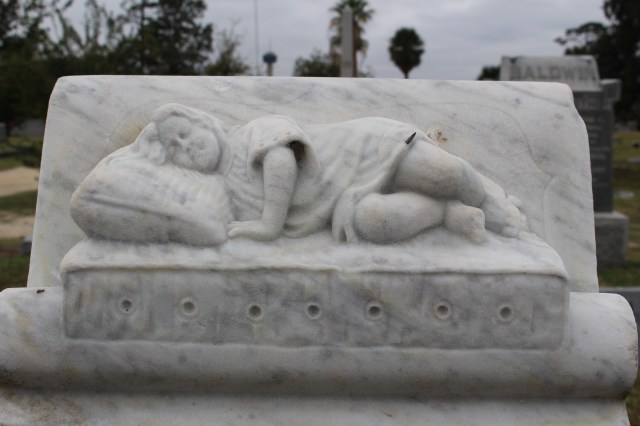
This white-marble monument in the St. Francis Cemetery at Phoenix, Arizona, memorializes the life of an infant girl who died shortly after her second birthday.  A drapery on the top of the gravestone reveals a sleeping baby representing the small child.

The drapery represents the passage from one realm to another; the veil that exists between the Earthly realm and the Heavenly one—the last partition between life and death.

Posted in Children's Graves, Symbolism, Uncategorized | Leave a comment

You Don’t See Those Much Any More!

William Hayes Fogg (1817 – 1884) and his brother, Hiram (1812 – 1860), share a gray granite obelisk in the Green-Wood Cemetery in Brooklyn, New York.  After trade with Japan opened up, the Fogg brothers founded a trading company to import silk, tea, and lamp oil and made their fortune.

The ornamented plinth that the obelisk sits atop has two white marble insets—each a portrait.  In the medallion bas-relief portrait of William he sports full, bushy muttonchops!

Facial hair was very popular during the mid-to-late 19th Century.  In fact, we had “whiskers in the White House” from 1861 to 1913   Every president from Abraham Lincoln with his chin curtain, who was elected in 1860 to William Taft with his walrus mustache, who was elected 1908, had facial hair except for two—Andrew Johnson and William McKinley.

President Chester A. Arthur sporting a mustache and muttonchops!

Posted in Uncategorized | Leave a comment

The Stag

The white marble gravestone in the Oakland Cemetery in Sandusky, Ohio, of Julius Wagner (born August 19, 1823 – died August 20, 1876) features a horn hanging from stag horns.  The stag horns symbolize piety and solitude and victory over Satan.

It also seems possible, a part from the symbolism attributed to antlers, that Julius Wagner was a successful hunter.

The stag when an elk is also a symbol of the Benevolent Protective Order of Elks, one of the many fraternal organizations in the United States.  The B.P.O.E. was originally a drinking club called the Jolly Corks founded in 1866 by a group of actors, who evidently liked to drink.  The club members made the fateful decision to change their organization’s name and increase their mission from frolic to public service.  Their symbol, obviously an elk, is a majestic animal as seen above in the Forest Lawn Cemetery in Omaha, Nebraska, standing guard in the Elks section of the graveyard.

Posted in Symbolism | Leave a comment

Neo-Classical Sarcophagus

Forest Lawn Cemetery, Buffalo, New York

Stanford White and Augustus Saint Gaudens collaborated on the pink granite Francis W. Tracy monument in the Forest Lawn Cemetery in Buffalo, New York.  It is clear that White took his inspiration from an ancient classical design replicated in many modern graveyards modeled after the Roman tomb of Lucius Cornelius Scipio Barbatus.

The Scipio sarcophagus was erected around 150 BC.  Lucius Cornelius Scipio Barbatus (died c. 280 BC) was one of the two elected Roman consuls in 298 BC. His tomb is now preserved in the Vatican Museum in Rome, Italy. It is an example of classical Greek design based on the same design principles used for the Parthenon and described in a trade publication for stone carvers, “Design Hints for Memorial Craftsmen”, written by John Cargill, a designer from the Chicago design firm of Chas. G. Blake & Company, November 1928, Volume 5, Number 5, pages 14-16. The magazine was published monthly at St. Cloud, Minnesota, by editor and publisher, Dan B. Haslam.

According to Cargill, the scroll work, at the top of the canopy represents the Heavens, and also represented a bed. “The scrolls represent a bed; the bed refers to sleep and sleep is a type of death; and to the righteous death is but glorious transport to Paradise.”

Neo-classical exemplar of Scipio-like sarcophagus from Mt. Auburn Cemetery, Cambridge, Massachusetts

Further in the article, he described the evolution of the classical architectural design principles, which he writes were conceived from the order that the ancients found in nature, primarily astrological, that were used in Greek architecture to imbue harmony into their structures.

The sarcophagus has three distinct planes representing the universe—the base, the middle, and the top. The base was symbolic of the Earth, the middle represented man and the gods, and the top of the sarcophagus where the scroll rests represented the Heavens.

In the traditional design there is the addition of more symbolism embedded on the monument. The triglyphs represent the column found in the Doric architectural order and most likely symbolizes a temple. The rosettes may be symbolic of sun gods. Some of the rosettes also have a cross designed into them. The cross was an ancient symbol adopted long before the Christians adopted it. For the ancients it was a symbol of the sun.

However, in the design by White, the triglyphs and rosettes have been replaced by and egg and dart design and an inset that includes a medallion bas-relief portrait of a young Tracy modeled by Saint Gaudens.  The portrait draws on Saint Gaudens’s expertise as an expert cameo cutter and his ability to imbue a bas-relief with detail. The medallion portrait within an ivy wreath is flanked by the inscription: TEARS TO THEE FAR FAR BELOW THE EARTH TEARS DO I BRING TO THEE AMONG THE DEAD.

The entire booklet, “Design Hints for Memorial Craftsmen,” can be found at the Quarries and Beyond Website: http://quarriesandbeyond.org/cemeteries_and_monumental_art/cemetery_stones.html.

The Quarries and Beyond Website was created by Peggy B. and Patrick Perazzo. It focuses on historic stone quarries, stone workers and companies, and related subjects such as geology. Whenever possible links of finished products are provided on the Website. There is a “Quarry Articles” section that presents articles, booklets, and links from the late 1800s to early 1900s, including the 1856 “The Marble-Workers’ Manual.” The “Cemetery Stones and Monuments” section provides references and resources, including many old monument magazines, catalogs, price lists, and a photographic tour “From Quarry to Cemetery Monuments.”

Posted in Symbolism | Leave a comment