Seated Angels

Not far inside the Gothic gates of the Green-Wood Cemetery in Brooklyn, New York, is the David and Adelia Stewart mausoleum.  The mausoleum was designed by Stanford White, of McKim, Mead and White, at one time, the largest and most prestigious architectural firm in the world.

The mausoleum is fairly plain ornamented with putti, or three winged and chubby-cheeked cherubs topping the building.

Underneath the cornice, a leaf design twines above the STEWART family name.  The bronze panels on either side the door feature an angel, both seated.  One holds a scroll with the Bible verse Matthew 5:4, “Blessed are they that mourn for they shall be comforted.”

The other angel, masculine with thicker arms and without flowers intertwined in his hair, holds a long trumpet and most likely represents Gabriel—a subtle laurel leaf and twig motif is in the background.  The laurel leaf symbolizing victory over death.

Stanford White collaborated with Augustus Saint Gaudens on several projects including Saint Gaudens most famous funerary sculpture created for Clover Adams in St. Paul’s Rock Creek Cemetery in Washington, D.C.  There is some dispute, however, about how much White and Saint Gaudens collaborated on this mausoleum.  According to Nancy Adgent, in the article, “Augustus Saint Gaudens: Bringing the American Renaissance to the Cemetery,” page21, MARKERS XXXIV, it is unclear if the putti were crafted by Louis Saint Gaudens, brother to Augustus.  It does seem clear that Augustus did model the angels, though they are clearly before he had fully developed his concept of the angel created for Amor Caritas.  The wings are not intricately defined and the faces of the angels “are not the iconic Davida visage” in his master work.

Gilded Amor Caritas sculpture in the Metropolitan Museum of Art, New York

Typical of the many of the designs in which White and Saint Gaudens collaborated is the egg and dart motif around the bronze door to the mausoleum and the treatment of the lettering—“u” is replaced with a “v” and a dot appears between each word on the banner the angel is holding to the left of the door into the mausoleum.  According to the article, the design work of the figures is Saint Gaudens’s work.

Posted in Angels, Mausoleums, Symbolism | Leave a comment

Angel of Charity

JOHN HUDSON HALL

BORN OCTOBER XV, M-D-C-C-C-XXXVIII DIED MARCH III, M-D-CCC-LXXXXI

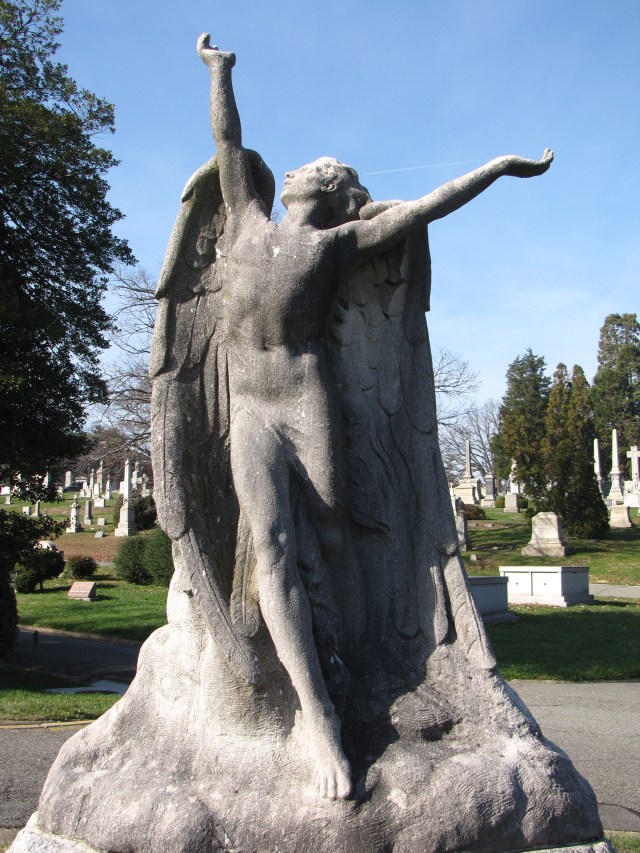
John Hudson Hall (October 15, 1828-March 3, 1891) was a successful paper manufacturer in the mid-to-late 19th Century.  He was also a patron of the arts.  Augustus Saint-Gaudens, the great Beaux-Arts sculptor, who some describe as the American “Michelangelo,” was commissioned to create the Hall Monument in the Sleepy Hollow Cemetery at Sleepy Hollow, New York.  The Hall Monument features an angel dressed in classical clothing holding a banner emblazoned with the Latin phrase “GLORIA IN EXCELSIS DEO” which translates to “Glory to God on the highest.”  The phrase is the name of a hymn known as the Greater Doxology and also the Angelic Hymn.  The angel’s wings sweep upward above her head almost encircling the Biblical verse, Revelation 14:13, “Write: Blessed are the dead which died in the Lord, from henceforth, Yea, saith the Spirit, for they rest from their Labors and their Works do follow them.”

The angel is a near replica of an earlier work he created titled, Amor Caritas, translated as Angel of Charity.

The model for the angel was Albertina Hulgen who became known as Davida Clark.  According to Nancy Adgent, in the article, “Augustus Saint Gaudens: Bringing the American Renaissance to the Cemetery,” page 19, MARKERS XXXIV, Clark had become, “Saint Gaudens’s mistress and the face for many of his public works.”

The gilded Amor Caritas, displayed in the Metropolitan Art Museum in New York City, describes Amor Caritas by saying it “represents the perfection of Saint Gaudens’s vision of the ethereal female, a subject that he modeled repeatedly, beginning in 1880.  The elegant figure in a frontal pose with free-flowing draperies and downcast eyes also appears in the caryatids for the Vanderbilt mantelpiece, displayed nearby, and in several [other] funerary works.”

The placard in the Met goes on to say, “Here, Saint-Gaudens made subtle changes in the drapery and added upward-curving wings, a tablet, and a belt and crown of passionflowers.”

Below the angel’s feet at the base of the monument is a medallion with a bas-relief portrait of John Hudson Hall with his birth and death dates on either side.  The medallion profiles were part of his signature works and shows his earlier craftsmanship as a cameo cutter, which began when he was a mere 13 years old.

Posted in Famous graves, Symbolism | 2 Comments

The Pitcher

Colma, California was established as a necropolis.  That is, the reason that Colma was created was to “house” the dead from San Francisco.  With the exception of the military cemetery at the Presidio, and a churchyard or two, all of the graves within the city were moved south to Colma.  Now the ratio of dead to living is so lopsided that the unofficial motto is, “It is great to be alive in Colma!”

What formed are cemeteries that are dedicated to various cultures and religions.  One of the historic cemeteries in Colma is the Home of Peace Cemetery—a Jewish cemetery.  Two of the gravestones within the cemetery display a pitcher.  In the Jewish tradition the pitcher connotes a person who descended from the Hebrew tribe of Levi.  One of the images actually shows water pouring from the pitcher in anticipation of a Levite assisting in the worship often by washing the hands of a priest.

The pitcher, however, in a Christian cemetery could take on one of two different meanings.  It could represent a person who was of strong moral character—often found on the gravestone of a woman.  Or it could mark the grave of a prohibitionist.

Posted in Symbolism | Leave a comment

The Rooster


The mosaic rooster on the columbarium in the St. Francis Cemetery in Phoenix, Arizona, and the rooster at the St. Bernard’s Cemetery, in Rockport, Indiana, represent awakening.  One can also imagine how the rooster crowing at the first rays of sunlight in the morning can also symbolize the resurrection.

Posted in Symbolism | Leave a comment

The Circle and the Hourglass

In memory of

Mrs. Mary Baxter

Widow of

Gregory Baxter

Who died Nov. 11, 1789

In the 88th, year

Of her age.

Mary Baxter’s dark gray slate tombstone in the Hancock Cemetery in Quincy, Massachusetts, portrays a woman, presumably Mary, holding a circle and an hourglass.

The two symbols are seemingly at odds with one another.  The metaphor of the hourglass suggests the grains of sand slip through one side of the hourglass to the other in a flash as do the minutes of our life.  The hourglass motif on a gravestone symbolizes time fleeting by quickly.

The message of the complete or unbroken circle, however, represents hope, inspiration, and eternal life.

How can these two symbols be compatible?

On the one hand, the hourglass symbolizes the mortal body that does not last long, while on the other hand, Mary holds the circle representing the spiritual life.  The circle emphasizes no beginning and no end.  Death on Earth for the mortal body, eternal life in Heaven for the soul.

Posted in Symbolism | Leave a comment

Buried Four Times!

High on a bluff overlooking the Missouri River, just south of what is present-day Sioux City, Iowa, stands the towering monument to Sergeant Charles Floyd, the only person to die during the Lewis and Clark Expedition.

President Thomas Jefferson enlisted William Clark and Merriweather Lewis to put together of team of handpicked frontiersmen to explore the Western part of the North American continent and the newly purchased Louisiana Territory.

On August 19, 1804, after only 98 days into the journey, Sergeant Floyd became violently sick with what Lewis and Clark diagnosed as “Beliose chorlick” or bilious colic.  The following day, August 20, 1804, Sergeant Floyd’s condition worsened.  Weakly he whispered, “I am going” and he slipped away.  Medical experts of today believe what Sergeant Floyd died from was acute appendicitis which most likely ruptured.  At the time, there was no known cure.

The corps member carried Floyd’s body to the highest bluff in the area and buried him with full military honors.  His grave was marked with a cedar stake painted with his name and date of death.  Two years later, on their return trip the Corps of Discovery stopped on the same spot and found that the grave had been disturbed.  They refilled the grave and finished the remaining leg of the trip to St. Louis.

By 1857, the bluff was being badly eroded and encroaching on Floyd’s grave.  To protect his grave from further erosion, his remains were dug up and moved 200 yards to the east and reburied.

In 1894, Sergeant Floyd’s journal, which had only recently been discovered, was published stirring interest in the Lewis and Clark Expedition and the story of Sergeant Floyd.  Once again his remains were exhumed and reburied in urns.  His grave was marked with a large marble ledger covering his grave.  A committee formed to mark his grave properly.  Congress and the State of Iowa appropriated funds, along with private donations from citizens to build a lasting and fitting memorial to the fallen soldier.

For the fourth and last time, Sergeant Floyd’s remains were unearthed.  They were reburied and placed in the lower courses of the monument.  The dedication of the monument took place on Memorial Day, 1901.

According the plaque at the site, “The monument is an Egyptian obelisk of white sandstone 100 feet high.  Its foundation is 22 feet square at the base, 11 feet, 14 feet square at the top, and made of solid concrete reinforced with 32 lengths of railroad irons.  Poured in one day, this mass weighs 278 tons.  The total weight of the monument is 717 tons.”

Posted in Uncategorized | Leave a comment

The Empty Chair

The gray-marble tufted chair in the Oakland Cemetery in Petersburg, Illinois, has FATHER carved on the front of the upholstered seat cushion.  The highl- elaborate, Victorian-style stone chair gravestone is a memorial for Richard C. Trenary (December 16, 1829 – August 4, 1889), whose large polished gray-granite ornamented obelisk is at the center of the family plot.

This motif gives the feeling that the vacant chair is just waiting for the father, who just stepped out for a moment, to return.  But, it stands empty, never to be sat in again.  In funerary symbolism, the vacant chair symbolizes the loss of a loved one.

Posted in Uncategorized | Leave a comment

Praying Hands and the Rosary

St. Francis Cemetery, Phoenix, Arizona

The Rosary is a prayer to the Mother Mary with a tradition that dates back to St. Dominic in the 1200s.  This symbol, combined with praying hands, is Catholic and predominately found on the gravestones of Catholics.  The Rosary as a gravestone symbol represents devotion to the Virgin Mary but also the unending constant prayers for the deceased.

Posted in Uncategorized | Leave a comment

Praying Hands

Greenwood Memorial Lawn Cemetery, Phoenix, Arizona

Praying hands, which can be found as incised carvings on gravestones or as statues that form a centerpiece in gardens within cemeteries, are a symbol of pious devotion.  Praying hands also symbolize the hope for an eternal life.

St. Francis Cemetery, Phoenix, Arizona

Posted in Symbolism | Leave a comment

The Virgin of Guadalupe

Greenwood Memorial Lawn Cemetery, Phoenix, Arizona

An image that one is likely to come across in cemeteries where there are high populations of Mexican immigrants is the Virgin of Guadalupe, also referred to as Mother of Guadalupe and Our Lady of Guadalupe.  The Virgin of Guadalupe is the Patron Saint to of Mexico.

According to the Catholic Church, the Virgin of Guadalupe was first seen as an apparition the first of four times by Juan Diego on December 9, 1531.  Juan Diego described the woman in the vision as the Virgin Mary dressed in a cloak the color of the clear blue sky.  The cerulean cape was emblazoned with eight point stars and She was standing on top of a crescent moon being carried by a cherubic angel.

Greenwood Memorial Lawn Cemetery, Phoenix, Arizona

The Virgin Mary called out to Juan Diego and introduced herself as “the Mother of a very true deity.”  She asked that a church be built in her honor on that spot on Tepeyac Hill (now a suburb of Mexico City).  The humbled Juan Diego excitedly approached the Archbishop Juan de Zumarraga to tell him of the apparition and of the Virgin Mary’s request.

St. Francis Cemetery, Phoenix, Arizona

Unfortunately the Archbishop did not believe Juan Diego.  A second time the Virgin Mary appeared before him.  Again She made her request.  Juan Diego returned to the Archbishop and pleaded his case and insisted that the vision he had witnessed was real.  The disbelieving Fray Zumarraga instructed Juan Diego to ask this apparition for a sign to prove that She was real.  During his third visit from the Virgin she agreed to supply the proof the very next day.

Boerne Cemetery, Boerne, Texas

Leaving from his uncle’s sick bed, Juan Diego hurried to meet with the apparition.  Upon seeing her for the fourth time, Diego apologized for being late and explained that his uncle was on his death bed and he had attended to him.  She assured him that his uncle had been healed.  The Virgin instructed Diego to go to the spot where he had first seen her to gather flowers.  Impossible, he thought, it was the dead of winter but he followed her instructions and went to the top of Tepeyac Hill where he discovered blooming Castilian roses which he gathered into his winter cloak to show the Archbishop.  When he arrived to show the Archbishop the proof he opened his cloak and the roses fell to the floor and the image of the Virgin of Guadalupe was emblazoned on the fabric of his coat.

Depictions of the Virgin of Guadalupe are varied, sometimes with the Virgin standing on the half-moon carried by a cherub, sometimes shown as carrying the baby Jesus, but always with the cerulean cloak and eight-pointed stars with rays of light behind Her—sometimes as an incised carving on a gravestone, sometimes as a free-standing sculpture.

Boerne Cemetery, Boerne, Texas

Posted in Symbolism | Leave a comment