Lost Hero

IN MEMORY

COURY

1st. LT. PETER E. COURY

BORN DEC. 28, 1914

SONORA ARIZONA

LOST JUNE 1, 1945

OSAKA JAPAN

Standing tall in the St. Francis Cemetery in Phoenix, Arizona, is the marble cenotaph memorializing the life and service of Lieutenant Peter E. Coury, who was an airman in World War II serving in the Pacific Theater.  Peter Coury was the son of Elias and Margarita Coury, born December 28, 1914, in Sonora, Arizona.

Coury was assigned to the 676th Bombardment Squadron, which was a unit assigned to the 444th Bombardment Group.  The 676th Bombardment Squadron began their training at the Davis-Monthan Field, Tucson, Arizona, on March 1, 1943, then to Great Bend Army Air Field, in Kansas from August 1943 to March of 1944.

The 676th first trained with the Consolidated B-24 Liberator, then the B-17 Flying Fortress in 1943 to 1944.  They then flew the YB-29 and finally the Boeing B-29 Superfortress aircraft.

Boeing B-29 Superfortress

Their first combat missions were staged from the Charra Airfield in Purulia, West Bengla, India, in the summer of 1944 where they bombed railroad yards at Bangkok, Thailand.   In the spring of 1945, the 444th moved to a West Field Airbase on Tinian Island, one of the three Northern Mariana Islands, to stage operations against the island of Japan.  The 676th Bombardment Squadron engaged in heavy bombardment operations against Japan to destroy their military and industrial capabilities.

On June 1, 1945, Lieutenant Peter Coury was declared “Missing In Action over Pacific aboard U.S. Army Air Corps B-29-35-BW Superfortress #42-24524, named “Super Mouse.” Nine other crewmembers also MIA, while returning from mission over Osaka, Japan.”  Along with his cenotaph in the St. Francis Cemetery at Phoenix, Arizona, his name also appears on the Tablets of the Missing at the Honolulu Memorial in Honolulu, Hawaii.

Army Air Force Engineer’s Wing

Carved into the marble in bas-relief on the gravestone’s flanks are shields each with a Latin cross, symbolizing the Christian faith.  Also on the cenotaph are the Army Air Force Flight Engineer’s Wing and the B-29 Superfortress in which he flew those heroic missions.

Posted in Uncategorized | Leave a comment

Broken

OUR MOTHER

SARAH A. MILLER

Born

July 3, 1825.

Died

July 26, 1892.

The rounded-top white marble tablet in the Stonewall Jackson Memorial Cemetery, in Lexington, Virginia, of Sarah A. Miller has turned gray as it has weathered.  The bas-relief sculpture in the top of the gravestone depicts the hand of God holding a broken chain. The broken link of chain represents a life that has ended. This symbolism dates back to medieval times when people believed that the soul could be held to the body by a golden chain. Once the chain was broken, the soul took flight and rose from the body leaving Earth and ascended to Heaven.

Posted in Symbolism | Leave a comment

Undaunted by Failure


LEON L. BEAN

Oct. 13, 1872

Feb. 5, 1967

BERTHA D. PORTER

WIFE OF

LEON L. BEAN

1865 — 1939

A few years ago I had a business trip to Freeport, Maine, the home and headquarters of the L. L. Bean Company.

The early failure and then success of Leon Leonwood Bean is legendary.  As a young boy, Leon was an avid hunter, fisherman, and outdoors man.  He was used to traipsing around the woods, marshes, and riverbanks in search of game and fish.  What he didn’t like, however, was the water that seeped up through his boots and soaked his feet.

On display outside the L. L. Bean Company is a monument to the Maine Hunting Shoe (also known as a duck boot) the company’s first and most famous product.

So, he went about inventing a boot that was rubberized to repel the water.  In 1912, Bean enlisted the services of a local shoe cobbler and had 100 pairs made for sale–which he sold through a mail-order catalog with a full refund policy if customers weren’t satisfied.  Of that first 100, 90 pairs of boots were returned.  Undaunted, he kept experimenting until, working with the U. S. Rubber Company, he came up with the right formula for the rubber that would not crack.  He made good on his promise and replaced all 90 of the pairs of boots that were returned.

His money-back guarantee and a unique and superior product gained him customers across the country.  Eventually he expanded his line of sporting goods to include clothing, tents, backpacks, and various other outdoor goods.  What started out as a small boot operation is now close to a two-billion dollar sporting goods mail order business still based in Freeport, Maine.

L. L. Bean died in Pompano Beach, Florida, at the age of 94. He was interred in the Webster Cemetery next to his wife, Bertha, in Freeport, Maine.  His gravestone is a modest, light-gray, unpolished granite grass marker.

Posted in Famous graves | Leave a comment

The Persistent Myth of Mother Goose

The entrance to the Granary Burial Grounds in Boston, Massachusetts

Old Mother Goose,
When she wanted to wander,
Would ride through the air
On a very fine gander.

Jack rode to his mother,
The news for to tell;
She called him a good boy
And said it was well.

Then Jack went a-courting
A lady so gay,
As fair as the lily,
And sweet as the May.

But then the old Squire
Came behind his back,
And began to belabor
The sides of poor Jack.

Then old Mother Goose,
That instant came in,
And turned her son Jack
Into famed Harlequin.

So then with her wand,
Touched the lady so fine,
And turned her at once
Into Sweet Columbine.

The old egg in the sea
Was thrown away then–
When Jack jumped in,
And got it back again.

Jack’s mother came by,
And caught the goose soon,
And mounting its back,
Flew up to the moon.

Most of us grew up with Mother Goose and her familiar nursery rhymes being read to us by our parents.  In fact, most of us can probably recite from memory such nursery rhymes as, Baa, Baa, Black Sheep; Hickory Dickory Dock; Jack and Jill, and Old Woman in the Shoe, among so many others. However, we don’t really know who the mysterious Mother Goose really was who supposedly collected the rhymes into one comprehensive volume to be shared with generations of children.

The truth: there was no Mother Goose—she is a mythical character.  But the myth of her as a real-life person persists.

There was a Mother Goose, but not one who collected stories, poems, and nursery rhymes—and she was a real, flesh and blood, woman.  This Mrs. Goose was a real mother—having birthed 10 children.  That certainly qualifies her to be called MOTHER GOOSE.  Her name was Mary Balston Goose (ca. 1648-1690) and she was married to Isaac Goose, also known as Isaac Vergoose, who made a living by moving things for people and picking up odds and ends.   They lived in Boston.  Mary died and was buried in the Granary, an ancient burial grounds in downtown Boston.

Isaac remarried to a southern woman named Elizabeth Foster, another Mother Goose, if you will.  Together they added five more to Isaac’s broad, one of whom was also named Elizabeth.  Elizabeth, the daughter, married Thomas Fleet, the publisher of the Boston Evening Post.

Erroneously, a story spread that got told as truth that Thomas Fleet’s mother-in-law (or the first of the two wives of Isaac Goose) had been the person who had collected the rhymes which Fleet then published.  Except for one small detail—no evidence of that has EVER been found that Fleet published such a volume.

And yet, many people flock to the Granary to see Mother Goose’s grave, which they can see—just not the Mother Goose they are looking for.

Posted in Famous graves | 2 Comments

Cherubim

Cherubim are one of nine orders or choirs of angels which are organized into three spheres, with three choirs in each sphere.  According to Christian tradition, the first sphere, which is made up of the Seraphim, Cherubim, and the Thrones, are considered the closet to Heaven.  In Ezekiel 10:14, the Cherubim are described as having four likenesses or four faces, “And every one had four faces; the first face was the face of a cherub, and the second face was the face of a man, and the third the face of a lion, and the fourth the face of an eagle.”  The Cherubim were to be guardian angels.

There are several beautifully carved examples of sculptures of cherubs adorning the graves in the St. Francis Cemetery in Phoenix, Arizona.

The first angel pictured above and below is clutching a cross, which is usually a sign of faith.  This angel wears a gossamer gown that swirls into the clouds it stands on.

KELLY T. HYDER

1882 – 1931

Often cherubim are depicted on the graves of children but that is not the case for this gravestone—Kelly Hyder was 49 years old at death.

The next example is of an angel holding a torch with a lit flame above his head and with his other arm he clutches a sprig of mixed flowers.  The lit torch symbolizes life.  The torch is also seen as an instrument that illuminates the darkness representing enlightenment.  It can symbolize zeal, liberty, and immortality.  The angel again stands on clouds which is the veil between God and the faithful.

OUR

DARLING

BABY

ALONZO DELGADO

SEP 17 1931  OCT 27 1932

The third example is an angel on the gravestone of Andres Telles who died at the age of 54.  The angel again stands on a cloud holding a palm frond that crosses his body and covers him.  The palm frond symbolizes victory over death.

1874 – 1928

ANDRES C. TELLES

RECUERDO DE SU

ESPOSA Y HIJOS


Posted in Angels | Leave a comment

The Chalice and the Host

Dominus spes mea.

Zum Andenken an

REV. PETER

TARRILLION.

Pfarrer von Fredericksburg.

Geb.

Zu Edlinger. Lothringen 1821.

Zum Priestergeweitht in Calveston 1855.

GEST.

MAERZ 25, 19oo.

R.I. P.

The white marble gravestone of Reverend Peter Tarrillion in the St. Joseph Society Cemetery in San Antonio, Texas, displays a chalice with the wafer in the quatrefoil in the top of the monument.  The chalice and the wafer represent the blood and the body of Christ.

Posted in Symbolism | Leave a comment

A Closer Look

St. Paul’s Rick Creek Cemetery, Washington, D. C.

The elaborately designed Neo-classical sarcophagi of James B. Oliver and Frances Oliver Johnson in the Allegheny Cemetery in Pittsburgh, Pennsylvania, and the St. Paul’s Rock Creek Cemetery in Washington, D. C., respectively, are imbued with a profusion of symbolism.

The four corners are flanked with winged angels standing on pine needles and pine cones holding a palm frond in one hand and a laurel wreath in the other:

Allegheny Cemetery, Pittsburgh

Palm fronds

The palm frond is an ancient symbol of victory, dating back to Roman times when victors were presented with palm fronds. The palm fronds were also laid in the path of Jesus as He entered Jerusalem. So, for many Christians, the palm represents righteousness, resurrection, and martyrdom, symbolizing the spiritual victory over death associated with the Easter story.

Laurel wreath

The laurel wreath dates back to Roman times when soldiers wore them as triumphal signs of glory.  The laurel was also believed to wash away the soldier’s guilt from injuring or killing any of his opponents.  In funerary art the laurel wreath is often seen as a symbol of victory over death.

Pine needles and pine cones

As is the case with many plants that are adopted by Christians it’s their characteristics that define what they symbolize.  Pine leaves are evergreen, which mean they stay green during the winter.  So, in this way, pine leaves came to symbolize immortality of the soul.   The pine cone carries the seed of the tree, so it symbolizes fertility.

Allegheny Cemetery, Pittsburgh

Poppy

In cemetery symbolism the poppy represents eternal sleep.  Just as it was portrayed in the movie, The Wizard of Oz, the main characters lie down in a field of poppies where they fall into a deep sleep.  That same imagery is used here.

Boughs of plenty

The boughs of plenty repeat the poppies and pine cones woven through them.  Each bough on the sarcophagus is held up by turtles.  In some cases the turtle can be strictly ornamental or can represent strength, durability, and the virtue of longevity.

The Skull

The ornamental post that holds the boughs is topped with an urn with a flame.   The flame, like many Christian symbols, has several different meanings—eternal life, religious fervor, and vigilance.  The flame can also represent martyrdom.  The other ornamentation on the base is a cow’s skull likely representing mortality.

St. Paul’s rock Creek Cemetery, Washington, D. C.

The Urn

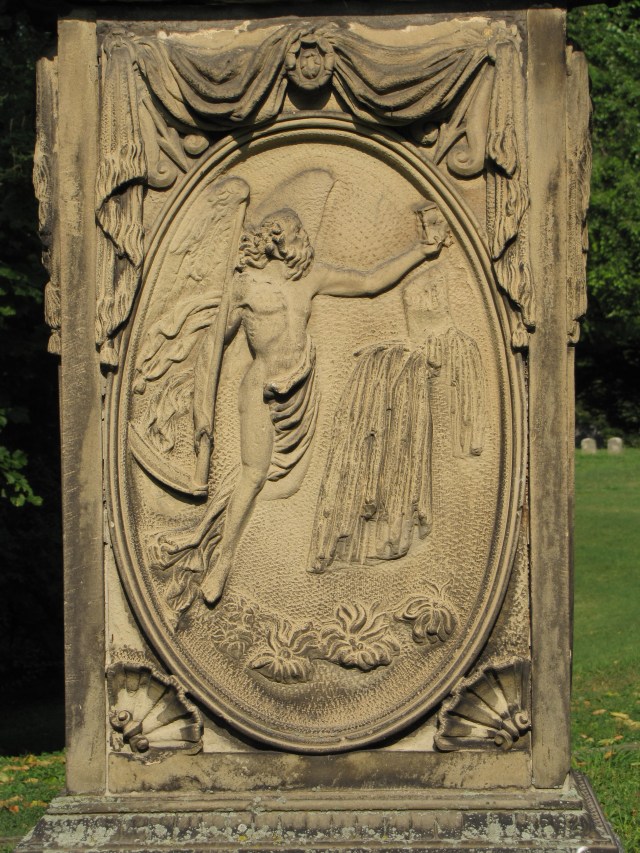
Topping off the Neo-classical design of the sarcophagus is the Neo-classical urn. The urn was used by Romans to store cremated remains and the willow was associated with the Persephone, the goddess of the underworld. Combined they represent the soul’s journey from the Earthly Realm to the Heavenly Realm. This design coincided with a Neo-classical revival that took place mid-18th Century in America.

St. Paul’s Rock Creek Cemetery, Washington, D. C.

Posted in Symbolism | Leave a comment

Two of a Kind

JAMES B. OLIVER

BORN APRIL IV,

MCCCCXLIV

DIED NOV., XXVIII

MCMV

James B. Oliver was a highly successful steel magnate in Pennsylvania.  He is buried in the Allegheny Cemetery in Pittsburgh in an elaborately adorned sarcophagus festooned with symbolism literally on every corner of the monument.

According to Images of America: Allegheny Cemetery, written by Lisa Speranza and Nancy Foley and published by Arcadia Publishing, 2016, page 26, “James opted for this spectacular original work in bronze, which depicts angels, virtues, and boughs of plenty held up on the shells of turtles.”

However, there was at least one other made just like it which rests in the St. Paul’s Rock Creek Cemetery in Washington, D.C. and marks the grave of James B. Oliver’s daughter, Frances Oliver Johnson and her husband:

FRANCES OLIVER

JOHNSON

BORN MARCH XXIV/MDCCC-LXXVII

DIED MAY XVII

MCMVI

LOREN BASCOM TABER

JOHNSON

BORN JUNE XV, MCCCLXXV

DIED DECEMBER SIV, MCMXLI

Both of these sarcophagi were manufactured at the John Williams Foundry (Jno. Williams, Inc.) in New York City.  The foundry was established in 1875 by John Williams who had been an employee of Tiffany & Company who left to start his own enterprise.

The foundry worked with some of the most influential and well-known sculptors of the late 19th and early 20th Centuries, such as, Louis Amateis, Karl Bitter, Gutzon Borglum, Pompeo Coppini, Daniel Chester French, Harriet Frishmuth Carl Augustus Heber, Anna Hyatt Huntington, Charles Keck, Edward Kemeys, Samuel Kilpatrick, Augustus Lukeman, Frederick MacMonnies, R. Tait McKenzie, Percival J. Morris, Allen George Newman, Charles Niehaus, Roalnd Hinton Perry, J. Massey Rhind, Andrew O’Connor, Alexander Phimister Proctor, Augustus Saint Gaudens, Anton Schaaf, Francois Tonetti, Gaetan Trentanove, J. Q. A. Ward, Olin Levi Warner, Albert Weinert, and George Julian Zolnay.

The foundry manufactured architectural pieces, such as bronze doors, for the Boston Public Library, the Library of Congress, and the United States Capitol building, as well as, sculptural pieces, such as, the tigers in front of Nassau Hall at Princeton University.


The Jno. Williams advertisements were all from an industry publication, The Monumental News, and were researched and provided by Peggy Perazzo who shares her vast collection of gravestone catalogs and resources at her Website: http://quarriesandbeyond.org/cemeteries_and_monumental_art/cemetery_stones.html.

The Quarries and Beyond Website was created by Peggy B. and Patrick Perazzo. It focuses on historic stone quarries, stone workers and companies, and related subjects such as geology. Whenever possible links of finished products are provided on the Website. There is a “Quarry Articles” section that presents articles, booklets, and links from the late 1800s to early 1900s, including the 1856 “The Marble-Workers’ Manual.” The “Cemetery Stones and Monuments” section provides references and resources, including many old monument magazines, catalogs, price lists, and a photographic tour “From Quarry to Cemetery Monuments.”

Posted in Uncategorized | Leave a comment

An Artist’s Influence

Many great artist’s works can be found in North American cemeteries, including those sculpted by Daniel Chester French, Augustus Saint-Gaudens, Aldabert Volck, Felix Weihs de Weldon, Karl Bitter, Martin Milmore, Alexander Milne Calder, T. M. Brady, Albin Polasek, Harriet Whitney Frishmuth, William Wetmore Story, Edward V. Valentine, Nellie Walker, Lorado Taft, Sally James Farnham, Adolph Alexander Weinman, Solon Borglum, and John Gutzon Borglum, a veritable who’s who in the art world.  These artists were able to earn a living creating sculptures, public and private.

However, a Danish neo-classic artist, Bertel Thorvaldsen (19 November 1770 – 24 March 1844) of international fame, did not work in North America.  Thorvaldsen was the son of a wood carver, born in Copenhagen, trained for a time at the royal Danish Academy of Art, then furthered his art education in Rome where he gained fame as a master sculptor.  His work can be found throughout Europe.  Even though his work does not appear in America, his influence can be seen in American cemeteries nonetheless.

The famed Lion of Atlanta was commissioned by The Ladies Memorial Association commissioned T. M. Brady of Canton, Georgia, to create a monument to the unknown Confederate war dead buried in Oakland Cemetery in Atlanta, Georgia.  The sculpture was commemorated on April 26, 1894.

The inspiration for the Lion of Atlanta was Bertel Thorvaldsen’s colossal Lion of Lucerne (Switzerland), which Mark Twain called “the most mournful and moving stone in the world.”  As the artist was completing the sculpture he was told he would not be paid the full amount for his work.  To demonstrate his contempt for those who contracted the work, Thorvaldsen carved the inset in the shape of a hog.

Variations of his bas-relief depicting an angel carrying two infants presumably to Heaven can be seen in many American cemeteries, including the Tollner gravestone in the Green-Wood Cemetery in Brooklyn, New York.

Posted in Symbolism | 1 Comment

Victorian Funerary Symbolism

John Baptiste Ford (November 11, 1811 – May 1, 1903) was born in Danville, Kentucky, and made his fortune as an industrialist producing various products including iron, steamboats, and eventually glass.

Ford is buried in the Allegheny Cemetery in Pittsburgh, Pennsylvania, in a grand Victorian gothic mausoleum with pointed arched windows, buttresses, composite column capitals, and a quatrefoil tracery on the pediment over the doorway.  The mausoleum is topped by the figure of hope.

Two figures flank the doorway representing sleep and death.  On the left is a mourning figure holding a sprig of three poppies.  In cemetery symbolism the poppy represents eternal sleep.  Just as it was portrayed in the movie, The Wizard of Oz, the main characters lie down in a field of poppies where they fall into a deep sleep.  That same imagery is used here.

On the right of the doorway is a figure holding a draped urn.  The draped urn represents the clothing of the deceased being shed to move from the Earthly realm to the Heavenly realm.  The urn was an almost ubiquitous 19th Century symbol found in nearly every American cemetery.

Posted in Symbolism | 1 Comment