
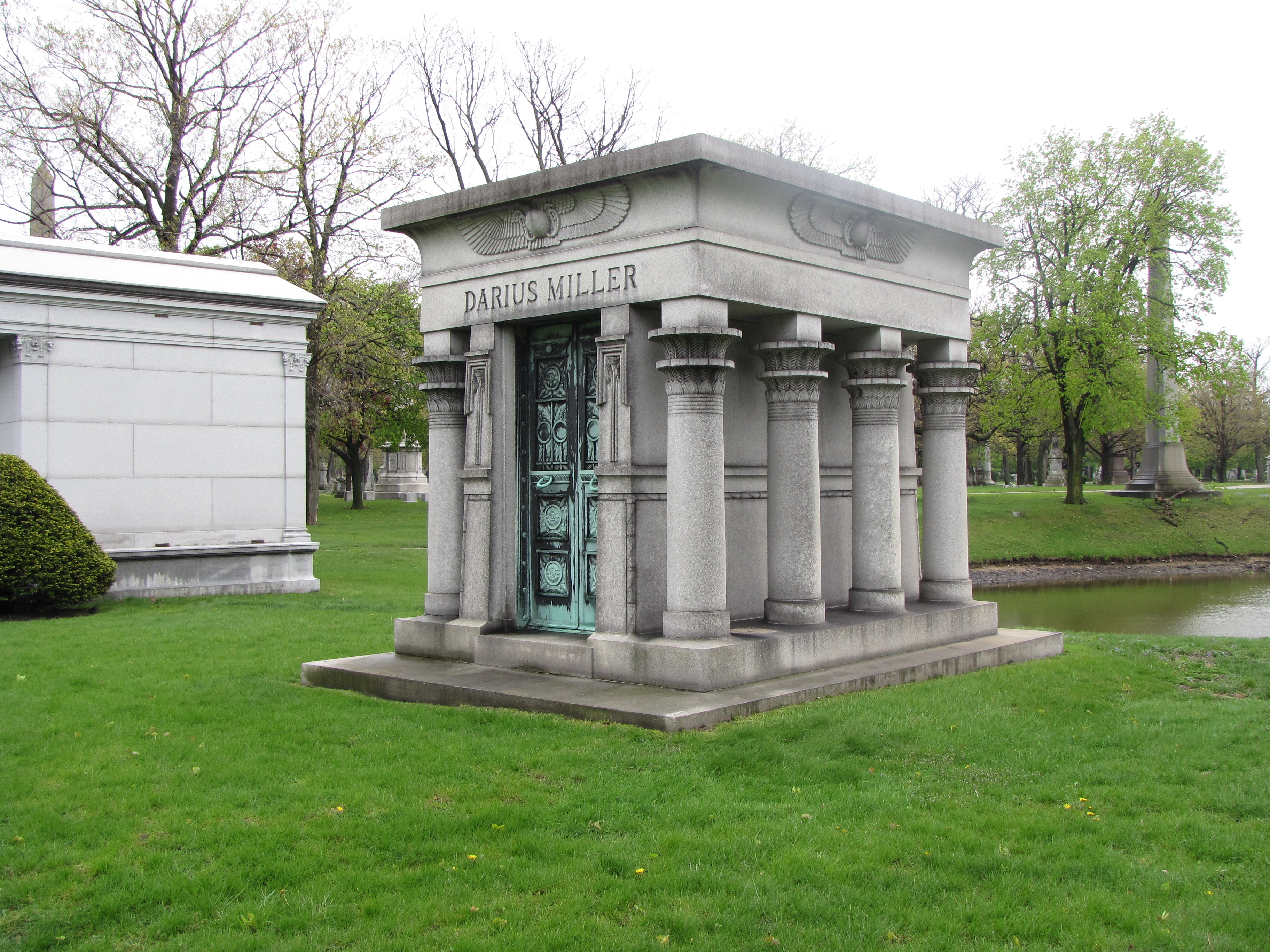
The Darius Miller Mausoleum in the Rosehill Cemetery at Chicago, Illinois, is a magnificent example of Egyptian Revival architecture found in many large urban cemeteries. Egyptian ornamentation can be divided into three categories—architectural, geometric, and natural. The mausoleum features–the cavetto cornice that curves into a half circle at the top of the tomb and above the doorway which is an example of architectural ornamentation; the torus molding that trails around the middle of the tomb, and the corners of the mausoleum that are designed to emulate long bundled papyrus; and the eight heavy columns with the highly stylized papyrus leaves at the top of each bell column are all examples of natural ornamentation.
The Darius Miller Tomb also features two winged globes with uroei above the doorway and on the side of the tomb in the cornice. In this example, there are three sets of falcon wings that are a symbol of the king, the sun, and the sky. The globe represents the Egyptian god, Horus. The uroei, snakes, are waiting to strike. They symbolize the king’s ability to ward off evil spirits. The tomb gives one the sense of solemnity and a sense of eternity, just as the temples of the pharaohs.
The story told on several Websites was that Darius Miller was fascinated with Egyptian art and architecture and that he supposedly had his tomb modeled after the Egyptian Temple of Anubis, the god of the underworld. Also, because of Miller’s Egyptian obsession, Darius Miller was at the historic opening of the King Tut Tomb in Egypt.
Much has been made of the “curse of King Tut.” Those who opened the tomb of King Tut and disturbed the contents would be susceptible to the curse, “Death comes on wings to he who enters the tomb of a pharaoh.” Lord Carnavon, who funded the expedition to find and excavate King Tut’s tomb was, according to the legend of the curse, the first to die. And many of the believers in the supernatural claim to this day that an eerie blue light emanates from the Darius Miller Tomb every May 1st and that he, too, was felled by the curse.
The problem with the assertion that Darius Miller died as a result of the curse is absolutely false. First of all, Darius Miller died August 23, 1914, at Glacier Park, Montana, and King Tut’s burial chamber was not opened until February 17, 1923, a difference of roughly nine years. Furthermore, Lord Carnavon did not die from the curse either—a mosquito got him!
The myth and mystery surrounding Darius Miller and his tomb, though debunked quite some time ago, was seemingly more interesting than the real story of a young Midwestern man born April 3, 1859, at Princeton, Illinois, who started out in the railroad business at the bottom and worked his way to the top. By all accounts, Darius Miller did it by being a hard worker and by being nice to all those he came in contact with. Darius began working in the railroad industry in late 1877. He held many positions at many different railway companies–stenographer in general freight office at the Michigan Central Railroad; clerk in the general freight office St. Louis Iron Mountain and Southern Railway; chief clerk to general manager and general freight and ticket agent at the Memphis and Little Rock Railroad; general freight and passenger agent and then traffic manager at the St. Louis Arkansas and Texas Railway; traffic manager on the Queen and Crescent Route; traffic manager and then vice-president at the Missouri Kansas and Texas Railway. From November 15, 1898, to Dec. 31, 1901, Darius served as second vice-president at the Great Northern Railway. On January 1, 1902, he was appointed first vice-president at the Chicago Burlington and Quincy Railway.
By the time of his death, Darius Miller had risen through the ranks to become the President of the Burlington Railroad. The August 26, 1914, issue of the Lincoln Daily News, flashed the headline, “Tribute Paid to Memory of R. R. Official: Railroad men and other citizens of Lincoln who knew Darius Miller, president of the Burlington road, express keen regret over his death. Two weeks ago President Miller and several other high officials of the road stopped for a short time in Lincoln on their way west in a private car. At that time President Miller appeared to be in the best of health.
“Secretary W. S. Whitten of the Lincoln Commercial club knew him well. When Whitten was chief clerk to the traffic manager of the Eastern Minnesota railway, a part of the Great Northern system, Miller was in the same building at St. Paul where Mr. Whitten was employed.
“Darius Miller was a grand, good man.” Said the secretary. “He was modest and unassuming. It was no trouble to see him. The door of his office was always open and it required no red tape to reach him.
“He was a great friend of young men. I may say that he was like a father to the young railroad men under his jurisdiction. H was ready any time with a word of encouragement and was never to busy to be helpful. He was a remarkable judge of men and picked out his subordinates with rare skill and judgment. He placed them on their mettle and when they made good they were rewarded with commendation and with advancement in the service. He was a big, brainy and genial and was the ideal railroad official. He belonged to the modern type of railroad executives who made friends for the railroad. Matters of traffic taken up with him were easily adjusted when they has merit to them. During the time I have been secretary of the Commercial club it has been necessary to seek the adjustment of vexing traffic problems affecting the commercial welfare of Lincoln with the Burlington and Mr. Miller has always been fair in his treatment. It was a pleasure to do to him with such matters because of his broad understanding of traffic conditions. The last time I saw President Miller was during the latter part of June when he came to the Commercial club in company with Vice President Byram. At that time he looked at the corner room on the first floor with a view to renting it for the district freight department. It was but a short time after this that the contract was closed with the railroad for the room. When I happened in Chicago and dropped in to see him he was very friendly and courteous and was never too busy to see me. I think no railroad official in a high place will be missed more keenly than Mr. Miller.”
B. N. Loverin, a passenger conductor on the Burlington running between Lincoln and Omaha was a schoolmate and boyhood friend of Darius Miller. Both lived in Princeton, Illinois. Loverin graduated from the high school of Princeton just a year before Miller. After his graduation the latter went railroading. President Miller always has a warm spot for his boy friend. And when Mr. and Mrs. Loverin were in Chicago three years ago they called at the C. R. & Q. headquarters to see President Miller. He had felt sure that Mr. Miller would get well. Mr. Bignell said that Mr. Miller had endorsed himself to all classes of railroads employees by his kindness and consideration for them and his winning personality.
The Oakland Tribune August 24 1914, ran the headline, “RAILROAD PRESIDENT IS CALLED BY DEATH.” Their article went on, “Glacier Park, Mont. Aug. 24—Darius Miller, president of the Burlington Railway, died here yesterday following an operation for appendicitis. Miller was touring the park when taken ill and returned to the hotel for treatment. Special trains brought physicians and nurses and the operation was performed Saturday afternoon. Hope was held out for Miller’s recovery until late this morning when he quietly passed away. Mrs. Miller, Louie M. Hill, Miller’s lifelong friend, and Hale Holden vice president of the Burlington route were at the bedside when the end came.”








 Gravely Speaking