Heartless

IMG_9959

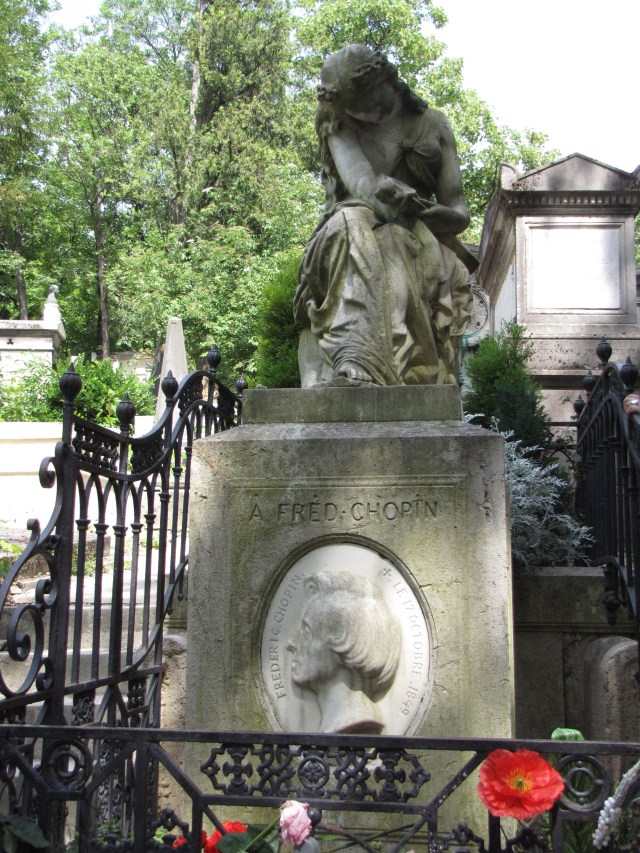
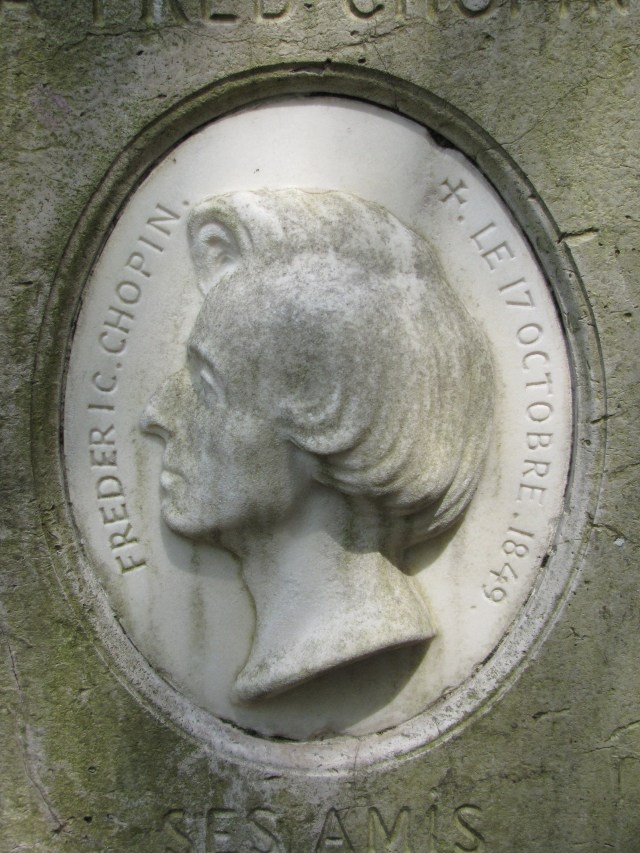
One of the most oft visited graves in the Père Lachaise Cemetery at Paris, France, is that of Frédéric François Chopin (February 22 or 1 March 1810 – October 17, 1849), the Polish composer and prodigy who was considered one of the greatest musicians of the Romantic Era.

Frédéric_Chopin_by_Bisson,_1849[1]

Chopin was born and raised in Warsaw, Poland, but at the age of 21 moved to Paris where he spent the rest of his short life composing and teaching piano. He gained enormous fame after Schumann touted Chopin as a musical genius elevating him to superstar status.

Chopin had a fragile constitution and was in declining health in his mid to late 30s. Most historians believe that Chopin died at the young age of 39 of tuberculosis. One of his dying wishes was to be buried in Paris, but to have his chest opened, so his heart could be removed and buried in the city of Warsaw. His sister, Ludwika, fulfilled her brother’s wishes returning his alcohol-preserved heart, in an urn to his homeland.

IMG_9960

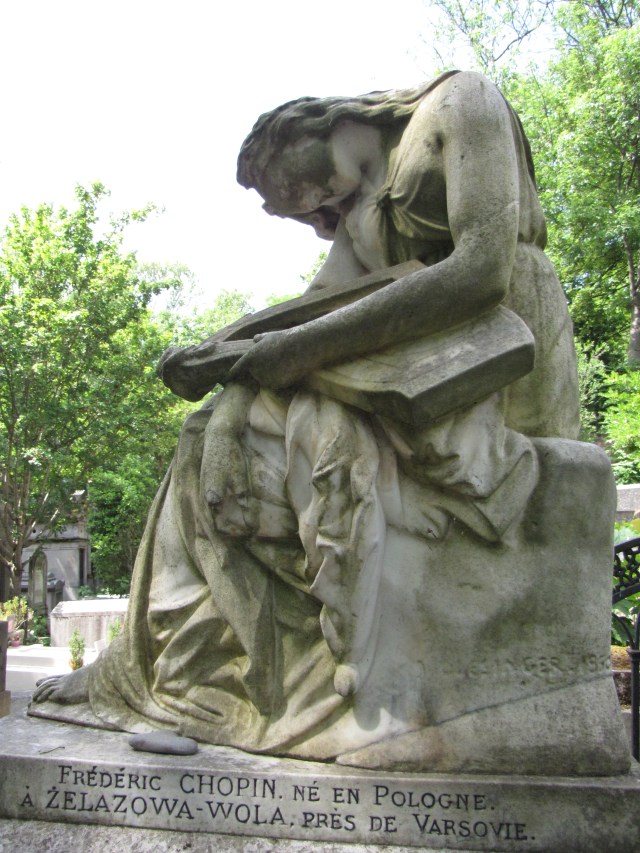
His gravestone in Père Lachaise has a sculpture of Euterpe, the muse of music, sculpted by famed artist Jean-Baptiste Auguste Clésinger. Euterpe cries over a broken lyre, a probable metaphor for the loss of the great musician.

IMG_9962

Posted in Famous graves | Leave a comment

The Flint Granite Company


From the Flint Granite Company which can be found in its entirety on the Quarries and Beyond Website

From the Flint Granite Company which can be found in its entirety on the Stone Quarries and Beyond Website

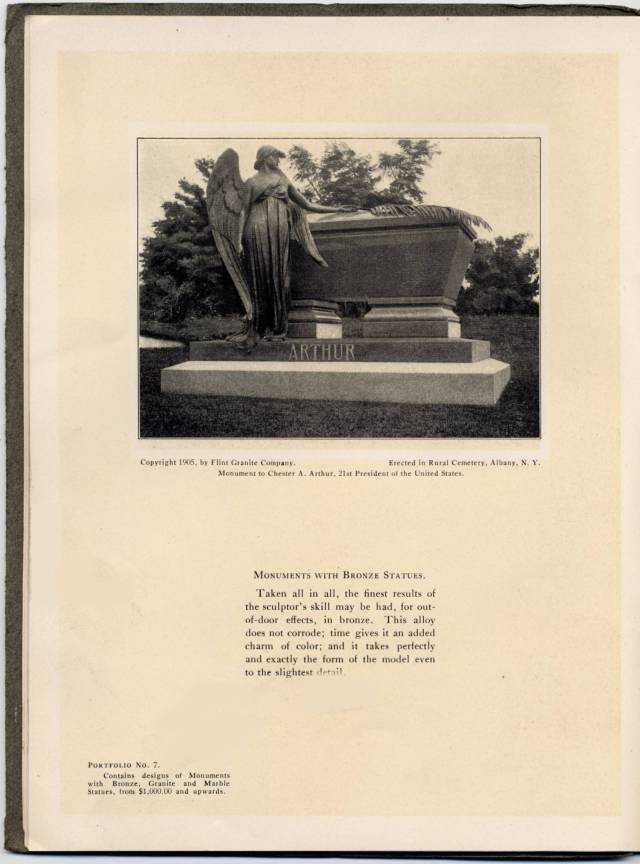
The Flint Granite Company of New York was, according to their brochure, “builders of artistic memorials in granite, marble and bronze.” Like many companies, The Flint Granite Company issued a catalog for potential customers showing the various sorts of monuments and memorials that could be purchased from them. The catalog that they published in 1905 pictures the grand memorial designed and built for President Chester A. Arthur, the 21st President of the United States, erected in the Rural Cemetery at Albany, New York. The caption says, “MOMUMENTS WITH BRONZE STATUES. Taken all in all, the finest results of the sculptor’s skill may be had, for out-of-door effects, in bronze. This alloy does not corrode: time gives it an added charm of color; and it takes perfectly and exactly the form of the model even to the slightest detail.” According to the booklet, PORTFOLIO NO. 7 contains “designs of Monuments with Bronze, Granite, and Marble Statues, from $1,000.00 and upwards.”

img_3382[2]

Chester Alan Arthur (b. October 5, 1829, Fairfield, Vermont – November 18, 1886) was the 21st President of the United States (1881–85). He assumed the office upon the death of James Garfield who was felled by an assassin’s bullet and a host of doctor’s who eschewed sanitary conditions when treating him. Arthur had been a political appointee in the New York City Republican political machine which meant expectations for him as president were low. To the surprise of many, Arthur stepped up and embraced the political reforms that he and Garfield campaigned on.

After his term, in poor health, Arthur only half-heartedly sought the re-nomination for the presidency in his own right in 1884. Grover Cleveland succeeded him. President Chester Arthur died two years later at the age of 57 years.

After a private funeral service in New York City, Arthur was laid to rest in the Albany Rural Cemetery at Menands, New York. In 1889, a large granite sarcophagus was created for his monument by the Flint Granite Company. Noted American sculptor Ephraim Keyser, created and cast a large bronze female angel that is depicted placing a palm leaf on the top of the tomb. The palm leaf represents victory over death.

img_3383[1]

img_9735[1]

Not long after the creation of Arthur’s memorial, Sidney Rowland Francis, brother and law partner of the Governor of Missouri died December 4, 1893, at St. Louis, Missouri. Francis was buried in the famed Bellefontaine Cemetery in that city. With the exception of the hand turned down as opposed to up and the absence of the palm leaf on the top sarcophagus the monument, angel and all, created for Francis’ grave appears to be a look-a-like of Arthur’s.

img_9737[1] 

The entire Flint Granite Company brochure can be found at the Stone Quarries and Beyond Website: http://quarriesandbeyond.org/cemeteries_and_monumental_art/cemetery_stones.html.

The Stone Quarries and Beyond Website was created by Peggy B. and Patrick Perazzo. It focuses on historic stone quarries, stone workers and companies, and related subjects such as geology. Whenever possible links of finished products are provided on the Website. There is a “Quarry Articles” section that presents articles, booklets, and links from the late 1800s to early 1900s, including the 1856 “The Marble-Workers’ Manual.” The “Cemetery Stones and Monuments” section provides references and resources, including many old monument magazines, catalogs, price lists, and a photographic tour “From Quarry to Cemetery Monuments.”

Posted in Presidential graves | Leave a comment

Cherubs

IMG_4823

FRANK F. JR.

BELOVED SON OF

FRANK F. & IRMA H. JONES

AUG. 5, 1916 – SEPT. 12, 1919

Sculptures of cherubs often adorn the graves of children. Here, two examples are found in the Elmwood Cemetery at Charlotte, North Carolina.

The chubby grief-stricken little angel above sits atop the gravestone of a three-year old Frank F. Jones, Jr. in the Elmwood Cemetery at Charlotte, North Carolina. The angel holds his face into one of his pudgy hands while the other holds a rose in the other. The rose symbolizes the messianic hope that Christ will return.

Cherubim are one of nine orders or choirs of angels which are organized into three spheres, with three choirs in each sphere.  According to Christian tradition, the first sphere, which is made up of the Seraphim, Cherubim, and the Thrones, are considered the closet to Heaven.  In Ezekiel 10:14, the Cherubim are described as having four likenesses or four faces, “And every one had four faces; the first face was the face of a cherub, and the second face was the face of a man, and the third the face of a lion, and the fourth the face of an eagle.”  The Cherubim were to be guardian angels.

The cherub pictured below does not have a name carved into the stone. The angel looks off into the distance with his hands crossed and resting on his knees, crossing his legs at the ankles. His head is slightly bent downward in a posture of sorrow.

IMG_4700

Posted in Angels | Leave a comment

Doppelganger Revisited

The Gray Family Monument at the Oakland Cemetery at Atlanta, Georgia

The Gray Family Monument at the Oakland Cemetery at Atlanta, Georgia

Doppelganger is a word that refers to two people who look the same.  Look-a-likes.   It is a German word that translates to “double goer”.  Popular television shows run photos next to each other showing actors and actresses together to show look-a-likes, such as, Christina Hendricks and Jessica Rabbit, Katy Perry and Zooey Deschanel, Morgan Freeman and Kofi Annan, Margot Robbie and Jaime Pressly, or Stephen Colbert and Bob Saget to name a few.  To poke gentle fun, some sites also match the faces of dogs to their look-a-like actors’ faces.

In this case, five gravestone sculpture doppelgangers—the Gray Family Monument at the Oakland Cemetery at Atlanta, Georgia; the Haggard monument at the Mount Olivet Cemetery at Nashville, Tennessee; The Inez M. and James Dunn Family Monument at the Glendale Cemetery at Akron, Ohio; the Mary Norcott Bryan London Monument in the Elmwood Cemetery at Charlotte, North Carolina; and The Mary Salmen Monument at the St. Joseph Catholic Cemetery at Evansville, Indiana, are clearly look-a-likes.

James Richard Gray – September 30, 1859-June 25, 1917

May Inman Gray – March 6, 1862-January 6, 1940

Gray Family Monument at the Oakland Cemetery at Atlanta, Georgia

Gray Family Monument at the Oakland Cemetery at Atlanta, Georgia

The Haggard monument at the Mount Olivet Cemetery at Nashville, Tennessee

The Haggard monument at the Mount Olivet Cemetery at Nashville, Tennessee

MARY LAURA CHAMPE-HAGGARD July 11, 1920

WILLIAM HAGGARD M.D. October 17, 1826 January 25, 1901

JENNIE DOUGLAS HAGGARD February 11, 1840 November 16, 1914

The Haggard monument at the Mount Olivet Cemetery at Nashville, Tennessee

The Haggard monument at the Mount Olivet Cemetery at Nashville, Tennessee

The Inez M. (March 16, 1852 – July 17, 1925) and James Dunn (January 17, 1854 – May 14, 1931) Family Monument at the Glendale Cemetery at Akron, Ohio.

The Inez M. and James Dunn Family Monument at the Glendale Cemetery at Akron, Ohio.

The Inez M. and James Dunn Family Monument at the Glendale Cemetery at Akron, Ohio.

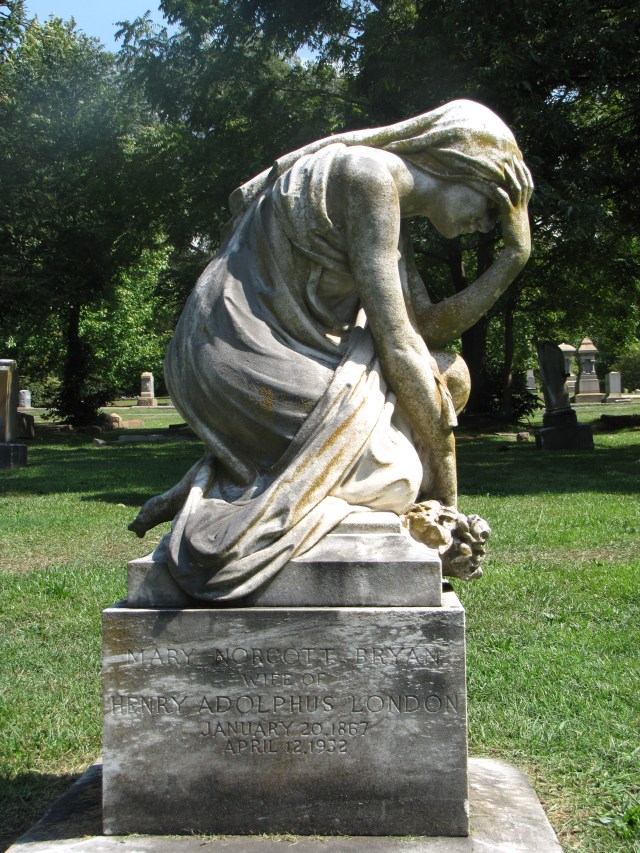
The Mary Norcott Bryan, the wife of Henry Adolphus London (January 20, 1867 – April 12, 1932) Monument in the Elmwood Cemetery at Charlotte, North Carolina.

The Mary Norcott Bryan London Monument in the Elmwood Cemetery at Charlotte, North Carolina

The Mary Norcott Bryan London Monument in the Elmwood Cemetery at Charlotte, North Carolina

The Mary Salmen (1857 – 1987) Monument at the St. Joseph Catholic Cemetery at Evansville, Indiana.

The Mary Salmen Monument at the St. Joseph Catholic Cemetery at Evansville, Indiana

The Mary Salmen Monument at the St. Joseph Catholic Cemetery at Evansville, Indiana

According to a book about the Oakland Cemetery, the Gray Family Monument is adorned with a magnificent white-marble sculpture of the Niobe, the Greek mythological Queen of Thebes. All of these sculptures most likely originate from the same tradition and possibly from the same monument company. But, the sculpture commemorating the grave of Mary Salmen in the St. Joseph Catholic Cemetery at Evansville, Indiana, titled the funerary sculptural, “The Morning Prayer”. Perhaps Christian sensibilities did not want a mythological interpretation of the sculpture in their cemetery.

Posted in Symbolism | Leave a comment

The Lamb and the Sea Shell

IMG_4725

EULIS

CALLOWAY

FEB. 1, 1900

FEB. 27, 1932

Gone but not

forgotten.

This small square-top soft white marble tablet in the Elmwood Cemetery at Charlotte, North Carolina, shows a lamb, nestled into a sea shell.  The shell is a symbol of baptism because of its obvious association to water.  In fact, a shell is often used to scoop up and sprinkle water during the baptismal ceremony. The lamb is the symbol of the Lord, the Good Shepherd. It also represents innocence; usually this motif adorns the tombstones of infants and young children. In this case that narrative does not fit because this symbol is found on the gravestone for a 32-year old.

IMG_4726

Posted in Symbolism | 2 Comments

The Wreath

IMG_4673

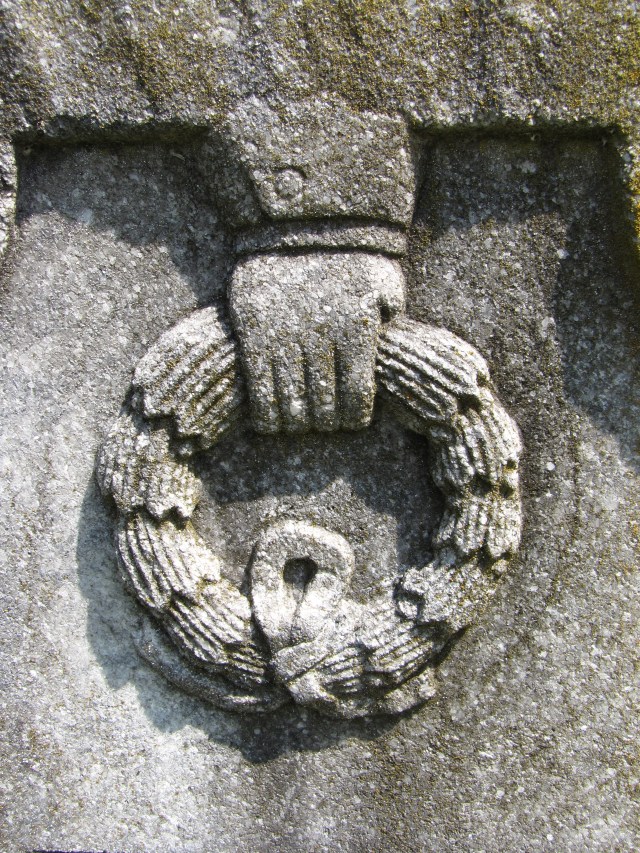
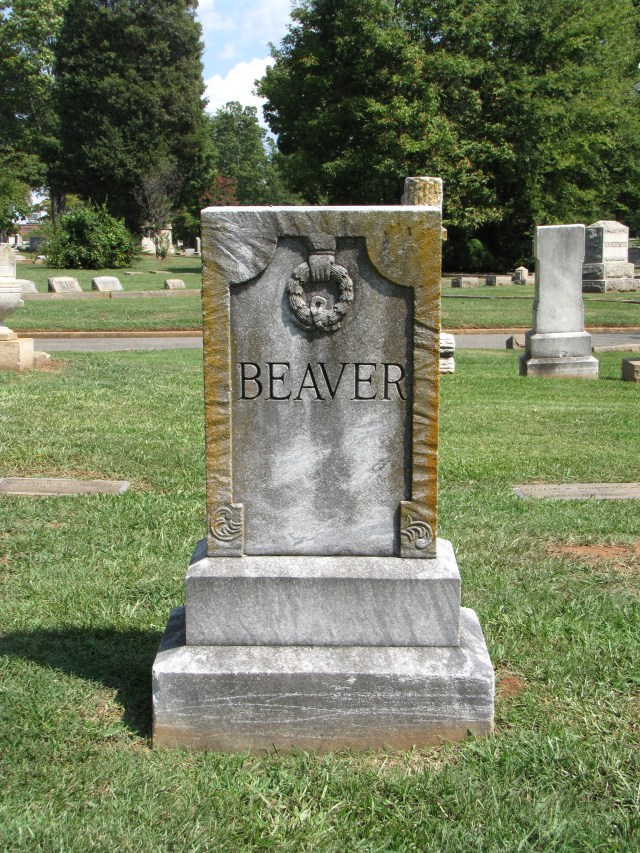
Various gravestones in the Elmwood Cemetery at Charlotte, North Carolina, display a wreath. The wreath on the William E. Beaver (May 7, 1871 – January 29, 1949) and Nancy J. Joyner Beaver (February 19, 1871 – June 25, 1939) family marker shows a hand coming down holding a wreath made of laurel. The laurel wreath dates back to Roman times when soldiers wore them as triumphal signs of glory.  The laurel was also believed to wash away the soldier’s guilt from injuring or killing any of his opponents.  In funerary art the laurel wreath is often seen as a symbol of victory over death.

IMG_4671

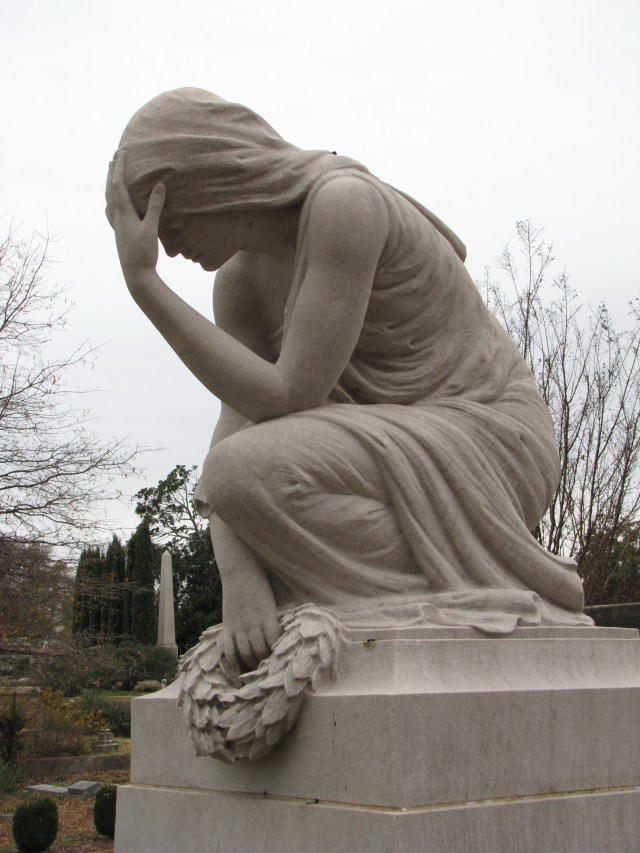
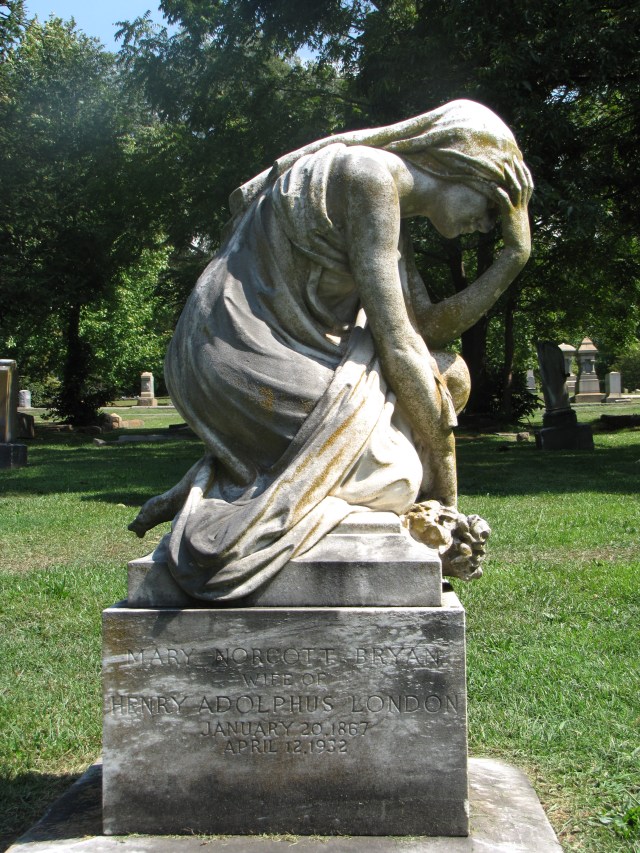
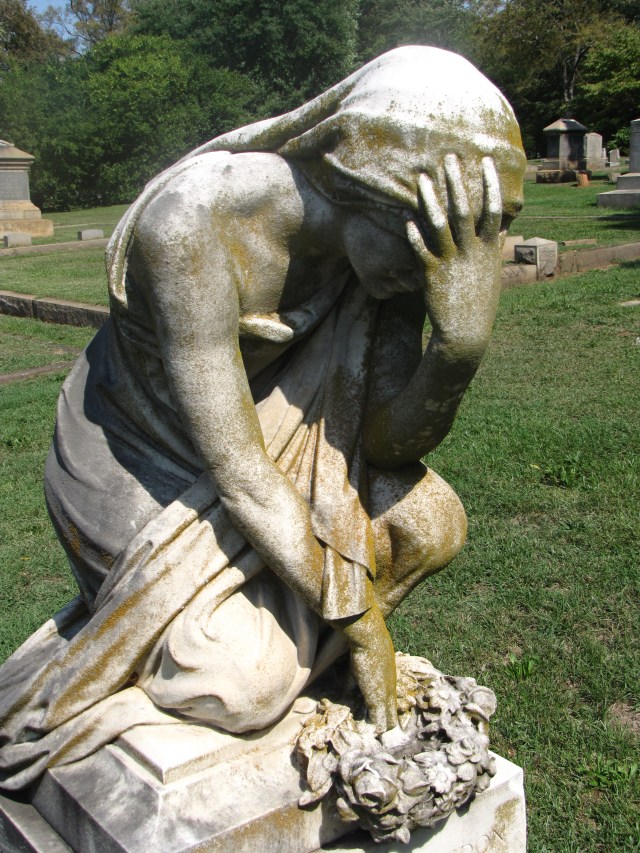
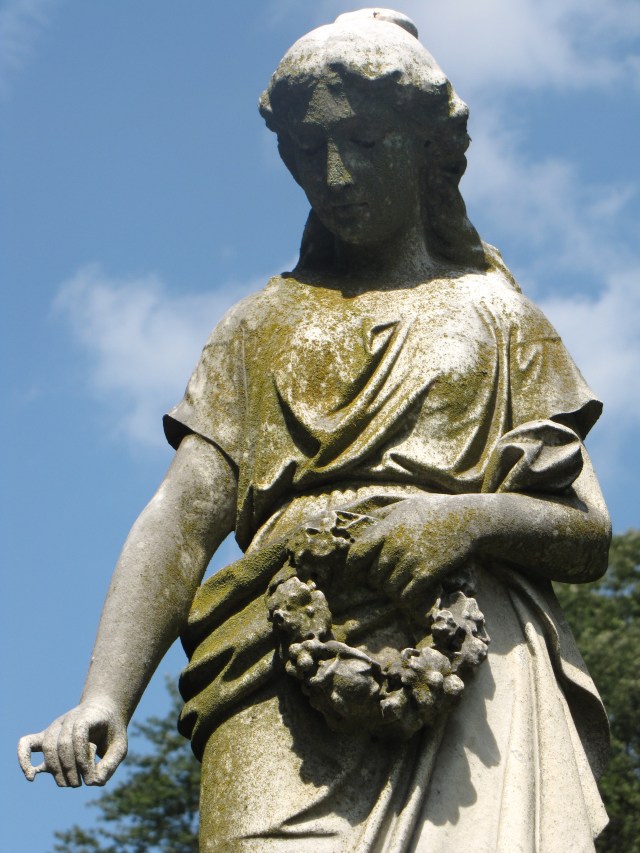
The second example of the wreath is found on the gravestone of Mary Norcott Bryan, the wife of Henry Adolphus London (January 20, 1867 – April 12, 1932). The monument is of a mourning figure with her head in her hand and a wreath in the other.

IMG_4756

The description of this very same sculpture in the Oakland Cemetery at Atlanta, Georgia, is that the mourning figure represents Niobe, the Greek mythological Queen of Thebes. Niobe had fourteen children (the Niobids) and taunted Leto, who only had two children, Apollo and Artemis. In his rage he sent his two children to avenge the slight done to him by Niobe striking out at what was most dear to her. Niobe, became the symbol of mourning when Apollo slaughtered her seven sons and Artemis killed her seven daughters. As one version of the story goes, upon seeing his dead fourteen children, Amphion, the King of Thebes, committed suicide. Niobe was so stricken with grief that she fled to Mount Siplyus, Manisa, Turkey, where she turned to stone. Her grief was so powerful that tears flowed ceaselessly from her forming the River Acheloos.

IMG_4764

IMG_4800

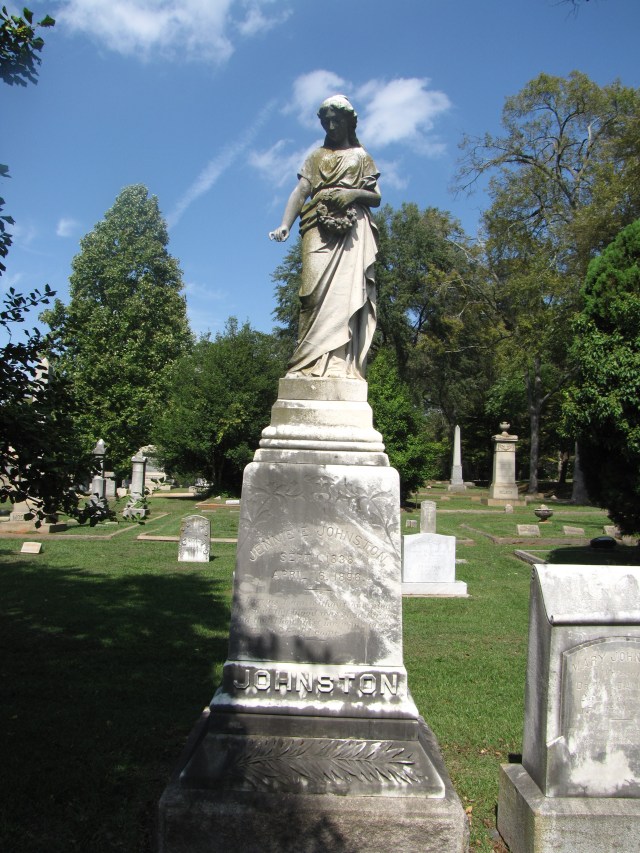
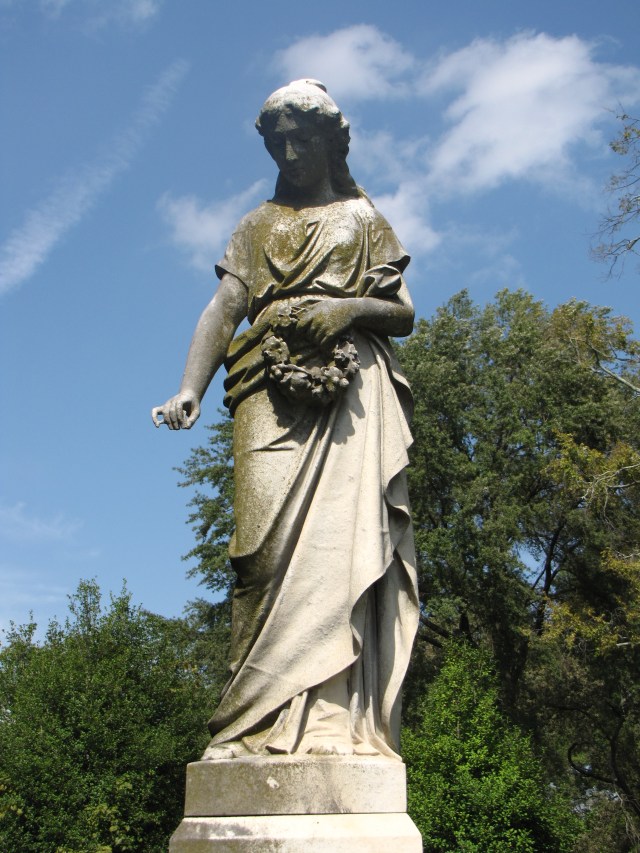
A third example of the wreath is found on the gravestone of Jennie E. Johnston (September 1, 1838 – April 16, 1896). The young female figure atop Johnston’s gravestone, depicts a young woman with her head looking down in reflection and sorrow, while holding a flower in one hand (the stem is still there but the bloom is missing) and clutching a floral wreath with the other.

IMG_4802

This is a common Victorian funerary motif. The Victorian Era lasted from about 1832 until Queen Victoria’s death in 1903.  The era was an eclectic period in the decorative arts with several styles—Gothic, Tudor, Neoclassical—vying for dominance.  The period was marked by ornamentation.  This was true in architecture, furniture, and funerary arts.  In cemeteries gravestones became taller, ornamented, and sentimental. This mourning figure here is expressing the transitory nature of life.

IMG_4803

Posted in Symbolism | Leave a comment

Monument to Heroism

Elmwood Cemetery at Charlotte, North Carolina

Elmwood Cemetery at Charlotte, North Carolina


ERECTED

OCTOBER 10, 1883

BY THE VOLUNTEER

FIREMEN OF CHARLOTTE

AS A LASTING TRIBUTE

TO THEIR DEAR COMRADES

FIRE DEPARTMENT

ORGANIZED

MAY 20, 1875

INDEPENDENT

HOOK AND LADDER CO.

ORGANIZED

AUGUST 4, 1868

PIONEER

FIRE COMPANY

ORGANIZED

MAY 20, 1871

HORNET

FIRE COMPANY

ORGANIZED

JANY. 29, 1862

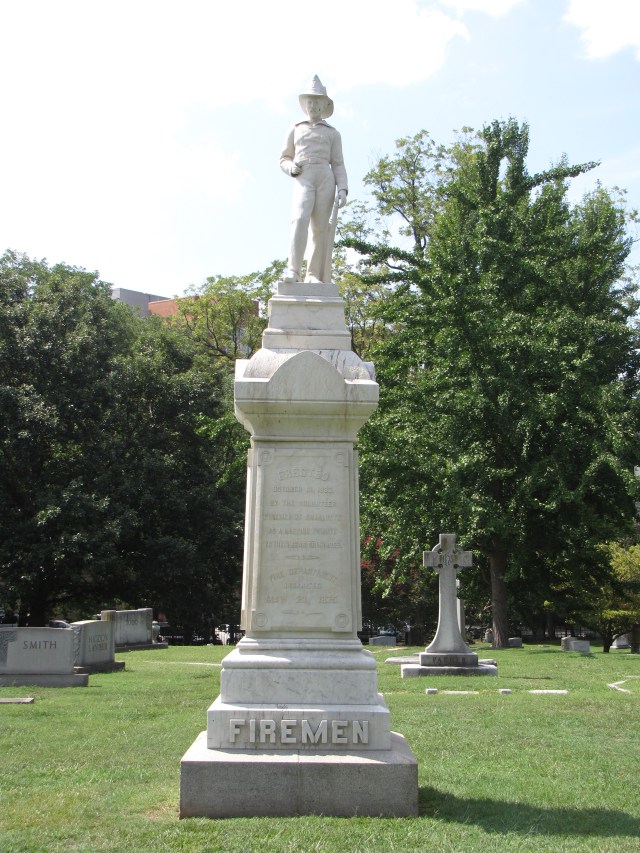
Firefighting Companies were vital to all communities which could be swept away by fire.  Entire communities could be lost to flame, so volunteer and professional firefighters were vital to save lives and citizens’ homes and businesses.  Firefighters had to be ready at a moment’s notice to fly into action and risk life and limb to battle an inferno.

IMG_4626

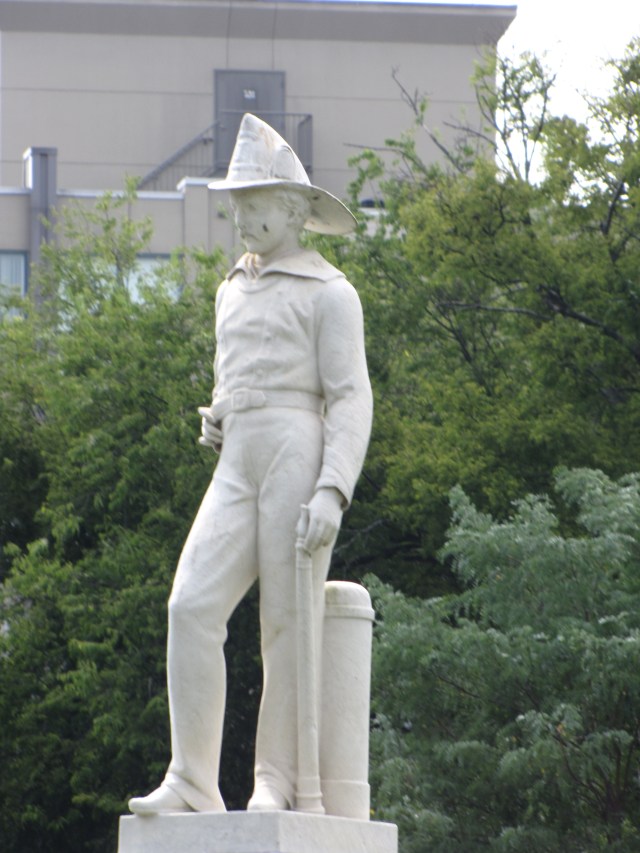
Fire companies formed in communities all across the country. And, in many cemeteries in those villages, towns, and cities monuments have been dedicated to their fallen and valiant firefighters. The monument in Charlotte, North Carolina, is dedicated to four fire companies—Charlotte, Pioneer, Hornet, and the Independent. The monument was erected in the Elmwood Cemetery on October 10, 1883. The fireman strikes a heroic pose and looks like he is ready to swagger, holds the nozzle of a hose in one hand, behind him a large fire extinguisher.  The white marble statue wears the traditional uniform and wide brimmed hat of a nineteenth-century firefighter standing atop a multi-tiered plinth.

IMG_4618

Posted in Symbolism | Leave a comment

Woodsmen

IMG_4645

As the story goes, while listening to a Sunday sermon at the First Congregational Church in Lyons (now Clinton), Iowa, given by Pastor Sydney Crawford, Joseph Cullen Root heard the pastor tell a parable about the good that came from woodmen clearing away the forest to build homes, communities, and security for their families.

Cullen was a strong believer and joiner in fraternal organizations, himself belonging to the Free Masons, the Knights Templar, the Independent Order of the Odd Fellows, and the Knights of Pythias. But he felt compelled after hearing the stirring sermon to create a fraternal organization with a mission to make sure families that lost their breadwinner would have some monetary payout that would help them stay on their feet.

Cullen, a serial organizer, and in keeping with the heart and message of Crawford’s sermon founded the Woodmen of the World. In keeping with the woodmen theme, Cullen adopted symbols of the woodsmen and their stock and trade – the axe, beetle and wedge – symbolizing industry, power and progress.

Root died in 1913 and by the time he died the Woodmen of the World Organization had nearly 700,000 members. The insurance in force in that year alone amounted to nearly a billion dollars. And according to some accounts, some 45,000 Woodmen monuments in all shapes and sizes can be seen marking the graves of members in every part of the United States.

The monuments, many of them carved to look like tree-stumps, fit in perfectly with the rustic movement. The rustic movement of the mid-nineteenth century was characterized by designs that were made to look like they were from the country. Elegant and slim curved lines in furniture gave way to bulkier and heavier forms made from pieces that came directly from the trees often with the bark still intact. Homes, cabins, and garden houses were designed in the rustic style eschewing classic designs. In decorative furniture this often took the form of chairs made from rough tree limbs curved to form arms and chair backs, chair legs made from tree roots growing upwards. But, the Genesis of the look was undoubtedly from the parable about the “woodsmen clearing away the forest to build homes, communities, and security for their families.”

Many of the monuments, all from the Elmwood Cemetery at Charlotte, North Carolina, don’t follow the rustic look—some do:
IMG_4608

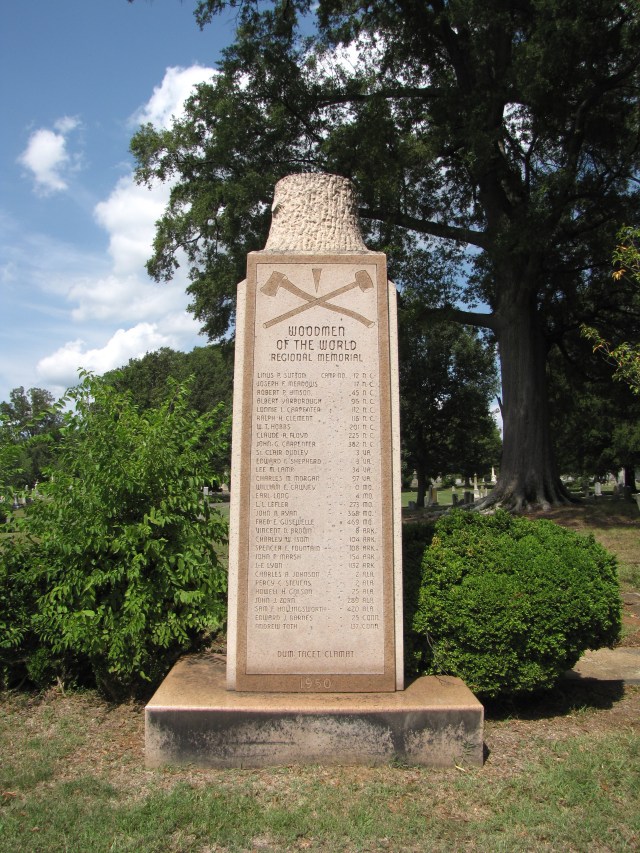
This towering rose-colored granite monument to Woodmen of the World members buried in the Elmwood Cemetery at Charlotte, North Carolina, commemorates their names and the “camp” to which they belonged. Members were from North Carolina, Virginia, Missouri, Arkansas, Alabama, and Connecticut. The top of the monument has the axe, wedge, and beetle—the familiar symbols of the organization. The tree stump tops the monument.
IMG_4628

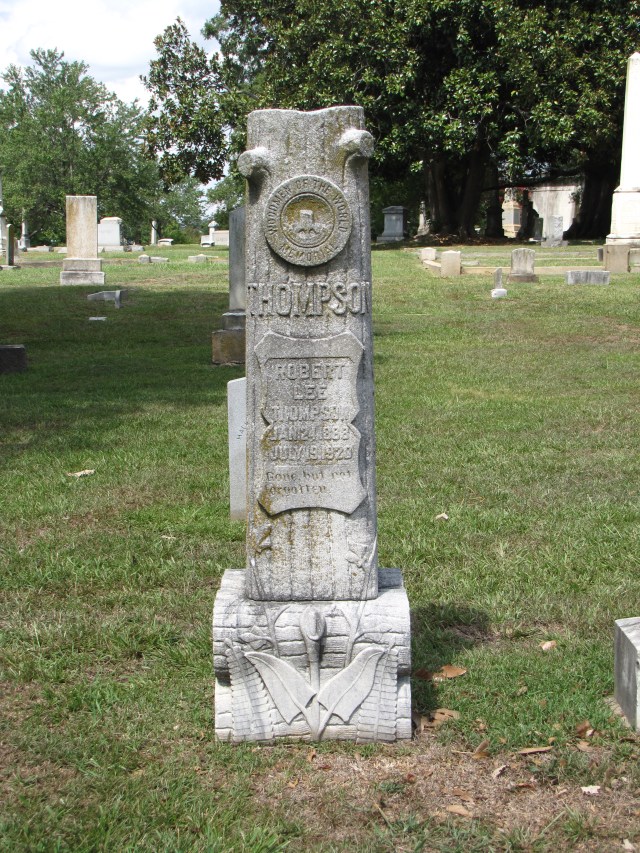
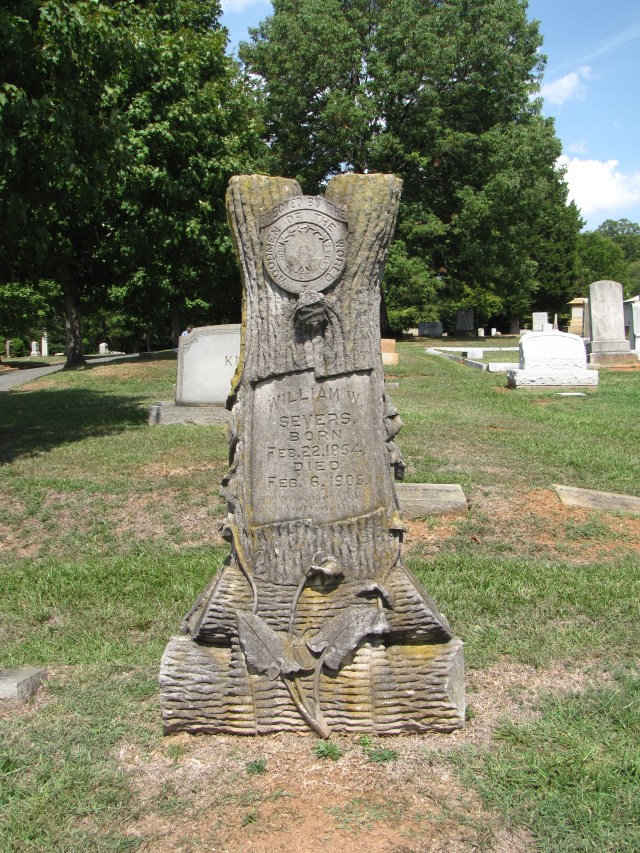
The Robert Lee Thompson (Jan. 24, 1868 – July 19, 1920) monument above and the William W. Severs (Feb. 22, 1854 – Feb. 6, 1905) monument below are clearly carved to resemble a tree stump. The cartouche on the face of the Thompson marker lists the name, birth and death dates of the deceased and the Severs monument replicates that but the marker in this case is made to look as if part of the bark from the tree has been removed, which is where the inscription is carved. In both cases the Woodmen of the World medallion is above the name. In both cases the medallion depicts a tree stump. And in both cases the bases of the markers have a calla lily carved into them. The calla lily represents majestic beauty and is often used on funerary art to symbolize marriage.  In some cases, they can also represent the resurrection.
IMG_4636

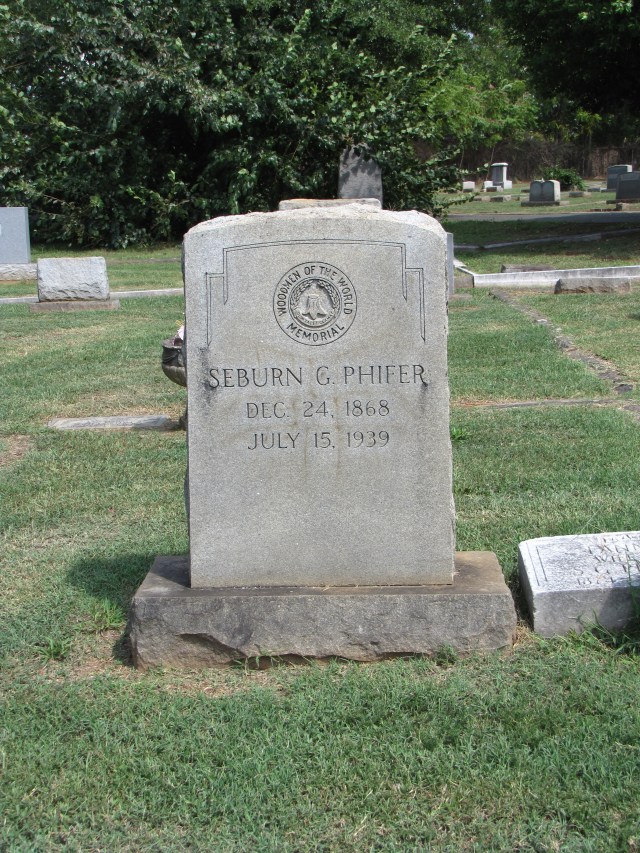
The Seburn G. Phifer (Dec. 24, 1868 – July 15, 1939) monument below is a plain gray granite block. Again, just above Phifer’s name is the Woodmen of the World medallion with the motto clearly carved in a ribbon below the tree stump is the Latin phrase DUM TACET CLAMAT which means “though silent, he speaks.”
IMG_4711

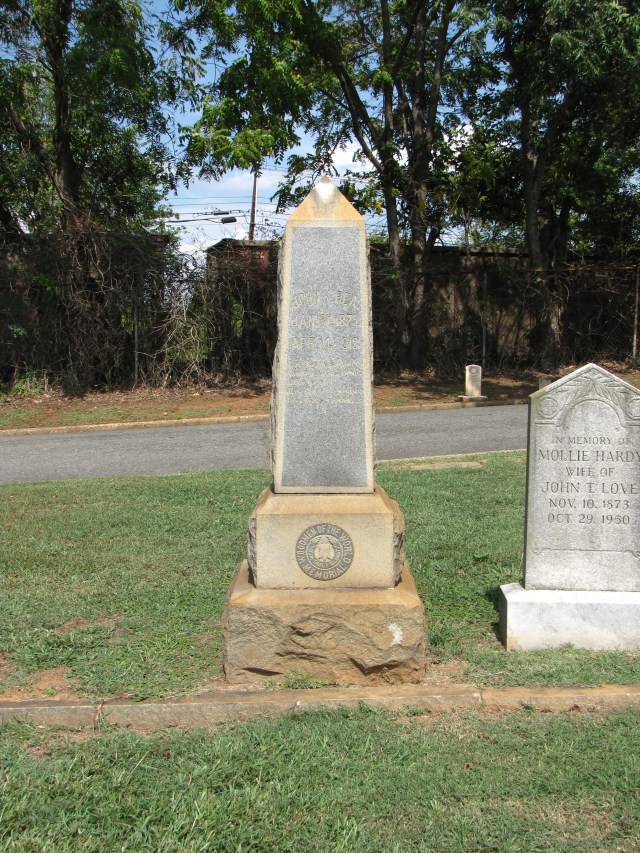
The John K. Rea (Jan 31, 1875 – Apr. 14, 1913) monument is an obelisk with the Woodmen of the World medallion on the base of the marker.
IMG_4722

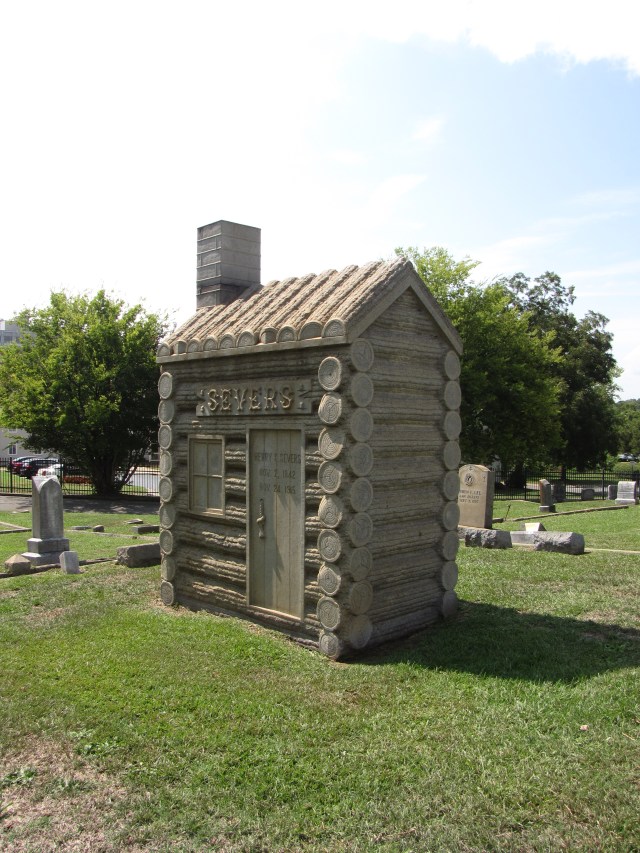
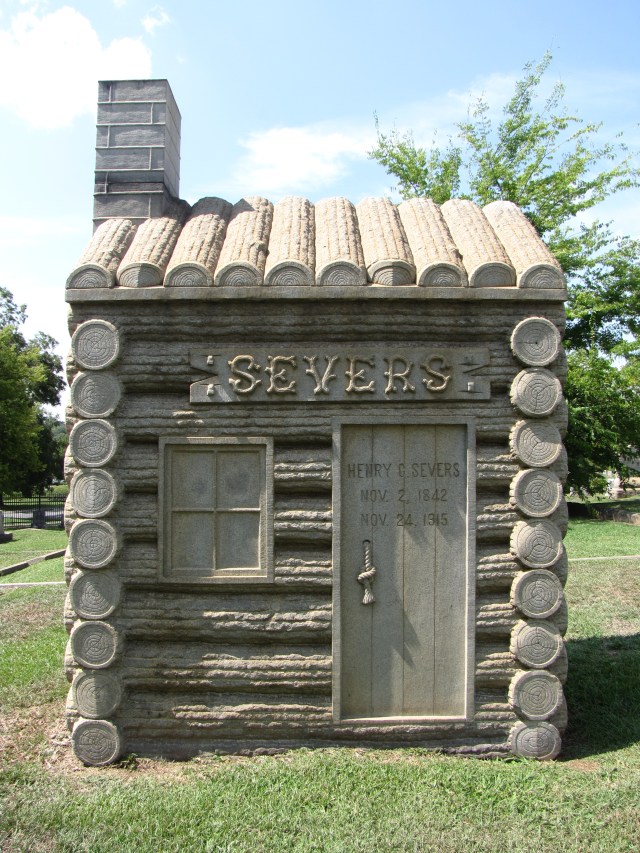
The HENRY C. SEVERS Monument (Nov. 2, 1842 – Nov. 24, 1915) in the Elmwood Cemetery at Charlotte, North Carolina, is one of the largest and most elaborate Woodmen of the World monuments built. It is free-standing and carved to look like a log cabin reminiscent of those woodsmen clearing away the forest to build homes.
IMG_4643

Posted in Symbolism, Treestump gravestones | 1 Comment

Mother and Infant

Old Settler's Cemetery, Charlotte, North Carolina

Old Settler’s Cemetery, Charlotte, North Carolina

HARRIET JOSEPHINE

DAUGHTER OF JAMES & M.A. ABLAKE

WIFE OF J.S.M. DAVIDSON

BORN DECEMBER 19TH 1836 MARRIED

OCT. 23RD 1856 & DIED OCT. 22ND 1861

YEA THOUGH I WALK THROUGH THE VALLEY OF THE SHADOW

OF DEATH I FEAR NO EVIL FOR THOU ART WITH ME

CLARA BLAKE

INFANT DAUGHTER OF

J.SM. & JOSEPHONE DAVIDSON

AGED 3 MONTHS

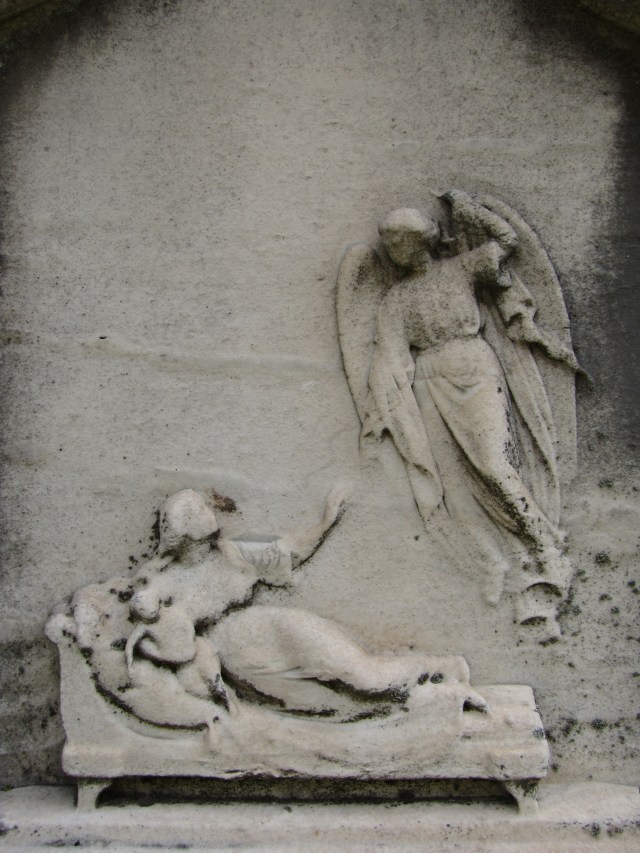
In the Old Settlers Cemetery at Charlotte, North Carolina, stands a white marble gravestone. The ornamented monument is topped with a plain finial. On the face of the stone is a scene of an angel hovering above a fainting couch with a reclining woman figure cuddling a baby. Though the soft stone has eroded the symbolism is clear; the angel is clearly reaching downward to grasp the woman’s hand to take her soul and that of her infant’s to Heaven.

The gravestone does not give a hint as to the birth and death date of the infant, Clara, but it may have been very close to the death of her mother, Harriet Josephine, if the stone tableau is a recreation of the inscription.

IMG_4911

Posted in Angels | Leave a comment

The Stone

Rock Creek Cemetery, Washington, D.C.

Rock Creek Cemetery, Washington, D.C.

THE TWELVE GATES WERE TWELVE PEARLS, REV. 21:21

“TO-DAY SHALT THOU BE WITH ME IN PARADISE.” LUKE 23:43

FRANK HAMILTON, 1853 – 1947, RESTING

CARRIE HAMILTON, 1852 – 1908, RESTING

ELBERTINE R. HAMILTON, 1862 – 1958, DEVOTED DISCIPLE

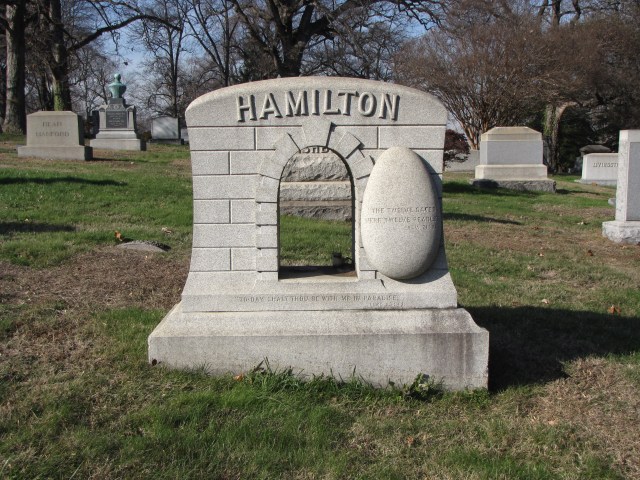
Two monuments, one in the Rock Creek Cemetery at Washington D.C. and the other in Cave Hill Cemetery at Louisville, Kentucky, depict an opening or gateway with a rock rolled away from the opening.

The Hamilton Tomb has two Bible verses carved into the face of it that indicate that the opening of that monument is meant to portray Jesus’ entry into Heaven, “To-day shalt thou be with me in paradise.” Here Jesus leaves the Earthly realm to the Heavenly realm—this is the Resurrection of Christ. The second Bible verse, Revelation 21:21, goes on to describe the destination, “And the twelve gates were twelve pearls; every several gate was one pearl; and the street of the city was pure gold, as it were transparent glass”.

The second monument that of Zachariah Madison Sherley, a prominent riverboat fleet owner and pilot and his wife Susan Wallace Cromwell Sherley, depicts a rough-hewn rock next to an entryway also. This one, too, depicts the Resurrection of Jesus. Many places in the Bible describe the Holy event, as does John 20:1 – 2, “The first day of the week cometh Mary Magdalene early, when it was yet dark, unto the sepulcher, and seeth the stone taken away from the sepulcher. 2. Then she runneth and cometh Simon Peter, and to the other disciple, whom Jesus loved, and saith unto them. They have taken away the Lord out of the sepulcher, and we know not where they have laid him.”

SHERLEY

Z. M. SHERLEY, 1811 – 1879

SUSAN W. CROMWELL, HIS WIFE, 1831 – 1928

Cave Hill Cemetery, Louisville, Kentucky

Cave Hill Cemetery, Louisville, Kentucky

Posted in Symbolism | Leave a comment