Souls Take Flight

img_4233

MORRISON

BORN

APL. 9, 1850

DIED

MARCH 6, 1859

THOMAS BORN

JAN. 11, 1855

DIED

FEB. 15, 1859

MARY

BORN

SEP. 16, 1856

DIED

FEB. 13, 1859

STANLEY

BORN

MAY 17, 1853

DIED

FEB. 12, 1859

STANLEY & MARY A. MATTHEWS


STANLEY MATTHEWS

DIED

MARCH 22. 1889

AGED 65 YEARS

— —

MARY A. MATTHEWS

WIFE OF

STANLEY MATTHEWS

DIED JAN. 22. 1885

AGED 62 YEARS

Stanley Matthews was a prominent Ohio native. Matthews was got his start at Kenyon College graduating at the young age of 16—he passed the bar at 18 and started his law practice in the Queen City—Cincinnati. From there he worked as a newspaper editor, judge, Ohio state senator. Matthews got a big break when President James Buchanan appointed him as the United States District Attorney for Southern Ohio. When the Civil War started he resigned his post as District Attorney to join the Union Army as a lieutenant colonel in the Twenty-third Ohio Infantry. In that same unit served two future presidents—Rutherford B. Hayes and William McKinley. Matthews was later promoted to Colonel. He began a political a national political career when Matthews ran for a United States Senate seat and won. In 1881, Matthews was nominated by President Hayes to an associate justice seat on the United States Supreme Court. His nomination was considered controversial and the Senate took no action on the nomination. After James Garfield became president, Garfield re-nominated Matthews. Matthews was confirmed by a single vote. He served as an associate justice until his death in 1889.

img_4232

In spite of Matthews’ soaring political career that peaked in the highest court in the land, his white-marble monument does not extoll any of his political accomplishments. The focus of the symbolism on his monument is about four of his eight children. In 1859, Stanley and Mary Matthews suffered a great tragedy. Within two weeks in February and March 4 of their children died: Stanley, a little over 5 years old, died February 12, 1859; Mary, just over 3 and a half years old, died, February 13, 1859; Thomas, just over 4 years old, died February 15, 1859; and Morrison, nearly 9 years old died MARCH 6, 1859.

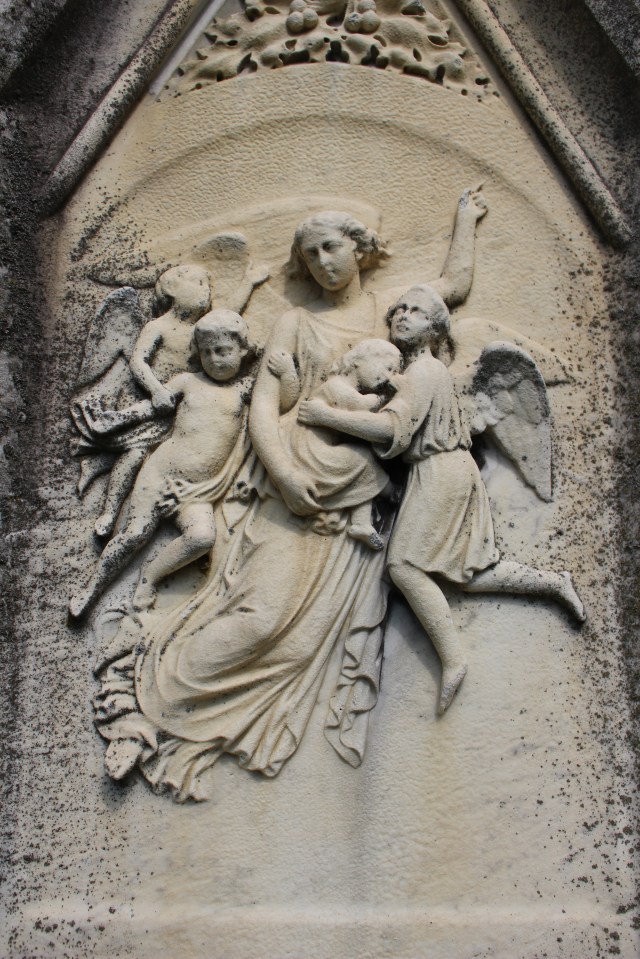
On the face of the gravestone is a bas-relief of a winged angel with one arm raised and pointing to the Heaven and one arm cuddling a small child. Three angels fly toward Heaven. The symbolism is clear—the angel is taking flight with the souls of the Matthews’ children giving them her protective care.
img_4235

Posted in Angels, Symbolism | Leave a comment

Good over Evil

img_1770

BRONGE

PETER G. BONI

1914 – 2000

DANIEL BONI

1891 – 1955

BABY PHYLLIS

1952

PHYLLIS BONI

1898 – 1936

MARIA FRANCESCA BRONGE

1868 – 1925

CARL BRONGE

1863 – 1952

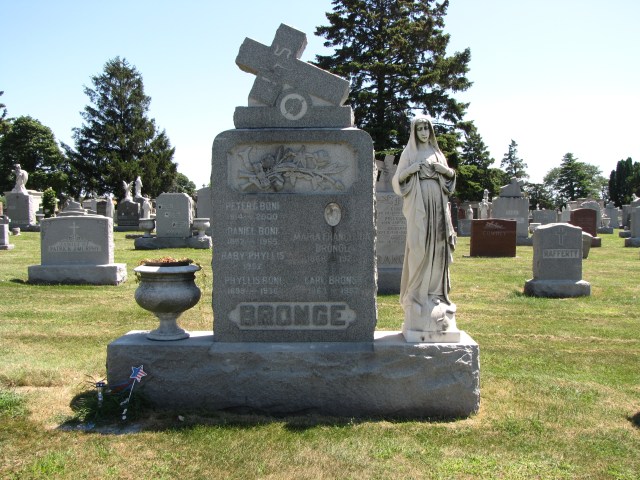
The Bronge Family monument in the Mount Carmel Cemetery at Hillsdale, Illinois, just outside of Chicago, is a gray granite block of polished granite sitting on a large horizontal base. The top of the block features a Latin cross on its side. Many works of art depict Christ carrying the cross, and this gravestone represents His suffering as He carried it. The cross on its side pays tribute to Christ carrying the cross without actually showing Christ in the depiction.

On one side of the block is a white marble planter. On the other side of the block is a white marble statue of the Virgin Mary imbued with symbolism. She points to her heart. This is a representation of the Immaculate Heart of Mary.

In Luke’s Gospel, Chapter 2, verse 19, it says, “But Mary kept all these things, and pondered them in her heart.” In devotion to the Heart of Mary, the faithful are to study and imitate the Heart of Mary as a place of love and devotion to Jesus and to God’s love.

img_1771

In addition to the symbolism of the Immaculate Heart of Mary, is the image and symbolism of Mary standing on a snake. In Genesis 3:15 God speaks to the serpent after the fall of Adam and Eve into sin, “I will put enmity between you and the woman, between your seed and her seed; He shall crush your head and you shall lie in wait for his heel.” In the Latin translation the passage read “she shall crush your head.”

The passage comes to be seen as a prophecy of the coming of the Messiah, Jesus Christ. Christ is the “seed of the woman.” Mother Mary is free from sin, both original and actual, and as such is viewed as the new Eve, the only woman who has a perfect enmity with the devil. It is the ultimate symbol of Mary’s victory over evil. In a larger sense it is viewed as the triumph of good over evil.

img_1773

Posted in Symbolism | 1 Comment

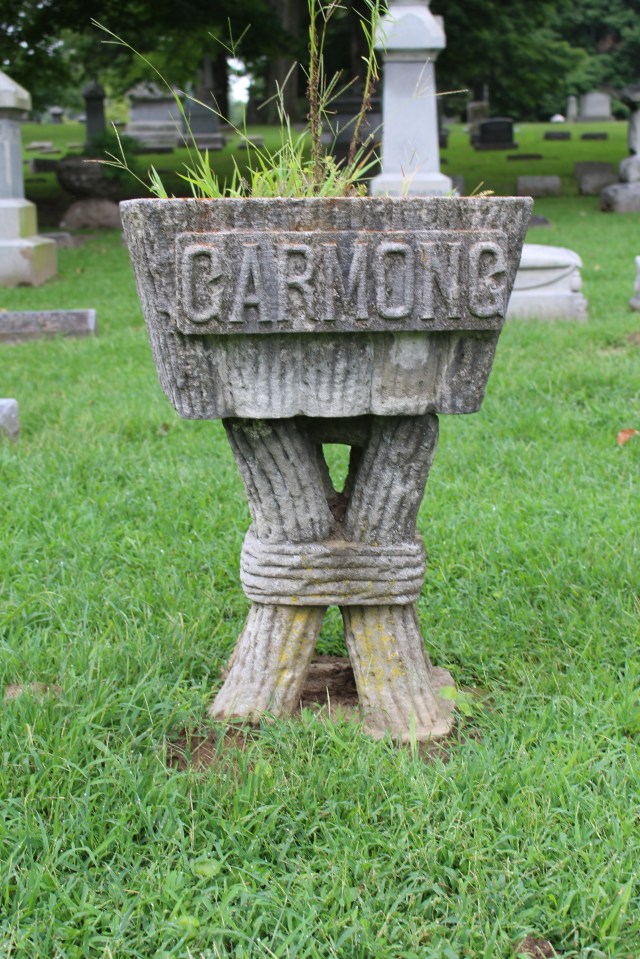
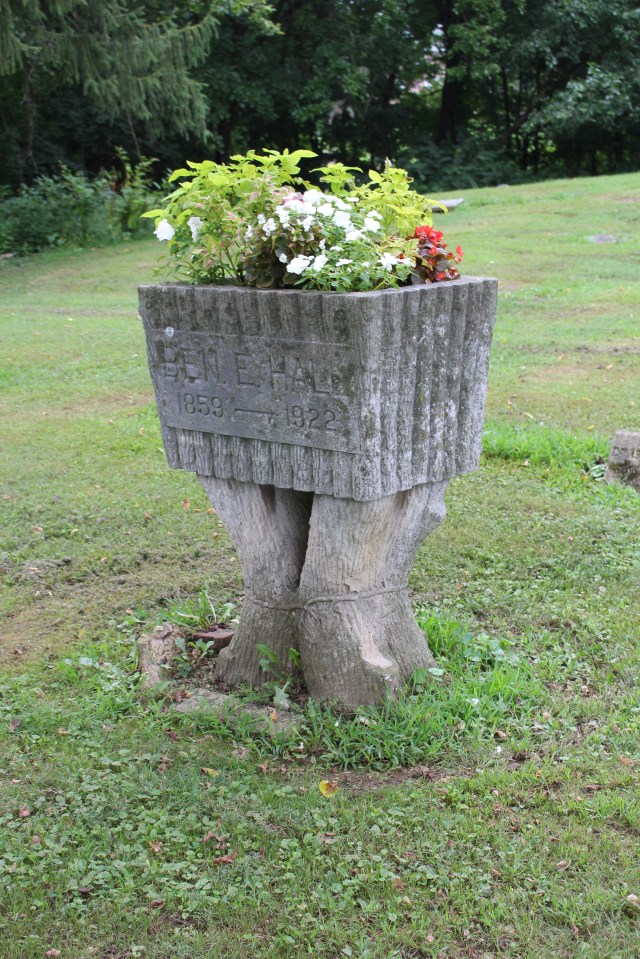
Tree-stump Planters

img_2283

The rustic movement of the mid-nineteenth century was characterized by designs that were made to look like they were from the country—crafted from tree branches often with the bark still intact. Elegant and slim curved lines gave way to bulkier and heavier forms made to look like they came directly from the trees.

img_2287

In decorative furniture this often took the form of chairs made from rough tree limbs curved to form arms and chair backs, chair legs made from tree roots growing upwards. This kind of design was mimicked in cemetery pieces, such as, benches.   Gravestones were designed to look like tree stumps with branches sawed off.

img_2330

That rustic design can also be seen in planters that were designed to decorate family plots. The planters are designed to look like pieces of wood, bark still on, formed to make planters. The designs pictured in this blogpost can all be found in the Highland Cemetery at Terre Haute, Indiana.

img_2257

Posted in Treestump gravestones | 1 Comment

“Sky Girl”

img_2393

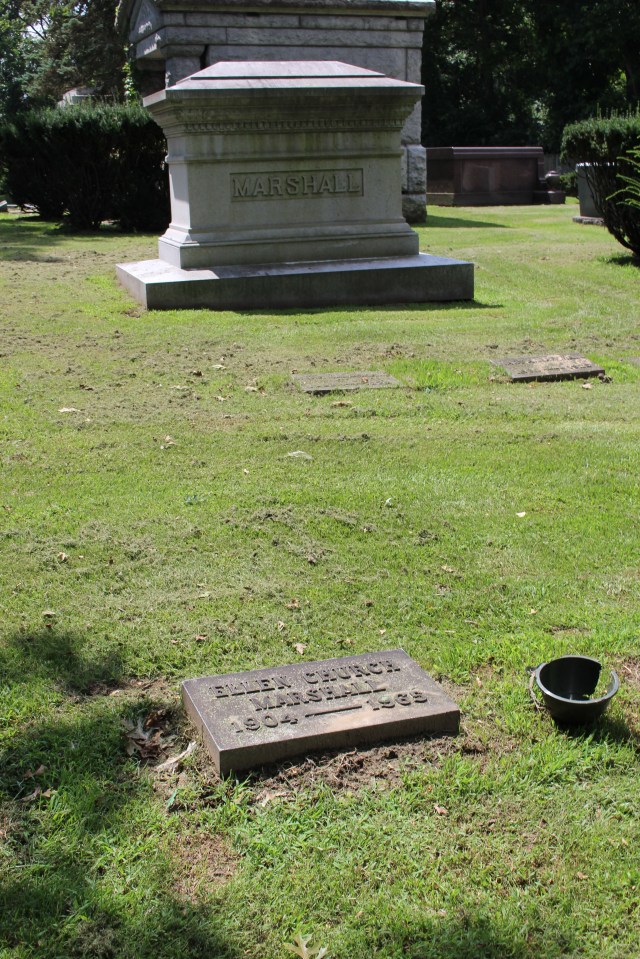
There are all sorts of pioneers in this world—those who have gone before and been the “first” to do something. One such person was Ellen Church, a young woman from the little town of Cresco, Iowa. Ellen graduated from high school and went west to California to, as the cliché goes, seek her fame and fortune. She became a nurse and, at a time when it was extremely rare, also became a pilot.

Ellen wanted to fly for a commercial airline and applied at Boeing Air Transport in San Francisco. Though she was not hired as a pilot, she was hired on as the first American air hostess on May 15, 1930. It was not her skill and knowledge as a pilot that landed her the job—it was the nursing. In the early days of commercial flight, passengers were scared and uncertain about air travel—and often suffering from air sickness. Boeing Air Transport specifically wanted young women (25 and younger) who could calm the fears of the passengers and offer aid and comfort.

In addition to having nursing skills, these young women had to meet physical requirements, as well. The first “sky girls” as they were first referred to, were to be no taller than 5’ 4” and weigh no more than 115 pounds. In spite of this diminutive size, the stewardesses had to tote luggage, fuel airplanes, and, if need be, assist pushing the airplanes into the hangars. Ellen only worked as an air hostess for a little less than a year and a half when a car accident sidelined her—but by then she had already made history.

Church went on to serve in World War II. She served in North Africa and Italy evacuating wounded soldiers. She also helped train nurses who were at the ready to aid wounded servicemen during the D-Day invasion. Church served with distinction being awarded an Air Medal, the European-African-Middle Eastern Campaign Medal with seven bronze service stars, the American Theatre Campaign Medal, and the Victory Medal as a captain in the Army Nurses Corps

Later she moved to Terre Haute where she met and married Leonard Briggs Marshall. She died in 1965 and is buried in the Highland Cemetery at Terre Haute, Indiana.

img_2391

Posted in Famous graves, Uncategorized | Leave a comment

Portraits in Zinc

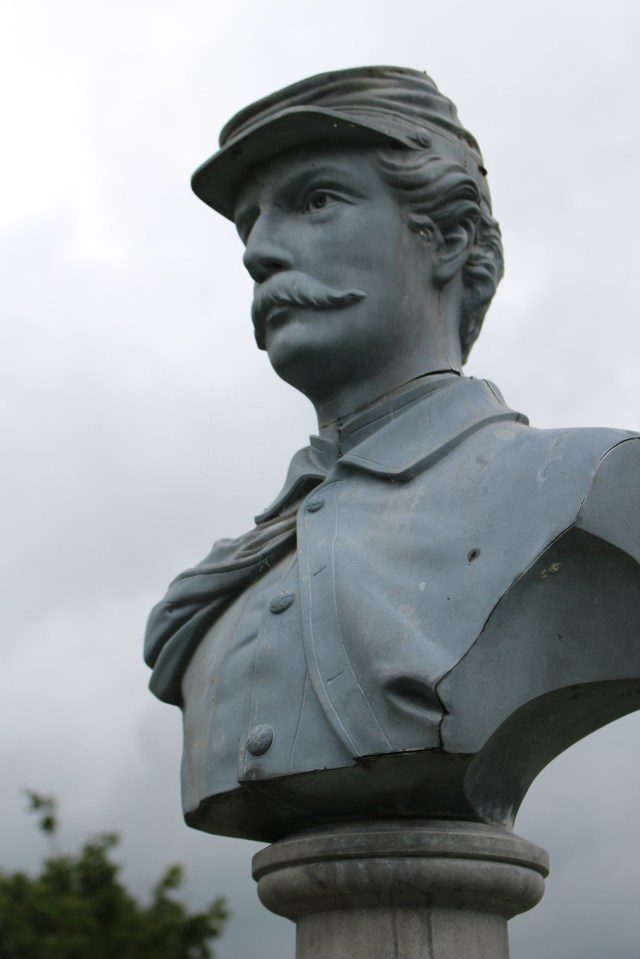
The Monumental Bronze Company of Bridgeport, Connecticut, produced cast zinc cemetery markers billed as “white bronze”.  The company set up their first subsidiary in Detroit, Michigan. Others followed in Philadelphia, New Orleans, St. Thomas, Ontario, Des Moines, and Chicago. The Chicago subsidiary was named the American Bronze Company. Enterprising salesmen carried a catalog door-to-door with them to show customers the many styles and price ranges of their product line. In many cemeteries you can find evidence of highly successful salesmen who sold a large number of the markers. The zinc markers were produced beginning in the 1870s until the company closed shop in 1912.

The markers are distinguishable by their bluish-gray tint. These grave markers came in a wide assortment of sizes and shapes and were somewhat like grave marker erector sets. The more elaborate markers had a shell of sorts and then various panels could be attached according to the tastes of the family ordering the grave marker. In this way, each marker could be “customized” to the tastes of the individual.

They were customized in other ways, as well. For instance, a customer could order a portrait cast in zinc for the monument—the ultimate personalization. These portraits came in several different forms—a bust, a full statue, or a bas-relief.  The examples below show the range of possibilities that existed and that customers ordered.

img_3914

This zinc marker is a bust found in the Pine Lake Cemetery at La Porte, Indiana, erected for Henry J. Martin, M.D. who died March 7, 1886. Henry Martin was 36 years 4 months, and 4 days old. He had served in Company D of the 17th Indiana Infantry. Even though the Civil War was long over when he died, his family chose to commemorate his marker with a bust of him displayed in his Union uniform.

img_3916

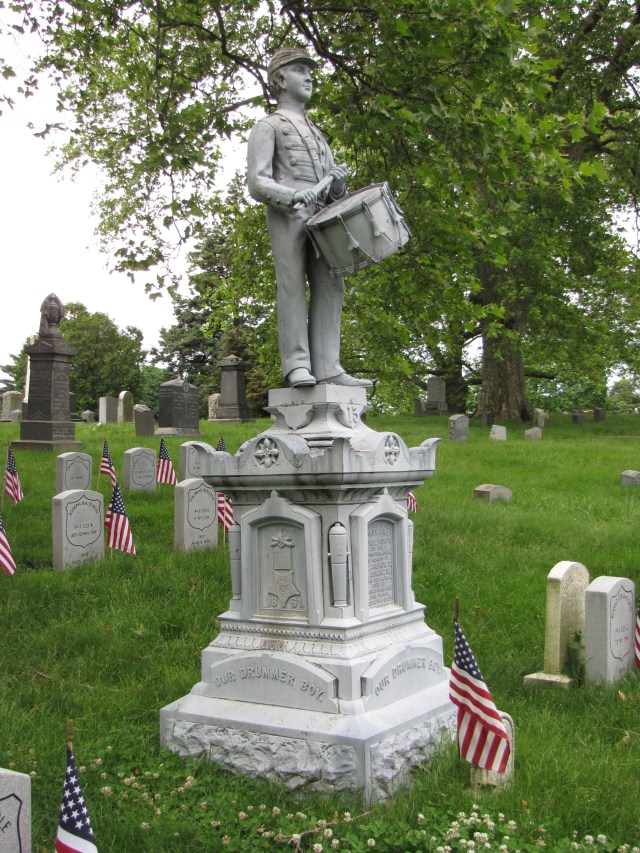
The Monumental Bronze Company of Bridgeport, Connecticut, produced “white bronze” cemetery markers and monuments in a wide assortment of sizes and shapes including statues like the one produced for and in the likeness of 12-year old Clarence Mackenzie found at the Green-Wood Cemetery at Brooklyn, New York.

img_4519

The panels tell part of his story.  The drummer boy was shot in his tent by an errant bullet from soldiers practice shooting close by.  Clarence never saw the battlefield and yet was the first casualty of the Civil War from King’s County.

img_4533

Erected by the Drum and Bugle Corps of the

13th REGT. N.G., S.N.Y.,

In Memory of

CLARENCE D. MACKENZIE,

Born Feb. 8, 1849,

Died at Annapolis, MD., June 11, 1861,

Aged 12 YRS 4 MOS 3 DYS

This Young Life Was the First Offering

From King’s County in the War of the Rebellion

OUR DRUMMER BOY

img_1744
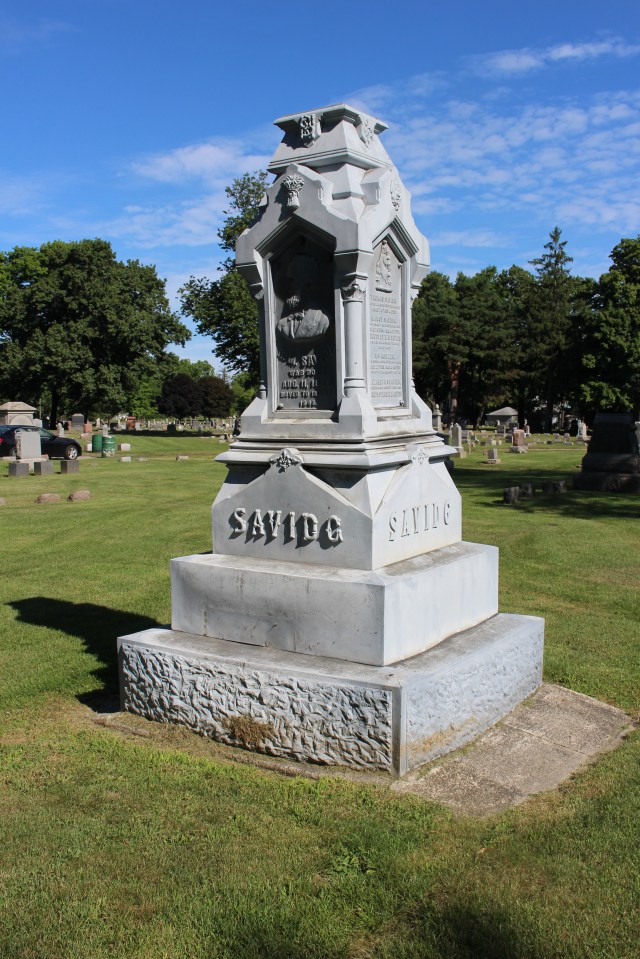
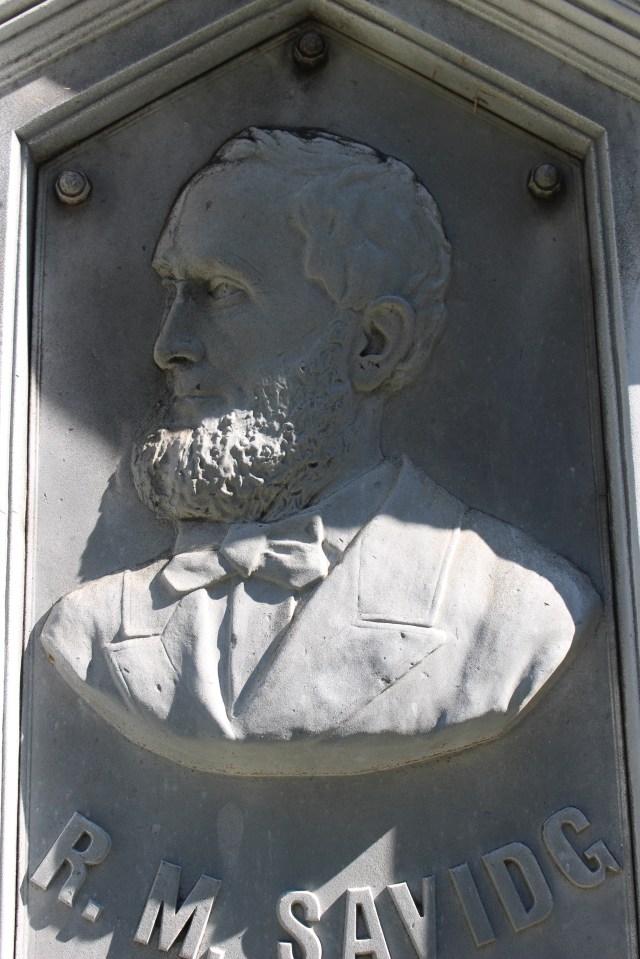
In the South Bend, Indiana, City Cemetery, the grave marker of Mrs. M. A. Savidg, displays a bas-relief of her on one side of the monument.  The other side of the monument displays her husband, also in bas-relief.

img_1741

MRS. M. A. SAVIDG

BORN 1830,

MOVED TO INDIANA 1836

MARRIED

R. M. SAVIDG,

1851.

img_1743

R. M. SAVIDG

WAS BORN 1830,

AUG. 11, 1826,

MOVED TO INDIANA

1840.

Posted in Zinc Markers | Leave a comment

Three tiny angels

img_3199

The largest Catholic Cemetery of the Archdiocese of Chicago is the Saint Adalbert Cemetery located in Niles, one of the northern suburbs. Saint Adalbert’s was established in 1872 to serve the large population of Polish Catholics. Saint Adalbert, the first Polish saint, was known as the “Apostle of the Slavs” and also the “Apostle of Bohemia”.

One of the most poignant gravestones in the cemetery is one dedicated to three children—Edouard, Albyna, and Alojs. There is no last names or dates of birth and death on the monument but the gravestone depicts three angels of the same age, each holding a rose and wreath. These three babies are all uniformly lined up and may have been triplets.

In funerary art the laurel wreath is often seen as a symbol of victory over death.  The rose also has a religious meaning, differing by color.  The white rose symbolizes purity while the red rose represents martyrdom and the messianic hope that Christ will return.

img_3201

Posted in Children's Graves, Symbolism | Leave a comment

Terre Haute, Egyptian Style

After the French and British occupations of Egypt, there was a renewed interest in Egyptian architecture and symbolism in America. The evidence of the influence of Egyptian design can be found in nearly every American cemetery, especially large urban cemeteries. The Highland Cemetery in Terre Haute, Indiana, the second largest cemetery in the state, has many examples that come in many different forms.

 img_2670

Pyramid

The pyramid is by far the epitome of Egyptian funerary architecture, the tomb of the pharaohs, and the quintessential example of great Egyptian architecture.  The oldest pyramid is the Pyramid of Djoser built over four thousand years ago from 2630 BC to 2612 BC.  The largest of the Egyptian pyramids is the Pyramid of Khufu at Giza built between 2589 and 2566 BC. This gray granite monument shaped as a pyramid is near the entrance to the Highland Cemetery. The monument gives one the sense of solemnity and a sense of eternity, reminiscent of the temples of the pharaohs.

img_2268

img_2307

Egyptian-influenced designed mausoleum

Funerary art and architecture was designed to illicit emotions, such as the finality of death and the Christian ideal of eternity. The Farmer and the Fuller mausoleums are examples of the Egyptian Revival architecture found in the Highland Cemetery.  Both mausoleums have many features of Egyptian temples–the cavetto cornice that curves into a half circle at the top of the tombs and the heavy columns that are designed to emulate long bundled plants with stylized palm leaves at the top. The G. E. Fuller mausoleum is plain and fairly without design. The Farmer mausoleum again features two winged globes with snakes waiting to strike with three sets of falcon wings symbolizing of the king, the sun, and the sky.  The globe represents the Egyptian god, Horus.

img_2657

Egyptian-influenced monument design

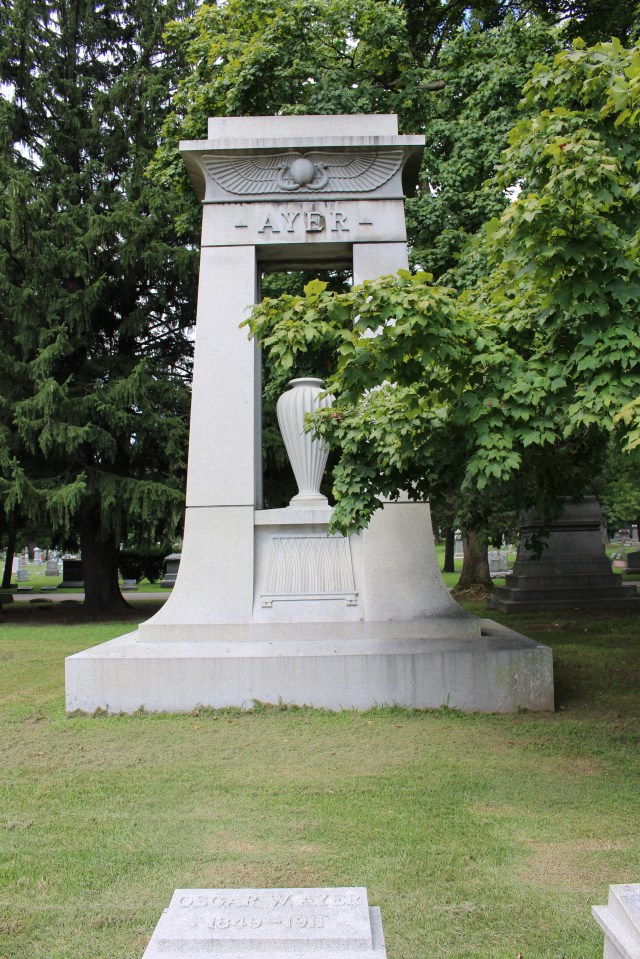
The Ayer Family Monument is an example of the influence of the Egyptian revival found in American cemeteries in the 19th century and on into the 20th century. Egyptian ornamentation can be divided into three categories—architectural, geometric, and natural.  The monument has strong and commanding architectural features. The sides of the monument tilt slightly inward forming a doorway, the cavetto cornice curves into a half circle at the top. The top of the monument features a globe with three sets of falcon wings that are a symbol of the king, the sun, and the sky. The globe represents the Egyptian god, Horus. They symbolize the king’s ability to ward off evil spirits. Two snakes face outward ready to strike. Below the opening are stylized long slender stems of the lotus flower, sacred to the Egyptian and Buddhist cultures. The Lotus represents purity and evolution. The lotus is born in the water, the primordial ooze—making it also a symbol of creation and rebirth. The urn is a popular symbol of mourning that represents mourning. The urn symbolizes the body as a vessel of the soul, originating as an ancient repository for the ashes of the dead.

img_2485

Obelisk

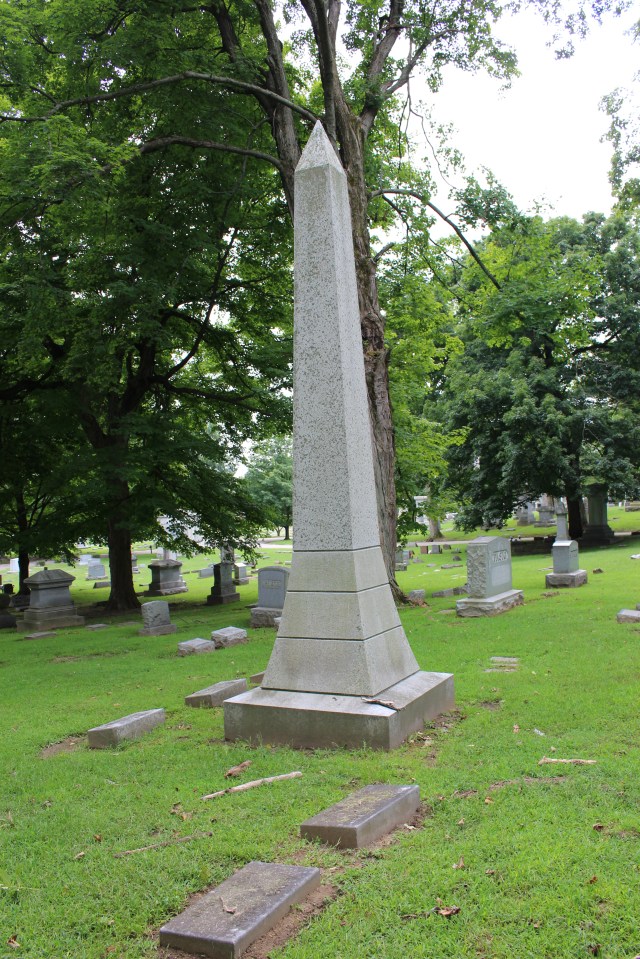
The Egyptian symbol that is most commonly found in American cemeteries is the obelisk.  The Georgia Marble Company published a book (page 63) describing the obelisk, saying “The steeple of the Church symbolizes the spiritual and uplifting power of religion and the moral aspiration of man. It was evolved from the obelisks which stood before Egyptian temple—emblems of the sun god Ra and the regeneration of man. It has long been a favored form for the civic and private memorial. Towering heavenward from a slightly location, the obelisk probably ranks among the most simple and impressive of all monuments.”

img_2291

Egyptian-influenced designed monument

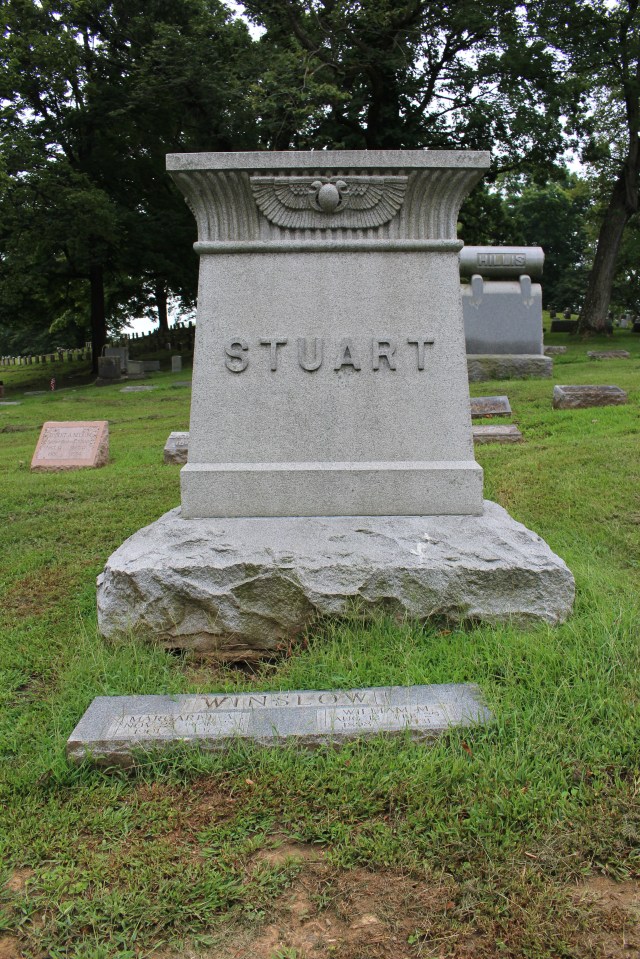
The Stuart Family gray granite monument is plain but has several distinctive features influenced by Egyptian design—such as the cavetto cornice that curves into a half circle at the top and a highly stylized globe with snakes waiting to strike with three sets of falcon wings symbolizing of the king, the sun, and the sky.  The globe represents the Egyptian god, Horus.

img_2469

Egyptian-influenced designed monument

The Helmer Family gray granite monument is plain but has several distinctive features influenced by Egyptian design. The mock cavetto cornice curves into a half circle at the sides replicating the traditional cornice. The highly stylized globe and snakes waiting to strike feature two sets of falcon wings incised into the face of the stone.  On each side of the face of the monument are stylized lotus leaves carved into the granite.


Posted in Symbolism, Tombs | Leave a comment

Off the Rack, Update

Crown Hill Cemetery, Indianapolis, Indiana

Crown Hill Cemetery, Indianapolis, Indiana

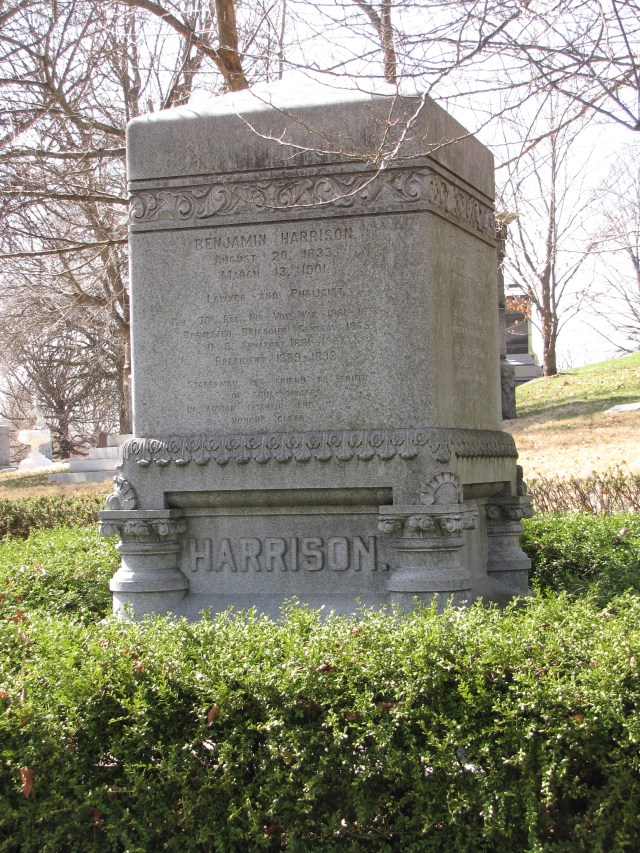
BENJAMIN HARRISON

AUGUST 20, 1833 – MARCH 13, 1901

LAWYER AND PUBLICIST

COL. 70th REG. IND. VOL. WAR 1861-1865

BREVETTED BRIGADIER GENERAL 1865 U.S. SENATOR 1881-1887

PRESIDENT 1889-1893

STATESMAN, YET FRIEND TO TRUTH OF SOUL, SINCERE IN ACTION, FAITHFUL

  AND IN HONOUR CLEAR

Harrison served admirably as a soldier in the Civil War, as a United States Senator, and as President.  Benjamin Harrison was also a highly successful lawyer, perhaps the most successful attorney to serve in our highest office. Though Harrison did not inherit a fortune from his father, his 18-year law practice was incredibly lucrative, even representing the government of Venezuela. In spite of his business and political success, his family chose a monument that was “off the rack” so to speak, most likely from one of the many gravestone catalogs available at the time. Two other examples can be found below:

Elmwood Cemetery, Detroit, Michigan

Elmwood Cemetery, Detroit, Michigan

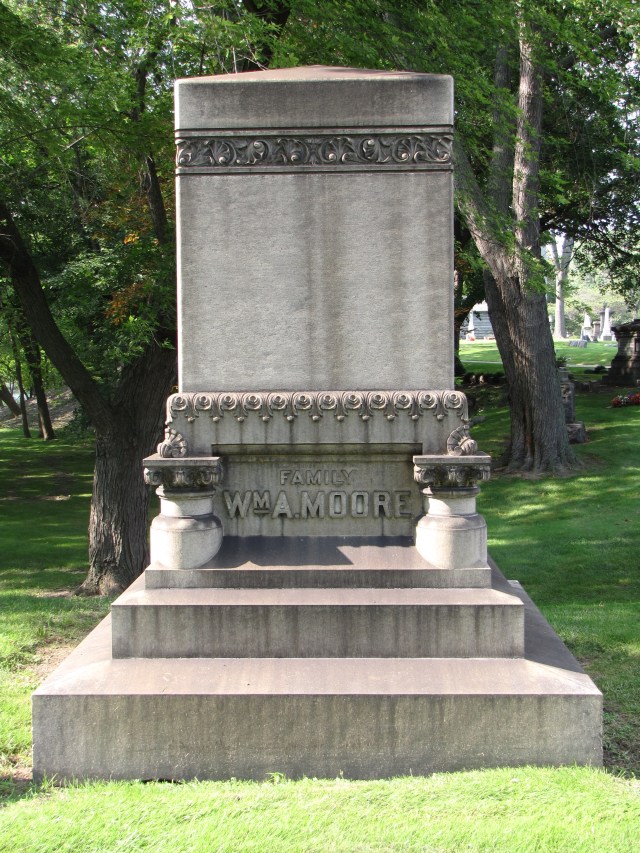
FAMILY

WM A. MOORE

WILLIAM A. MOORE, 1823 – 1906

LAURA J. MOORE, 1837 – 1911

Wm. V. MOORE, 1856 – 1925

JANE A. MOORE, 1859 – 1937

The William A. Moore family monument in the Elmwood Cemetery at Detroit is a large gray granite monument. It is exactly the same monument as the one marking the grave of President Benjamin Harrison.

Highland Cemetery, Terre Haute, Indiana

Highland Cemetery, Terre Haute, Indiana

PERRY S. WESTFALL

DEC. 18, 1834

JAN. 17, 1889

NANCY M. WESTFALL

BORN FEB. 23, 1836

DIED JULY 16, 1915

The very successful editor of Terre Haute Daily Express and the Saturday Evening Mail, Perry and his, wife, Nancy, Westfall chose the same gray granite monument to mark their family’s graves in the Highland Cemetery in Indiana’s second largest cemetery in Terre Haute as did President Harrison.

Posted in Presidential graves | Leave a comment

VEEP

US Vice President Seal.svg

America’s first vice president, John Adams said this about the job, “My country has in its wisdom contrived for me the most insignificant office that ever the invention of man contrived or his imagination conceived.” Not exactly high praise. The reputation for the office was not off to an auspicious start, to say the least. And, it didn’t get much better over the course of time. John Nance Garner, vice president under Franklin Delano Roosevelt, described the position this way, “The vice presidency isn’t worth a warm pitcher of spit.”

However, no matter how the office has been described various candidates have lined up to take the job—47, in fact, have served as vice president. As Bill Vaughan was quoted, “The vice presidency is sort of like the last cookie on the plate. Everybody insists he won’t take it but somebody always does.”

This year two men have signed up for the bottom of the ticket—Tim Kaine of Virginia and Mike Pence of Indiana. And, with the exception of New York which boasts 11, more vice presidents have been from Indiana than any other state. Five have hailed from the Hoosier state—Schuyler Colfax, Thomas Hendricks, Charles Fairbanks, Thomas Marshall, and Dan Quayle.

Honorable-Schuyler-Colfax[1]

Schuyler Colfax (March 23, 1823 – January 13, 1885) served as vice president from March 4, 1869 to March 4, 1873; served with President Ulysses Grant. He was 61 when he died.

IMG_1894

Schuler Colfax is buried in the City Cemetery at South Bend, Indiana under a tall white marble gravestone. At one time it had a small angel on top of the column but it is now missing. There is a small bronze marker with the following inscription:


SCHUYLER COLFAX

VICE PRESIDENT OF THE UNITED STATES

1869 TO 1873

STATESMAN AND BELOVED CITIZEN

SOUTH BEND POST 50 AMERICAN LEGION

ACKNOWLEDGES THE SERVICE

HE RENDERED TO HIS COUNTY.


 245px-Thomas_Andrews_Hendricks[1]

Thomas Andrews Hendricks (September 7, 1819 – November 25, 1885) served as vice president from March 4, 1885 to November 25, 1885; served with President Grover Cleveland. He was 66 when he died.

 IMG_2680

Hendricks has a soaring gray granite octagon-shaped column resting on a ornamented plinth in the Crown Hill Cemetery at Indianapolis, Indiana. The monument has the following inscription:


THOMAS A.

HENDRICKS

BORN SEPTEMBER 7, 1819

DIED NOVEMBER 25, 1885

ELIZA C.

HENDRICKS

BORN NOVEMBER 23, 1823

DIED NOVEMBER 3, 1903

140px-CharlesWFairbanks[1] 


Charles Warren Fairbanks (May 11, 1852 – June 4, 1918– January 13, 1885) served as vice president from March 4, 1905 to March 4, 1909; served with President Theodore Roosevelt. He was 66 when he died. Fairbanks is buried in the Crown Hill Cemetery at Indianapolis.

IMG_2677

The Fairbanks monument in the Crown Hill Cemetery at Indianapolis, Indiana is designed in of the Ionic order, one of the three organizational systems of Greek architectural design.  The Ionic order is characterized by the use of a capital (the top of the column) that uses volutes, a spiral scroll-like ornamentation.  The Ionic columns are slender and fluted and the monument is topped with an acroterion motif–a stylized palm leaf that can be found on classical Roman and Greek architecture. His monument lists his and his wife’s accomplishments:


CHARLES WARREN FAIRBANKS

U.  S. SENATE 1897 – 1905

VICE PRESIDENT THE UNITED

STATES

1905 – 1909


CORNELIA COLE FAIRBANKS

PRESIDENT GENERAL

D.  A. R.

1901 — 1905

 Thomas_Riley_Marshall_headshot[1]
Thomas Riley Marshall (March 14, 1854 – June 1, 1925) served as vice president from March 4, 1913 to March 4, 1921; served with President Woodrow Wilson. He was 71 when he died.

IMG_9644

Marshall and his wife, Lois Irene Kimsey, 1873 – 1958, are both buried at the Cown Hill Cemetery at Indianapolis, Indiana, in a light gray limestone mausoleum.

Dan Quayle (February 4, 1947 –         ) served as vice president from January 20, 1989 to January 20, 1993; served with President George W. H. Bush. Dan Quayle is alive and well.


Only 14 of the 47 men to serve as Vice President have become president, five by election. John Tyler was the first to ascend to the presidency upon the death of a president. He was derisively referred to as “His Accidency.” Seven other men became president under the same circumstances—Millard Fillmore, Andrew Johnson, Chester Arthur, Theodore Roosevelt, Calvin Coolidge, Harry Truman, and Lyndon Johnson. As Will Rogers said, “The person with the best job in the country is the vice president. All he has to do is get up every morning and say, ‘How is the president?’” Gerald Ford became president when Richard Nixon resigned the presidency.

Posted in Famous graves | 1 Comment

Message in Glass

IMG_0669

In this stained glass window in a mausoleum in the Westview Cemetery at Atlanta, Georgia, and angel holds two Christian symbols.

The torch in her right hand represents life.  The torch is also seen as an instrument that illuminates the darkness representing enlightenment.  It can symbolize zeal, liberty, and immortality.

The anchor is an ancient Christian symbol that has been found in early catacomb burials.  The anchor was used by early Christians as a disguised cross.  The anchor also served as a symbol of Christ and his anchoring influence in the lives of Christians.  Just as an anchor does not let a moored boat drift, the anchoring influence of Christ does not allow the Christian life to drift.

Posted in Angels, Symbolism | Leave a comment