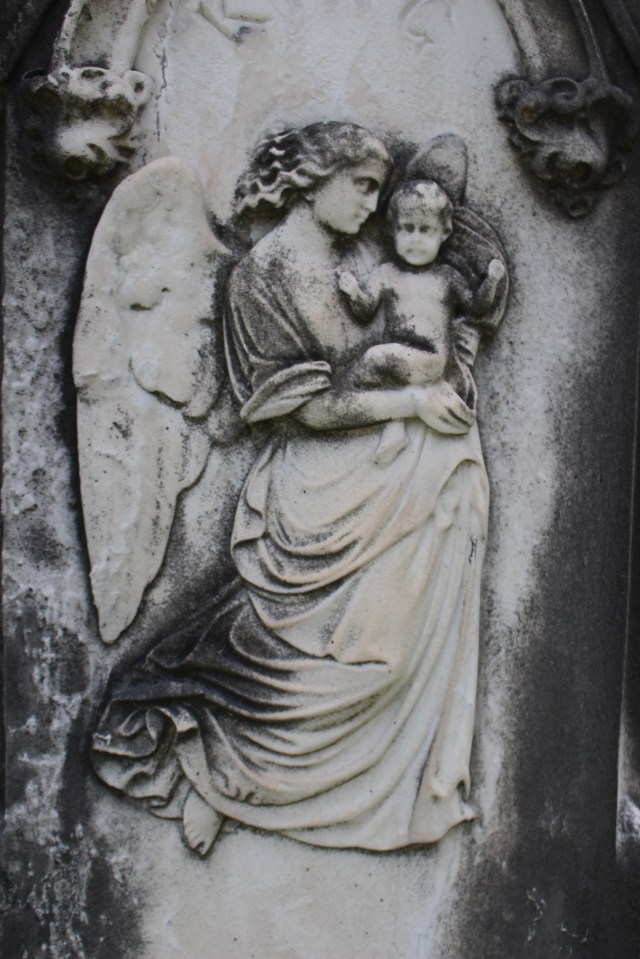
Recording Angels

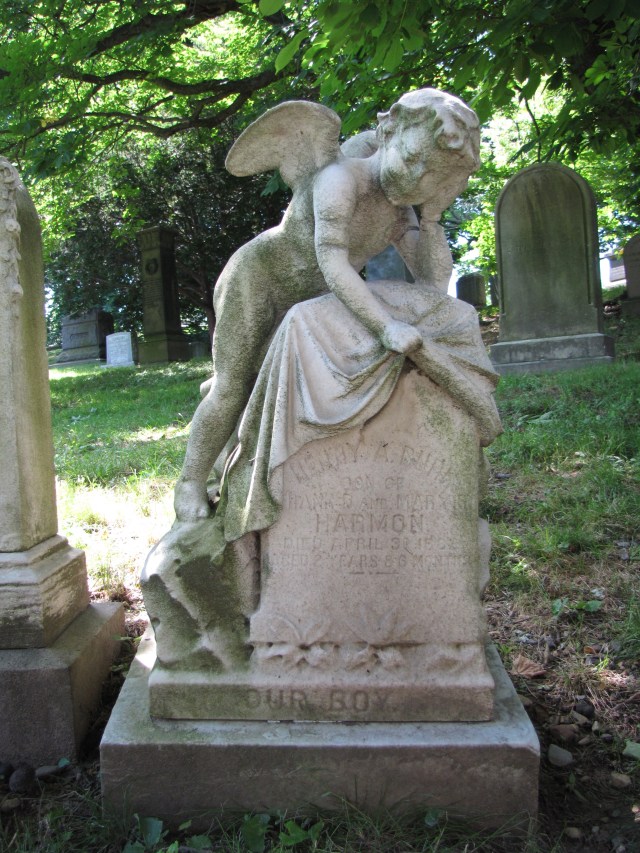
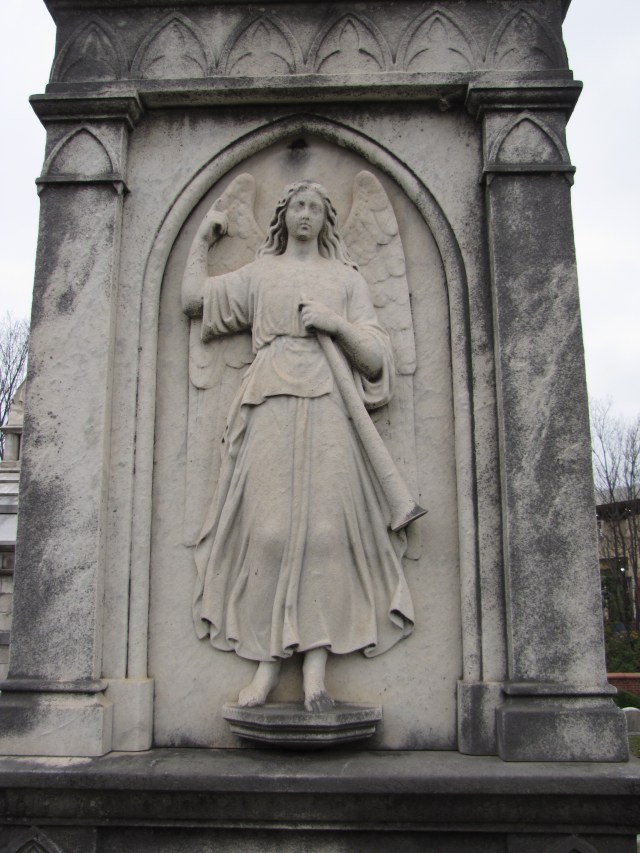
Forest Lawn Cemetery, Buffalo, New York

In the article, “Embodying Immortality: Angels in America’s Rural Garden Cemeteries, 1850—1900”, pages 56 – 111, 2007 edition of Markers, XXIV, written by Elisabeth Roark, she categorized the eight most commonly found types of graveyard angels—which included recording angels.

The recording angels depicted here are shown with wings. Winged figures in a cemetery are instantly recognize as an angel–a messenger of God.  However, Christian art did not depict angels with wings until the fourth century.  Before then, angels were represented in several different forms–sometimes in human form, but also represented as a dove, or even just as a hand reaching down to Earth from the Heavens.  Beginning with the reign of Constantine, angels began being depicted with wings, as we commonly portray them today. “Based on the winged Greco-Roman Nike or Victory, their form thus embodied Christianity’s promised triumph over death. Medieval and Renaissance tombs often featured angels that attended images of the deceased.”
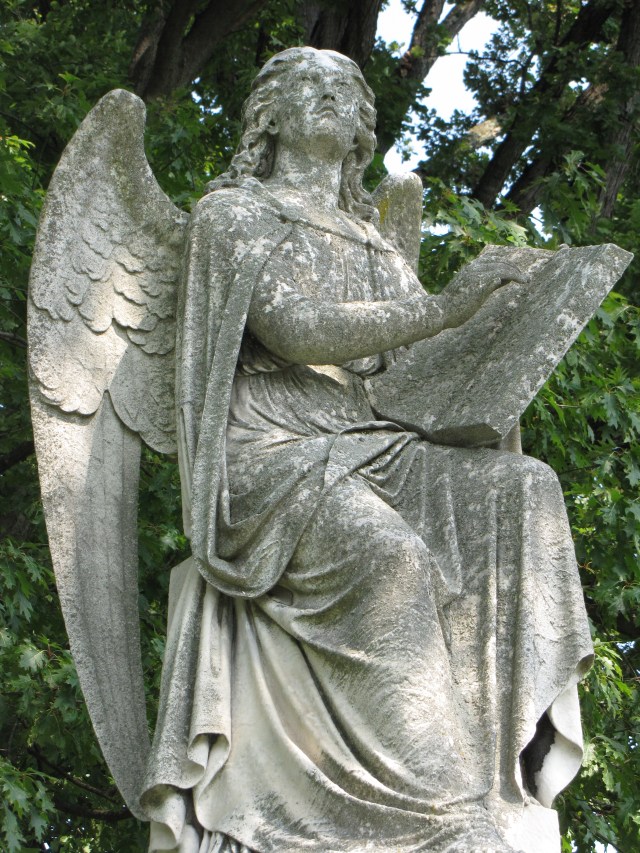
Cave Hill Cemetery, Louisville, Kentucky

This recording angel, carved out of white marble, has an open book resting on his knee and a quill in his hand.  The angel is youthful, dressed in a short, knee-length tunic. These depictions are reminiscent of “boyish winged figures that appeared on ancient Roman sarcophagi and are considered another possible source for Christian angels.”

The angel is clearly poised to write in the book.  Here the angel is registering the name of the deceased into the Book of Life.  In Judaism and Christianity, the names of the righteous were recorded in the Book of Life; they were assured entry into Heaven.

Fairmount Cemetery, Huntingburg, Indiana

The Book is referenced many times in the Bible (King James Version), including Revelation, Chapter 20,

Verse 12: “And I saw the dead, small and great, stand before God: and the books were opened: and another book was opened, which is the book of life: and the dead were judged out of those things which were written in the books, according to their works.”

Verse 13: “And the sea gave up the dead which were in it; and death and hell delivered up the dead which were in them: and they were judged every man according to their works.”

Verse 14: “And death and hell were cast into the lake of fire.  This is the second death.”

Verse 15: “And whosoever was not found written in the book of life was cast into the lake of fire.”

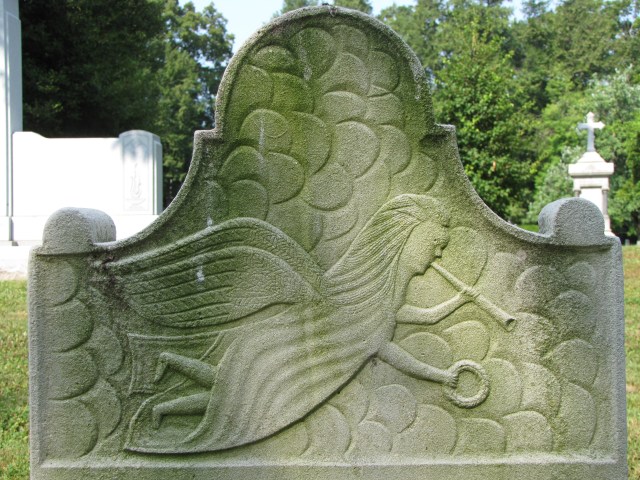
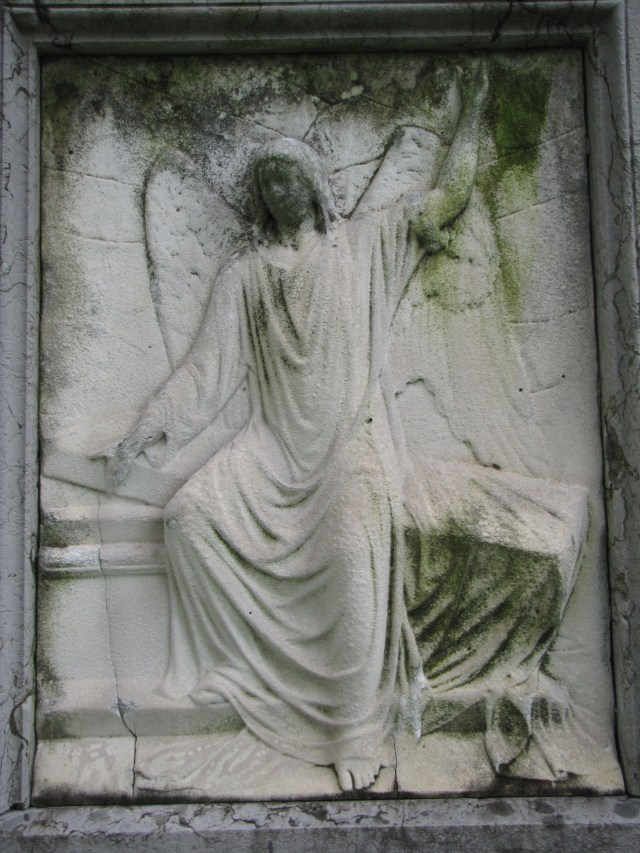
Not all of the recording angels are depicted writing names into books. The angel in the bas-relief from the Cave Hill Cemetery at Louisville, Kentucky, is writing the name onto a shield.

Cave Hill Cemetery, Louisville, Kentucky

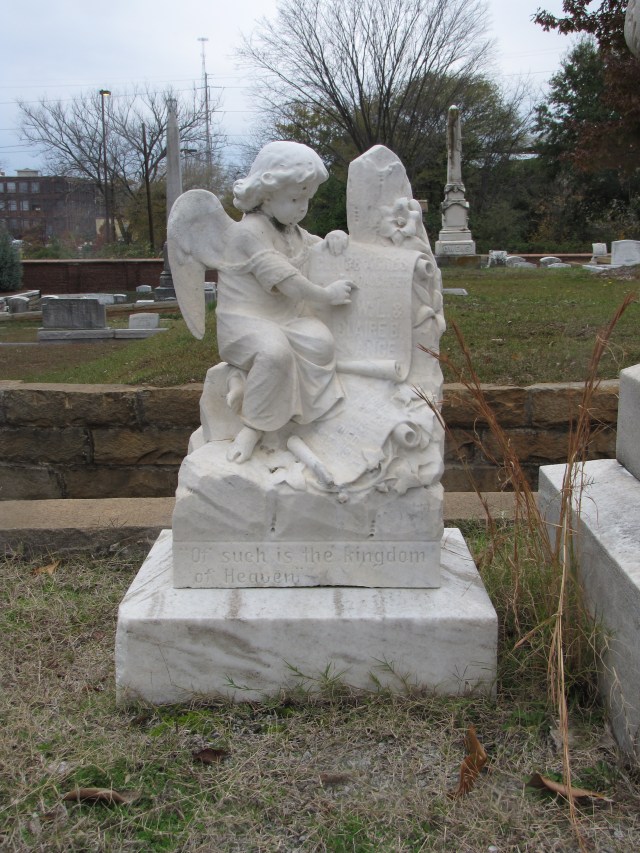
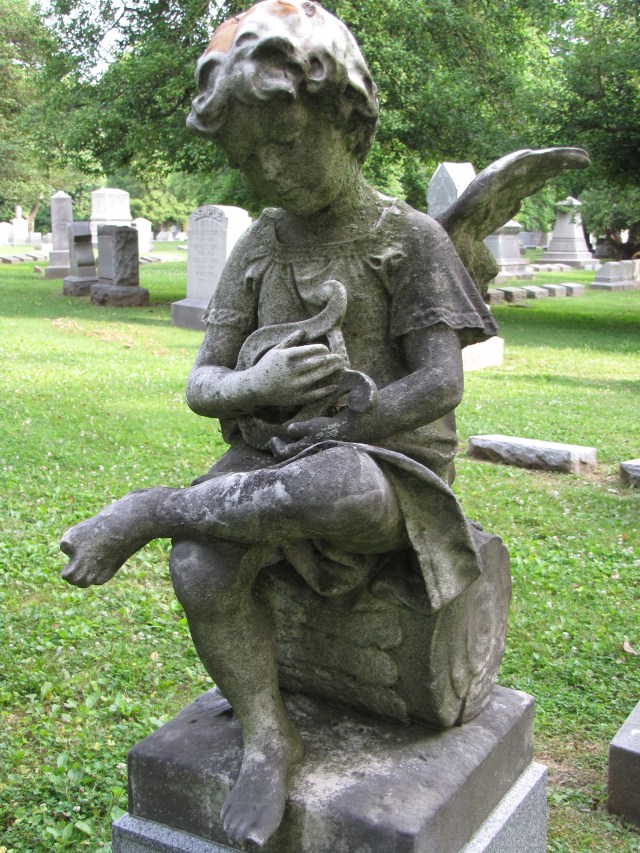
And in some cases, the recording angel is depicted as a cherub.
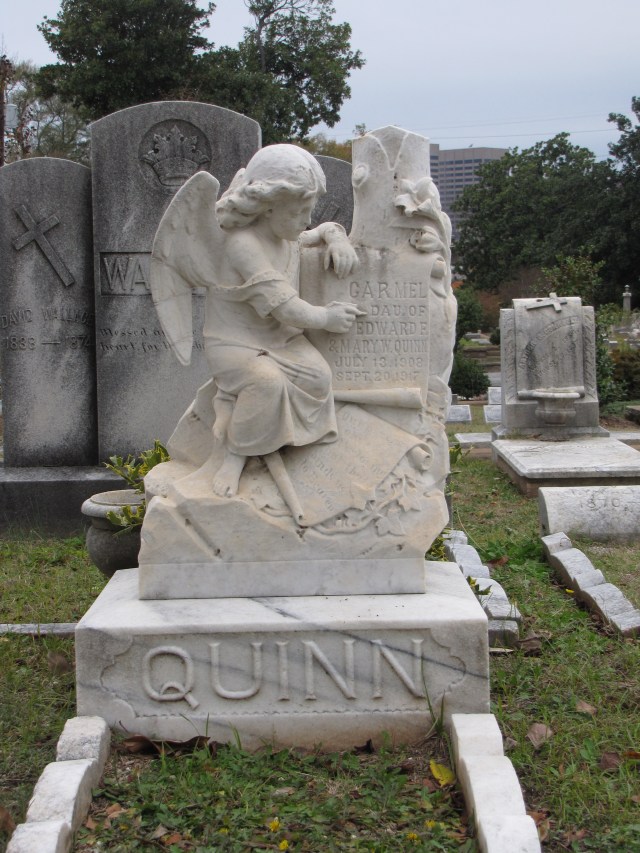
Oakland Cemetery, Atlanta, Georgia

Posted in Angels | 1 Comment

Pointing Angels

Laurel Hill Cemetery, Philadelphia

In the article, “Embodying Immortality: Angels in America’s Rural Garden Cemeteries, 1850—1900”, pages 56 – 111, 2007 edition of Markers, XXIV, written by Elisabeth Roark, she categorized the eight most commonly found types of graveyard angels—which included pointing angels.

Erie Cemetery, Erie, Pennsylvania

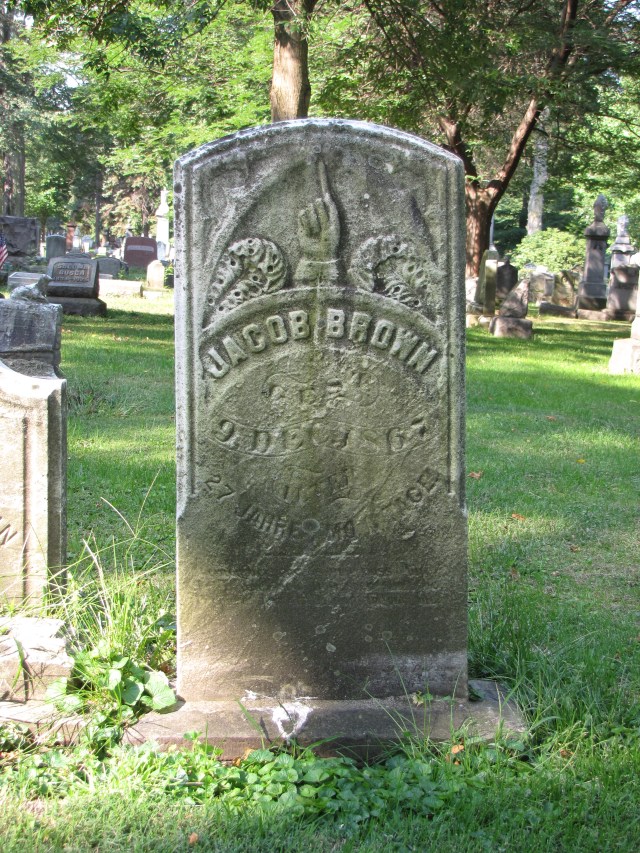
The hand with a finger pointing upwards is a commonly found motif. The finger pointing upwards, indicates the soul traveling to Heaven, sometimes a presumptuous claim, though a hopeful one. The finger pointing upwards motif was often coupled with other symbols:

  • a willow tree, a traditional symbol of sorrow indicating while the soul of their loved one has gone to Heaven, the family on Earth mourns the loss and grieves for their loved one
  • the crown symbolizing victory. Sometimes the combination of the images represent the flight of the soul from the earthly realm to the Heavenly realm

Green-Wood Cemetery, Brooklyn, New York

However, the angel pointing upwards originated from depictions of angels at Jesus’s sepulcher sitting beside His tomb. Roark writes, “pointing angels were often connected with guardian angels but attended to the bereaved as much as the deceased, fulfilling their role as messengers.”

Oakland Cemetery, Atlanta, Georgia
Posted in Angels | Leave a comment

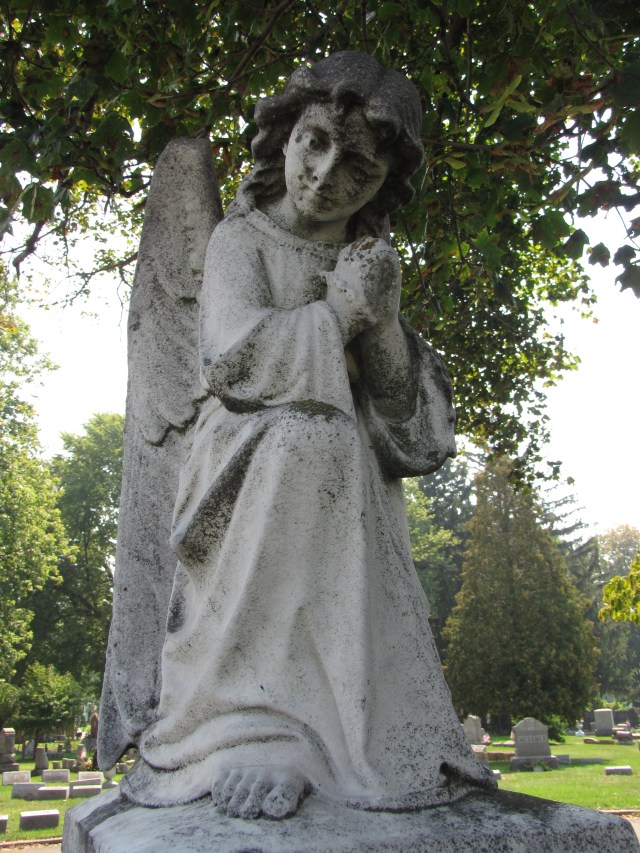
Angels Who Decorate and Watch Over the Grave

Westview Cemetery, Atlanta, Georgia
Elisabeth L. Roark wrote an article about angels titled, “Embodying Immortality: Angels in America’s Rural Garden Cemeteries, 1850—1900”, pages 56 – 111, 2007 edition of Markers, XXIV, in which she categorized the eight most commonly found types of graveyard angels—grouped the task they performed: soul-bearing; praying; decorating and guarding; pointing; recording; trumpeting; sword-bearing (archangel Michael); and child angels.

Forest Lawn Cemetery, Buffalo, New York

Angels are mentioned over 270 times in the Bible but of the eight categories of angels that Roark describes in her article, this is the only type with this task that is not specifically defined in the Bible. Roark notes that decorating graves with flowers originates with the ancient Greeks, this type of symbolism, however, is something newly found in graveyards of the 19th Century. After the Civil War, it became popular to decorate graves lavishly with flowers. Roark writes, “Like their live counterparts, the angels’ sculpted flowers suggest the parallels drawn at this time between the cyclical nature of plant life and human birth, death, and resurrection.”

Rock Creek Cemetery, Washington, DC

Posted in Angels | Leave a comment

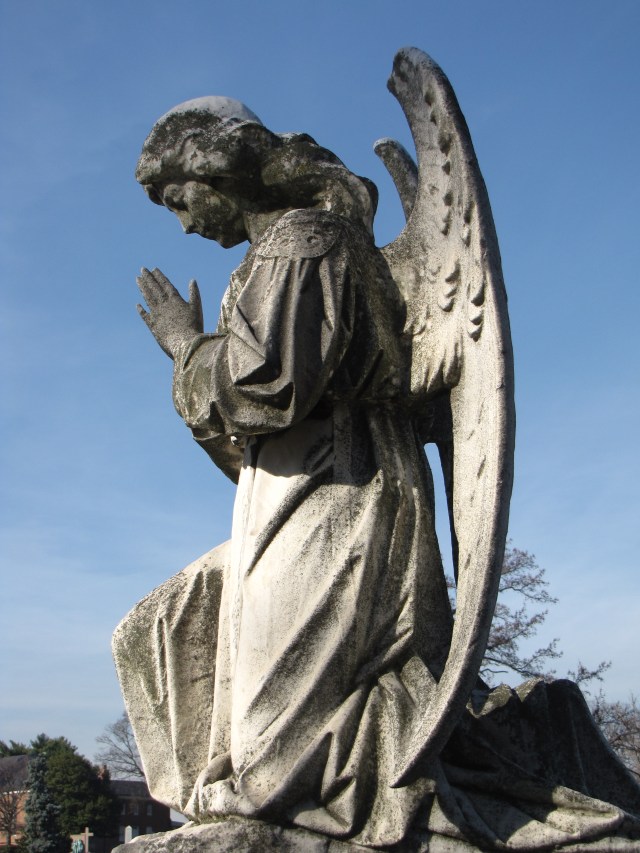
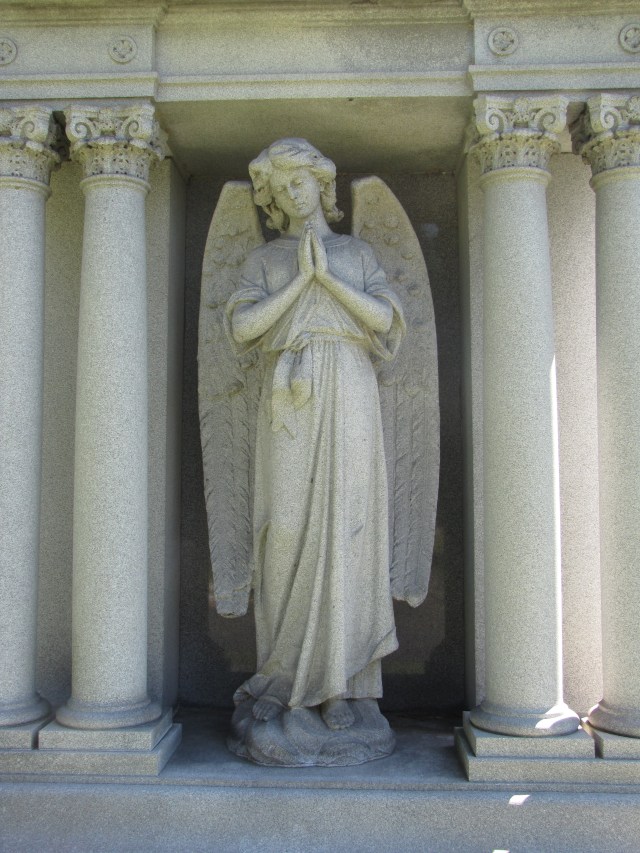
Praying Angels

Rock Creek Cemetery, Washington, DC

Elisabeth L. Roark wrote an article about angels titled, “Embodying Immortality: Angels in America’s Rural Garden Cemeteries, 1850—1900”, pages 56 – 111, 2007 edition of Markers, XXIV, in which she categorized the eight most commonly found types of graveyard angels—grouped the task they performed: soul-bearing; praying; decorating and guarding; pointing; recording; trumpeting; sword-bearing (archangel Michael); and child angels.

Bellefontaine Cemetery, St. Louis, Missouri

The winged protectors served to watch over the “soul while living, removed occasions of sin and provided protection when danger threatened, interceded on their charges’ behalf, attended at death, eased the transition to the next world, conducted the soul to Heaven, and looked after the gravesite and the deceased’s remains until resurrection.” These were busy angels. In addition to those duties, the praying angels served as an intercessor conveying messages from their charges to Heaven. These angels usually are looking upward toward the Heavens, hands clasped together in prayer, sometimes coupled with emblems of faith, such as, anchors and crosses, often clad in toga-like clothing.

Laurel Hill Cemetery, Philadelphia, Pennsylvania

Posted in Angels | Leave a comment

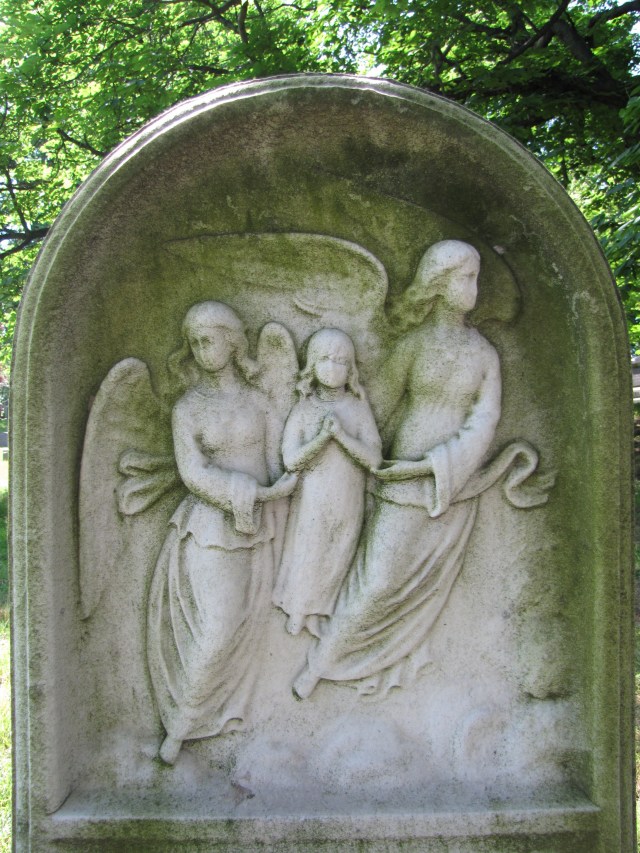
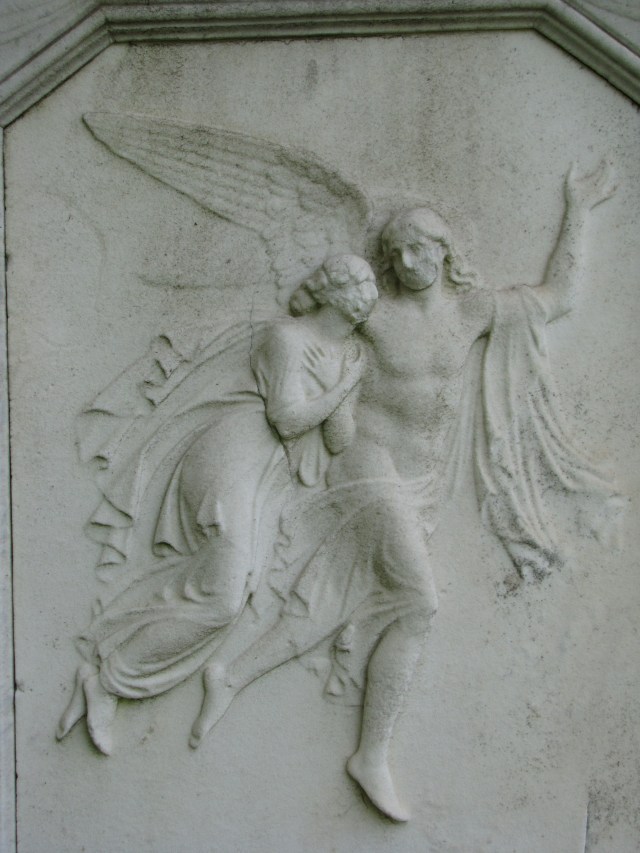
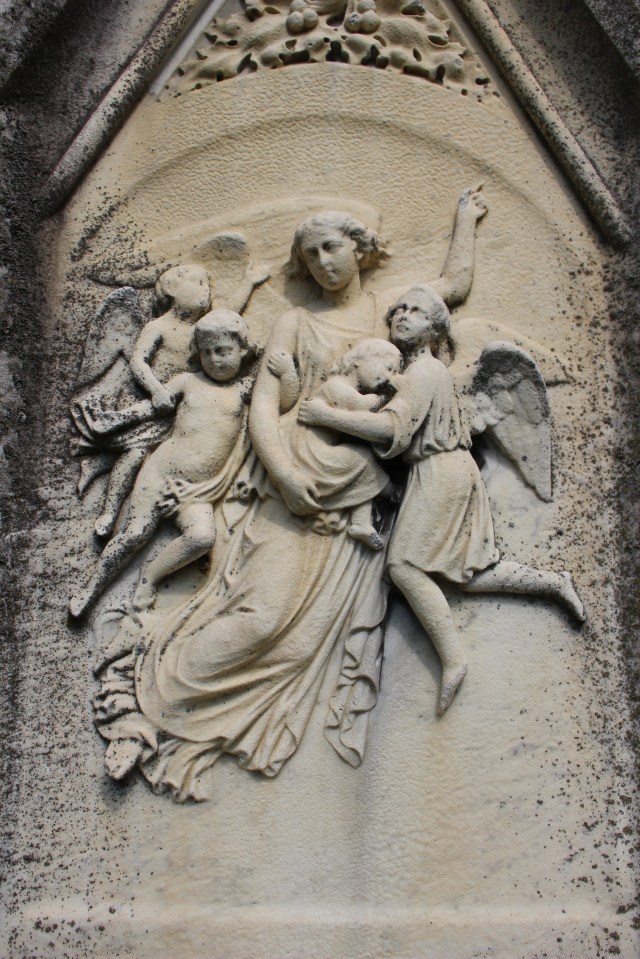
Soul-bearing Angels

c. 1860, Green-Wood Cemetery, Brooklyn, New York

Elisabeth L. Roark wrote an article about angels titled, “Embodying Immortality: Angels in America’s Rural Garden Cemeteries, 1850—1900”, pages 56 – 111, 2007 edition of Markers, XXIV, in which she wrote Catholics had embraced the concept of angels but Protestants were slow to. That changed in the second half of the 19th Century. She explains that there was an “invasion” of angels in rural garden cemeteries, which were for the most part Protestant graveyards. Roark explains in the article that Protestants accepted the concept of angels because they not only expressed a message of consolation but were also utilitarian—these angels performed tasks.

c. 1850, Green-Wood Cemetery, Brooklyn, New York

In this category of angels, the angels are depicted carrying the soul to Heaven. In most of the examples the author found, the angels were carved in bas-relief because of the complexity of carving them in the round.

c. 1860, Spring Grove Cemetery, Cincinnati, Ohio

All four examples are from the second half of the 19th Century—two from Green-Wood Cemetery at Brooklyn, New York, and two from Spring Grove Cemetery at Cincinnati, Ohio. In all but one case, the angels are bearing children’s souls to Heaven.

c. 1865-1895, Spring Grove Cemetery, Cincinnati, Ohio

Posted in Angels | Leave a comment

Eight Categories of Angel Monuments

img_3701

In the 2007 edition of Markers, XXIV, published by the Association for Gravestone Studies, Greenfield, Massachusetts, Elisabeth L. Roark wrote an article about angels titled, “Embodying Immortality: Angels in America’s Rural Garden Cemeteries, 1850—1900”, pages 56 – 111.

Roark argues in her piece that while Catholic scholastics wrote a great deal about angels that some Protestants counterparts dismissed angels as “a hodge-podge.” She further writes that Protestants were more or less ambivalent about theories about angels that largely originated with a work about angels titled On the Celestial Hierarchy written around 500 CE by a Greek known as Pseudo-Dionysus the Areopagite. This writing stimulated other theologians, such as Bonaventure and Thomas Aquinas, to write about angels.

Roark argues that angels were not “Romantic attempts to beautify death.” She writes, “while this was part of their appeal, angel monuments are far more complex in meaning and can act to reveal manifestations of popular Christian beliefs.”

According the article, angels come onto the scene in rural garden cemeteries in a big way starting in 1850 and then throughout the rest of the century. Though angels come in many variations and forms, in her study of 14 rural cemeteries from each region of America, Roark found that the majority of angels fall into the following eight categories:

  1. Soul-bearing Angels
  2. Praying Angels
  3. Angels who decorate and watch over the grave
  4. Pointing angels
  5. Recording angels
  6. Trumpet angels
  7. Michael the archangel
  8. Child angels

img_3766

Posted in Angels | Leave a comment

Updated Version

img_5956

The monument in the St. Raphael Church Cemetery, at Dubois, Indiana, has atop it a young female figure. Her head is bent forward, she is looking down in reflection and sorrow, while she is holding a rose bloom in one hand and clutching a floral wreath in the other. This is a common Victorian funerary symbol expressing the transitory nature of life.

img_5957

The rose is a secular symbol for love and beauty but is also associated with the Virgin Mary—the rose without thorns. The rose, however, can also connote age. A rose bud, generally found on a child’s grave, represents the life that has yet to bloom. Often, in that case the bud will be on a broken stem indicating that the life was cut short. A partial bloom on the rose would indicate an older child, such as a teenager, while a full bloom, indicates the life of someone who has reached maturity.

The example below decorates a grave in the Fairmount Cemetery at Huntingburg, Indiana, from the 1990s. In this updated version, the mourning figure is not wearing flowing robes, but modern dress. She is knelling, holding roses as she leans forward in the act of laying a rose.

img_6217


Posted in Uncategorized | Leave a comment

Nancy Hanks Lincoln

img_6347

NANCY HANKS

LINCOLN

Mother of President

LINCOLN

DIED

Oct. 5, A.D. 1818

Aged 35 years

Erected by a friend of her martyred Son

1879

Nancy Hanks Lincoln was born on February 5, 1784 in Campbell County Virginia, and died October 5, 1818, in Spencer County, Indiana, when Abraham Lincoln was only 9 years old.

The future president moved with his parents, Thomas and Nancy Lincoln, and sister, Sarah, in 1816. The family constructed a small cabin near Pigeon Creek. Two short years later, Nancy fell ill. Thomas, who was a carpenter by trade, constructed a pine coffin from trees on their property. Mrs. Lincoln was buried in a simple ceremony with a few neighbors and her family in attendance. The family moved from Indiana in 1830 and the gravesite was forgotten and fell into disrepair.

img_6345

Years later a white marble pointed-arched tablet was erected to mark her gravesite located in a Pioneer Cemetery.

img_6374

Posted in Uncategorized | 2 Comments

The Garden

img_0937

The night before Jesus was crucified, Jesus went to the Garden of Gethsemane to pray with three of his disciples—James, John, and Peter. Gethsemane was a garden at the foot of the Mount of Olives just outside of Jerusalem, though the exact location is unknown today. According to Biblical accounts, Jesus prayed while his disciples slept. Judas easily betrayed Jesus because the Garden of Gethsemane was a place often frequented by Jesus for solace and prayer, making the arrest certain.

Many cemeteries have sculptures and artwork depicting Jesus praying in the Garden of Gethsemane. Two such works can be found in the Westview Cemetery of Atlanta, Georgia. The stained glass window in the Westview Cemetery Mausoleum depicts Jesus praying. A small portion of the window shows the three disciples who fell asleep while Jesus prayed. The white-marble sculpture features a solitary Jesus looking to the Heavens in prayer.

img_0979

Posted in Symbolism | 1 Comment

The Singing Evangelist

img_5558

Sowing in the morning, sowing seeds of kindness,

Sowing in the noontide and the dewy eve;

Waiting for the harvest, and the time of reaping,

We shall come rejoicing, bringing in the sheaves.

Refrain: Bringing in the sheaves, bringing in the sheaves,

We shall come rejoicing, bringing in the sheaves;

Bringing in the sheaves, bringing in the sheaves,

We shall come rejoicing, bringing in the sheaves.

Sowing in the sunshine, sowing in the shadows,

Fearing neither clouds nor winter’s chilling breeze;

By and by the harvest, and the labor ended,

We shall come rejoicing, bringing in the sheaves.

Going forth with weeping, sowing for the Master,

Though the loss sustained our spirit often grieves;

When our weeping’s over, He will bid us welcome,

We shall come rejoicing, bringing in the sheaves.

“Bringing in the Sheaves”, that great Protestant hymn, was written by Knowles Shaw in 1874. The hymn was inspired by the Bible verse, Psalm 126:6—“He that goeth forth and weepth, bearing precious seed, shall doubtless come again rejoicing, bringing his sheaves with him.”

Knowles Shaw was an unlikely preacher and hymnist. He was born October 31, 1834, in Butler County, Ohio, and raised in Rushville, Indiana. He was the son of Albin and Hulda Knowles. At a young age, Shaw’s father lay dying and admonished his son to take care of his mother and siblings and to prepare to meet God. Shaw proved to be a scrapper and took all sorts of odd jobs—cobbler, carpenter, shop clerk, among others—to help his family make ends meet. One source of joy and income was the violin that Shaw’s father had left him. Shaw had musical talent and used the instrument to play at dances and parties. It was at one of the parties that Shaw had an epiphany. He would no longer use his instrument for entertainment but would dedicate his talent and his life to the Lord and for good purposes.

shaw201

Knowles Shaw, who was not only a talented musician, was also a spirited speaker and preacher with a deep knowledge and understanding of the Bible, soon gathered a large following. His meetings would draw huge crowds where there would be singing, preaching, and baptisms of people coming to the Lord. It is estimated that Shaw baptized 20,000 during his tenure as a preacher. Knowles became known as “The Singing Evangelist.”

On June 7, 1878, died when the train he was riding in derailed and plunged into a ravine on his way to McKinney, Texas. When his body was returned to Rushville for the funeral, the crowd was large that his service had to be performed outside in the courthouse square to accommodate the throngs of mourners who wanted to pay their last respects.

img_5560

Knowles Shaw’s white marble tombstone in the East Hill Cemetery at Rushville, Indiana, tells the story of his death, the epitaph reports his last words:

KNOWLES SHAW

AN ACCEPTABLE EVANGELIST

Of the church of Christ

Born

Oct. 13, 1834.

KILLED BY AN ACCIDENT

ON THE TEXAS GENERAL RAIL

ROAD NEAR MCKINNEY TEXAS

JUNE 7, 1878.

INTERED JUNE 13, 1878.

It is a grand thing to rally

People to the cross.

img_5562

Posted in Famous graves | Leave a comment