Bivouac of the Dead

In Memory of

JAMES A. T. McGrath

Lieut. Co. A. 15th Ky. Vol. Inf.

fell at the battle of Perryville, Ky.

Oct. 8, 1862.

On Fate’s eternal camping-ground

His silent tent is spread,

And glory guards, with solemn round

The bivouac of the dead.

The white marble grave marker in the Grove Hill Cemetery at Shelbyville, Kentucky, is constructed of three distinct parts—the tablet, the plinth, and the base.  This gravestone is put together by drilling two holes in the base into which metal rods are positioned.  These metal rods also run through the plinth (or substructure underneath the tablet), and then up into the tablet to give the gravestone stability from toppling over.  In this case, the marble split where the two rods penetrated the bottom of the tablet.  When the tablet was cemented in an effort to stop the split some of the epitaph was lost.

However, enough of the epitaph survives that it is clear the epitaph are lines from the second quatrain of a poem by Danville, Kentucky native Theodore O’Hara titled, “Bivouac of the Dead.”  The poem was written by O’Hara to honor Kentucky soldiers who had lost their lives in the Mexican-American War.

The elaborate carvings on the gravestone signal that this was the grave of a soldier.  McGrath, as the inscription on his gravestone states, fell in battle—the Battle of Perryville which has also been referred to as the Battle for Kentucky.  The Union forces were led primarily by Major General Don Carlos Buell and the Confederate forces were primarily led by General Braxton Bragg.  Both sides had heavy casualties—the North had 845 killed and 2,851 wounded and the South lost 510 in battle, with 2,635 wounded.  The Southern forces retreated from Kentucky, which the North held for the remainder of the Civil War.

The tablet features an inset oval festooned with a floral spray of mixed flowers atop that has an intricate carving of an eagle surmounted on a stripped shield with three stars in the top third of the shield.  At the base of the shield there is an olive branch on one side and on the other oak leaves and acorns symbolizing peace and strength alternatively.  Behind the eagle on either side are flags.  Rays emanate above the entire motif.   The plinth has a carving of a sword that is crossed with its sheath and tied in the center with an elaborate bow, a nod to McGrath’s standing as a soldier and military officer.

“BIVOUAC OF THE DEAD”

The muffled drum’s sad roll has beat
The soldier’s last tattoo;
No more on life’s parade shall meet
That brave and fallen few.

On Fame’s eternal camping-ground
Their silent tents are spread,
And Glory guards, with solemn round,
The bivouac of the dead.

No rumor of the foe’s advance
Now swells upon the wind;
Nor troubled thought at midnight haunts
Of loved ones left behind;

No vision of the morrow’s strife
The warrior’s dream alarms;
No braying horn nor screaming fife
At dawn shall call to arms.

Their shriveled swords are red with rust,
Their plumed heads are bowed,
Their haughty banner, trailed in dust,
Is now their martial shroud.

And plenteous funeral tears have washed
The red stains from each brow,
And the proud forms, by battle gashed
Are free from anguish now.

The neighing troop, the flashing blade,
The bugle’s stirring blast,
The charge, the dreadful cannonade,
The din and shout, are past;

Nor war’s wild note nor glory’s peal
Shall thrill with fierce delight
Those breasts that nevermore may feel
The rapture of the fight.

Like the fierce northern hurricane
That sweeps the great plateau,
Flushed with the triumph yet to gain,
Came down the serried foe,

Who heard the thunder of the fray
Break o’er the field beneath,
Knew well the watchword of that day
Was “Victory or death!”

Long had the doubtful conflict raged
O’er all that stricken plain,
For never fiercer fight had waged
The vengeful blood of Spain;

And still the storm of battle blew,
Still swelled the gory tide;
Not long, our stout old chieftain knew,
Such odds his strength could bide.

Twas in that hour his stern command
Called to a martyr’s grave
The flower of his beloved land,
The nation’s flag to save.

By rivers of their father’s gore
His first-born laurels grew,
And well he deemed the sons would pour
Their lives for glory too.

For many a mother’s breath has swept
O’er Angostura’s plain —
And long the pitying sky has wept
Above its moldered slain.

The raven’s scream, or eagle’s flight,
Or shepherd’s pensive lay,
Alone awakes each sullen height
That frowned o’er that dread fray.

Sons of the Dark and Bloody Ground
Ye must not slumber there,
Where stranger steps and tongues resound
Along the heedless air.

Your own proud land’s heroic soil
Shall be your fitter grave;
She claims from war his richest spoil —
The ashes of her brave.

Thus ‘neath their parent turf they rest,
Far from the gory field,
Borne to a Spartan mother’s breast
On many a bloody shield;

The sunshine of their native sky
Smiles sadly on them here,
And kindred eyes and hearts watch by
The heroes sepulcher.

Rest on embalmed and sainted dead!
Dear as the blood ye gave;
No impious footstep shall here tread
The herbage of your grave;

Nor shall your glory be forgot
While fame her records keeps,
Or Honor points the hallowed spot
Where Valor proudly sleeps.

Yon marble minstrel’s voiceless stone
In deathless song shall tell,
When many a vanquished ago has flown,
The story how ye fell;

Nor wreck, nor change, nor winter’s blight,
Nor Time’s remorseless doom,
Shall dim one ray of glory’s light
That gilds your deathless tomb.

Posted in Symbolism | 1 Comment

Sleeping Baby

ANETA

LOIS

Daughter of

Joe AND Bessie

HARRIS

BORN

June 17, 1900

DIED

Nov. 22, 1907

A light from our household has gone

A voice we loved is stilled

A place is vacant in our hearts

That never can be filled.

The white marble gravestone of Aneta Harris in the BPOE 216 (Benevolent and Protective Order of Elks) Cemetery in San Antonio, Texas, is imbued with an abundance of symbolism.  First of all, it is topped with a chubby baby girl nestled against a pillow and asleep on top of a cushion.

These gravestones for children, for me, are the most poignant.  The mortality rates for children were very high.  In the 1850s, for example, the mortality rates for children under one year were estimated at over 200 deaths per thousand, with much higher mortality rates for children under 5.  It would have been far more comforting to think of a young child sleeping rather than the alternative.  The sentiment is tender and terribly sad.

On the face of the gravestone, barely visible in an incised carving above her name, are two angles holding a crown as if they are ready to place it on the little girls head as she ascends to Heaven.  The crown is a fairly common symbol found in American cemeteries.  Sometimes it can be found as an incised carving at the top of the gravestone—often in conjunction with other symbolism such as palm leaves.  The crown is a symbol of glory and reward and victory over death.  The reward comes after life and the hard-fought battle on Earth against the wages of sin and the temptations of the flesh.  The reward awaits in Heaven where the victor will receive a crown of victory.  The crown also represents the sovereign authority of the Lord.

Above the crown is a five-point star.  The star can represent the life of Christ and the Five Holy Wounds of Christ–one wound in each hand, a wound in each foot, and one in His side where Jesus was pierced to check to make sure He was dead.

Marking the grave is a long curbing outlining the burial plot which would have been planted with blooming flowers.

Posted in Angels, Children's Graves, Symbolism | Leave a comment

A Fair Bud

INDIA BELLE

Daughter of

JAMES R. and MAMIE

BALDWIN

Born Nov. 21. 1898

Died July 17

1903,

Aged 4 yrs.

8 Months

Beautiful, lovely,

She was but given,

A fair bud to earth,

To blossom in Heaven.

The white marble gravestone of India Belle Baldwin in the BPOE 216 (Benevolent and Protective Order of Elks) Cemetery in San Antonio, Texas, is topped with a lamb.  There are many gravestone symbols that seem to be ubiquitous in cemeteries—the lamb is one of them. Walk into nearly any American graveyard and you will find tiny little lambs marking the graves of mostly children.  The lambs come in many sizes and positions—often sleeping. But the lamb on the gravestone of four-year old India is raising its head up. The weather has eroded the details of the face of the lamb.

On the face of the gravestone, there is also an ivy trailing up the marker.  The ivy represents friendship and, like many symbols found in the cemetery, immortality.

Marking the grave is a long curbing outlining the burial plot which most likely was filled with blooming flowers until her caring parents themselves died. As her epitaph states, her flower didn’t bloom on earth but would do so in Heaven.

Posted in Children's Graves, Symbolism | Leave a comment

Lamb of God

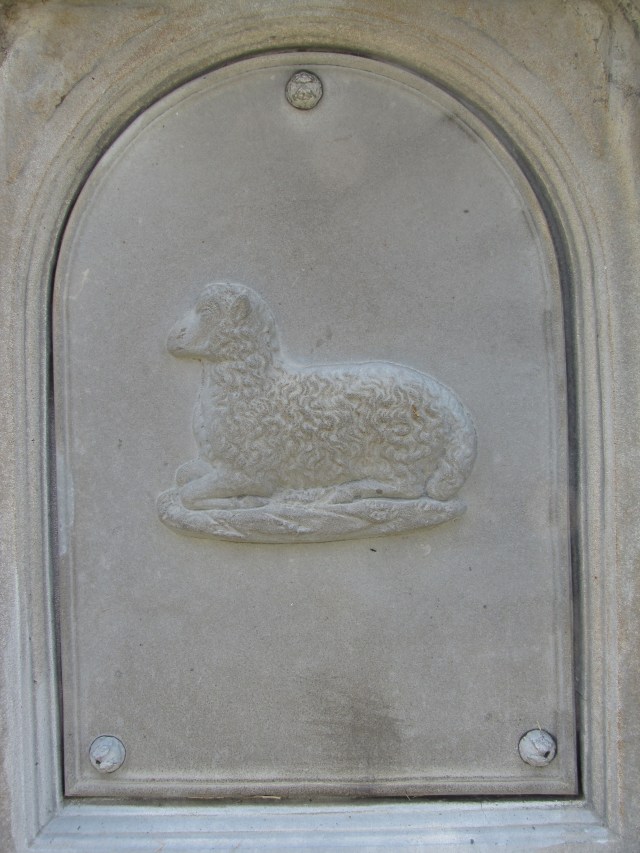
Homemade grave markers come in all forms and are made of many different kinds of materials.  This grave marker in the St. Francis Catholic Cemetery in Phoenix, Arizona, is a Latin cross made of cement with intricately molded terracotta tiles embellishing the cross.  In the center of the cross, where the long and short crossbars meet, is a tile with the image of a lamb with a banner behind it.  This image is the Lamb of God symbol.

The Lamb of God symbol represents the sacrifice Jesus Christ made with His blood to wash away the sins.  In the King James Version (KJV) of the Bible, in the book of John 1:29 John the Baptist said of Jesus, “Look, the Lamb of God who takes away the sin of the world!”   This idea was rooted in the Old Testament during Exodus when Moses performed none signs to have the Pharaoh to agree to let the Jews flee Egypt.  Finally with the Pharaoh still not relenting, the Bible says that Moses heard from God and that he was to instruct the faithful to sacrifice a lamb and paint lintel of each doorway with the blood.  In that way, the Angel of Death would “Passover” those houses.  The houses, however, without the painted lintels would suffer by losing their first born.  After that, the Pharaoh told Moses he could lead his people out of Egypt—from the bondage they experienced to the freedom and promise of a new land.

Jesus, as the Lamb of God, was the sacrificial lamb offering his life and blood to wipe away the sins of humanity.

Posted in Symbolism | Leave a comment

Homemade Elegance

Homemade grave markers come in many shapes and made of many different materials.  This particular homemade marker in the St. Joseph’s Cemetery in south Indianapolis, Indiana, is made of metal.  Two crossbars form a Latin cross—the universal symbol for Christianity—and a medallion of Jesus is at the center of the cross.  A Rosary, a prayer to the Mother Mary with a tradition that dates back to St. Dominic in the 1200s, is draped over the cross.  This is a Catholic symbol representing devotion to the Virgin Mary, but when found in cemeteries, also symbolizes the unending and constant prayers for the deceased.

The marker is simple but elegant.  The portrayal of Christ is dramatic depicting Him wearing a Crown of Thorns that He wore as He was mocked as a king, which is described in John, Chapter 19, (King James Version):

Verse 1, “Pilate therefore took Jesus, and scourged him.”

Verse 2, “And the soldiers platted a crown of thorns, and put it on his head, and they put on him a purple robe.”

Verse 3, “And said, Hail, King of the Jews! and they smote him with their hands.”

The agony of His face as He looks upward is a moving tribute to the pain He endured before the Crucifixion.

Posted in Uncategorized | Leave a comment

Monumental Designs

Brenda Putnam (1890-1975), was a well-known 20th Century sculptor born in Minneapolis, Minnesota. She had impeccable training having studied at the School of the Museum of Fine Arts in Boston.  Putnam also studied with the famed artist, James Earle Fraser, at the Art Students League of New York, as well as, studying at the Corcoran Museum Art School in Washington, D. C.

Putnam initially gained notoriety creating busts of children and sculptures for gardens. But her sculptures brought her notice and soon she was creating sculptures of famed Americans, such as, Admiral Ernest Joseph King, Jane Addams, Amelia Earhart, Pablo Casals, Mary Baker Eddy, and Harriet Beecher Stowe.  Putnam produced the artwork for the Moses Cleveland Centennial half dollar and the Art Deco sculpture of Puck for the Folger Shakespeare in Washington, D. C.

Like many great artists, such as, Daniel Chester French, Augustus Saint-Gaudens, Aldabert Volck, Felix Weihs de Weldon, Karl Bitter, Martin Milmore, Alexander Milne Calder, T. M. Brady, Albin Polasek, Mario Korbel, Harriet Whitney Frishmuth, William Wetmore Story, Edward V. Valentine, Nellie Walker, Lorado Taft, James Earle Fraser, Edward Virginius Valentine, Sally James Farnham, Adolph Alexander Weinman, Solon Borglum, John Gutzon Borglum, Mary Theresa Hart, William Ordway Partridge, Lee Oscar Lawrie, Jules Dechin, Pietro Lazzari, J. Perrin, Jeptha Barnard “Barney” Bright, Jr., Robert Koepnick, Robert Ingersoll Aiken, and Jay Hall Carpenter, Putnam also sculpted several noted funerary works, including the Simon Memorial (1918), the Porter Angel (the stone 1890s angel replaced with a bronze, 1931–32), and the Morton Memorial (1943).

THE SIMON MEMORIAL

ANNE SIMON

“A SOUL WHOSE EYES WERE KEENER THAN THE SUN

A SOUL WHOSE WINGS WERE WIDER THAN THE WORLD”

“There is no Death”

Anne Simon (1870-1916) was a talented artist who expressed her creativity through poetry and prose writing. She was an accomplished pianist, too. In fact. The morning of her death she performed in an instrumental trio.

After her death, her husband Otto Torney Simon wrote a book, The Message, the text of which he claimed he received from Anne after her death. The book published in 1920 and was titled, The Message of Anne Simon. Part of her epitaph, “A SOUL WHOSE EYES WERE KEENER THAN THE SUN, A SOUL WHOSE WINGS WERE WIDER THAN THE WORLD” is in the foreword to the book. The last cryptic line of her epitaph, “There is no Death” is also from the book written after her death. On page 26, Otto writes, “There is identity here! You will know me. And give the message: There is no Death, but there is Life, a new Life, which mortals will understand when they know love. The veil is thin (use gossamer; it is beautiful). Love will rend even this…Give this message!

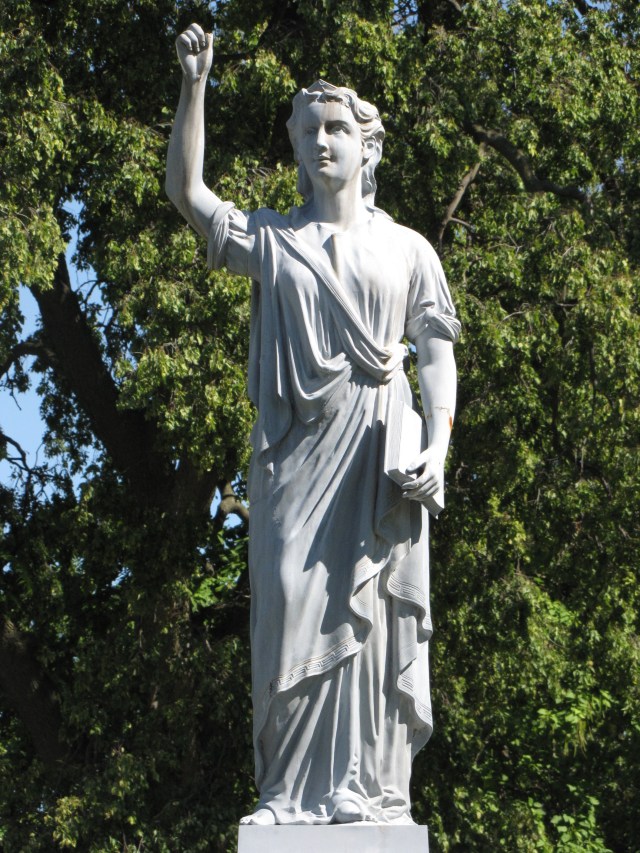
The symbolism of the angel carved by Putnam for Simon’s gravesite was described, “…with wide flung hands and upward gaze symbolizes liberation of our faculties and our abilities, the enfranchisement of the soul released by the kindly gift of Death.

THE MORTON MEMORIAL

The Morton Memorial was created as a monument for the Spring Hill Cemetery, in Lynchburg, Virginia.  The limestone memorial depicts three allegorical figures representing—Fortitude, Vision, and Kindliness.  It was completed and installed in 1945.  Inscribed on the base of the monument, “THIS MEMORIAL, GIFT OF ROSALIE SLAUGHTER MORTON MD, IS A TRIBUTE TO THE SONS AND DAUGHTERS OF OUR CITY OF THE HILLS.”  The memorial was sculpted by Brenda Putnam.

Posted in Symbolism | Leave a comment

Bible Verse Illustrated

Ecc’s. XII. 6, 7, V.

“Then shall the dust return to the

Earth as it was: and the spirit shall

Return unto Go who gave it.”

MARTHA A.

WIFE OF LEWELLYN LODGE

BORN JAN. 13, 1808:

Died Aug. 24, 1877.

The white marble gravestone of Martha Lodge and of Mary Scearce have an elaborately carved deep bas-relief illustrating a Bible verse depicting a cistern in the center of the sculpture framed by two columns.  Water flows from a fountain into a cistern.  On top of the cistern is a broken pitcher and a broken cup.  On one side of the cistern is a broken wheel with what must be the sliver cord described in the Bible verse.  On the other side twines an ivy vine up the side of the cistern.

There are two gravestones of this design in the cemetery that I found—possibly more.  They were carved by a stone cutter, J. S. Clark & Company, out of Louisville, Kentucky.  The imagery is Biblical from two verses from Ecclesiastes, which are identified in the base of the scene:

King James Version:

Ecclesiastes 12:6

Or ever the silver cord be loosed, or the golden bowl be broken, or the pitcher be broken at the fountain, or the wheel broken at the cistern.”

Ecclesiastes 12:7

Then shall the dust return to the earth as it was: and the spirit shall return unto God who gave it.”

Ecc’s. XII. 6, 7, V.

MARY E.

W. H. SCEARCE

DIED APR. 11, 1877

AGED 45 YEARS.

Posted in Symbolism | Leave a comment

The Divine Scales of Justice

BE JUST AND FEAR NOT

WILLIAM DANIEL, JR.

JUDGE OF THE

SUPREME COURT OF APPEALS

OF VIRGINIA

FROM 1846 TO 1865.

BORN

NOVEMBER 26, 1806:

DIED

MARCH 29, 1873.

The memory of the Just, is blessed.

William Daniel, Jr. (November 26, 1806 – March 28, 1873) was born in Winchester, Virginia, the son of jurist William Daniel, Sr. and Margaret Baldwin Daniel. William, Jr. graduated from Hampden-Sydney College and attended the University of Virginia to study law.  At the young age of 21, he was admitted to the bar.  William Daniel Jr. was elected to the House of Delegates for the terms of 1831–1832, 1835–1836, and 1838.  The apex of his career was when William Daniel, Jr. was appointed as a judge on the Virginia Supreme Court of Appeals from 1847 to 1865.  On March 28, 1873 – William Daniel Jr. died of apoplexy. He was laid to rest in the Old City Cemetery, also called the Old Methodist Cemetery, in Lynchburg, Virginia.

The gray marble tablet marking the judge’s grave appropriately has the scale of justice carved into the top which one might expect on a jurist’s gravestone.  However, this scale is held by the hand of God coming down from the clouds.  The epitaph, “The memory of the Just, is blessed.” is a Biblical verse—Proverbs 10:7.  The verse is truncated with the second clause not carved into the stone.  The second half is “but the name of the wicked shall rot.”  Now it is the jurist’s turn to be judged in the ultimate judgment!

The Old City Cemetery has several walking tour guides.  In A Quick Guide to Gravestones in the Old City Cemetery: Their History, Art and Symbolism, Daniel’s gravestone is described, “The marble tombstone marking the grave William Daniel, Jr. (1806 – 1873) is a well-preserved example of an epitaph having Biblical and biographical messages as well as the symbolism of God’s hand descending from Heaven holding the scales of justice….”

Posted in Symbolism | Leave a comment

The Cross

St. Joseph’s Cemetery in San Antonio has a variety of grave markers in the form of a cross—the universal symbol for Christianity.  The crosses come in many different styles, shapes from plain to very elaborate.

HIER

RUHT

IN

GOTT

MARIA HOFACKER

GEBORNE NENTWIG

GEB

26

DEZ

1856

GEST

OKT

1913

This cast iron cross shape is a Latin cross with rays emanating out from the crossbars and is called a Glory Cross.   The rays symbolize God’s glory.   It makes use of the shape by stacking the words in the vertical bars and running the deceased name along the horizontal bar.

In Loving Memory

FLORENCE O. BROUSSARD

MARCH 10, 1902

FEBRUARY 16, 1931

The iron cross is almost fanciful with the heart shape in the center.  The heart shape is repeated in the arms of the cross.

Robert Salm

Geb. Mai 1 – 1855

Geft. Marz 19 –

1898

This elaborate iron cross was enameled at one time, though, most has been eroded.  This cross is adorned with a winged cherub.

The winged cherub was a symbol that became popular in the 18th Century.  Winged cherubs replaced the stark and morbid flying death’s heads from our Puritan forefathers.  The cherubs have a childlike countenance of innocence.  The iconography represents the flight of the soul from the body upward to Heaven and the hope of the resurrection.

This iron cross has an intricate design that crisscrosses the vertical and horizontal arms of the cross.  At the bottom of the cross is a chalice with a wafer.  The chalice and the wafer represent the blood and the body of Christ.

This marker, crafted from wood, is shaped into a Botonee Cross.  The Botonee Cross is characterized by a trefoil at the end of each arm of the cross which symbolizes the Holy Trinity.

Posted in Symbolism | Leave a comment

Emerging Woman

I Corinthians 15:51-52

MOTHER, WIFE, ARTIST, AND SCIENTIST

SUSAN CERVENY COLBERT

JULY 27, 1947 – JANUARY 4, 1992

Marking the grave of Susan Colbert in St. Paul’s Rock Creek Cemetery in Washington, D.C., is a 6-foot bronze statue, sitting on a rose-colored, polished granite base, completed in 1995, titled, “Emerging Woman,” sculpted by Jay Hall Carpenter.

Carpenter is a world-renowned, award-winning sculptor who gained early fame from his monumental work on the National Cathedral in Washington, D.C. where he created over 500 carver’s models of angels, gargoyles, and saints for the massive gothic church. His work can be found at the State Department, the Smithsonian Institution, the New England Medical Center, Canterbury Cathedral, the Maryland State Capitol, and Saint Anne’s Catholic Church in Barrington, Illinois, among many others.  Notable works include a sculpture of Jim Henson and Kermit the Frog and a bronze statue of Douglas Fairbanks, Jr.

The bronze Carpenter created for Susan Colbert’s memorial shows a woman emerging from stone which is reminiscent of the brilliant sculptures that are on display at the Academy in Florence, Italy, of four slaves.  Michelangelo was carving the statues for the tomb of Pope Julius but the project was never completed.

In a blog post by David Leeds (August 21, 2011) titled, “Michelangelo at the Accademia, Part 2 – The Unfinished Slaves,” Leeds writes, “Michelangelo is famous for saying that he worked to liberate the forms imprisoned in the marble. He saw his job as simply removing what was extraneous. The endless struggle of man to free himself from his physical constraints and liberate the more enlightened spirit within….”

When one looks at the Carpenter bronze, Leeds could just as easily been describing the Colbert monument.  The woman is emerging from the rock, struggling to free herself.

Leeds writes, “The burden of the flesh constrains the soul. This is by far the most dynamic and expressive battleground of these forces I’ve ever encountered. The metaphor is inescapable.”

Another metaphor is possible and it relates to the Biblical verse that is inscribed on the base of the statue, I Corinthians 15:51-52, that says, 52—“Behold, I shew you a mystery; We shall not sleep, but we shall all be changed, 52 In a moment, in the twinkling of an eye, at the last trump, for the trumpet shall sound, and the dead shall be raised incorruptible, and we shall be changed.

The sculpture may be the physical representation of the Bible verse, “…We shall not sleep …the trumpet shall sound, and the dead shall be raised incorruptible….”  In the same blogpost Leeds writes, “This piece is one of the most powerful and expressive works of art I’ve ever seen. The figure feels like it is writhing and straining, and going to imminently explode out of the marble block that holds it.”  Looking at the Colbert bronze, it is as if Leeds is writing about Carpenter’s bronze.  Leeds writes further, “The latent power one feels is extraordinary. Is this a Herculean effort to be born physically from the imprisoning stone, or a titanic struggle to escape the bounds of physical reality and move onto some other plane?

Often in funerary art the artist tries to convey the passage from one realm to another.  Sometimes it is depicted as a veil that is lifted so the soul can travel from the Earthly Realm to the Heavenly Realm.  Thus, this bronze could be a metaphor for the physical being struggling to be released from its mortal coil to escape to the next plane.

Susan Colbert was born July 27, 1947 in Baltimore, Maryland, and she passed away on January 4, 1992, the age of 44—a very young age for such an accomplished woman—IBM computer developer, member of the Junior League, consultant for NBC, scientist, mother of two, and wife.  The title of the sculpture, Emerging Woman, might also be a reference to a woman who was coming into her own—in the prime of her powers.  It could be that the sculpture represents all three metaphors.

Posted in Uncategorized | Leave a comment