The Tuscan Order

David D. Pursglove

Born April 3, 1881 England

Died December 19, 1921

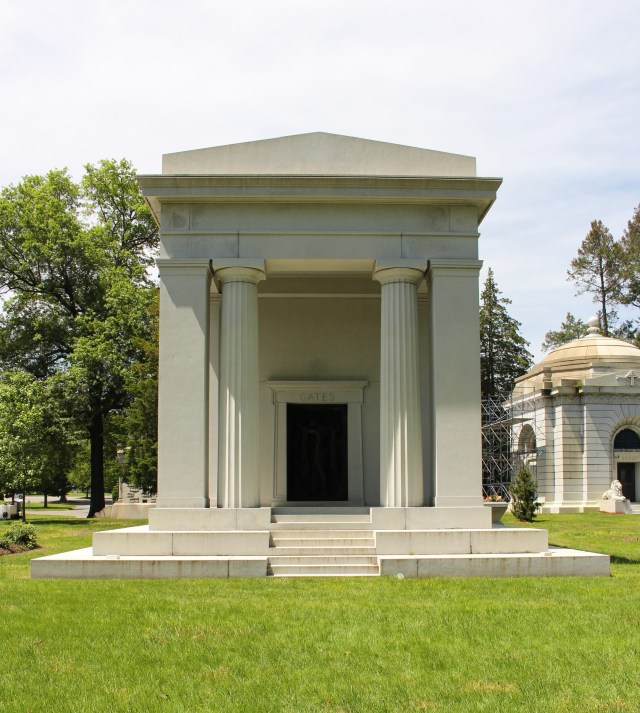
The gray granite mausoleum in the Saint Clairsville, Ohio, Union Cemetery is an example of Neo-classic design in the Tuscan order characterized, in part, by the plain Doric columns and the lack of ornamentation such as triglyphs or guttae.  The Tuscan order was largely a simplified version of the Doric order.  The protruding porch is supported by highly-polished non-fluted columns.  The occupant’s name, David Pursglove, is emblazoned on the architrave.

The tomb displays symbolism inside out—the passionflower, for example, adorns the pediment.  The passionflower was so named by Spanish Christian missionaries because they identified parts of the flower with the Passion of Jesus Christ.

  • Then ten petals represent the ten faithful disciples.  The two apostles who were not considered were St. Peter, the denier, and Judas Iscariot, the betrayer.
  • The filaments that circle the center of the flower represent Christ’s crown of thorns.
  • The curled filaments represent the whips used in flagellation of Christ.
  • The white color was equated with Christ’s innocence.
  • The styles symbolize the nails.

The bronze doors are split into two sections.  The upper section has a wreath overlaid on bars.  The wreath traditionally symbolizes victory over death.

The bottom panels feature inverted torches. The flame is symbolic of the soul.  The inverted torch represents a life that has been extinguished but the soul continues to exist in the Heavenly Realm.

A peek inside the tomb reveals a stunning stained-glass window in the rear of the mausoleum displaying a profusion of red American roses.

Romantics have waxed poetic about the rose and the connection to love for centuries which has made the rose an undeniable symbol of love.  The rose also has a religious meaning, differing by color.  The white rose symbolizes purity while the red rose represents martyrdom and the messianic hope that Christ will return.

Posted in Mausoleums, Symbolism | Leave a comment

Man of Sorrows

Charles Hutchinson

October 3, 1828

August 9, 1893

Emily Smith Hutchinson

February 25, 1833

January 30, 1911

The Hutchinson monument in the Graceland Cemetery in Chicago, Illinois, displays a stylized bronze bas-relief of Christ surrounded by four attendants.  The title of the sculpture is “Man of Sorrows” which is a traditional devotional image that developed in the 13th Century.

This painting by Meister Francke, created around the year 1430, is a traditional rendition of a “Man of Sorrows” image. The painting depicts Christ with the wounds of His Passion. The painting also features four angels attending to the Messiah.

This sculpture differs from the iconic images produced at that time.  The artists of Northern Europe usually depicted Christ naked above the waist prominently displaying the wounds of His Passion often shown wearing the Crown of Thorns and sometimes attended by angels.  Here, Italian-born artist, Alfeo Faggi, depicts a seated Messiah with four attendants but no visible marks from the Passion.

Alfeo Faggi’s sculptures, like many other great artist’s works, can be found in North American cemeteries, including those sculpted by Daniel Chester French, Augustus Saint-Gaudens, Aldabert Volck, Felix Weihs de Weldon, Karl Bitter, Martin Milmore, Alexander Milne Calder, T. M. Brady, Albin Polasek, Harriet Whitney Frishmuth, William Wetmore Story, Edward V. Valentine, Nellie Walker, Lorado Taft, Sally James Farnham, Adolph Alexander Weinman, Solon Borglum, and John Gutzon Borglum, a veritable who’s who in the art world.  These artists were able to earn a living creating sculptures, public and private.

Alfeo Faggi was born in Florence, Italy on September 11, 1885.  He studied art with his father—a fresco painter, as well as, studying at the Academia Belle Arti.  In 1913, Faggi immigrated to the United States to begin his art career.  Faggi is most well-known for his stylized forms and anti-Classical religious sculptures and paintings.  Faggi died October 17, 1966 at Woodstock, New York.

Posted in Symbolism | Leave a comment

In Stone and Iron

The A. C. Peck mausoleum and the Lynes-Peters mausoleum in Green-Wood Cemetery in Brooklyn, New York, both display the winged hourglass symbol prominently.

The Peck mausoleum displays the symbol on the iron gate that guards the entrance to the tomb.  The Lynes-Peters mausoleum has the motif carved on the lintel above the doorway.

There are several expressions in the American lexicon that express how fleeting our time on this Earth is, how this temporal life is short. The grand old soap opera, Days of Our Lives, has as their catchphrase, “Like sands through the hourglass, so are the days of our lives.”  Life measured by the grains of sand slip through one side of the hourglass to the other in a flash.

The hourglass symbol on a gravestone, often shown with wings, as it is in these two examples represent the same thought of time fleeting by quickly reminding us of the expression “Time Flies.”  This symbol, a winged hourglass, brings that expression to life, so to speak.

A reminder in stone and iron that life is short and that time is fleeting, every minute of every day brings one closer and closer to death.

It is also an admonition to us NOT to put off making that phone call to an ailing parent, sending that letter to a distant friend, mailing that birthday card even if it’s a day late, getting that present purchased and wrapped to celebrate an anniversary, or the simple act of telling those who you love that you do before it is too late and time has taken flight.

Posted in Symbolism | Leave a comment

The Cross and the Crown

The stained-glass window in a mausoleum in the Bonaventure Cemetery in Savannah, Georgia, displays a radiant cross and crown. The crown is a symbol of glory and victory over death.  The reward awaits in Heaven where the victor will receive a crown of victory. The cross represents the suffering of Christ and is a universal symbol of Christianity.

Posted in Symbolism | Leave a comment

Walking Past the Mundane

Sometimes we walk by the mundane and pay no attention like I did recently in a cemetery in Kentucky.  Then when I looked across the cemetery, I suddenly spotted a wide variety of basket hangers.

I must admit, I never paid attention to them before, but this cemetery had so many different kinds I found myself walking back through the cemetery just to snap pictures of them.

And, they came in all sorts of shapes and sizes—single hangers, double hangers, or butterflies, birds, hummingbirds, bird houses, and bunnies—oh, my.

Some were adorned with a simple cross, while others looked like lampposts and others were just plain iron rods bent and shaped to hold baskets.

Some may have had religious meaning—like the butterfly—which not only represents the resurrection but also the transformation from life to death and then to the next life.

Others most likely were chosen because the deceased or the family of the deceased just plain liked the design—like with the bird house or the bunnies.

Posted in Uncategorized | Leave a comment

Art Nouveau

The Tiedeman mausoleum in the Bonaventure Cemetery, in Savannah, Georgia, with a rounded roof line is an outstanding example of Art Nouveau design.  The flowing design on the bronze doors exhibit the characteristics of the movement that made it popular.

The Art Nouveau movement was a bridge between Neoclassicism and Modernism and reached its popularity from 1890 to 1905.  Luminary artists such as Alphonse Mucha, Gustav Klimt, and Henri de Toulouse-Lautrec; glass designers Rene Lalique and Louis Comfort Tiffany, and Spanish architect Antoni Gaudi among others used long fluid lines inspired from florals and plants in their work.

Posted in Mausoleums | Leave a comment

It’s all about the business

IN MEMORY OF

FRED WESSELS, SENIOR

WHOSE VISION, FAITH AND COURAGE MADE

THESE COMPANIES POSSIBLE

ATLANTIC MUTUAL INSURANCE COMPANY

SOUTHERN SAVINGS & LOAN COMPANY

ATLANTIC INSURANCE & INVESTMENT COMPANY

Fred Wessels, Senior was born on October 26th, 1879, in Savannah, Georgia, and died July 31st, 1950, in Hendersonville, North Carolina.  He was buried in his hometown in a gray granite Art Deco mausoleum in the Bonaventure Cemetery.

The mausoleum has the horizontal lines and the geometric patterns that are characteristic of the style. Art Deco is a design movement from the 1920s that marked a break from the fluid and flowing Art Nouveau designs of the 1890s. The term ‘Art Deco’ is derived from the Exposition Internationale des Arts Décoratifs et Industriels Modernes, an exhibition of artists that showed their work in Paris in 1925.  Arts Décoratifs was eventually truncated to Art Deco.

Wessels was a successful banker and businessman who wanted to be remembered for founding three insurance and banking businesses.  To make sure passersby were witness to his success a bronze plaque was affixed to the side of the tomb with his bas-relief portrait touting his accomplishments.

Posted in Uncategorized | Leave a comment

Which Bearded Mythological Character Is More Buff?

The face of the Owen and Ann Cwathmey Monument at the Cave Hill Cemetery, Louisville, Kentucky

There are many images of Death at the door.  The question when the door opens is, “Who is knocking—is it the Grim Reaper or is it Father Time?”

The differences between the two are subtle, especially since they are both often seen with the same instruments—the hourglass and the scythe.  The main difference is in body type and clothing.

Father Time is a good eater and, as so, is usually depicted as a portly figure whereas the Grim Reaper spends more time at the gym and is more svelte and in shape—often depicted without a shirt exposing a muscular body.  Swinging the scythe while harvesting souls is a great ab exercise.

Father Time is often depicted wearing a long robe as he ushers out the passing year while the Grim Reaper is seen sporting a cloth around his lower regions.

SENG-EICHER sun dial marker–It is appropriate for Father Time to be on and instrument of Time!

So, now when you hear the knocking, you’ll know the difference when you open the door!

Posted in Symbolism | 1 Comment

Victorian Melange, Take 2


SEBASTIANO ORSINI

BORN IN SIRACUSA, ITALY, FEB. 3. 1873.

DIED IN SAVANNAH, JAN. 9. 1918.

A TRUE AND KIND MAN.  A FAITHFUL

HUSBAND, LIVED A QUITE BUT USEFUL

LIFE, AND DIED REGRETTED BY ALL

WHO KNEW HIM.


SALVATRICE ORSINI

BORN IN SIRCUSA, ITALY

FEB. 21, 1875

DIED IN SAVANNAH, GA.

AUG. 10, 1953

MAY HER SOUL REST IN PEACE

The white marble gravestone of Sebastiano and Salvatrice Orsini in the Bonaventure Cemetery in Savannah, Georgia, is a Victorian mélange of symbolism—the family crest, the wreath, the scrolls, oak leaves circling the column, drapery, and the lion. The gravestone shape itself—the broken column—is a symbol.   The broken column iconography represents a life ended.  The broken column symbolizes a life cut short. Some sources say that it represents the loss of the head of the family—others that it represents the life cut down in its prime.

This elaborately carved gravestone was carved by Antonio Aliffi (188-1936) who was a well-known sculptor.  According to a book titled, Historic Bonaventure Cemetery: Photographs from the Collection of The Georgia Historical Society. Copyright 1998 by Amie Marie Wilson and Mandi Dale Johnson, Arcadia Publishing, Charleston, SC. Aliffi was born in Sicily, and descended from a long line of Italian sculptors.  Aliffi was hired to work for Walz  who owned a marble yard.  According to the book, “Aliffi was a very busy sculptor, working on projects in Savannah and around the country.  He is reported to have carved on Georgia’s Stone Mountain and Mount Rushmore in South Dakota, as well as on the ceiling of Savannah’s Lucas Theater.”

According to Historic Bonaventure Cemetery: Photographs from the Collection of The Georgia Historical Society,  “Sabastian Orsini (1873-1918) was also an Italian immigrant.  He came to Savannah around 1898 and along with several brothers was involved in the grocery business.  From 1912 to 1915, the Savannah City Directory listed him as proprietor of the Savannah Macaroni Works.”

The symbols:

Wreath

The wreath’s shape—the circle—represents eternal memory and immortality.  The wreath’s use dates back to Greek and Roman times when soldiers wore them as triumphal signs of glory.  The ancients also awarded poets and athletes wreaths as a prize.  In funerary art the wreath is seen as a symbol of victory over death.

Lion

The lion has long been a symbol of bravery, strength, and majesty. In popular culture, the lion is known for its power and is called King of the Jungle and King of the Beasts.  The lion is often used as a royal emblem, found eight times in the Royal Arms for the Queen of England alone!  The lion in funerary art symbolizes the power of God. It is often depicted flanking the entrance of a tomb to guard against evil spirits to the passageway to the next realm. It also represents the courage of the souls the lions guard. There is also a connection of the lion to the Resurrection. It was once believed that lion cubs were born dead but would come to life after three days when the cubs were breathed upon by a male lion. The three days is significant because it is the number of days Jesus was in the tomb before he was resurrected.

The base that the lion stands on has four initials inscribed on its base: O. F. D. I.  Two different readers supplied an answer to the meaning of the initials: Ordina Figli D’Italia or “The Sons of Italy.”  Often a member of that fraternal organization will have a metal marker with the symbol of the lion in the center to mark their membership.  Orsini’s grave did not have the marker below as the symbol was carved into the face of his gravestone.

Drapery

Some sources say that drapery with a fringe represents the veil between one realm and another—Earth and Heaven.

Scroll

The scroll represents both the life of the deceased and the time spent on Earth. The scroll is unfurled, most likely representing the life that is being recorded by the angels.

Oak leaf

According to an industry publication, The Monumental News, “The Oak is representative of Firmness and Strength while the Ivy symbolizes Memory and Friendship.  From this the reader will understand why the oak and ivy are so often arranged in a single memorial design.  The sturdy oak for Father and the clinging ivy for Mother, representing impregnable friendship, devotion and lasting memory.”

Posted in Metal Markers, Symbolism, Uncategorized | 4 Comments

The Angel in the Boat Redux

[?] MAY 7TH 1880 — OBIT DECEMBER 1St 1906

A PERFECT AND UPRIGHT MAN

TO THE GLORY OF GOD

IN LOVING MEMORY OF

BERT HOOF

LATE VALUED AND ESTEEMED OFFICER OF DALGETY & COY

VICE CAPTAIN MERCANTILE R CLUB

ACCIDENTLY [sic] DROWNED IN RIVER YARRA

THIS STONE IS ERECTED

AS TOKEN OF UNDYING AFFECTION

BY HIS AUNT FLORENCE PICKERING

ALSO IN LOVING MEMORY OF

ANN RELICT OF JAMES HOOF OBIT 1891

DARLING GRANDMA

Not far from the main gate of the Melbourne General Cemetery, Melbourne, Australia, on College Crescent, to the right on First Avenue, is a gravestone dedicated to Bert Hoof.  The epitaph does not tell the circumstances of his accidental drowning on the Yarra River, but on this gravestone Bert Hoof is depicted as an angel holding up the mast of the tiny boat.

My friend and super sleuth, Meredith, reads my blog and decided to see if, with a little digging, she could uncover more details about the accidental death of Bert Hoof.  She found the following article in the Saturday December 8, 1906 edition, of The Independent on page 2:

THE RIVER TRAGEDY

The circumstances surrounding the death of Mr. Albert Edward Hoof, the victim of last Saturday’s boating accident on the river Yarra during the course of the rowing matches were investigated by the district coroner (Dr. Cole), at the Footscray morgue, on Monday, and Melbourne morgue on Tuesday.  In his finding, the coroner … the deceased died from asphyxia by drowning.  He had not been struck on the head or injured in any way.  He had stepped out of the boat, in spite of the fact that Mr. Warburton had told him to sit still, and that there was no danger.  It was evidently a case of where a man had lost his nerve.  The condition of the host appears to have been bad, and the deceased could not swim.  There was a notice in the Mercantile Club’s sheds to the effect that nobody unable to swim should go out in single sculling boats.  That notice might well be extended to apply to other boats.  It was very necessary that all men should learn to swim, and especially those who went on the Yarra.  The incident of the Assistant Harbour Master, speaking to Fawcett (who was diving in the nude), and telling him that ladies were present on the boat, was regrettable.  He was sure no regretted it more than the Assistant Harbour Master himself.  Modesty was a very good thing in its way: but modesty should never interfere with the chance of saving human life.  A word of praise was due to Messrs. Brown and Fawcett, who had risked their lives in the endeavour to save the deceased.  The coroner then recorded the following verdict:–“I find that on 1st December, at the junction of Coode’s Canal and the River Yarra, Albert Edward Hoof was accidently drowned.”

Posted in Angels | Leave a comment