The Helmet

ALEXANDER MACOMB

MAJOR GENERAL COMMANDING-IN-CHIEF

UNITED STATES ARMY

DIED AT WASHINGTON

THE SEAT OF GOVERNMENT

25 JUNE 1841

IT WERE BUT A SMALL TRIBUTE TO HIS MEMORY TO SAY THAT IN YOUTH AND MANHOOD, HE SERVED HIS COUNTRY IN THE PROFESSION IN WHICH HE DIED, DURING A PERIOD OF MORE THAN FORTY YEARS, WITHOUT A STAIN OR BLEMISH ON HIS ESCUTCHEON.

BY GENERAL ORDERS OF WAR DEPARTMENT

THE HONORS CONFERRED UPON HIM BY PRESIDENT MADISON, RECEIVED ON THE FIELD OF VICTORY FOR DISTINGUISHED AND GALLANT CONDUCT IN DEFEATING THE ENEMY AT PLATTSBURG AND THE THANKS OF CONGRESS BESTOWED WITH A MEDAL COMMEMORATIVE OF THIS TRIUMPH OF THE ARMS OF THE REPUBLIC ATTEST THE HIGH ESTIMATE OF HIS GALLANTRY AND MERITORIOUS SERVICES.

GENERAL ORDERS OF WAR DEPARTMENT

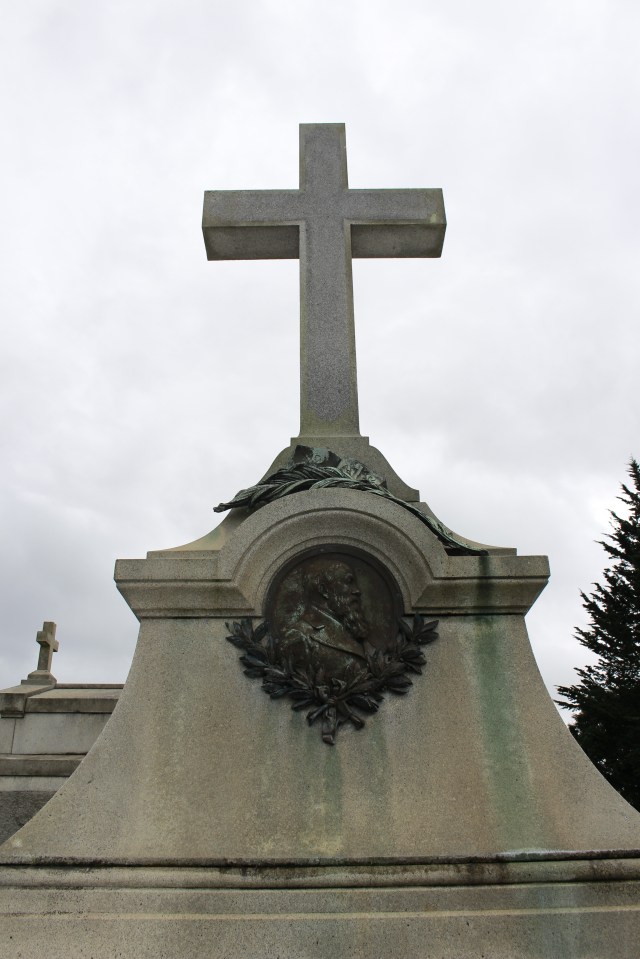
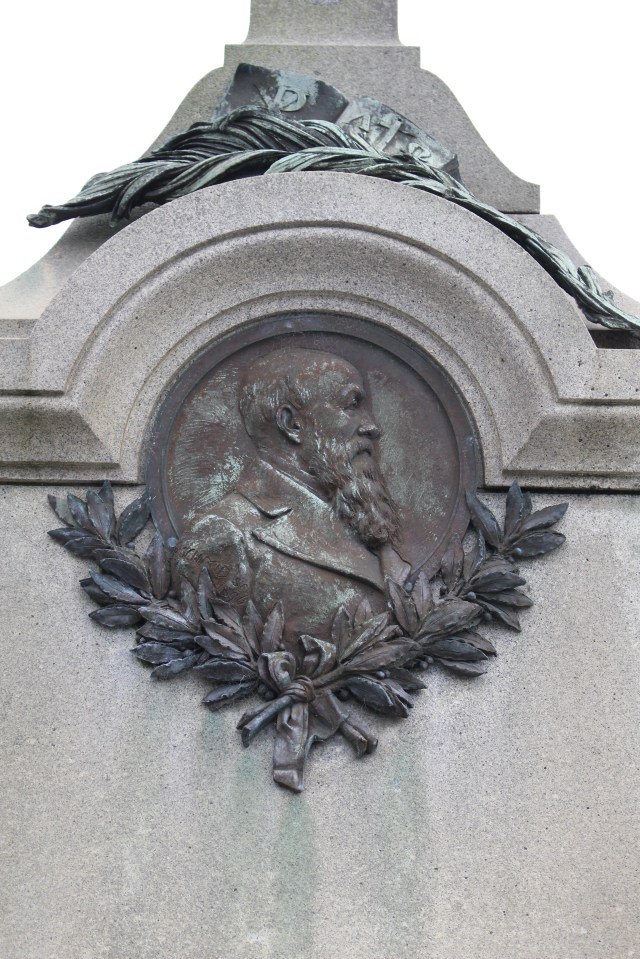
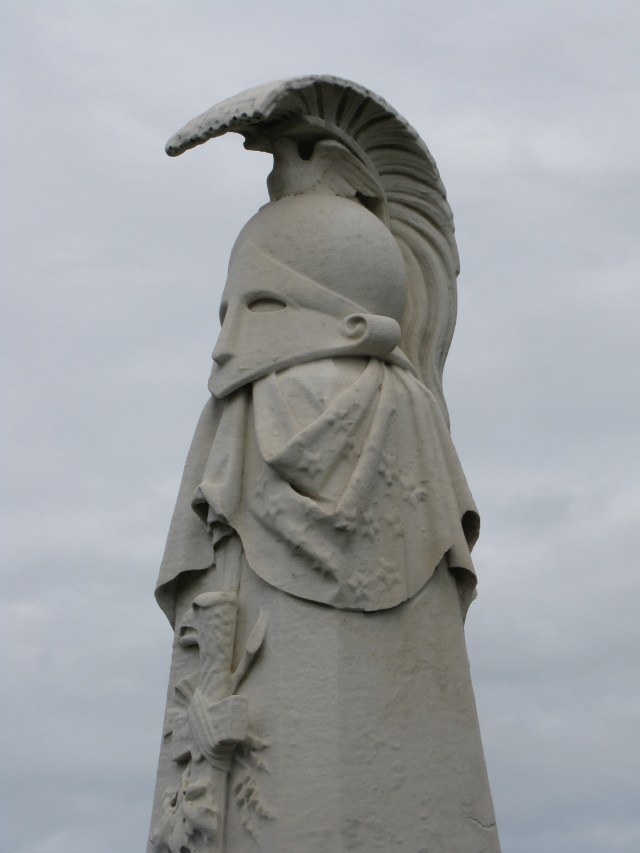
The elaborate and soaring white marble grave marker of Major General Alexander Macomb is adorned with several symbols—a winged hours glass, a butterfly, and topped with an ancient-styled helmet—Roman, Corinthian, or Macedonian.  In this case, as most, the helmet denotes military service.  Here, it honors the proud and gallant military service of Major General Macomb’s leading several successful missions against the British during the War of 1812.

Posted in Symbolism | Leave a comment

The Mighty Cannon

The Mighty Cannon

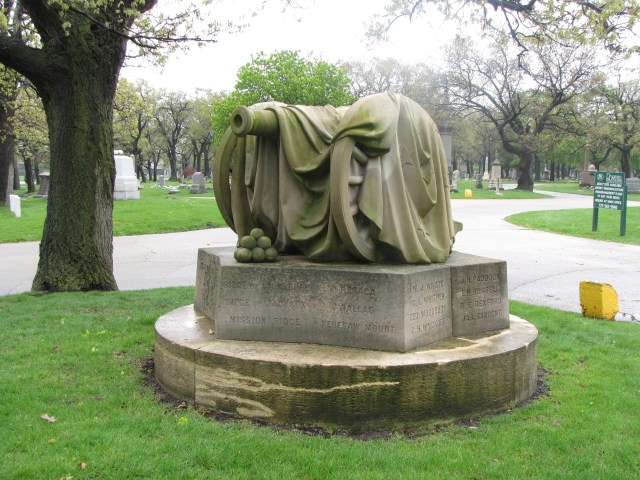
Near the entrance of the Rosehill Cemetery in the Northside of Chicago is a monument dedicated to Battery A of the Chicago Light Artillery unit.  According to a newspaper account from the time of the dedication, the monument was designed by artist Leonard Volk to commemorate the “first soldiers who left Chicago to take part in the War of the Rebellion.  The company was formed by Capt. James Smith, and left for the front on the 21st of April 1861.  In the will of the late Capt. Smith, a bequest of $2,000 was made for the purpose of erecting the monument.

The monument of a flag-draped cannon is carved out of sandstone.  The monument lists the names of the battles in which the unit fought and lists the names of the soldiers who lost their lives in those battles.  Here the cannon is at rest, draped in the national symbol of the American flag.  The country was at peace afterwards.  Like the other cannons in cemeteries throughout the country, the cannon is a symbol of military service, of patriotism, and of sacrifice.  Like so many other symbols, however, found in the cemetery, the cannon, depending on positioning can take on other meanings.


The Upright Cannon

SACRED

TO THE MEMORY OF

JOHN T. McLAUGHLIN

A LIUETENANT

IN THE NAVY OF THE U. STATES

DIED JULY 6, 1847 AE 35 YEARS.

The John McLaughlin monument in the Congressional Cemetery in Washington, D.C. is in the shape of an upright cannon resting on a base of cannon balls.  The upright cannon symbolizes that the region is now at peace.

The Crossed Cannon

On the gravestone of Major Robert Low Bacon (July 23, 1884 – September 12, 1938) in Arlington National Cemetery are two crossed cannons displayed in the tympanum of the rounded-top light gray granite tombstone.  As one might expect when they happen upon a gravestone that has crossed cannons carved into the stone, it is most likely an indication of a soldier who served in an artillery unit.  In fact, Bacon served in an Army artillery unit in World War I.

Straight Cannon

LIEUT. COL. GEORGE F. LEPPIEN.

REGt. MAINE MOUNTED ARTILLERY.

MORTALLY WOUNDED AT

CHANCELLORVILLE

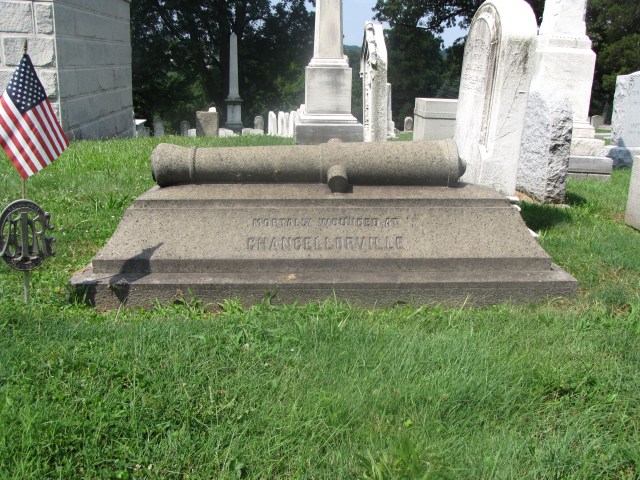
Here at the Laurel Hill Cemetery in Philadelphia, Pennsylvania, is the gravestone of Lieutenant Colonel Lippien who was killed at the Battle of Chancellorsville.  He, like the cannon carved atop of his monument, was laid to rest.  The symbolism of the cannon is clear, the cannon was stilled as was the brave soldier.

A Real Cannon

ROBT. R. STRONG

1842 – 1924

HELPED TO DEFEND THE FLAG OF THE UNITED STATES IN THE FOLLOWING BATTLES:

FORT DONELSON ON THE TENN. SHILOH. STONE RIVER. CHICAMAUGA GA.

MISSION RIDGE TENN. RESACA GA. KENNESAW MOUNTAIN

ATLANTA. FRANKLIN TENN. NASHVILLE

A VETERAN VOL. CO. G 31 REG. INDIANA INFT.

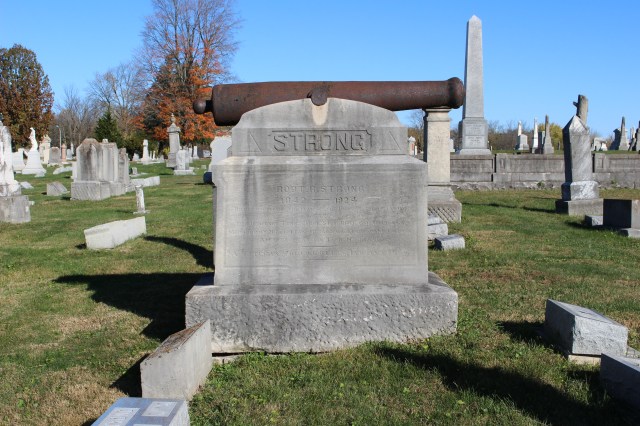
In the Rosehill Cemetery in Bloomington, Indiana, is the commanding marker of Robert Strong, a veteran of the Civil War.  Topping off his monument is a real disabled cannon.

Posted in Symbolism | Leave a comment

Second Burial

SACRED TO THE MEMORY

OF

FREDERICK A. RAUCH

FIRST PRESIDENT

OF MARSHALL  COLLEGE

BORN IN KIRCHBRACHT

JUL 27, 1806

DIED AT MERCERSBURG

MARCH 2, 1841

Frederick Augustus Rauch, was the first and founding president of Marshall College in Lancaster, Pennsylvania, which later merged with Franklin College to become Franklin & Marshall College.  Rauch was a German-born biblical scholar who graduated from the University of Marburg.  At the very young age of 24, Rauch was appointed to a full professorship at the University of Heidelberg.

Due to his political views, Rauch fled from Germany to the United States in 1831. After he landed in the U.S., Rauch served, for a short time, as a professor of German at Lafayette College. He then took a position at the German Reformed Church at York, Pennsylvania.  After his ordination, Rauch was appointed professor of biblical literature in the theological seminary at York. In 1835, he moved to Mercersburg to lead an academy that was eventually transformed into Marshall College.

Dr. Rauch was remembered affectionately.  According to A EULOGY: Delivered on Occasion of the Re-Interment of His Remains at Lancaster, PA., March 7th, 1859 by Rev. John W. Nevin, D.D., published by M. Kieffer & Co., 1859, Chambersburg, Pa., his colleague remembered him, “As a scholar, [who] excelled particularly in Classical Literature, in Natural History, in Moral Philosophy and in Mental Science.  He was at home also int eh sphere of Aesthetics, and had his mind richly stored with the creations of genius as they belong to the fine arts generally.  The German Philosophy with all its bewildering abstractions, was for him the subject of full, familiar knowledge; while it commanded also his general confidence and respect.”

Rauch died on 2 March 1841 and was buried in Mercersburg in the grove on the grounds of the College.  After the consolidation of Marshall College and Franklin College, in the Spring of 1853, “the Alumni Association discussed the question of the removal of the remains of Doctor Rauch from Mercersburg to Lancaster, and in July, 1855, took the following actions:

Whereas, since the removal of Marshall College to Lancaster and the sales of College property at Mercersburg, the remains of the venerated Dr. Rauch, the first President of Marshall College, lie alone, and are liable to exposure and abuse; and

Whereas, it is proper that the honored remains should lie near the spot to be occupied by the new College edifice; and finally,

Whereas, the relatives of the deceased President, have, upon consultation, acquiesced in any proper measure, which may be devised for the removal and suitable consignment of his remains….”

Ruch’s tomb was to “bring… the contents of that honored grave to Lancaster; that being solemnly committed here to a new tomb, and crowned with new marble, they might be outwardly and openly joined henceforward with the living history of the College in its new form.  Let the city of Lancaster welcome these illustrious remains.”

Rauch has a towering white-marble column that is now badly weathered.  The facial details of the figure has eroded.  Many of the other sculptural details in the bas-relief in the plinth are being lost.  However, it is still clear that the tableau is that of an educator surrounded by shelves of books and a globe at his feet—the professor’s tools of his trade so to speak.  In the scene, Dr. Rauch sits at a desk with an open book for his review while he is poised with a writing utensil.  A fitting tribute to venerable scholar.

Posted in Famous graves | Leave a comment

His Empty Cradle


JOSEPH DENNIS

WING

JUNE 20, 1909

MARCH 5, 1912

A little time on earth he spent

Till God for him his angel sent.

For me, the most poignant and tender gravestones are those for children because in the sweep of life, parents are not to outlive their babies.  It is not the natural order.  And what could be more sad than losing a child?

Here is the gravestone of Joseph Dennis Wing, not yet three years old, buried in the Oakland Cemetery in Atlanta, Georgia.  Many different symbols are used to denote a child on a gravestone: a lamb, a hanging bud, a chubby little cherub, a dove with a broken wing, a pair of baby shoes.

But carved into the top of the gray marble gravestone for Joseph is an empty cradle.  The image is chilling.  The cradle is empty, the toddler’s voice is stilled.  One can only imagine that the home was filled with emptiness.


Posted in Children's Graves, Symbolism | Leave a comment

Flatware and Bronze Doors

The doors to mausoleums are often imbued with symbolism.  In fact, the door itself represents a portal.  Portals come in many forms—a door, a window, even your eyes and your mouth are considered portals.  Many superstitions about death concern portals, many of which come from the Victorian Age, some of which still exist today.

The eyes, for instance, are considered the windows to the soul. Victorians believed the eyes were powerful, almost magical, even in death. When a person died therefore, the body had to be removed from the home feet first (most people died at home in the 19th Century). In that way, the eyes of the deceased could not look back and lure a live person to follow the dead through the passageway to death.

The Victorians also believed that as you passed by a cemetery that you needed to hold your breath. The fear was that if one opened one’s mouth, that a spirit from the dead residing in the cemetery would enter your body through the portal—the open mouth.

Another superstition had to do with the mirrors in the home. After a death, the family very quickly covered the mirrors. It was believed that mirrors were false portals in a sense. The Victorians believed that the spirit of the dead could enter a mirror and become trapped in the mirror. If the spirit did so, it would not be able to complete its trip through the passageway from the Earthly realm to the Heavenly realm, or in some cases, to warmer climes.

The door as a motif in funerary art symbolizes mystery.  The door is the portal from the Earthly realm to the next. In Christianity, the door is usually viewed with hope, charity, and faith.  The next life in the hereafter will be better than the one experienced here on Earth.

The door pictured here was created for the Charles B. Bohn mausoleum in Detroit’s Woodlawn Cemetery by Rhode Island artist, Philip Bernard “Ben” Johnson.  Johnson was a long-time sculptor at the Gorham Silver Company and Foundry for over 50 years.  While working at Gorham, Johnson created Silver place settings, flatware, tea sets, and doors.

The bronze door features a classically dressed and draped mourning figure standing with her head bowed, tentatively waiting in somber silence.  In David Robinson’s book, Saving Graces, he describes these figures as “grieving women who signify how deeply the deceased is missed.  As symbolic mourners, their idealized beauty is spiritual, representing purity, passion, and commitment…But these women also serve as escorts on the journey ahead. 

With her other hand the mourning figure is lifting part of her garment uncovering part of her face.  The veil represents the partition that exists between the Earthly realm and the Heavenly one–between life and death.  Again, this door has two main symbols—pine cones and leaves and laurel leaves.  The bottom of this door has one additional symbol nestled in with the laurel branches—the Easter lily. The Easter lily, as a funerary symbol, has many meanings including purity, innocence, virginity, heavenly bliss, majestic beauty, and Christ’s resurrection.  Christians believe that the trumpet-shaped blossoms announce the Resurrection of Jesus Christ.   The Easter lily has long been associated with the Christian religion, commonly referred to as “White-Robed Apostles of Christ.” Early Christians believed that lilies sprouted where Jesus Christ’s sweat fell to the ground in the Garden of Gethsemane.

Posted in Saving Graces, Symbolism | Leave a comment

…that immortal sea…

Anna Dorinda Blaksley Barnes Bliss

1851-1935

Anna Bliss was a generous benefactor to many charities including the Metropolitan Museum of Art and Museum of Natural History in New York and the Cottage Hospital in Santa Barbara, California.  Mrs. Bliss was also a supporter of the suffragette movement and donated over a half a million dollars to the League of Political Education.

When her niece, Cora Barnes, fell to her death, Anna Bliss held a secret competition to create a memorial in the Woodlawn Cemetery in the Bronx to commemorate her life.  The competition was unusual.  Most patrons or their estates chose the sculptors themselves.  Each of the six artists were given photographs of the lot on which the memorial would stand.  Robert Aitken’s design was chosen.

The book, Sylvan Cemetery: Architecture, Art, & Landscape at Woodlawn, described the memorial as “The two figures … of heroic size … symbolical of the soul leaving the body, the … figures are of Faith and Hope.  The spirit-forms of a man and a woman, carved by the Piccirilli Brothers from Aitken’s model, stand atop a low curving bench, with spiral forms at each end, suggestive of flowing water.  Chiseled on the bench is the quotation, “Our soul has sight of that immortal sea which brought us hither.” Which comes from William Wordsworth’s ode, Imitation of Immortality from Recollections of Early Childhood. In the poem, the lines suggest that our soul can reconnect with the formless, timeless realm from which we arrived as infants, when we were closer to the celestial before engaging the material world.”

The cinerarium in the back of the monument holds the ashes of Cora Barnes and Mrs. Bliss.

Posted in Famous graves, Symbolism | Leave a comment

Stained Glass Pieta

Many mausoleums have a window in the rear part of the tomb—often made of stained glass. Many of these windows are hand painted works of art, most often depicting religious symbolism or religious figures.

This stained glass and hand-painted window features the Virgin Mary and the dead body of Jesus Christ, known as a pieta.  Works of art, usually sculptures, depicting this subject first began to appear in Germany in the 1300’s and are referred to as “vesperbild” in German.  Images of Mary and the dead body of Jesus began to appear in Italy in the 1400’s. The most famous of these sculptures is Michelangelo’s pieta which he sculpted for St. Peter’s Basilica in the Vatican, carved when he was only 24 years old.  Pieta is Italian for “pity.”  The scene in this window is reminiscent of the sculptures that were first popularized in Germany depicting the Lamentation.

Here The Virgin Mary tenderly holds the limp and dead body of Jesus Christ, clutching Him close, Her head bowed in sorrow.

In the Heilbrunn Timeline of Art History (http://www.metmuseum.org/toah/works-of-art/2001.78 (October 2006)) a Bohemian Pieta on display at the Metropolitan Museum of Art is described in details that as easily could apply to this window from a mausoleum in the Woodlawn Cemetery in the Bronx, “Images of the Virgin with the dead Christ reflect late medieval developments in mysticism that encouraged a direct, emotional involvement in the biblical stories… The sculptor exploits the formal and psychological tensions inherent in the composition…Christ’s broken, emaciated body, naked except for the loincloth, offers a stark contrast to the Virgin’s youthful figure, clad in abundant folds.”

Posted in Symbolism | Leave a comment

Escorts on the journey ahead

The modest mausoleum in the Woodlawn Cemetery in the Bronx was built for Charles Waite Waller (March 20, 1870-January 19, 1927) and his wife, Rose Ann Hutchcroft Waller.  Charles was born in the tiny coastal village of Anderby, England, with the original name of Whaler, which he later changed to Waller.  Waller was the financial officer and vice president for the United Hotel Company.  According to the January 20, 1927, Washington, D.C. Evening Star, (page 16), Waller was a hotel finance expert who died at the age of 56.  In addition to his work at the hotel company, Waller was long interested in electrical power and was associated in business with General Electric for over 15 years.  Waller died during a business conference he was conducting in his home.

The building is a plain unpolished gray granite tomb with a curved pediment as its only adornment.   The focal point of the mausoleum is the door which was created by Austrian-born artist Julius Loester.  Loester (April 12, 1861—July 20, 1923) was the son of Josef and Wilhelmine Loester who, like many artists at the time, took private and public commissions.

The figure Loester created for the Waller Waite mausoleum is like so many of the doors for tombs, it features a classically dressed and draped mourning figure standing with her head bowed, tentatively waiting in somber silence.  In David Robinson’s book, Saving Graces, he describes these figures as “grieving women who signify how deeply the deceased is missed.  As symbolic mourners, their idealized beauty is spiritual, representing purity, passion, and commitment…But these women also serve as escorts on the journey ahead.  As designated companions in eternity, they are posted there to watch over and take care of the deceased.  Forever present, they are also forever young…these women symbolize the aspiration of eternal life, not the acceptance of death.  They may grieve, but they also comfort, and in this role, their beauty is more sensual than spiritual.”  Robinson notes that these mourning figures are “Pure on the one hand, sensual on the other, idealized yet lifelike…a very human combination of spiritual devotion and earthly desire.”

Loester took commissions for funerary monuments.  For instance, he created the doors for the Winter Mausoleum in the Allegheny Cemetery in Pittsburgh and the door for the Woolworth Mausoleum in Woodlawn Cemetery.  But He also received commissions for innovative and new sculptural projects.  An article titled, “Models in Miniature: A New Device of Architects to Prevent Disappointment of Owner,” in the New York Tribune from November 16, 1902, states that millionaires building palatial homes in Manhattan were often disappointed once the house was built because they didn’t really understand the plans they looked at when the blueprints were drawn up.  According to the article, innovative artist Julius C. Loester took the plans and constructed a plaster scale model of the house so the owners could see in 3-D what their house would look like thereby preventing disappointment.

He also won some major public commission work, such as the contract for the creation of the statuary for the Liberal Arts Building and the Horticulture Building at the Trans-Mississippi International Exposition of 1898 in Omaha, Nebraska.

Posted in Mausoleums, Saving Graces | Leave a comment

Double Take

The Egyptian Revival was an architectural movement that swept the United States and Europe.  The movement in America was influenced by three separate events—the first was Napoleon’s defeat of Egypt in the 1790s.  Later Napoleon published the results of his scientific expedition, which was printed in serial form, the last released in 1826.  The second event was when the so-called “Cleopatra’s Needle” was erected in Central Park in New York on February 22, 1881.  Lastly, “Egypto-mania,” as some called it, reached fever pitch in November 1922 when King Tut’s tomb was discovered, and the news flashed around the world.

The influence of the Egyptian Revival was reflected in buildings in the United States as early as the 1820s.  The revival was also found in American cemeteries in the 19thcentury and on into the 20th century. Egyptian ornamentation can be divided into three categories—architectural, geometric, and natural.

One example of a mausoleum that was Egyptian Revival-style architecture was the F. W. Woolworth (of five-and-dime department store fame) Mausoleum in Woodland Cemetery in the Bronx built by the Farrington, Gould, and Hoagland Monument Company.  According to the book, Sylvan Cemetery: Architecture, Art, & Landscape at Woodlawn, (page 107) “Egyptian themes inspired mausoleum doors, such as the one designed by Julius Loester for the Woolworth mausoleum, with costume, birds, and flowers intended to signify ancient Egypt and its enduring mysteries .”

The door to the Woolworth Mausoleum.

The door to the Winter Mausoleum.

According to a flyer published by the Allegheny Cemetery Historical Association in Pittsburgh, Pennsylvania, an exact replica of the Woolworth Mausoleum was built for Emil Winter.  Winter was an “industrialist, banker, and founder of The Pittsburgh Steel Company, making him a man of vast  wealth…Living in New York City in his later years, he saw the Egyptian-style Woolworth family Mausoleum in Woodlawn and had an exact replica made for him in 1930 for his own lot in the Allegheny Cemetery.”  Even the door created by Julius Loester adorns the Winter Mausoleum.

The Winter Mausoleum sphinx.

The two gray granite mausoleums have strong and commanding architectural features. The sides of the tombs tilt slightly inward from the bottom to the top.  Rather than a traditional cavetto cornice curves which forms into a half circle at the top, the tomb has an architrave with a repeating reed pattern. The pediment rises very slightly to a peak.  The monument is geometrically balanced—two sphinxes flank the tomb.

The natural elements of the monument feature two winged globes with uroei above the doorway and on the cornice. In these examples there are three sets of falcon wings that are a symbol of the king, the sun, and the sky. The globe represents the Egyptian god, Horus. The uroei, snakes, are waiting to strike. They symbolize the king’s ability to ward off evil spirits.

Along the sides of the doorway are the long slender stems of the lotus flower, sacred to the Egyptian and Buddhist cultures. The Lotus represents purity and evolution. The lotus is born in the water, the primordial ooze—making it also a symbol of creation and rebirth.  Etched into the columns are incised scarabs and ankhs—both symbols from ancient Egypt.  The scarab beetle was represented the cycle of life—rebirth and regeneration and the ankh as the key to eternal life.

The monument gives one the sense of solemnity and a sense of eternity, reminiscent of the temples of the pharaohs.

The Winter Mausoleum.

Posted in Mausoleums, Symbolism | Leave a comment

James Cash Penny, Jr.

The light gray granite mausoleum belongs to J. C. Penny (September 16, 1875 – February 12, 1971) the American businessman and department chain founder that bears his name.

The mausoleum is relatively plain, except for the elaborate repeating pattern surrounding the entryway that serves as a frame for the sculptured bronze door that features a classically draped mourning figure.  A circle of oak leaves and acorns forms a halo around the bowed head of the   melancholy woman.  One hand is bent and resting on her shoulder, while the other clutches a flower, as if it might be an offering.

The door as a motif in funerary art symbolizes mystery.  The door is the pathway from the Earthly Realm to the Heavenly Realm.  In Christianity, however, the door is usually viewed with hope, charity, and faith—the next life will be better.

The door was created by artist Oronzio Maldarelli, the son of Louisa Rizzo and Michael Maldarelli, Italian immigrants who came to America in 1901 when eight or nine years old.   Oronzio’s father, Michael, was a goldsmith.  Oronzio showed early promise as an artist and took lessons at the Cooper Union before enrolling at the National Academy of Design.  Maldarelli enjoyed a long career as a successful and award-winning sculptor whose commissions included architectural sculpture, his own free-standing works, and funerary designs.  He taught at Sarah Lawrence College and Columbia University.  This bronze door is signed in the lower right hand corner of the door by the Maldarelli.

Posted in Mausoleums, Saving Graces | 1 Comment