“His Accidency”

JOHN TYLER

PRESIDENT

OF THE

UNITED STATES

1841 1845

BORN

IN CHARLES CITY COUNTY VA

MARCH 29 1790

DIED

IN THE CITY OF RICHMOND

PRESIDENT JOHN TYLER

MARRIED FIRST

LETITIA CHRISTIAN

BORN NOVEMBER 12 1790

DIED SEPTEMBER 10 1842

INTERRED AT CEDAR GROVE

NEW KENT COUNTY VA

MARRIED SECOND

JULIA GARDINER

BORN 29 1820

DIED JULY 10 1889

INTERRED BY HIS SIDE

UNDER THIS MONUMENT

On President’s Day most people, if they are thinking about presidents at all, other than the weekend sales events, most likely think of the current occupant of the White House or the presidents who have served during their lifetime.  Some, of course, think of the most notable presidents, such as Abraham Lincoln, Thomas Jefferson, Theodore Roosevelt, Franklin Roosevelt, or John Kennedy.  Some think of our greatest and first president, George Washington.  Afterall we wouldn’t have a Republic without Washington and the current holiday was born out of national celebrations for his birthday—February 22.  After Washington’s death, beginning in 1800, unofficial remembrances were held to honor and celebrate Washington on his birthday each year—this didn’t become an official national holiday until 1885.  Then in 1971, under the Uniform Monday Holiday Act—to create more three-day holidays—George Washington’s birthday was officially to be celebrated on the third Monday in February.  Hence Presidents’ Day was born.

But who thinks of the lesser known presidents on Presidents’ Day, such as William Henry Harrison, Martin Van Buren, Rutherford Hayes, or Chester Arthur, names few Americans would even be able to conjure up?  Or how about John Tyler?

John Tyler was our tenth president and notable in many ways.  First, Tyler could have been given the moniker of “Father of his Country”—he had 15 children after all!  Tyler was also the first president to ascend to the office upon the death of a president.  Wiliam Henry Harrison, of Tippecanoe and Tyler, too-fame and the oldest man elected to the office at the time, gave his inaugural address in the rain—as a show of vigor.  He caught cold which turned into pneumonia and a month later Harrison was dead.  Tyler became president.  Many believed that since he was not elected to the office that he did not have all the rights to carry out the duties of president.  At the time, many political wags referred to him as “His Accidency.”  Tyler was not popular even with members of his own Whig party. Over a dispute about re-establishing the National Bank, all his cabinet members except Daniel Webster resigned. An angry mob gathered at the White House and hurled stones at the building along with epithets.  An impeachment resolution was introduced in the House of Representatives, but it didn’t go any further than a Congressional investigation.  On his last full day as president Congress overrode his veto of a bill—the first override in American presidential history.

If all of that wasn’t enough to assign Tyler to the dustbin of presidential history, once the Civil War began, Tyler sided with the Confederate States.  He was even elected to the Confederate House of Representatives.  A premature death kept him from taking his seat. He died in Richmond, Virginia, where he was buried.  His coffin was draped with the Confederate flag and Confederate flags in Richmond were lowered to half-staff.  Tyler may be one of the most unpopular presidents in our history, though, he never sought popularity.  In fact, he once said, “Popularity, I have always thought, may aptly be compared to a coquette—the more you woo her, the more apt is she to elude your embrace.”

Tyler is buried in the famed Hollywood Cemetery in Richmond, Virginia. Tyler’s monument is a soaring granite shaft topped with a bronze urn with eagles back to back.

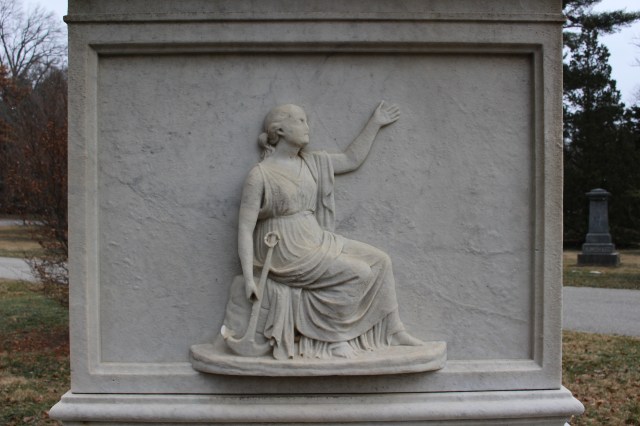
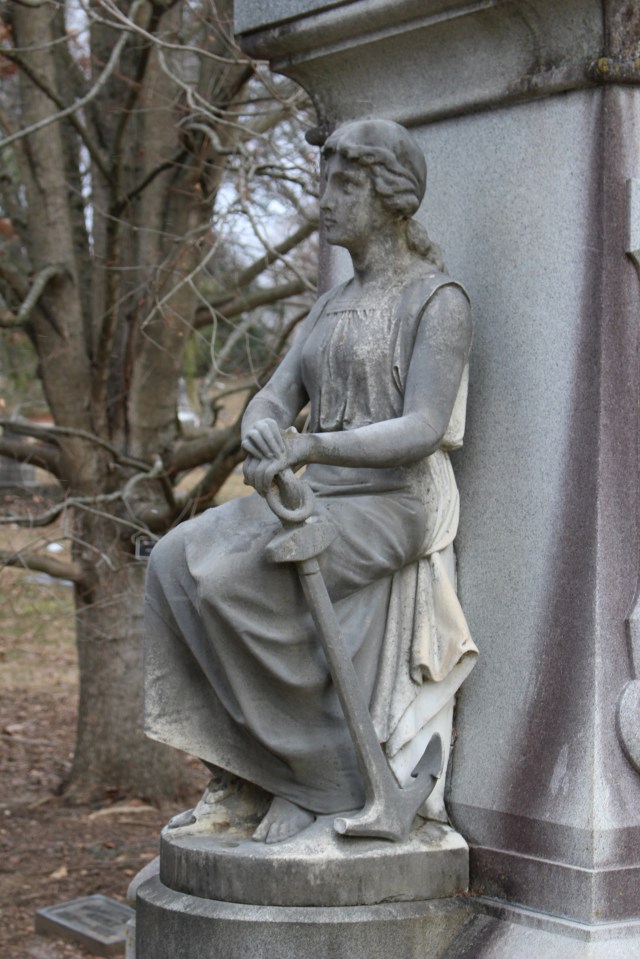
On one side of the column is the allegorical figure of Memory standing next to the “Tree of the Republic” with her left hand holding a laurel wreath.

The other side of the column depicts an allegorical figure with her hand around a mace and in the other hand she holds a twig while balancing a shield bearing the seals of the United States and the Commonwealth of Virginia.

In the center of the monument is a bronze bust of Tyler sculpted by Raymond Averill Porter (1883-1949).

Porter was a teacher and sculptor well known for his sculptures, monument, and medallions.

Posted in Presidential graves, Symbolism | 1 Comment

Hoosier Artist

HENRY W LAWTON

MAJOR GENERAL – U S V

BORN MARCH 17, 1843 DIED DEC. 19, 1899

KILLED IN ACTION PHIIPPINE ISLANDS

MARY C LAWTON

WIFE OF HENRY W LAWTON

The Henry Ware Lawton marker is in the Arlington National Cemetery at Arlington, Virginia, on what was at one time the Robert E. Lee plantation. The Smithsonian sculpture database notes that the Lawton monument was created by sculptor Myra Reynolds Richards (1881-1934).

Richards was an Indiana-born sculptor and teacher. She studied at the Herron Art Institute in Indianapolis, in New York under famed artist Isidore Konti, and at the Academie Scandivave in Paris.  Her most notable works were created and exhibited in Indiana:

A statue of James Whitcomb Riley, the famous Hoosier poet, which was unveiled at the Hancock County courthouse at Greenfield, Indiana, in 1918;

The Murphy Memorial Drinking fountain at the Carroll County Courthouse, also in 1918;

The Juliette V, Strauss statue in the Turkey Run State Park near Marshall, Indiana;

The Bird Boy unveiled in 1924 for the Columbus Central Middle School; and two works that were stolen—Pan and Syrinx created for the Depew Memorial Fountain in Indianapolis.

However, like many great artists of the day, such as, Robert Ingersoll Aitken, Karl Bitter, John Gutzon Borglum, Solon Borglum, Jeptha Barnard “Barney” Bright, Jr., T. M. Brady, Alexander Milne Calder, Jay Hall Carpenter, Leonard Craske, Jules Dechin, Sally James Farnham, Harriet Whitney Frishmuth, James Earle Fraser, Daniel Chester French, Mary Theresa Hart, Philip Bernard “Ben” Johnson, Robert Koepnick, Mario Korbel, Lee Oscar Lawrie, Pietro Lazzari, Julius C. Loester, Oronzio Maldarelli, Martin Milmore, William Ordway Partridge, J. Perrin, Albin Polasek, Raymon Averill Porter, Brenda Putnam, Augustus Saint-Gaudens, Rupert Schmid, William Wetmore Story, Lorado Taft, Edward Virginius Valentine, Aldabert Volck, Nellie Walker, Felix Weihs de Weldon, and Adolph Alexander Weinman, Myra Reynolds Richards also took funerary commissions.

The bronze Henry Ware Lawton monument was cast by the Roman Bronze Works of New York. The Smithsonian sculpture catalog describes the work as “resembling an abstract casket, each corner composed of a palm tree with fronds extending to the tapered top. At each end is a boy wearing only a loincloth, with arms uplifted and hands clasped behind his head, sheltered by the palm fronds. The bottom of the gravestone widens and is multi-tiered. Each side of the gravestone is inscribed.”

It could also be described as a sarcophagus that portrays the jungle in which he fought his last battle in what was a long and distinguished career serving with distinction in the Civil War, the Apache Wars, the Spanish-American War and the Philippine-American War.

Lawton was born on March 17, 1843, at Maumee, Ohio, the son of George W. Lawton and Catherine Daley Lawton. The same year Henry Lawton was born, his father, a millwright, moved the family to Fort Wayne, Indiana. Most of Lawton’s youth was spent between Indiana and Ohio. Lawton volunteered for a three-month call in the Company E of the 9th Indiana Volunteers in the early part of the Civil War. When his three-month stint was up, he re-enlisted in the 30th Indiana Infantry. He fought in several major battles and by the end of the war had been promoted to Brevet Colonel after having received the Medal of Honor.

After studying at Harvard, Lawton accepted a 2nd lieutenant’s commission, and joined the 41st Infantry Regiment on July 28, 1866, which saw action in the Apache Wars. Lawton not only earned a reputation for being a fierce fighter but also compassionate toward the Native Americans. Lawton advocated on behalf of the Indians who were being cheated out of food allotments by the local Indian Agency.

In May 1898, after having served continuously in several different position in the armed forces, including as Inspector General, Lawton was appointed Brigadier General and given of the 2nd Division, which was being sent to Cuba during the Spanish-American War.

Lawton was transferred to the Philippine-American War front to command the 1st Division of Eight Army. It was during this campaign that Lawton received the nickname, The General of the Night, from General Emilio Aquinaldo, his opponent during the Philippine-American War. Aquinaldo is known that have said that “Lawton attacked him so often at night that he never knew when Lawton was coming.” Lawton was shot and killed on December 19, 1899, by a Filipino sharpshooter during the Battle of Paye. After a funeral service in the Paco Cemetery in Manila, Lawton’s body was transported to the United States and buried at Arlington National Cemetery on February 9, 1900.

Posted in Symbolism | 2 Comments

Immortality Symbols

IN MEMORY OF

LOUISA B. FYFFE

WIFE OF

JEHU WILKINSON

BORN AUGUST 19, 1844

DIED MARCH 5, 1880


REST IN PEACE

The Monumental Bronze Company of Bridgeport, Connecticut, produced what was billed as ‘white bronze’ cemetery markers from the 1870s until 1912.  The markers are distinguished by their bluish-gray tint.  The markers are not bronze but cast zinc.  The zinc is resistant to corrosion, but the zinc becomes brittle over time and cracking and shrinking can occur.

These grave markers came in a wide assortment of sizes and shapes and were somewhat like grave marker erector sets.  The more elaborate markers had a shell of sorts and then various panels could be attached according to the tastes of the family ordering the grave marker.  In this way, each marker could be “customized” to the tastes of the individual.  The markers were designed to look like traditional markers and from a distance, except for the tale-tale bluish-gray color, they do.  The markers come in many of the shapes and sizes of gravestones that were popular during that time period.

This example is in the front row of the Brick Chapel United Methodist Church cemetery just outside of Greencastle in rural Putnam County Indiana. In this example the marker sits on a limestone base.  The monument features a century plant growing from the urn atop the tall ornamented shaft.

Many Christian symbols have been appropriated because of the qualities of the animal or the plant are held up by the religion.  The peacock, for example, became a symbol of the resurrection because the feathers on the male peacock grow back each year more beautiful than the year before.  It was also a symbol of the incorruptibility of the flesh because of a mistaken belief that peacock flesh did not rot.

Just as the peacock became a Christian symbol due to its natural qualities, so, too, did the century plant (Agave americana).  It was mistakenly believed that the century plant lived to 100 years or more.  Because of that, the misnamed “century plant,” which only lives 10 to 30 years, was adopted as a symbol of immortality.

Posted in Symbolism, Uncategorized | Leave a comment

Columbarium & Sarcophagus Mausoleum

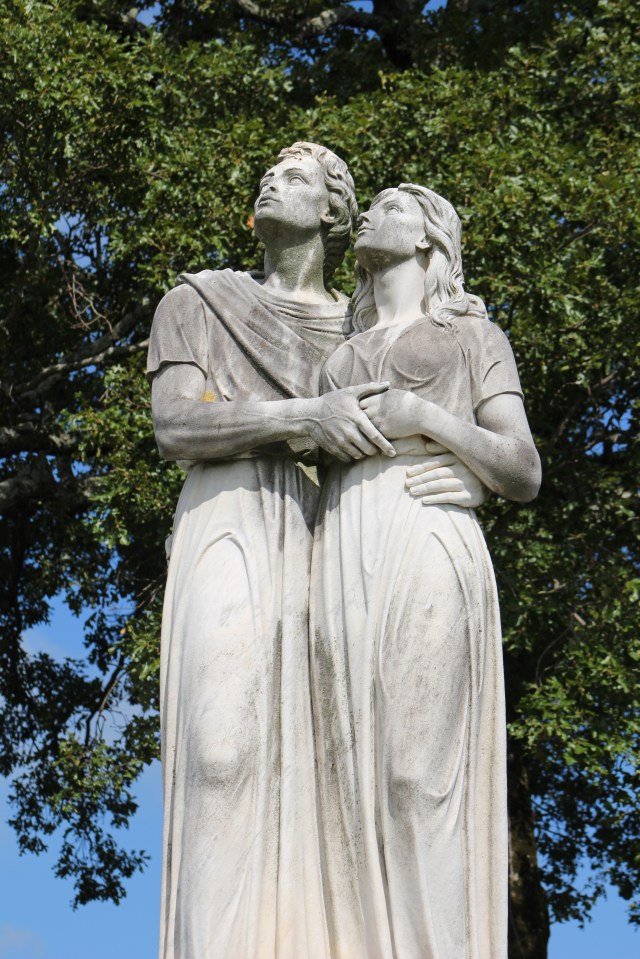
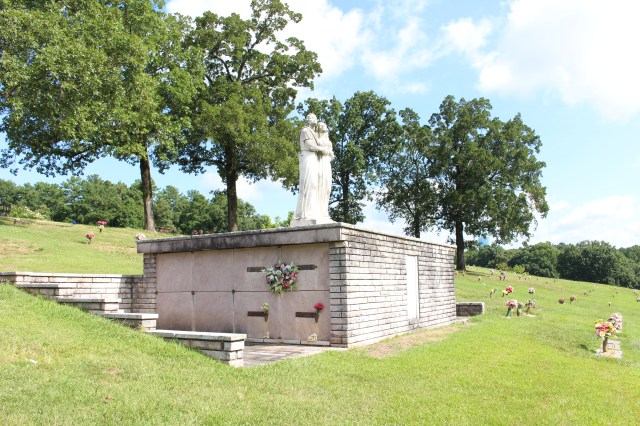
Two cemeteries very far apart—Greenwood Cemetery in Phoenix, Arizona, and Crest Lawn Cemetery in Atlanta, Georgia, have the exact same statue of a man standing next to a woman with his arm around her.

In Greenwood the statue (pictured above) sits atop a columbarium which is a place where urns are “stored” in a cemetery.  The word “columbarium” has a Latin root and comes from the word “columba.” Columba referred to housing for doves that was divided into compartments for their housing.

In Crest Lawn the statue (pictured below) sits atop a sarcophagus mausoleum.  A ‘sarcophagus” is defined as a stone coffin and, generally, these structures do not have windows and are partially above ground.

Posted in Mausoleums | Leave a comment

The Whittell Egyptian Revival-Style Mausoleum

George Whittell, Jr.

September 28, 1881 – April 17, 1969


Elia Pascal Whittell

September 9, 1892 – May 1, 1977

George Whittell, Jr. was born rich—very rich.  His grandfather invested in real estate during the California Gold Rush and made a fortune.  Whittell made the decision not to enter the family business but to follow a life of leisure.  He had two failed marriages, both brief and to chorus girls.  His third marriage was to Elia Pascal, the nurse he met while wounded and serving in France as an ambulance driver.

Whittell pursued the life suitable to a multimillionaire, building a home near Lake Tahoe he named Thunderbird Lodge, and adding to his growing collection of Duesenbergs.  He was prescient about the Stock Market—taking out 50 million dollars of his investments out of the market only months before the crash which insulated him from the Great Depression.  Though, Whittell was considered a relatively private person, he did throw lavish parties in his home and on his 55-foot mahogany yacht, also bearing the name Thunderbird.  His lavish mausoleum in the Cypress Lawn Cemetery in Colma, California, is a testament to his fortune.

The Whittell Mausoleum is an example of the Egyptian Revival architecture found in many large urban cemeteries.  The Egyptian Revival was an architectural movement that swept the United States and Europe.  The movement in America was influenced by three separate events—the first was Napoleon’s defeat of Egypt in the 1790s.  Later Napoleon published the results of his scientific expedition, which was printed in serial form, the last released in 1826.  The second event was when the so-called “Cleopatra’s Needle” was erected in Central Park in New York on February 22, 1881.  Lastly, “Egypto-mania,” as some called it, reached fever pitch in November 1922 when King Tut’s tomb was discovered, and the news flashed around the world. The influence of the Egyptian Revival was reflected in buildings in the United States as early as the 1820s.  The revival was also found in American cemeteries in the 19th century and on into the 20th century. The obelisk, and ancient Egyptian form, is ubiquitous in cemeteries across the North American continent.

The mausoleum has many features of Egyptian temples such as the cavetto cornice that curves into a half circle at the top of the tomb.  Also, the torus molding at the bottom of the cornice and around the corners of the mausoleum are designed to emulate long bundled plants.   Another feature of Egyptian architecture are the heavy columns that flank the doorway with palm leaves at the top.

The Whittell Tomb also features a winged globe with uroei cavetto cornice above the doorway.  In this example, there are three sets of falcon wings that symbolize the king, the sun, and the sky.  The globe represents the Egyptian god, Horus.  The uroei, snakes, are waiting to strike.  They symbolize the king’s ability to ward off evil spirits.

The globe and uroei symbolism is repeated in the amulets around the necks of the sphinxes on the panels on the lower third of the bronze doors leading into the mausoleum.  The steps lead up to a pair of bronze doors that feature lotus flowers and buds.

The entryway is guarded by two large couchant sphinxes.  The most famous sculpture of a sphinx is the Great Sphinx of Giza outside of Cairo, Egypt.  In the Egyptian tradition the benevolent mythological creature has the head of a man and the body of a lion.  However, In the Greek tradition the sphinx is usually depicted as a woman, sometimes with wings.  This example is in the Greek tradition.  In addition to the gender difference, the Greek sphinx is considered a malevolent being.

The massive tomb gives one the sense of solemnity and a sense of eternity, just as the temples of the pharaohs.

Posted in Mausoleums | Leave a comment

Gothic Architecture Inspired by Sainte-Chappelle

Tucked away under some massive trees that form a canopy over a large part of the Dexter Family Mausoleum in the Spring Grove Cemetery in Cincinnati, Ohio, is a great Gothic Revival-style tomb.  The sandstone mausoleum was designed for the Dexter brothers by famed Queen City architect James Keyes Wilson and inspired by the Sainte-Chappelle Cathedral in Paris.  The tomb took four years to build between 1865 and 1869 at the exorbitant sum of $100,000, a staggering amount of money at the time.  The first Dexter to be buried in the family tomb was Edmund Dexter who died at the age of 61 in 1862.  Dexter was an English immigrant who made his fortune selling liquor in Cincinnati.  He was buried in the tomb in 1870.  Now nearly 20 family members are buried within the walls of the mausoleum.

The mausoleum was a curiosity from the beginning.  People who took their carriage rides through the cemetery slowed or stopped to view the ostentatious tomb.  The mausoleum has two distinct levels.  The upper level was created as a chapel measuring 12 feet wide, 30 feet long, and 34 feet high.  One of the features that makes Sainte-Chappelle so well-known are the magnificent stained-glass windows the recount the major events in the Bible from the Creation story to the Resurrection of Jesus Christ.  Unfortunately, the chapel in the mausoleum was never completed so the stained-glass windows that had been planned for the chapel were never installed.  The lower section of the mausoleum houses the crypts.

The massive tomb has many features of the medieval cathedral from which it was inspired.  Typical of Gothic architecture, including Sainte-Chappelle, are the pointed arches which became popular in Western building designs during the 12th Century.  Every window and nearly every door in the mausoleum do, indeed, have a pointed arch.  Visually the pointed arch is lighter and also allowed builders to create taller windows which gave the buildings an airy feeling.  In addition to the visual lightness, the pointed arch was stronger than the rounded arch which was popularized in Romanesque architectural designs.  The arches are highly decorated with multiple moldings giving the windows a delicate appearance.  Even though the moldings seem to be separate they are, in fact, carved together from the same blocks of stone—called voussoir blocks.

In addition to the decorative moldings each arched window has small decorative points projecting from the curves in the arch—this is known as cusping.  These are formed using small curves.  It is where these small curves meet and form a point or cusp.  Lastly, each window has a hood molding that forms at the side of the window and then culminates in the pointed arch.

Flanking both sides of the tomb are flying buttresses.  These highly decorative arches gave additional support to the walls within a building.  The buttresses were positioned at the points of greatest stress and added additional structural support.  Each of the flying buttresses are decorated with tall pinnacles which add weight to the buttress.  The connecting pieces between the buttresses and the building are referred to as flyers and even those are highly decorated with tracery and quatrefoils.

Even though the Dexter Family Mausoleum has deteriorated and many of the decorative elements, such as turrets, spires, crockets, and pinnacles, have decayed, the tomb remains a magnificent example of Gothic architecture and continues to be one of the most-sought after sights in the Spring Grove Cemetery a century and a half after it was completed.

If you view the four pinnacles on these flying buttresses in the picture above, only one is complete.  Tops of the pinnacles have fallen to the ground as well as the crockets.  Crockets are the protruding and highly-stylized foliage sculptural decorative pieces adorning the pinnacles.

Some of the pinnacles are missing entirely.

The sandstone in the tracery is beginning to deteriorate.

Posted in Mausoleums | 1 Comment

A Simpler Version

The Belmont Mausoleum, in the Woodlawn Cemetery in the Bronx, is a near replica of the Chapel of Saint Hubert; the original in Amboise, France—the final resting place of Leonardo da Vinci.

The Murphy Family mausoleum in the Cypress Lawn Cemetery in Colma, California, was designed with the Chapel of Saint Hubert as the inspiration.  While many of the more elaborate elements of the original do not appear in the Murphy mausoleum, such as the lintel sculpture, gargoyles, and tracery, it is easy to see that the basic design of the original exists in this tomb.

The mausoleum was designed in 1921 as the final resting place for San Francisco dry goods merchant Daniel T. Murphy (1863-1919). Murphy played a major role in the development of California.

Instead of the sculpture in the pointed arch above the door depicting King Charles VIII and Anne of Brittany kneeling in deference to the Madonna and Child, this sculpture only has two kneeling angels paying homage to Mary and the Christ child.

The two-door opening in the Belmont Mausoleum and the original chapel is cut down to one door in this simplified design.  Here the arch is supported by columns instead of resting above the lintel.  This is called an “order.”  Here the term order is used to refer to an arched molding supported in columns which was a common architectural device used during the Romanesque and Gothic periods.

The gable on the front of the chapel features a trefoil, three-lobed form, but in this version is in not within a roundel, a small circular frame.

The balustrade above the arch is ornamented with pointed arches and tracery, far less decorative than in the original design of Saint Hubert’s Chapel.

Comparing these two mausoleums is like playing those find-what’s-different games in the back of children’s magazines.  While they definitely have differences it is easy to see that the basic design and inspiration for both tombs are the same–one a replica and one based on the original.

Posted in Mausoleums, Symbolism | 1 Comment

French Gothic

Oliver Hazard Perry Belmont (1858-1908)

Alva Smith Vanderbilt Belmont (1853-1933)

The Belmont Mausoleum, in the Woodlawn Cemetery in the Bronx, is a near replica of the Chapel of Saint Hubert; the original is in Amboise, France, and is the final resting place of Leonardo da Vinci.

Alva Smith Vanderbilt Belmont commissioned the architectural firm of Hunt and Hunt to build the tomb after the death of her second husband Oliver Belmont in 1908.  The mausoleum was completed in 1913 and is a masterpiece of late-fifteenth-century French Gothic architecture.

The front façade displays two intricately carved sculptures.  The lintel—or horizontal block above the door—features a sculpture depicting the legend of Saint Hubert from which the chapel is named.  According to the legend, while hunting Hubert saw a stag with a crucifix between his anthers.  After the vision, Hubert converted to Christianity.  Because of his humane treatment of the animals he hunted, Saint Hubert became the patron saint of hunters.  That was particularly fitting for a focal point for the Belmont Mausoleum because of the Belmont family’s association with horse racing—the Belmont Racetrack and the world-famous Belmont Stakes, the oldest prize in the Triple Crown.

The sculpture in the pointed arch above the door depicts a scene with King Charles VIII and his wife, Anne of Brittany, kneeling in deference to the Madonna and Child.

The chapel has many architectural features that were common to Gothic design:

Gargoyles—The spouts that were designed to divert rainwater away from the building were often elaborately designed to look like grotesque animals and human forms known as gargoyles.  These figures became popular in France during the Middle Ages, though they can be found in other countries during that time, as well.

Hood molding—If you look above the scene of the stag, there is a three-sided molding, also known as a drip molding.

Pinnacles—These ornamented structures are usually pointed and are found on the corners of the Saint Hubert Chapel.  They are often found on the buttresses of Gothic buildings.

Stepped buttresses—in the chapel, the stepped buttresses can be seen of the front of the building’s sides.  These are a mass of masonry built against a wall to give the building additional support and strength.  The buttresses on the chapel are stepped, meaning in this case, the buttress has a wider segment, then on top of that is a smaller one, and still one more smaller buttress on top of that.  Topping the buttress is a gargoyle.

Trefoil window—In the middle of the gable on the front of the chapel is a roundel, a small circular frame.  Inside the roundel is a trefoil—three-lobed form—in this case, a window.

Spire—The tall oxidized copper structure tapering up from the roof is a steeple or a spire.

Posted in Mausoleums | Leave a comment

Neo-Classical

The seemingly plain light gray granite Cuneo family mausoleum is a stunning example of Neo-classical architecture.  The pedimented porch is a key aspect of Neo-classical door design.  The porch features polished granite Ionic columns.  The entablature, the horizontal structure above the capitals, is plain as is the pediment.

The pedimented porch frames the elaborate bronze door.  The arched window above the door is called a fanlight or a transom light.  One each side of the fanlight is a wreath symbolizing memory and victory over death.

The door itself is imbued with symbolism from top to bottom.  The top half of the door has crosses with passionflowers on the cross.  The passionflower was so named by Spanish Christian missionaries because they identified parts of the flower with the passion of Jesus Christ.

  • Then ten petals represent the ten faithful disciples.  The two apostles who were not considered were St. Peter, the denier, and Judas Iscariot, the betrayer.
  • The filaments that circle the center of the flower represent Christ’s crown of thorns.
  • The curled filaments represent the whips used in flagellation of Christ.
  • The white color was equated with Christ’s innocence.
  • The styles symbolize the nails.

Behind the crossbars are rays of light.  The bottom has crossed palm fronds.  The palm frond is an ancient symbol of victory, dating back to Roman times when victors were presented with palm fronds. The palm fronds were also laid in the path of Jesus as He entered Jerusalem. So, for many Christians, the palm represents righteousness, resurrection, and martyrdom, symbolizing the spiritual victory over death associated with the Easter story.

In the panels just below the crosses are winged hourglasses surrounded by a laurel garland.   The winged hourglass is a reminder in bronze that life is short, and that time is fleeting, every minute of every day brings one closer and closer to death.  Again, the laurel wreath symbolizes victory over death. The laurel wreath dates to Roman times when soldiers wore them as triumphal signs of glory.  The laurel was also believed to wash away the soldier’s guilt from injuring or killing any of his opponents.

The bottom panel of the bronze door are modernized version of the winged cherub’s heads, which have a fluid, almost art nouveau style. The winged cherub was a symbol that became popular in the 18th Century.  Winged cherubs replaced the stark and morbid flying death’s heads from our Puritan forefathers.  The cherubs have a childlike countenance of innocence.  The iconography represents the flight of the soul from the body upward to Heaven and the hope of the resurrection.

Joseph Cuneo was born March 12, 1834, in Genoa, Italy, and died September 21, 1902— 68 years old.  His wife, Mary, was born in 1849 and she passed away in 1909.  The door to their tomb is flanked by statuary—the Madonna on the left of the entrance and Joseph holding baby Jesus on the right.  Sitting on the pediment is an angel holding a trumpet and looking perfectly bored.

Posted in Mausoleums, Symbolism | 4 Comments

The Last Supper


HERE RESTS

THE RIGHT REVEREND MONSIGNOR

MICHAEL DAVID CONNELLY LLD

PASTOR OF ST. BASIL’S CHURCH

SAN FRANCISCO

MEMBER OF THE ARCHBISHOP’S COUNCIL

WHO FELL ASLEEP IN THE LORD

AUGUST 19 1932 IN THE FIRST YEAR OF HIS LIFE

AND

THE FIFTY FIRST YEAR OF HIS PRIESTHOOD

“THE GREATEST THE NOBLEST PRIEST WE HAVE

EVER KNOWN”  — ARCHBISHOP HANNA

MAY HE REST IN PEACE

The monument for Monsignor Connelly in the Holy Cross Catholic Cemetery in Colma, California, pays tribute to the priest with a reproduction in stone of Leonardo DaVinci’s famous masterpiece of “The Last Supper.”

Da Vinci began the work in Milan in 1495.  It was a time in Da Vinci’s lifetime when he had earned a reputation of not being able to finish a work for which he received a commission.  Da Vinci needed this commission and he needed to complete it to redeem his much-sullied reputation.

The work he completed is a depiction of Jesus’s last meal with his disciples.  During that meal he revealed that one of the 12 would betray him.  He also instructed the disciples to drink the wine and eat the bread in remembrance of Him—which became the basis for the Eucharist.  This event in the Bible is so important that all four of the Gospels—Matthew, Mark, Luke, and John—write about it.

The work itself is a nod to Da Vinci’s love of order and symmetry.  The painting was laid out on a horizontal line with Jesus in the middle of the design—side to side and bottom to top. In addition to that, the painting is well balanced, with six of the disciples on one side of Jesus and six on the other—everything perfectly in balance and harmony.  The painting is imbued with symbolism as well, much of it well known and much of it speculative.  Judas, for instance, is the disciple who is shown next to a split container of salt.  Spilled salt, like many symbols, has more than one meaning and, thus, open for interpretation.  Consequently, the spilled salt could symbolize bad luck, or a lack of faith, or that Jesus was and is the salt of the Earth.  Judas was also the disciple who betrayed Jesus—was the salt Da Vinci’s way of revealing that?

Unfortunately, Da Vinci, while in complete control of his composition skills, was not a master fresco painter.  Because of that, Da Vinci experimented by painting on dry plaster whereas an experienced fresco painter would have applied the paint directly on wet plaster.  His experiment has not passed the test of time—his original is badly damaged, with paint flaking off.  Many attempts have been made to restore the iconic painting but it continues to deteriorate.  DaVinci’s Last Supper is one of the most reproduced works of art in history—including reproductions that were made shortly after the original was completed.  Hopefully, those reproductions, as well as the one in stone in the Holy Cross Catholic Cemetery, will help Da Vinci’s original live on.

Posted in Symbolism | Leave a comment