The Anvil

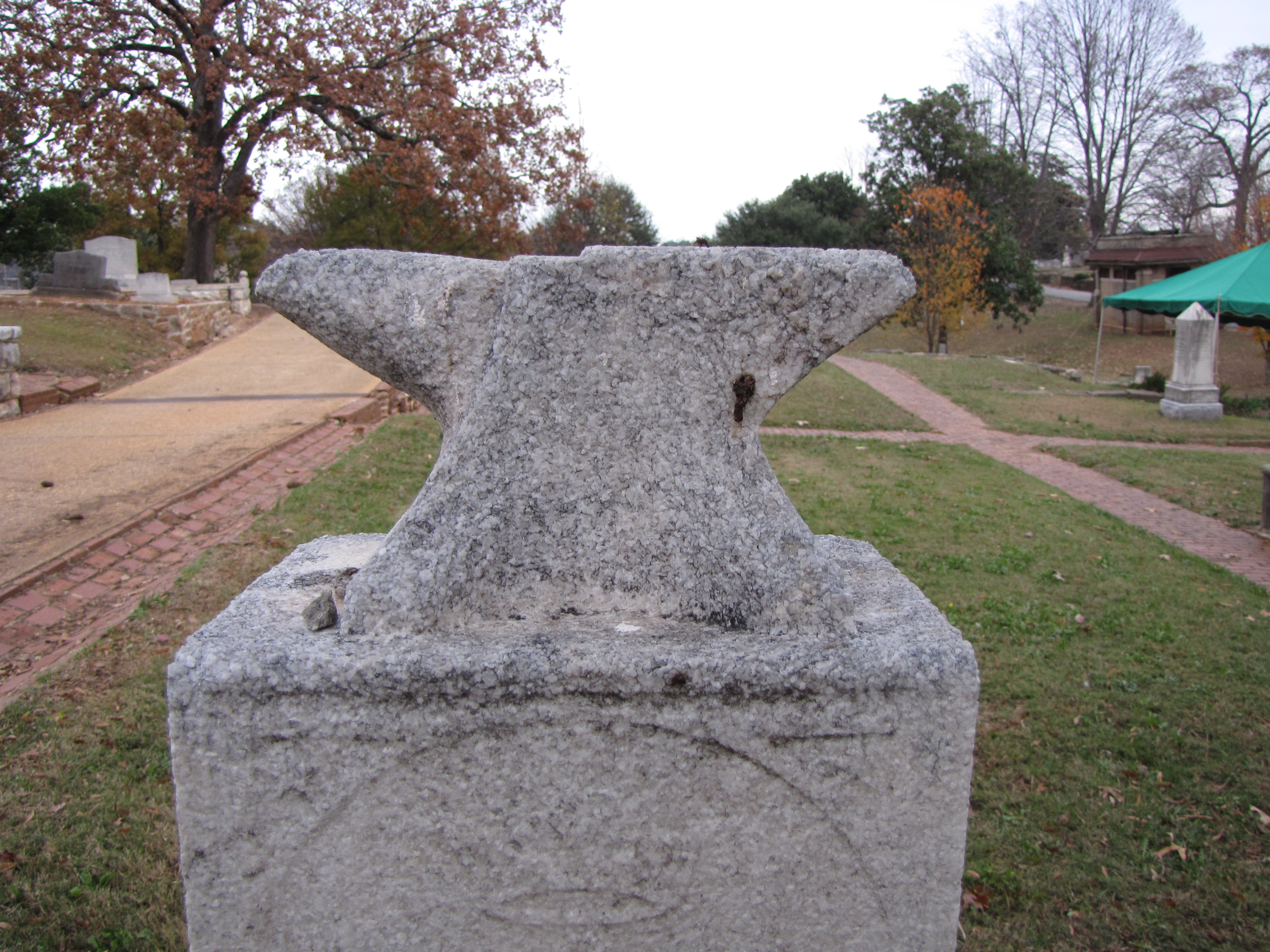
Augustus Thompson's gravestone, Oakland Cemetery, Atlanta, Georgia

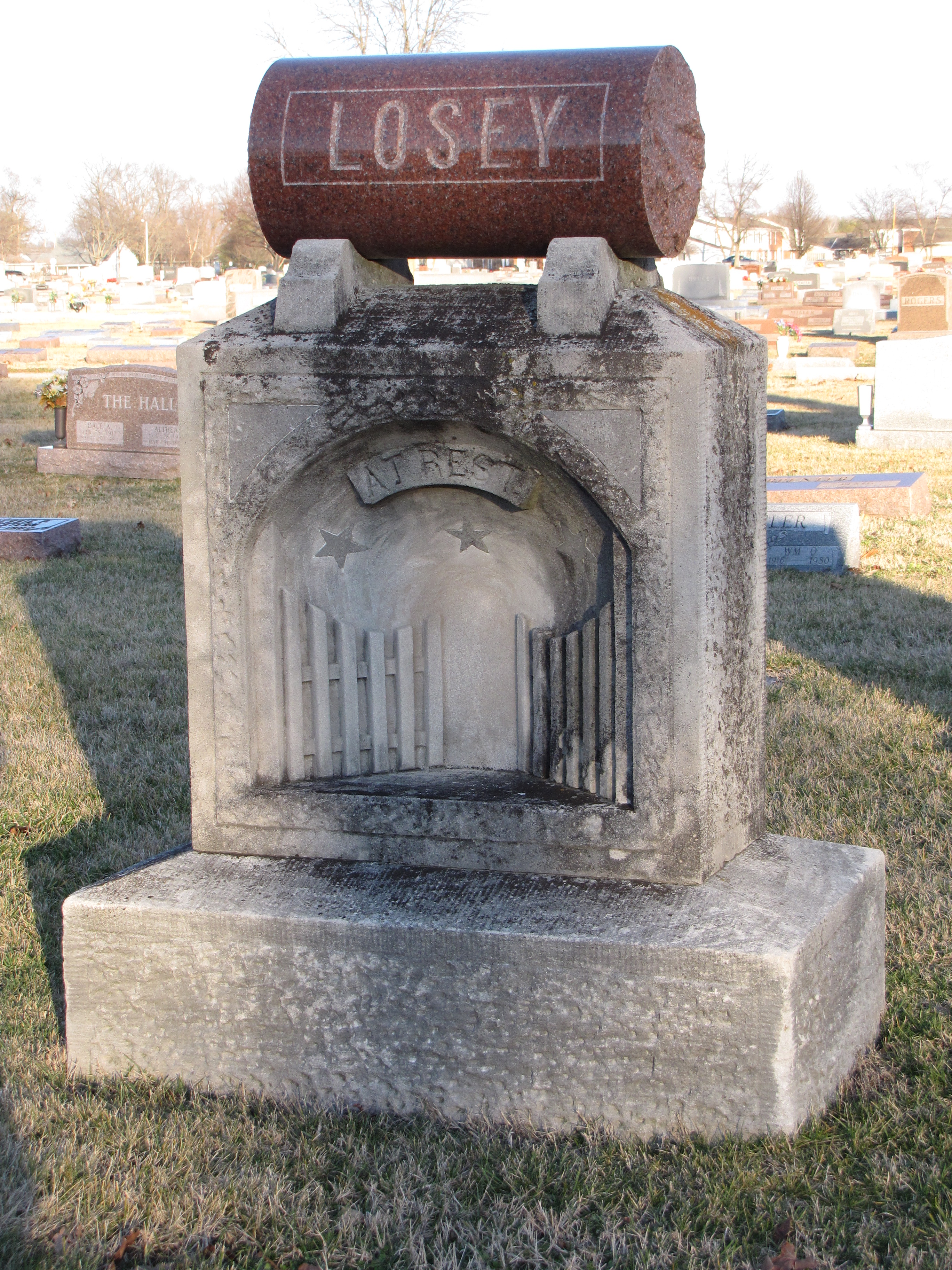
The anvil gravestone pictured above is in what is historically been called the Black Section of the Oakland Cemetery, Atlanta, Georgia.  The monument commemorates the grave of Augustus Thompson (1837-1910) a prominent citizen of the city.  Thompson moved from Mississippi, out of slavery, to settle in Atlanta to work as a blacksmith, hence, the anvil atop of the gravestone. 

This gravestone displays four symbols: 

Anvil: The anvil is a symbol of universe being forged and can also represent martydom. 

The Crown above the mansions in the sky: From the Bible verse John 14:2, “In my Father’s house are many mansions.”  (This symbol is quite faint on the tombstone and difficult to see.)

Three links of chain: A symbol of the Independent Order of Odd Fellows. (Thompson organized teh St. James Lodge of African-American Odd Fellows in Atlanta.)

Open Gates: Represents the passage from the Earthly Realm to the Heavenly Realm.

Oakland Cemetery, Atlanta, Georgia

Posted in Famous graves | Leave a comment

Cohanim

Oakland Cemetery, Atlanta, Georgia

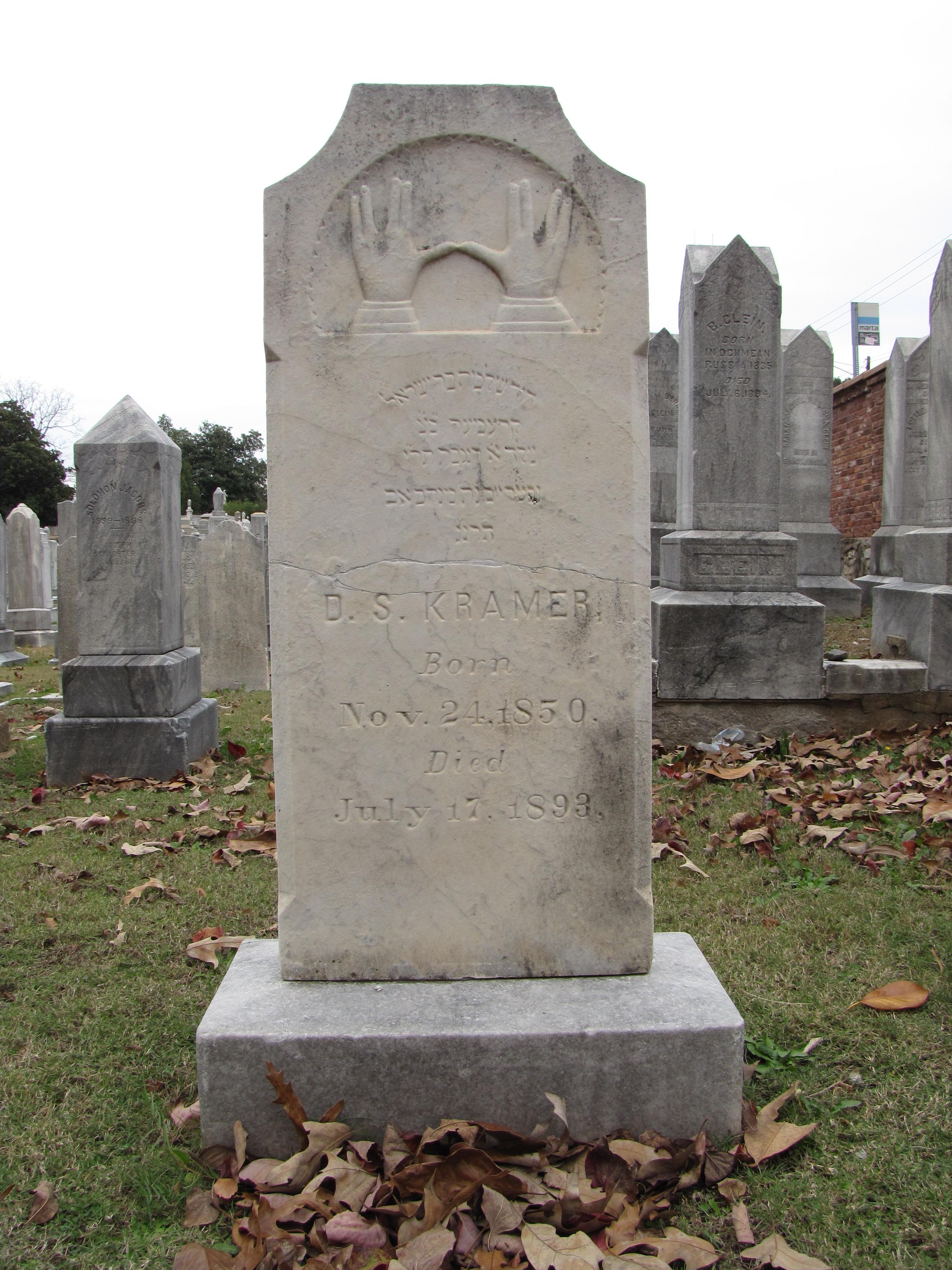
The Oakland Cemetery in Atlanta, Georgia, has a section that was purchased by Russian Jewish immigrants who belonged to the Ahavath Achim Congregation for the burial of their members.  This particular white marble tablet displays a commonly seen funerary symbol found on Jewish tombstones–Cohanim.  The two hands in this position represents a priestly blessing.  The origin of the word–Cohen–is Hebrew for priest.  Cohen is singular, Cohanim is plural.  Families with the last names of Cohn, Kohn, Conn, Cahn, Kahn, Cohen, and Kohen are believed to be descendant of Aaron, the brother of Moses, and the first of the family name–Kohen.
 
This symbol of a hand with fingers separated most likely looks familiar to Star Trek afficionados and Mr. Spock fans as a Vulcan hand sign, coupled with the often repeated “live long and prosper” greeting.  Leonard Nimoy, who saw this blessing as a child attending Temple, suggested a one-handed greeting for his for his character on the iconic television show.
 

Oakland Cemetery, Atlanta, Georgia

Posted in Symbolism | 2 Comments

Gone with the Wind

Oakland Cemetery, Atlanta, Georgia

 
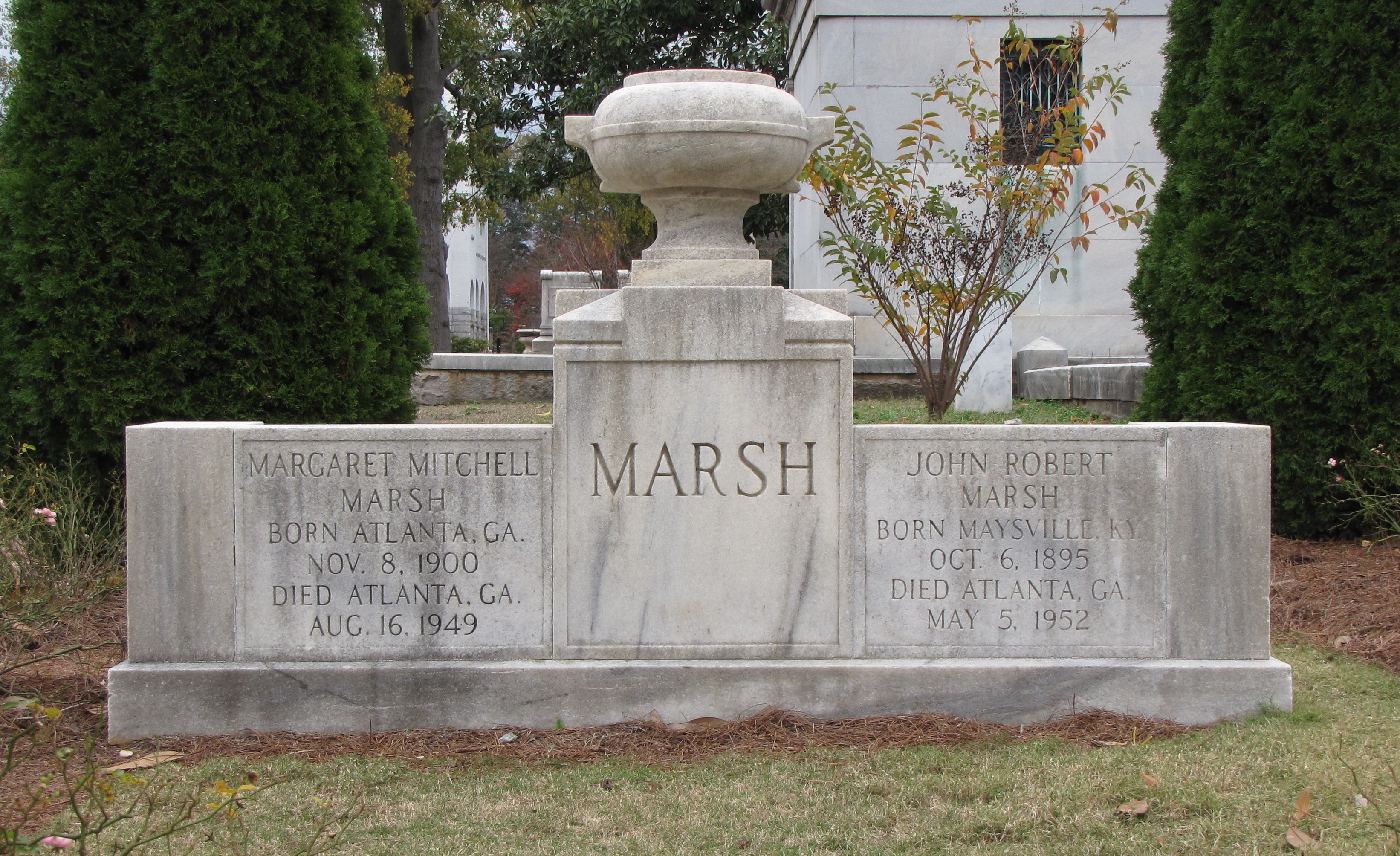
Margaret Mitchell Marsh, born Atlanta, Ga, Nov. 8, 1900, Died Atlanta, Ga. Aug. 16, 1949

John Robert Marsh, born Maysville, Ky, Oct. 6, 1896, Died Atlanta, Ga., May 5, 1952

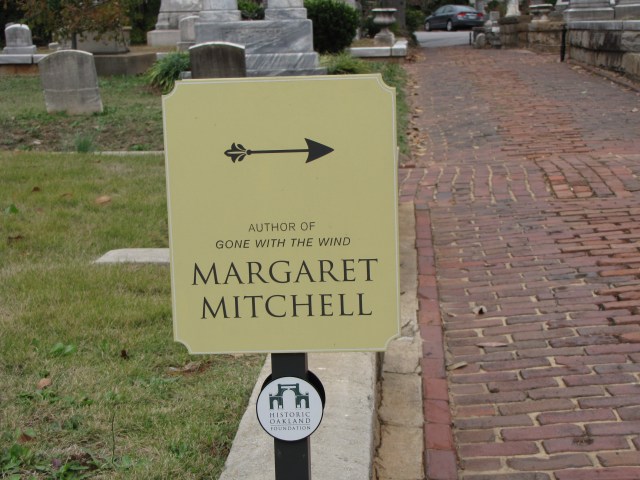
Margaret Mitchell’s grave lies within the walls of Oakland Cemetery, a fitting place for her bones to rest, as she was a daughter of Atlanta, born and bred and died in that city. Margaret Mitchell Marsh’s monument is one of the most visited in the cemetery. Signs point the way for the gawkers who amble by to catch a glimpse of the white marble monument with a large urn centered to divide the monument into equal halves. She shares the tombstone with her second husband, John Robert Marsh, who was also the best man at her short-lived first marriage to an alcoholic, abusive, and hot-tempered man.
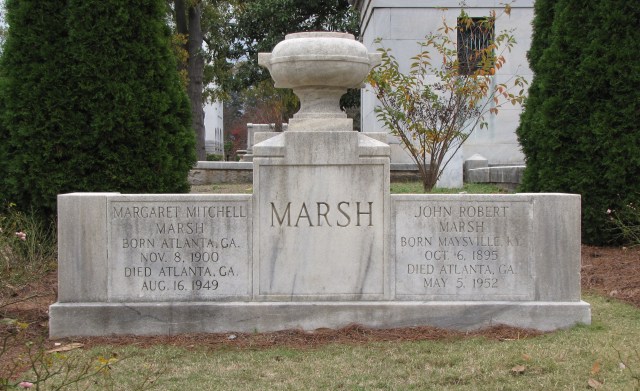
Margaret Mitchell's Monument, Oakland Cemetery, Atlanta, Georgia

Mitchell was a celebrated author. She wrote the epic novel, Gone with the Wind, which was a love song for her beloved South. Pat Conroy, the author of The Prince of Tides, The Great Santini, and My Reading Life wrote, “Margaret Mitchell writes of the Confederacy as paradise, as the ruined garden looked back upon by a stricken and exiled Eve, disconsolate with loss.” Mitchell’s book won the National Book Award in 1936 and the Pulitzer in 1937 for her novel which was turned into a movie and premiered in Atlanta in 1939, starring Vivian Leigh and Clark Gable. Mitchell was the toast of Atlanta and the South.

When she was less than fifty years old, on the evening of August 11, 1949, Margaret and her husband, John, were crossing the street to see a movie when a drunk driver struck her as she stepped into the street. Mitchell was rushed to the hospital but never regained consciousness and died in the city she loved five days later.

Posted in Famous graves | 1 Comment

No Ties

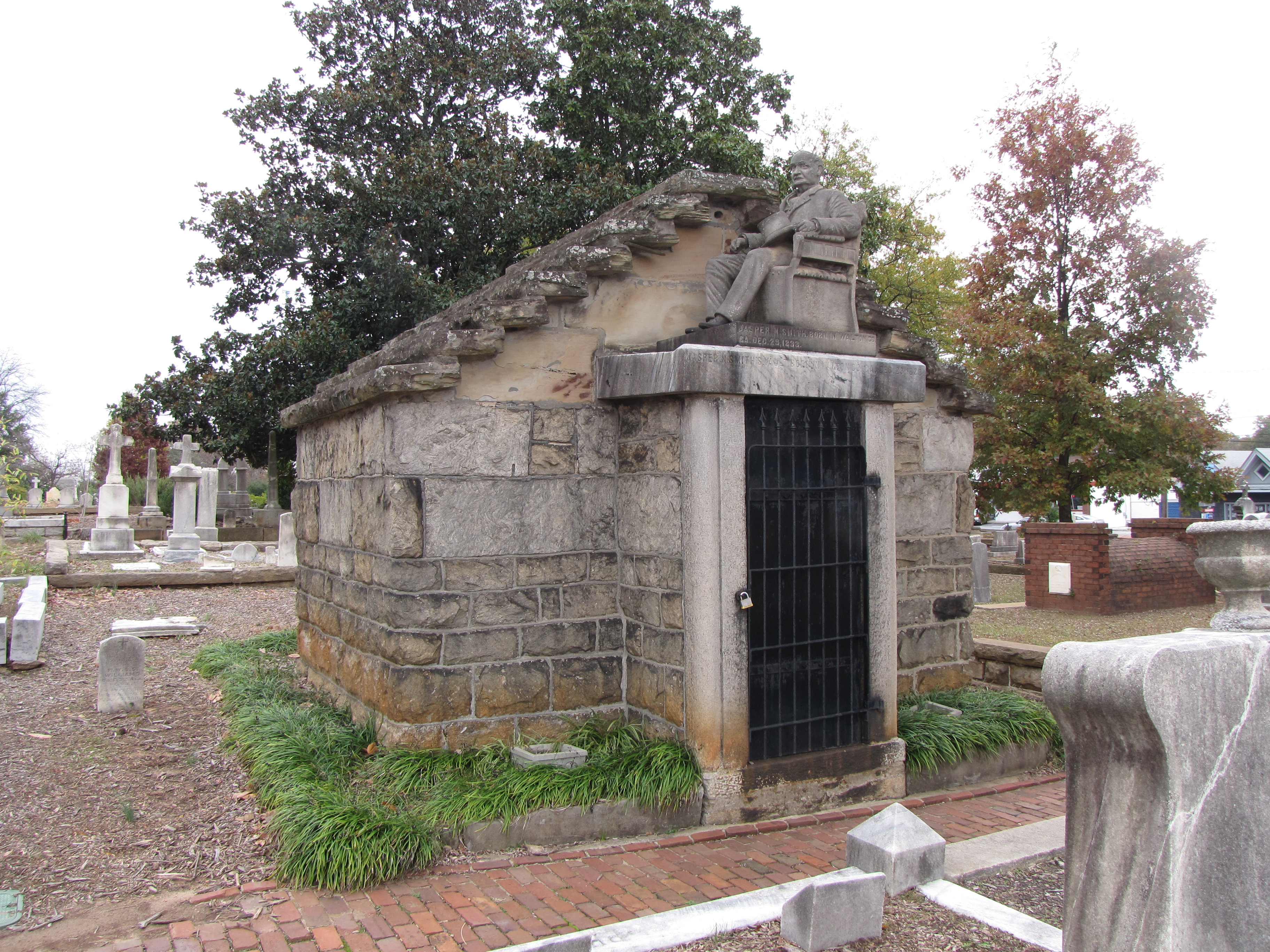
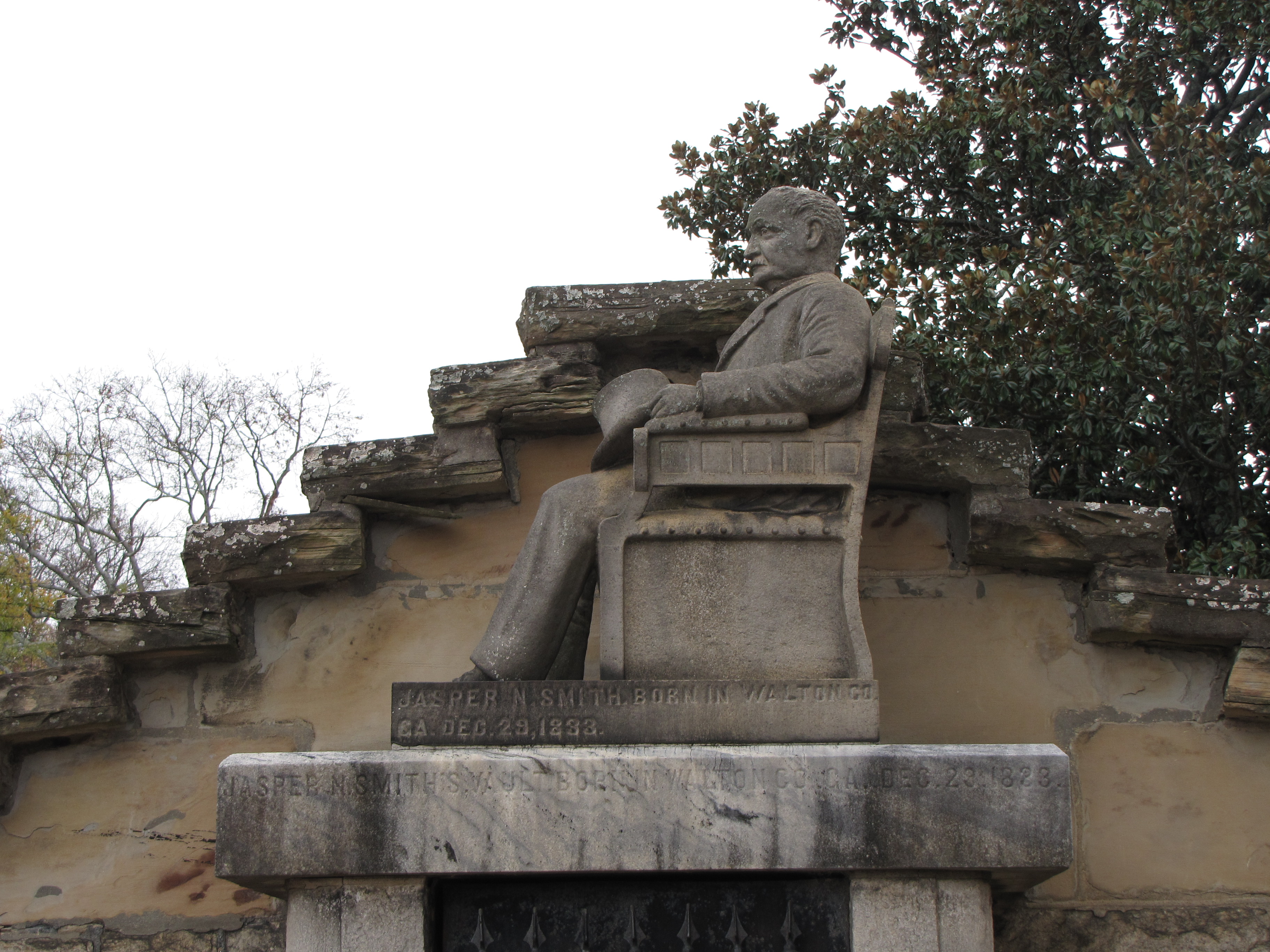
Jasper Newton Smith Mausoleum, Oakland Cemetery, Georgia

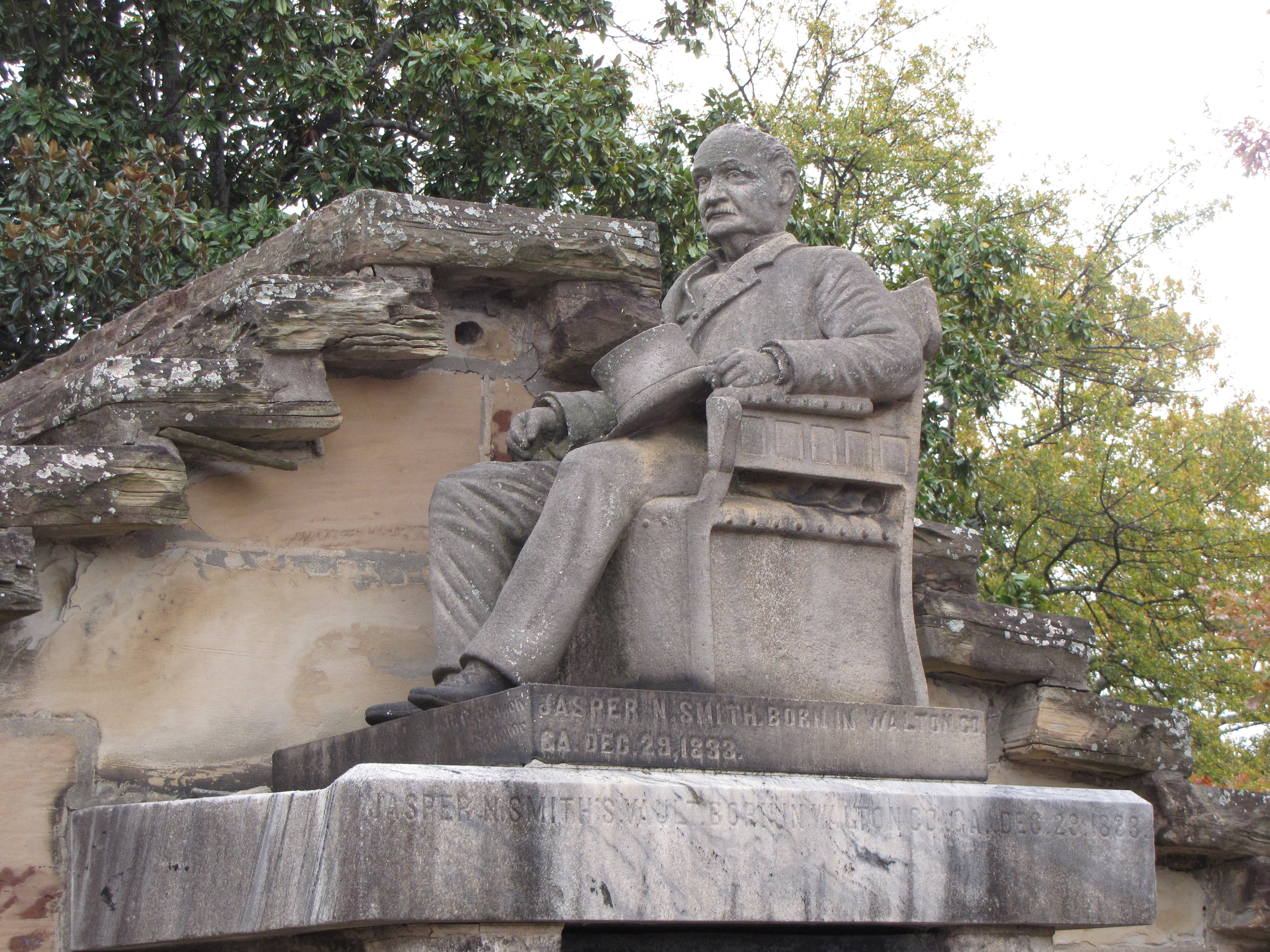
 Jack” Jasper Newton Smith (1833-1918)

Perched over the steel-gated doorway of a rough-hewn stone mausoleum, sits “Jack” Jasper Newton Smith. Smith, the son of William and Elizabeth Brady Smith, was born on a farm to a large family of ten boys and two girls in Walton County, Georgia, on December 29th, 1833. Jack married Rebecca Hawke in 1856—this union bore the couple six children. When the Civil War began, he joined the Tenth Georgia Cavalry but was forced to resign before the end of the War due to illness.

Jasper Newton Smith, Oakland Cemetery, Atlanta, Georgia

Smith, an eccentric and successful businessman, tried his hand at many pursuits including farming, brick manufacturing, and as proprietor of The Bachelors’ Domain, a forty-four room hotel, each room named after the states of the Union. He also built an unique structure that was pieced together from remnants of other buildings that became known as the “House that Jack Built.”

In 1906, at age 73, Smith, sitting upright in a upolstered chair holding a silk hat, posed for sculptor C.C. Crouch for the statue for his own mausoleum.  As the story goes, Crouch sculpted Smith wearing a tie with his suit coat.  Smith didn’t object to the thinning hair or the waddle under his chin, but he so hated wearing neck ties and ascots that he told Crouch that if the necktie wasn’t chisled out of the scupture, Smith would not pay him. Keeping with that theme Smith didn’t want any vines twinning up his sculpture for fear that the vine might look like neckwear!

Jasper Newton Smith, Oakland Cemetery, Atlanta, Georgia

Posted in Mausoleums | 2 Comments

First Burial

Dr. James Nissen's grave, Oakland Cemetery, Atlanta, Georgia

Not far within the gates of the Oakland Cemetery in Atlanta is an eroded and faded ornamented-top marble tablet, the inscription lost to the elements.  But for the survey done of the cemetery in the 1930s by Franklin Miller Garrett, the name of the person in the grave would have been lost to history.  Garrett, however, Atlanta’s only official city historian (and Coca-Cola Company historian for 28 years) preserved a part of the story. According to legend, Nissen was a doctor visiting Atlanta when he took ill.  He died September 22, 1850.  The metal plaque mounted in front of his weathered tombstone tells the gruesome piece of the story, “Nissen, the cemetery’s first interment was fearful of being buried alive; therefore, he requested his jugular vein be severed prior to burial.”  As far as anyone knows, his last request was granted and then he was buried in the city where he died.
Posted in Uncategorized | Leave a comment

Six Feet Under

The View from Oakland Cemetery facing Six Feet Under Pub and Fish House

Garden cemeteries were laid out and designed so they could be a respite from the cities that surrounded them. Not only were the cemeteries intended to be burial places for the dead but a park that families could go to for a Sunday afternoon picnic or drive. Oakland Cemetery, founded in 1850, in Atlanta, Georgia, is one such cemetery. At first, it only had six acres but later expanded to 88 acres containing the graves of many Georgia luminaries such as Gone With the Wind author Margaret Mitchell Marsh, golfer Bobby Jones, and John Pemberton, the pharmacist who concocted Coca-Cola.

If traipsing through a cemetery works up a thirst and hunger, leaving you wanting a nosh, a perfect oasis was opened by a restaurantuer with a sense of humor right across Memorial Street appropriately named SIX FEET UNDER. You can sit and enjoy a beer and some Southern food favorites like seafood gumbo, hush puppies, fried green tomatoes, or a catfish po’ boy along with many other pub-food favorites. The fish house has a terrace on top that has a bird’s eye view of Oakland Cemetery, the perfect place to sample the keylime pie and ponder life and death.


Six Feet Under Pub and Fish House, Atlanta, Georgia


Posted in Uncategorized | 1 Comment

End of the Trail

Ben F. Perry Jr. Tombstone, Oakland Cemetery, Atlanta, Georgia

Among the many unique and beautiful monuments in the Oakland Cemetery, in Atlanta, Georgia, is Ben Perry Jr’s gravestone. His marker is a rounded-top tablet with a bas-relief replica of the sculpture, The End of the Trail, a powerful tribute mourning the loss of the Sioux people, by the famous western sculptor, James Earle Fraser.  Fraser created the sculpture for the Panama Pacific Exposition held in 1915 in San Francisco.  The End of the Trail is also a fitting metaphor for the end of one’s life.
 

The End of the Trail scupture by James Earle Fraser

In addition for his fame for The End of the Trail, his most famous work, Fraser was also recognized for the art he created for the United States Mint, for the Indian Head Nickel.
Posted in Uncategorized | Leave a comment

Niobe

The Gray Family Monument, Oakland Cemetery, Atlanta, Georgia

The monument of James Richard Gray (September 30, 1859-June 25, 1917, THE HEART OF OAK THE STRONG ARMS THE BUSY HANDS ARE DUST) and May Inman Gray (March 6, 1862-January 6, 1940, “MY TASK ACCOMPLISHED AND THE LONG DAY DONE) is adorned with a magnificent white-marble sculpture of the Niobe, the Greek mythological Queen of Thebes. Niobe had fourteen children (the Niobids) and taunted Leto, who only had two children, Apollo and Artemis. In his rage he sent his two children to avenge the slight done to him by Niobe striking out at what was most dear to her.
 

Niobe

Niobe, became the symbol of mourning when Apollo slaughtered her seven sons and Artemis killed her seven daughters. As one version of the story goes, upon seeing his dead fourteen children, Amphion, the King of Thebes, commited suicide. Niobe was so stricken with grief that she fled to Mount Siplyus, Manisa, Turkey ,where she turned to stone. Her grief was so powerful that tears flowed ceaselessly from her forming the River Acheloos.


The Gray Family Monument, Oakland Cemetery, Atlanta, Georgia


Posted in Uncategorized | 4 Comments

The Lion of the Atlanta

Oakland Cemetery, Atlanta, Georgia

Today a friend of mine, Renet Bender, has written a guest post about a cemetery that she likes and one of her favorite monuments within it, The Lion of Atlanta.  The Ladies Memorial Association commissioned T. M. Brady of Canton, Georgia, to create a monument to the unknown Confederate war dead buried in Oakland Cemetery.  The sculpture was commemorated on April 26, 1894.  The inspiration for the Lion of Atlanta was Bertil Thorvaldsen’s colossal Lion of Lucerne (Switzerland), which Mark Twain called “the most mournful and moving stone in the world.”   As the artist was completing the sculpture he was told he would not be paid the full amount for his work.  To demonstrate his contempt for those who contracted the work, Thorvaldsen carved the inset in the shape of a hog.
 

The Lion of Lucerne

 
The Lion of the Confederacy
 

Oakland Cemetery is an eighty-eight acre space of beauty and serenity in the heart of Atlanta, Georgia.  The cemetery served as the final resting place for everyone in Atlanta between 1850 and the early 1880’s, including all races, religions, and social classes (segregated of course).  Among the notables in this cemetery you can find the graves of  James Tate, co-founder of the first black school in Atlanta, Bishop Wesley John Gaines, a former slave and founder of Morris Brown College, Dr. Joseph Jacobs, the pharmacist who introduced Coca-Cola, and author of Gone with the Wind, Margaret Mitchell, just to name a few. 

In July of 1864,  Confederate General John Bell Hood stood on a hill and watched the Battle of Atlanta just a couple of miles away.  So it is only fitting that there be a large area of unmarked graves from this battle.  It is said that some three thousand soldiers are buried in several mass graves here.  Their only monument is the beautiful marble “Lion of Atlanta”. This monument represents the Confederate soldiers who died defending their beliefs.   The proud, mortally wounded lion is lying down, signifying defeat in battle.  In his paw, he clutches a fallen battle flag, and he seems to be pulling his beloved banner toward him.  Standing on the grass beside the lion, one can almost sense the thousands of souls interred here and the great sadness of the Confederacy.  This place commands – and demands – reverence. 

Oakland Cemetery, Atlanta, Georgia

Posted in Famous graves | 17 Comments

United Daughters of the Confederacy

Oakland Cemetery, Atlanta, Georgia

Just as the women of the North had founded an organization to honor the service of their soldiers, so did the women of the South.  Any female 16 years of age or older who can document direct lineal or collateral descent from a soldier who served honorably in the Army, Navy or Civil Service of the Confederate States of America is eligible to join.
 
The organization was founded in 1894, by two women, Caroline Meriwether Goodlet and Anna Davenport Raines.  The purpose of the UDC is to preserve the history of the Confederacy, honor the memory of those who served, and to preserve and mark historical locations.  Their motto is, “Love, Live, Pray, Think, Dare.”
 
The United Daughters of the Confederacy maintain a library at their headquaters in Richmond, Virginia.  They preserve and house a collection of rare books, letters, diaries, and other papers relevant and important to the history of the war.  The UDC also awards a scholarship for original research about Confederate history.
 
The metal marker is a replica of the emblem of the UDC.  A laurel, gathered together with a ribbon with two dates 61 and 65, the beginning and ending of the war, surrounds a Confederate flag and the intertwined letters U D C. 
 

Oakland Cemetery, Atlanta, Georgia

Posted in Metal Markers | Leave a comment