Open Gates

Garland Brooks Cemetery, Columbus, Indiana

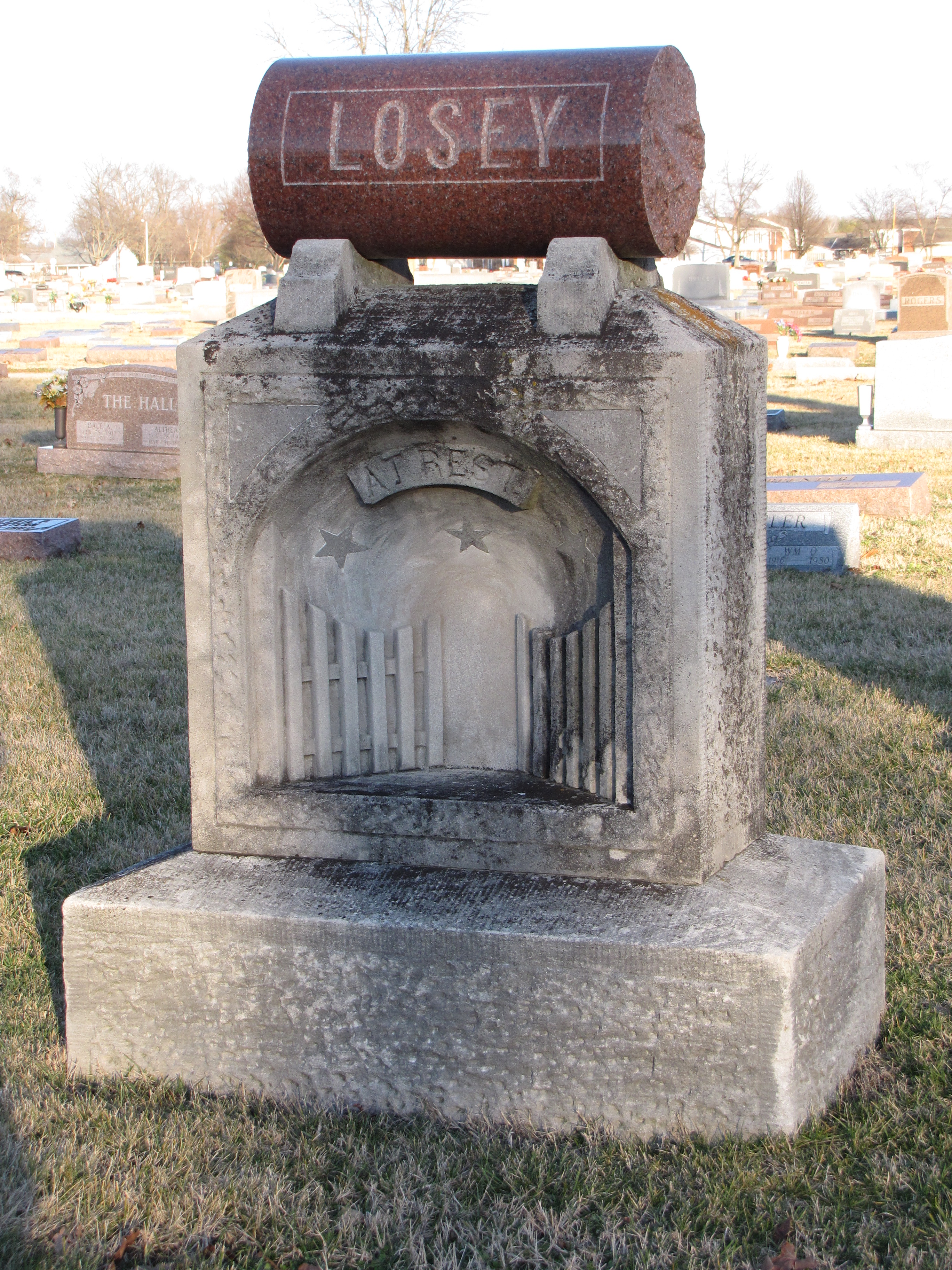
The gravestone pictured above displays an open gate carved from limestone.  In this example, the open gates, which are central to the Last Judgment, are opened to a starred sky with a banner above that reads “AT REST”.  The gates represent a passageway, the gates are the portal for saved souls to make their passage from the Earthly realm to Heaven upon Christ’s return.

Posted in Symbolism | Leave a comment

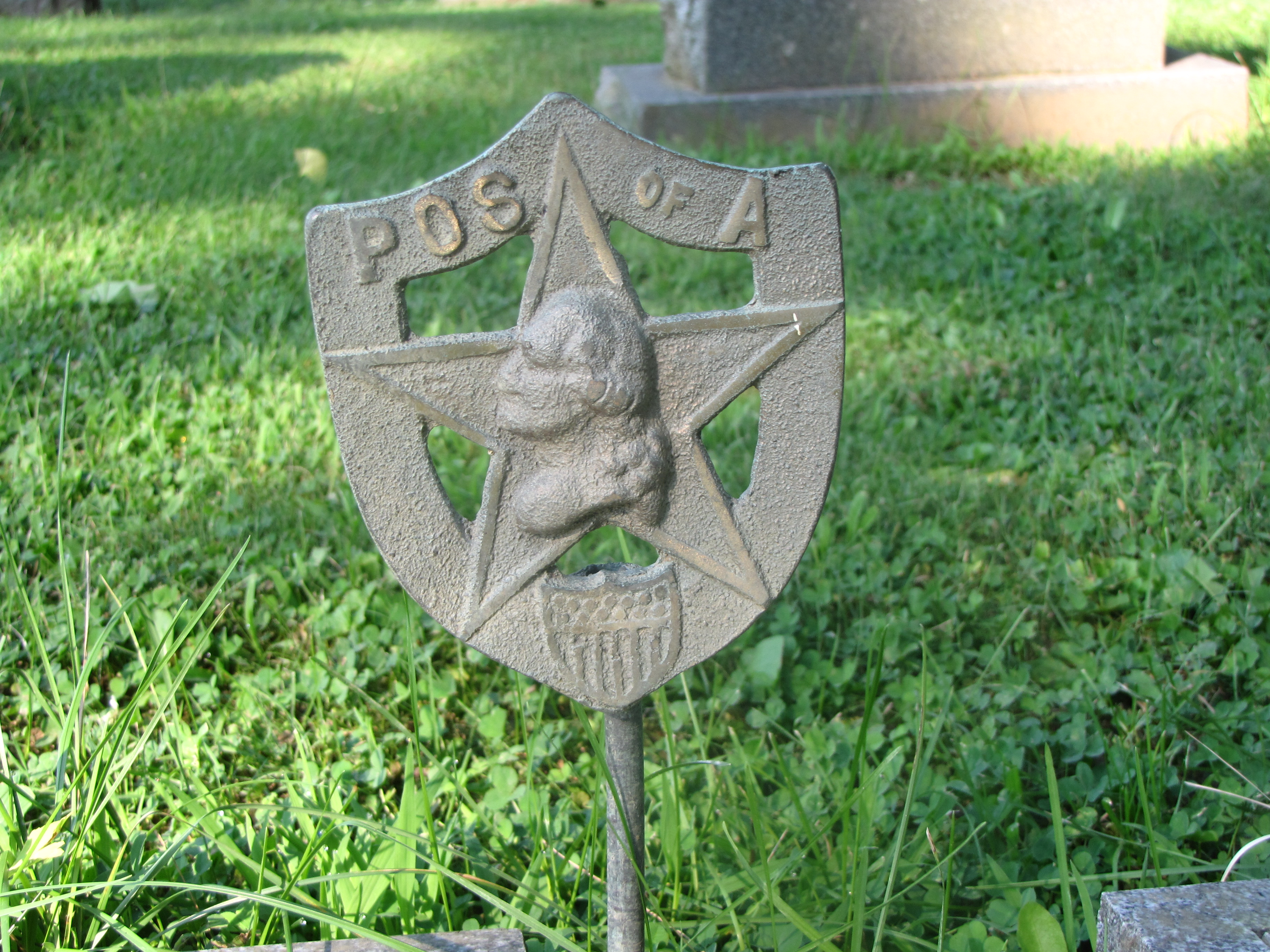
P.O.S. of A.

Princeton Cemetery, Princeton, New Jersey


The Patriotic Sons of America (P.O.S. Of A.)

In 1847, Dr. Reynell Coates founded the Patriotic Sons of America as an organization to promote the ideals upon which America was created and to pay honor and duty to the flag. Some of the main aims of P.O.S. Of S. were to:

  • build appreciation for American heritage and history

  • devotion to the United States Consitution and the American flag

  • defend the American public School system

  • support a strong national defense

  • lobby to restrict immigration

  • cultivate harmony, fellowship, and friendship among its members

Posted in Metal Markers | 3 Comments

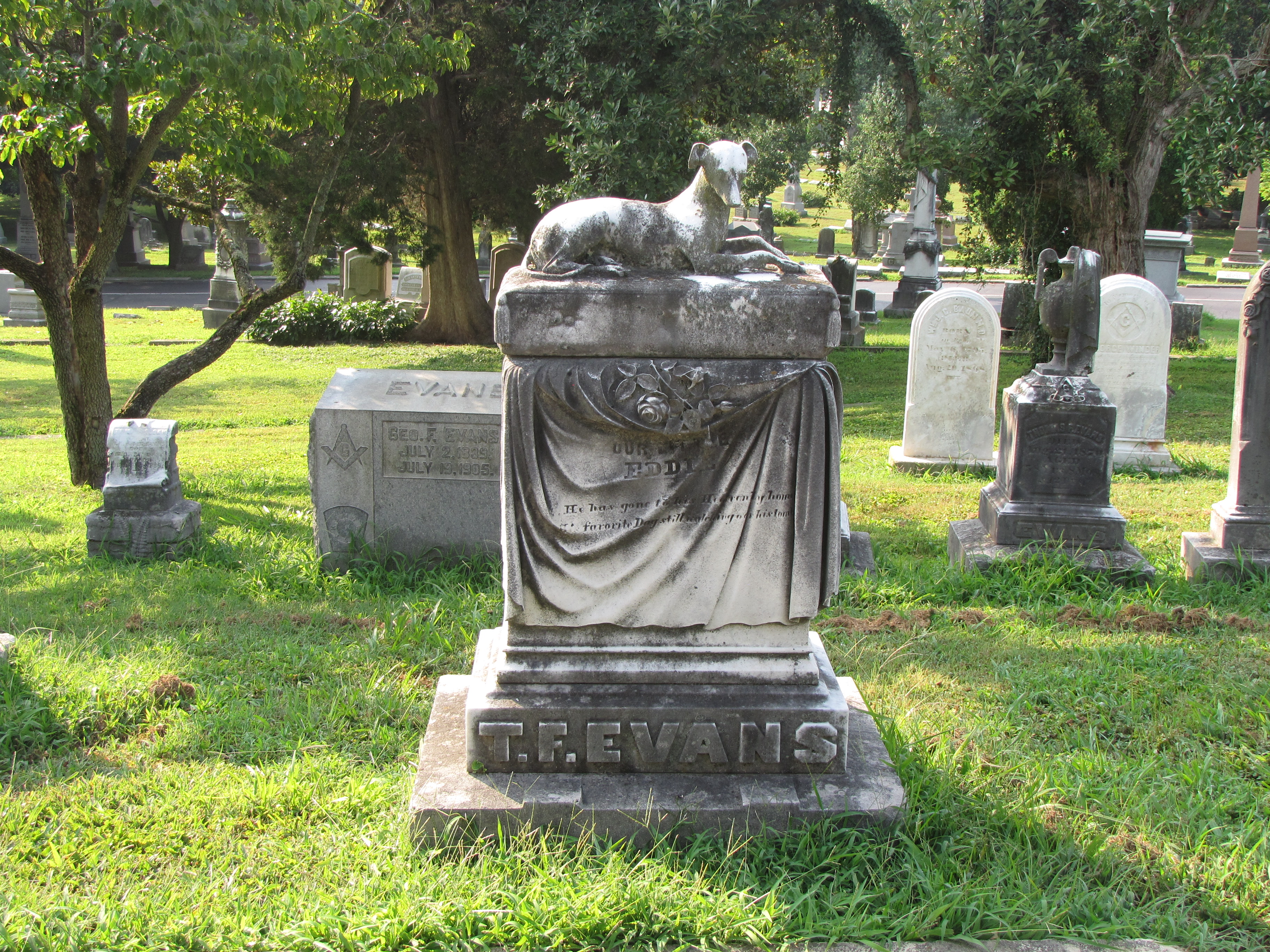
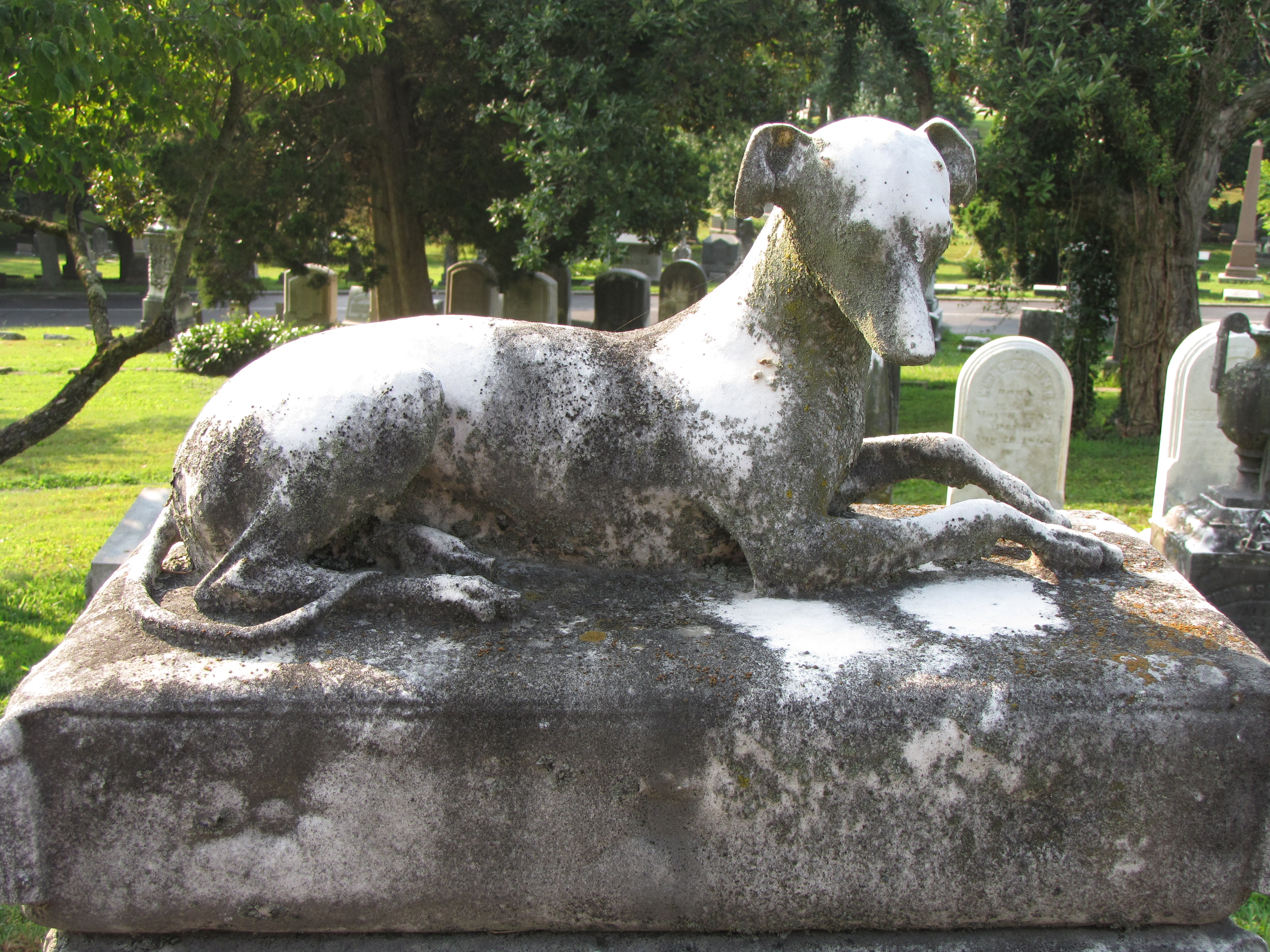
Dogs

Cave Hill Cemetery, Louisville, Kentucky

 Our Little Eddie

He has gone to his Heavenly home

His favoraite Dog still watching his tomb.

Cave Hill Cemetery, Louisville, Kentucky

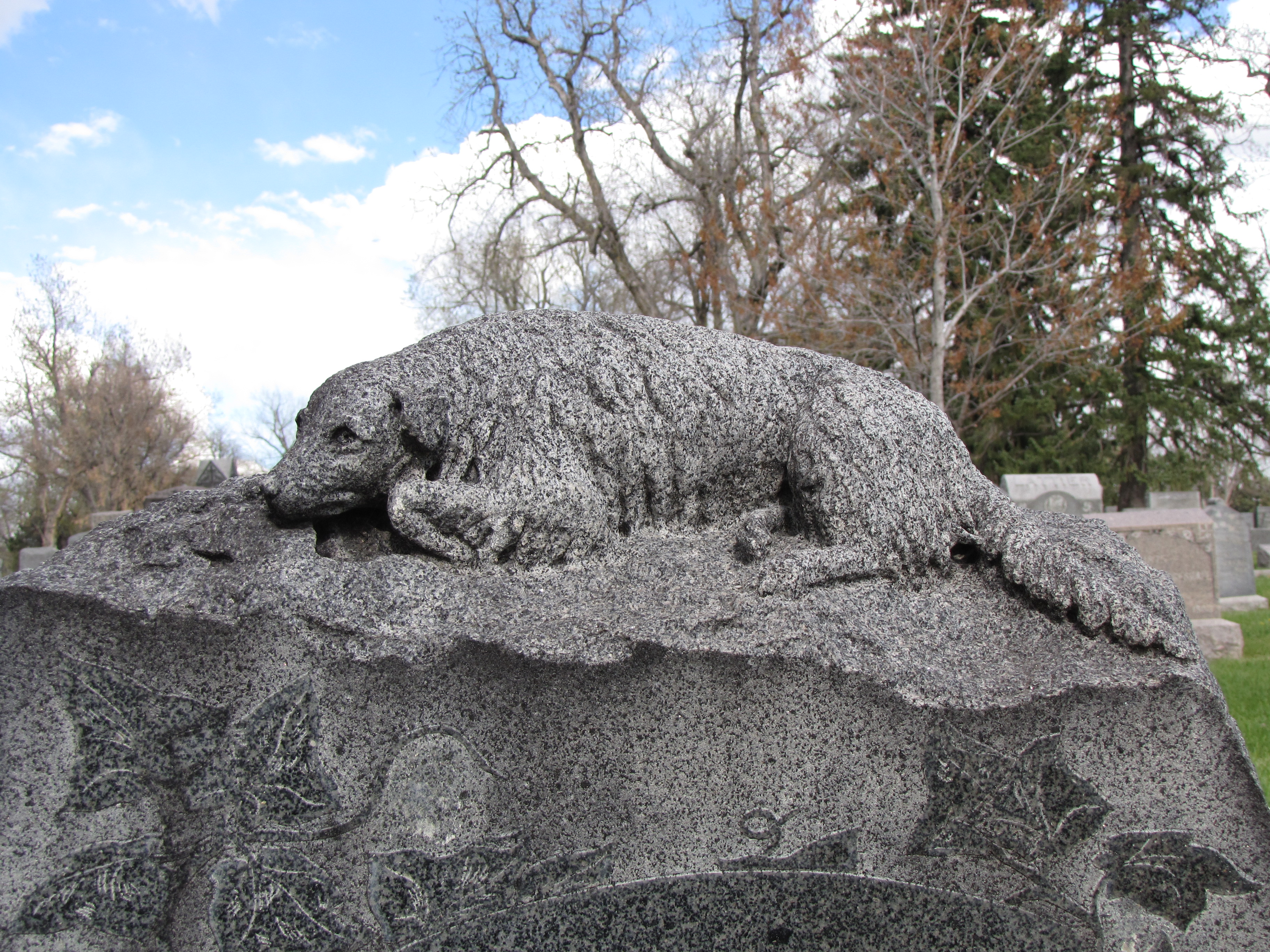
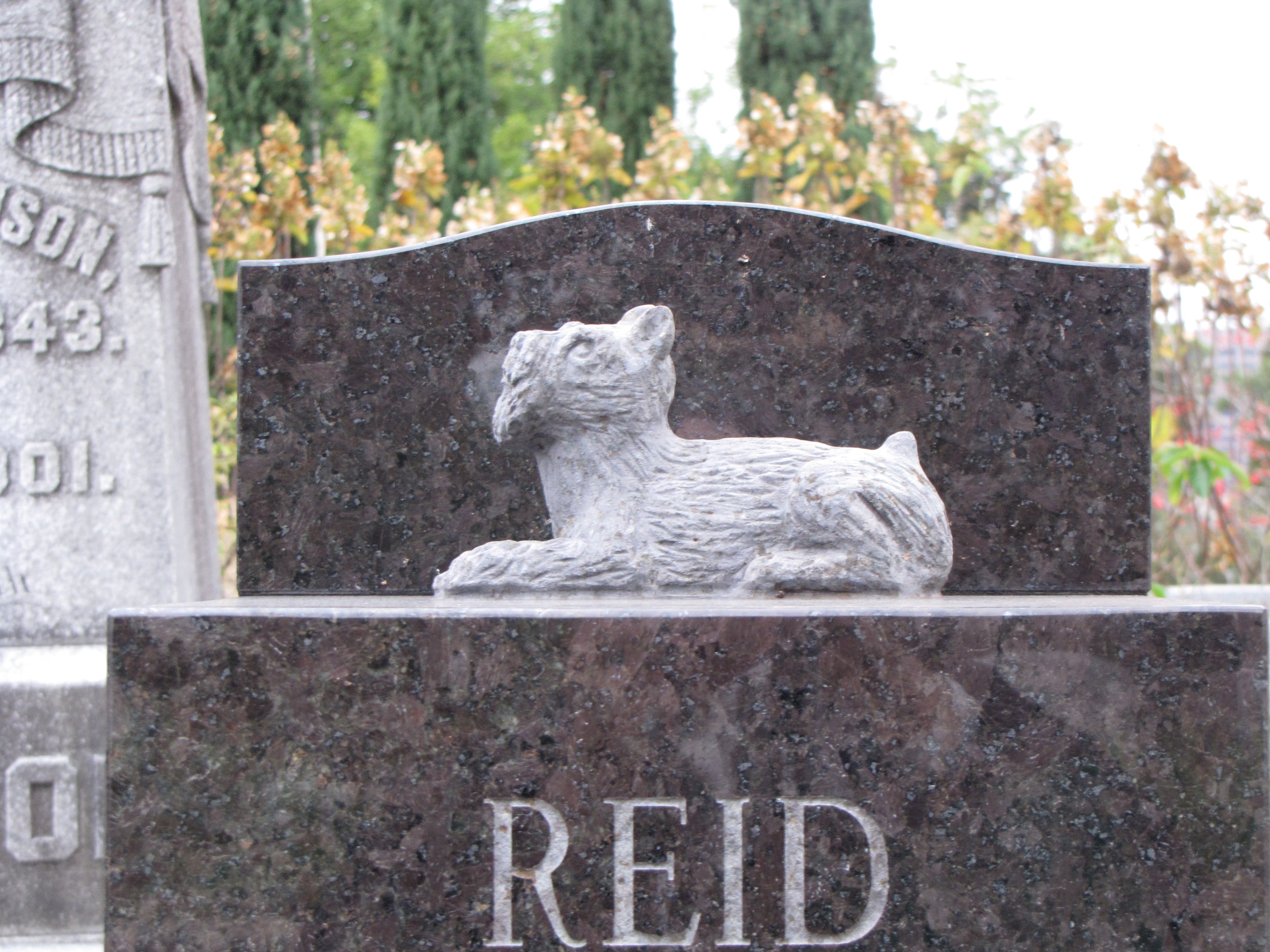
Some of my favorite memories as a child were spent with the dogs that we had while I was growing up. We had many dogs—Happy, Pal, Sandy, Fritzy, and Pokie—all members of our family. They each had distinct personalities.

Happy got his name because he, was well, happy. Pal followed us everywhere, including to school. Sometimes I would look out and Pal would be staring in the school window waiting for the bell to ring so he could walk home with me. Sandy was an odd dog that liked lettuce and even jelly sandwiches. Fritzy was a cranky toy Manchester that became very feeble but never lost his appetite to nip at strangers and family members he didn’t like! Pokie was a social blonde cocker spaniel with a bad case of asthma. He had his little home on our back porch that he shared with our black cat—Bad Luck. When she had kitties they all slept together in a box and Pokie carried the kitties around like they were his.

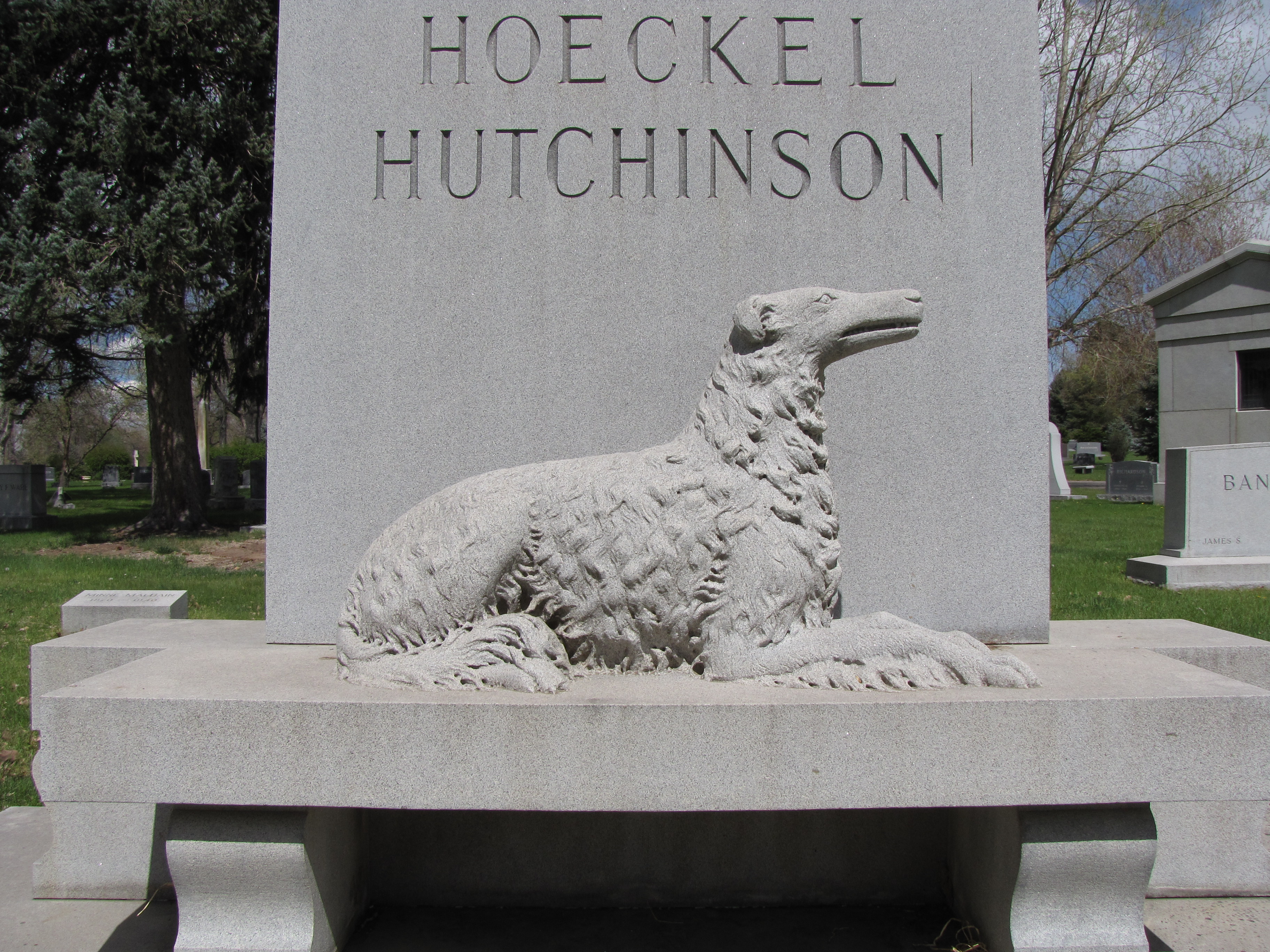
Fairmont Cemetery, Denver, Colorado

All of them had the qualities we think of good dogs having—loyalty, fidelity, and vigilance.

Fairmont Cemetery, Denver, Colorado

This dog looks as if he is mourning the loss of his best friend. 


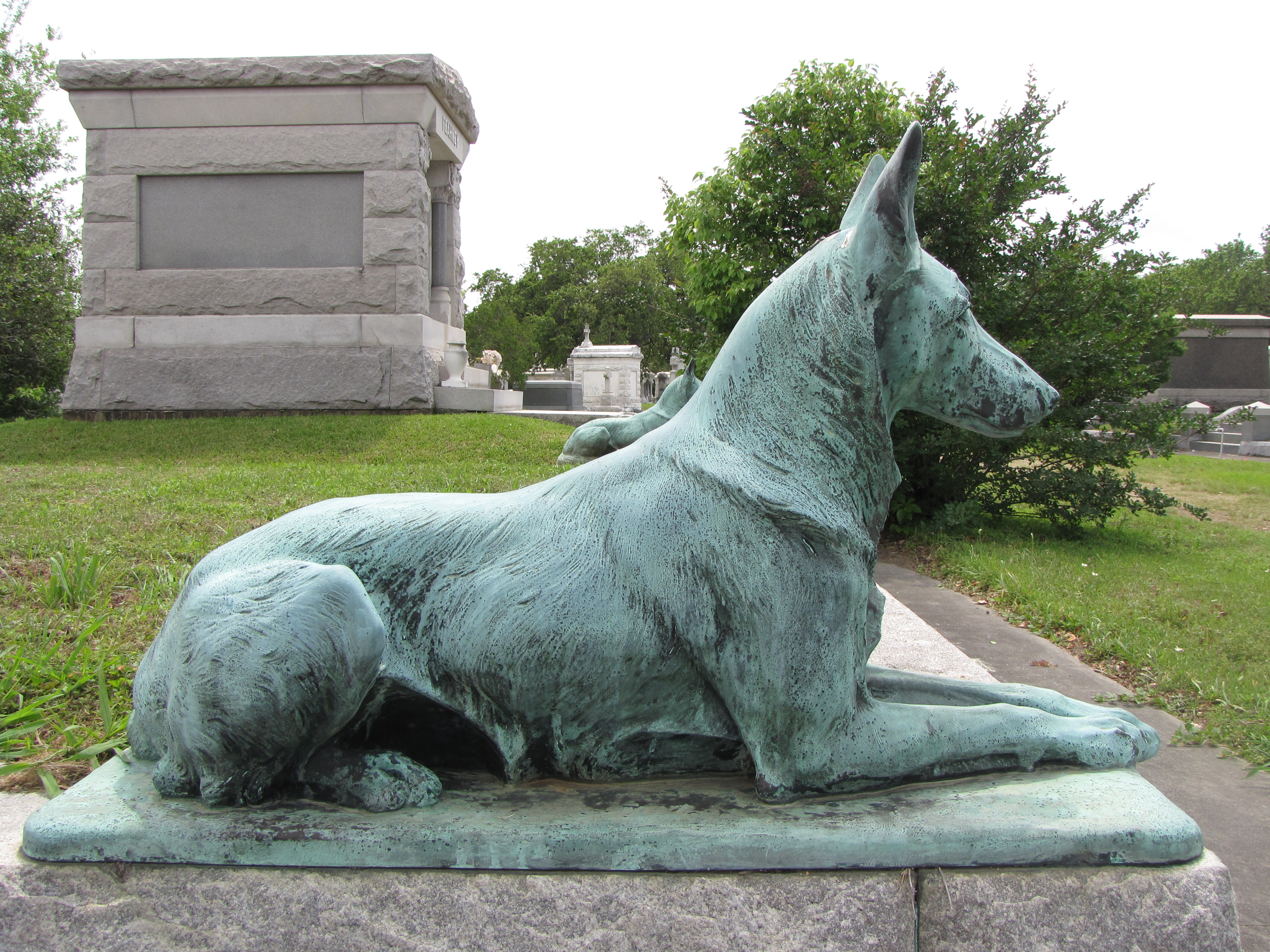
Metarie Cemetery, New Orleans, Louisiana

This pair of dogs are alert, as if on guard.
 

Oakland Cemetery, Atlanta, Georgia

 
Posted in Symbolism | 2 Comments

Table Tomb

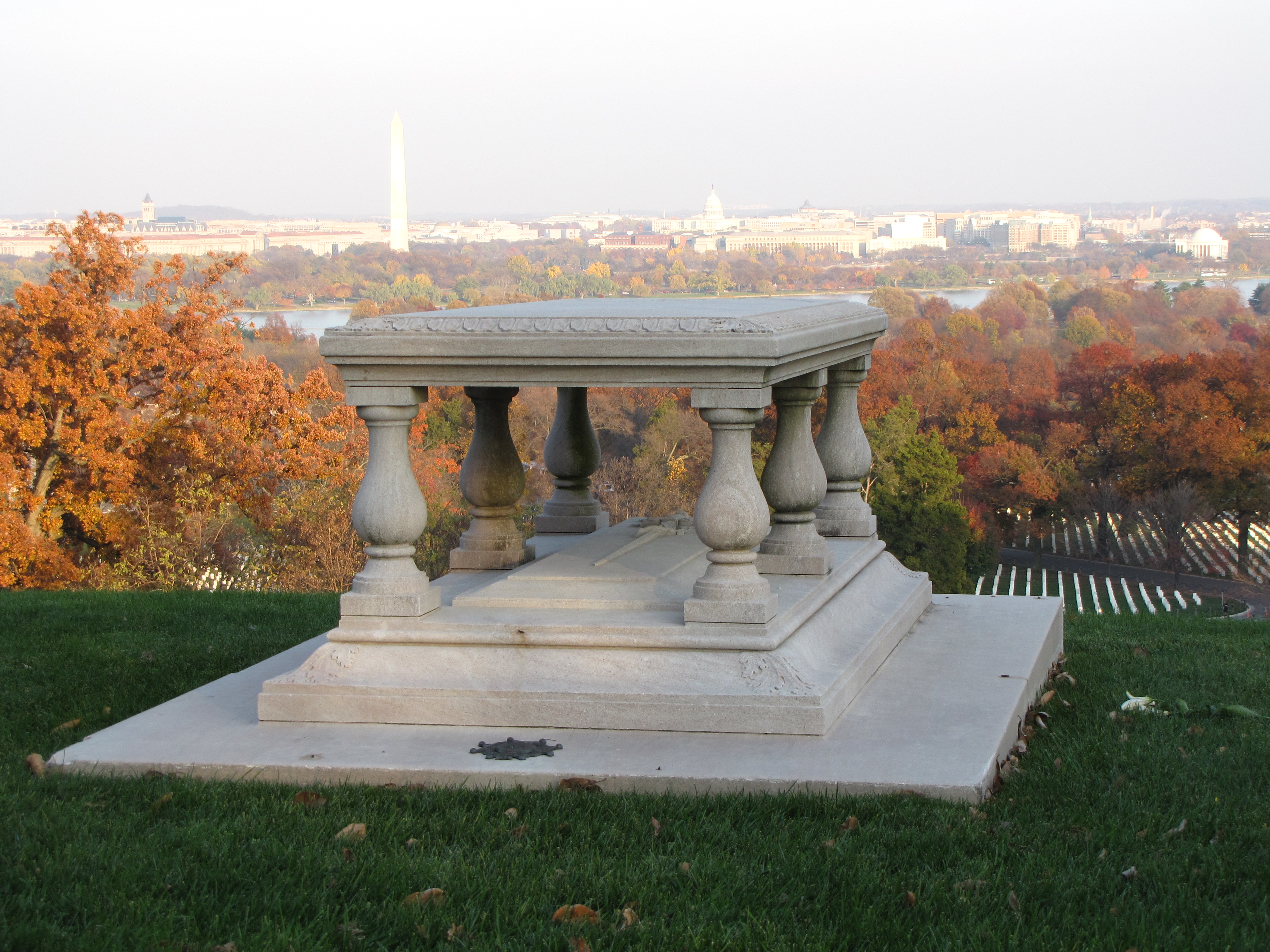
Pierre L'Fant Table Tomb, Arlington National Cemetery, Arlington, Virginia


REVOLUTIONARY SOLDIER 1775-1763

PIERRE CHARLES L’FANT

ENGINEER ARTIST SOLDIER

UNDER THE DIRECTION OF GEORGE WASHINGTON

DESIGNED THE PLAN FOR THE FEDERAL CITY

MAJOR US ENGINEER CORPS 1782

CHARTER MEMBER OF THE SOCIETY OF THE CINCINNATI

DESINGED ITS CERTIFICATE & INSIGNIA

BORN IN PARIS FRANCE AUGUST 2, 1755

DIED JUNE 14, 1825 WHILE RESIDING AT CHILHAM CASTLE MANOR

PRINCE GEORGE’S CO. MARYLAND AND WAS INTERRED THERE

REINTERRED AT ARLINGTON APRIL 28, 1909

When you walk out onto the veranda of what was Robert E. Lee’s home, now in the center of Arlington Cemetey, you overlook the United States Capital City and the tomb of Pierre L’Fant, who designed the plan for the city. 

The name of the type of gravestone that marks L’Fant’s grave is called a table tomb for an obvious reason—it looks like a table. Usually the table tomb is six legged supporting a stone tablet which carries the inscription of the deceased.  In this case, the six legs are supported by an elaborate base that also has a sword carved into the top representing L’Fant’s service in the Revolutionary War.

Posted in Famous graves, Tombs | Leave a comment

Barrel Tomb

Oakland Cemetery, Atlanta, Georgia

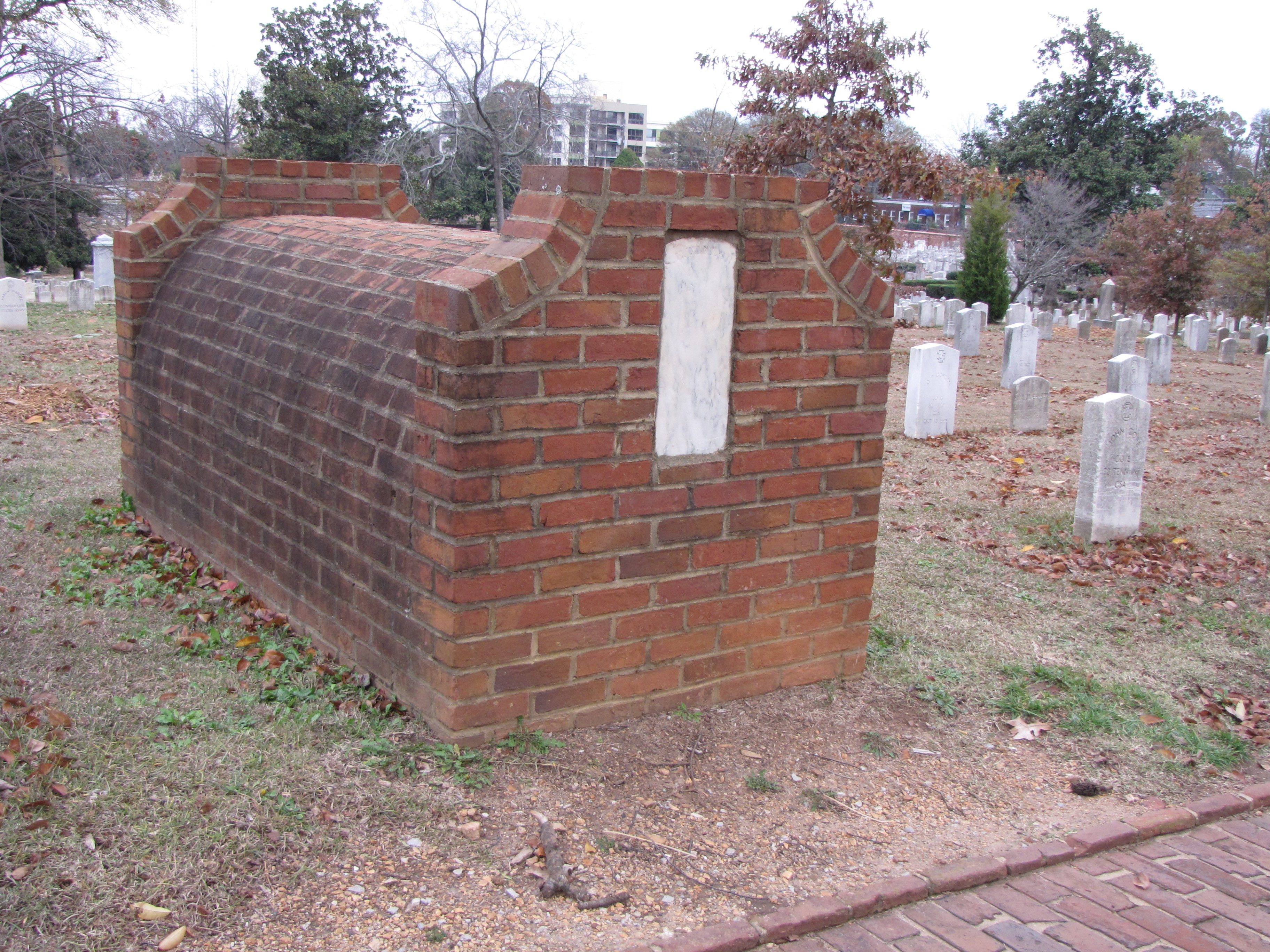
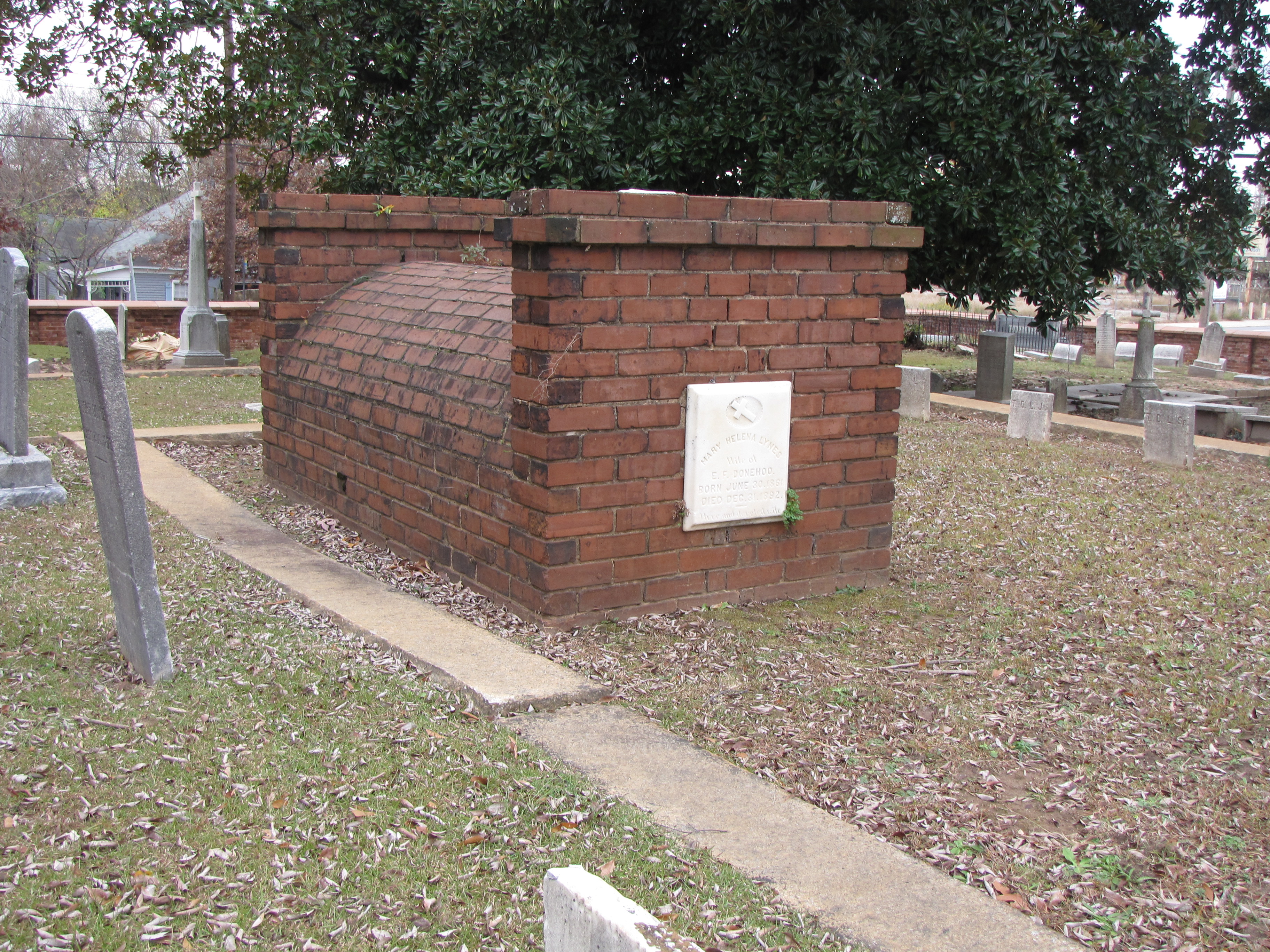
Tombs, like gravestones, come in many shapes and sizes and are made of many types of materials.  These tombs constructed of brick, are called barrel tombs characterized by the rounded tops.  They are differentiated by the designs of the face of the tombs, square versus ornamented, and the insets that have the name of the deceased inscribed in them.
 

Oakland Cemetery, Atlanta, Georgia

Posted in Tombs | Leave a comment

Floriated Cross

Oakland Cemetery, Atlanta, Georgia

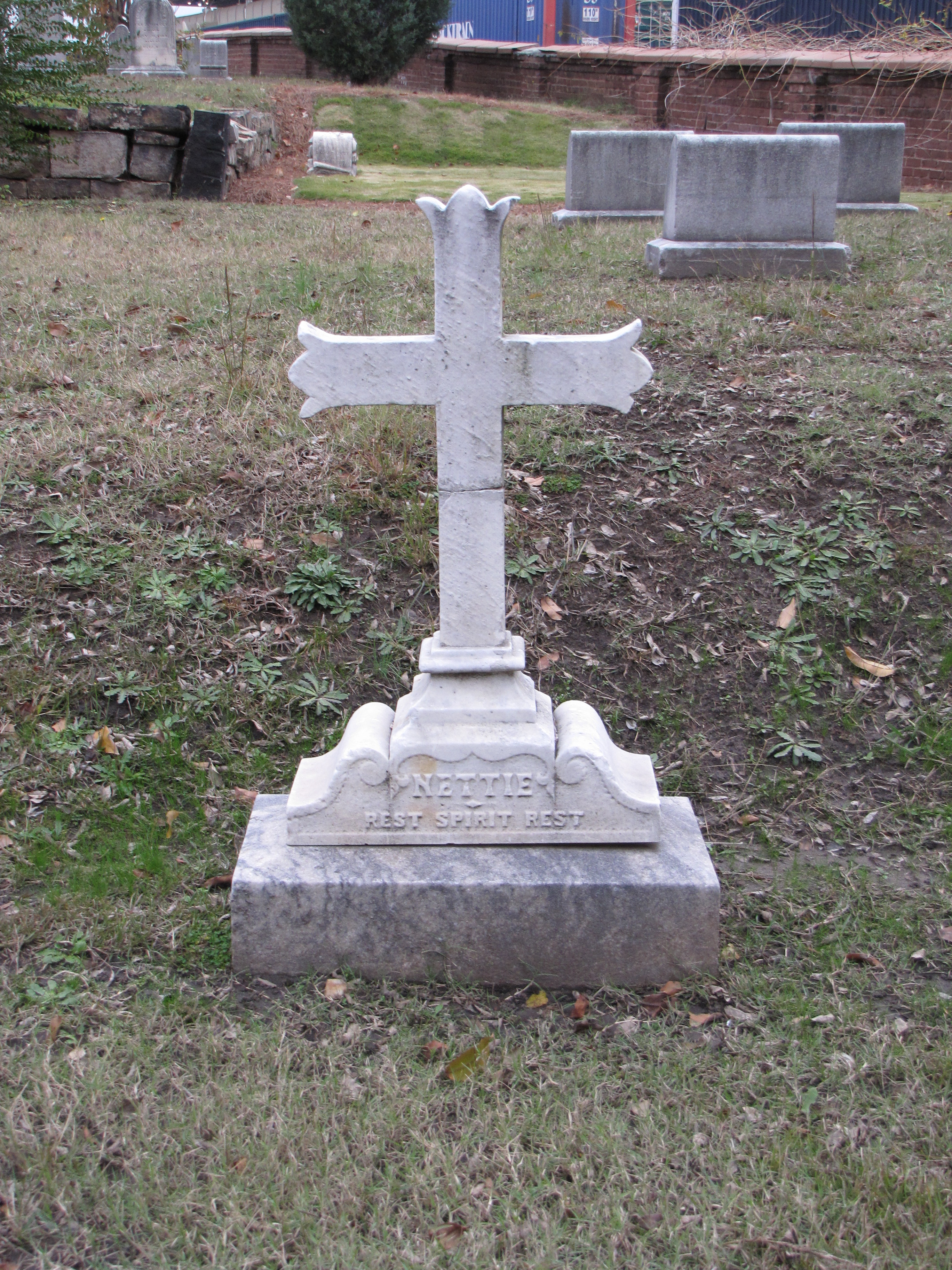
The cross is one of the most common symbols found in cemeteries. It is a Christian symbol that comes in many different designs with separate meanings often with ancient origins. The cross in the photo is called a fleury or floriated cross. What distinguishes this cross are the three-petaled tips at the end of the arms of the cross representing the petals of the lily. The number three also has significance in Christianity and represents the Holy Trinity—the Father, the Son, and the Holy Ghost. This type of cross was also used in the symbolism of heraldry to represent the virtues of wisdom, faith, and chivalry.
Posted in Symbolism | 1 Comment

The Anvil

Augustus Thompson's gravestone, Oakland Cemetery, Atlanta, Georgia

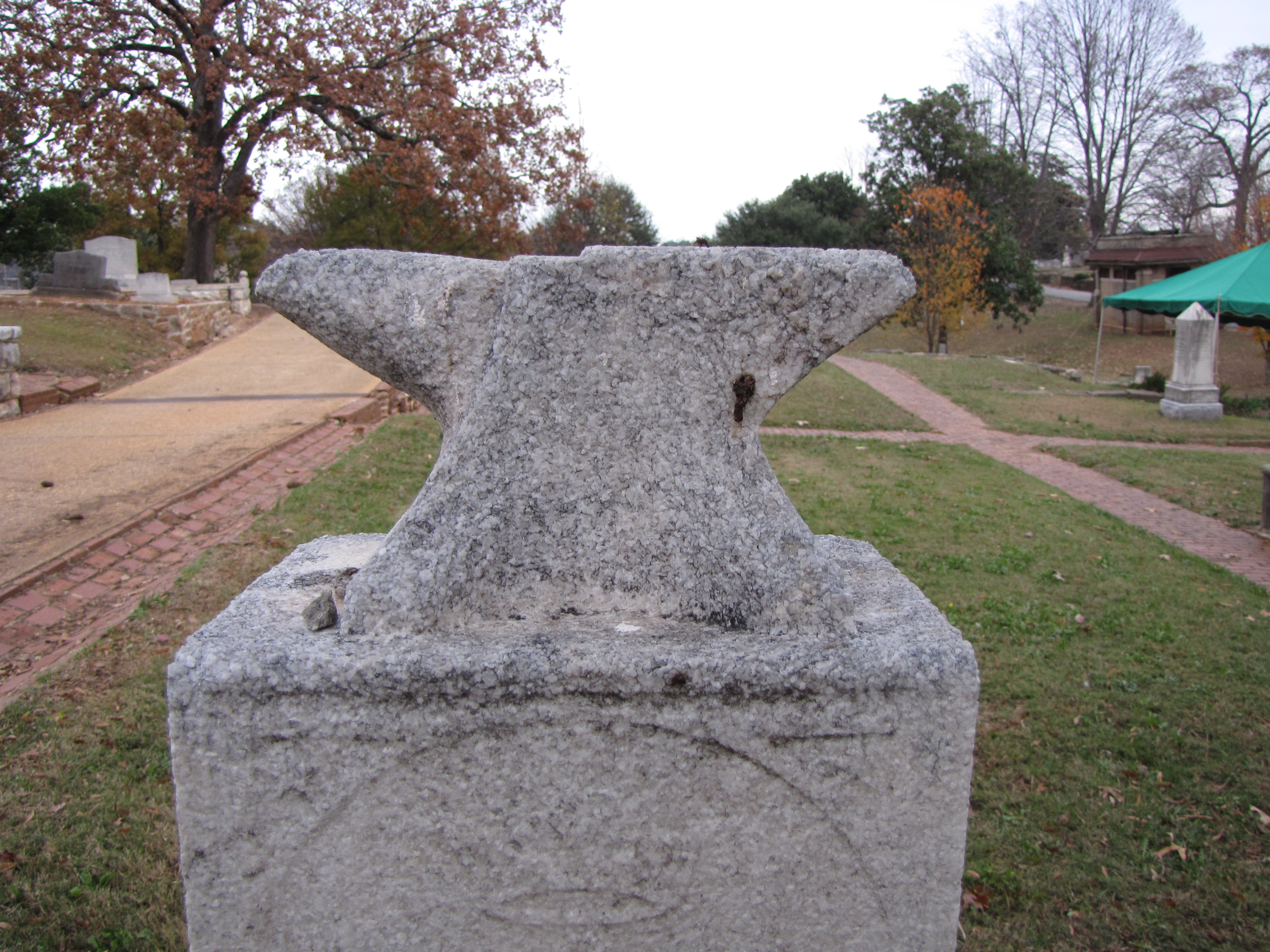
The anvil gravestone pictured above is in what is historically been called the Black Section of the Oakland Cemetery, Atlanta, Georgia.  The monument commemorates the grave of Augustus Thompson (1837-1910) a prominent citizen of the city.  Thompson moved from Mississippi, out of slavery, to settle in Atlanta to work as a blacksmith, hence, the anvil atop of the gravestone. 

This gravestone displays four symbols: 

Anvil: The anvil is a symbol of universe being forged and can also represent martydom. 

The Crown above the mansions in the sky: From the Bible verse John 14:2, “In my Father’s house are many mansions.”  (This symbol is quite faint on the tombstone and difficult to see.)

Three links of chain: A symbol of the Independent Order of Odd Fellows. (Thompson organized teh St. James Lodge of African-American Odd Fellows in Atlanta.)

Open Gates: Represents the passage from the Earthly Realm to the Heavenly Realm.

Oakland Cemetery, Atlanta, Georgia

Posted in Famous graves | Leave a comment

Cohanim

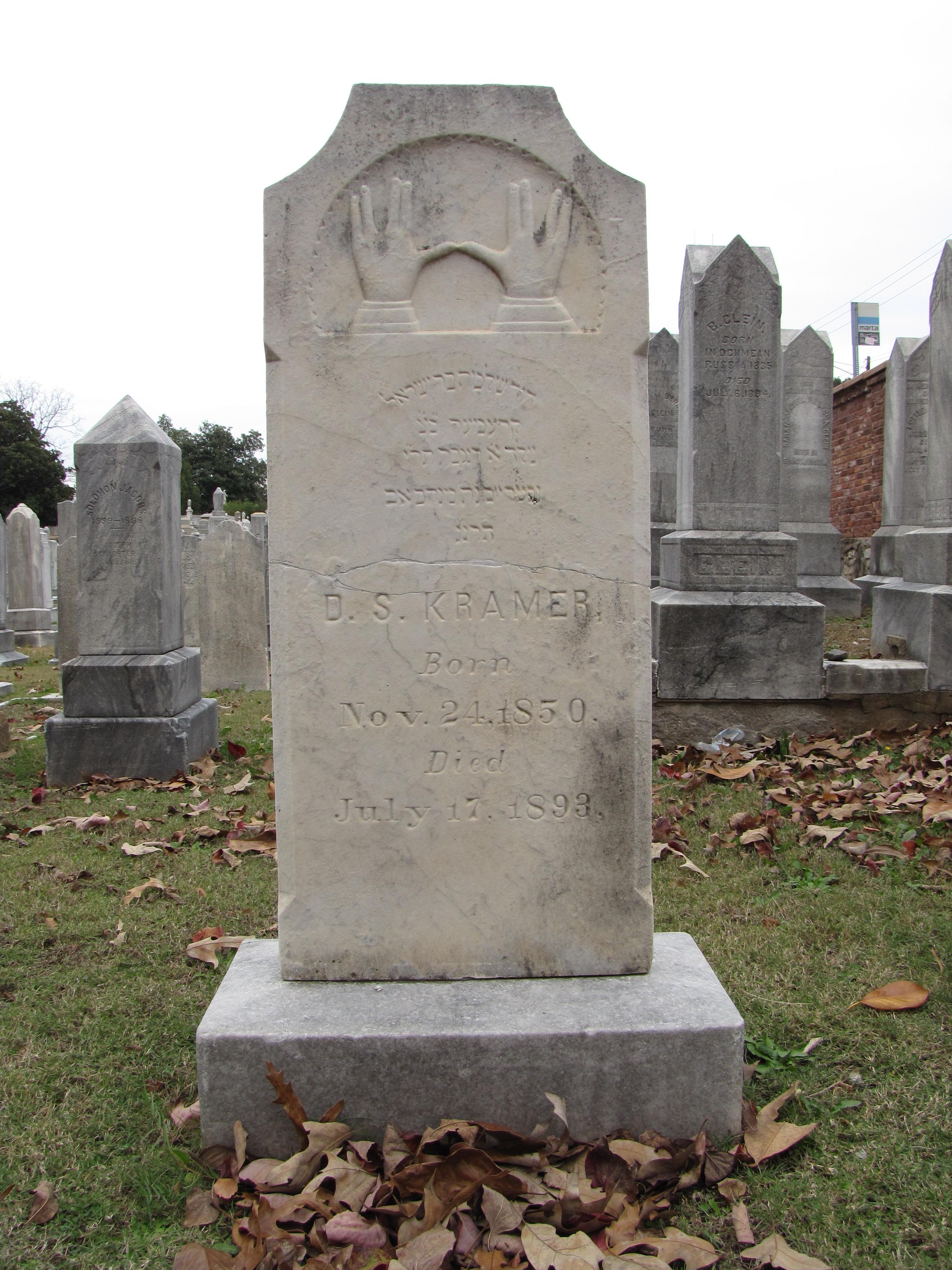
Oakland Cemetery, Atlanta, Georgia

The Oakland Cemetery in Atlanta, Georgia, has a section that was purchased by Russian Jewish immigrants who belonged to the Ahavath Achim Congregation for the burial of their members.  This particular white marble tablet displays a commonly seen funerary symbol found on Jewish tombstones–Cohanim.  The two hands in this position represents a priestly blessing.  The origin of the word–Cohen–is Hebrew for priest.  Cohen is singular, Cohanim is plural.  Families with the last names of Cohn, Kohn, Conn, Cahn, Kahn, Cohen, and Kohen are believed to be descendant of Aaron, the brother of Moses, and the first of the family name–Kohen.
 
This symbol of a hand with fingers separated most likely looks familiar to Star Trek afficionados and Mr. Spock fans as a Vulcan hand sign, coupled with the often repeated “live long and prosper” greeting.  Leonard Nimoy, who saw this blessing as a child attending Temple, suggested a one-handed greeting for his for his character on the iconic television show.
 

Oakland Cemetery, Atlanta, Georgia

Posted in Symbolism | 2 Comments

Gone with the Wind

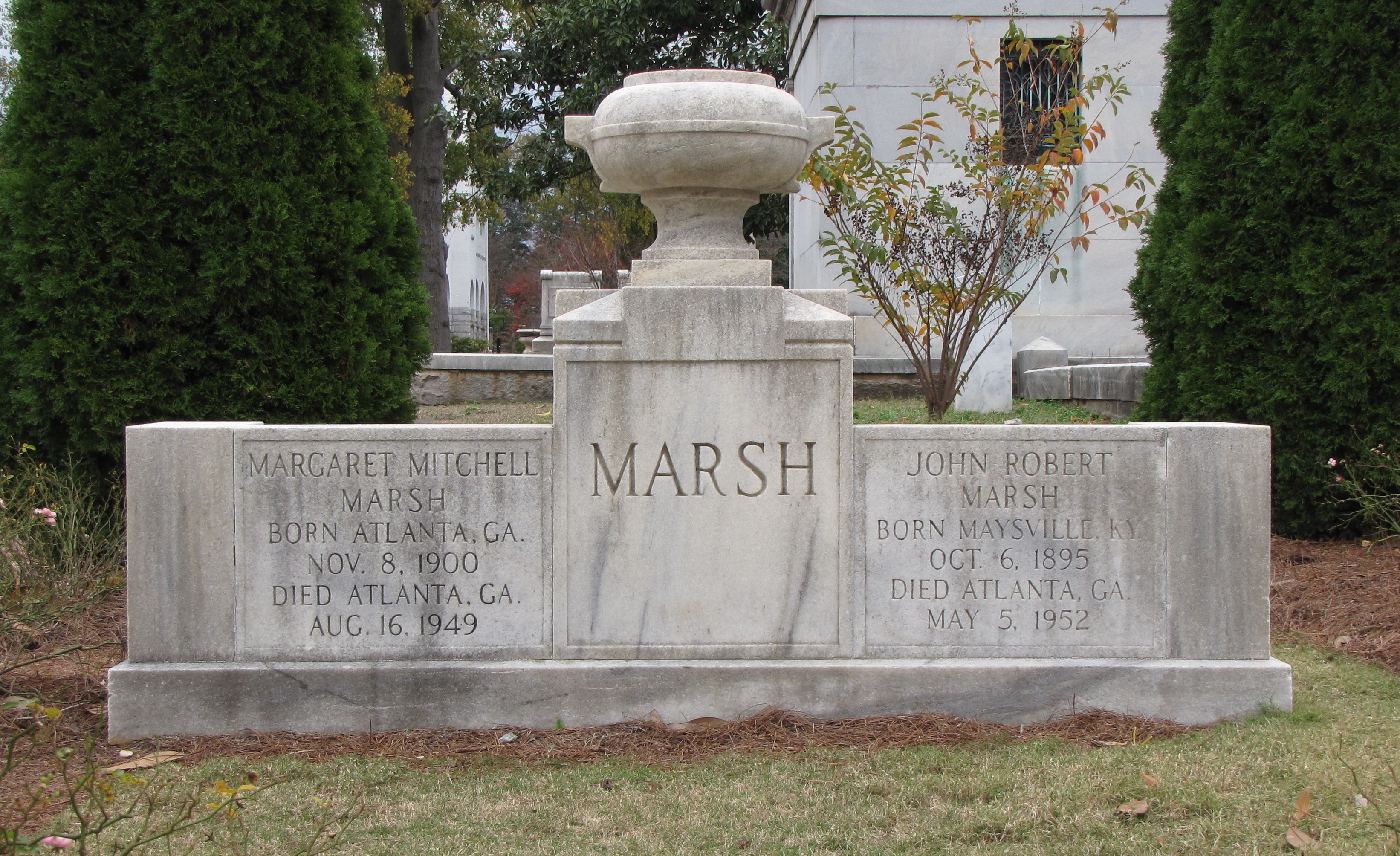
Oakland Cemetery, Atlanta, Georgia

 
Margaret Mitchell Marsh, born Atlanta, Ga, Nov. 8, 1900, Died Atlanta, Ga. Aug. 16, 1949

John Robert Marsh, born Maysville, Ky, Oct. 6, 1896, Died Atlanta, Ga., May 5, 1952

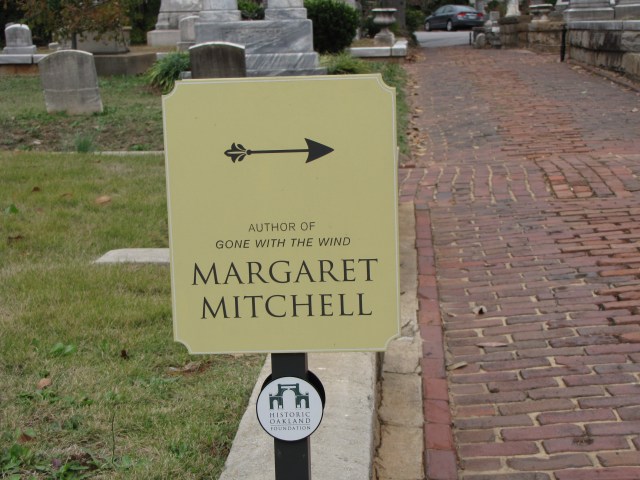
Margaret Mitchell’s grave lies within the walls of Oakland Cemetery, a fitting place for her bones to rest, as she was a daughter of Atlanta, born and bred and died in that city. Margaret Mitchell Marsh’s monument is one of the most visited in the cemetery. Signs point the way for the gawkers who amble by to catch a glimpse of the white marble monument with a large urn centered to divide the monument into equal halves. She shares the tombstone with her second husband, John Robert Marsh, who was also the best man at her short-lived first marriage to an alcoholic, abusive, and hot-tempered man.
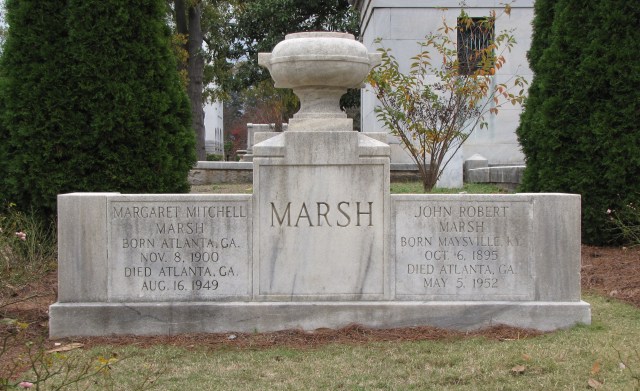
Margaret Mitchell's Monument, Oakland Cemetery, Atlanta, Georgia

Mitchell was a celebrated author. She wrote the epic novel, Gone with the Wind, which was a love song for her beloved South. Pat Conroy, the author of The Prince of Tides, The Great Santini, and My Reading Life wrote, “Margaret Mitchell writes of the Confederacy as paradise, as the ruined garden looked back upon by a stricken and exiled Eve, disconsolate with loss.” Mitchell’s book won the National Book Award in 1936 and the Pulitzer in 1937 for her novel which was turned into a movie and premiered in Atlanta in 1939, starring Vivian Leigh and Clark Gable. Mitchell was the toast of Atlanta and the South.

When she was less than fifty years old, on the evening of August 11, 1949, Margaret and her husband, John, were crossing the street to see a movie when a drunk driver struck her as she stepped into the street. Mitchell was rushed to the hospital but never regained consciousness and died in the city she loved five days later.

Posted in Famous graves | 1 Comment

No Ties

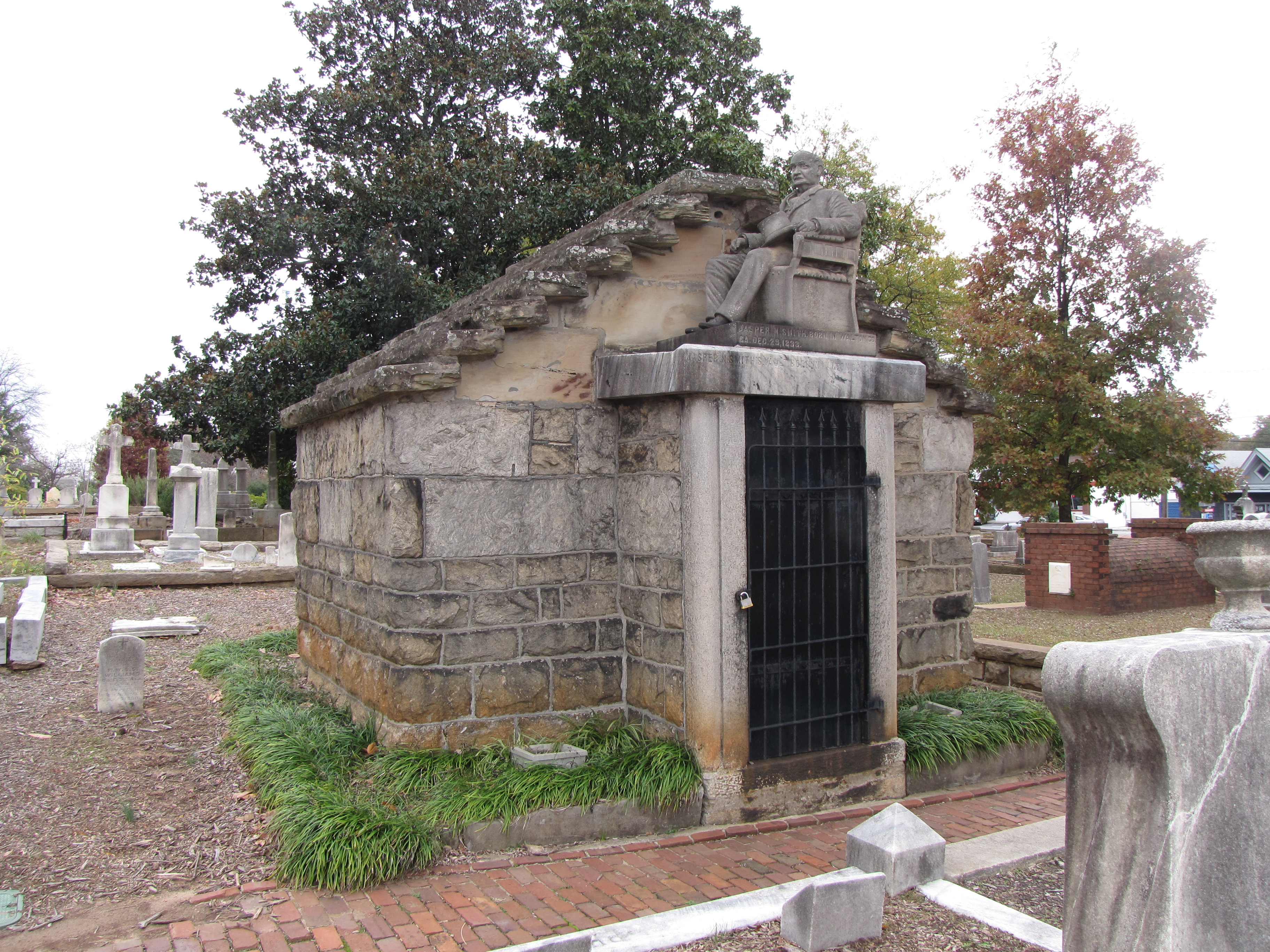
Jasper Newton Smith Mausoleum, Oakland Cemetery, Georgia

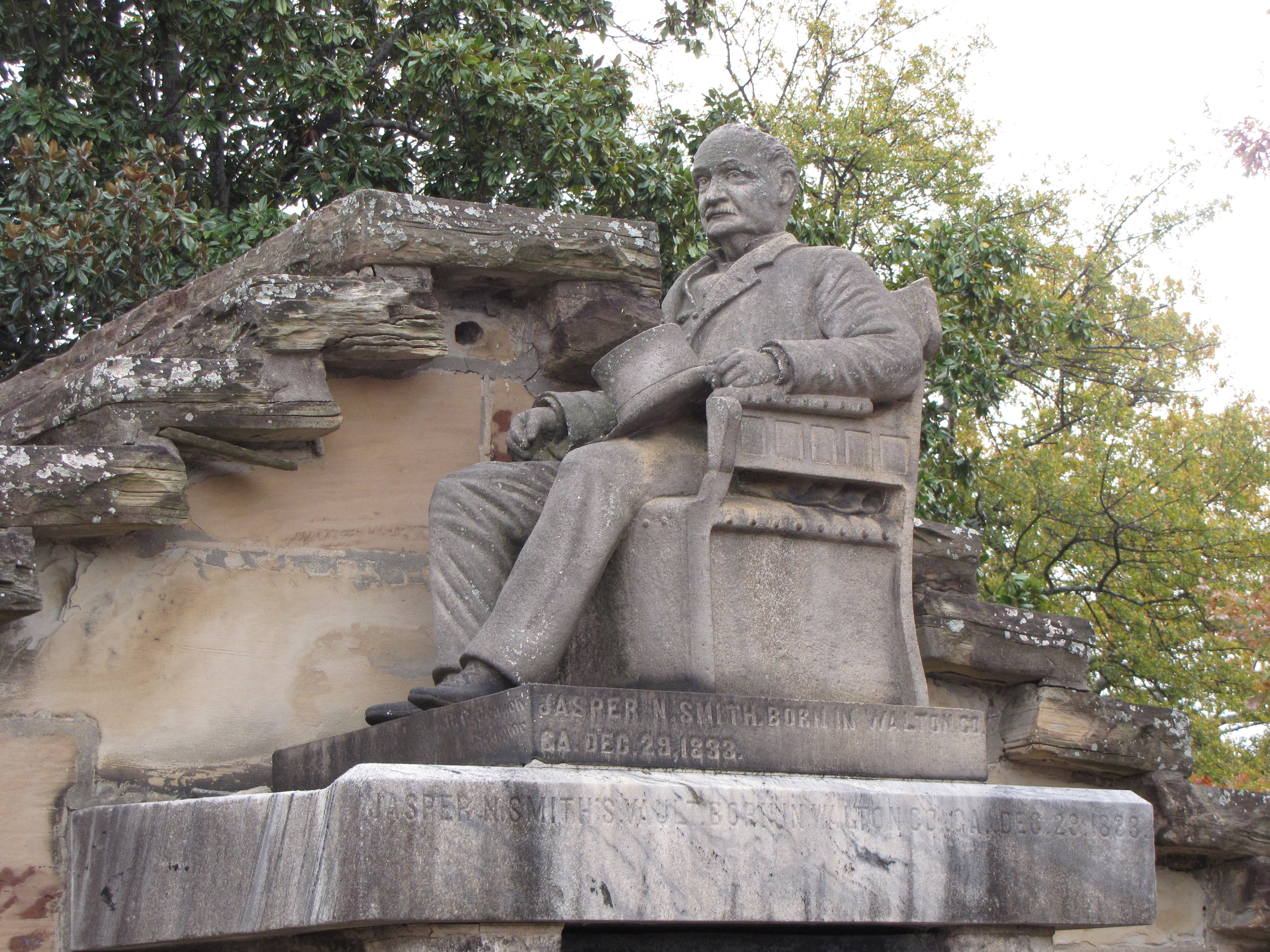
 Jack” Jasper Newton Smith (1833-1918)

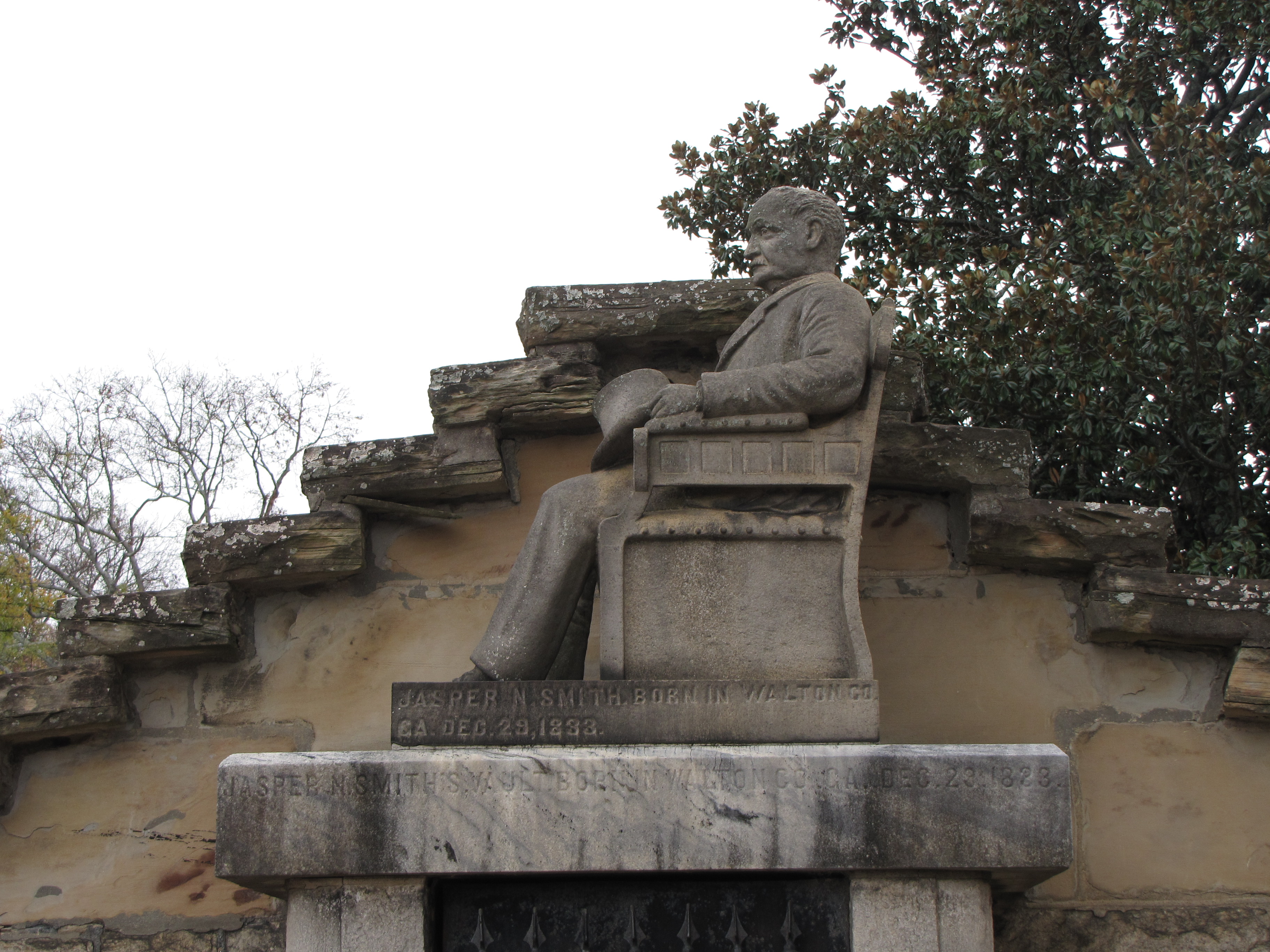
Perched over the steel-gated doorway of a rough-hewn stone mausoleum, sits “Jack” Jasper Newton Smith. Smith, the son of William and Elizabeth Brady Smith, was born on a farm to a large family of ten boys and two girls in Walton County, Georgia, on December 29th, 1833. Jack married Rebecca Hawke in 1856—this union bore the couple six children. When the Civil War began, he joined the Tenth Georgia Cavalry but was forced to resign before the end of the War due to illness.

Jasper Newton Smith, Oakland Cemetery, Atlanta, Georgia

Smith, an eccentric and successful businessman, tried his hand at many pursuits including farming, brick manufacturing, and as proprietor of The Bachelors’ Domain, a forty-four room hotel, each room named after the states of the Union. He also built an unique structure that was pieced together from remnants of other buildings that became known as the “House that Jack Built.”

In 1906, at age 73, Smith, sitting upright in a upolstered chair holding a silk hat, posed for sculptor C.C. Crouch for the statue for his own mausoleum.  As the story goes, Crouch sculpted Smith wearing a tie with his suit coat.  Smith didn’t object to the thinning hair or the waddle under his chin, but he so hated wearing neck ties and ascots that he told Crouch that if the necktie wasn’t chisled out of the scupture, Smith would not pay him. Keeping with that theme Smith didn’t want any vines twinning up his sculpture for fear that the vine might look like neckwear!

Jasper Newton Smith, Oakland Cemetery, Atlanta, Georgia

Posted in Mausoleums | 2 Comments