Cat Lover

IMG_1260

In Loving Memory

WHITFIELD

Hal

1937-1984

Jean

1936-2008

IMG_1258

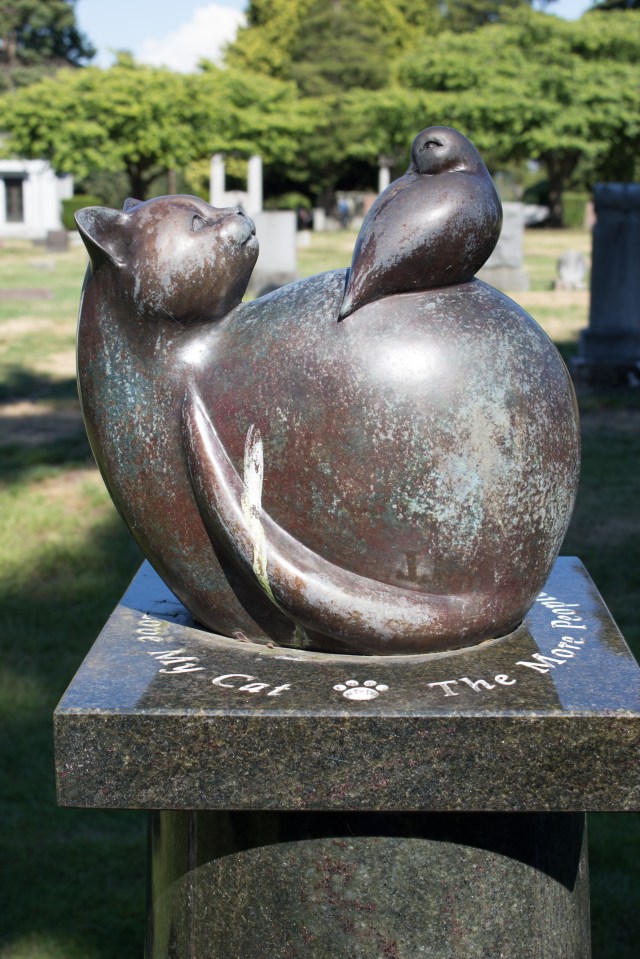
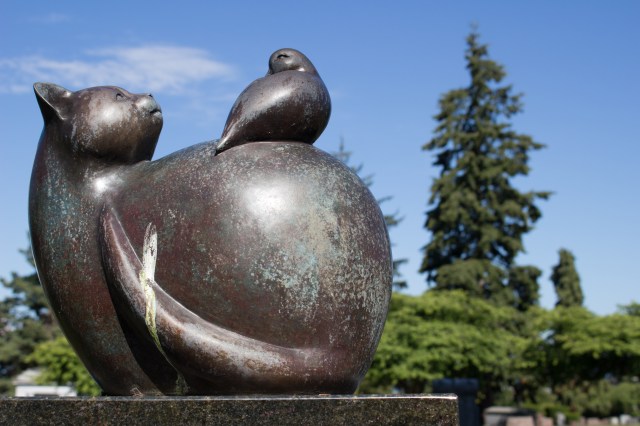
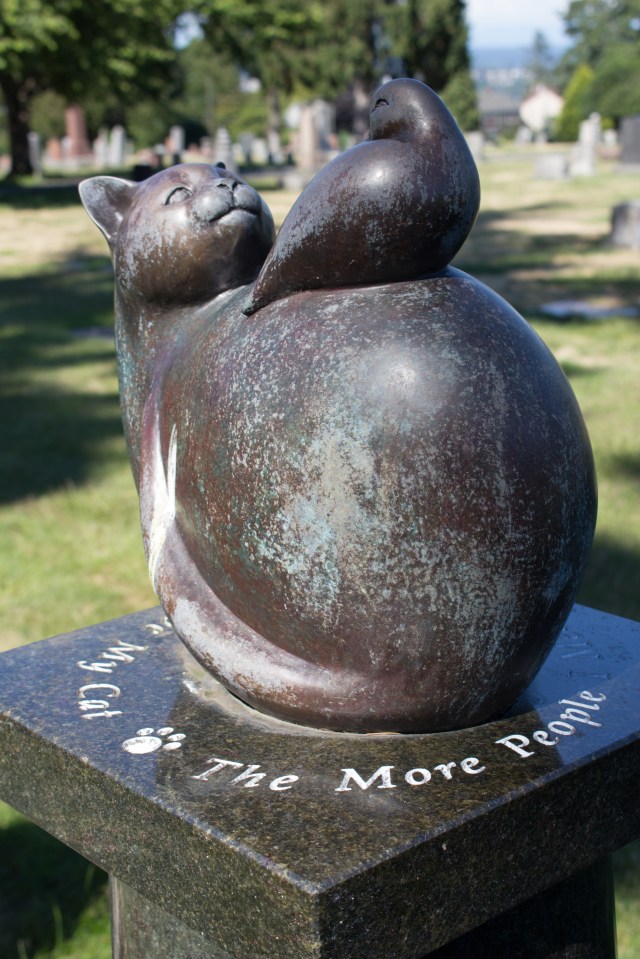
The Hal and Jean Whitfield monument in the Lake View Cemetery at Seattle, Washington, has a whimsical look and message. Atop the gray polished granite shaft sits a sculpture of a round, highly-stylized cat with a bird sitting on its back. The two are looking directly at each other. The bird looks as if it might be daring the cat—the cat looks with suspicion at the bird as one natural enemy might to another. There they sit—coexisting.

IMG_1259

Written in gold lettering tracing around the statue is an epitaph that is surely shared by many cat lovers, “The More People I Meet, The More I Like My Cat”.  The epitaph is punctuated by a paw print carved into the stone.

IMG_1255

Posted in Epitaphs | Leave a comment

Weeping Angel

447px-William_Wetmore_Story_-_Brady-Handy[1]

William Wetmore Story (February 12, 1819 – October 7, 1895), the son of Joseph Story—Supreme Court Justice from 1811—1845, was a multitalented Renaissance man. Story was an editor, poet, art critic, and an incredible sculptor. Though trained as a lawyer at the Harvard Law School, he abandoned the legal profession to follow the arts.

His body of art work includes among others, a sculpture of his father, Joseph Story, fittingly at the Harvard Law School and a statue of another famous jurist and judicial colleague of his father’s, Chief Justice John Marshall. But the sculpture that has become replicated and imitated in cemeteries in Europe and America is the monument that he carved for his wife’s grave in the Protestant Cemetery in Rome, Italy.

453px-Emelyn_Story_Tomba_(Cimitero_Acattolico_Roma)[1]

An article written in the Sept. 1896, issue of Cosmopolitan Magazine stated:

The loss of the wife of his youth whom he survived but a year, was a bitter blow; and with her passed his interest in affairs. It was only when his children suggested that he should make a monument to her memory that he consented to resume work; the design he chose was the “Angel of Grief”, and it is wrought to exquisite finish…When this was done he left the studio never to return.”

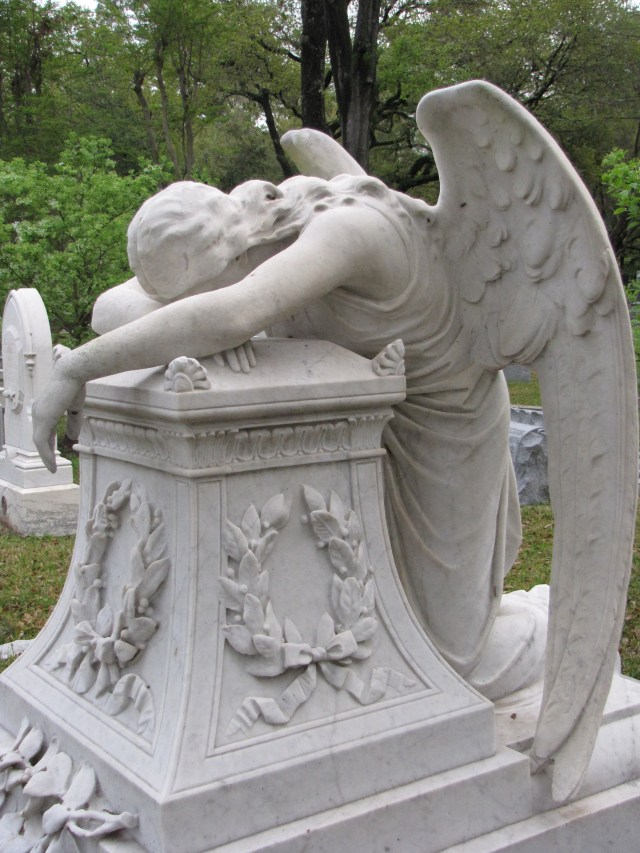
The statue marking Emelyn and William Wetmore Story’s grave depicts an angel collapsed and distraught in grief. The statue is dramatic and evokes the solemn loss of a loved one. The statue is known, aptly as the Angel of Grief perhaps because of its ability to capture devastating grief from departure due to death.

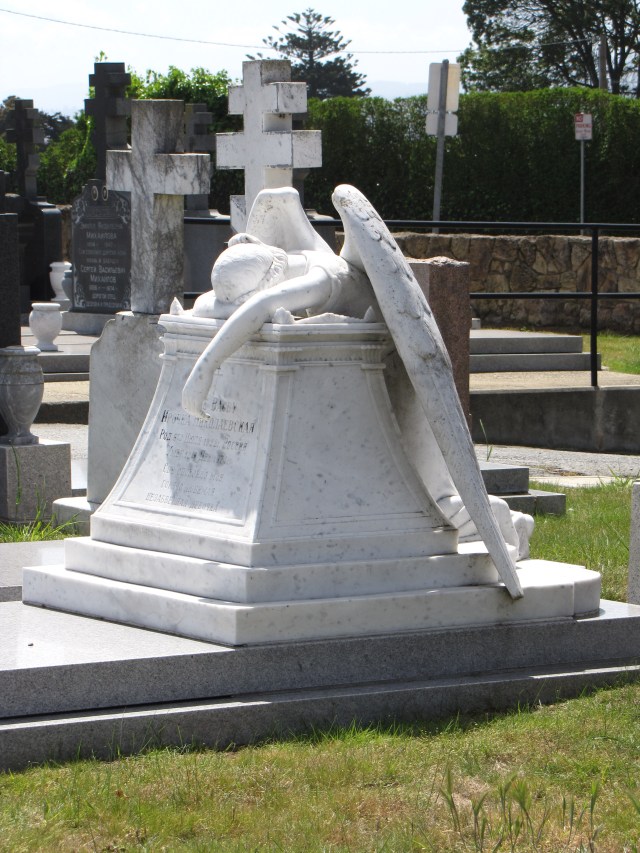
The statue’s imitators can be found in many cemeteries including the ones below:

IMG_2749

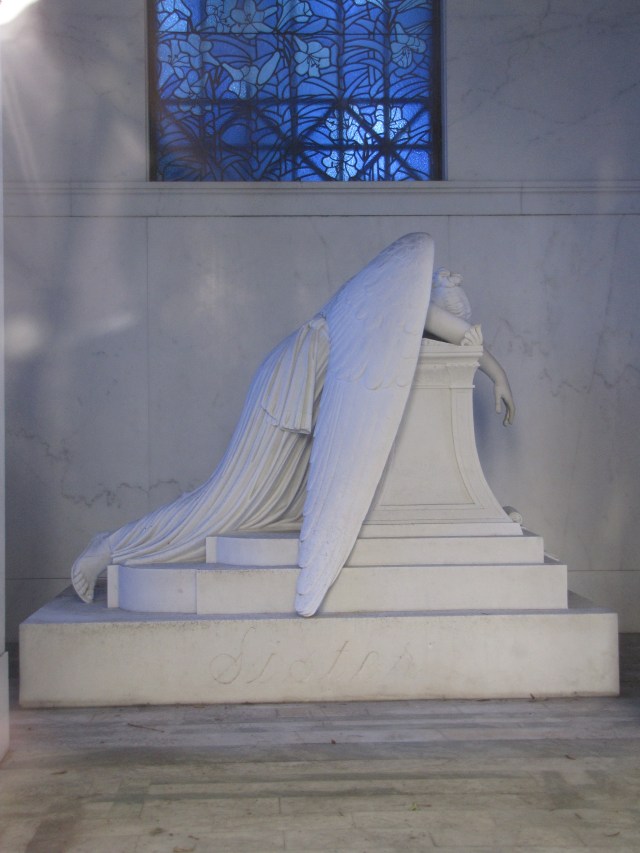
Perhaps one of the most elegant examples can be found in the Metarie Cemetery at New Orleans in the Chapman H. Hyams mausoleum. The blue light from the stained glass showers the statue in a calming hue.

IMG_6415

This example is in the Mount Hope Cemetery at San Diego, California, and marks the grave of Marjorie Marie Pierce.
IMG_7257
Marking the grave of the Hill Family in the Glenwood Cemetery at Houston, Texas, is a replica of nearly exacting quality.

IMG_2380
Irene Bagby’s marker in the Serbian Cemetery at Colma, California.

IMG_2014

Jennifer Roosevelt Pool’s monument in the Cypress Lawn Cemetery at Colma, California. Pool was the cousin of President Theodore Roosevelt.

IMG_4405
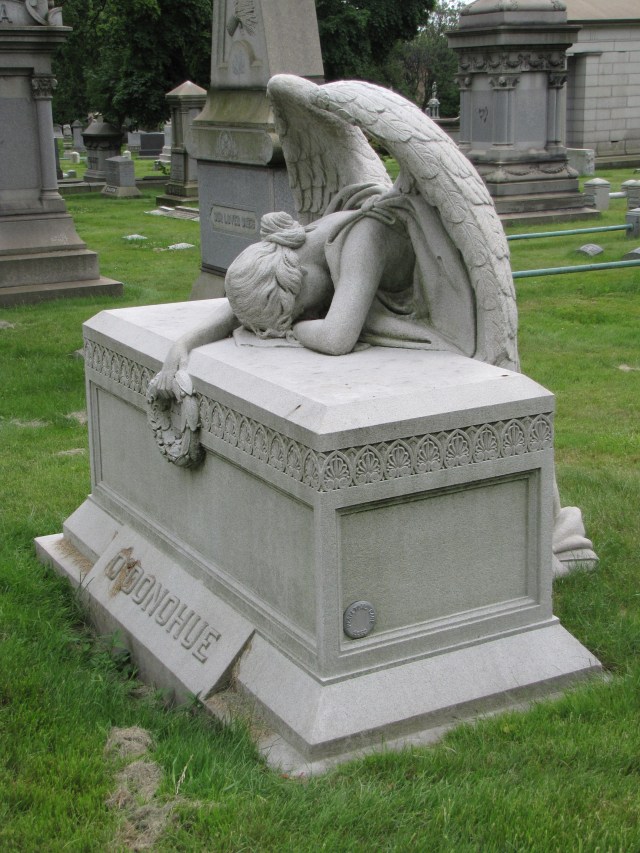
Two examples in the Green-wood Cemetery at Brooklyn, New York, have a slightly deviated design. In this version for the O’Donohue Family has the angel holding a wreath. The laurel wreath dates back to Roman times when soldiers wore them as triumphal signs of glory.  The laurel was also believed to wash away the soldier’s guilt from injuring or killing any of his opponents.  In funerary art the laurel wreath is often seen as a symbol of victory over death.

IMG_3918
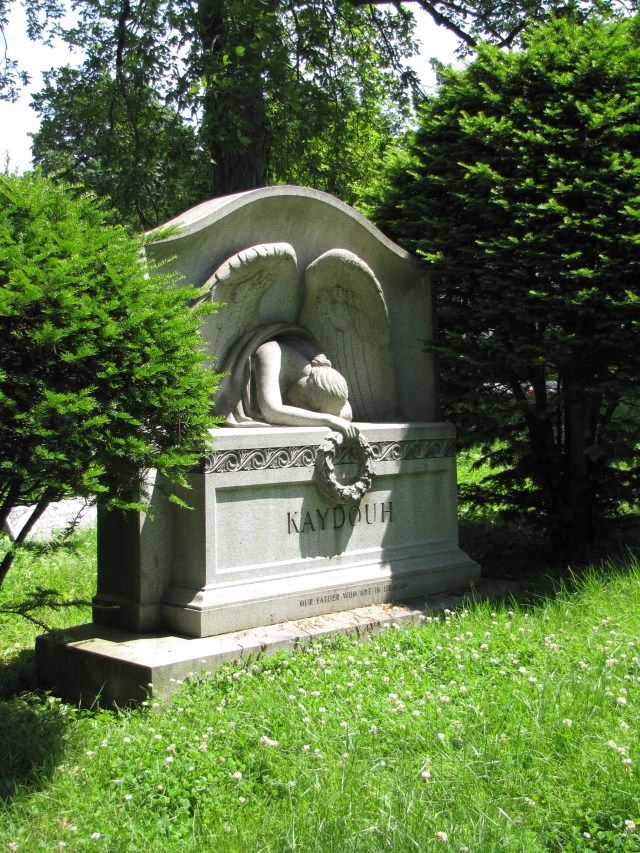
This example is also found in the Green-Wood Cemetery at Brooklyn. It marks the grave of Michael and Shamsi Kaydouh.

IMG_5847

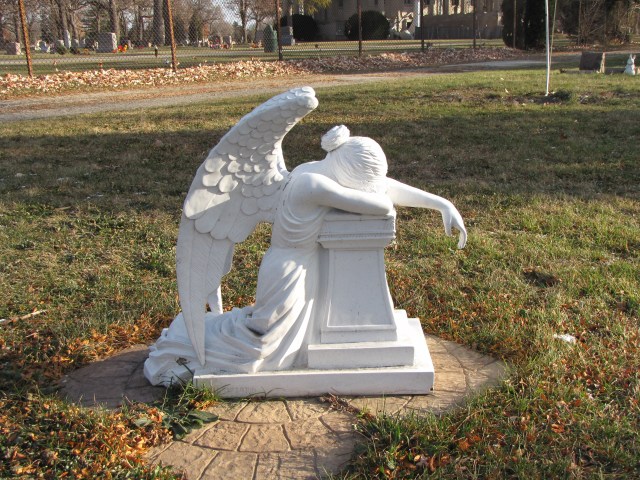
This example is found in the St. Luke Cemetery at Chicago. It is a small version and does not mark a grave but is used as a piece of artwork for the cemetery.  On the front of the monument is the poem:

The bud was spread, To show the rose

Our Savior smiled, The bud was closed. 

Anon.


Posted in Angels, Symbolism | 6 Comments

The Four Evangelists

IMG_8427

The Catholic Calvary Cemetery in Erie, Pennsylvania, has many tombs, gravestones, and markers imbued with Christian symbolism. One of the monuments in that cemetery has a display of all four of the Evangelists—St. Mark, St. John, St. Matthew, and St. Luke. The monument has four sides and in each alcove stands one of the Apostles. Under each statue of an Apostle is the symbol associated with Him.

IMG_8446

St. Mark is depicted as a winged lion. The emblem refers to Christ’s power and regal dignity.

IMG_8459

St. John is represented as an eagle because of his soaring writing in the Gospel that bears His name. Lecterns are often carved into an eagle in His honor.

IMG_8457

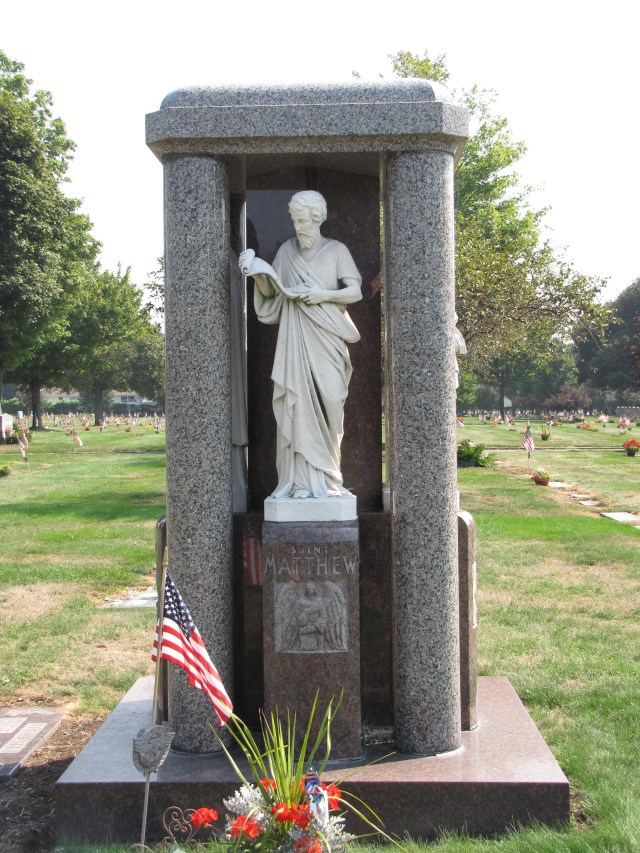
St. Matthew’s emblem depicts the Evangelist as a winged man to represent the divine inspiration that is possible for all of mankind. In statuary St. Matthew is often shown with a quill.

IMG_8458

St. Luke’s emblem is a winged ox. The Gospel written by St. Luke emphasized the sacrifice of Christ—the ox was an animal of sacrifice and associated with Luke because of his writings. The wings symbolize that Christ’s message is to travel throughout the globe. St. Luke is the patron saint of butchers.

IMG_8460

Posted in Symbolism | Leave a comment

Still Missing, Mystery Unsolved

IMG_1283

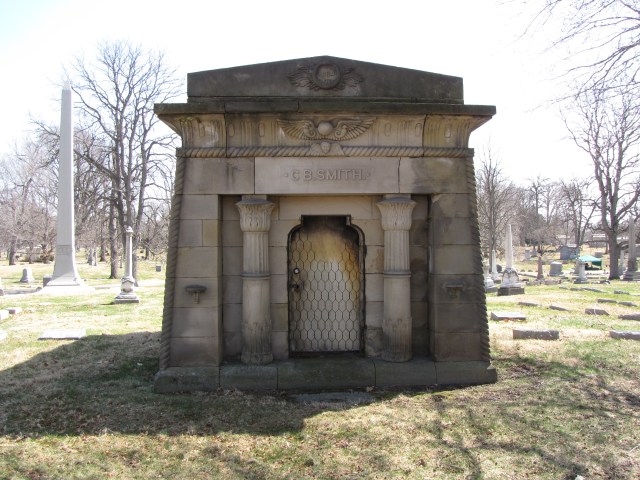
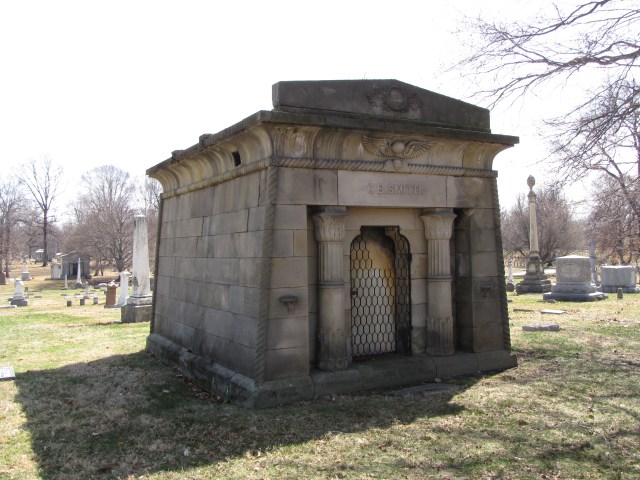
The first private mausoleum built in the Crown hill Cemetery at Indianapolis, Indiana, is an example of the Egyptian Revival architecture found in many large urban cemeteries.

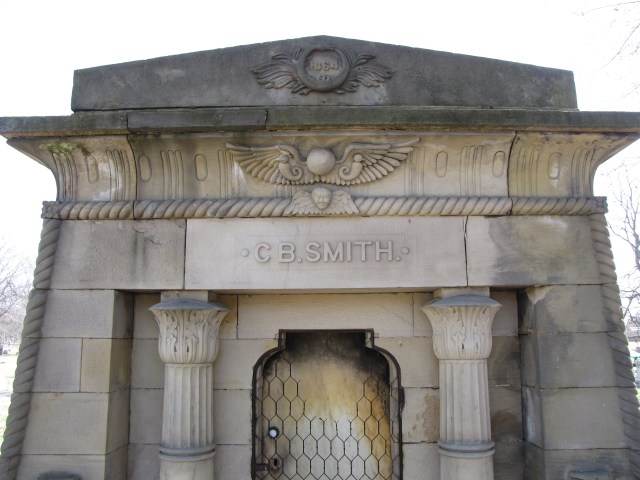
The large sandstone mausoleum has many features of Egyptian temples–the cavetto cornice that curves into a half circle at the top of the tomb and above the doorway, the torus molding at the bottom of the cornice, around the door, and the corners of the mausoleum that are designed to emulate long bundled plants, and the heavy columns with the palm leaves at the top that flank the entrance to the tomb.

IMG_1285

Funerary art and architecture was designed to illicit emotions, such as the finality of death and the Christian ideal of eternity. The tomb also features a winged globes with uroei.  The globe represents the Egyptian god, Horus.  The uroei, snakes, are waiting to strike.  They symbolize the king’s ability to ward off evil spirits.

Carved on the top of the tomb is the Ouroboros ophis, an ancient symbol depicting a snake eating its tail. The word, Ouroboros, is Greek—oura meaning tail; vora meaning eating, and ophis meaning serpent or snake. In ancient Egypt, the Ouroboros represented the daily passage of the sun.  The snake eating its tail in cemetery symbolism represents the cycle of life—birth and death—and eternity.

The massive tomb gives one the sense of solemnity and a sense of eternity, just as did the temples of the pharaohs. It was built to hold the remains of Caleb Blood Smith (April 16, 1808 – January 7, 1864), a towering political figure in 19th Century politics. Smith was admitted to the Indiana bar and hung out his shingle to work as an attorney. He was elected to several terms in the Indiana state legislature. In 1843 Smith was elected to Congress as a Whig representing the 4th Indiana District and served until 1849. Smith campaigned for Abraham Lincoln and as a reward Lincoln appointed Smith Secretary of the Interior—a post he only held for less than two years. Smith was appointed as District Court Judge for the District of Indiana, which he held until his death on January 7, 1864.

Hon._Caleb_B._Smith,_Ind_-_NARA_-_526254[1]

According to Memories of the Past: A Tour of Historic Crown Hill Cemetery by Wayne L. Sanford (page 11), “Smith’s wife, the former Elizabeth B. Watson, buried him temporarily at City Cemetery and was on hand during the first public sale of Crown Hill property held June 8, 1864. On that occasion she selected this property on which she immediately constructed this mausoleum. The structure was completed that year, but for unknown reason she never entombed her husband inside. For that matter, there is still some mystery as to what Elizabeth actually did with Caleb’s remains.”

Caleb Smith’s wife, daughter and son are buried in the tomb—but not Caleb Smith. His body is still missing.

IMG_1287

Posted in Uncategorized | 3 Comments

“Cogito ergo sum”

IMG_7129

CARL A. NORGREN

1890 – 1968

JULIET E. NORGREN

1896 – 1987

On a bronze plaque on the side of the marker:

“I CANNOT HELP BUT WONDER

HOW I CAN CARELESS BE

OF THE SWIFTLY PASSING MOMENTS

THAT SEEK OBLIVION’S SEA;

METHINK THEN – HOW MUCH BETTER

TO IMPROVE THEM AS THEY FLEE.

THOUGH I LIVE BUT A MOMENT,

MY DEEDS – ETERNITY…”

C. A. N.

The two gravestones in today’s blogpost are topped with sculptures with the same theme—thinking.

The first gravestone from the Fairmont Cemetery at Denver, Colorado marks the grave of Carl and Juliet Norgren. Carl Norgren was a mechanical engineer who founded a successful manufacturing company, still in existence today.

IMG_7131

The bronze statue on top of the Norgren’s marker is a replica of the great Rodin statue of the “Thinker”, originally called “Le Pensuer”, in Rodin’s native French. The “Thinker” is most likely one of the most well known and most parodied statues ever created.

IMG_7132

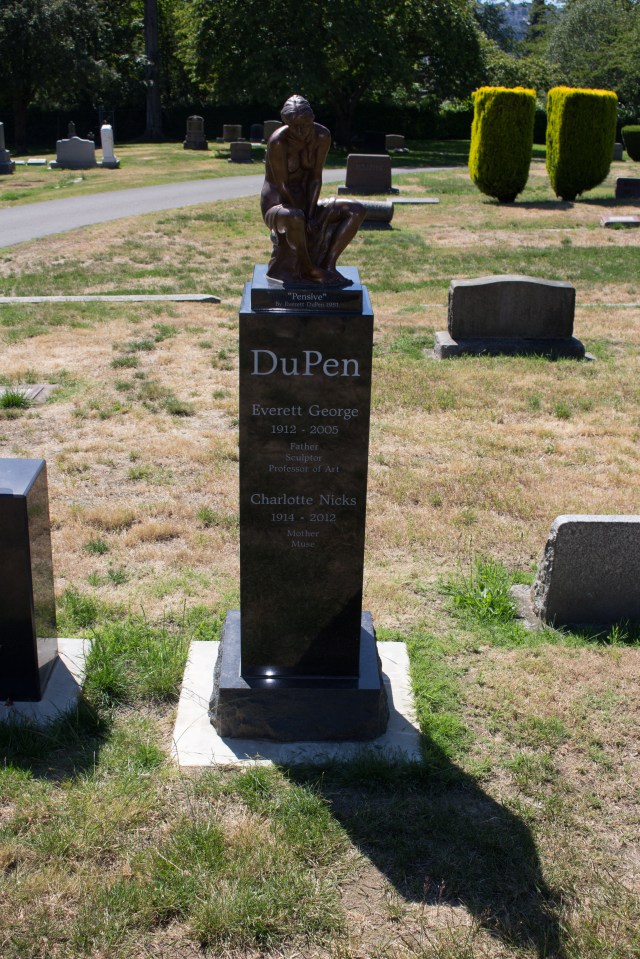
The second monument in the Lakeview Cemetery at Seattle, Washington, for Everett George DuPen and his wife of 65 years, Charlotte Nicks, is a shaft of black polished granite with a bronze of a statue he sculpted himself, titled, “Pensive.” DuPen was a famed artist and acclaimed teacher of sculpture with a long and distinguished career that spanned eight decades.

IMG_1096

What is not clear from either monument is the meaning of the sculptures chosen for their markers. It could be that the Norgren family chose the “Thinker” because it was their favorite sculpture. It could also be that “Pensive” was chosen because it was of Everett DuPen’s favorites. Or it they could both be a call to action—to think about death or maybe more importantly—life.

IMG_1097

Both statues could both be an ode to René Descartes’ statement, “Cogito ergo sum“, Latin translated in his native French as, “Je pense, donc je suis” (1637). The statement, in English, means, “I think, therefore I am”.

DuPen

Everett George

1912 – 2005

Father

Sculptor

Professor of Art


Charlotte Nicks

1914 – 2012

Mother

Muse

IMG_1101

Posted in Uncategorized | Leave a comment

Preach Independence from the Pulpit

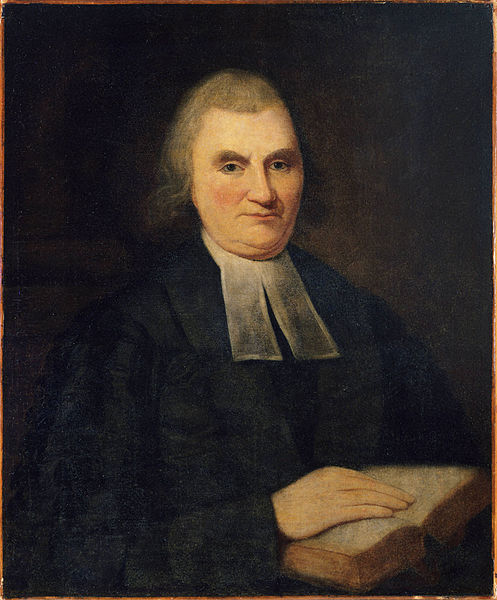
Portrait of Rev. John Witherspoon by Charles Wilson Peale (Public Domain)

Portrait of Rev. John Witherspoon by Charles Wilson Peale (Public Domain)

REVOLUTIONARY PATRIOT

REV. JOHN WITHERSPOON

SIGNER, DECLARATION OF INDEPENDENCE

BORN FEBRUARY 5, 1722

DIED NOVEMBER 15, 1794

On this day, the 4th of July, it is good to remember that our independence from Great Britain was not assured. At the beginning of the war only about a third of the colonists favored separation from good Old King George III and we were up against the best-trained, most well-equiped army in all of Europe. But those patriots who favored it were fervent in their belief and steadfast in their resolve and eventually a majority of the colonists came along.

There were colonists like the Reverend John Witherspoon, a fairly recent immigrant from Scotland, who favored independence and, in fact, advocated it from the pulpit. Witherspoon was the only active minister to sit in the Continental Congress and to sign the Declaration of Independence. During the rousing debate about the Declaration, Witherspoon said in a floor speech in favor that the colonies were “not only ripe for the measure but in danger of rotting for the want of it.”

Witherspoon was at the time a minister but also the President of the College of New Jersey which later became Princeton University. During the Revolutionary War Witherspoon’s hatred of the British increased as the war dragged on. His son, James, was killed in the Battle of Germantown, Pennsylvania. In addition his beloved college was occupied by British. They took control of the main building, Nassau Hall, and burned the library. After the British evacuated Nassau Hall became a hospital to treat wounded soldiers.

Even after the conclusion of the War, Witherspoon remained active in politics. He participated in the New Jersey Convention that ratified the U.S. Constitution.

In 1791, at the ripe old age of 68, Witherspoon married again, this time to a 24-year old widow, who bore him two more children. He died in 1794 and his body was laid to rest in the President’s Lot in the Princeton Cemetery.

Rev. John Witherspoon Chest Tomb, Princeton Cemetery, Princeton, New Jersey.

Rev. John Witherspoon Chest Tomb, Princeton Cemetery, Princeton, New Jersey.

Posted in Famous graves | Leave a comment

The Train Wreck

IMG_3780

ERWIN J. GNAU

Son of

J. & E. M. GNAU

BORN

April 2, 1889

Died

Sep 1, 1891


NORMA C. GNAU

Dau of

J. & E. M. GNAU

Born

Oct. 12, 1884

Died

Sept. 1, 1891

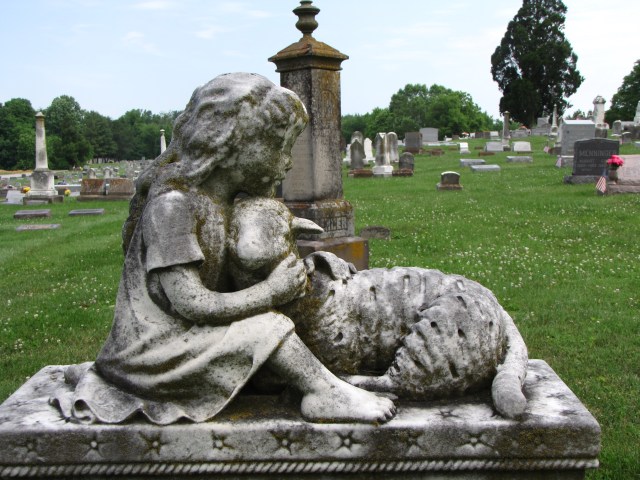
The sweet carving of a little girl hugging a lamb atop the highly-ornamented white marble gravestone in the Greenwood Cemetery at Tell City, Perry County, Indiana, marks the grave of Erwin and Norma Gnau. The sweetness and serenity of the sculpture does not hint at the tragedy of their painful and untimely deaths.
IMG_3781

The September 2, 1891, Wednesday Edition of the Evansville Courier, screams the headline, SEVEN ARE DEAD that tells the sad story:

A Traveling Man Tells of the Scenes and Incidents That Followed the Disaster.

The death list of disaster Monday on the Cannelton branch of the Air Line road has been increased to seven. The correct list of fatalities are as follows:

Miss Emma Nermer, Fulda, Ind.

Miss Emma Schuh, Tell City.

Mrs. John Gnau, Troy

Little Norma Gnau, Troy.

Little Irwin Gnau, Troy.

Mural Durbin, boy, Hawesville, Ky.

Peter Gaesser, Tell City

The home of John Gnau , in Troy, is one of mourning. The wife was terribly scalded by escaping steam. She suffered intense agony and the physicians pronounced her case hopeless. She lingered in intense suffering until yesterday morning, when death came to her relief. Little Irwin Gnau died shortly after being taken home and little Norma Gnau, a bright little girl, was also so badly burned that she died yesterday. Three bodies now lie in the house made desolate by death….

Engineer App arrived in this city yesterday by boat. He went at once to his home and is not badly injured, beyond a number of burns and bruises.

A force of men are at work at the scene of the wreck and at last account it was nearly cleared. The engine is badly damaged.

WAS AT THE WRECK

A Description of the Scene Following the Disaster.

Mr. Schroeder, a travelling salesman, arrived in the city yesterday from the scene of the disaster. To a COURIER representative Mr. Schroder, while at the Lottie, told what he saw of the wreck. He said that he was near Troy when he heard the engine whistle for brakes. He did not hear the crash, but soon learned that the wreck had occurred. He hastened to the scene and arrive a half hour later it had occurred. All had been removed from the fated coach, which was then a smoldering wreck. The wreck occurred on one of the worst curves of the road. Mr. Schroder made an examination of the rails and found that for some distance pieces were cut out at regular intervals. This went to show conclusively that a flange had broken. The notches in the rails were so large that a finger could be placed in the depression. The point where the engine trucks climbed the rails was plainly discernable.

            Mr. Schroder said that when the passenger coach followed the engine into the ditch the front end was shoved in. The smoking apartment, occupying about one-third of the car, was in front. In this were a number of gentlemen. When the coach landed on top of the aperture made in the front of the car. One was Editor Bott of the Tell City Anzeiger. Another was Mr. Kasser, at traveling man, who is large and fleshy and has but one arm. The third was a man whose name is unknown. All three found themselves in the ditch among the wreckage….

The death chamber was near the partition in the car. Here Miss Nemer last her life. She was sitting near the partition and was caught in the wreckage. The engine was immediately beneath. The steam pipe leading to the whistle broke and the unfortunate young lady was roasted to death. Mrs. Gnau and her children was sitting near Miss Nemer and they also received the full steam from the engine….”

According to the article on the Find-A-Grave site for Emma Gnau, mother of Edwin and Norma, as she was being carried out of the train car in terrible pain blinded by the steam injuries she pleaded with those around her to save her children. She, nor her children survived the accident. Emma, a 38-year mother was laid to rest next to two of her children after a requiem in the St. Pius Church of Troy. She was survived by her husband, John, and her son, Oscar.

Nearly three weeks later, after investigating the accident, the county coroner came forward with his assessment of the accident which was reported in the September 20, 1891, Sunday Edition of the Evansville Courier. The paper ran the headline, “THE AIR LINE WRECK” and sub headline, “Coroner Cluthe’s Verdict Censures the Railroad Company”.

CANNELTON, IND., Sept 19—[Special]—Coronoer Cluthe’s verdict in the late disaster, wherein eight people were killed on the Air Line five miles west of this place, reads about as follows:

“I, William Cluthe, coroner of Perry county, Indiana, find that Emma Schuh, Carrie Nemer, Mrs. Gnau, Norma Gnau, Edwin Gnau, Arthur Keck and Mrs. Chamier came to their death by scalds, burns, bruises, inhalation of steam, in a railroad accident on the L.E. & St. L. Railroad.

“I further find the point where the accident occurred was on a high curve without sufficient grade on the road-bed. I will also censure the company on the high rate of speed called for in the schedule time.

“I also found rotten and broken ties near the place of the wreck.”

According to the coroner, the railroad itself had been at fault for the accident that shattered the Gnau family forever. The little girl and the lamb are reminder of the innocent lives lost that day leaving no hint of the tragedy that caused their deaths. The lamb is the symbol of the Lord, the Good Shepherd. It also represents innocence, likely the reason why this motif almost always adorns the tombstones of infants and young children.

IMG_3785

Posted in Uncategorized | 2 Comments

T.O.T.E.

IMG_4597

THOMAS BAKER

BORN

NOV. 13 1847

DIED

JAN. 18 1896

Farewell my wife and

Children all. From you

A father Christ doth call.

FRANCIS T.

Son of

T. & M. E. BAKER

BORN FEB. 23 1874

DIED OCT. 10 1874

God seized the precious treasure

To us so lately given

He took the lovely flower

And planted it in Heaven.

The gravestone of Thomas Baker, in the Mount Carmel Cemetery at Stinesville, Indiana, has hatchet, more specifically a tomahawk, with the initials T. O. T.E. carved into it. The tomahawk marks the grave of a member of the Improved Order of Red Men (I.O.R.M.), which claims its beginnings with the patriots who were in the Sons of Liberty during the American Revolution.

IMG_4598

The society models itself after the Iroquois Confederacy councils.  In fact, some of the markers display images of Native Americans because the society based their organization on the rites and rituals of the Native Americans.

The initials T.O.T.E stands for Totem of the Eagles.  According to their Website, the IORM “promotes patriotism and the American Way of Life, provides social activities for the members, and supports various charitable programs.”

Posted in Symbolism | 5 Comments

Supermodel Muse

Melvin Brothers Memorial, Sleepy Hollow Cemetery, Concord, Massachusetts

Melvin Brothers Memorial, Sleepy Hollow Cemetery, Concord, Massachusetts

ASA HEALD MELVIN

BORN SEPTEMBER 26, 1834

KILLED IN BATTLE BEFORE PETERSBURG VA

JUNE 16, 1864

JOHN HEALD MELVIN

BORN JULY 27, 1841

DIED IN A MILITARY HOSPITAL AT

FORT ALBANY VIRGINIA

OCTOBER 13, 1863

SAMUEL MELVIN

BORN APRIL 9, 1844

TAKEN PRISONER AT HARRISS FARM VA

MAY 19, 1864

DIED AT ANDERSONVILLE GA.

IN MEMORY OF THREE BROTHERS BORN IN CONCORD

WHO AS PRIVATE SOLDIERS GAVE THEIR LIVES

IN THE WAT TO SAVE THE COUNTRY

THIS MEMORIAL IS PLACED HERE BY THEIR SURVIVING

BROTHER HIMSELF A PRIVATE SOLDIER IN THE SAME WAR

“I WITH UNCOVERED HEAD

SALUTE THE SCRED DEAD

WHO WENT AND WHO RETURN NOT”

IMG_0907

When James Melvin came back from the Civil War after serving in the 6th Massachusetts Infantry, he was not joined by his brothers, Asa, John, and Samuel. They had all served in the 1st Massachusetts Heavy Artillery unit which took heavy losses throughout the war. John was the first to perish—he at a military hospital in Fort Albany, Virginia. Asa died on the battlefield during an assault on Petersburg, and Samuel, who had been captured, died at the infamous and reviled Andersonville prison.

IMG_0908

James, the fourth and youngest brother, later became a successful businessman and commissioned Daniel Chester French to design a memorial to his three fallen brothers. Daniel Chester French was arguably the most noted sculptor of his day, creating such monumental works as Minute Man at Concord, Massachusetts, the Marshall Field Memorial in Graceland Cemetery at Chicago, and his most famous work—the Seated Lincoln in the Lincoln Memorial at Washington, D.C.

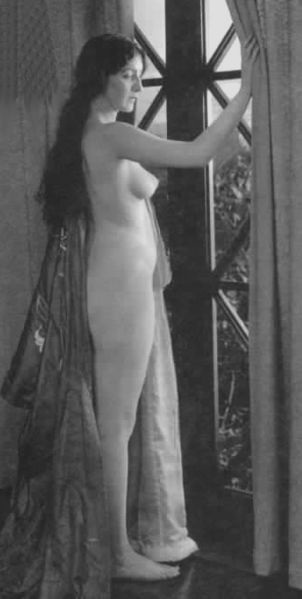
To create what he titled, Mourning Victory, French hired Audrey Munson to model for the sculpture. Though, Munson, is not a household name like Cindy Crawford, Gisele Bundchen, or Christy Brinkley, some say, Munson was America’s first supermodel. Her likeness can be found today in statues in New York, Wisconsin, California, and as far away as the Netherlands. Audrey became the model of choice for acclaimed artists, such as, Alexander Stirling Calder, Karl Bitter, Sherry Edmundson Fry, Adolph Alexander Weinman, and of course, Daniel Chester French.

Audrey Munson in the silent film, Heedless Moths, 1921

Audrey Munson in the silent film, Heedless Moths, 1921

Not only was she a model to be found on statues from coast to coast, but she posed for the Walking Liberty dollar designed by Adolph Alexander Weinman. It is believed, she is the model for the Liberty Dime, too, which he also designed.

Walking Liberty Dollar designed by Alexander Weinman

Walking Liberty Dollar designed by Alexander Weinman

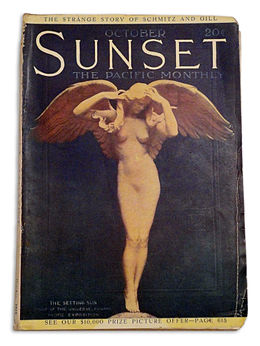
Her likeness can be found on magazine covers of the time and she also worked in the fledgling movie industry appearing in four silent movies—Inspiration in 1915, Purity in 1916, The Girl o’ Dreams in 1916, and Heedless Moths in 1921. Audrey Munson was the first actress to appear fully nude in a film—Inspiration.

Sunset magazine, (October 1915) her image in a sculpture by Alexander Weinman

Sunset magazine, (October 1915) her image in a sculpture by Alexander Weinman

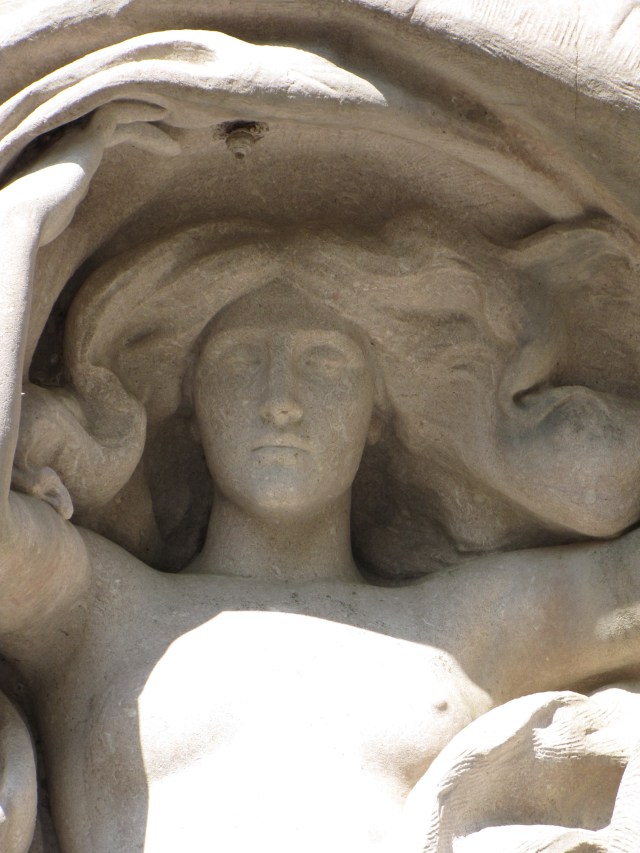
The sculpture by French for the Melvin Brothers Memorial is titled Mourning Victory. It features a woman as the allegorical figure of victory. The Metropolitan Museum of Art in New York City, which has a replica of the statue in marble in their collection, describes the statue, “The massive figure of Mourning victory emerges from the block of stone projecting two moods: melancholy, in her downcast eyes and somber expression, and triumph, in the American flag and laurel she holds high. French captured the sense of calm after the storm of battle, which must have referred to the pride, after the sorrow of grieving, felt by the surviving brother.”

The monument is a tribute not only to the Melvin Brothers and to the soaring talent of French, but to Audrey Munson, who was the muse for so many artists of her day.

StarASC[1]

In 1922, Munson attempted suicide. Nearly ten years later, her Mother petitioned to have Munson committed to an insane asylum, which is where she spent the last 65 years of her life—dying at the St. Lawrence State Hospital in Ogdensburg at the age of 104 years old. Munson is buried in the New Haven Cemetery at new Haven, New York, in an unmarked grave. Her image, however, lives on.

Posted in Uncategorized | 2 Comments

His Last Trip

IMG_4540

Killed at New Albany

North Y. while on duty for the

Monon R. W. Co.

EMORY L.

SON OF J. N. & E. A.

TITZEL

BORN

SEP. 15. 1880

DIED

DEC. 20. 1902

HIS LAST TRIP

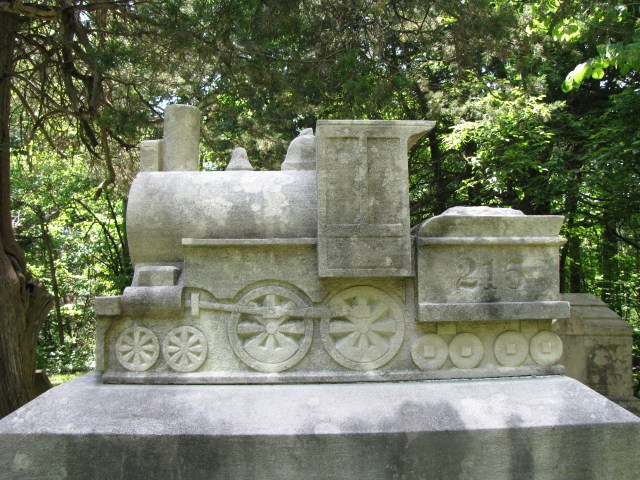
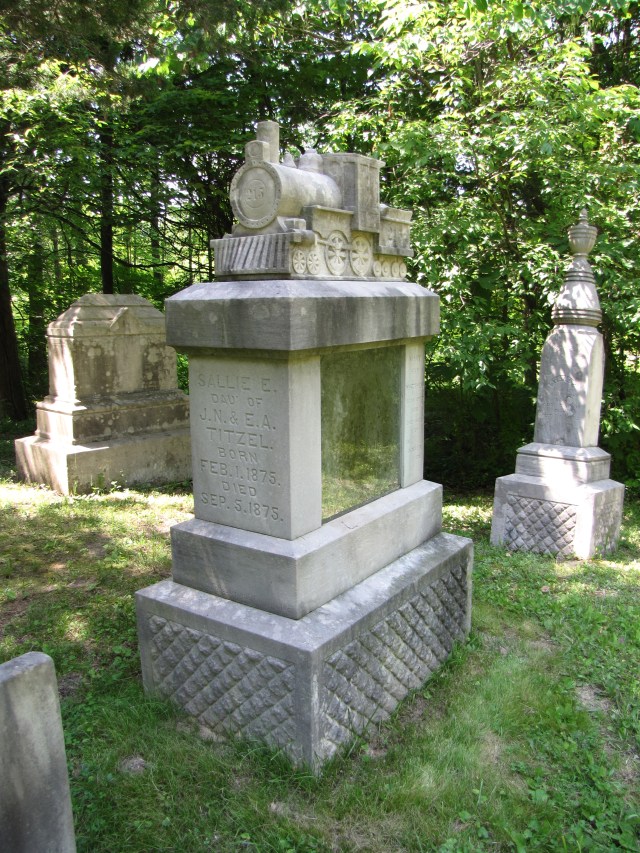
C. R. Salyards of Orleans, Indiana, carved the train on top of the gravestone for Emory Titzel in the Mount Carmel Cemetery at Stinesville, Bean Blossom Township, Monroe County, Indiana.

IMG_4551

Emory Titzel was a brakeman on the Monon Rail Way Company when he was killed in a accident.

In addition to the intricate carving of the train engine, there is a glassed compartment in the center of the gravestone that housed the flowers from the funerals. The flowers have long since decomposed.

IMG_4542

Even though the train marked the untimely death of Emory Titzel and his “last trip” on the Monon, other children of Joseph Newcomer and Edwina Ann (Williams) Titzel are memorialized on the stone:

MARY

FAY

MATTHEW

BORN APR. 22

1898

DIED AUG. 23

1909

IN

DENVER

COLO.


SALLIE E.

DAU OFN. & E. A.

TITZEL

BORN

FEB. 1. 1875.

DIED

SEP. 5. 1875

IMG_4553

Posted in Uncategorized | 2 Comments