The Bride in the Mist

IMG_2116

FILOMENA BUCCOLA REMEMBRANCE OF MY DAUGHTER

JULIA AGE 29 YRS.

questa fotografia

presa dopo 6 anni morta

BUCCOLA

IMG_2117

On moonless nights when there is a gentle rain, there have been reports in the Mount Carmel Cemetery at Hillside, Illinois, of a mist with a faint light emanating from the haze. Inside the mist is the apparition of a bride hovering above the ground—always looking downward as if she has lost something—or someone. Upon investigation the visage is almost always spotted near the gravesite of Julia Buccola Petta and her stillborn son. Julia Petta is legend here, known simply as the Italian Bride. Her macabre story is one of heartbreaking sadness and mystery.

The story starts in 1909, when Enrique Buccola immigrates to Chicago to join his brother, Giuseppe from Palermo, Italy. Both brothers work in the fashion industry—Henry as a tailor and Joseph as a clothing designer.

Because of the brothers’ success, they bring over other members of the family to join them. Rosalia was the first sister to join them. In 1913, their mother, Filomena and their sister, Julia, immigrate to America, too.

On June 6, 1920, Julia married Matthew Petta at the Holy Rosary Parish. Nine months later, on March 17, 1921, Julia died giving birth to a stillborn son, Flippo. Julia was buried in her wedding dress with her son in her arms. Her mother, Filomena, was beside herself with grief.

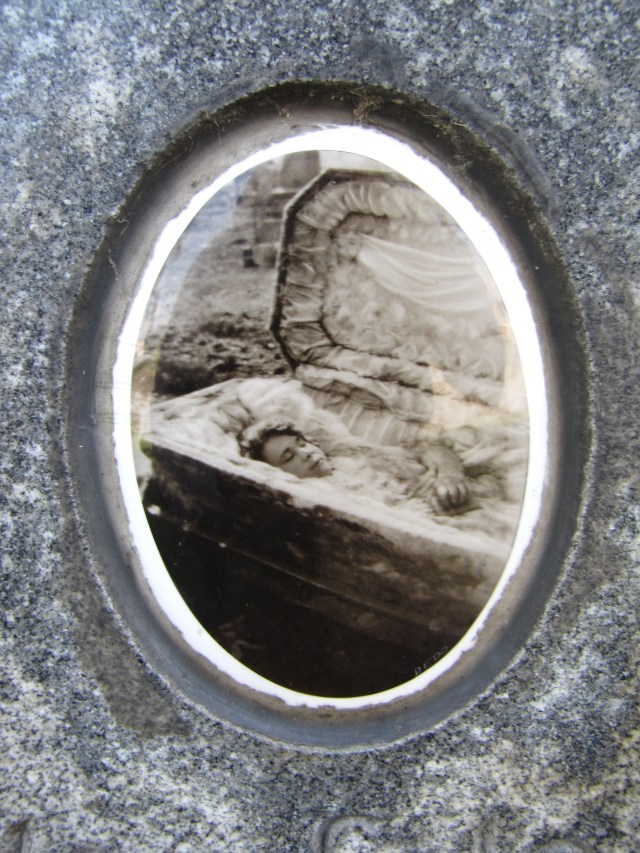
Filomena began having dreams that her daughter was still alive. The dreams went on and were so vivid and real to her that after six years, she mustered the courage to have her daughter’s body exhumed so she could see once and for all that the dreams were not real—that Julia and her son had died.

The casket was opened and to the surprise of everyone, Julia’s body was nearly as she was buried—still with rose-colored cheeks and soft supple skin except where her son lay. He had decomposed. Many believed that Julia’s preserved body was a sign that she was a saint.

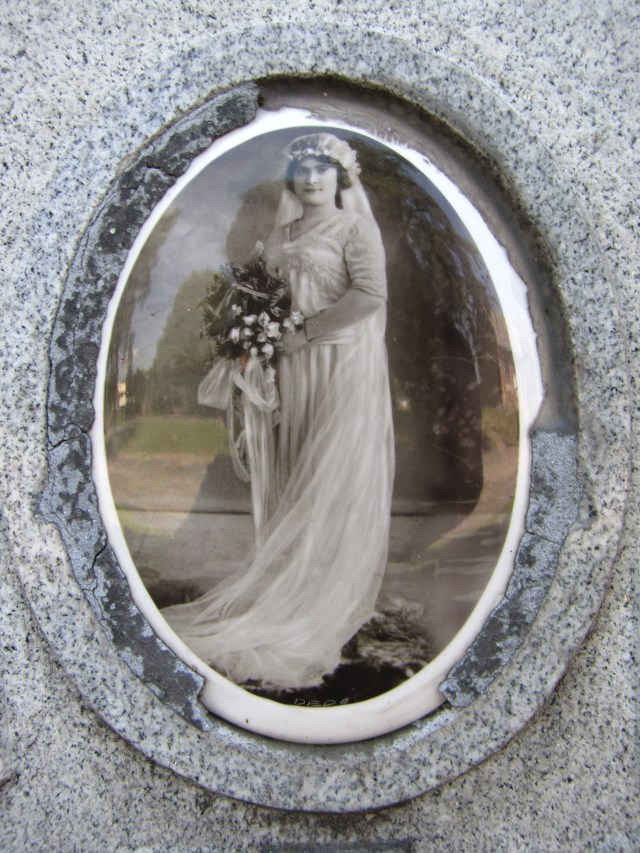
To honor her daughter, Filomena talked one of her sons into paying what was reported to be an astronomical sum at the time for an elaborate monument to be sculpted in Julia’s likeness. Julia stands atop the base in the wedding dress she had been married in and eventually buried in.
IMG_2118

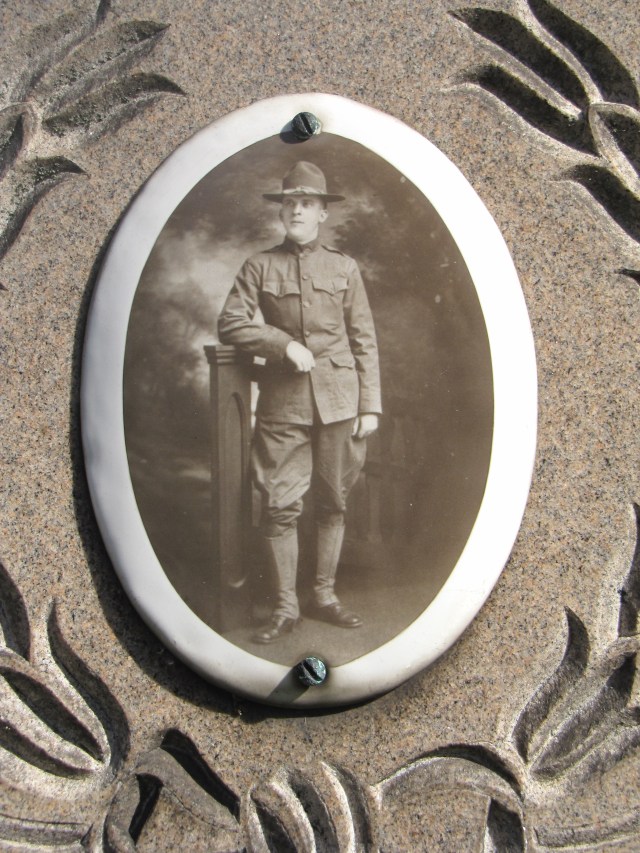
On the face of the stone is a porcelain photograph of Julia not only in the dress, after which the sculpture was modeled, but also a porcelain photograph of Julia on the day her body was exhumed after six years of being entombed.
IMG_2119

The stone has the inscription:

FILOMENA BUCCOLA REMEMBRANCE OF MY DAUGHTER

JULIA AGE 29 YRS.

questa fotografia

presa dopo 6 anni morta

BUCCOLA

Of note, is the fact that Julia’s married name, Petta, is not mentioned on the gravestone. Also the epitaph, written in Italian, reads:

questa fotografia

presa dopo 6 anni morta

Which translates roughly into English as:

this photograph was

taken 6 years after she died

The story became a local sensation. It was not long after that people told stories of seeing the apparition of the bride in the flowing white wedding gown in the cemetery. Even to this day, there are reports of the bride in the mist.

IMG_2121

Posted in Uncategorized | 1 Comment

Hope


IMG_4143

DR. OSCAR SCHULTZ

NOV. 9, 1848

FEB. 11, 1890

LOUISA HIS WIFE

MAR. 9, 1850

MAR. 6, 1903

IMG_4146

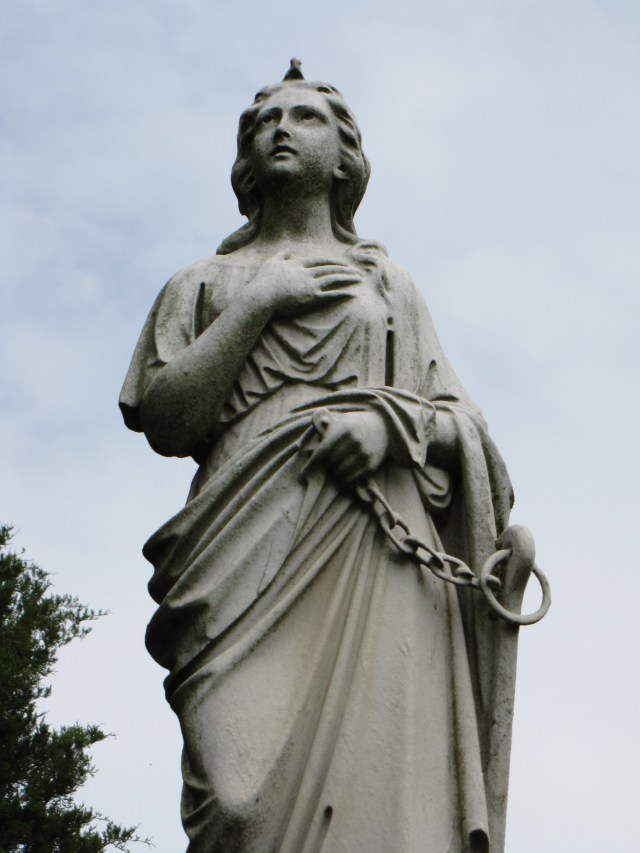
The representation of Hope can be easily found in American cemeteries.  Hope is most often portrayed as a woman standing and leaning against an anchor.  In the example above, from the Bellefontaine Cemetery at Mount Vernon, Posey County, Indiana, the allegorical figure of Hope is holding a chain that connects to the anchor.

The anchor is an ancient Christian symbol that has been found in early catacomb burials.  The anchor was used by early Christians as a disguised cross.  The anchor also served as a symbol of Christ and his anchoring influence in the lives of Christians.  Just as an anchor does not let a moored boat drift, the anchoring influence of Christ does not allow the Christian life to drift.

IMG_4149

Posted in Uncategorized | Leave a comment

Tribute to the Doughboys

IMG_6793

A TRIBUTE TO

THE MEN OF MONROE COUNTY

WHO IN THE SPIRIT OF LOYALTY

SERVED THEIR COUNTRY

IN THE WORLD WAR 1917 – 1918

AND LOVING MEMORY OF

THOSE INSCRIBED BELOW

WHO MADE THE SUPREME SACRIFICE

Memorial Day is a time to stop and remember the ultimate sacrifices that American soldiers gave for the freedom of their fellow citizens. Tributes to those soldiers can be found in town squares and cemeteries all across a grateful nation.

IMG_6796

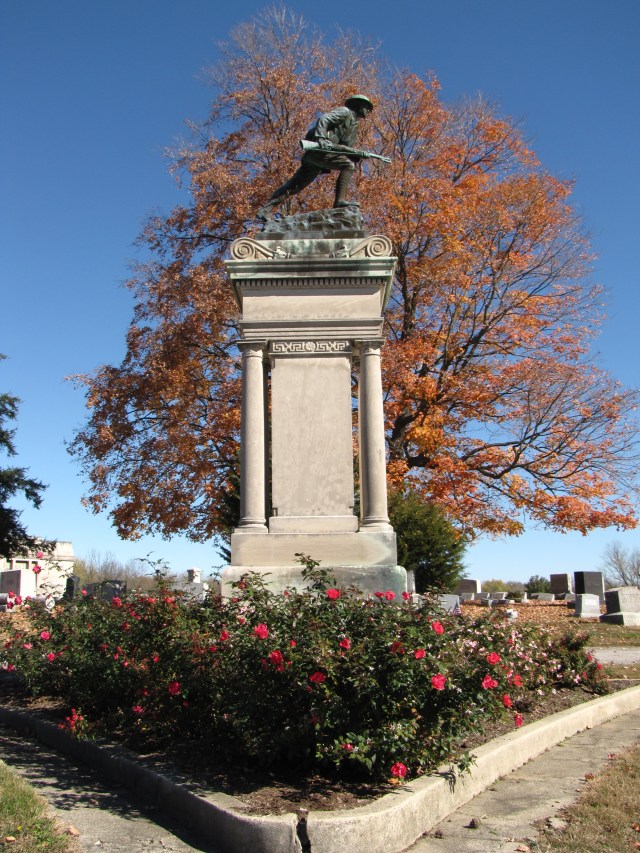
The tribute here is honoring soldiers from Monroe County, Indiana, who fought in World War I. In 1923, the memorial in the Rose Hill Cemetery at Bloomington, Indiana, was commemorated depicting “The Spirit of the Doughboy.”

IMG_6794

Posted in Uncategorized | 2 Comments

Spanish-American War Veterans

IMG_5238

Erected by

Public

Donations

In memory

Of the

Veterans

Of the Spanish-

American

War 1896 – 1902

Dedicated

9-26-1926

IMG_5239

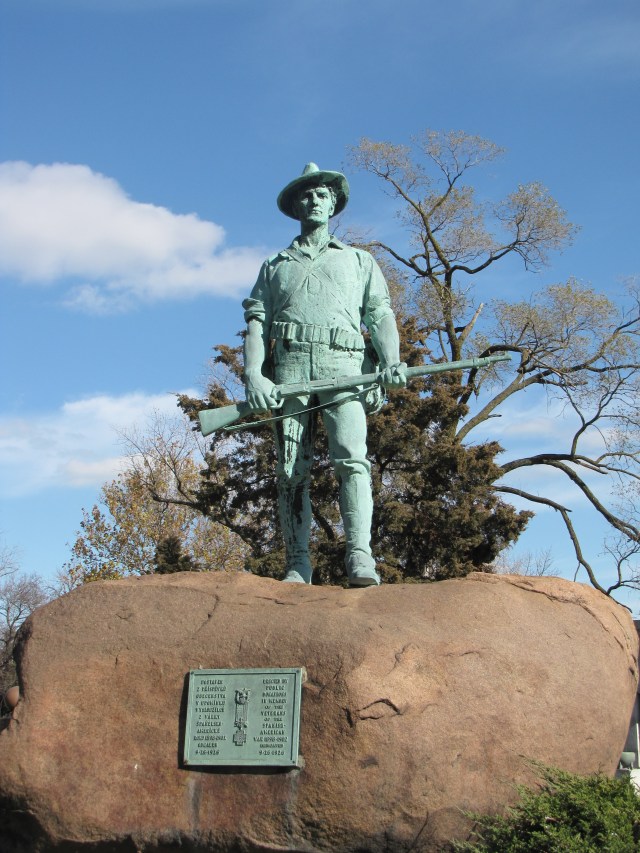
The Spanish-American War monument in the Bohemian National at Chicago, Illinois, was designed by Theo Ruggles Kitson. The eight-foot statue weighs a whopping 600 pounds. The statue, dubbed the Hiker stands atop a 25-ton boulder.

IMG_5242

Posted in Uncategorized | Leave a comment

In Honor to Soldiers, Their Mothers, Wives, and Daughters

IMG_4375

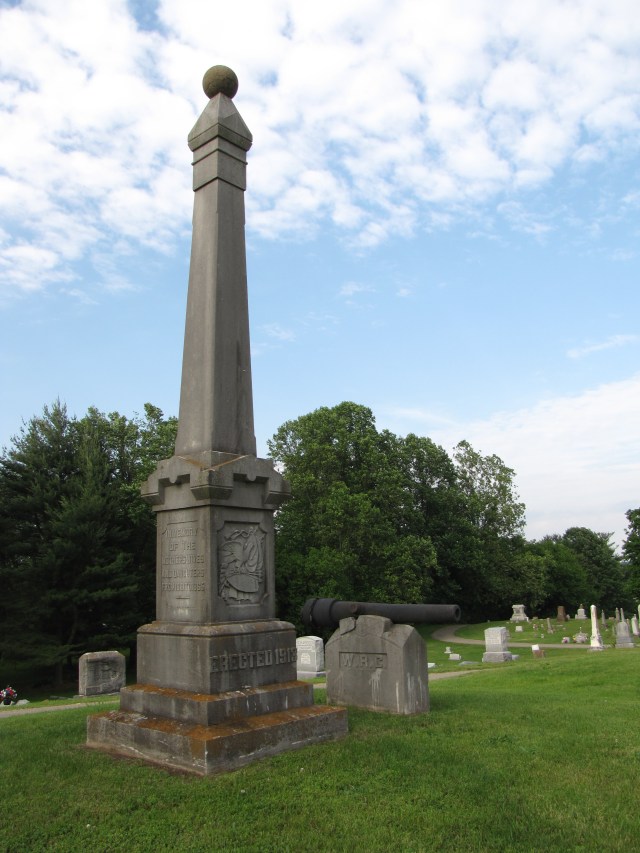
On the highest hillock in the Walnut Hill Cemetery at Petersburg, Pike County, Indiana, stands a monument and cannon to those who served in the Civil War. The column rests on a four-sided plinth. Two sides have bas-reliefs of eagle, flag, and shield.

IMG_4376

IMG_4378

The other two sides have the following inscriptions:

IN MEMORY

OF THE

MOTHERS, WIVES,

AND DAUGHTERS

FROM 1861 – 1865

IN MEMORY

OF THE

SOLDIERS

OF THE

CIVIL WAR

IN PIKE Co.

No other war was like the American Civil War for Americans because every sailor or soldier, every collateral death, every field or railway yard that was destroyed, every city or town devastated by artillery was American.  And, more Americans were killed in the Civil War than any other war that Americans have fought in.

Total American Deaths by War

Civil War                        625,000

World War II                  405,399

World War I                   116,516

Vietnam                            58,151

Korean War                      36,516

Revolutionary War           25,000

War of 1812                      20,000

Mexican American War    13,283

War on Terror                      6,280

Spanish American War       4,196

During the Civil War Americans were fighting against Americans. Brothers against brothers—cousins against cousins, every casualty and every fatality was an American. The war tore the country apart and threatened the existence of the Republic.  Cemeteries throughout the United States pay tribute to the soldiers that fought to preserve the Union, often with special sections where soldiers are buried.

IMG_4380

Posted in Uncategorized | Leave a comment

In Honor

IMG_5284

PVT. MICHAEL

KOKOSKA

CO. L. 127 INF.

He gave his life in Honor

Of our Country

Born Sept. 28, 1892

Died June 27, 1918

in France

Many cemeteries feature memorials to soldiers. Some statues commemorate all of the soldiers who served in a war, some commemorate an individual soldier.

IMG_5287

This memorial in the Bohemian National Cemetery at Chicago, Illinois, was erected in honor of Private Michael Kokoska, the son of Joseph and Majdelena Kokoska, Bohemian immigrants. Kokoska served in the Great War where he was killed in France and temporarily buried in the Morvillars Military Cemetery. His parents petitioned the Quartermaster of the Army to have their son returned to America for reburial. His monument is a testament to his loyalty and patriotism.

IMG_5285

Posted in Uncategorized | Leave a comment

The Lamb

Walk into nearly any American graveyard and you will find tiny little lambs marking the graves of children mostly. These lambs are often found on the tops of gravestones and comes in many sizes and positions—often curled up and sleeping, sometimes with a cross behind the lamb.

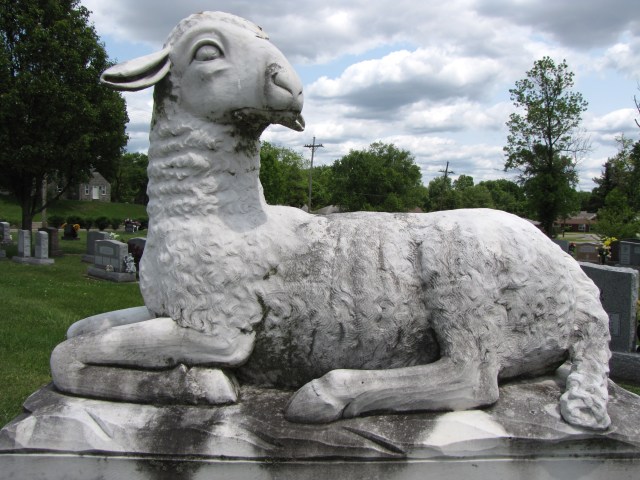
However, two examples show the lamb a bit differently—both of these sculptures are freestanding and not marking a specific grave but used as a work of art in each of the cemeteries.

The first is found in the Fairview Cemetery at Linton, Indiana. This little sculpture is found tucked in between two gravestones, neither of which is for an infant. The lamb in this small sculpture in this example, is being cradled by a child.

IMG_9644

The lamb in St. Mary’s Catholic Cemetery at New Albany, Indiana is raising its head up, eyes wide open, as if it is looking at the passersby. The lamb, alert and bright eyed, looks like it could stand up at any moment and scamper away. This is also one of the biggest lambs I have come across in a cemetery—it is about the size of a full-grown Labrador.

IMG_3629

The lamb is the symbol of the Lord, the Good Shepherd. It also represents innocence, likely the reason why this motif usually adorns the tombstones of infants and young children.

Posted in Symbolism | Leave a comment

Allegory vs Realism; Female vs Male Depictions

IMG_3721

A few posts ago, I quoted June Hadden Hobbs, the editor of the Association for Gravestone Studies publication, Markers XXIX, who made an observation about nineteenth-century cemetery design (pages 4 and 5) writing that, “statues of men are historical while statues of women are usually allegorical.” Statues of men tend to be portraits while statues of females are nearly always not a representation of the deceased female but of an idea.

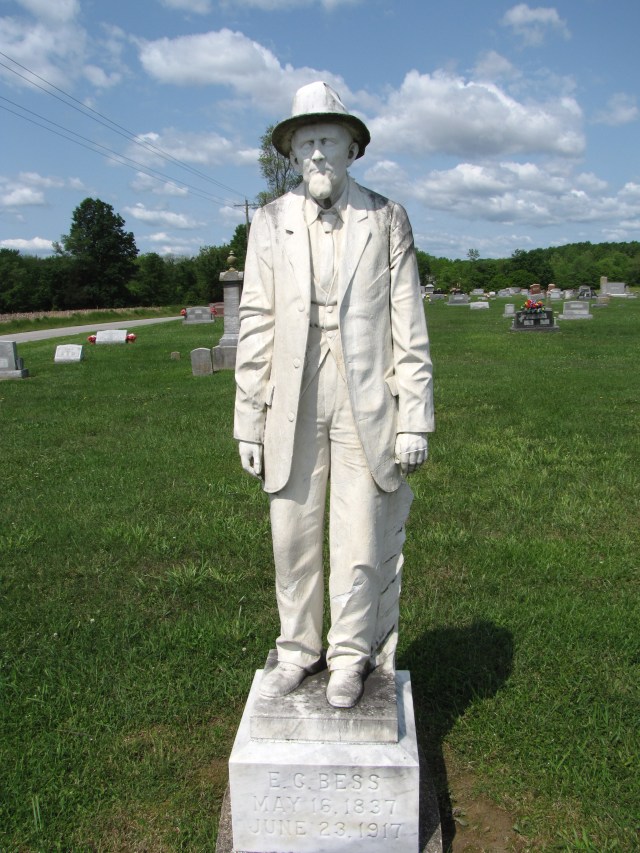
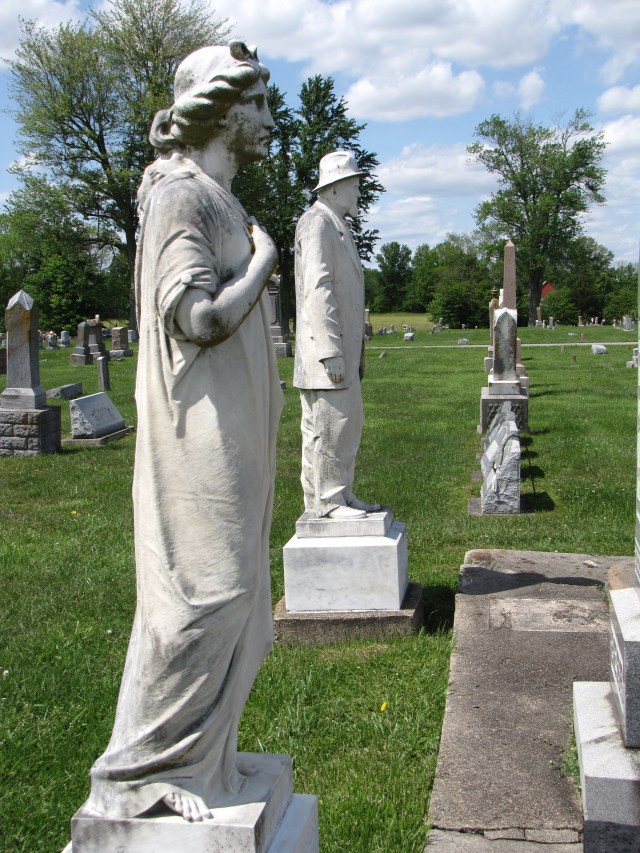
Another example of that can be found in the Crothersville Cemetery at Crothersville, Indiana. Two white marble statues mark the graves of Elisha Collins Bess, Sr., (May 16, 1837 – June 23, 1917) and Martha Jane Bess (April 13, 1840 – June 15, 1912). One statue features an aged slightly stooping bearded man in a suit and hat. Clearly a sculpture of the deceased Elisha.

IMG_3378

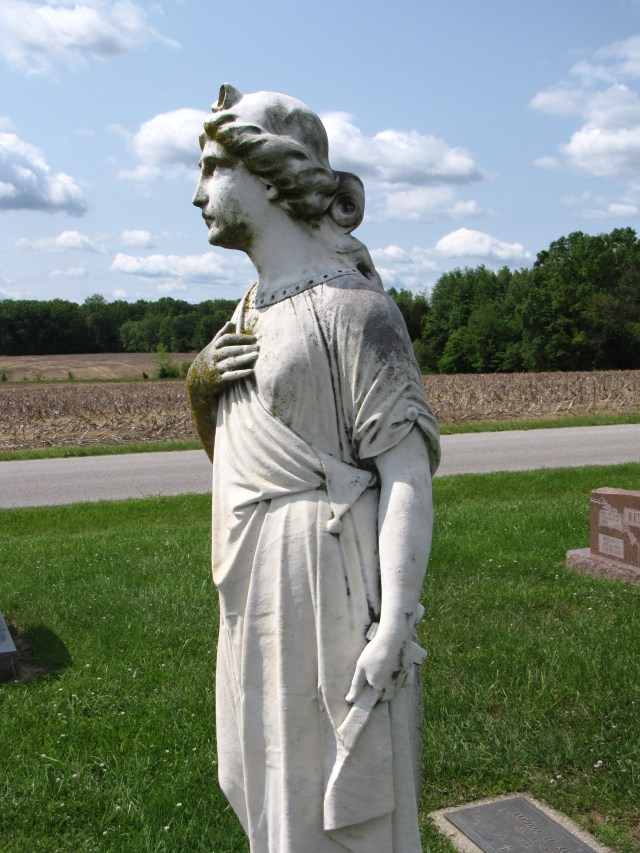
To the left of him is the statue that marks the grave of his wife, Martha Jane. She, however, is depicted as the allegorical figure of faith. The indication of that is that she holds a cross in her left hand. She is also portrayed in classical clothing, not the period dress that Martha Jane would have worn at the time of her death. Her statue is a young idealized portrayal of a virtue in the form of a woman, not the portrait sculpture of the 72-year old Martha Jane Bess buried beneath.

IMG_3391

The sculptures reflects the gendered response to death of the era. According to Laurie Stanley-Blackwell and Brenda Appleby in an article in Markers XXIX, “Romancing the Stone: Female Figural Monuments in Late-Nineteenth-Century Nova Scotia Cemeteries” page 37, “During this era. Prominent male statesmen, was heroes, prosperous businessmen, and religious leaders prevailed as the most deserving subjects for memorialization.” That is men were much more likely to have a realistic portrait in sculptural form than a woman—though, exceptions do exist.

IMG_3719

Women on the other hand were part of the romanticization of death during the Victorian era. Women were quite often portrayed in classical garb, often in mourning, depicted overcome by grief. As Stanley-Blackwell and Appleby describe, “These secular marble beauties were idealized, etherealized, and in some cases eroticized embodiments of ritual mourning. They represented a wide spectrum of mythologized female experiences, from classically austere and occasionally featureless to romantically voluptuous, barely clothed, in some cases starkly nude.”

IMG_3393
True to form, the statues marking the graves of Elisha and Martha Bess illustrate the point made in the article written by Laurie Stanley-Blackwell and Brenda Appleby.

Posted in Symbolism | Leave a comment

A Baby Saved

IMG_3449

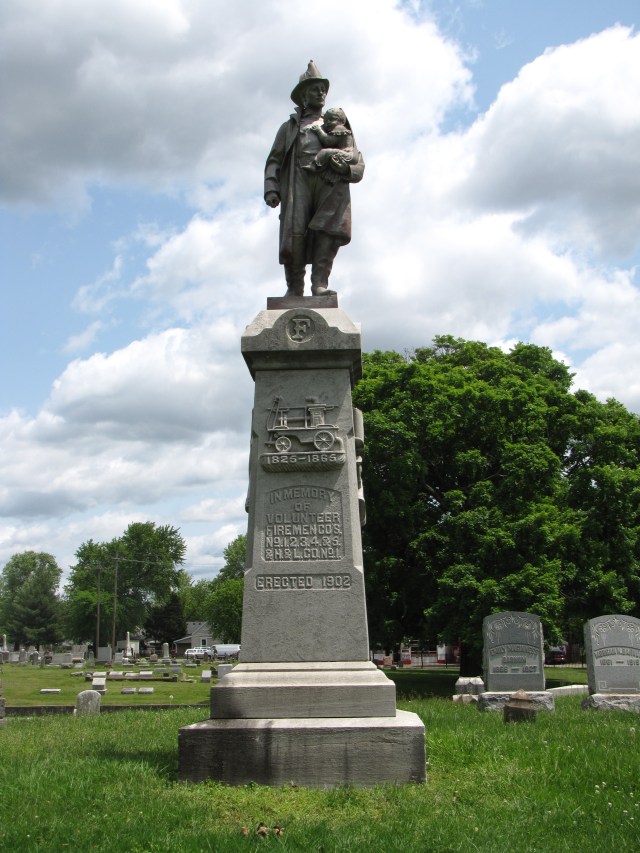
IN MEMORY

OF

VOLUNTEER

FIREMEN CO’S

No. 1,2,3,4, & 5.

& H & L. CO No. 1.

ERECTED 1902

IMG_3458

Firefighting Companies were vital to all communities which could be swept away by fire.  Entire communities could be lost to flame, so volunteer and professional firefighters were vital to save lives and citizens’ homes and businesses.  Firefighters had to be ready at a moment’s notice to fly into action and risk life and limb to battle an inferno.

Fire companies formed in communities all across the country. And, in many cemeteries in those villages, towns, and cities monuments have been dedicated to their fallen and valiant firefighters.

IMG_3459

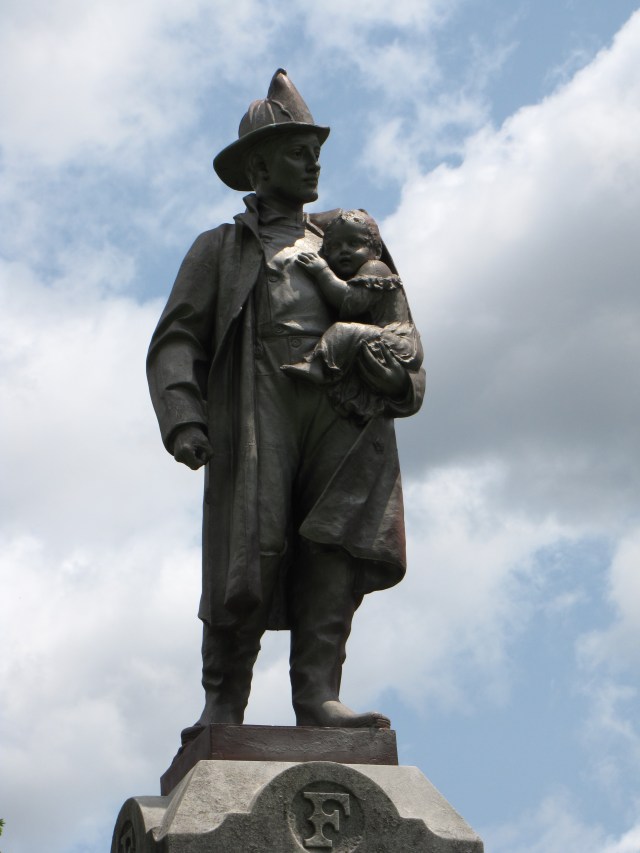
The monument in New Albany, Indiana, is dedicated to six fire companies. The monument was erected in the Fairview Cemetery on 1902, and dedicated September 7th of that same year. Charles Edwards sculpted the firefighter—in pewter. The New Albany firm of John Vernia & Son fabricated the monument.

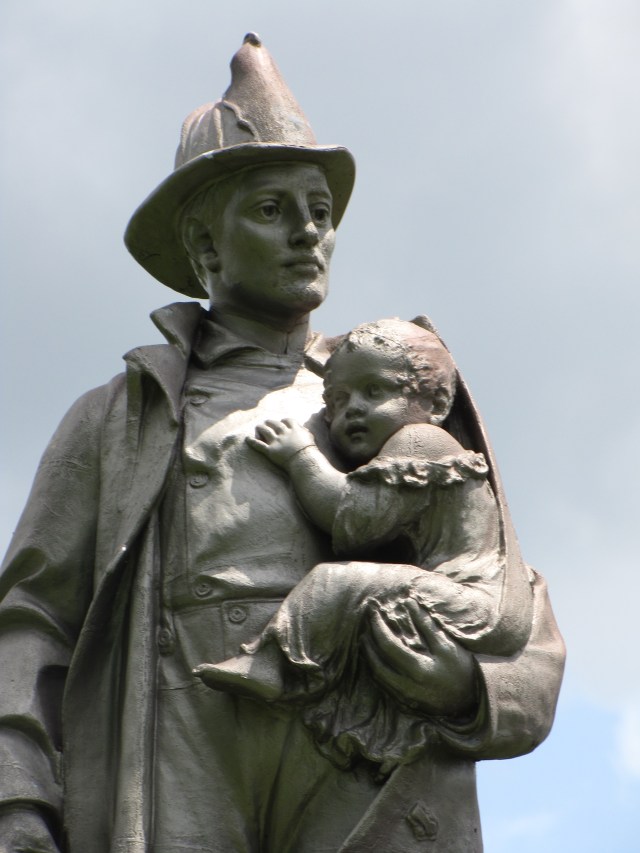
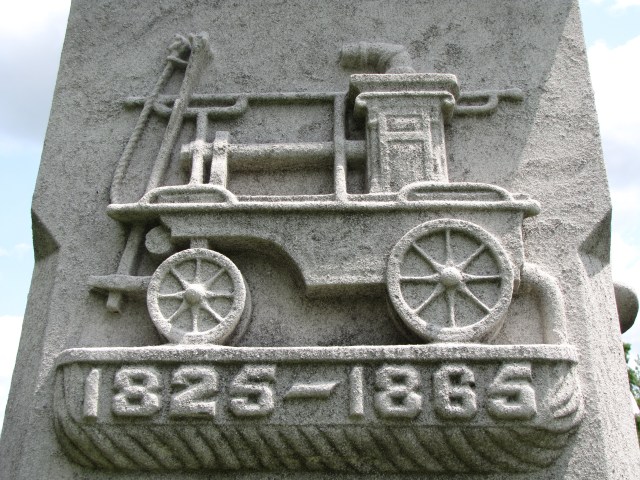
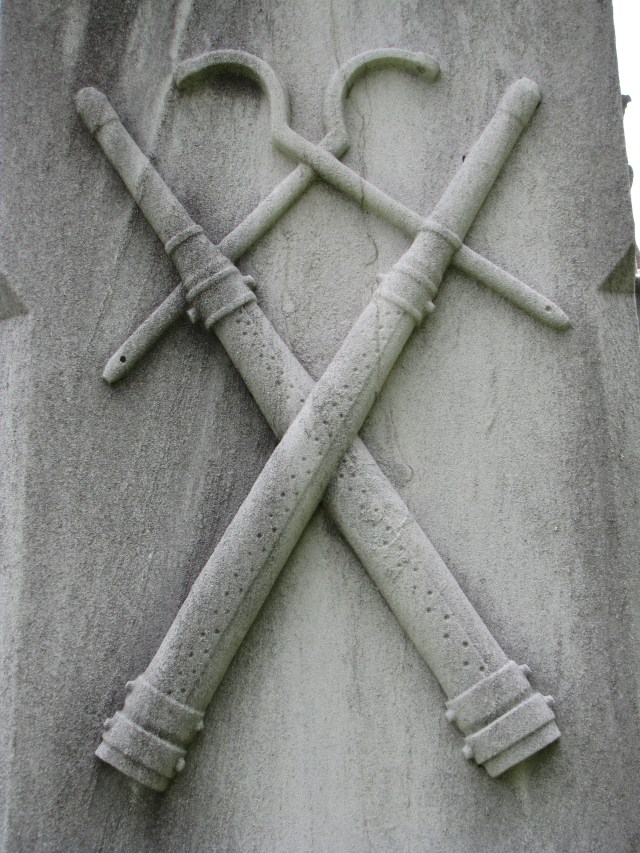
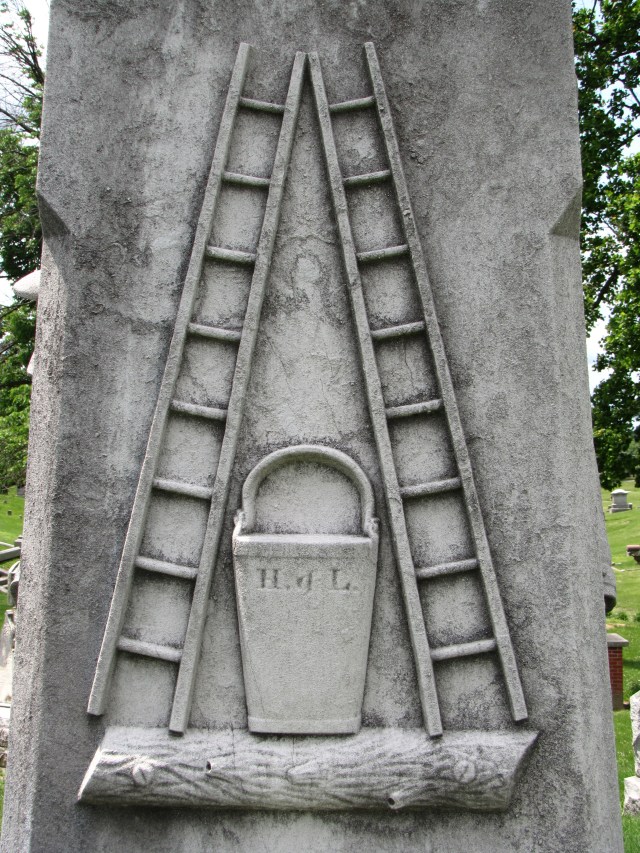
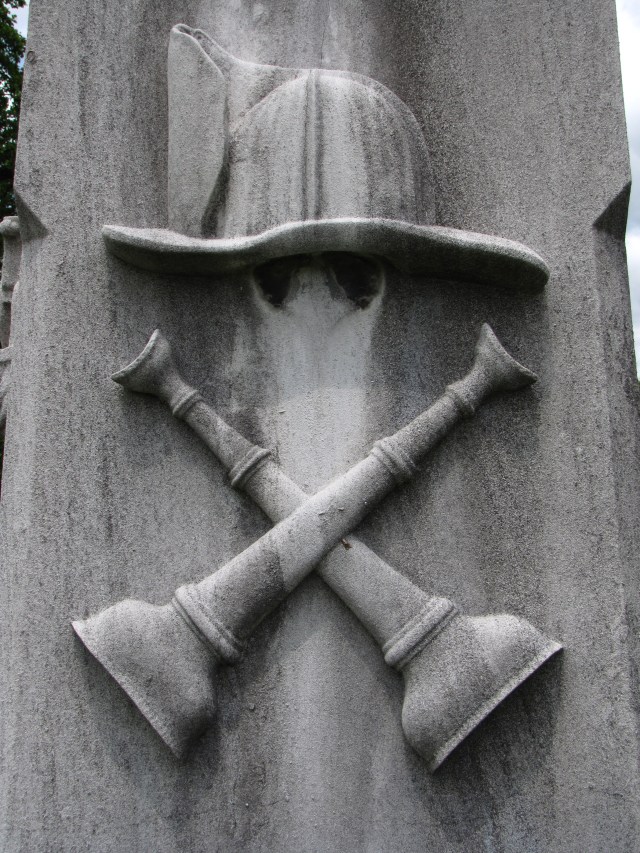
The fireman strikes a heroic pose holding a baby presumably that he rescued.  The firefighter has a clenched right hand to hold a lantern, but the lantern is now missing.  The statue of the firefighter stands atop a limestone plinth that has an engine on one side and the tools of the firefighter’s trade represented on the other three sides.

IMG_3452

IMG_3455

IMG_3456

IMG_3457

Posted in Symbolism | 2 Comments

The Plumed Warrior in Stained Glass

IMG_1906

The plumed warrior in stained glass in the Mount Carmel Cemetery at Hillsdale, Illinois, features an angel wearing armor, carrying a  shield, an wielding a sword indicate that the winged angel represented here is the Archangel Michael, one of three angels mentioned by name in the Bible.  The sword He carries represents a cross but also a weapon in his war against the devil’s warriors.  Archangel Michael is a Christian soldier fighting Satan’s hordes.   Archangel Michael is often represented standing on a worm, or a dragon.  The Archangel Michael is also considered the guardian of souls.

Posted in Symbolism | Leave a comment