Faith

img_4053

WILLIAM T. DEAN

MAY 23, 1847,

NOV. 3, 1898.

AMELIA C. DEAN

SEPT. 15, 1820

NOV. 16, 1904.

img_4055

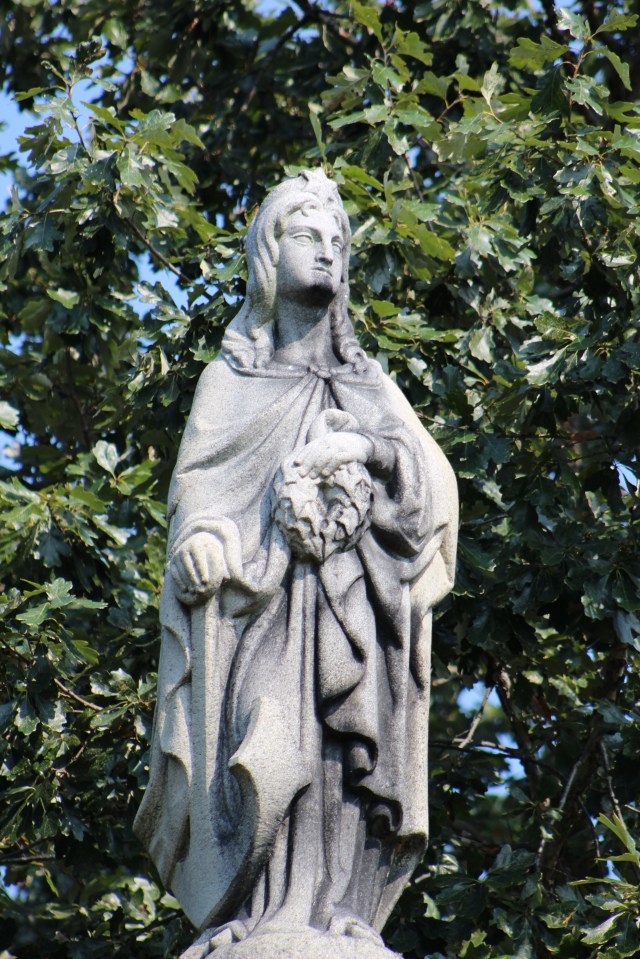
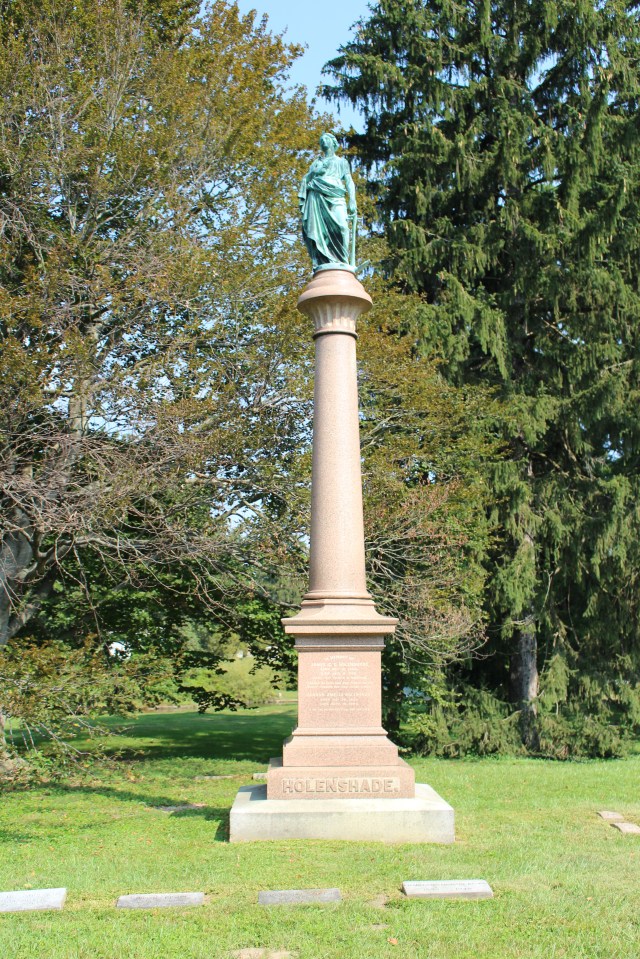
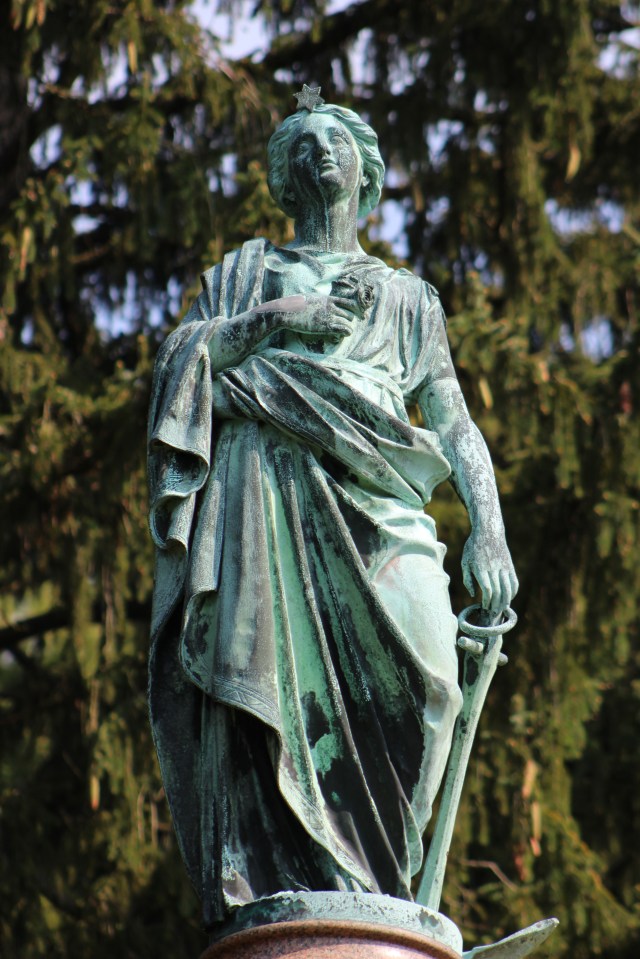
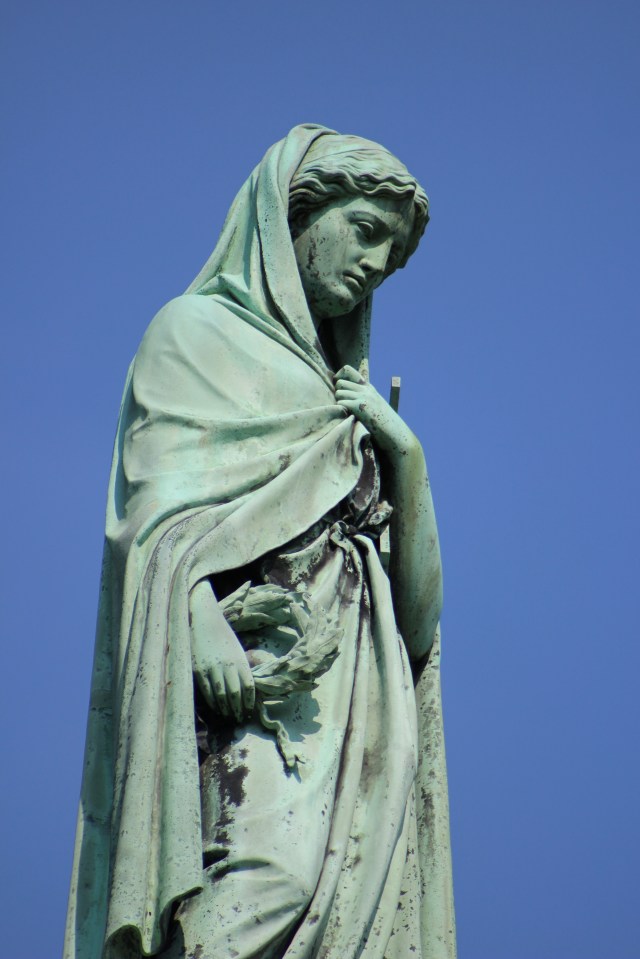
In the Spring Grove Cemetery at Cincinnati, Ohio, a tall rose-colored column of granite is topped with a bronze statue that marks the graves of William and Amelia Dean. The bronze is an allegorical figure indicated by her classical dress. She represents faith. The figure holds a cross and a palm frond in her left hand. The Cross symbolizes her faith. The palm represents victory over death as does the laurel wreath in her right hand. The laurel wreath dates back to Roman times when soldiers wore them as triumphal signs of glory.

img_4061

Posted in Symbolism, Uncategorized | Leave a comment

Standing Angel

img_1714

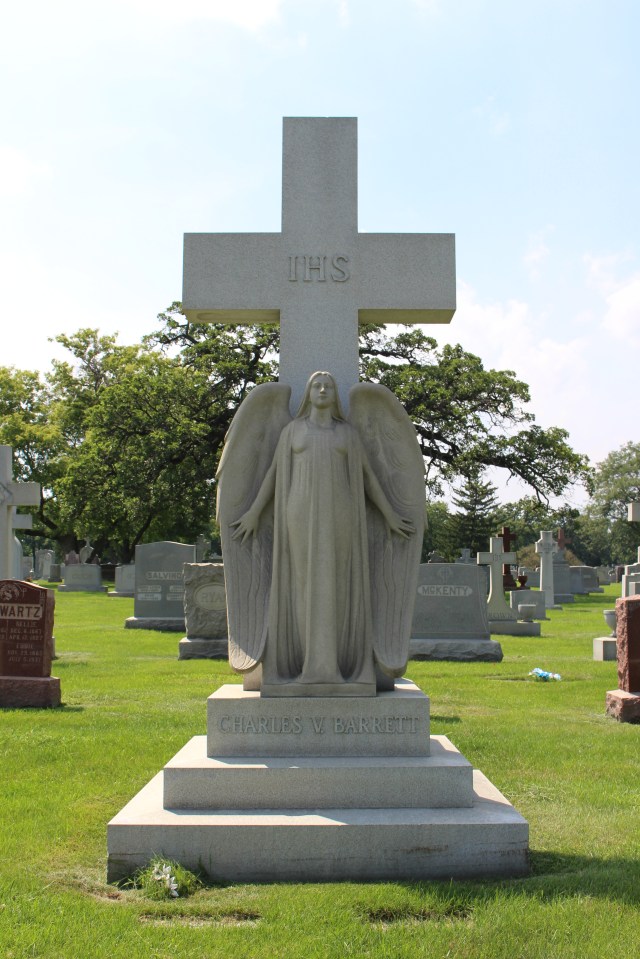
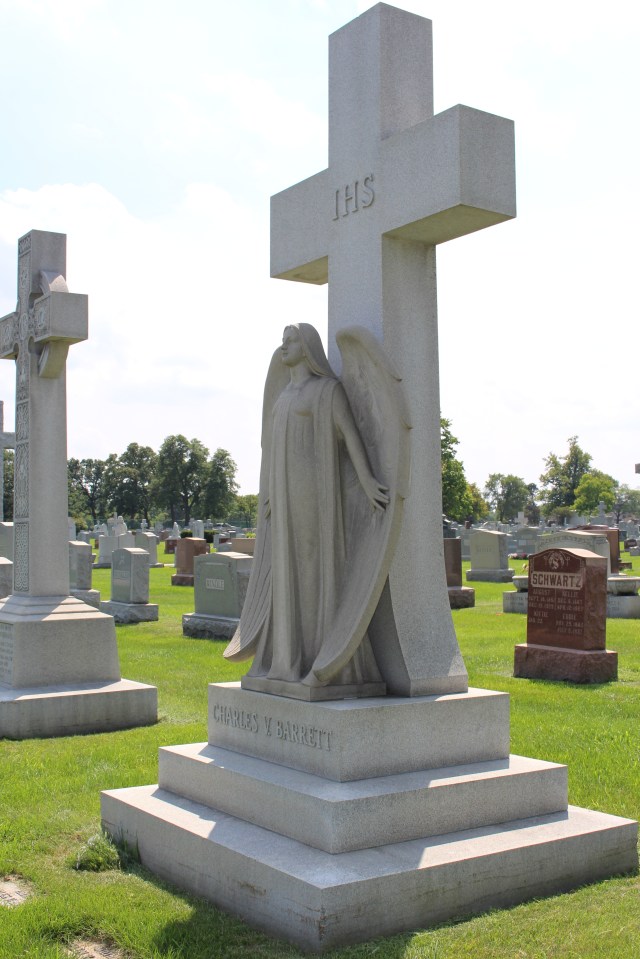
The Charles V. Barrett monument in the Mount Carmel Cemetery at Hillsdale, Illinois, is constructed of light gray granite depicting a standing angel in front of a Latin cross. The winged angel is a messenger of God and sent to Earth to fight demons and untangle mysteries. This angel has its head up and shoulders back and hands gentle pushing back on its wings taking a defiant stance as she stands on the last of the three steps leading to the cross.

The Latin cross is universally recognized as the symbol of Christianity. Though it may look simple to the eye, the symbol is imbued with deep meaning to all Christians. In 1928, the Georgia Marble Company of Tate, Georgia, published a book of monuments titled, Memorials: To-Day for To-Morrow by William Henry Deacy, which describes the symbolism of the Latin cross on a three-step base, “Faith had brought Him to Calvary. The Betrayal, the Trial, the piercing Crown of Thorns, the tortuous road to Golgotha, the cruel weight of the Cross, the hour of Crucifixion—through all these Faith had led Him on. What wonder, therefore, that he Cross of Calvary, instrument of the Passion, has been throughout the ages a memorial of the Faith, the Chosen Symbol?

The Latin Cross, however, is not the only symbolism in the monument, which may be lost on many viewers. In this monument, the cross rests on a foundation of three progressively larger stones as a base. Each represents a different virtue—“Faith in the will of God…Hope for the dawn of that yet more glorious day and Charity toward all men.”

img_1724

Posted in Angels, Symbolism | Leave a comment

Matching Markers

img_4046

JAMES

Vanamburgh

Died

Feb. 14 1876

Aged

78 yr’s 9 m’s 13 d’s

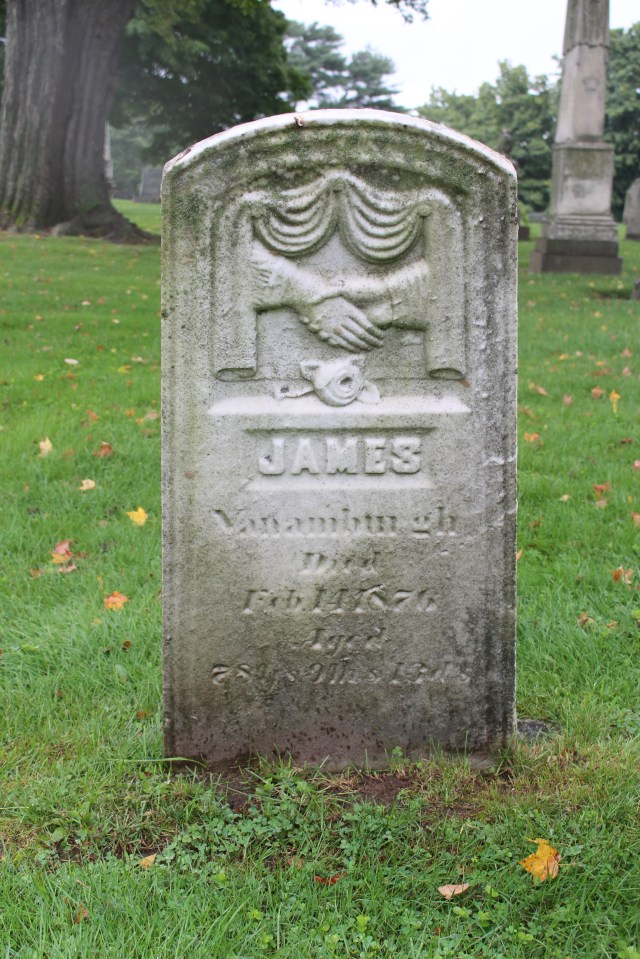
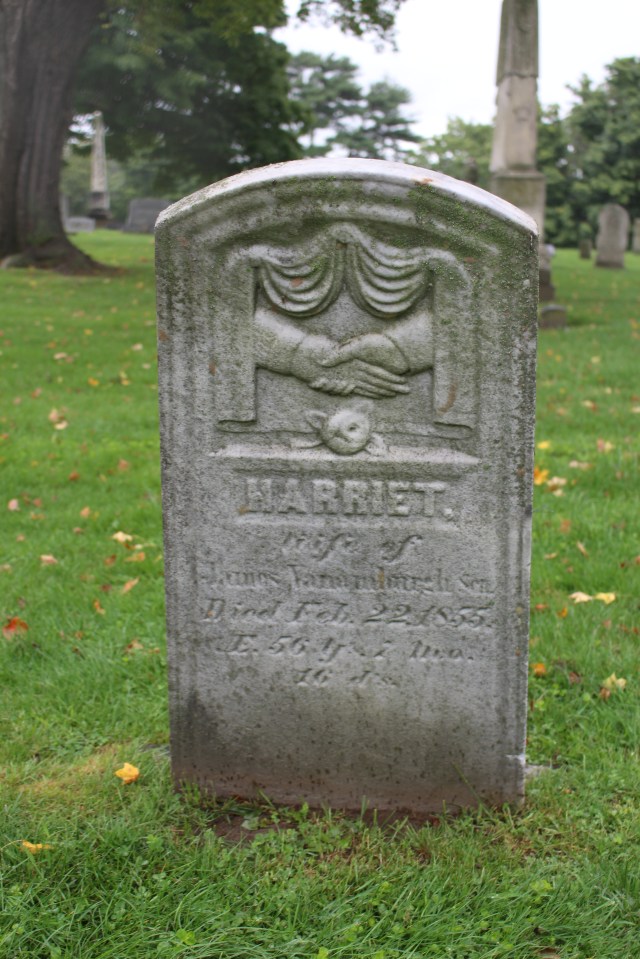
Side by side in the Pine Lake Cemetery at La Porte, Indiana, are two identical gravestones carved for a husband and a wife. The top of each of the white marble tablets display a curtain pulled back to reveal a pair of clasping hands and an American rose. The curtain represents the passage from one realm to another; the veil that exists between the Earthly realm and the Heavenly one.

The clasping hands represent holy matrimony.  This motif symbolizes the holy union between a man and a woman.  The cuff on the left side of the motif is slightly more elaborate and the hand is slender and feminine—it represents the wife.  The hand on the right side is the husband’s—the cuff is plain.

The single rose is an undeniable symbol of love.  The rose is in full bloom–likely representing the death an adult. The rose also has a religious meaning, differing by color.  The white rose symbolizes purity while the red rose represents martyrdom and the messianic hope that Christ will return.

HARRIET

Wife of

James Vanamburgh Sen.

Died Feb. 22. 1855

AE 56 y. 7 mo.

16 d’s.

img_4047

Posted in Symbolism | 1 Comment

St. Francis of Assisi

Mt. Carmel Cemetery, Hillsdale, Illinois

Mt. Carmel Cemetery, Hillsdale, Illinois

Many images of St. Francis of Assisi depict the monk cloaked in a brown sack-cloth frock surrounded by animals—sheep, dogs, cats, bunnies, and even birds circling him. That image is so ingrained in us that we don’t think of the Saint as a person. Most people would never think of St. Francis as a young man, let alone as a playboy. In fact, we don’t think of such a thing in the 12th Century, yet Francis was a good-looking, charming young man. He was considered a playboy in his time. Francis was born in Assisi, Italy, in 1181, or thereabouts. His mother was a beautiful French woman and his father was a wealthy cloth merchant—born into a life of luxury. As such, he imbibed in wine and the epicurean delights of rich food. He celebrated life.

But that changed.

A war broke out between Assisi and Perugia. Francis enlisted to fight and donned battle armor. Many of his comrades were cut down and lay dead on the battlefield but Francis was captured and spared death. His captors could see by his armor and finery that he was wealthy and was held in prison for ransom. Negotiations dragged on for nearly a year before the payment was made and Francis was released and returned safely back to Assisi to his family. He had changed while suffering in prison—having had visions of God. Francis slowly began the process of breaking with his family and embracing a life of prayer and devotion to the Lord. He adopted Christ-like poverty and forsook his family’s wealth and riches, renouncing his inheritance, his family, and declaring that God was his only father.

St. Adalbert Cemetery, Chicago, Illinois

St. Adalbert Cemetery, Chicago, Illinois

Francis began preaching in a plain brown tunic. His charisma and devotion drew crowds to hear him preach. Some thought he was a madman while others were convinced that he had true visions of God. He attracted followers who became known as Franciscan friars. Francis preached in villages near and far—he even preached to the animals—which garnered him the epithet, “God’s Fool.” However, it is one of the reasons he is remembered for his love of animals and why he is often depicted surrounded by them.

img_3656

But, he is also shown with a skull. Francis had failing health and often contemplated death. Sometimes to encourage his brethren to also contemplate death, he would put a skull on the breakfast table. He did not see death as an enemy of man, but a friend. In “The Canticle of Brother Sun and Sister Moon,” Francis wrote, “Be praised, my Lord, for Sister Death, from whom no-one living can escape. Woe to those who die in mortal sin!” The skull emphasized the ephemeral nature of life and that a life devoted to God would have victory over death.

Francis died on October 3, 1226, at the young age of 44, in Assisi. He was the first to have received the stigmata of Christ—marks resembling the wounds that Jesus Himself suffered when he was crucified—which he bore with strength and courage. Less than two years after his death, Francis was canonized as a saint on July 16, 1228.

St. Adalbert Cemetery, Chicago, Illinois

St. Adalbert Cemetery, Chicago, Illinois

Posted in Symbolism | Leave a comment

The Master Is Come

img_2806

The stained glass window from a mausoleum in the St. Adalbert Catholic Cemetery in Chicago depicts Jesus Christ standing at a door, just at the moment He is about the open it. Underneath the window is written, “THE MASTER IS COME AND CALLETH FOR THEE.”

The scene is described in the Bible in John 11:28, “28 And when she had so said, she went her way, and called Mary her sister secretly, saying, The Master is come, and calleth for thee.” Jesus had come to comfort the two sisters of his friend, Lazarus, who had died, which makes it appropriate décor for a mausoleum.

The passage is also the theme for a 19th Century hymn written by American Baptist Lydia Baxter titled, “The Master Is Coming, He Calleth for Thee.”

1 The Master is coming, He calleth for thee,

And loved ones are hast’ning their Savior to see

He’s full of compassion, why will you delay?

He’s calling, still calling, oh, come, come today!


Refrain:

Calling oh, hear Him calling. still calling,

Why, O why will you delay?

Oh, hear Him calling, so sweetly calling, hear Him,

Hear the Master calling, come, oh come today.


2 The Master is coming, receive Him and live:

Oh, will you not trust Him your sins to forgive?

On Calvary’s cross, amid anguish and pain,

Thy ransom was purchased with Jesus was slain. [Refrain]


3 The master is coming, He calleth today:

Awake from thy slumber, to labor and pray;

The morning is breaking, the noontide is near,

And evening’s dark shadows will quickly be here. [Refrain]


4 The Master is coming, to call from the grave

His loved ones to glory; He’s mighty to save;

And all who believes Him in rapture shall sing,

Salvation through Jesus, our Master and King. [Refrain]

Posted in Uncategorized | Leave a comment

Taphophobia and a telephone

img_2143

Martin Sheets

1853 – 1926

Susan Sheets

1859 – 1929

Ethel

13 months

In the 19th Century there were cases of people who had been found to be buried alive, in fact, one researcher found hundreds of such cases. Out of that sprang many such stories recounted to the horror of the public.

Edgar Allan Poe, master of the macabre, wrote a short story recounting tales of premature burial, in which he wrote, “To be buried alive, is beyond question, the most terrific of these extremes which has ever fallen to the lot of mere mortality denied by those who think. The boundaries which divide Life from Death, are at best shadowy and vague. Who shall say where the one ends. And where the other begins?” It was widely known that Poe himself feared being buried alive—as did others at the time. He wrote about it in several of his stories, including The Premature Burial, The Cask of Amontillado, and The Fall of the House of Usher.

That fear of being buried alive is known as taphophobia. The word can be broken in two—taphos, from the Greek meaning grave or tomb and phobos which is translated as fear. Together the word literally means fear of graves.

Some were determined that it would not happen to them and they would take measures to make sure that they were not buried alive. George Washington, for example, gave directions that he was not to be laid into his crypt until after three days. Others had devised glass top coffins so that others could see for themselves that the person in the coffin, had, in fact, died. Contraptions were also conceived to alert those above ground if an alive person had been lowered into the ground with the lid shut by rigging an attached rope to a bell above ground that could be tugged if suddenly the dead came “alive”. It makes good copy but the expressions “dead ringer” and “saved by the bell” did not originate from those devices.

The tales of people afraid of being buried alive are not all from long ago or to only be found in Edgar Allan Poe stories. The M. A. Sheets mausoleum in the Highland Lawn Cemetery at Terre Haute was essentially a modern version of the rope connected to a bell contraption to protect Mr. Sheets from being buried alive without a way to telling someone on the outside of the tomb that he was inside still with a beating heart! But instead of the rope and bell, Sheets had the mausoleum fitted with a telephone—making his mausoleum a sort of elaborate telephone booth. For safe measure Martin Sheets also had a bottle of whiskey in the tomb, as well. One would certainly need a bracer while waiting rescue!

The telephone lines are long gone now, but a mystery still remains. When Mrs. Sheets was found in her home dead, she was grasping the telephone—most likely in an effort to call for help…or, at least, that is what people thought initially. When her coffin was taken to the mausoleum for burial the telephone on the inside was off the hook!

The final paragraph in The Premature Burial tells what we must do with our fear—“There are moments when, even to the sober eye of Reason, the world of our sad Humanity may assume the semblance of a Hell—but the imagination of man is no Carathis, to explore with impunity its every cavern. Alas! the grim legion of sepulchral terrors cannot be regarded as altogether fanciful—but, like the Demons in whose company Afrasiab made his voyage down the Oxus, they must sleep, or they will devour us—they must be suffered to slumber, or we will perish.”

img_2147

Posted in Mausoleums, Tombs | 1 Comment

F.O.E.

img_2124

The Fraternal Order of Eagles, an international non-profit organization, unites fraternally in the spirit of liberty, truth, justice, and equality, to make human life more desirable by lessening its ills, and by promoting peace, prosperity, gladness and hope.

Founded February 6, 1898, by six Seattle, Washington, theater owners John Cort, John W. and Tim J. Considine, Arthur Williams, Mose Goldsmith, and Harry Leavitt organized as “The Order of Good Things”.  Within two months, in April of the same year, the fraternal order changed its name to The Fraternal Order of Eagles and adopted the American bald eagle as their emblem.

Many of the members’ graves are commemorated with a metal marker placed next to their gravestones. The Fraternal Order of Eagles metal grave markers come in many shapes and forms, often with the eagle inside a circle on a staff. This cast aluminum eagle marker in the Memorial Park Cemetery at Kokomo, Indiana, is a bit unusual because of its high-relief, almost 3-dimensional design. In this example, the eagle wraps its talons around perch with the letters F O E. The eagle’s wings are spread tipped upward, with its head turned.

The Eagles organize local chapters into aeries, (the chapter number is on the center of the marker–859) so named for the nests of eagles which are usually high and difficult to access.  Nearly since their inception, the Eagles have lobbied for causes important to the organization, such as the creation of Mother’s Day in 1904, later in the 30s for Social Security, and in 2006 to keep the two words “under God” in the Pledge of Allegiance.  The Eagles also contribute to many charities, such as, St. Jude’s Hospital, a Disaster Relief Fund, Diabetes Research Center at the University of Iowa, Art Ehrmann Cancer Fund, D. D. Dunlap Kidney Fund, among others.

Posted in Metal Markers | Leave a comment

Souls Take Flight

img_4233

MORRISON

BORN

APL. 9, 1850

DIED

MARCH 6, 1859

THOMAS BORN

JAN. 11, 1855

DIED

FEB. 15, 1859

MARY

BORN

SEP. 16, 1856

DIED

FEB. 13, 1859

STANLEY

BORN

MAY 17, 1853

DIED

FEB. 12, 1859

STANLEY & MARY A. MATTHEWS


STANLEY MATTHEWS

DIED

MARCH 22. 1889

AGED 65 YEARS

— —

MARY A. MATTHEWS

WIFE OF

STANLEY MATTHEWS

DIED JAN. 22. 1885

AGED 62 YEARS

Stanley Matthews was a prominent Ohio native. Matthews was got his start at Kenyon College graduating at the young age of 16—he passed the bar at 18 and started his law practice in the Queen City—Cincinnati. From there he worked as a newspaper editor, judge, Ohio state senator. Matthews got a big break when President James Buchanan appointed him as the United States District Attorney for Southern Ohio. When the Civil War started he resigned his post as District Attorney to join the Union Army as a lieutenant colonel in the Twenty-third Ohio Infantry. In that same unit served two future presidents—Rutherford B. Hayes and William McKinley. Matthews was later promoted to Colonel. He began a political a national political career when Matthews ran for a United States Senate seat and won. In 1881, Matthews was nominated by President Hayes to an associate justice seat on the United States Supreme Court. His nomination was considered controversial and the Senate took no action on the nomination. After James Garfield became president, Garfield re-nominated Matthews. Matthews was confirmed by a single vote. He served as an associate justice until his death in 1889.

img_4232

In spite of Matthews’ soaring political career that peaked in the highest court in the land, his white-marble monument does not extoll any of his political accomplishments. The focus of the symbolism on his monument is about four of his eight children. In 1859, Stanley and Mary Matthews suffered a great tragedy. Within two weeks in February and March 4 of their children died: Stanley, a little over 5 years old, died February 12, 1859; Mary, just over 3 and a half years old, died, February 13, 1859; Thomas, just over 4 years old, died February 15, 1859; and Morrison, nearly 9 years old died MARCH 6, 1859.

On the face of the gravestone is a bas-relief of a winged angel with one arm raised and pointing to the Heaven and one arm cuddling a small child. Three angels fly toward Heaven. The symbolism is clear—the angel is taking flight with the souls of the Matthews’ children giving them her protective care.

img_4235

Posted in Angels, Symbolism | Leave a comment

Good over Evil

img_1770

BRONGE

PETER G. BONI

1914 – 2000

DANIEL BONI

1891 – 1955

BABY PHYLLIS

1952

PHYLLIS BONI

1898 – 1936

MARIA FRANCESCA BRONGE

1868 – 1925

CARL BRONGE

1863 – 1952

The Bronge Family monument in the Mount Carmel Cemetery at Hillsdale, Illinois, just outside of Chicago, is a gray granite block of polished granite sitting on a large horizontal base. The top of the block features a Latin cross on its side. Many works of art depict Christ carrying the cross, and this gravestone represents His suffering as He carried it. The cross on its side pays tribute to Christ carrying the cross without actually showing Christ in the depiction.

On one side of the block is a white marble planter. On the other side of the block is a white marble statue of the Virgin Mary imbued with symbolism. She points to her heart. This is a representation of the Immaculate Heart of Mary.

In Luke’s Gospel, Chapter 2, verse 19, it says, “But Mary kept all these things, and pondered them in her heart.” In devotion to the Heart of Mary, the faithful are to study and imitate the Heart of Mary as a place of love and devotion to Jesus and to God’s love.

img_1771

In addition to the symbolism of the Immaculate Heart of Mary, is the image and symbolism of Mary standing on a snake. In Genesis 3:15 God speaks to the serpent after the fall of Adam and Eve into sin, “I will put enmity between you and the woman, between your seed and her seed; He shall crush your head and you shall lie in wait for his heel.” In the Latin translation the passage read “she shall crush your head.”

The passage comes to be seen as a prophecy of the coming of the Messiah, Jesus Christ. Christ is the “seed of the woman.” Mother Mary is free from sin, both original and actual, and as such is viewed as the new Eve, the only woman who has a perfect enmity with the devil. It is the ultimate symbol of Mary’s victory over evil. In a larger sense it is viewed as the triumph of good over evil.

img_1773

Posted in Symbolism | 1 Comment

Tree-stump Planters

img_2283

The rustic movement of the mid-nineteenth century was characterized by designs that were made to look like they were from the country—crafted from tree branches often with the bark still intact. Elegant and slim curved lines gave way to bulkier and heavier forms made to look like they came directly from the trees.

img_2287

In decorative furniture this often took the form of chairs made from rough tree limbs curved to form arms and chair backs, chair legs made from tree roots growing upwards. This kind of design was mimicked in cemetery pieces, such as, benches.   Gravestones were designed to look like tree stumps with branches sawed off.

img_2330

That rustic design can also be seen in planters that were designed to decorate family plots. The planters are designed to look like pieces of wood, bark still on, formed to make planters. The designs pictured in this blogpost can all be found in the Highland Cemetery at Terre Haute, Indiana.

img_2257

Posted in Treestump gravestones | 1 Comment