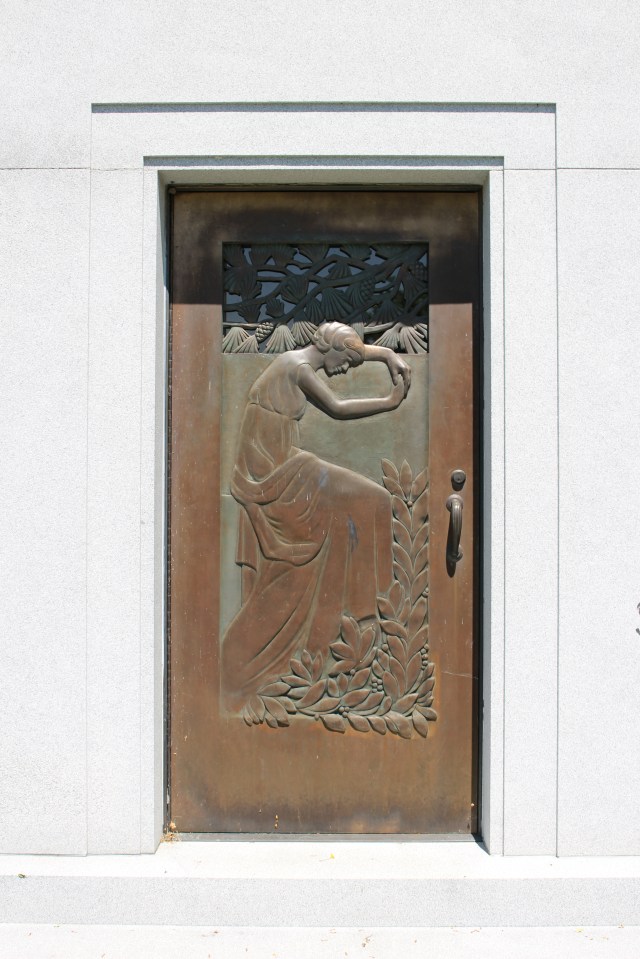
The Sarcophagus

LORETTA

RECKMEYER

1893 – 1959

WILLIAM F.

SANGER

1875 – 1955

CORNELIUS O.

SANGER

1869 – 1943

MARGARET

SCHULER – SANGER

1871 — 1929

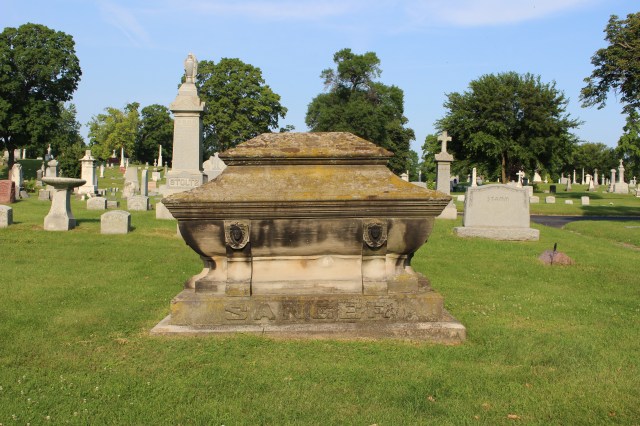
The large sarcophagus of the Sanger family in the Calvary Cemetery in Milwaukee, Wisconsin, is a massive limestone tomb embellished with winged cherub heads, their eyes closed.

The sarcophagus is an ancient burial monument designed to look like a coffin.  Most often they are set on a platform or a base.  The tomb is often embellished with ornamentation and nearly always has feet, though this one does not.  But the “coffin” is empty–just an empty symbol of the receptacle.

The word, sarcophagus, is derived from two ancient Greek words, sarx, which meant flesh and phagein meaning to eat.  The two words together, sarkophagus, meant flesh eating.  The term came from the limestone used by the ancient Greeks to bury the dead which was thought to decompose the flesh of the deceased.

The winged cherub was a symbol that became popular in the 18th Century.  Winged cherubs replaced the stark and morbid flying death’s heads from our Puritan forefathers.  The cherubs on the Sanger family have their eyes closed as though they are sleeping.  The iconography represents the flight of the soul from the body upward to Heaven and the hope of the resurrection. In this motif the wings give flight not only to the soul but to time.

Posted in Symbolism | Leave a comment

She’s gone no more to greet you here


ELIZABETH P.

wife of CHAs. N. SHEPARD

& dau. Of

Col. Daniel Chase

DIED

Sept. 20, 1854.

AE. 29 yrs. 9 days.

She’s gone no more to greet you here

Husband, brothers, and sisters dear

But in that far off better land

She waits to give the welcome hand.

The rounded-top white marble tablet of Elizabeth Shepard’s epitaph in the Tomb Cemetery in Holden, Maine, is full of warm sentimentality for her family—though she is gone, she waits on the other side with her hands open to welcome them.

Posted in Epitaphs | Leave a comment

Celestial Smile

JOHN F. ROBINSON

DIED

Jan. 20, 1876

AE 54 yrs. 9 mos.


Go to thy rest and while

Thy absence we deplore,

One thought our sorrow shall beguile

For soon with a celestial smile

We meet to part no more.

The small, white marble segmented-top tombstone in the Tomb Cemetery in Holden, Maine, marks the grave for John Robinson.  This epitaph has two themes: “go to thy rest” and “we meet to part no more,” both of which are commonly found.  This eipitah, however, says that not only will they meet again to part no more, but with a “celestial smile.”

One aspect that is different with this epitaph is that it reads almost like a limerick.  The typical limerick which was popularized in 18th Century England, is five lines with rhyming pattern—a a b b a.  However, this epitaph’s rhyming pattern is—a b a a b, which is not typical.  One other convention is turned round.  Limericks usually have the first, second, and fifth lines long, with lines three and four being short and punchy.    The longest lines in this epitaph are three and four, again, breaking with convention.

Posted in Epitaphs | Leave a comment

Gone home! Gone home!

The tall columned monument in the Mt. Hope Cemetery in Bangor, Maine, marks the graves of Carlton and Amelia Bragg.  The stained white marble gravestone is topped with a botonee cross characterized by trefoil at the end of each arm of the cross which symbolizes the Holy Trinity.

Two of the sides of the monument are blank while the other two sides are carved with the names of Carlton and his wife, Amelia—one name on each of two sides.  Amelia has a twelve-line, heartfelt epitaph memorializing her.  In the first quatrain there is a reference to her inheriting a “heavenly mansion, a reference to the Biblical passage John 14.2, “In my Father’s House are many mansions; if it were not so, I would have told you.  I go to prepare a place for you.”

The epitaph also gives the passerby an idea about how very much she will be missed, presumably by her husband, who surely commissioned the monument and the epitaph to be carved in her memory.


AMELIA T.

Wife of

CARLTON S. BRAGG

DIED

Oct. 6, 1865.

AE 53 yrs.


Gone home! Gone home! Here earnest, active spirit

Her very playfulness, her heart of love!

The heavenly mansion now she doth inherit,

Which Christ made newly ere she went above.


Gone home! Gone Home! The door through which she vanished,

Closed with a jar, and left us here alone.

We stand without, in tears, forlorn and banished

Longing to follow where one loved has gone.

Gone home! Gone home! O human-hearted Saviour!

Give us a balm to soothe our heavy woes;

And if thou will, in tender, pitying favor,

Hasten the time when we may rise and go!

C. S. BRAGG

DIED

In Boston, Mass.

Oct. 30, 1876

AE 64.

On the opposite side on the monument is the simple inscription for Carlton Sylvanus Bragg, who died in Boston, 11 years after his beloved wife.  He has no epitaph.

Posted in Epitaphs, Symbolism | Leave a comment

Eschew Grief

ENOCH H. LELAND

DIED

Feb. 25, 1877,

AE 56 yrs. 7 mos.

& 27 days

Why lament the christian’s (sic) dying,

Why indulge in tears and gloom,

Calmly in his Lord relying,

He has met the opening tomb.


Hark the golden harps are ringing.

Sounds unearthly fill his ear;

Millions now in heaven are signing,

Greet his joyful entrance there.

In the Village Burial Ground in downtown Bar Harbor, Maine, a town once known as Eden, is the small, white marble gravestone of Enoch Leland.  On the back of his gravestone is the eight-line epitaph that tells the passerby to eschew grief because of his death and instead celebrate his entrance into the Kingdom of Heaven.

Posted in Epitaphs | Leave a comment

The Saviour’s Book

SACRED

to the memory

CHARLES CHRIS’r KEPPLER

who died April 18th 1839,

aged 5 years.

and

ELIZA CATHERINE KEPPLER

who died August 7th 1839

aged 18 months

Son and daughter of Henry and Eliza Keppler.

Weep not for us our Parents dear

But to the Saviour look,

Twas he that brought us here below

Our names were in his book.

This gray marble ornamented top tablet in St. Paul’s Rock Creek Cemetery marks the graves of two children.  The epitaph makes reference to the Saviour’s book.  Often graveyard sculptures of “recording angels” are depicted writing the names of the deceased into an open book.  The angels registered the names of the deceased into the Book of Life.  In Judaism and Christianity, the names of the righteous were recorded in the Book of Life; they were assured entry into Heaven.

The Book is referenced many times in the Bible (King James Version), including Revelations, Chapter 20,

Verse 12: “And I saw the dead, small and great, stand before God: and the books were opened: and another book was opened, which is the book of life: and the dead were judged out of those things which were written in the books, according to their works.”

Verse 13: “And the sea gave up the dead which were in it; and death and hell delivered up the dead which were in them: and they were judged every man according to their works.”

Verse 14: “And death and hell were cast into the lake of fire.  This is the second death.”

Verse 15: “And whosoever was not found written in the book of life was cast into the lake of fire.”

Posted in Epitaphs | Leave a comment

Heavenly friendship

In St. Paul’s Rock Creek Cemetery in Washington, D.C. stands the gray marble ornamented-top tablet of Thomas Sunderland with an interesting epitaph that attempt’s to comfort those grieving.


SACRED

To the memory of

THOMAS I. SUTHERLAND

departed this life

in the city of Washington D. C.

on the 12th of October 1827

in the 40th year of his age.

Mourning friends refrain from grief,

For he that wounds can send relief:

Your Heavenly Father’s pleasure ‘tis

To take your friends and make them his.

Posted in Epitaphs | 1 Comment

Neo-classical mourning figure

IN LOVING MEMORY OF

JOHN SPENCER

BORN 1811 – DIED 1854

CATHERINE SPENCER

BORN 1811 – DIED 1874

MARY ANN SPENCER

BORN 1840 – DIED 1919


Adolph Alexander Weinman (December 11, 1870 – August 8, 1952) was a noted German-born American sculptor who worked on several commissions for monuments and buildings around Washington D.C. and in state capitols, such as Wisconsin, Missouri, and Louisiana.  Some of his most notable works can be found in the architectural sculptures found in the pediments of the Jefferson Memorial, the Library of Congress, and the interior of the United States Supreme Court Building.

Like many artists, including Daniel Chester French, Augustus Saint-Gaudens, (both with whom he studied), Aldabert Volck, Felix Weihs de Weldon, Karl Bitter, Martin Milmore, Alexander Milne Calder, T. M. Brady, Albin Polasek, Harriet Whitney Frishmuth, Edward V. Valentine, Sally James Farnham, and others, Weinman was able to earn his living creating sculptures, public and private.  He also created iconic images for the “Walking Liberty” half dollar and the “Mercury” dime.

1943D Mercury Dime obverse.jpg

Walking Liberty Half Dollar 1945D Obverse.png

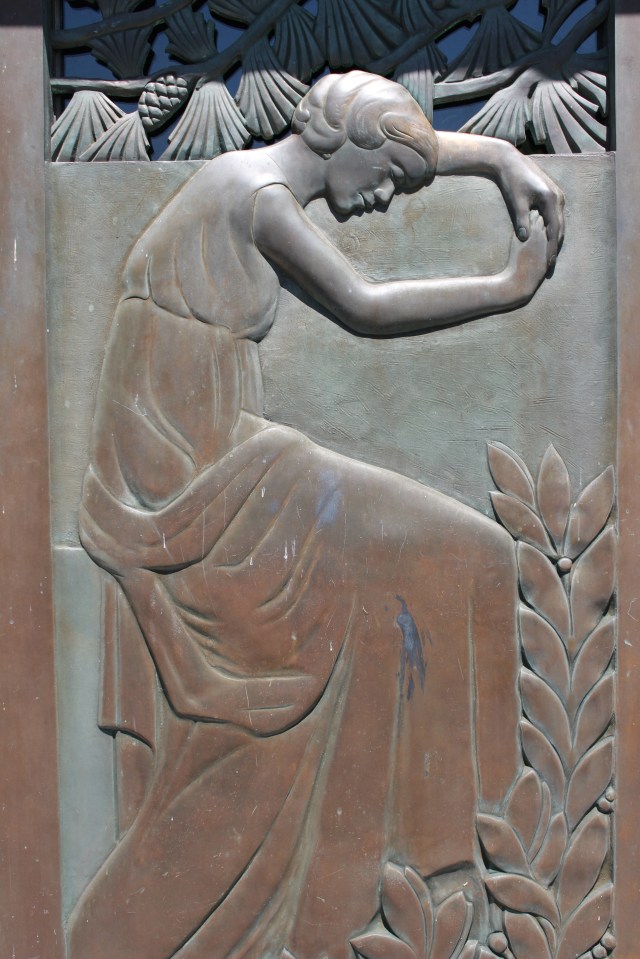
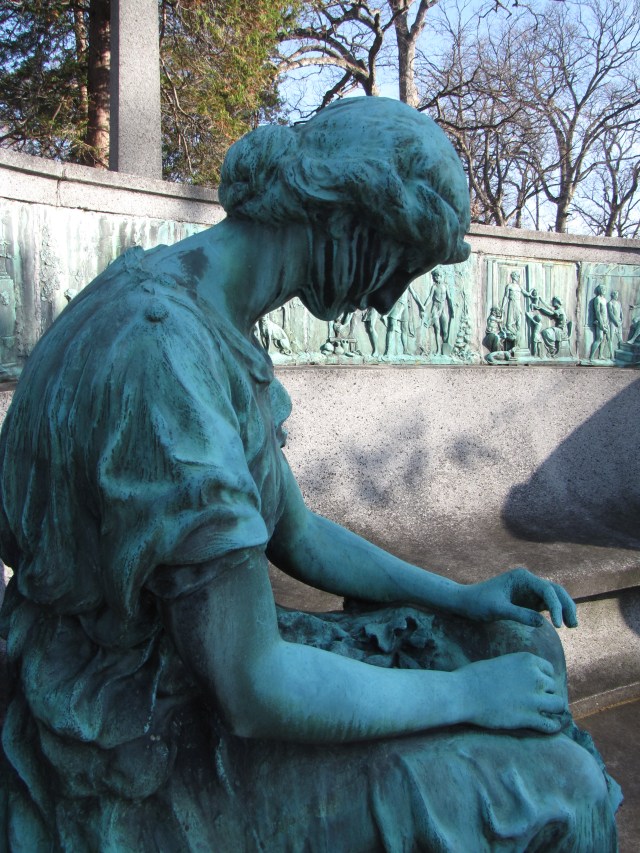
The bronze sculpture commissioned for the Spencer family monument is executed in a lyrical neoclassical style.  The mourning figure is depicted seated wearing classical drapery.  The figure is leaning against an urn with her head bent downward in a pose of grief and sorrow.  In one hand she is holding a mixed flower bouquet that lay in her lap also pointing downward.  The urn was an almost ubiquitous 19th Century symbol found in nearly every American cemetery. The urn was a Greek symbol of mourning, fitting for a neoclassical designed monument.  The urn also represents the body as the container or vessel for the soul.  The bouquet of flowers may represent the transient nature of life itself but often the condolences to the grieving.

The statue is a powerful portrayal of mourning figure.  The angularity of his statue and the fluidity of his work has been described as is “a harbinger of the Art Deco style that was to come.”

Posted in Saving Graces | Leave a comment

Weeper

ROBERT GOLDEN DONALDSON

1876 – 1940

ANTOINETTE COLETTE DONALDSON

DIED SEPT 13, 1927

In his book, Saving Graces, published by W. W. Norton & Company in 1995, David Robinson identified four categories of “Saving Graces”:

  1. Women completely overcome by grief, often portrayed as having collapsed and fallen limp on the grave.
  2. Women who are portrayed reaching up to Heaven as if to try to call their recently lost loved one back to Earth.
  3. Women who are immobile and grief stricken, often holding their head in their hands distraught with loss.
  4. The last category of “Saving Grace” as the mourning figure who is “resigned with the loss and accepting of death.”

An example of the first category of mourning figure or “Saving Graces” can be found in the St. Paul’s Rock Creek Cemetery in Washington D.C. on the Donaldson family monument. The “weeper” is depicted with seated but with her head bent in grief, clutching a wreath, the classical gown cascading around her.

The laurel wreath dates back to Roman times when soldiers wore them as triumphal signs of glory.  The laurel was also believed to wash away the soldier’s guilt from injuring or killing any of his opponents.  In funerary art the laurel wreath is often seen as a symbol of victory over death.

Posted in Saving Graces | Leave a comment

A birthday wish

Today is my birthday and a friend of mine sent the following birthday wish:

May your epitaph be a long way away and as clever as these:


If cash thou art in want of any,

Dig four feet deep and find a Penny.”

Epitaph of John Penny, Wimborne, England.


“In loving memory of Ellen Shannon, aged 25,

Who was accidentally burned March 21, 1870,

By the explosion of a lamp filled with R.E. Danforth’s

Non-explosive burning fluid.”

Epitaph in cemetery at Girard, Pennsylvania


“Here lies the body of Jonathan Blake,

Stepped on the gas instead of the brake.”

Gravestone near Uniontown, Pennsylvania


“Here lies John Yeast,

Pardon me for not rising.”

Cemetery in Ruidoso, New Mexico


Here lies the body of our dead Anna

Gone to death by a banana

It wasn’t the fruit that dealt the blow

But the skin of the thing that laid her low!

On a tombstone in Enosburg Falls, Vermont


Here lies Ezekial Aikle

Age 102

The Good Die Young

East Dalhousie Cemetery, Nova Scotia, Canada


Here lies the body of Emily White,

She signaled left, and then turned right.


John Brown (18th Century) Dentist

Stranger! Approach this spot with gravity!

John Brown is filling his last cavity.


“I Told You I Was Sick”

Cemetery in Key West, Florida

That last one reminded of me one just like it that I found and wrote about Buffalo, New York, and the Forest Lawn Cemetery:

Nothing is as final as death.  The quote, “Dead men tell no lies” reminds us of the silence of the grave.  However, the dead can speak one last time in wills, diaries, letters, and epitaphs.  Though many epitaphs are chosen for the person after he or she has passed away, some people do choose their own.  Mel Blanc’s epitaph signs off with his signature Porky Pig closing at the end of the Looney Tunes cartoon, “That’s All Folks!”  One wonders if Mr. Banc was also making a larger statement on the afterlife.

In the case of Barry Becher, the advertising guru who pioneered late-night infomercials hawking Ginsu Knives who just recently died, his family has announced that his epitaph will read, “But wait, there’s more!”  This is his famous catch phrase that has been mimicked by nearly every infomercial now.  Again, this epitaph could be read as a double entendre referring to the hereafter.

Amaryllis Jones, who is buried in the Forest Lawn Cemetery in Buffalo, New York, also had the last word.  Her epitaph reads, “I told you I was sick.”  No mistaking that message; she wanted to remind those who she left behind that she was not complaining, this was not the typical ailment, that she was RIGHT, she was sick!  Or, she had a good sense of humor.

Posted in Uncategorized | 1 Comment