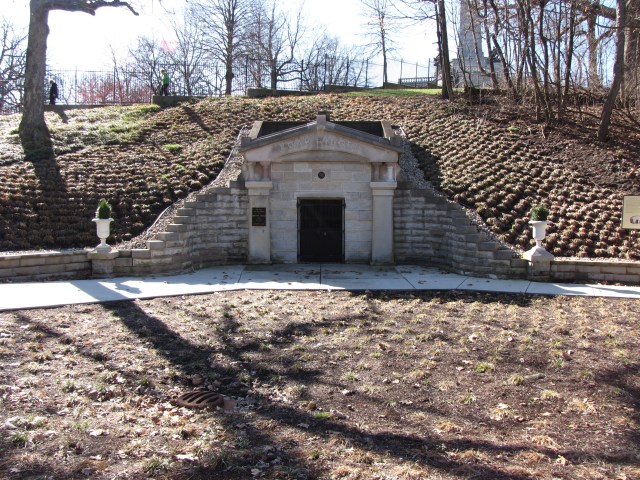
The Snake

Spring Grove Cemetery, Cincinnati, Ohio

In one of the most told and retold stories from the Bible, the snake became associated with the fall of man when he whispered in Eve’s ear and encouraged her to eat from the Tree of Life while Adam and Eve were still living in the Garden of Eden.

The Bible:

Genesis 3, Verse  1: NOW the serpent was more subtil than any beast of the field which the LORD God had made.   And he said unto the woman, Yea, hath God said, Ye said not eat of every tree of the garden.

2: And the woman said unto the serpent, We may eat of the fruit of the trees of the garden.

3: But of the fruit of the tree which is in the midst of the garden.  God hath said, Ye shall not eat of it, neither shall ye touch it, lest ye die.

4: And the serpent said unto the woman, Ye shall not surely die:

5: for God doth know that in the say ye eat thereof, then your eyes shall be opened, and ye shall be opened, and ys shall be as gods, knowing good and evil.

6: And when the woman saw that the tree was good for food, and that it was pleasant to the eyes, and a tree to be desired to make one wise, she took of the fruit thereof, and did eat, and gave also unto her husband with her; and he did eat.

7: And the eyes of them both were opened, and they knew that they were naked; and they sewed fig leaves together, and made themselves aprons.

8: And they heard the voice of the LORD God walking in the garden in the cool of the day: and Adam and his wife hid themselves from the presence of the Lord God amongst the trees of the garden.

9: And the LORD God called unto Adam, and said unto him, Where art thou?

10: And he said, I heard thy voice in the garden, and I was afraid, because I was naked; and I hid myself.

11: And he said, Who told thee that thou wast naked? Hast thou eaten of the tree, whereof I commanded thee that thou shouldnest not eat?

12: And the man said, The woman whom thou gavest to be with me, she gave me of the tree, and I did eat.

13: And the LORD God said unto the serpent, Because thou hast done this, thou art cursed above all cattle, and above every beast of the field; upon thy belly shalt thou go, and dust shall thou eat all the days of thy life.

14: And I will put enmity between thee and the woman, and between thy seed and her seed; it shall bruise thy head, and thou shalt bruise her heel.

In most cases, snakes represent sin or Satan in funerary art.  There are exceptions, though, as in the case of the Ouroboros, the Rod of Asclepius, and the Caduceus.

Spring Grove Cemetery, Cincinnati, Ohio

Posted in Symbolism | Leave a comment

Sheathed Sword

CHARLES F. TAGGART

MAJOR 2ND PENN. CAVALRY

DIED OCT. 24, 1863

FROM WOUNDS RECEIVED

AT BEALETON STATION, VA.

The segmented-top white marble gravestone that marks Major Charles Taggart’s grave is imbued with symbolism.  Draped over the top of the gravestone is a cloth.  In this case, it likely symbolizes that Taggard’s Earthly garments have been cast aside as his soul makes the transition to the Heavenly plane.

Also carved on the stone is a soldier’s sword in its sheath.  Typically the sheathed sword would represent temperance and restraint.  It is obviously also a nod to honor Major Taggard’s service in the Civil War.  Charles Taggard served in two units—first in 1st Philadelphia City Troop from November 10, 1857 until August 17, 1861 when he mustered out.  The 2nd Pennsylvania Volunteer Calvary formed on November 18, 1861 with Taggard rising to the rank of Major.  Nearly from the very beginning when the new unit was formed they saw action when they joined the Army of the Potomac in the Battles of Battles of the 2nd Bull Run and Chantilly.  Later the unit chased the famous Colonel Mosby, then later saw action in the Battle of Gettysburg in those three fateful days of July in 1863.  But Major Taggard’s last battle was a skirmish at Bealeton Station, Virginia.  Taggard was shot in the knee while leading a charge against Confederate cavalry and infantry units.  Taggart’s leg was amputated but died two days later.  His body was returned to Philadelphia and on October 29th, 1863 his funeral was held.  Taggard’s body was laid to rest in the Laurel Hill Cemetery by six pallbearers who had served with him in the City Troop.

Posted in Symbolism | Leave a comment

Inverted Sword

Owen F. Solomon

1829 – September 27, 1859

Carved atop a shaft of white marble rests a pillow with the hat of a soldier.  There are four symbols on this monument: the soldier’s hat, a sword, the laurel wreath, and the Masonic symbol.  With the exception of the later, the others refer to Solomon’s service in the Army.

The obelisk prominently features an inverted sword referring to Solomon’s military service.  When the sword points downward, tip toward the ground, it symbolizes the handing over of power and victory.

The entry (#1596) in Bvt. Major-General George Washington Cullum’s (Colonel, Corps of Engineers, U.S. Army) Biographical Register of the Officers and Graduates of the United States Military Academy at West Point, New York, from Its Establishment March 16, 1802 to the Army Reorganization of 1866-67, Second Edition, Volume 2 (published by D. Van Nostrand, 192 Broadway, New York, 1891) details his military career:

Military History:

Cadet at the Military Academy, July 1, 1849, to July 1, 1853, when he was graduated and promoted in the Army to

Bvt. Second Lieut. of Artillery, July 1, 1853.

Served: in garrison at Ft. Moultrie, South Carolina, 1853, — and Ft. Myers,

(Second Lieut., 4th Artillery, Nov. 25, 1853)

Fla., 1853‑54; on frontier duty at Ft. Brady, Michigan, 1854‑55, — and Ft. Brown, Texas, 1856; in garrison at Jefferson Barracks, Missouri, 1856‑57; (First Lieut., 4th Artillery, Oct. 31, 1856)

Florida Hostilities against the Seminole Indians, 1857‑58; and on frontier duty at Ft. Leavenworth, as Acting Asst. Adjutant-General, Feb. 6 to May 18, 1858, in quelling Kansas Disturbances, — and Ft. Laramie, Dakota Territory, 1858‑59.

Solomon died, Sep. 27, 1859, at Ft. Laramie, Dakota Territory.

Owen F. Solomon was 30 years old.  Some sources say his body was brought to Atlanta, Georgia, and he was buried in the Oakland Cemetery, while others indicate that he is buried at the Camp Floyd Cemetery in Utah.

Posted in Symbolism | Leave a comment

Crossed Swords

MAURICE E. FAGAN

LIEUT. COLONEL

19TH PENNSYLVANIA CAVALRY

FEBRUARY 4, 1863

IN LOVING REMBRANCE OF

MY BROTHER

Lieutenant Colonel Maurice E. Fagan’s segmented-top white marble gravestone features a banner hanging from a rifle.  In the center the banner, two swords are crossed, honoring Fagan’s service in the Pennsylvania Volunteer Cavalry. Crossed swords on a gravestone nearly always marks the burial spot of a highly ranked military officer, as in this instance.

Laurel Hill Cemetery, Philadelphia

Posted in Symbolism | Leave a comment

Sons and Daughters

North Conway Cemetery, North Conway, New Hampshire

Many organizations were founded in the later part of the 19th Century that required the prospective members demonstrate that their ancestors had been in the United States before a certain date or that their ancestors had served in a war.  Examples of these organizations are The Daughters of the War of 1812 (1892), The Order of the Founders and Patriots of America (1896), The National Society, Colonial Daughters of the Seventeenth Century (1896), The Mayflower Society (1897), and The National Society of the Colonial Dames of America XVII (1915).

Two of the most well-known are Sons of the American Revolution and The Daughters of the American Revolution.  The Sons of the American Revolution was founded April 30, 1889, and requires members to prove that one of their ancestors served in the American Revolutionary War (1775-1783.

The Sons of the American Revolution (S.A.R.) refused to let women join the organization, so on July 13, 1890, four women—Mary Smith Lockwood, Eugenia Washington, Ellen Hardin Walworth, and Mary Desha—founded the Daughters of the American Revolution (D.A.R.).  They organized the first chapter on October 11, 1890.  The organization was supported and promoted by Caroline Lavina Scott Harrison, the wife of President Benjamin Harrison.  The D.A.R. is also a lineage-based membership service organization.

Both organizations promote patriotism and the preservation of American history.  Ironically, The S.A.R., though founded first, would not allow women but the D.A.R. membership eclipsed the S.A.R. decades ago.

Rose Hill Cemetery, Bloomington, Indiana

Posted in Metal Markers | 1 Comment

The Ubiquitous Urn

Oakland Cemetery, Atlanta, Georgia

According to James Deetz and Edwin S. Dethlefsen, in their groundbreaking article, “Death’s Head, Cherub, Urn and Willow” the willow first made its appearance in cemeteries in the early 18th century.  The motif represented a break from the stark and cold reminders that death would bring that the Puritans carved into their gravestones—flying death’s heads, skulls and crossbones, and gravedigger’s equipment. In addition to the grim reminders of the inevitability of death Puritan gravestones often accompanied the haunting imagery with blunt words such as, “Here lies the body.” Nothing subtle there. The willow and the urn, however, represented a more sentimental view of death. There was a softening of Puritan views during the Great Awakening and the beginning of the Romantic Era.

Village Cemetery, Bar Harbor, Maine

Often the willow and urn is accompanied with words like, “In memory of” or “Sacred to the memory of”. This represented a softer approach. Like many symbols found in the cemetery, they can have multiple meanings, or there can be disagreement about the meaning of the motif—the Willow and urn is no exception. Christians saw the ability of the tree to live seemingly no matter how many of the branches were cut from the tree as a symbol of immortality. Others, however, suggest that the willow and urn predate Christianity to Roman times. The urn was used by Romans to store cremated remains and the willow was associated with the Persephone, the goddess of the underworld. Combined they represent the soul’s journey from the Earthly Realm to the Heavenly Realm. This design coincided with a neo-classical revival that took place mid-18th Century in America.

Oakland Cemetery, Atlanta, Georgia

The monument in the photograph is of a draped urn.  This particular urn is a dramatic example of this symbol, cast in bronze and freestanding.  For the most part, the urns are found on top of columns and mausoleums, ornaments.  The draped urn represents the clothing of the deceased being shed to move from the Earthly realm to the Heavenly realm.

Like most funerary symbols, even nuances make a difference to their meaning.  For instance, if the drape on the urn is fringed, the drapery represents a shroud symbolizing sorrow, the motif that represents a veil that separates the Earth and Heaven, life and death.

City Cemetery, Davenport, Iowa

The urn with a flame emanating from the top, symbolizes eternal remembrance and religious zeal.

Franklin, Indiana

The urn was an almost ubiquitous 19th Century symbol found in nearly every American cemetery.  Often, the urn tops a monument—sometimes depicted with a wreath looped around it.  The wreath, according to Tui Snyders’ book, Understanding Cemetery Symbols, can symbolize “mourning and eternal remembrance.  The laurel wreath also symbolizes victory over death—so even the kind of wreath makes a difference to the meaning.

Oakland Cemetery, Atlanta, Georgia

The shattered urn, according to Snyder, signifies old age.

Laurel Hill Cemetery, Philadelphia, Pennsylvania

The irony of the urn being such a popular 19th Century funerary symbol is that very few people were cremated when the urn motif was at the height of its popularity.  For instance, during the eight years from 1876 until 1884, only 41 Americans were cremated.  Though the number of cremations in the United States slowly increased, by the 1950s only less 4% of our dead were cremated.  Cremation, though, has been increasing each decade: 1960–3.56%; 1970–4.59%; 1980–9.72%; 1990–17.13%; 2000–26.24%; 2010–35.93%.  Some are predicting that by 2025, almost half of our dead will be cremated.  Maybe the urn will re-emerge as a symbol for the 21st Century.

Laurel Hill Cemetery, Philadelphia, Pennsylvania

Posted in Symbolism | 4 Comments

Variations

The Adolph Zang monument is a variation of the previous monuments found in Muncie, Brooklyn, and Colma, with the design being featured in the Dodds Granite Company catalog.  For one thing, the exedra is gone from this monument–only the monolith marks the grave.

For another, the figure’s position has changed as it did slightly in the others.

Adolph Zang Monument in the Fairmount Cemetery in Denver


Posted in Uncategorized | Leave a comment

Dodds Granite Company, Muncie, Brooklyn, and Colma

JOHN EDGAR JOHNSON SR.

AUGUST 16, 1873

MARCH 30, 1919

The John Edgar Johnson Sr. monument in the Beach Grove Cemetery in Muncie, Indiana,is described and pictured in the Dodds Granite Company catalog.  The advertising copy described the monument: “There is an atmosphere of peace and rest surrounding the very presence of this remarkable work of art.  The central portion with its symbolic figure and delicately draped ornamentation blends naturally into the monolithic exedra on either side.  There is a life-like quality in the statue and an exactness of detail throughout, made possible by the use of that fine grained, even textured granite, Victoria White.”

The monument described is of the Art Nouveau style demonstrated by the long fluid vines of the florals adorning the monolith in the center and designs trailing into parts of the seats to either side.  The Art Nouveau movement was a bridge between Neoclassicism and Modernism and reached its popularity from 1890 to 1905.  Luminary artists such as Alphonse Mucha, Gustav Klimt, and Henri de Toulouse-Lautrec; glass designers Rene Lalique and Louis Comfort Tiffany, and Spanish architect Gaudi among others also used long flourishing lines inspired by florals and plants in their work.  Not all of the lines in the exedra are rounded and shows the emergence of Modernism in the design of this piece.

Further demonstrating the Art Nouveau design of this monument is the look of the mourning figure in the center.  The figure has the characteristics of many of the women portrayed during the late 1800s and early 1900s, such as the Gibson girl that was popularized at that time.

Generally an exedra is a semi-circular structure, often with a bench with a high back.  This exedra breaks with the traditional design by being a straight bench on either side of the monolith.  Sometimes there is an architectural feature in the center of the exedra, often with statuary or the family name as in this example from the Dodds Granite Company.  In antiquity the exedra was designed to facilitate philosophical discussion and debate.  In cemetery architecture the exedra is usually a part of a landscape design.

An oil lamp is carved into the monolith at the feet of the mourning figure.  A flickering flame can be seen coming from the lamp providing light.  The Bible verse, II Samuel: Chapter 22, verse 29, says, “For thou art my lamp, O LORD: and the LORD will lighten my darkness.”  The light emanating from the lamp represents the pathway to Truth and to Knowledge.

I have also found this exact design in the Green-Wood Cemetery in Brooklyn, New York, marking the grave of:

ALONZO B. SEE

OCTOBER 25, 1849

DECEMBER 16, 1941

I also found one at the Cypress Lawn Cemetery in Colma, California.  There is a notable difference between the examples in Brooklyn and Colma–the exedras to either side of the monolith are longer than the exedra in the example in Muncie.

ALBERT GALLATIN

The Dodds Granite Company catalog and many other gravestone and monument company brochures can be found at the Stone Quarries and Beyond Website: http://quarriesandbeyond.org/cemeteries_and_monumental_art/cemetery_stones.html.

The Stone Quarries and Beyond Website was created by Peggy B. and Patrick Perazzo. It focuses on historic stone quarries, stone workers and companies, and related subjects such as geology. Whenever possible links of finished products are provided on the Website. There is a “Quarry Articles” section that presents articles, booklets, and links from the late 1800s to early 1900s, including the 1856 “The Marble-Workers’ Manual.” The “Cemetery Stones and Monuments” section provides references and resources, including many old monument magazines, catalogs, price lists, and a photographic tour “From Quarry to Cemetery Monuments.”

Posted in Symbolism | Leave a comment

The New England Granite Works

EDWIN LISTER

BORN SEPTEMBER 10, 1829

DIED MAY 18, 1898

LISTER

The 12-foot high Edwin Lister monument stands on a slope in the Sleepy Hollow Cemetery in Tarrytown, New York.  The monument was created by New England Granite Works Company and featured in one of their catalogs to demonstrate the company’s skill in producing one-of-a-kind grave markers.

The neo-classical design constructed of gray granite is expertly carved, though it is not signed.  The central feature of the monument is a bust of Lister atop a sarcophagus flanked on either side by Corinthian columns, supporting a lintel and cornice. Lister’s bust is facing slightly to the right and framed by a recessed seashell.  A mourning figure dressed in a classical gown draping her body, her head leaning against one arm, with what looks to be a scroll in the other, rests on an elaborately carved plinth.

Edwin Lister was born in England and immigrated to the United States with his father and family as a teenage boy.  Lister’s father, Joseph, manufactured button.  Edwin apprenticed in his father’s business.  Differing descriptions of Edwin Lister’s business include him following in the family business as a button maker while others describe him has a manufacturer of fertilizer.  Whatever his business, he was obviously successful.

The New England Granite Works catalog and many other gravestone and monument company brochures can be found at the Stone Quarries and Beyond Website: http://quarriesandbeyond.org/cemeteries_and_monumental_art/cemetery_stones.html.

The Stone Quarries and Beyond Website was created by Peggy B. and Patrick Perazzo. It focuses on historic stone quarries, stone workers and companies, and related subjects such as geology. Whenever possible links of finished products are provided on the Website. There is a “Quarry Articles” section that presents articles, booklets, and links from the late 1800s to early 1900s, including the 1856 “The Marble-Workers’ Manual.” The “Cemetery Stones and Monuments” section provides references and resources, including many old monument magazines, catalogs, price lists, and a photographic tour “From Quarry to Cemetery Monuments.”

Posted in Uncategorized | 1 Comment

EXCEPIT ILLUM MAGNA ET AETERNA PAX

THOMAS TRUEMAN GAFF
1854-1923
“EXCEPIT ILLUM MAGNA ET AETERNA PAX”

The memorial statue on the Thomas Trueman Gaff grave in St. Paul’s Rock Creek Cemetery in Washington, D.C., as described by the Smithsonian Art Inventory Catalog: “The memorial features a bronze male figure seated on a tomb, his body loosely draped in a long hooded robe, and his left hand raised over his head as he gazes straight ahead. The sculpture is installed at one end of a long flat granite base with an inscription plaque on top.

The bronze statue was created by French artist Jules Dechin, the base of the statue is marked with his name and the year, 1922.  The Smithsonian description makes no mention of the meaning behind the statue.

Gaff was born in Aurora, Indiana, but made his fortune in Cincinnati, Ohio, in the distillery and heavy machinery industries.  Gaff was appointed by Howard Taft, who was the Secretary of War at the time, to be a commissioner on the Panama Canal.  The Gaffs moved to Washington, D.C., in 1904.  Gaff died in 1923; here below is his obituary from the Washington, D.C., January 18, 1923, edition of the Evening Star:

“THOMAS GAFF DIES IN HIS 66TH YEAR

Well Known Resident of Washington Had Long Been Ill—Funeral Here.

Thomas Trueman Gaff, a well known resident of Washington, died yesterday at his apartment, in the Lenox, Boston, Mass., after a long illness.  The family home in this city is at 1520 20th street northwest.  Mr. Gaff was sixty-six years old.  While the arrangements for the funeral have probably not been completed, the services will probably be held at St. John’s Episcopal Church next Monday at 11 o’clock.  Announcement of the complete funeral arrangements will be made later.

Mr. Gaff who was the son of James Wilson and Rachel Conwell Gaff was born at Aurora, Ind., September 27, 1856, but ten years later his parents moved to Cincinnati, Ohio, where they became presently identified with that city.  He was educated at Phillips Exeter Academy and entered Harvard College in the class of 1876, but left in his junior year to spend one semester studying at the University of Gottingen and two semesters at the University of Leipzig.  In 1899 he was given the degree of bachelor of arts by Harvard College as of 1876.

Moves to Capital.

Upon his return from abroad, Mr. Gaff entered business in Cincinnati and subsequently became actively associated with a number of important corporations, among them the Pratt and Whitney Company and the Niles-Bement-Pond company, of which he was one of the organizers and a director until his death.

November 14, 1883, he was married at Newport, R. I., to Miss Zaidee Ellis, youngest daughter of Mathias and Sarah Forsyth Ellis of Carver, Mass., who were well known in Boston, Lenox, Albany, and Newport.  In subsequent years much of Mr. and Mrs. Gaff’s life was spent in travel abroad, in Washington, or at their place, the Ship, at Osterville, Mass.

In 1897 they took up their residence in Washington, and their handsome house at 1520 20th street northwest, has been the scene of many brilliant entertainments in the past years.  In the spring of 1905 Mr. Gaff was appointed by Secretary of War Taft, a member of the board of arbitration to value the land which had not already been acquired, but which was necessary for the construction of the Panama Canal.

Mr. Gaff was a member of Institute, D. K. E., “Med. Fac.” and Porcellian of Harvard College: Queen City and Riding clubs of Cincinnati: Metropolitan, Chevy Chase, Montgomery Country, Cosmos, University and Lock Tavern clubs of Washington, University, Harvard and Manhattan clubs of New York, and the Royal Mersey Yacht Club of Liverpool, England.

He is survived by his wife, a daughter, Mrs. Cary Duval Langhorne, and by two sisters, Mrs. Daniel H. Homes and Mrs. Charles M. Hinkle.”

Posted in Uncategorized | 4 Comments