The Pittsburgh Dispatch

DANIEL O’NEILL

January 1, 1830 – Cloughbawn, County Wexford, Ireland

January 30, 1877  — Pittsburgh, Pennsylvania

Daniel O’Neill was born in Cloughbawn, County Wexford, Ireland, where he was a contributor to the local newspaper.  When he immigrated to the United States in 1851, he worked as an editor of the Pittsburgh Dispatch and the competing newspaper, the Chronicle.  He and his brother, Eugene O’Neill, eventually bought controlling interest in the Dispatch.  The paper was successful and influential.  One of their top writers was Nellie Bly who won acclaim for her swashbuckling trip around the world in 72 days.  She was a pioneer in journalism becoming one of the first investigative journalists.  “Nellie Bly” was a pen name—her birth name was Elizabeth Jane Cochran.

Many writers take on pen names, one of the most famous was Samuel Langhorne Clemens who wrote under the name of Mark Twain regaling readers with the tales of Huck Finn and Tom Sawyer.  Children’s book author and illustrator Theodor Geisel best known for Cat in the Hat, Green Eggs and Ham, and The Grinch Who Stole Christmas, among dozens of other books was known to children as Dr. Seuss.  Geisel took his middle name as his nom de plume.  The polemics 1984 and Animal Farm were written by author Eric Arthur Blair who wrote under the name of George Orwell.  Like many writers, Daniel O’Neill’s son, Florence, took on a pen name.  While Florence was the circulation manager at the Pittsburgh Dispatch, he wrote a daily column under the pen name Dick Dasher until he resigned the post in 1904. 

Daniel O’Neill’s granite monument shows him at this writing desk toiling away, pen in hand—an editor’s work is never done.

Posted in Uncategorized | Leave a comment

And Now Abideth Faith, Hope, Charity

At the highest point in the Allegheny Cemetery is a soaring column topped by an allegorical statue of Faith commissioned in 1877 for the Moorhead Family of Pittsburgh.  On the face of the base of the Corinthian column is a bronze bas-relief of the three allegorical figures—Faith, Hope, and Charity.  Just below the three draped figures is written the Biblical passage from 1 Corinthians 13:13, “And Now Abideth Faith, Hope Charity.”  The rest of the passage adds, “but the greatest of these is Charity.  Oddly enough, the figure atop the column is not Charity as one might expect given the Bible passage highlighted on the monument.  The sculpture also includes a palm leaf and a crown which represents victory over death and the triumph of the soul.

The bas-relief was sculpted by Carl Conrads (1839-1920).  Conrads was born in Breisig, Germany and immigrated to the United States.  He only returned to Germany for a short time to study sculpture.  He found work at the Hartford Granite Company and created public monuments as well as funerary sculpture.  His works can be found in

U. S. Capitol, the Connecticut State Capitol, West Point, Antietam National Cemetery, among others.  One of the greatest 19th Century sculptors, Lorado Taft, described Conrads as “a German of good training” … “who has done much creditable work well adapted to the requirements of that ungrateful material.”

Posted in Uncategorized | Leave a comment

The Crown and the Lily

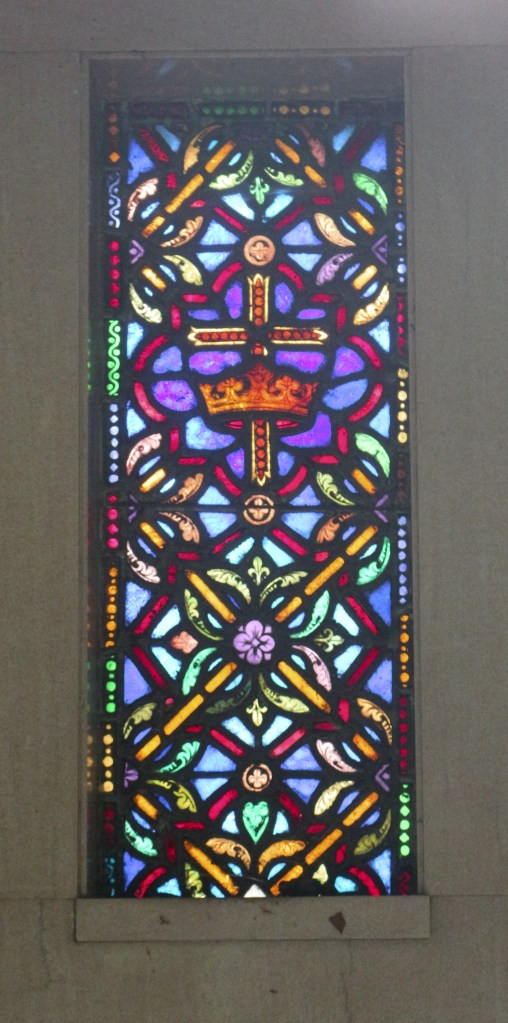
This stained-glass window in the Allegheny Cemetery in Pittsburgh, has two prominent symbols, both of which, are commonly found in American cemeteries, though not usually as colorfully and vivid as this.

The crown is a symbol of glory and reward and victory over death.  The reward comes after life and the hard-fought battle on Earth against the wages of sin and the temptations of the flesh.  The reward awaits in Heaven where the victor will receive a crown of victory.  The crown also represents the sovereign authority of the Lord.

The lily, as a funerary symbol, has many meanings including purity, innocence, virginity, heavenly bliss, majestic beauty, and Christ’s resurrection.  Christians believe that the trumpet-shaped blossoms announce the Resurrection of Jesus Christ.

The Easter Lily has long been associated with the Christian religion, commonly referred to as “White-Robed Apostles of Christ.” Early Christians believed that lilies sprouted where Jesus Christ’s sweat fell to the ground in the Garden of Gethsemane.

White has typically been a color associated with virtues of purity and innocence.  Often the lily can be found on the grave of a child, the epitome of purity and innocence.

The white lily is also associated with virginity and marriage, in particular relationship to women.  On one hand, the lily represents virginity and innocence, which is an appropriate symbol for a young unmarried woman.  On the other hand, it is symbolic of majestic beauty and marriage, which makes it an appropriate symbol for all married women regardless of their age.

If this stained-glass window were a pictogram, the literal meaning might be—after death comes the resurrection (lilies) and the victory over death (crown).

Posted in Uncategorized | Leave a comment

A Family Favorite?

ROY ARTHUR HUNT

AUGUST 3, 1881 – OCTOBER 21, 1966

RACHEL McMASTERS MILLER HUNT

Wife of ROY ARTHUR HUNT

June 30, 1882 – February 22, 1963

The Hunt family marker in the Allegheny Cemetery in Pittsburgh has two matching flowers flanking the central part of the gravestone.  Often stylized flowers are difficult to key, but the distinct features of the fritillaria made this one easy.  The fritillaria is in the lily family and the common English name is “snake head’s”. 

Many flowers can be found in dictionaries explaining flowers’ meaning. In Victorian times, flowers took on significance as a way to send coded messages; this was known as floriography from the Latin combining flora—“goddess of flowers”—and graphein—“writing.”

In 1878, Kate Greenaway, a popular author and illustrator, gained fame for an illustrated children’s book of verse she wrote titled Under the Window, which delighted children.  Just six short years later, Greenaway published the Language of Flowers.  And although, the book is a nearly complete listing of flowers along with their “secret” or symbolic meanings, I could find no meaning for any of the various common names for the fritillaria—guinea-hen flower, leper lily, drooping tulip, or checkered daffodil.

Perhaps, since there doesn’t seem to be a symbolic meaning, this flower was a family favorite.

Posted in Uncategorized | Leave a comment

An Unexpected Fanboy

STEPHEN C. FOSTER

of Pittsburgh, Pa.

BORN

July 4, 1826

DIED

January 13, 1864

Prolific song writer and musician, Stephen Foster became known as the “Father of American Music,” and for good reason, too.  Even though his most noteworthy songs were written well over a century ago, they are still recognized today.  Two of his songs were adopted as state songs—“Old Folks at Home” also known as “Swanee River” as Florida’s and “My Old Kentucky Home” became the state song for, of course, Kentucky. Many of his other songs are also a part of American culture—such as the rollicking “Camptown Races” one of more than 200 songs he wrote during his short lifetime.

His popularity was memorialized in stained glass in the Temple of Memories, the public mausoleum dedicated in 1961 in the Allegheny Cemetery in Pittsburgh.  The window features Stephen Foster in the center seated at a piano.  There are scenes of his most famous songs in the window and the side panels—including depictions of “Oh, Susanna” and “I Dream of Jeannie.”

According to Images of America: Allegheny Cemetery by Lisa Speranza and Nancy Foley page 108, Arcadia Publishing 2016, Charleston, South Carolina, devoted music fan Harry Houdini visited the grave of Foster many times and even paid for the upkeep of Foster’s grave.  Houdini credited Foster with the creation of “real American songs.”

Posted in Uncategorized | 2 Comments

Open-Air Museums

GEORGE HOGG

Born at Cramlington

Northumberland County,

England June 22, 1784

Immigrated to the US

September 1804

And Died in Allegheny

City, December 5, 1849

MARTHA HOGG

Daughter of Nathaniel Breeding and Mary Ann Ewing Breeding

Born September 4, 1787

Fayette County, Pennsylvania

According to Images of America: Allegheny Cemetery by Lisa Speranza and Nancy Foley page 28, Arcadia Publishing 2016, Charleston, South Carolina, “George Hogg was born in England in 1784 and came to the United States in 1804.  He was known in Pittsburgh for having developed the Brownsville Glass Factory and later as founder of the Monongahela Navigation Company in 1836.”

The monument marking the graves of George Hogg and his wife, Martha, was created by famed sculptor, Henry Kirke Brown.  Though the angel has become known as the “Hogg Angel”, the artist named it the “Angel of the Resurrection”.  Fittingly, the angel, resting on a sandstone pedestal, is depicted with one hand reaching toward the heavens and one toward Earth, to signify to the “creator that a Christian soul rests here, among the tree-lined paths at Allegheny.”

Henry Kirke Brown (1814-1886) was in high demand for his work creating statues of some of the most famous Americans in our history, including equestrian statues of George Washington, Andrew Jackson, and General Winfield Scott.  Three of his works—statues of Nathanael Greene, George Clinton, and Philip Kearny—are in Statuary Hall in the United States Capitol.

Another of his works that can be found in the Green-Wood Cemetery in Brooklyn, New York, is a bronze statue of New York Governor De Witt Clinton.  According to the Smithsonian American Art Museums Art Inventories Catalog, created a “Standing portrait of DeWitt Clinton in suit with Classical drape over left shoulder and around waist. His proper left arm is bent at the elbow, hand resting on hip and covered completely by the drape. His right arm hangs straight down, his hand resting atop a stack of books.”

Two pieces of great art found in an open-air museum—also known as a cemetery.

Posted in Uncategorized | 3 Comments

The Shipwreck Arctic

James Breading Hogg

1813 – September 27, 1854

Before the horrific sinking of the Titanic, another maritime disaster made huge headlines.  According to Images of America: Allegheny Cemetery by Lisa Speranza and Nancy Foley page 111, Arcadia Publishing 2016, Charleston, South Carolina, “James B. Hogg was lost on the infamous sinking of the Collins liner Arctic due to a collision with the steamer Vesta off the coast of Cape Race on September 27, 1854.”  Cape Race is located at the southeastern tip of the Avalon Peninsula coast of Newfoundland, Canada.

Unfortunately, for the passengers on the Arctic, there were not enough lifeboats to accommodate all of those aboard the ship. When the two ships collided, confusion and panic took over and all sense of order was lost.  Chaos ensued.  Of the 250 passengers and 150 crew members, only “24 male passengers and 61 crew members survived.  Every last woman and child was lost…Among the survivors was the captain of the ship, who was never called to account.”  The captain did NOT go down with the ship.

James Hogg, the son of George and Martha Hogg, drowned in the catastrophe.  A marker was erected in the Allegheny Cemetery in Pittsburgh to commemorate his life, even though his body was never recovered. James Hogg’s marker is a cenotaph which originates from the Greek word kenotaphion.  Kenos means empty and taphos translates to tomb–together they form “empty tomb.”

While the monument is badly eroded the sculpture still gives a glimpse into the confusion and drama that took place as the ship was taking on water. The Hogg’s commissioned Patrizio Piatti (1825—1888) to create the tombstone.  Piatti was an Italian sculpture born in Lombardy, Italy, who immigrated to the United States in 1850, and plied his trade as a sculptor specializing in marble mantelpieces and cemetery monuments.

Posted in Uncategorized | Leave a comment

A Statue of a Mother for Those Who Didn’t Have One

ONONDAGA COUNTY

ORPHAN ASYLUM

ERECTED TO HONOR ITS DEAD

BY

CHRISTINA COLVIN

ONE OF ITS FOUNDERS.

1894.

In the Oakwood Cemetery in Syracuse, New York, philanthropist Christina Colvin commissioned sculptor Ralph Cook (1847 – 1912) to create a monument to honor those orphans of the asylum who had died.  According to the April 4, 1892 edition of the Syracuse Journal, Colvin’s “devotion to the Orphan Asylum has often stimulated others to follow her example. She labored for it in various directions … How large would be the pile of socks, stockings and mittens she knit till her lame, tired hands could knit no longer. She did good, as she had opportunity. Often stricken by sorrow, she strove in helping others to forget her own loneliness. Long connected with the Reformed church, whether she took the care and responsibility from less broad and experienced shoulders in her own social gatherings, greatly helping to ensure their success, or came into our homes with strong but tender hands and heartfelt sympathy in times of sickness and death, we all know we could trust dear “Aunt Tiny.”

According to the Smithsonian American Art Museums Art Inventories Catalog, the sculpture created by Cook depicts a “female figure holding a child in her left hand while comforting a toddler with her right.”  The irony of the monument featuring a mother with two children and dedicated to the orphans of the county, is that the children buried in this section of the cemetery did not have mothers. 

Posted in Uncategorized | Leave a comment

Artist Unknown

William Freame Johnston

November 29, 1801 – October 25, 1872

Mary Ann Montieth Johnston

1814 – May 18, 1898

Major William Graham McCandless

July 10, 1838 – January 17, 1909

Elizabeth Freame Johnston McCandless

April 1, 1842 – February 23, 1922

Two Pennsylvanian prominent families united—Johnston and McCandless.  William Freame Johnston was an attorney and politician, elected to the state Assembly and state Senate and was eventually elected Governor.  After a successful term as Governor, he went on to prove his ability in business in several different industries—oil refining, iron manufacture, and salt production.

Johnston’s daughter married William McCandless.  William McCandless was an officer in the Civil War.  After he mustered out with an honorable discharge he went into business as president of the American Window Glass Company.

Their Neo-classic monument features the Doric order characterized by columns that are usually fluted with a slightly curved and unadorned capital.  The architrave is enhanced with triglyphs and a repeating motif of circles in the Allegheny Cemetery in Pittsburgh, Pennsylvania.  Between the columns, the monument features a classically dressed angel standing in a field of lilies. The lily, as a funerary symbol, has many meanings including purity, innocence, virginity, heavenly bliss, majestic beauty, and Christ’s resurrection. 

The Easter Lily has long been associated with the Christian religion, commonly referred to as “White-Robed Apostles of Christ.” Early Christians believed that lilies sprouted where Jesus Christ’s sweat and tears fell to the ground in the Garden of Gethsemane.  Christians also believe that the trumpet-shaped blossoms announce the Resurrection of Jesus Christ.

The bronze inset was cast at the T.F. McGann & Sons Foundry in Boston, Massachusetts.  Unfortunately, there is not an artist’s signature on this piece.

Posted in Uncategorized | Leave a comment

Creative to the End!

Alexander Timothy Brown

November 21, 1854 – January 31, 1929

Mary Lillian Seamans Brown

August 3, 1863 – June 22, 1932

The Brown Family Mausoleum in the Oakwood Cemetery in Syracuse, New York, is an Art Deco masterpiece.  Art Deco is a design movement from the 1920s that marked a break from the fluid and flowing Art Nouveau designs of the 1890s.  The term ‘Art Deco’ is derived from the Exposition Internationale des Arts Décoratifs et Industriels Modernes, an exhibition of artists that showed their work in Paris in 1925.   Arts Décoratifs was eventually truncated to Art Deco.

The Brown Family Mausoleum was constructed with white granite, and exhibits the clean, straight lines characteristic of the Art Deco designs from the 1920s. This mausoleum was modelled to look like a skyscraper, partly achieved with the vertical lines and by its soaring height of 25 feet.  The exterior of the mausoleum is white granite, but the interior is a stark contrast constructed of polished black marble.

The inventor, Alexander Brown and his wife are buried within the mausoleum.  Brown was a serial inventor with over 150 patents to his name in a wide variety of areas which included the L.C. Smith Shotgun, the Smith Premier full-keyboard upstrike typewriter, as well as various patents for the automatic telephone and different automative parts.  In addition to his inventions, Brown was president of the Franklin Automotive Company and Director of the First Trust and Deposit Company. 

With all of his inventions and creations, one of his most lastly designs was the design for his own mausoleum!

Posted in Uncategorized | 1 Comment