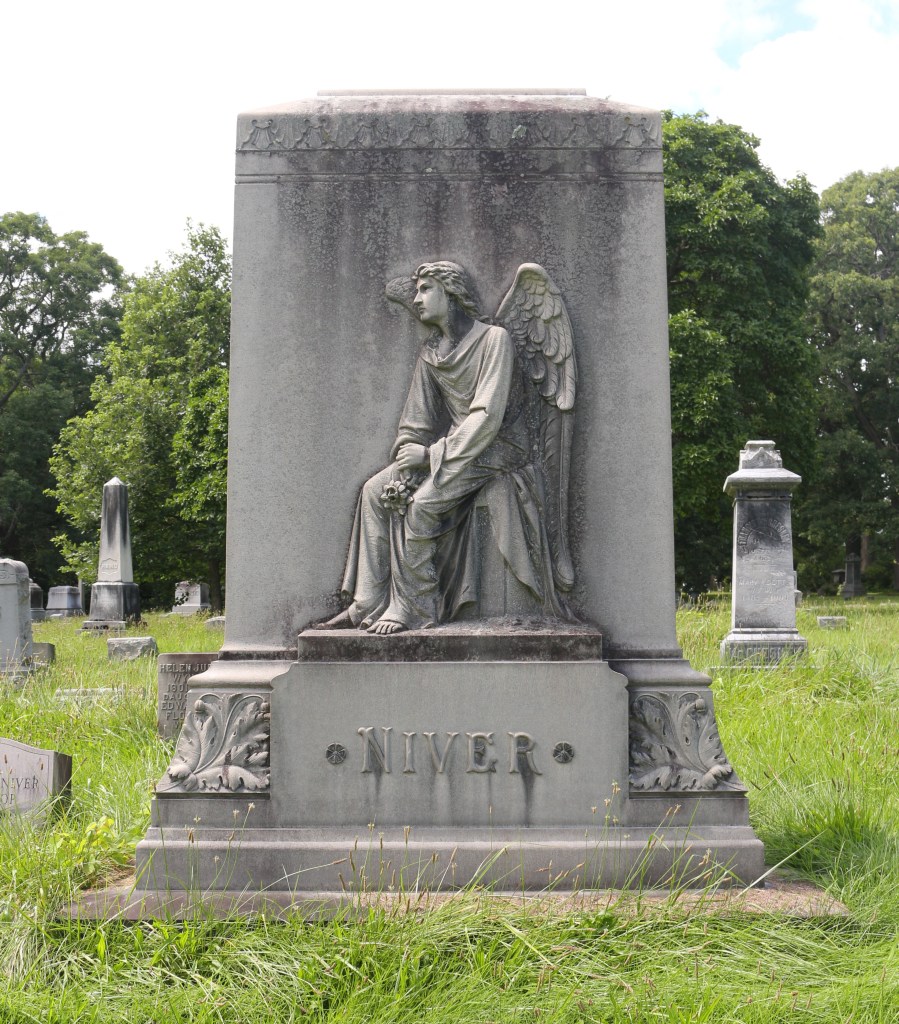
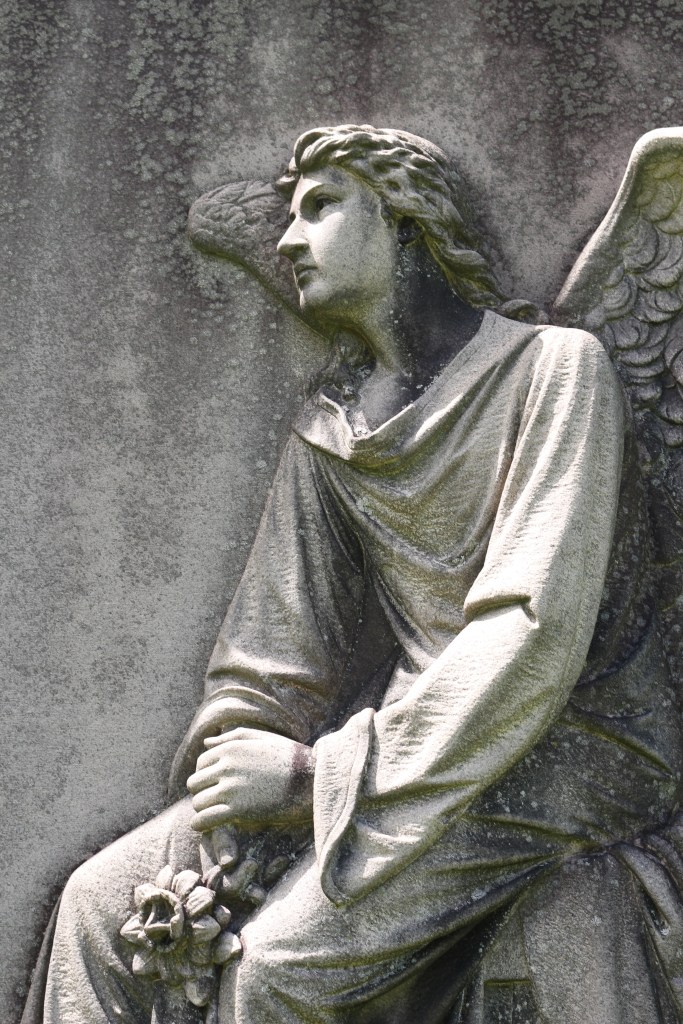
The Niver Family monument in the Oakwood Cemetery in Syracuse, New York, depicts a mourning figure—in this instance, an angel. We know it is an angel by its wings. Christian art began depicting angels with wings in the fourth century. Before then, angels were represented in several different forms–sometimes in human form, but they were also represented as a doves, or even as a hand reaching down from Earth from the Heavens. Beginning with the reign of Constantine, angels began being portrayed with wings, as is this figure, sullen with its eyes cast toward Heaven.
The angel here is seated and holding a passionflower. The passionflower was so named by Spanish Christian missionaries because they saw the flower imbued with religious symbolism and identified the parts of the flower and associated them with the passion of Jesus Christ.
Then ten petals represent the ten faithful disciples. The two apostles who were not considered were St. Peter, the denier, and Judas Iscariot, the betrayer.
The filaments that circle the center of the flower represent Christ’s crown of thorns.
The curled filaments represent the whips used in flagellation of Christ.
The white color was equated with Christ’s innocence.
The styles symbolize the nails.
Flanking the name plate are poppies. In cemetery symbolism the poppy represents eternal sleep.
Many organizations were founded in the later part of the 19th Century that required the prospective members demonstrate that their ancestors had been in the United States before a certain date or that their ancestors had served in a war. Examples of these organizations are Sons of the American Revolution (1889), The Daughters of the American Revolution (1890), The Daughters of the War of 1812 (1892), The Order of the Founders and Patriots of America (1896), The National Society, Colonial Daughters of the Seventeenth Century (1896), The Mayflower Society of Descendants (1897), and The National Society of the Colonial Dames of America XVII (1915).
The National organization of the Daughters of Union Veterans of the Civil War, 1861 – 1865 (DUV) was founded May 30, 1885, by Olive Howard, Harriet Knapp, Eva Merwin, Frank Merwin, and Bertha Martin. On June 3, 1885, the first meeting was held at the home of Eva Meerwin, 419 First Street, SE Massillon, Ohio, with the purpose of preserving the history of the Civil War.
The organization accepts all females, eight years or older, who can document lineal descent from an honorably discharged soldier or sailor who served in the Union Army, Navy, Marine Corps, and Revenue Cutter Service during the Civil War (1861 – 1865), and those who died or were killed while serving in the armed services of the Union between April 12, 1861 and April 9, 1865. The organization maintains a museum and library dedicated to preserving the history of the war at their headquarters at 503 S. Walnut, Springfield, Illinois.
The Daughters of Union Veterans organization’s motto is, “Fraternity, Charity, and Loyalty. Their mission is, “To spread widely the teachings of patriotism, that those who dwell in this broad of ours will so live that, in peace or in war, there shall be no stain on “The Flag Our Fathers Saved”.
The metal marker is a replica of the organization’s insignia, a laurel wreath, surrounding the intertwined letters D U V. The laurel is a traditional symbol of victory and military glory from as far back as the times of the Romans.
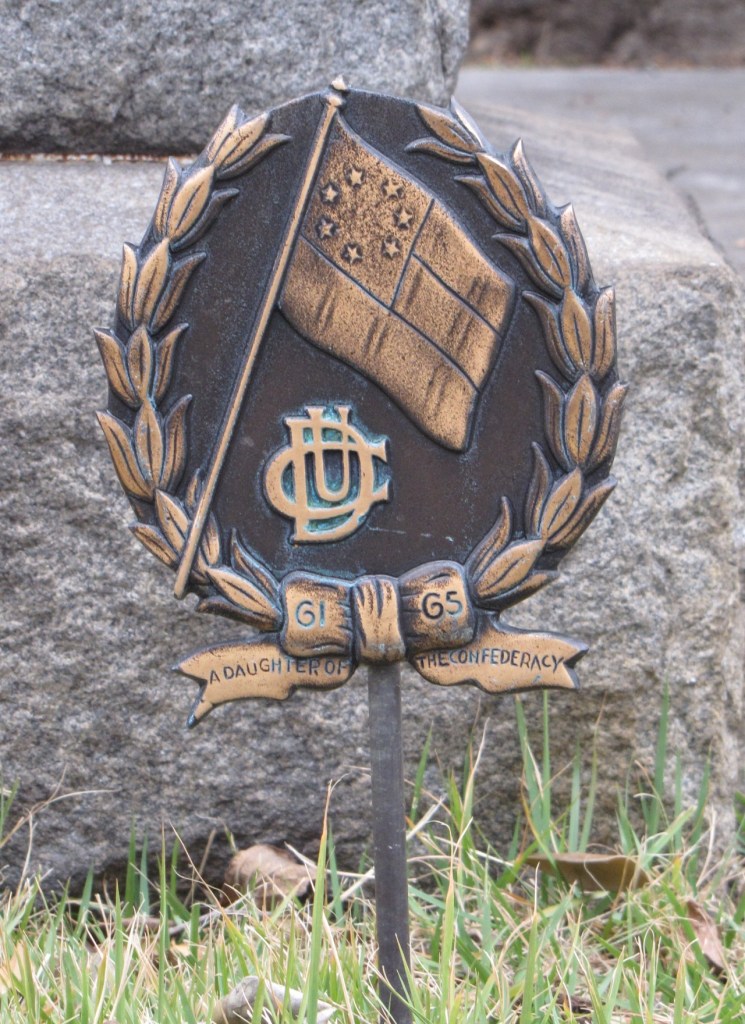
Just as the women of the North had founded an organization to honor the service of their soldiers, so did the women of the South. The organization was founded in 1894, by two women, Caroline Meriwether Goodlet and Anna Davenport Raines. The purpose of the UDC is to preserve the history of the Confederacy, honor the memory of those who served, and to preserve and mark historical locations. Their motto is, “Love, Live, Pray, Think, Dare.”
Any female 16 years of age or older who can document direct lineal or collateral descent from a soldier who served honorably in the Army, Navy or Civil Service of the Confederate States of America is eligible to join.
The United Daughters of the Confederacy maintain a library at their headquarters in Richmond, Virginia. They preserve and house a collection of rare books, letters, diaries, and other papers relevant and important to the history of the war. The UDC also awards a scholarship for original research about Confederate history.
The metal marker is a replica of the emblem of the UDC. A laurel, gathered together with a ribbon with two dates 61 and 65, the beginning and ending of the war, surrounds a Confederate flag and the intertwined letters U D C.
Gravely Speaking and Syngrammata have decided to dig deep into our photo collections in order to bring you pairs of images drawn from our many years combing through American cemeteries. Each pair will be linked by a theme which we are free to interpret. Suggestions of future themes to follow are welcome in the comments! This week’s theme is all about dogs.
Gravelyspeaking writes:
Gone to the Dogs!
FRANK E.
Son of
J. C. & H. F. SHY
DIED
Oct. 29, 1879
We Loved Our Boy
Riverside Cemetery and Fairmont Cemetery in Denver vied for the title of premier burial ground for Denver’s elite. Riverside, however, was the older of the two and from the beginning had less restrictive codes for monuments erected in the cemetery in its early days. Fairmont had laid out their rules early on in its development. Riverside hadn’t and therefore, the cemetery had a hodgepodge of markers made of many different kinds of materials, including “white bronze” which was actually zinc. The zinc markers were expressly forbidden in the rival Fairmont Cemetery.
According to Annette Stott, author of Pioneer Cemeteries: Sculpture Gardens of the Old West, published by the University of Nebraska Press, Fairmont Cemetery was the larger of the two cemeteries. Fairmont … had a fairly strict list of what kinds of monuments were acceptable, “No footstones … only gravestones and monuments made of granite, marble, or real bronze … no monument or grave marker will be admitted which is cut in imitation of dogs, cattle, or any grotesque figure.” The implication being that these types of monuments which could be readily found in Riverside, “were inappropriate, perhaps even in vulgar taste.”
One such gravestone in the Riverside Cemetery was that of 13-year-old Frank Shy. Sheep ranchers, John and Hannah Shy, commissioned a white-washed marble dog to be placed on their son’s grave. They tenderly inscribed it with the words, “We Loved Our Boy.” This was not an unusual monument as carved dogs began to appear in American cemeteries in the first half of the 20th century. According to Annette L. Student who researched and updated the pamphlet, Walk Through Historical Riverside Cemetery, (page 25), “the Shy Memorial, under a small elm tree, is a white marble monument topped with the sculpture of a dog.” The dog was the pet of Frank Shy, and his parents wanted “their young son guarded in death by the dog he loved in life.”
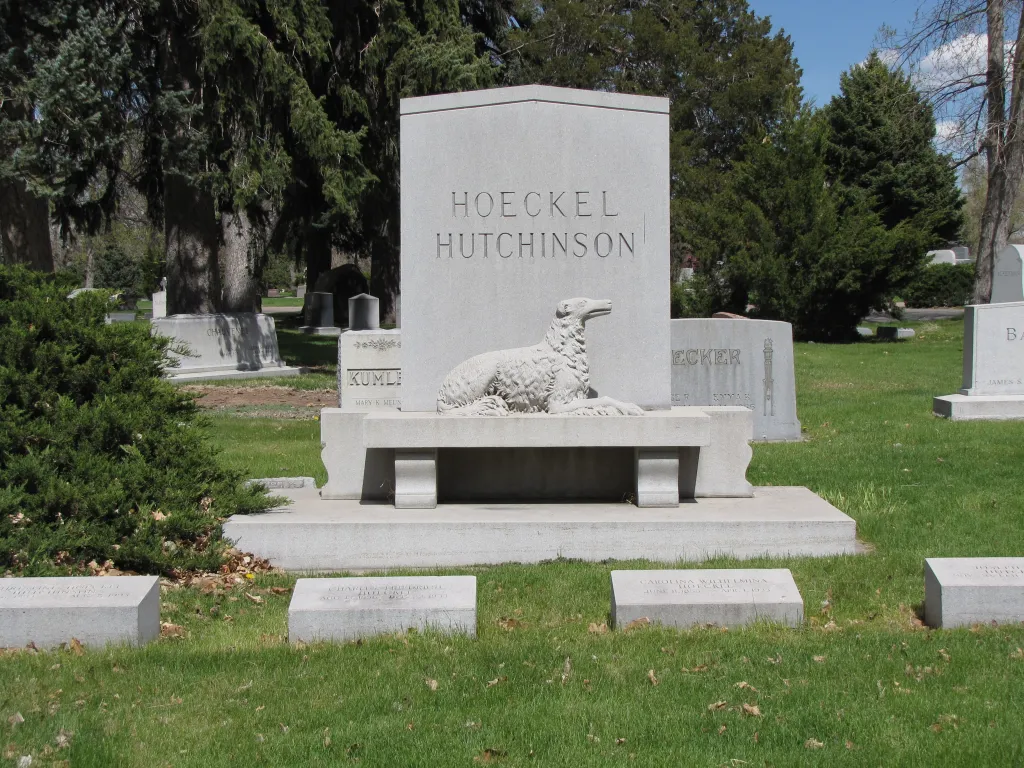
While the Fairmont trustees may have thought the Shy Memorial vulgar, Riverside had the last laugh when the Hoeckel-Hutchinson family erected a monument featuring a dog no less in the Fairmont
Syngrammata writes:
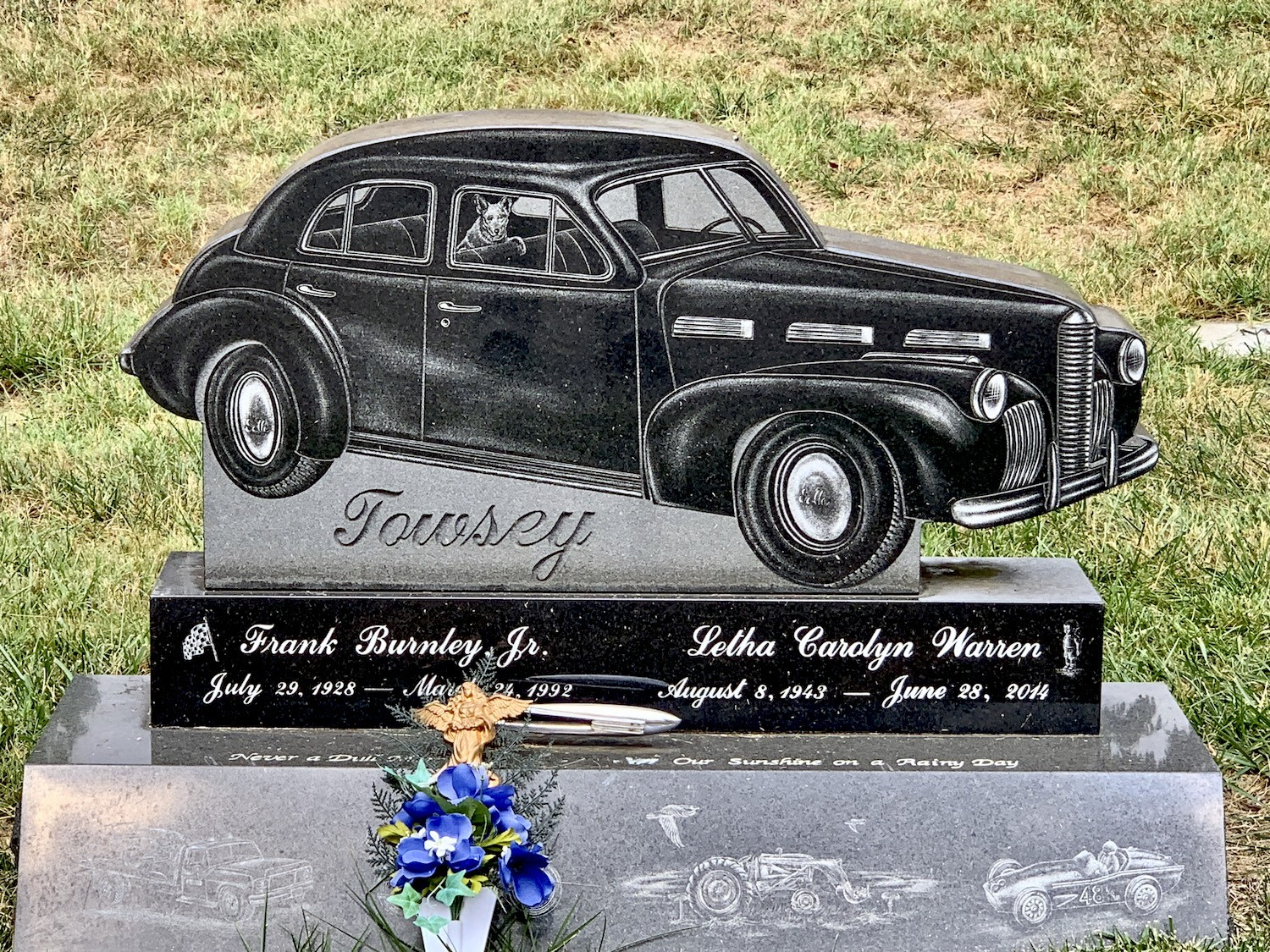
It is hard to choose a favorite out of the multitude of gravehounds on display! However, I would say that for me, the most interesting dogs are the interactive ones. Put another way, an arf-ul lot of these dogs are, irrespective of their love for their owner or vice-versa, reduced to bit-player decorations. The best I think I’ve seen, though, is the anonymous pooch accompanying the sculpted girl atop the monument of Elizabeth Kennedy in Green Mount Cemetery in Baltimore, Maryland (figure 1).
Figure 1. Kennedy monument, Green Mount Cemetery, Baltimore, MD. Photo: Syngrammata.
The pose strikes one as derived from the observation of real dogs.
But I could be wrong. For a strong claim could be advanced for the Towsey monument. Towsey (the dog, I take it, figure 2), “our sunshine on a rainy day,” interacts with us, the viewers, waiting for us to get in the car and chauffeur him around.
Gravely Speaking and Syngrammata have decided to dig deep into our photo collections in order to bring you pairs of images drawn from our many years combing through American cemeteries. Each pair will be linked by a theme which we are free to interpret. Suggestions of future themes to follow are welcome in the comments! This week’s theme is all about Cats.
Gravelyspeaking writes:
Her Cat, Her Only Friend
There has always been a debate between dog and cat lovers about which furry little friend makes the best companion. I have many friends who have cats galore and swear by them, while others like myself, have dogs and always have. We see dogs as the old bromide tells us, “as man’s best friend”. And it is true—you walk into the room and your dog’s eyes light up, tail wags. Walk out and back again, and he is just as happy, almost like he hadn’t seen you in hours! You just don’t get that reaction from a cat.
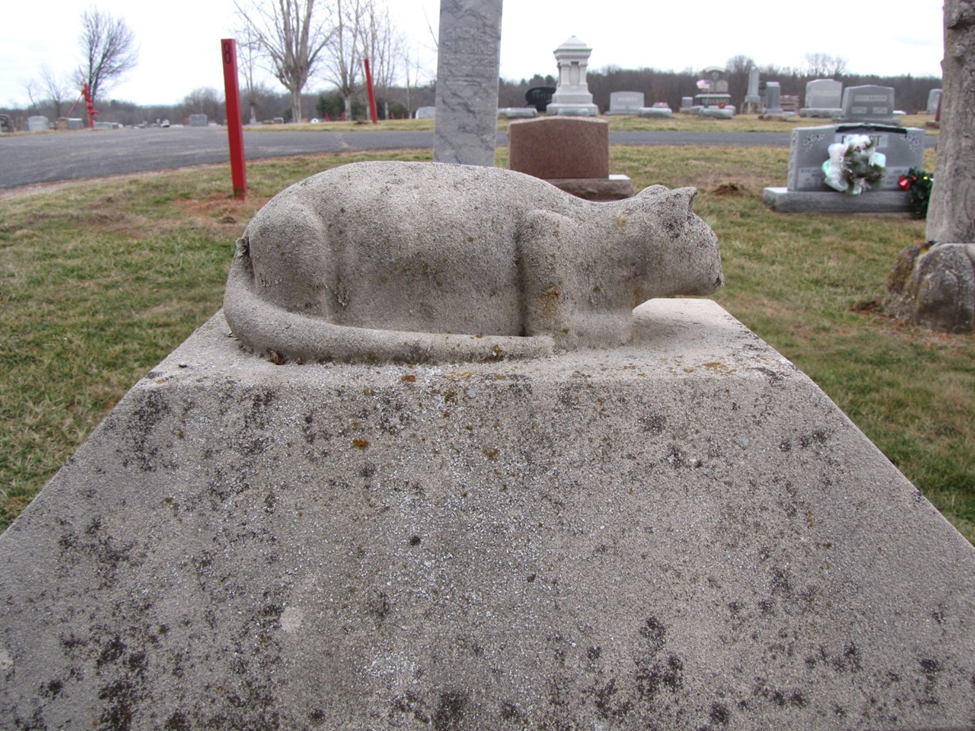
Whether dog and cat lovers can agree or not, graveyard aficionados can attest that many more dogs can be found on gravestones than cats. In fact, in my experience, I have seen very few cats adorning tombstones—so when I saw a gray marble cat perched atop the gravestone of Pollie Barnett in the Fairview Cemetery in Linton, Indiana, I was drawn to it. Then I was pulled in further by the following epitaph:
HERE POLLIE BARNETT IS AT REST,
FROM DEEPEST GRIEF AND TOILSOME QUEST,
HER CAT, HER ONLY FRIEND,
REMAINED WITH HER UNTIL LIFE’S END.
Surely, there was a mystery surrounding this gravestone. According to the area legend, Pollie (born September 23, 1836 – died February 27, 1900) had two daughters, one spirited girl named Sylvania. Her other daughter’s name has been lost to history, most likely because she wasn’t the focus of the sad tale. The book, Weird Indiana: Your Travel Guide to Indiana’s Local Legend’s and Best Kept Secrets, says that Sylvania disappeared without a trace. There were several reasons that could have explained the disappearance—she never came home from a quilting bee, she didn’t return to the house from gathering fire wood, or that she ran off with a local boy.
Whatever happened, Pollie never recovered from the loss. She became despondent and made it her life’s mission to search for her absent daughter. For the rest of her life, Pollie traveled the roads in and around Linton, calling for her daughter. According to the book, Pollie kept the search wandering hither and yon for the next 32 years—never giving up her desperate search for Sylvania. Area storytellers recalled Pollie tired and bedraggled carrying her black cat with her wherever she went—often only stopping to sleep in a road ditch or a kind farmer’s barn.
Linton townspeople commissioned a tombstone tribute to Pollie and her best friend—a black cat, which rests with a watchful eye, on top of her gravestone forever looking after Pollie.
Syngrammata Writes:
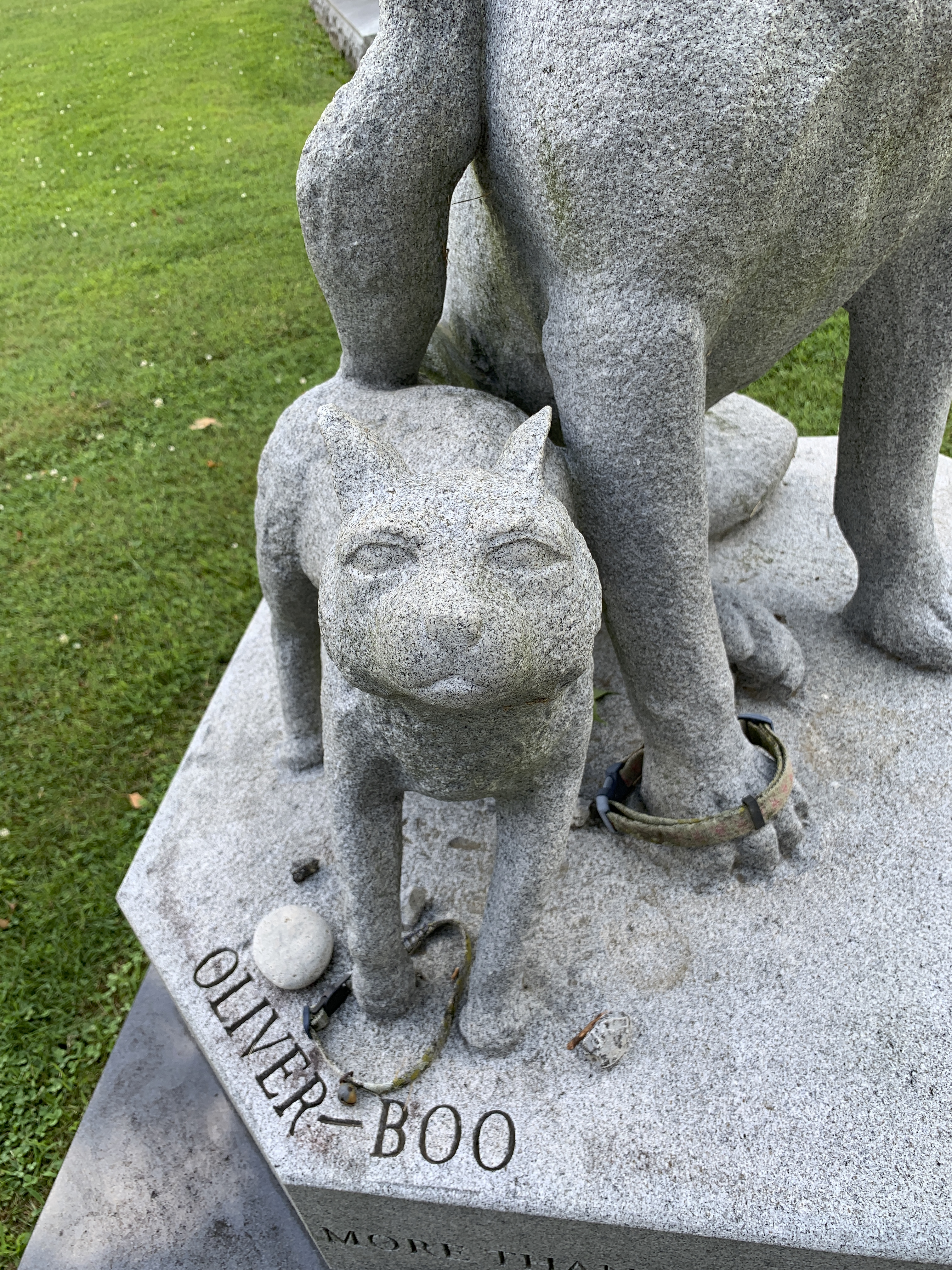
In West Laurel Hill Cemetery in Bala Cynwyd, a suburb of Philadelphia, stands the monument of Lee A. Holloway. Above the inscriptions, “More than just friends,” and “They asked for so little but gave so much,” stand the sculpted granite figures of a cat and a dog.
Figure 1. Holloway monument. West Laurel Hill Cemetery, Bala Cynwyd, PA. Photo: author.
Both figures are stylized but imbued with personality. The cat is labeled with the name “Oliver-Boo,” and (like the dog, “Archie”) looks up at the cemetery visitor with a glance they might have shown in life. Oliver-Boo affectionately rubs against Archie, and both have had small offerings laid at their feet.
Figure 2. Holloway monument. Detail of Oliver-Boo. West Laurel Hill Cemetery, Bala Cynwyd, PA. Photo: author.
This highly detailed stained-glass window in a mausoleum in the Forest Home Cemetery in Forest Park, Illinois, most likely refers to several Bible verses. In this window, Jesus holds a lamb—a symbol of innocence and purity. It also refers to the Biblical verse John 1:29: “The next day John seeth Jesus coming unto him, and saith, Behold the Lamb of God, which taketh away the sin of the world.” A reminder to the faithful that Jesus died as redemption for the sins of the world.
Jesus stands next to a small girl who is offering up flowers. Several Bible verses offer a similar rebuke from Jesus to the disciples who were trying to keep children from coming to Him, Luke 18:16 and 18:17: “But Jesus called them unto him, and said, Suffer little children to come unto me, and forbid them not: for of such is the kingdom of God. Verily I say unto you, Whosoever shall not receive the kingdom of God as a little child shall in no wise enter therein.” Similar passages can be found in Matthew 19:14 and Mark 10:14.
Notice, too, at the base of the window the flowers framing the scene—on one side a white Easter lily, a symbol of purity because of its white color as well as a symbol of the resurrection. On the other side is the poinsettia—its red color representing the blood of Christ.
Buried Forest Home Cemetery, Forest Park, Illinois*
*Her gravestone inaccurately lists her day of birth as June 29 and inaccurately lists her date of death as May 14, 1939.
Emma Goldman was a tireless champion for free speech, women’s equality, and the rights of workers to unionize. She founded the Mother Earth magazine where she advocated for those and other causes. During World War I Goldman railed against the draft which led to her arrest and a two-year prison sentence. After she served her sentence, she was deported and lived the rest of her life in Toronto, Canada.
The event that stirred her, seemingly more than any other, was the Haymarket affair of 1886. During a union strike at the McCormick Harvesting Machine Company in Chicago, a crowd had gathered with workers and police clashing when a bomb was thrown—officers and workers were killed in the incident. A funerary monument to commemorate the incident was commissioned and unveiled in 1893. Goldman’s wish was to buried next to that monument in the Forest Home Cemetery.
Goldman’s monument is a tall ornamented unpolished gray granite gravestone with a bronze bas-relief of her portrait by American-born sculptor Jo Davidson (March 30, 1883 – January 2, 1952). Her monument reads: “Liberty will not descend to a people, a people must raise themselves to liberty“.
The Mentzer Family gravestone, in the Forest Home Cemetery also known as Waldheim Cemetery in Forest Park, Illinois, is a square column with a number of symbols carved into the polished red granite—oak leaves and acorns, palms leaves, and topped with a fully sculptured owl resting on a torch and sword.
The acorn, seed of the mighty oak, is a symbol of prosperity and fruitfulness. When the acorn is paired with oak leaves it is seen as a traditional symbol of strength. The single acorn can represent a kernel of truth born into spiritual growth. Two acorns can represent truth and power of the Holy Spirit. The former is revealed in the Earthly realm and the later after entering the Heavenly realm.
The palm frond is an ancient symbol of victory, dating back to Roman times when victors were presented with palm fronds. The palm fronds were also laid in the path of Jesus as He entered Jerusalem. So, for many Christians, the palm represents righteousness, resurrection, and martyrdom, symbolizing the spiritual victory over death associated with the Easter story.
The owl is often seen as wise, possibly because of its impressive bright and alert eyes, and is sometimes depicted costumed with a mortar board complete with a tassel. Since ancient Greece, the owl was associated with Athena—the Greek Goddess of wisdom. In funerary symbolism the owl also represents wisdom and watchfulness. As a nocturnal bird, the owl is master of the night, and Christians regard it as a reminder that Christ has the ability to guide the soul through the darkest of times.
Here the owl is depicted with a torch seen as an instrument that illuminates the darkness representing enlightenment. It can symbolize zeal, liberty, and immortality. Crossed with the torch is a sheathed sword. Typically, the sheathed sword would represent temperance and restraint. The owl sits with its watchful eyes looking straight ahead. Carved into the block below the owl is the German word “FREI” translated into English meaning “FREE.”
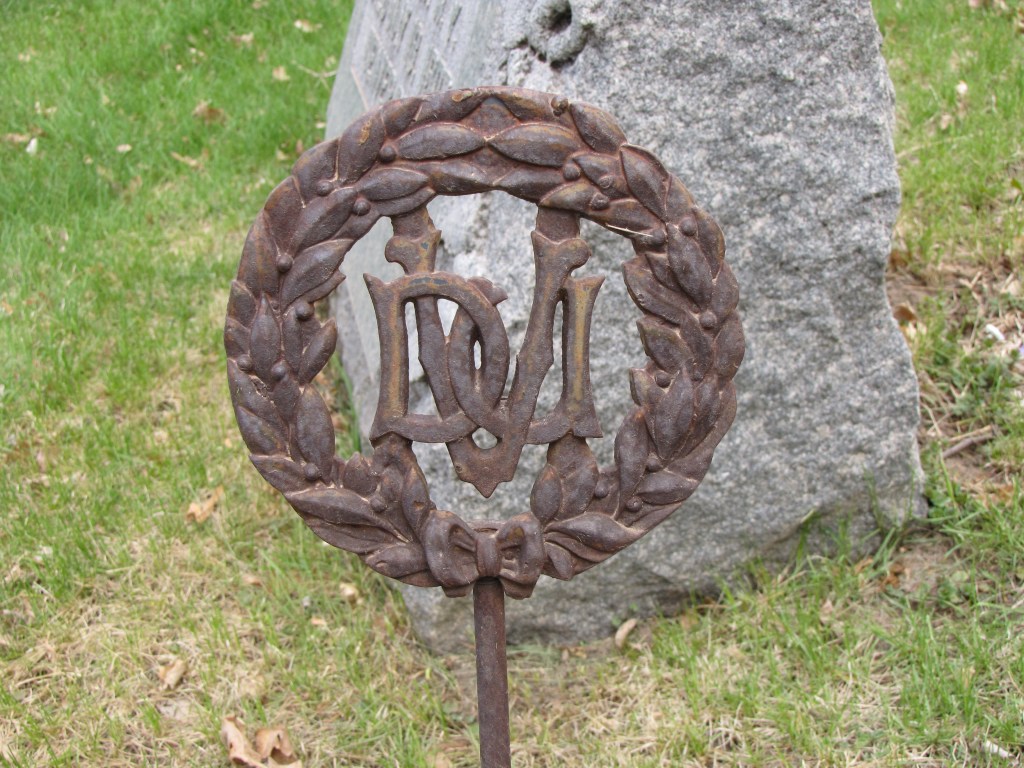
The rusted metal marker in the Woodland Cemetery in Jackson, Michigan, seen next to a gravestone denotes that the deceased was a member of the fraternal organization of Independent Order of Odd Fellows, Lodge 29.
Many fraternal organizations and membership societies were founded in the mid and later part of the 19th Century. Some of the organizations, such as, the Sons of the American Revolution (1889), The Daughters of the American Revolution (1890), The Daughters of the War of 1812 (1892), The Order of the Founders and Patriots of America (1896), The National Society, Colonial Daughters of the Seventeenth Century (1896), The Mayflower Society (1897), and The National Society of the Colonial Dames of America XVII (1915) required the prospective members to demonstrate their ancestors had been in the United States before a certain date or that their ancestors had served in an American war. Other fraternal organizations arose as well, such as the Knights of Pythias (1864), the Patrons of Husbandry (the Grange, 1867), The Benevolent and Protective Order of Elks (1868), The Knights of Columbus (1882), The Loyal Order of the Moose (1888), and the Woodmen of the World (1890). The time between about 1860 and 1915 is often referred to as The Golden Age of Fraternalism.
Two organizations pre-date that time in origin—The Freemasons and the Independent Order of the Odd Fellows. Both saw surges of membership during that period. The Odd Fellows is a fraternal organization that formed in England in the 1700s as a service organization. The American association was founded in Baltimore, Maryland, on April 26, 1819. According to the I.O.O.F. Website, “Thomas Wildey and four members of the Order from England instituted Washington Lodge No. 1. This lodge received its charter from Manchester Unity of Odd Fellows in England.” The Odd Fellows membership rose to its peak in 1915 at about 3.5 million members.
This marker has four different symbols contained on it. The main symbol of the Odd Fellows is the three links of chain. Within the three links are three letters, F L T, which signify the organization’s motto: Friendship, Love, and Truth.
This marker also features a shepherd’s crook and battle axe crossed atop a heart. In 2016, the American Folk Art Museum in New York City, exhibited a number of artifacts related to the Independent Order of Odd Fellows titled, Mystery and Benevolence: Masonic and Odd Fellows Folk Art from the Kendra and Allan Daniel Collection. The exhibit was curated by Stacy C. Hollander and displayed two golden shepherd’s crooks. According to the exhibition label, “The crook, as the “staff of the shepherd,” is associated with the Odd Fellows Encampment Degrees. These degrees have rituals that tell stories of a shepherd’s life. The curved head is used to reach after and draw a member back to safety as part of the ritual. The members recognize the crook as a symbol of watchful care, which they are expected to exhibit toward other members, family, friends, and their community.”
The battle axe is about the struggle within and is a call to the members to cut away selfish desires and shun negative influences so they can focus on helping others.
The heart symbol is often depicted inside a hand—here, however, it is shown alone as the main part of the metal marker with the other symbols laced through. The heart represents the values of candor and sincerity and is a call for charity given with an open heart.
Elisabeth L. Roark wrote an article about angels titled, “Embodying Immortality: Angels in America’s Rural Garden Cemeteries, 1850—1900”, pages 56 – 111, 2007 edition of Markers, XXIV, in which she wrote that in the second half of the 19th Century. there was an “invasion” of angels in rural garden cemeteries, which were for the most part Protestant graveyards. Roark explains in the article that Protestants accepted the concept of angels because they not only expressed a message of consolation but were also utilitarian—these angels performed tasks.
According the article, angels come onto the scene in rural garden cemeteries in a big way starting in 1850 and then throughout the rest of the century. Though angels come in many variations and forms, in her study of 14 rural cemeteries from each region of America, Roark found that the majority of angels fall into the following eight categories:
Soul-bearing Angels
Praying Angels
Angels who decorate and watch over the grave
Pointing angels
Recording angels
Trumpet angels
Michael the archangel
Child angels
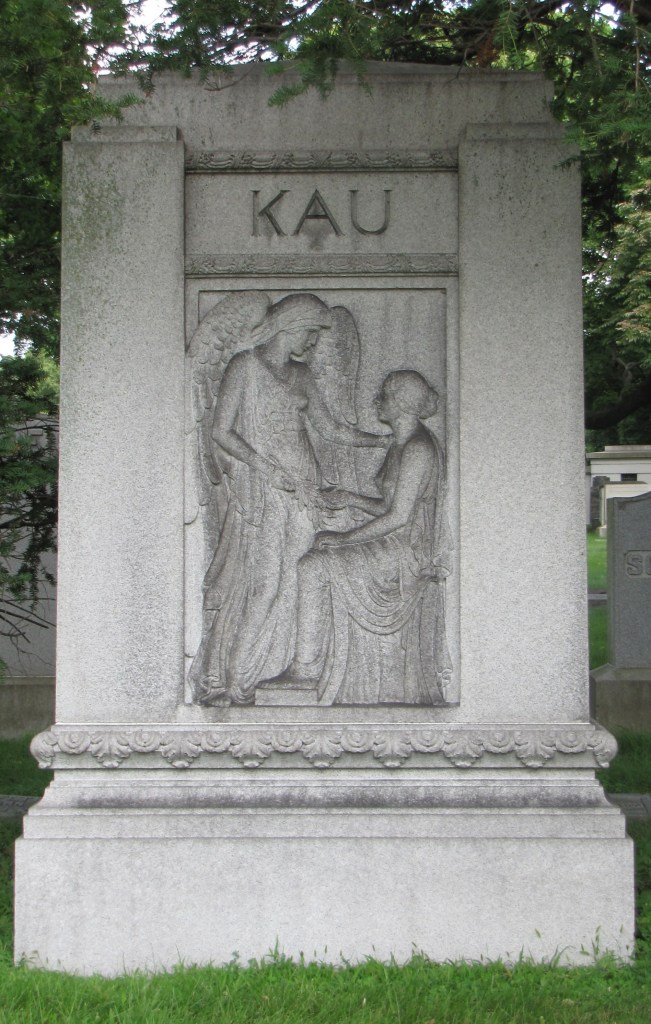
In this example, in the Rose Hill Cemetery in Chicago, Illinois, the Kau monument depicts a classically dressed soul-bearing angel standing in front of a seated woman. The angel, a messenger of God, in a comforting moment touches the woman’s shoulder while offering her an olive sprig. This seems to be the moment just before the angel and the woman ascend to Heaven. Here the olive branch likely symbolizes that the soul of the soon-to-be departed woman will leave in peace with God. The olive sprig can also represent a desire for peace and harmony for the loved ones who are left behind.










 Gravely Speaking