Calla Lily

Tomlinson Cemetery, rural Muncie, Indiana

The calla lily is a stunner with it’s long slender stem, brillant white flowers, and broad leaves.  Though it is called a lily it is actually not in the flower family liliacea.

The South African native is actually a cousin to the jack-in-the pulpit and is in the family of araceae. In Africaans the calla lily is called the Varkoor, or pig’s ear, because that is what they believed it resembled. The calla lily was imported out of South Africa in the later part of the nineteenth and early twentieth century.  It almost immediately became associated with Easter and is sometimes referred to as an Easter lily.

Tomlinson Cemetery, rural Muncie, Indiana

The calla lily represents majestic beauty and is often used on gravestones to symbolize marriage.  In some cases, they can also represent the resurrection.

Posted in Symbolism | Leave a comment

Tree-stump chair

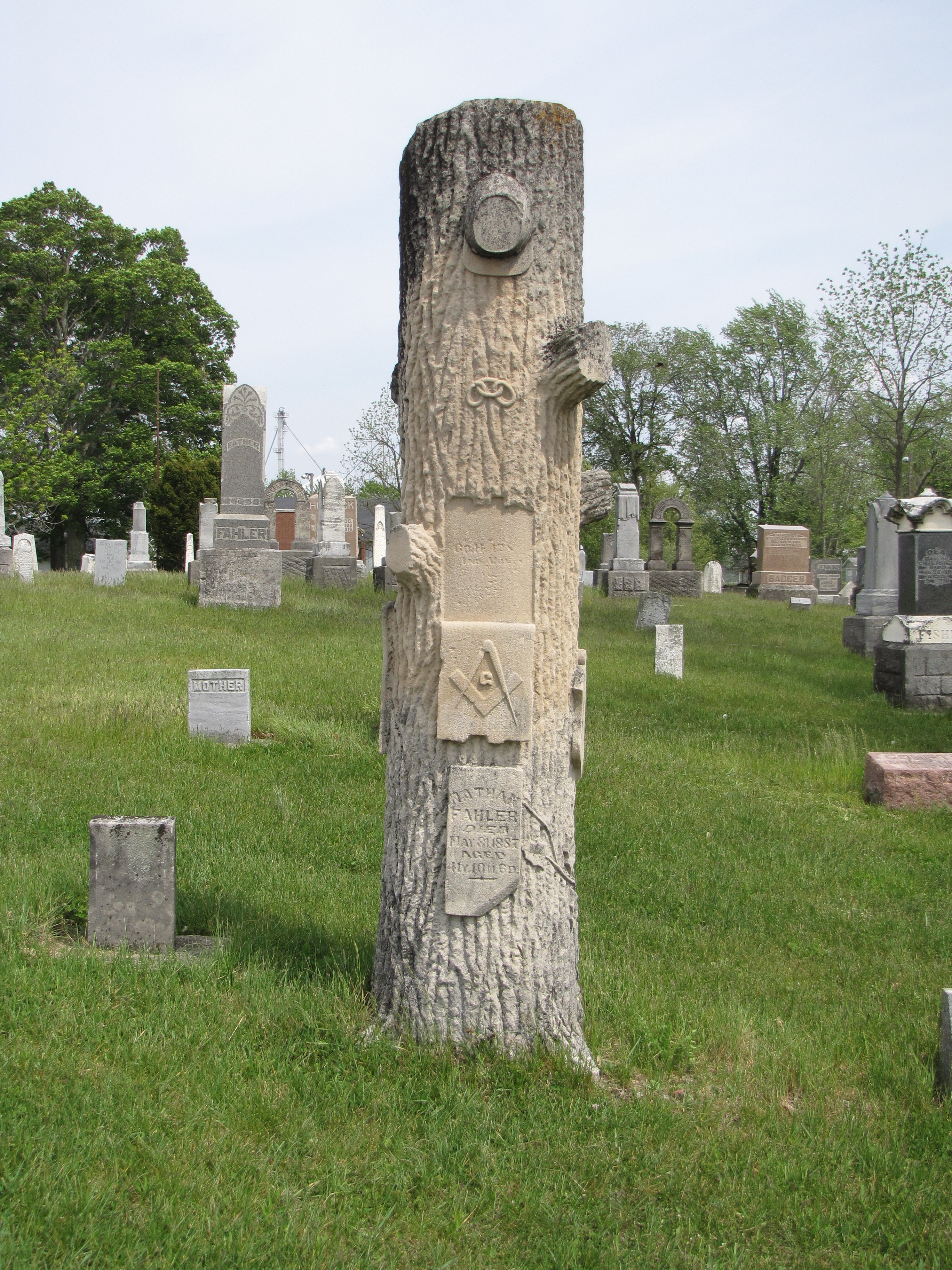
The rustic movement of the mid-nineteenth century was characterized by designs that were made to look like they were from the country. Elegant and slim curved lines in furniture gave way to bulkier and heavier forms made from pieces that came directly from the trees often with the bark still intact. Homes, cabins, and garden houses were designed in the rustic style eschewing classic designs. In decorative furniture this often took the form of chairs made from rough tree limbs curved to form arms and chair backs, chair legs made from tree roots growing upwards. In cabins, railings and the siding were made from unhewn logs with the bark still in place.

In funerary art, tombstones took on the look of tree stumps. The gravestones were purposefully designed to look like trees that had been cut and left in the cemetery to mark a grave. Most of these tree-stump tombstones were carved from limestone, which is easier to carve, though some are made from marble and even a few from granite. Often, the gravestones were carved to look like rustic furniture. Benches and chairs can be found in many cemeteries. The creativity of the carvers were boundless. Thousands of tree-stump tombstones exist in nearly as many designs.

Here the tree-stump tombstone in the Greenbush Cemetery at Lafayette, Indiana, is carved into the form of an empty chair.  The chair back and the arms of the chair are carved to look like the chair is formed out of tree branches with the several logs cut logs on end forming the base of the chair.

In funerary symbolism the vacant chair symbolizes the loss of a loved one.

Posted in Treestump gravestones | 3 Comments

President James Knox Polk’s Last Words

James and Sarah Polk

James Knox Polk was born at Mecklenburg County, North Carolina, on November 2, 1795.  Polk was an accomplished politician representing Tennessee in Congress and serving as Speaker of the House of Representatives (1835–1839).  He was later elected Governor of Tennessee (1839–1841), and eventually elected the 11th President of the United States in 1844, serving from 1845 to 1849.

Polk was a strong president successfully negotiating with Britain for much of the Oregon Country.  He had campaigned on annexing Texas, and when Mexico refused, he led the nation to a swift victory in the Mexican-American War.  Polk also campaigned on serving one term, a promise he kept.  At the end of his term Polk was exhausted.  His time in office had taken its toll on his body.  Polk left office on March 4, 1849, weak and most likely battling cholera, which he was thought to have contracted during a visit to New Orleans, Louisiana.

Polk retired to his newly built Nashville, Tennessee, home dubbed, Polk Place.  Just 103 days after leaving the White House, Polk died at 3:15 pm on June 15, 1849.

Polk’s last words were, “I love you, Sarah. For all eternity, I love you.”  His last thoughts were not about the power he had wielded as president, or the service he had rendered to the nation, but only of his love for his wife.

President Polk’s Tomb, Tennessee Capitol Grounds, Nashville, Tennessee

Polk was buried first at his home, Polk Place.  When his wife Sarah Childress Polk died on August 14, 1891, she was buried next to her husband.  When their home, Polk Place, was demolished their tomb was moved to its present location on the Tennessee Capitol grounds in Nashville, Tennessee.

Other famous last words:

Friends applaud, the Comedy is over.”  Ludwig van Beethoven

Get my Swan costume ready.”  Anna Pavlova

All my possessions for a moment of time.”  Queen Elizabeth I

I’m dying as I have lived, beyond my means.”  Oscar Wilde

Let me go quietly, as I cannot last long.”  George Washington

If this is dying, I don’t think much of it.”  Lytton Strachey

Posted in Presidential graves | 1 Comment

Lotus

Lake View Cemetery, Seattle, Washington

The lotus plays prominently in ancient Egyptian and the Eastern cultures.

According to Egyptian mythology, the lotus flower rises up out of the primordial ooze from which all life was created, opened, and the sun itself arose from the tender pink flower.  The lotus symbolizes creation and rebirth most likely because of its unique ability to bear fruit and flower at the same time.  The lotus also symbolizes the sun because at night the lotus sinks under the water, but rises out of the water in the morning, its flower opening and following the sun during the day, to close again when the sun goes down.

In Eastern cultures, the lotus is revered, as well, as a symbol of purity and spiritual grace.  Buddhists view the stem of the flower as the axis on which the world spins.  Buddha is often pictured seated in the center of the flower.

Posted in Symbolism | 1 Comment

Old Soldiers Never Die

Beech Grove Cemetery, Muncie, Indiana

In an address to Congress on April 19, 1951, General Douglas MacArthur delivered the most rousing speech of his career, and one of the most memorable lines of all times–old soldiers never die; they just fade away–in the last paragraph of his speech:

“I am closing my 52 years of military service. When I joined the Army, even before the turn of the century, it was the fulfillment of all of my boyish hopes and dreams. The world has turned over many times since I took the oath at West Point, and the hopes and dreams have all since vanished, but I still remember the refrain of one of the most popular barracks ballads of that day which proclaimed most proudly that old soldiers never die; they just fade away. And like the old soldier of that ballad, I now close my military career and just fade away, an old soldier who tried to do his duty as God gave him the light to see that duty.”

When I think of that line about the old soldiers, I am reminded of the many gravestones that I have seen where the image of the soldier is showing the signs of weathering and is fading away from the soft white marble markers, like the one in the photograph from the Beech Grove Cemetery in Muncie, Indiana.  The image of the 20-year old Michigan volunteer color bearer, delicately carved into the top quarter of this segmented-top tablet, who was wounded in battle at Spottsylvania, is becoming faint.  The details of his face, uniform, and flag have been lost to the wind and rain.

Beech Grove Cemetery, Muncie, indiana

I am also reminded that on days like Memorial Day, we are asked, and rightly so, to remember the commitment and sacrifice of the soldiers who have fought in all of our wars and have guarded our freedoms.

Posted in Uncategorized | Leave a comment

Memorial Day

Forest Lawn Cemetery, Omaha, Nebraska

Memorial Day was first called Decoration Day and was created out of the desire for Americans to commemorate the sacrifices made during the American Civil War. More Americans were killed in the Civil War than any other war that Americans have fought in.

Total American Deaths by War

Civil War                        625,000

World War II                  405,399

World War I                   116,516

Vietnam                            58,151

Korean War                      36,516

Revolutionary War           25,000

War of 1812                      20,000

Mexican American War    13,283

War on Terror                      6,280

Spanish American War       4,196

During the Civil War Americans were fighting against Americans. Brothers against brothers—cousins against cousins, every casualty and every fatality was an American. The war tore the country apart and threatened the existence of the Republic.  Cemeteries throughout the United States pay tribute to the soldiers that fought to preserve the Union, often with special sections where soldiers are buried.

Forest Lawn Cemetery, Omaha, Nebraska

Posted in Uncategorized | 1 Comment

Draped American Flag

Grove Lawn Cemetery, Pendleton, Indiana

The United States flag is almost exclusively used as a symbol on the gravestones of veterans.  The flag is the symbol of our country and denotes patriotism and love of country.  It is displayed on the graves of veterans because of their devotion and their sacrifice made in the service of our country.

A dramatic example of this can be found in the the Grove Lawn Cemetery in Pendleton, Indiana, on Jonathan W. Zeublin’s (1838- 1919) gravestone.   An immense block of gray granite has been carved to look as if an American flag is draped over the stone.  The flag is so convincingly carved it almost looks as if a big gust of wind could carry it aloft.  The ripples and the draped fabric of the flag is amazingly realistic.  The alternating stripes of our flag are made by highly polishing a stripe and leaving one rough finished to make the contrast between the red and white stripes.  The same technique is used for the stars in the canton, which are polished while what would be the blue background is left matte.

The flag drapes over the face of the stone which displays the G.A.R. (Grand Army of the Republic) medal that veteran soldiers who fought for the North wore to commemorate their service.  Jonathan Zeublin joined Company B, 89th Regiment, Indiana Volunteers as a private on August 8, 1862.  Zeublin had a somewhat meteoric rise in the service.  He was elected a first sergeant and within twenty days of entering the service was commissioned a lieutenant.  One of the campaigns in which Zeublin fought was the Battle of Mumfordsville, Kentucky, which occurred September 14th through the 17th.  The fighting ended in a Confederate victory with over 4,000 casualties and losses for the Union side and a little over 700 on the Confederate side.  In 1863, due to injuries sustained during the course of his short tenure in the Union Army, Zeublin was forced to resign.  He returned to Pendleton, Indiana, to work as a merchant.  He married, had a family and belonged to the Methodist Church and the Odd Fellows Lodge.  But Zeublin chose only to commemorate his service in the Army on his gravestone.

Grove Lawn Cemetery, Pendleton, Indiana

Posted in Symbolism | 1 Comment

Royal Neighbors of America

Chesterton Cemetery, Chesterton, Indiana

“For better is a neighbor that is near than a brother that is far.”

Proverbs 27:10

Marie Kirkland of Council Bluffs, Iowa, placed an add in her local paper, the Council Bluffs Nonpareil, to bring together a meeting of the wives of the Modern Woodmen of America.  The meeting was to be a social activity.  The nine women who came that first night formed a ladies auxiliary to Modern Woodmen Camp 171.

This fledgling social group, however, grew into the Royal Neighbors of America.  Within a year they had written and adopted a constitution, bylaws, and articles of incorporation based on the Biblical passage of Proverbs 27:10, “to bring joy and comfort into many homes that might otherwise today be dark and cheerless. . . by affording the mother an opportunity to provide protection upon her life.”.  They believed that their mission was so noble that they added “royal” to the organization’s name, dubbing it the Royal Neighbors of America. Marie Kirkland, known as the Mother of the Society, became the first Supreme Vice Oracle.  They also adopted six founding principles: Faith, Unselfishness, Courage, Endurance, Modesty, and Morality.

Many organizations at that time offered insurance to their members but excluded insuring women.  The RNA began offering insurance to women in 1895, and to children in 1918, one of the first to do so.  The organization has also helped victims of natural disasters in time of need since the Great San Francisco Earthquake of 1906, and helping victims as recently as the Katrina Hurricane.

Posted in Metal Markers | 1 Comment

Wheat

Grove Lawn Cemetery, Pendleton, Indiana

Wheat’s origins are unknown but is the basis of basic food and a staple in many cultures. Because of wheat’s exalted position as a mainstay foodstuff, it is viewed as a gift from Heaven.

Wheat symbolizes immortality and resurrection.  But, like many symbols found on gravestones, they can have more than one meaning.  For instance, because wheat is the main ingredient of bread, the sheaf of wheat can represent the Body of Christ.  Wheat can also represent a long life, usually more than three score and ten, or seventy years.

Coupled with the epitaph, “Gathered Home,” the wheat, in this case, suggests that the sheafs of wheat are gathered together like Christian souls on their way to Heaven.

Grove Lawn Cemetery, Pendleton, Indiana

Posted in Symbolism | Leave a comment

Like the morning dew

Kingsbury Cemetery, Kingsbury, Indiana

Displayed on the square-top white marble gravestone of 30-year old Arad Davis who died in 1852, is a highly-stylized willow tree, symbolizing sorrow and mourning.  The epitaph on the gravestone, faded and weathered but still legible, speaks to the fleeting nature of life:

How short is life, how sure is death

Our days alas how few,

Our mortal life is but a breath

Tis like the morning dew.

Posted in Epitaphs, Symbolism | Leave a comment