A Potpourri of Symbolism

SOLOMON LEVY

BORN IN SCHWERSENZ NEAR POSEN,

GERMANY

SEPTEMBER 29, 1826,

DIED

SEC. 28, 1898

IN SWEET REMEMBRANCE

OF THE JUST

SHALL LIVE

WHEN INGRATES SLEEP IN DUST

The Solomon Levy monument in the Mount Hope Cemetery in Rochester, New York, is a white marble sarcophagus—and a potpourri of symbolism. The sarcophagus as a gravestone form is an ancient burial monument designed to look like a coffin.  This tomb is embellished with ornamentation and draped with a funeral pall held up with lion’s feet resting on a light gray granite block.  But the “coffin” is empty–just an empty symbol of the receptacle.

The word, sarcophagus, is derived from two ancient Greek words, sarx, which meant flesh and phagein meaning to eat.  The two words together, sarkophagus, mean flesh eating.  The term came from the limestone used by the ancient Greeks to bury the dead which was thought to decompose the flesh of the deceased.

This powerful monument was designed to project strength.  Holding up the tomb are four large meaty lion paws.  The lion has long been a symbol of bravery, strength, and majesty. In popular culture, the lion is known for its power and is called King of the Jungle and King of the Beasts.  The lion is often used as a royal emblem, found eight times in the Royal Arms for the late Queen of England alone!

The lion in funerary art symbolizes the power of God. It is often depicted flanking the entrance of a tomb to guard against evil spirits to the passageway to the next realm. It also represents the courage of the souls the lions guard. There is also a connection of the lion to the Resurrection. It was once believed that lion cubs were born dead but would come to life after three days when the cubs were breathed upon by a male lion. The three days is significant because it is the number of days Jesus was in the tomb before he was Resurrected.

In addition to the other motifs carved into this monument, the sarcophagus also displays a fringed funeral pall in a sign of grief.  The drapery represents a shroud symbolizing death and sorrow. The drapery can also be a motif that represents a veil that separates the Earth and Heaven.  

Emblazoned on the front of the tomb is the most recognizable emblem of the Freemasons, the square and compass, with the letter “G” appears in the middle of the emblem.  Each component of the symbol represents a different Masonic orthodoxy, though, these are not hard and fast: The compasses represent the boundaries of wisdom a person should have the strength to circumscribe and stay within.  The square symbolizes virtue in all actions, just as the expression “square deal” means treating people with fairness.  The letter “G” seems to have more than one meaning.  It could possibly mean God, as in the creator of the universe; or Gimel, which is the word for the third letter of many Semitic languages.  The number three is significant to many Masonic rituals and beliefs.  Some also believe the “G” may represent geometry.

Lastly, in Hebrew, in a half circle at the top of the tomb on the side that gives Levy’s scant biographical information, are the two letters “pey” and “nun” which is translated to “here lies buried”.  Below the Levy’s date of death are inscribed the Hebrew letters “taf”, “nun”, “tzadik”, “bet”, and “hey” meaning “May their soul be bound up in the bonds of eternal life”.

Posted in Uncategorized | 2 Comments

Handfasting

LOVINIA

wife of

G. BOSTATER

DIED

May 5, 1878 (?)

Aged

38Ys 2Ms & –Ds

Weep not for Her who

now at rest in her repose

and care no more annon

Her spirit smiles from

that bright shore

And softly whispers

weep no more.

The titled and eroded white marble gravestone of Lovinia Bostater in the Wyuka Cemetery in Lincoln, Nebraska, displays one of the most common Victorian motifs found in American cemeteries—clasping hands.

The symbol can take on many meanings and sometimes the cuffs on the wrists can give the viewer a clue and can indicate a particular meaning.  If for instance, one cuff has lace and one is a buttoned shirt cuff, it likely represents the matrimonial bond—that link between a married couple.  If the cuffs on both wrists are shirt cuffs, it can symbolize fraternal brotherhood—for members of the same organization or union—a brotherhood. 

Some gravestones depict the hands descending through the clouds—the clouds symbolizing Heaven. This motif likely represents a final farewell or eternal bond between the living and the dead. The handshake may also represent God reaching down for the deceased to bring them into his presence as a welcome to Heaven—the Heavenly handshake.

In this case, the clasping hands most likely represent the marriage bond.  In addition, to the symbolism of the clasping hands, there is a ribbon draped over each wrist.  This may be a depiction of “handfasting”, an ancient Celtic ritual.  In this ritual, the hands are tied together to symbolize the binding together of two lives, as in marriage.

Posted in Uncategorized | 1 Comment

Blessed are the pure in heart

Blessed are the

Pure in heart, for

They shall see God.

                             Matt.

JENNIE L.
1873 – 1927

HANSON

The white marble monument marking the grave of Jennie L. Hanson in the Wyuka Cemetery in Lincoln, Nebraska, depicts an angel leaning against a pilar.  Billowing clouds surround the haloed angel holding a ribbon with the words, “PAX”, Latin for “PEACE.”

When we see a winged figure in a cemetery, we instantly recognize it as an angel–a messenger of God.  However, Christian art did not depict angels with wings until the fourth century.  Before then, angels were represented in several different forms–sometimes in human form, but also represented as a doves, or even just as a hand reaching down to Earth from the Heavens.  Beginning with the reign of Constantine, angels began being depicted with wings, as this angel is portrayed.

Posted in Uncategorized | 1 Comment

Slightly ajar

CORA

WIFE OF JOSEPH F.

LEMBERGER

MAY 1, 1860

SEPT. 17, 1901

The tall gray-marble square column gravestone in the Wyuka Cemetery in Lincoln, Nebraska, pictured above displays an incised carving of gate, a very common symbol found in American cemeteries.  In this example a crown and a cross are carved above the gates.  The gates, which are an important part of the Last Judgment, represent a passageway.  The gates are the portal for saved souls to make their passage from the Earthly realm to Heaven upon Christ’s return.

The crown is a symbol of glory and reward and victory over death.  The reward comes after life and the hard-fought battle on Earth against the wages of sin and the temptations of the flesh.  The reward awaits in Heaven where the victor will receive a crown of victory.  The crown also represents the sovereign authority of the Lord.  The cross, of course, is the universal symbol of Christianity.

ROSA B. MOORE

1876 – 1911

GONE BUT NOT

FORGOTTEN

In the example below, also found at the Wyuka Cemetery, the symbol of the gates is not carved on the gravestone, but the gates ARE the gravestone.  And, in this case the gates are not closed but slightly ajar.  The cemetery booklet* suggests the gates just might be ajar “for easy passage by Rosa Moore to her eternal reward.”

*Wyuka Cemetery: A driving & Walking Tour, page 78, written by Ed Zimmer, published in 2009 by the Wyuka Historical Foundation  

Posted in Uncategorized | 2 Comments

Two Poignant Stories in Zinc

JOSEPH OADES

OF ENGLAND

DIED DEC. 10, 1885 AGED 57 YRS.

— —

IN MEMORY OF MARY ELIZA OADES

THE BELOVED WIFE OF JOSEPH OADES

DIED MAR. 26, 1871 AGED 29 YEARS

The Oades grave markers in the Wyuka Cemetery in Lincoln, Nebraska, were produced by the Western White Bronze Company of Des Moines, Iowa, a subsidiary of the Monumental Bronze Company of Bridgeport, Connecticut. 

Though the company billed the markers as “white bronze” they were cast zinc.  The zinc markers are often referred to as “Zincies” by cemetery aficionados.  The markers are distinguishable by their bluish-gray tint. Many of the designs mimicked designs that were commonly found carved from stone. The Oades markers are designed to look like rounded-top tablets. The zinc markers were produced beginning in the 1870s until the company closed shop in 1912.

A scroll on the face of each of the markers contains the name and death dates of the Joseph and Mary Eliza Oades. The scroll represents both the life of the deceased, and the time spent on Earth.

Above the scroll is a dove.  Several references in the Bible refer to the dove as a symbol of the Holy Spirit including Mark 1:10 the Bible says, “And Straightway coming up out of the water, he saw the heavens opened, and the Spirit like a dove descending upon him.” Again in John 1:32, the Bible reads, “And John bare record, saying, I saw the Spirit descending from heaven like a dove, and it abode upon him.”  Along with the dove symbolizing the Holy Spirit, the dove is also closely associated with peace, often depicted with a olive in its beak. This, too, originated in the Bible. After the waters receded in the story of Noah, the dove appears. Genesis 8:11, “And the dove came in to him in the evening; and, lo, in her mouth was an olive leaf pluckt off; so Noah knew that the waters were abated from off the earth.”   It was a sign of God’s forgiveness. Thus the dove symbolizes the Holy Spirit, peace, and purity. 

The back of the markers features a woman’s hand holding a lily of the valley sprig. The lily of the valley is much like other lilies in funerary art and viewed as a symbol of innocence and purity.  

According to the booklet, Wyuka Cemetery: A driving & Walking Tour, page 70, written by Ed Zimmer, published in 2009 by the Wyuka Historical Foundation, “The Oades were born in England and immigrated to Lancaster County through Canada.  Mary Eliza was only 29 years old when she died in 1871, just two years after the founding of Wyuka.  Mr. Oades was suffering from “St. Vitus’s dance” a neurological disease that causes uncontrollable movements, when he took his own life at age 57 in 1885.”

Posted in Uncategorized | Leave a comment

And now…

The Forest Home Cemetery in Forest Park, Illinois, is divided into two sections by the Des Plaines River.  Emma Goldman’s gravestone, the Druid Monument, the Haymarket Martyr’s Monument among others are in the main section of the cemetery.  The smaller section of the cemetery just across the Des Plaines River has fewer gravestones and mausoleums.  But one unmarked and plain mausoleum holds within its walls a famous broadcaster and his wife, “Angel”.

He got his start in life in Tulsa, Oklahoma—the son of a police officer who was killed in a robbery gone wrong. As a young boy, he was fascinated with radios and in his spare time made radio receivers.  As is often the case, a big influence on his life was a teacher who remarked that he had a certain timbre in his voice that would be terrific for radio. 

Radio at the time was a medium that had taken off and most families listened to the radio for their news and entertainment.  So, in 1933, the teenaged boy got a job cleaning the local radio station in Tulsa.  It turned out to be his big break in radio as he was eventually given the chance to read commercials and news on KVOO Radio.  While attending the University of Tulsa, he continued to work as an announcer at the station and was promoted to program director, which led to other positions in other markets—Oklahoma City, Salina, Kansas, and St. Louis, Missouri.  It was in St. Louis in 1940, while working for KXOK Radio that he met and married Lynne Cooper—“Angel”—a school teacher who later became his producer and partner in the radio business.

During World War II, he continued his radio career after a brief stint in the armed forces.  In 1951, he began airing segments for which he became famous.  Eventually these segments became syndicated, and his program reached a staggering 24 million people a week and was broadcast on 1,200 radio stations.

His unique way of describing a story and his staccato-style delivery gained him fame and multitudes of recognition and many industry awards including induction into the National Association of Broadcasters National Radio Hall of Fame, induction into The Oklahoma Hall of Fame, and the prestigious Paul White Award of the Radio and Television Digital News Association. He even received America’s highest civilian award—the Presidential Medal of Freedom.

The son of Harry Harrison Aurandt and Anna Dagmar Christensen Aurandt, became nationally known for his radio program which aired from 1951 until 2008, his unique delivery, his staccato-style, and such catch phrases as “Hello Americans, this is Paul Harvey, stand by for news!”  That famous broadcaster in the unmarked mausoleum is none other than Paul Harvey—“Now you know the rest of the story!”

Paul Harvey Aurandt

September 4, 1918 – February 28, 2009

Lynne “Angel” Harvey

October 4, 1913 – May 3, 2008

Posted in Uncategorized | 3 Comments

The Veil

David E. Thompson

February 28, 1854

August 25, 1942

Jeanette M. Thompson

October 16, 1867

July 21, 1911

The Thompson monument in the Wyuka Cemetery in Lincoln, Nebraska, was commissioned by D. E. Thompson upon the death of his wife Jeanette Thompson.  The Thompsons were a “power couple” in Lincoln in the 1890s and early 1900s.  D. E. Thompson was a prominent businessman serving as superintendent of the Burlington Railroad west of the Missouri River and as the president of the local gas and insurance companies.  Eventually his business acumen and connections led him into politics.  According to Wyuka Cemetery: A Driving & Walking Tour by Ed Zimmer (2009), Thompson was appointed by President Theodore Roosevelt U. S. envoy to Brazil and later as ambassador to Mexico. 

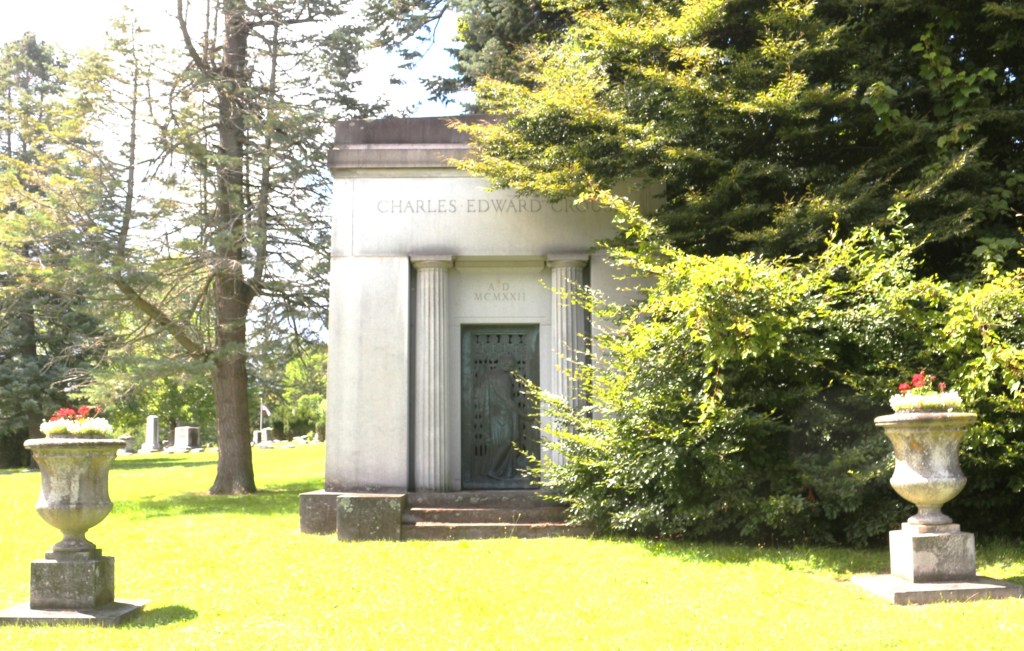
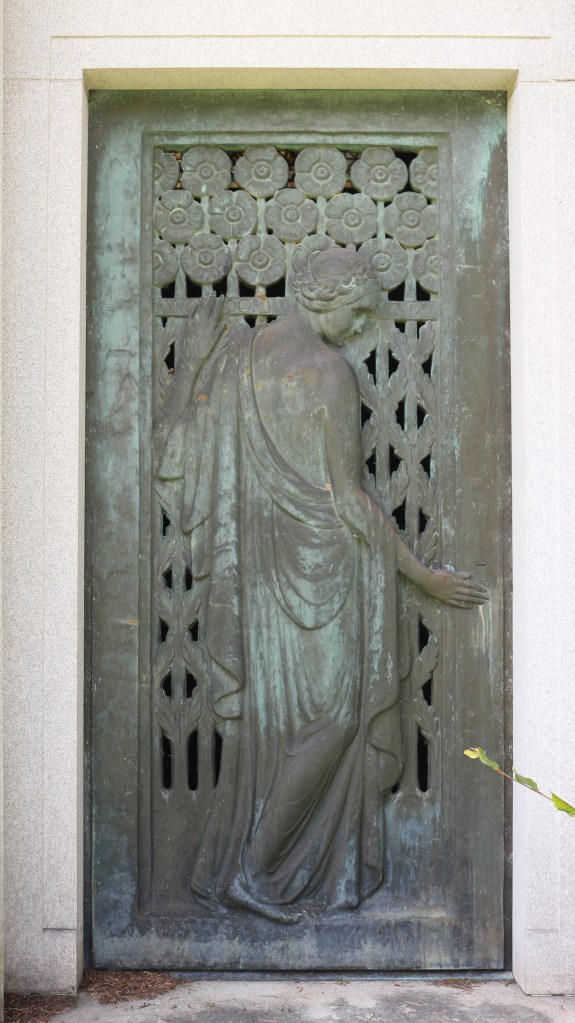
Thompson commissioned Fred L. Kimball, a noted Nebraska artist, to create the Thompson family monument.  The sculpture was cast at the Jno Walters Foundry in New York.  The monument is comprised of pink granite and has a life-size bronze relief sculpture in the center depicting a mourning figure lifting part of her garment over her head to form a veil.  The veil represents the partition that exists between the Earthly realm and the Heavenly one–between life and death.  In her other hand she is clutching a floral wreath. This is a common Victorian funerary symbol expressing the transitory nature of life.  D. E. Thompson died in 1942 in Southern California.  His remains were cremated and interred at the family plot.

The Thompson Monument is similar to a monument created for James Melvin who commissioned Daniel Chester French to design a memorial to his three fallen brothers. The monument is in the Sleepy Hollow Cemetery in Concord, Massachusetts.  Daniel Chester French was arguably the most noted sculptor of his day, creating such monumental works as Minute Man at Concord, Massachusetts, the Marshall Field Memorial in Graceland Cemetery at Chicago, and his most famous work—the Seated Lincoln in the Lincoln Memorial at Washington, D.C.

When James Melvin came back from the Civil War after serving in the 6th Massachusetts Infantry, he was not joined by his brothers, Asa, John, and Samuel. They had all served in the 1st Massachusetts Heavy Artillery unit which took heavy losses throughout the war. John was the first to perish—he, at a military hospital in Fort Albany, Virginia. Asa died on the battlefield during an assault on Petersburg, and Samuel, who had been captured, died at the infamous and reviled Andersonville prison.

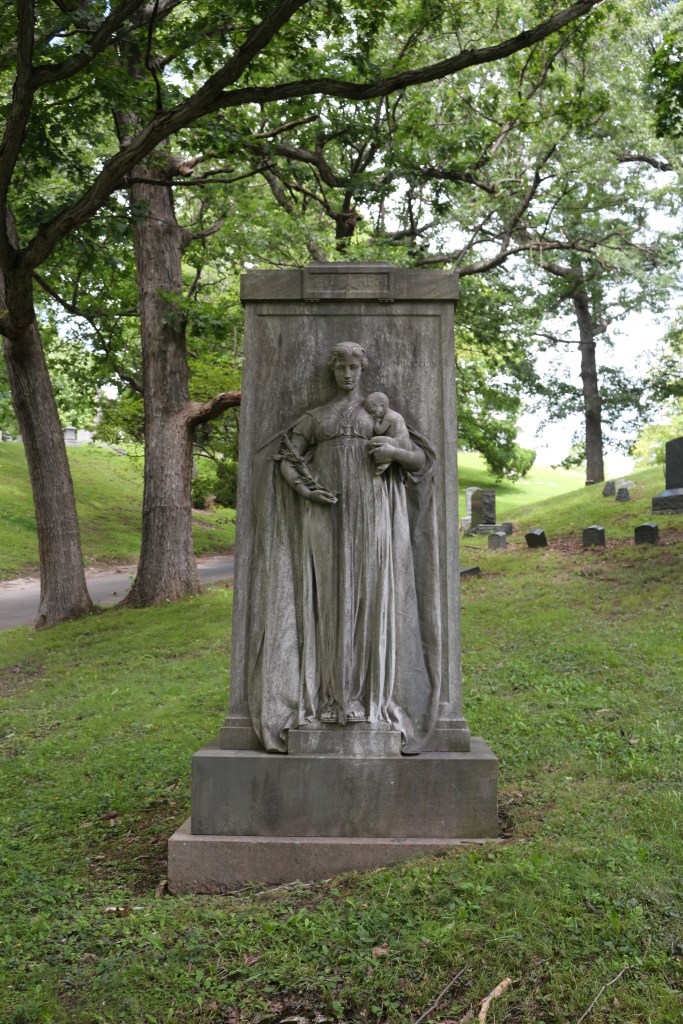
French created the sculpture he titled, Mourning Victory, which features a woman as the allegorical figure of victory. Here again the mourning figure is lifting part of her garment over her head to form a veil. However, in French’s sculpture the mourning figure is holding a sprig of laurel in her other hand. The laurel wreath dates back to Roman times when soldiers wore them as triumphal signs of glory.  The laurel was also believed to wash away the soldier’s guilt from injuring or killing any of his opponents.  In funerary art the laurel wreath is often seen as a symbol of victory over death.

The Metropolitan Museum of Art in New York City, which has a replica of the statue in marble in their collection, describes the statue, “The massive figure of Mourning victory emerges from the block of stone projecting two moods: melancholy, in her downcast eyes and somber expression, and triumph, in the American flag and laurel she holds high. French captured the sense of calm after the storm of battle, which must have referred to the pride, after the sorrow of grieving, felt by the surviving brother.”

The similarities of the two monuments display common Victorian symbolism captured by each artist.

Posted in Uncategorized | 3 Comments

Acroterion

OLOF W. PALM

NOVEMBER 8, 1863

OCTOBER 28, 1939

CLARA LOUISA PALM

MARCH 29, 1861

SEPTEMBER 21, 1931

In 1928, the Georgia Marble Company of Tate, Georgia, produced a marketing piece in the form of a book titled, Memorials: To-Day for To-Morrow written by William Henry Deacy. The book was designed to showcase their memorial designs by highlighting them in the book with lush full-color watercolor illustrations of the various memorials. Along with the illustrations the book provided explanations of the symbolism found in the memorials. The book also coupled an architectural drawing of how the memorial is to be made.

The stele, a stone or wooden slab generally taller than it is wide and designed as a funeral commemorative, dates back many centuries and is one of the oldest gravestone forms.  Many examples of steles can be found in the National Archaeological Museum of Athens, Greece.

This example of a stele below was created for Daisios, son of Euthias on the east coast of Attica in Southern Greece.  The stele dates to the middle of the 4th Century B.C. and has two rosettes on the shaft and is topped with an acroterion motif.

The example, however, found in the Wyuka Cemetery in Lincoln, Nebraska, marking the graves of Olof and Clara Palm varies.  Though it has notable features of a traditional stele gravestone—the marker is taller than it is wide and the acroterion motif tops the marker—it is markedly different.  Traditionally the face of the stone would be bare except for two rosettes.  In this case, the Palms commissioned the Kimball Brothers to create the morning figure of a woman holding a rose, the symbol of romantic love.  The figure was carved by noted Nebraska sculptor Fred L. Kimball.

The stele was an interesting choice for the Palms as the acroterion is a classical motif found in Roman and Greek architecture and has its origins in Egyptian art and architecture.  The acroterion is a stylized palm leaf.  Coincidence?

Posted in Uncategorized | 7 Comments

Tribute to a Generous Spirit

TO THE GREAT GLORY OF GOD

AND IN LOVING MEMORY OF A

TRUE DAUGHTER OF THE OLD NORTH STATE

QUIDA ESTELLE EMERY HOOD

BORN RALEIGH, N. C. SEPT. 19TH 1883

DIED MONROE, MICH. FEB. 27TH 1930.

A magnificent and wonderful woman of noble deeds

and high attainment, a devoted Christian, trusting

in God’s goodness and mercy, whose life was

dedicated to untiring service to humanity.

Her memory will endure as a priceless heritage.

Patient, cheerful and unselfish.  A faithful true

and admirable friend a loving companion.  A lover

of her country, courageous and unafraid; through

her did all my achievements some, to God owe all.

Placing my trust in God I wait, setting my face

to the dawn of that new day when the shadows

will lift and we shall be again united.

FRANKLIN S. PRIKRYL

Ouida Estelle Emery Hood’s grave marker is one of the most elaborate in the Oakwood Cemetery in Raliegh, North Carolina. Hood who was born in Raliegh, North Carolina made her home in Frenchtown, Michigan, where she became active in the Frenchtown community—the Frenchtown Grange #749, the Frenchtown Juvenile Grange #85, the Boys and Girls 4-H Clubs, and the Ladies Economic Club.  Though she and Wallace had no children of their own, Ouida hosted annual Christmas and Easter parties for the Frenchtown area.  Her Easter festivities included hiding up to 1,000 colored Easter eggs for the children to hunt—and each child went home with their own chocolate egg.  Her gardens were acclaimed and she was a beloved member of the community.

Hood was married to Wallace C. Hood an automobile designer.  The couple rented a room to Franklin Stanley Prikryl, a real estate developer.  One day Wallace left and never returned—a mystery that was never solved.

The monument that marks Hood’s grave was commissioned by Franklin Prikryl and manufactured in Germany for the princely sum of $40,000, which in today’s dollars would be over $640,000.  In addition to that, Prikryl had 50 wooden barrels of soil from Ouida’s flower gardens from Monroe County, Michigan, to cover the ground above Ouida’s casket.  Prikryl purchased a grave plot for himself next to Ouida and had his name carved on the monument but inextricably was buried in the Forest Lawn Cemetery in Glendale, California.

Posted in Uncategorized | 4 Comments

A True Fan

LESTER C. MADDEN

SEPT. 24, 1931—June 7, 1983

Yesterday, June 20th, was the 49th anniversary of the release of Steven Spielberg’s blockbuster movie Jaws.  That movie, based on the Peter Benchley novel of the same name, spawned three sequels and so many knock-offs that there is an entire week devoted to shark movies for fans’ viewing pleasure.  Movies that include the original movie and sequels as well as Sharknado, Shark Night, Raiders of the Lost Shark, and Two-Headed Shark Attack, among many others.

Jaws also spawned a huge fan—Lester C. Madden.  In fact, he loved the movie so much that his wish was to have a gravestone that paid tribute to the movie.  His gravestone, in the Allegheny Cemetery in Pittsburgh, Pennsylvania, is a black granite replica of the original shark on the Jaws movie poster—with the shark’s open mouth bearing its deadly teeth.

Now that is a true fan!

Posted in Uncategorized | 7 Comments