The Virtue of Hope

Woodland Cemetery, Des Moines, Iowa

Woodland Cemetery, Des Moines, Iowa

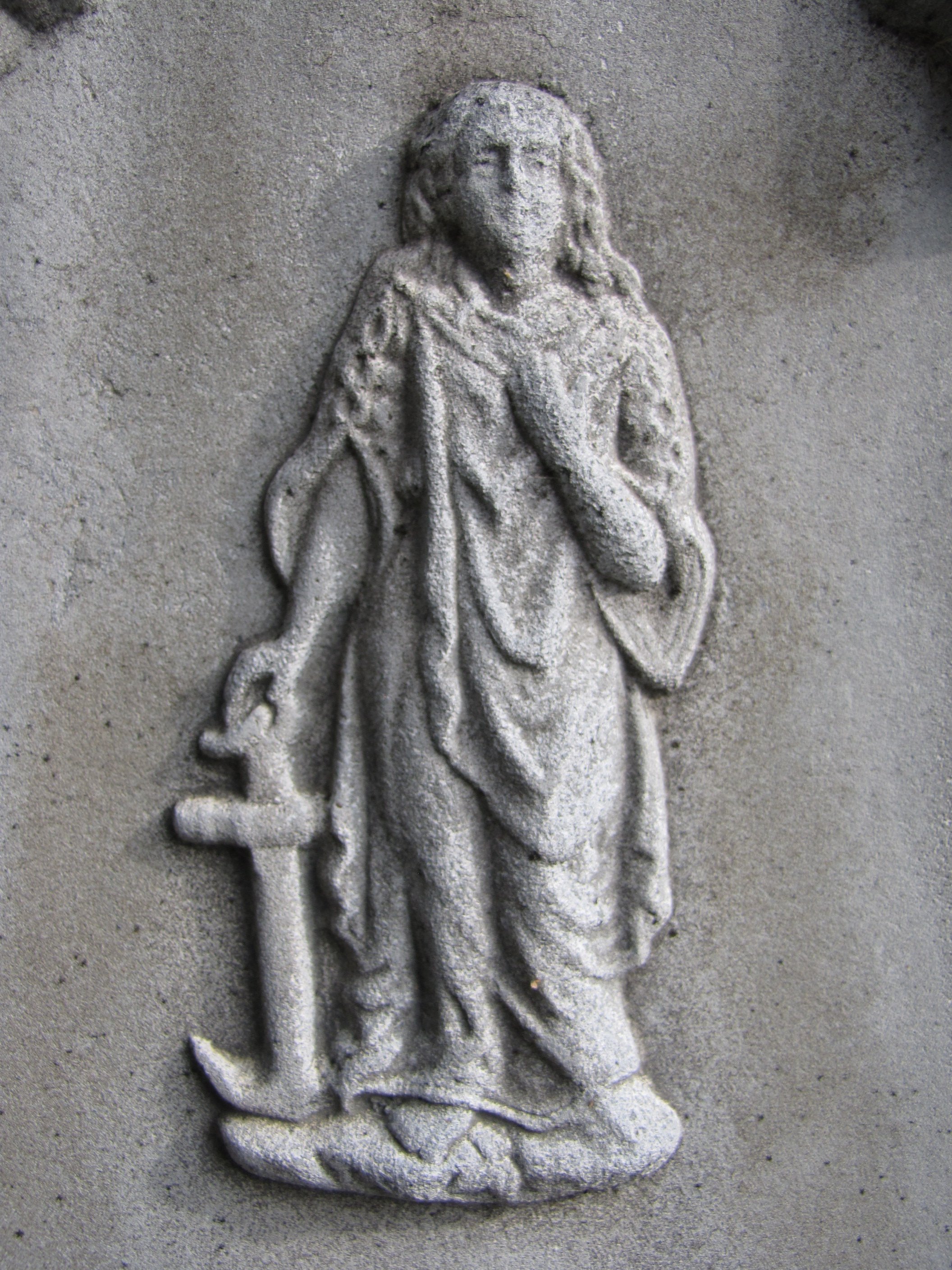
The representation of the Virtue of Hope is a fairly common symbol found in American cemeteries.  It can be found on zinc monuments as a bas-relief and as a full statue carved in marble or granite on stone markers.  Hope is portrayed as a woman leaning against an anchor.  The anchor is an ancient Christian symbol that has been found in early catacomb burials.  The anchor was used by early Christians as a disguised cross.  The anchor also served as a symbol of Christ and his anchoring influence in the lives of Christians.  Just as an anchor does not let a moored boat drift, the anchoring influence of Christ does not allow the Christian life to drift.

Woodland Cemetery, Des Moines, Iowa

Woodland Cemetery, Des Moines, Iowa

Posted in Symbolism, Zinc Markers | 3 Comments

Winged Cherubs

Mt. Auburn Cemetery, Cambridge, Massachusetts

Mt. Auburn Cemetery, Cambridge, Massachusetts

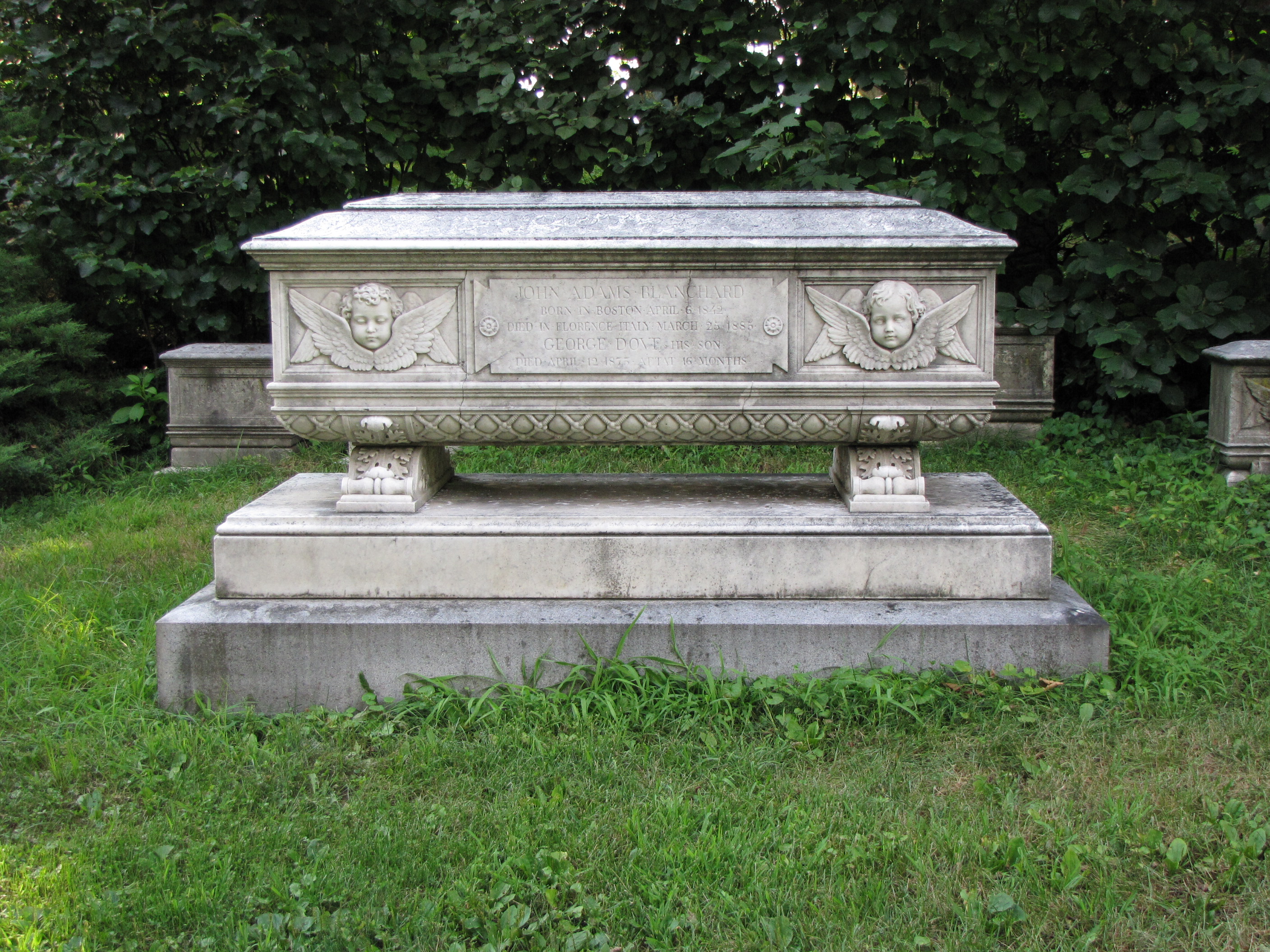
JOHN ADAMS BLANCHARD

BORN IN BOSTON APRIL 6, 1842

DIED IN FLORENCE ITALY MARCH 25, 1885

GEORGE DOYLE, HIS SON

DIED APRIL 12, 1875 [illegible] 16 MONTHS

The white marble sarcophagus tomb in the Mt. Auburn Cemetery at Cambridge, Massachusetts was designed to look like a coffin.  Though this tomb is designed to appear like a coffin it is empty—the deceased is buried beneath the marker.  The word, sarcophagus, is derived from two ancient Greek words, sarx, which meant flesh and phagein meaning to eat.  The two words together, sarkophagus, meant flesh eating.  The term came from the limestone used by the ancient Greeks to bury the dead which was thought to decompose the flesh of the deceased.

IMG_5575

IMG_5576

Four winged cherubs, two on each side, embellish the footed tomb.  The winged cherub was a symbol that became popular in the 18th Century.  Winged cherubs replaced the stark and morbid flying death’s heads from our Puritan forefathers.  The cherubs have a childlike countenance of innocence.  The iconography represents the flight of the soul from the body upward to Heaven and the hope of the resurrection.

Posted in Symbolism | Leave a comment

Grief

IMG_6411

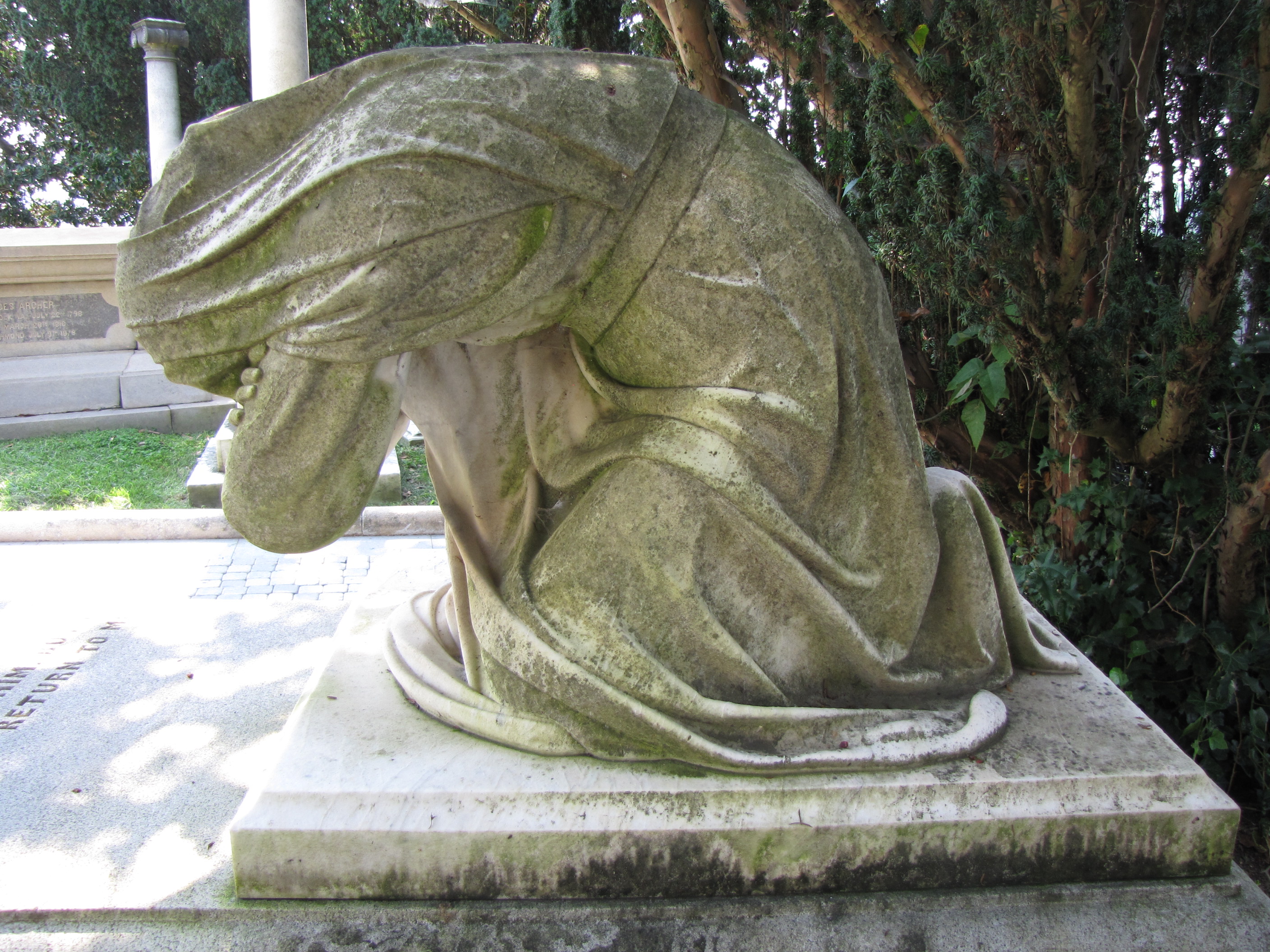
WM. N. WORTHINGTON,

DIED JUNE 30th, 1871

AGED 29

I SHALL GO TO HIM, BUT HE

SHALL NOT RETURN TO ME.


“Grief” is a statue designed by Edward V. Valentine for the William Worthington monument in the Hollywood Cemetery at Richmond, Virginia.  Worthington was only 29 years old when he died. The statue was commissioned by his step father to commemorate his death and his mother’s deep sadness. “It is a story of a woman’s grief—the grief of a mother over the death of her son, symbolized in a kneeling female figure, with arms folded and head bowed in the utter abandonment of self-communion.”*  Even though, the grieving woman’s face is completely shrouded the statue conveys the anguish of the mother through the position of the body.

IMG_6422

*Richmond’s Hollywood Cemetery by John O. Peters, page 80, The Valentine Richmond History Center

Posted in Saving Graces | 7 Comments

An Empty Bassinet

Mt. Auburn Cemetery, Cambridge, Massachusetts

Mt. Auburn Cemetery, Cambridge, Massachusetts

MARY WIGGLESWORTH

BORN JAN. 29, 1883.

DIED DEC. 19, 1884.

The intricately-carved white marble gravestone of Mary Wigglesworth, who died just shy of her first birthday, is an empty bassinet, her inscription on the pillow.  The symbolism is obvious.  The marker is clearly for a child but also represents the emptiness and sadness from the loss.

Posted in Children's Graves | 2 Comments

The hand that belonged to John Hancock

IMG_4982

THIS MEMORIAL ERECTED

A. D. MDCCCXCV  BY THE COM

MONWEALTH OF MASSACHU

SETTS TO MARK THE GRAVE OF

JOHN HANCOCK


An impressive stele in the Granary Burying Ground marks the grave of John Hancock (January 23, 1737-October 8, 1793).  The stele is the tallest tombstone in the cemetery and replaced Hancock’s original gravestone which had deteriorated and disappeared. The stele is topped with the Hancock family crest which includes a pictogram of the family name and the Latin phrase which means “resist the beginnings”.  The memorial also includes a bas-relief portrait of a young and dashing looking John Hancock surrounded in laurel wreath.

IMG_4981

According to legend, the revolutionary patriot John Hancock, the first to sign the Declaration of Independence, signed his name large enough so that ol’ King George III would be able to see it without putting on his spectacles.  That signature is now arguably the most famous in American history.  And, you know you have quite a signature when your name becomes a synonym for signature!

That hand, the one that signed the Declaration of Independence, was later cut off by grave robbers.  When Hancock died he had the largest funeral in Massachusetts history up ’till that point and was buried by his wife in his finest clothes and jewelry.  As the story is told, grave robbers tried to pry the rings from his fingers but struggled.  When they didn’t slip off easily, they cut off his hand apparently to take them off later at a more secluded spot.

Posted in Famous graves | 2 Comments

Mother Goose…Believe it or not?

IMG_6000

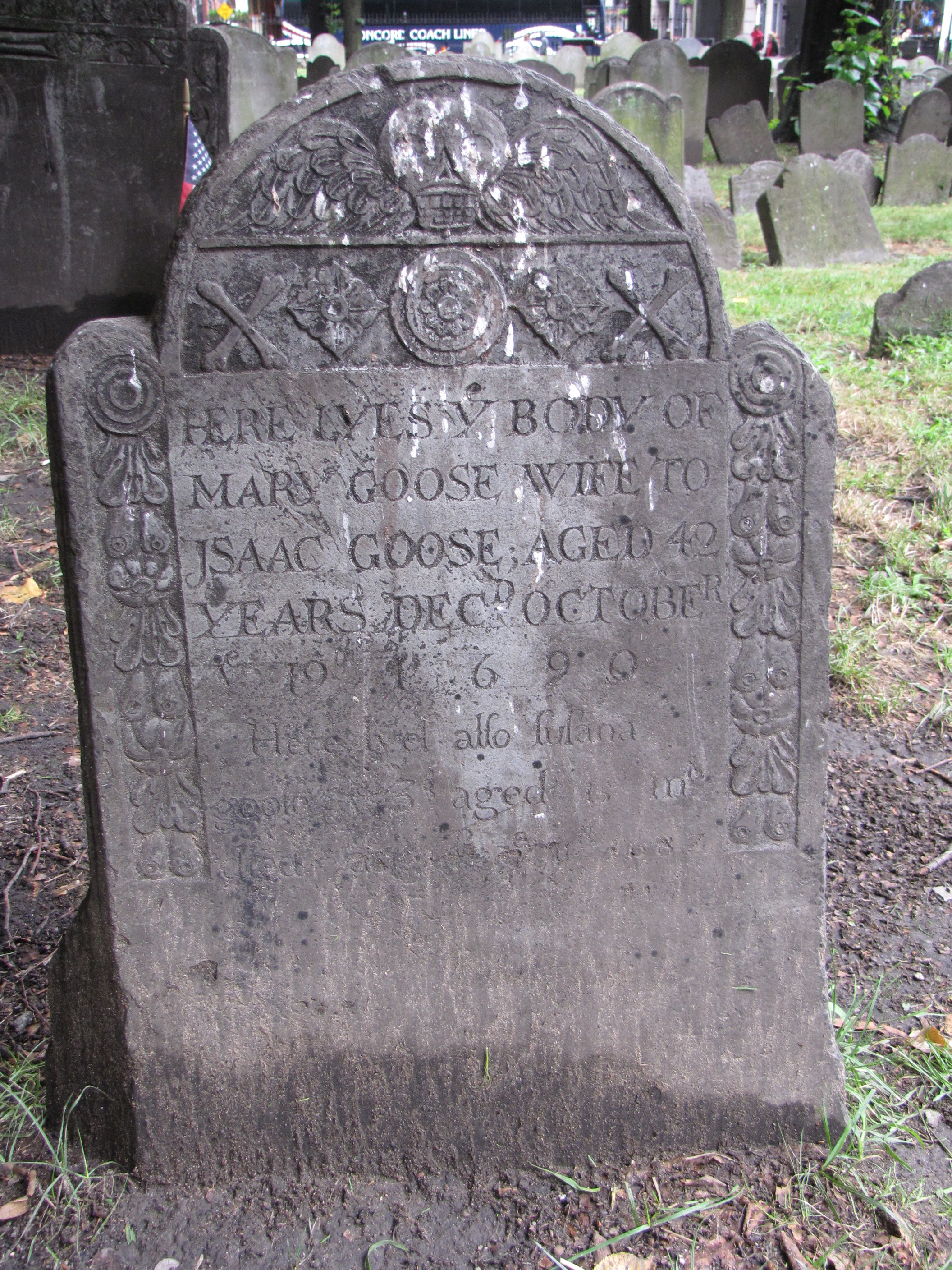
HERE LYES Ye BODY OF

MARY GOOSE WIFE TO

ISAAC GOOSE; AGED 42

YEARS DEC’D OCTOBER

Ye 19th 1690

Here lyeth also susana

goose Ye [illegible] aged 15 mo

died August .[illegible]. 1687

According to some, namely a 1930s travel writer, the original and undeniable Mother Goose is buried at the Granary Burying Ground at Boston.  As the story goes, Mary Goose reportedly sang to her brood of children (16 altogether—six from her first marriage and her husband’s ten came together in a hers and his family).  The children loved the stories and rhymes that she told and sang to them.  Supposedly, her son-in-law, Thomas Fleet, who was a publisher in Boston on Pudding Lane gathered up her rhymes and ditties into a book and printed them.

Just one small problem.  No copy of the book has ever been found.  There is no evidence to support the claim.  In addition to that, nursery rhyme scholars (yes, there are such people) have found mention of “Mother Goose” in France years before Mary Goose was born.

Posted in Famous graves | 2 Comments

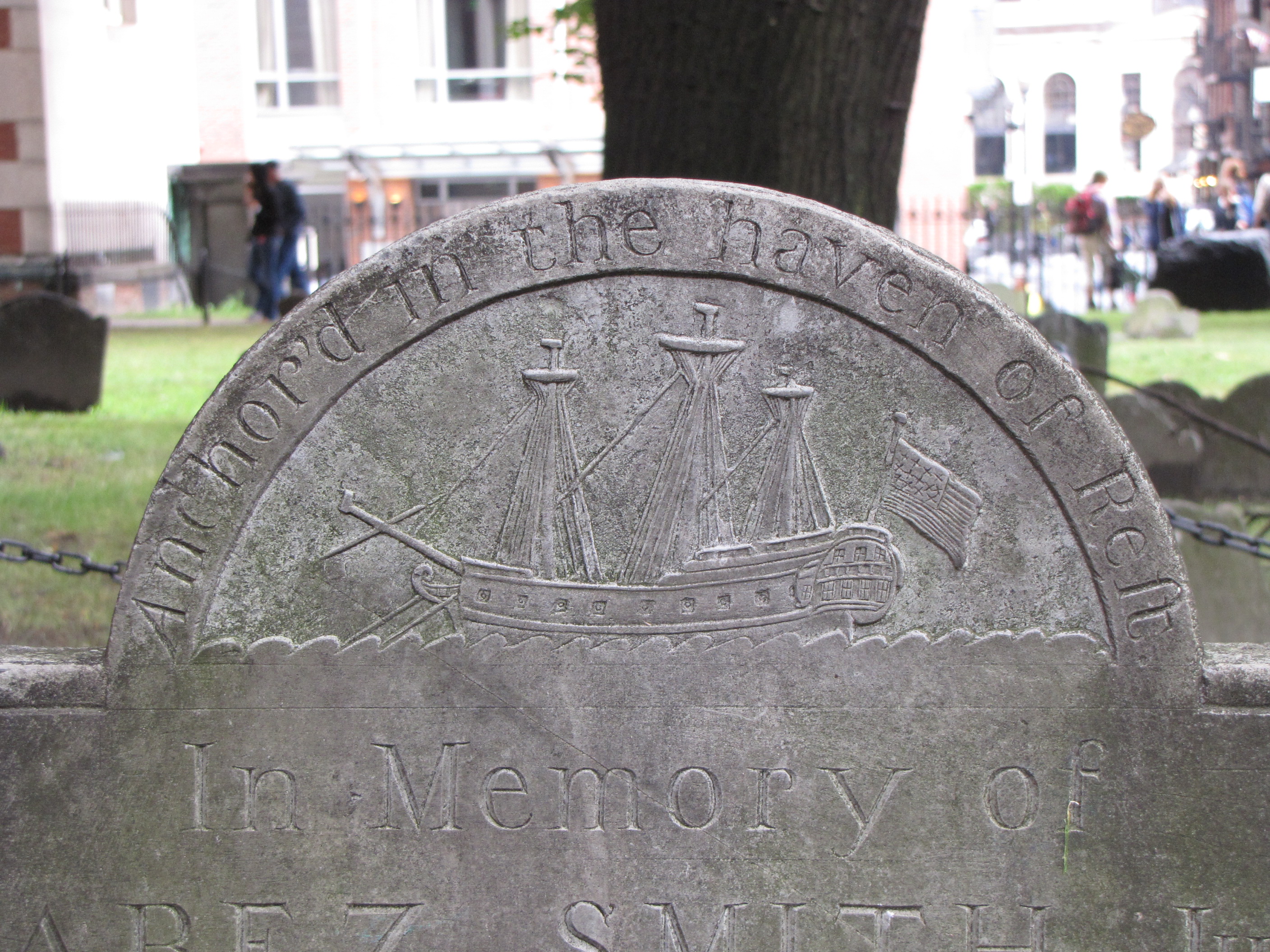
Anchored in the haven of Rest

IMG_5945

Anchor’d in the haven of Rest

In Memory of

JABEZ SMITH Jun,r

Lieu,t of Marines

On board the Continental

Ship Trumbull

Born in Groton

State of Connecticutt

August 31, 1751

Departed this Life in Boston

June 28, 1780 

The death’s head is the most common symbol in the Granary Burying Ground at Boston, Massachusetts.  There are some gravestones, however, that do have other symbols, such as the Jabez Smith Jr gravestone that depicts the ship on which he served.

IMG_5946

Posted in Symbolism | 3 Comments

The King of Terrors takes a rest

IMG_4978

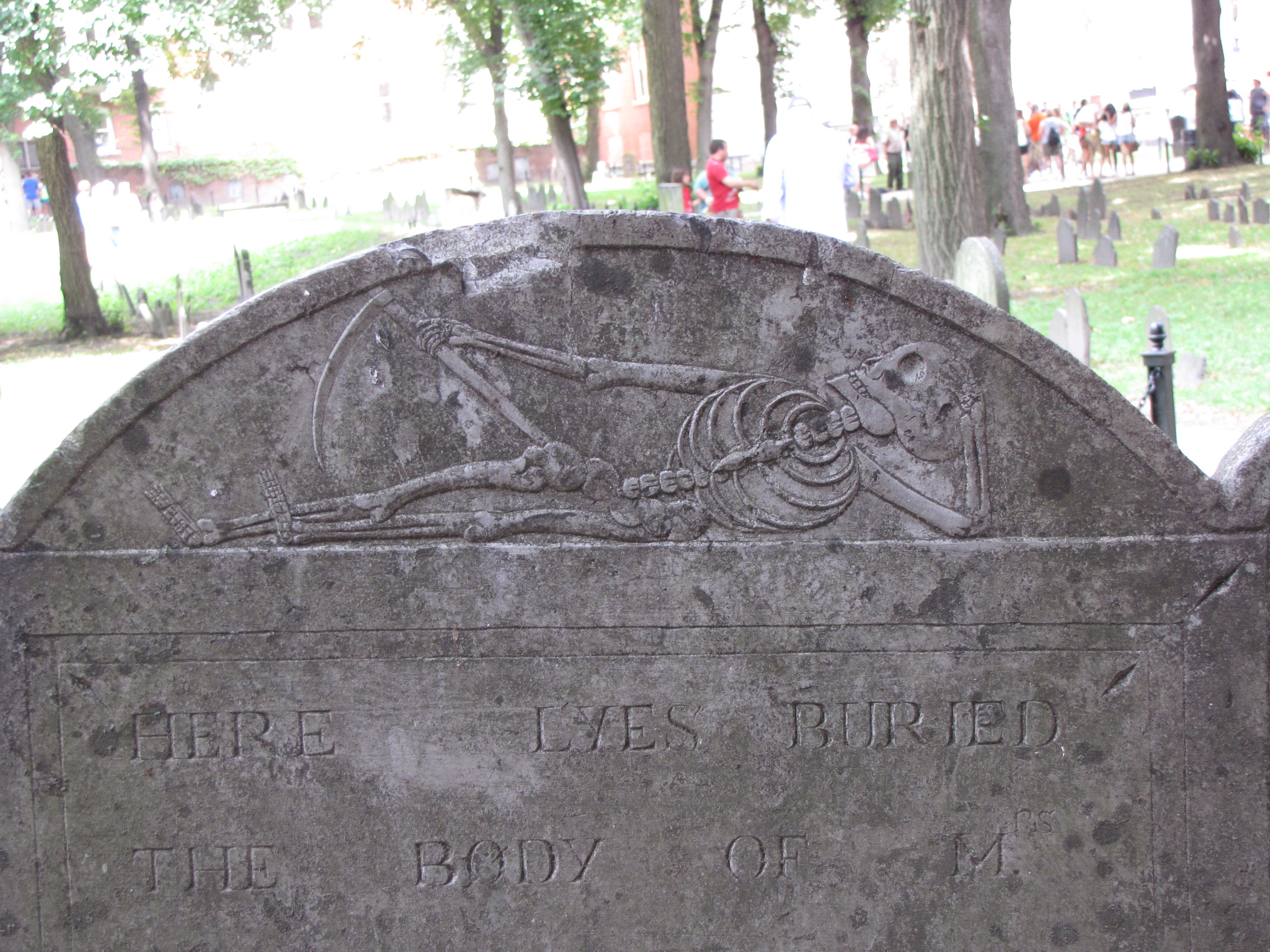
HERE LYES BURIED

THE BODY OF MRS.

ELIZABETH IRELAND WIFE

TO MR. WILLIAM IRELAND

AGED 52 YEARS

DEC’D. OCT. Ye 12, 1738.

Many symbols in the graveyard are meant to remind passersby that life is short and that all will die. These images are called Memento Mori and are a call to “remember death“. The skeleton is one of these symbols. The skeleton above is holding a scythe, a weapon with which the lives are cut down in the Divine Harvest. When the skeleton is depicted with a scythe, arrow, spear, or darts, the figure is referred to as the “King of Terrors”. Here, on this gravestone in the Granary Burial Ground at Boston, the King of Terrors is depicted reclining, either taking a respite from the exhausting work of harvesting lives or resting up before his brutal work begins.

IMG_4977

Posted in Symbolism | 3 Comments

The Man of the Revolution

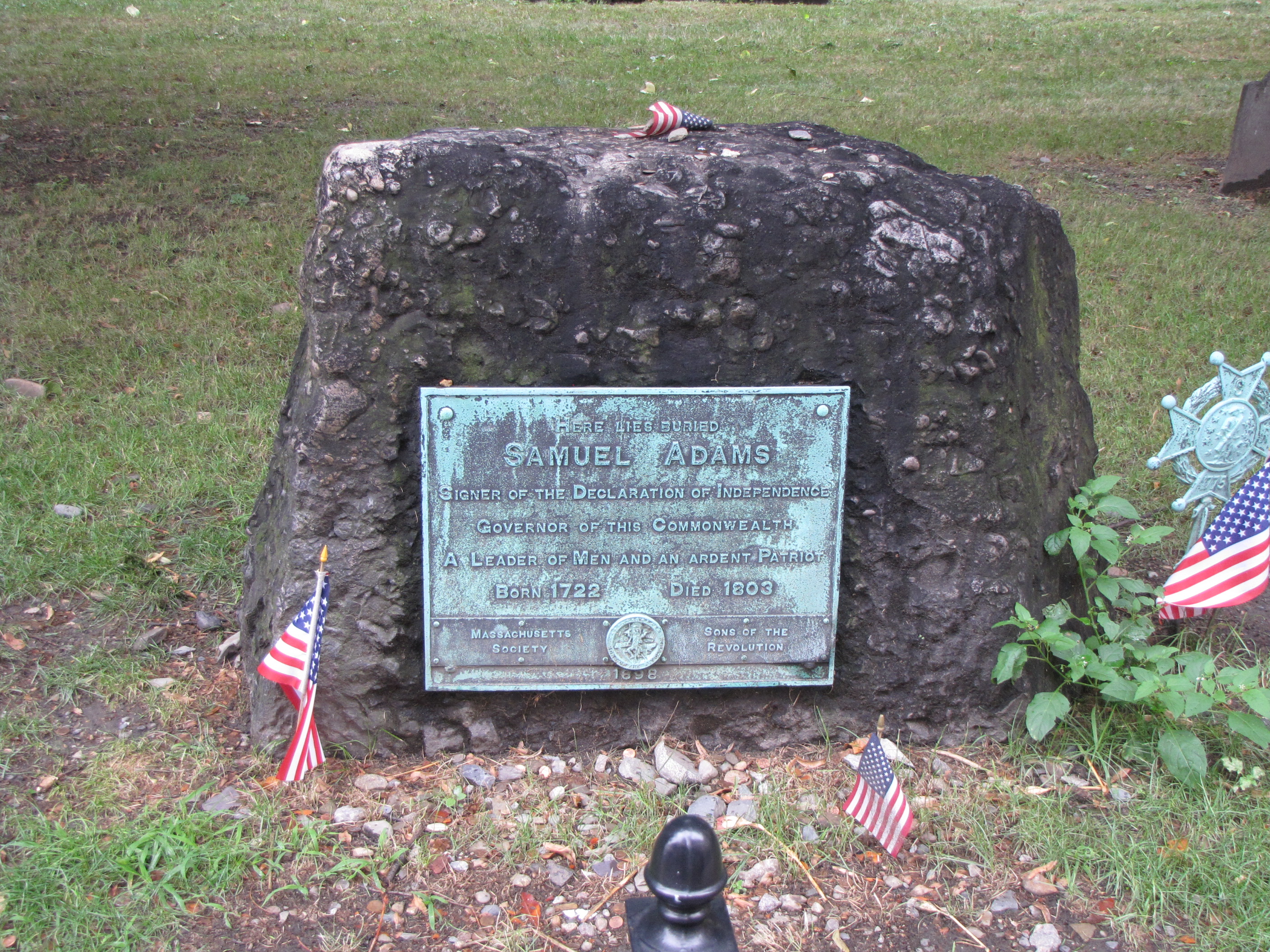
IMG_6113HERE LIES BURIED

SAMUEL ADAMS

SIGNER OF THE DECLARATION OF INDEPENDENCE

GOVERNOR OF THIS COMMONWEALTH

A LEADER OF MEN AND AN ARDENT PATRIOT

BORN 1722 DIED 1803


Sam Adams (1722-1803) was a firebrand who as much as anyone inspired and led men to cast off the British monarchy.  His revolutionary credentials were so well known Thomas Jefferson called him, “The Man of the Revolution”.

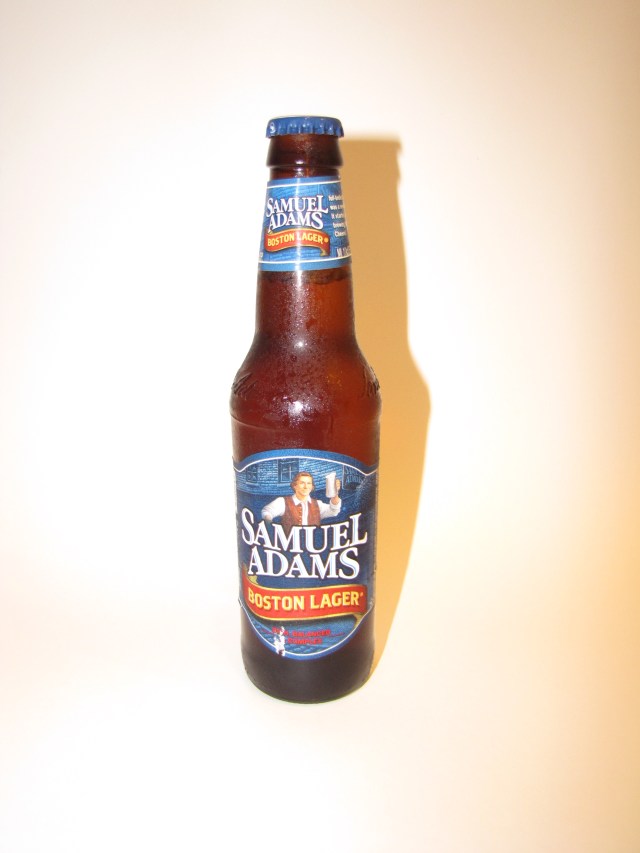
During his lifetime Sam Adams was well known to every American as a patriot but lost favor with historians and the story of his influence and participation during the war became less emphasized and written about.  Then in the 1980s, Jim Koch founded a Boston-based brewing company naming his signature great-tasting beer after Sam Adams.  Sam Adams was once again on the lips of Americans!

Sam Adams is buried in the Granary Burying Ground at Boston.  His large rock marker is slightly to the right of the main gate and in the front, visible from the fence surrounding the burial ground.  The plaque on his grave was placed there by the Massachusetts Society and the Sons of the American Revolution.  The docents who give tours through the cemetery take visitors past the venerated Sam Adams’ grave.  One wag was heard to remark, “You can go across the street to the tavern and have a cold Sam Adams, and look across the street at a cold Sam Adams!”
IMG_6143

While the beer was named after Sam Adams and honors him, his family most likely never were brewers.  They did, however, make malt a main ingredient in beer.  Even Sam worked as a maltster, though there is no evidence he was a brewer.

Posted in Famous graves | 2 Comments

Transitions

IMG_4986

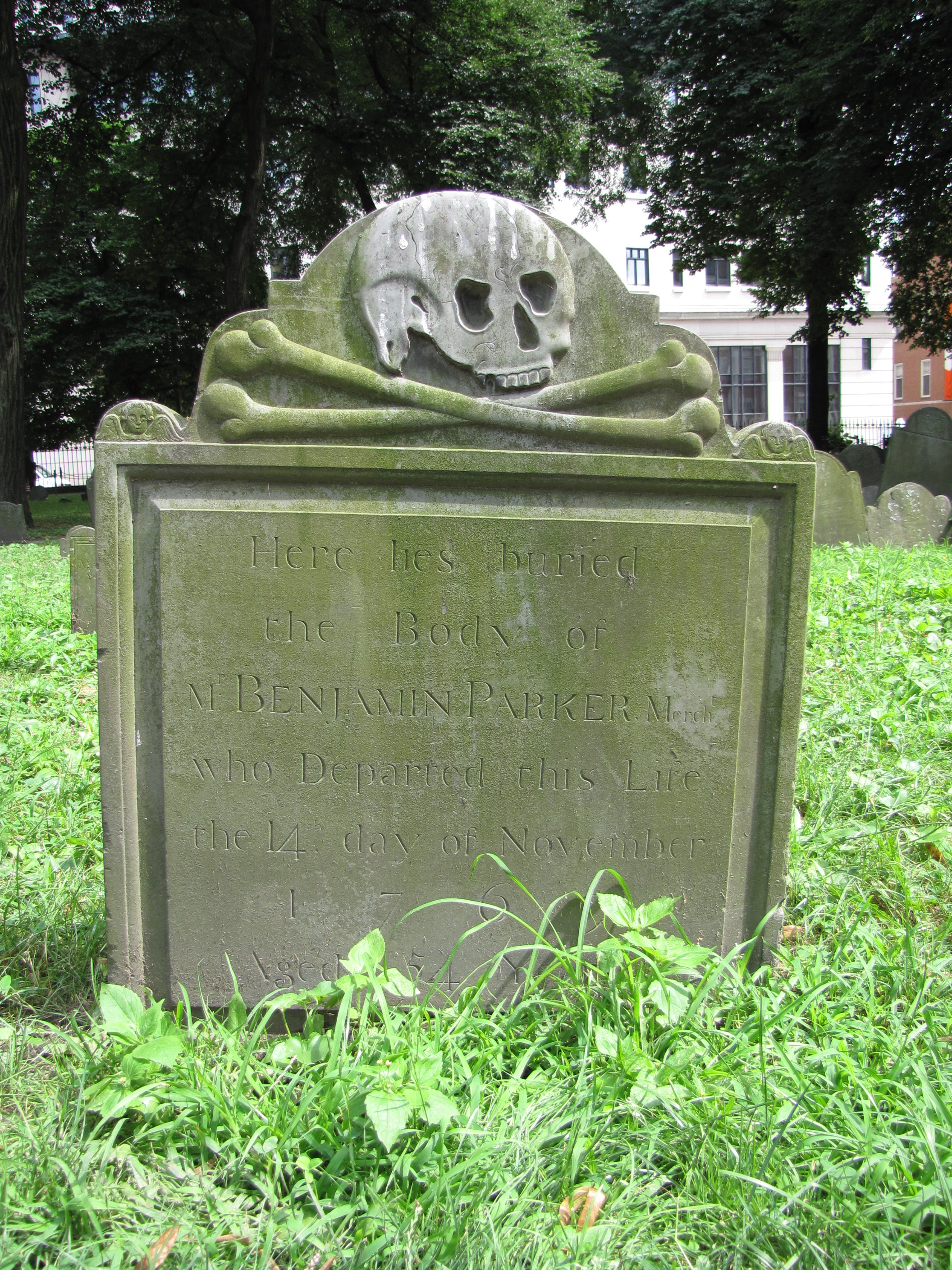
Here lies buried

The Body of Mr BENJAMIN PARKER Mercht

Who Departed this Life

The 14th day of November

1769

Aged 54 Years

Here again on this gray slate gravestone in the Granary Burying Ground at Boston is an example of the skull and crossbones symbol broadcasting the message to remember death”.  This gravestone, however, is a bridge between the memento mori symbolism meant to remind that life was short.

IMG_4987

Here, just on the edges of the gravestone were the beginnings of a softer message.  Two small winged cherub faces are carved on the marker.  These images are called “soul effigies”.  They mark the transition away from harsh Puritan theology to the gentler Age of Enlightenment that gave way to the sentimentality of the Victorian Era.

These figures represent the flight of the soul away from the body, presumably to Heaven.  Instead of the symbolism of skulls, bones, grave-digging equipment and the like, the soul effigies speak to a message of optimism and the glory of the soul and the hereafter.

Posted in Symbolism | Leave a comment