The Queen of Mean

IMG_7290

Harry B. Helmsley March 4, 1909 – January 4, 1997

Leona Mindy Roberts Helmsley July 4, 1920 – August 20, 2007

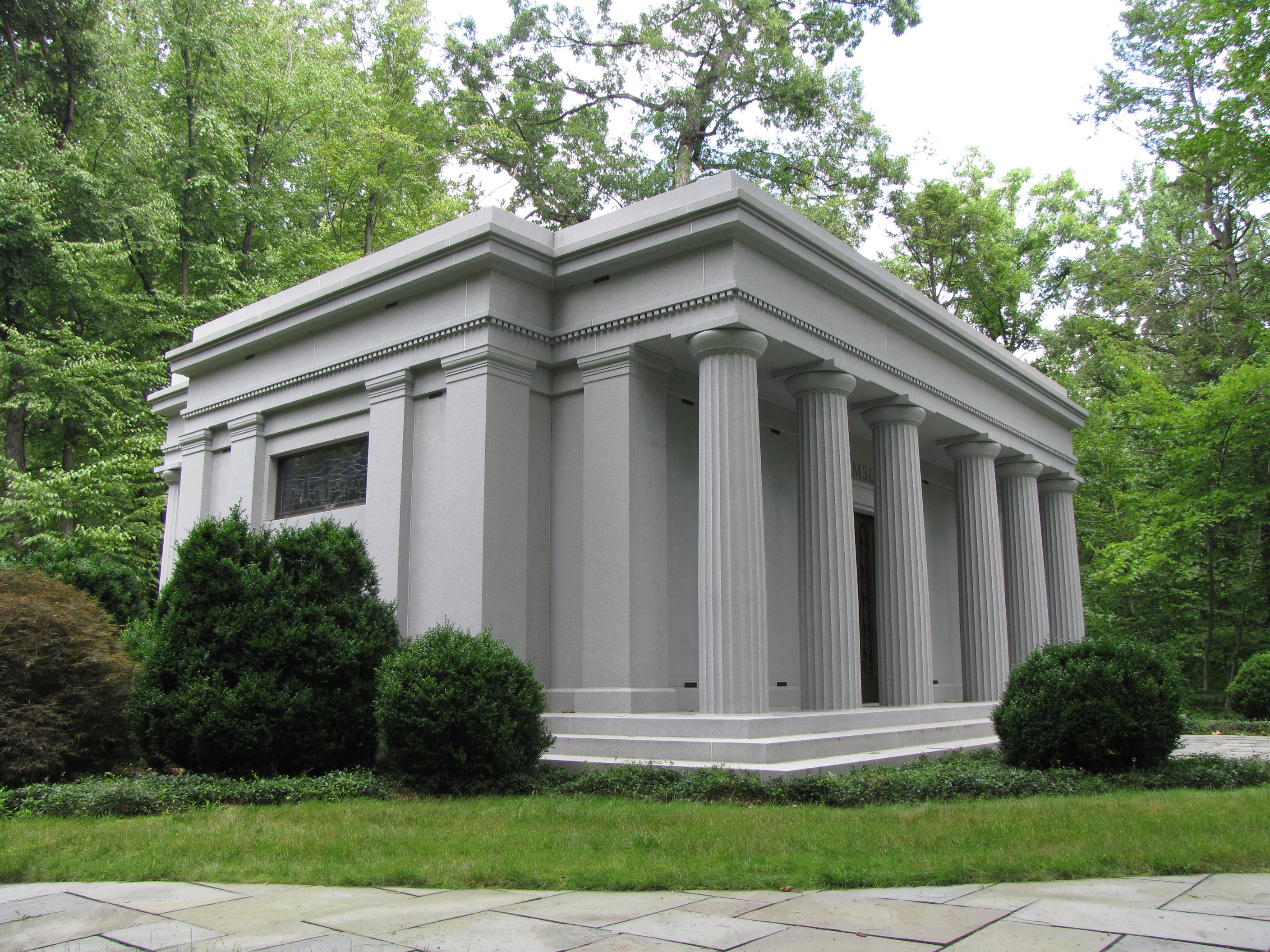
Harry and Leona Helmsley were a New York power couple who owned real estate and hotels throughout the city.  They made a multi-billion dollar fortune in real estate properties including the Empire State Building, the crown jewel of Manhattan.  By 1989, Leona managed 23 of the Helmsley hotels and was featured in the advertising campaign that helped make her a household name.

She was dubbed the “Queen of Mean” because of the way she treated her employees.  In a famous tax evasion trial, one of Leona’s employees testified that Leona said, “Only the little people pay taxes.”  She was convicted and sentenced to prison.  She served 18 months in a federal prison.

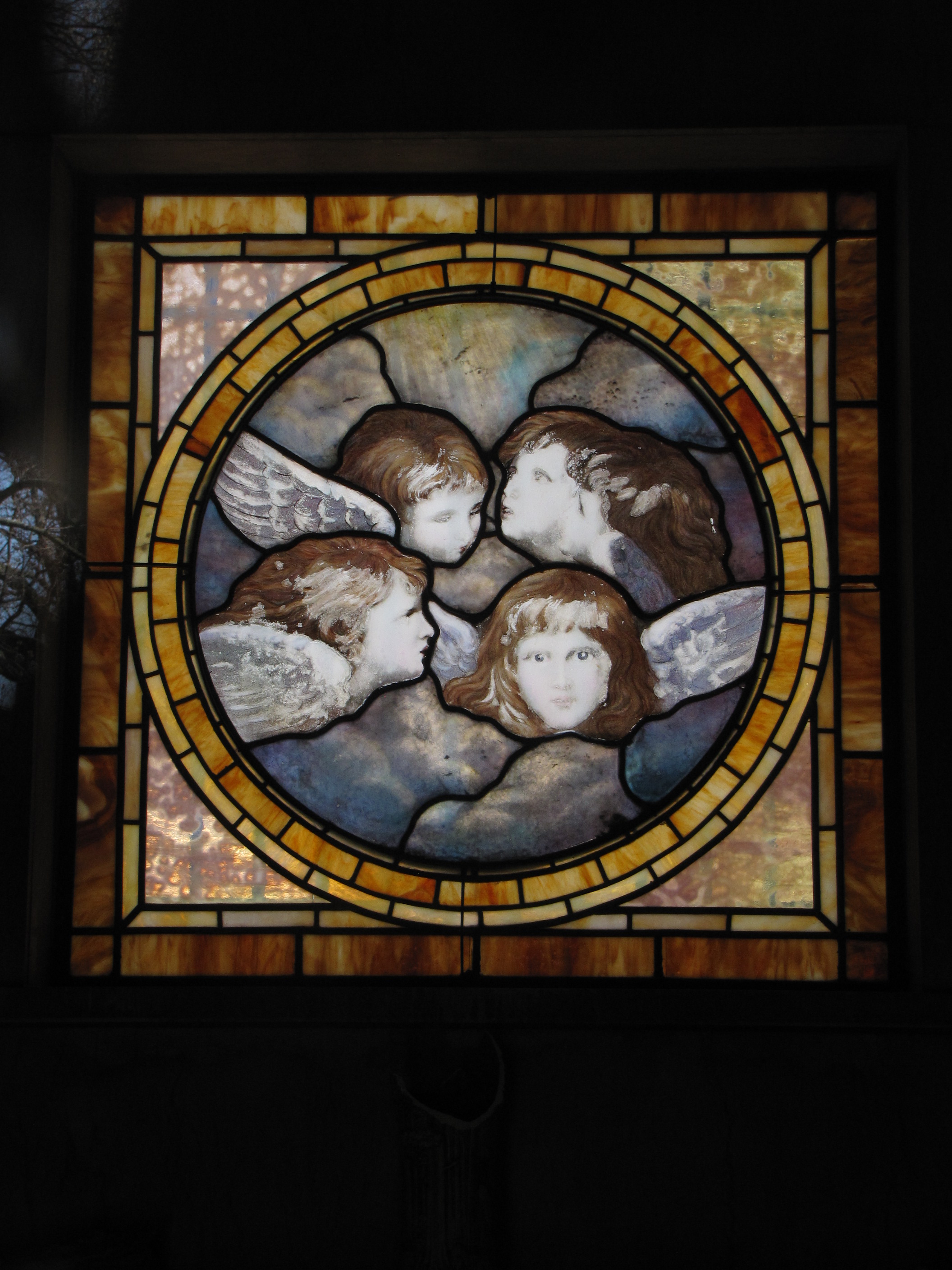
The Helmsley’s are buried in a neo-classical Doric-style mausoleum in the Sleepy Hollow Cemetery in Sleepy Hollow, New York.  In a nod to their success in the real estate market in New York, the mausoleum features three stained-glass windows that depict the city skyline.

IMG_7287

Posted in Uncategorized | 2 Comments

Angels of Glass

IMG_9651

In this stained-glass window in the E.B. Cones and E.L. Patrick Mausoleum in the Crown Hill Cemetery at Indianapolis, Indiana, an array of cherubim–angels–are depicted.  Cherubim are one of nine orders or choirs of angels which are organized into three spheres, with three choirs in each sphere.  According to Christian tradition, the first sphere, which is made up of the Seraphim, Cherubim, and the Thrones, are considered the closet to Heaven.  In Ezekiel 10:14, the Cherubim are described as having four likenesses or four faces, “And every one had four faces; the first face was the face of a cherub, and the second face was the face of a man, and the third the face of a lion, and the fourth the face of an eagle.”  Cherubim are most always depicted as chubby babies.


Posted in Angels | Leave a comment

The Angel and the Horn


Edward Fay Claypool Mausoleum, Crown Hill Cemetery, Indianapolis, Indiana

Edward Fay Claypool Mausoleum, Crown Hill Cemetery, Indianapolis, Indiana

Many mausoleums are embellished with ornate stained-glass windows.   The angel featured in this window is carrying a horn with one hand and pointing upward with the other.  The angel uses the horn to announce the coming resurrection.  The other hand is pointing the way!

Posted in Uncategorized | Leave a comment

Quoth the Raven

Edgar_Allan_Poe_by_Pratt,_1849[1]

The Raven

Once upon a midnight dreary, while I pondered, weak and weary,

Over many a quaint and curious volume of forgotten lore—

While I nodded, nearly napping, suddenly there came a tapping,

As of some one gently rapping, rapping at my chamber door.

“’Tis some visitor,” I muttered, “tapping at my chamber door—

            Only this and nothing more.”

On October 8th, 1849, at 4:00 p.m., 23 hours after Edgar Allan Poe died in mysterious circumstances, he was buried on a raw and stormy afternoon.  His funeral was a hasty three-minute service with less than a dozen people in attendance.  Poe, a noted literary critic, poet, fiction writer, and the creator of the modern detective story was buried in a homemade coffin, handmade shroud, and an unmarked grave next to his grandfather’s grave in the Westminster Hall and Burying Ground at Baltimore, Maryland.

His cousin, Neilson Poe, later purchased a marker for Edgar Allan Poe but in a freak accident, a train jumped the tracks and smashed the marker that had been carved to mark his grave.  So, his grave remained unnoticed under a stone simply marked “No. 80”.  After a newspaper article was published describing Poe’s unmarked grave, a local school teacher, Sara Sigourney Rice, took up the torch to raise money to have a monument designed for Poe.

IMG_3924

On October 1, 1875, Poe’s body was moved from the back of the graveyard to a place of prominence just inside the West gates.  A white marble monument was designed by architect George A. Frederick.  Featured in the center of the shaft is a medallion with a bas-relief of Poe’s bust by artist Adalbert Volck.  The new monument was dedicated on October 17th in a ceremony that included poet Walt Whitman.

IMG_3926

Ten years later, Poe’s wife, Virginia, whose bones in a macabre twist had been hidden under William Gill’s bed, was finally laid to rest next to her husband.

Poe’s original grave was later marked, paid for by Orrin Painter, in the 1920s by with a gravestone depicting a raven, a nod to his most famous poem.

IMG_4008

Posted in Famous graves | Leave a comment

The King of Rock ‘n Roll

elvis grave

Recently my friend, Caroline Weiss, snapped this picture of Elvis Presley’s grave on her visit to Graceland, Elvis’ Memphis, Tennessee estate.

It made me think about the annual Forbes list of the top earners from the grave.  Yes, those entertainers who are bringing in the most money AFTER their careers and their lives ended.

The top performer this past year was the King of Pop, Michael Jackson, with the King of Rock ‘n Roll, Elvis Presley, coming in a distant second, but then Elvis has been dead for over 36 years!

Elvis Presley is buried on his estate.  A relatively plain bronze grave ledger covers the memento-strewn grave that thousands flock to see every year.

The top five earners are:

Michael Jackson, 160 million, died June 25, 2009

Elvis Presley, 55 million, died August 16, 1977

Charles Schultz, 37 million, died February 12, 2000

Liz Taylor, 25 million, died March 23, 2011

Bob Marley, 18 million, died May 11, 1981

Posted in Famous graves | 1 Comment

Weeping Willows

Somerset Cemetery, Somerset, Ohio

Somerset Cemetery, Somerset, Ohio

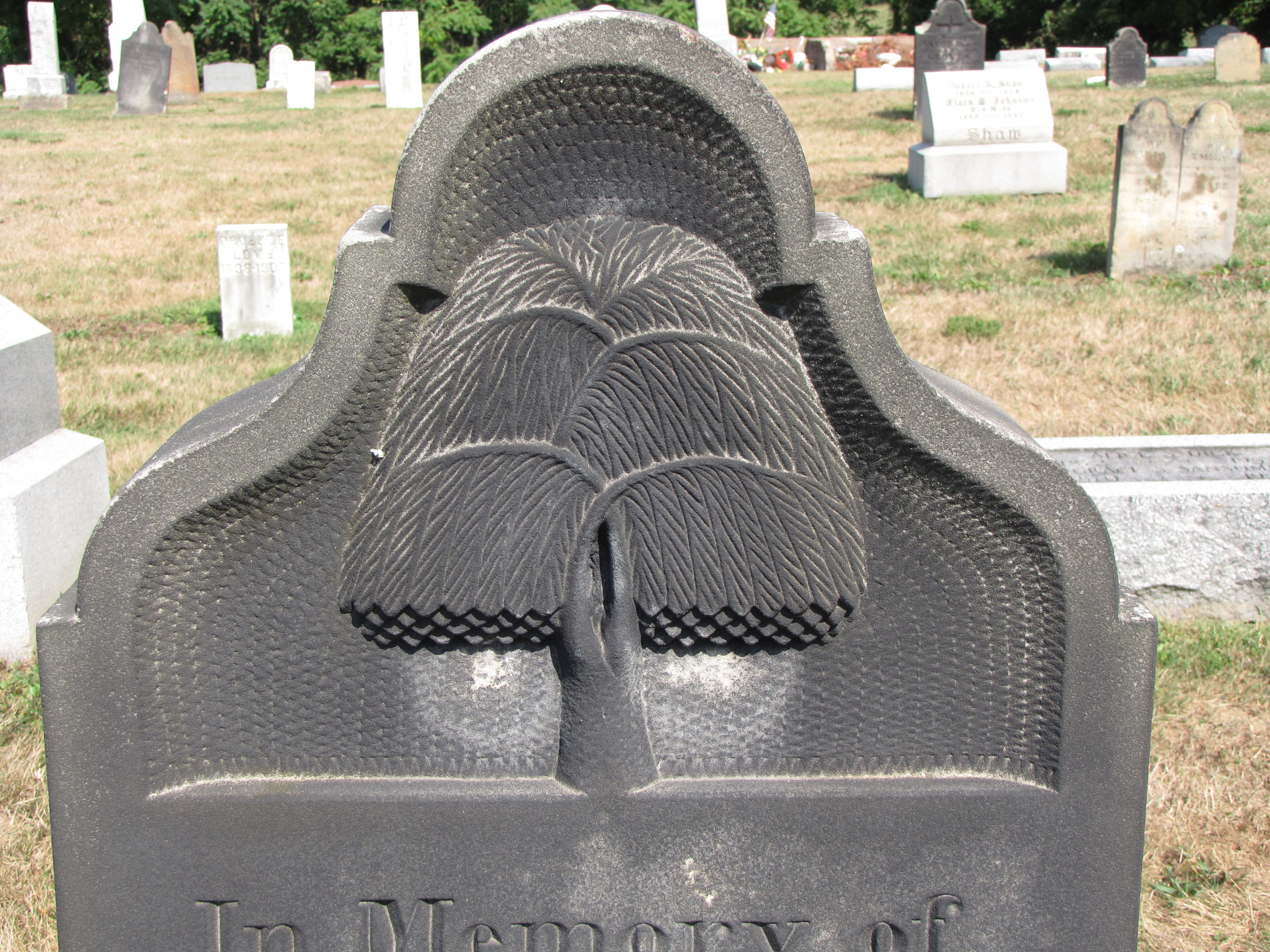
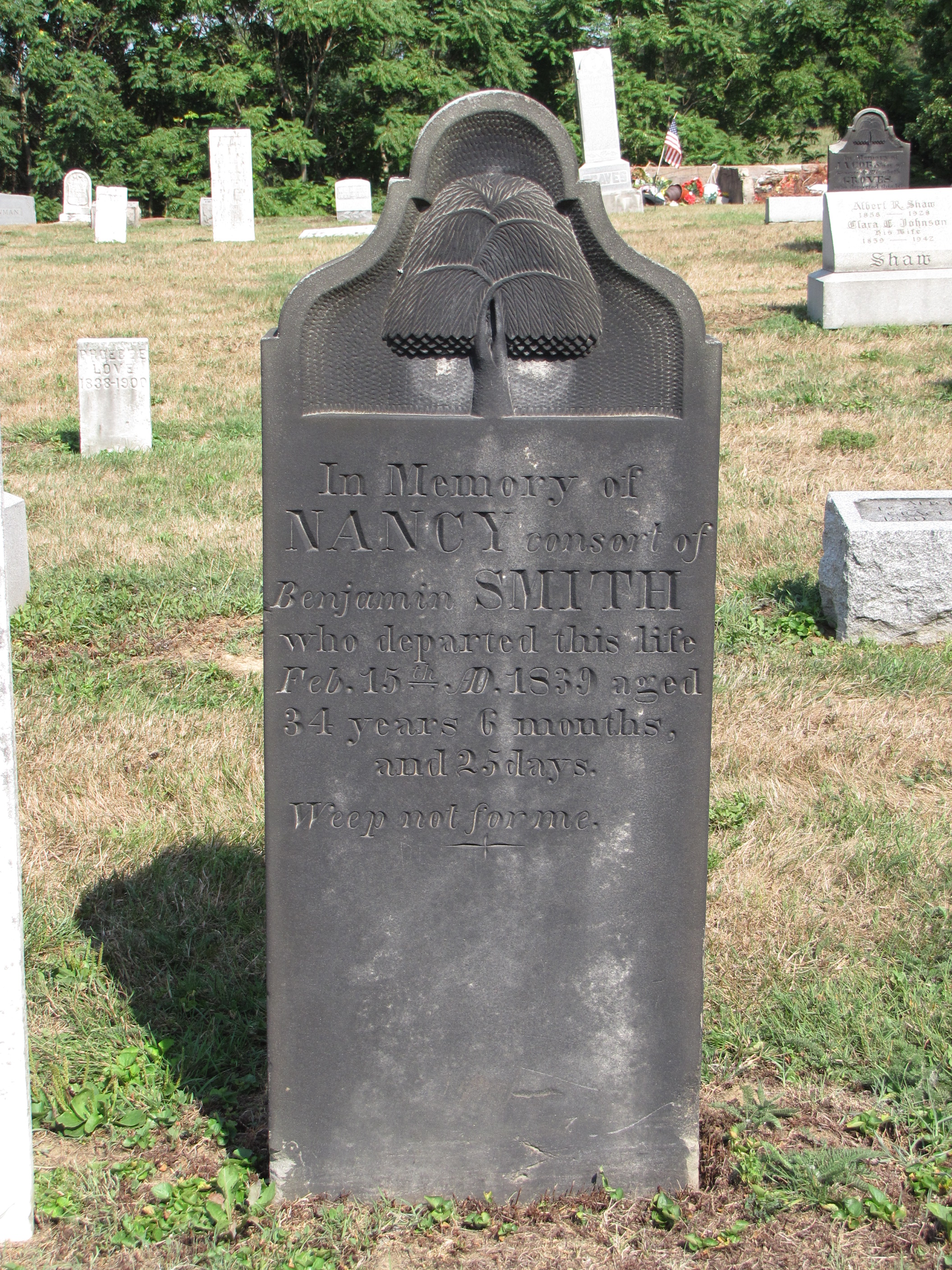
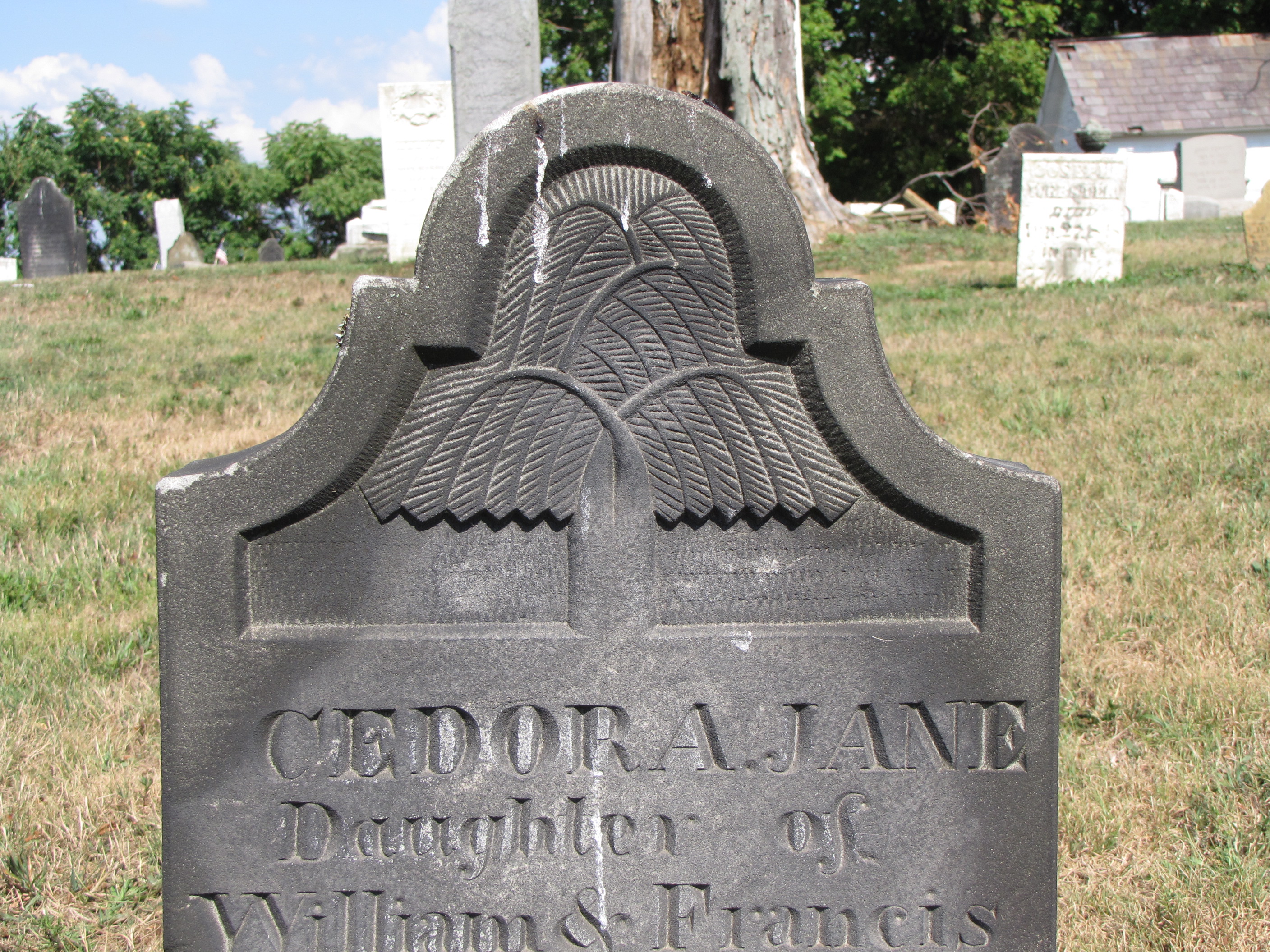
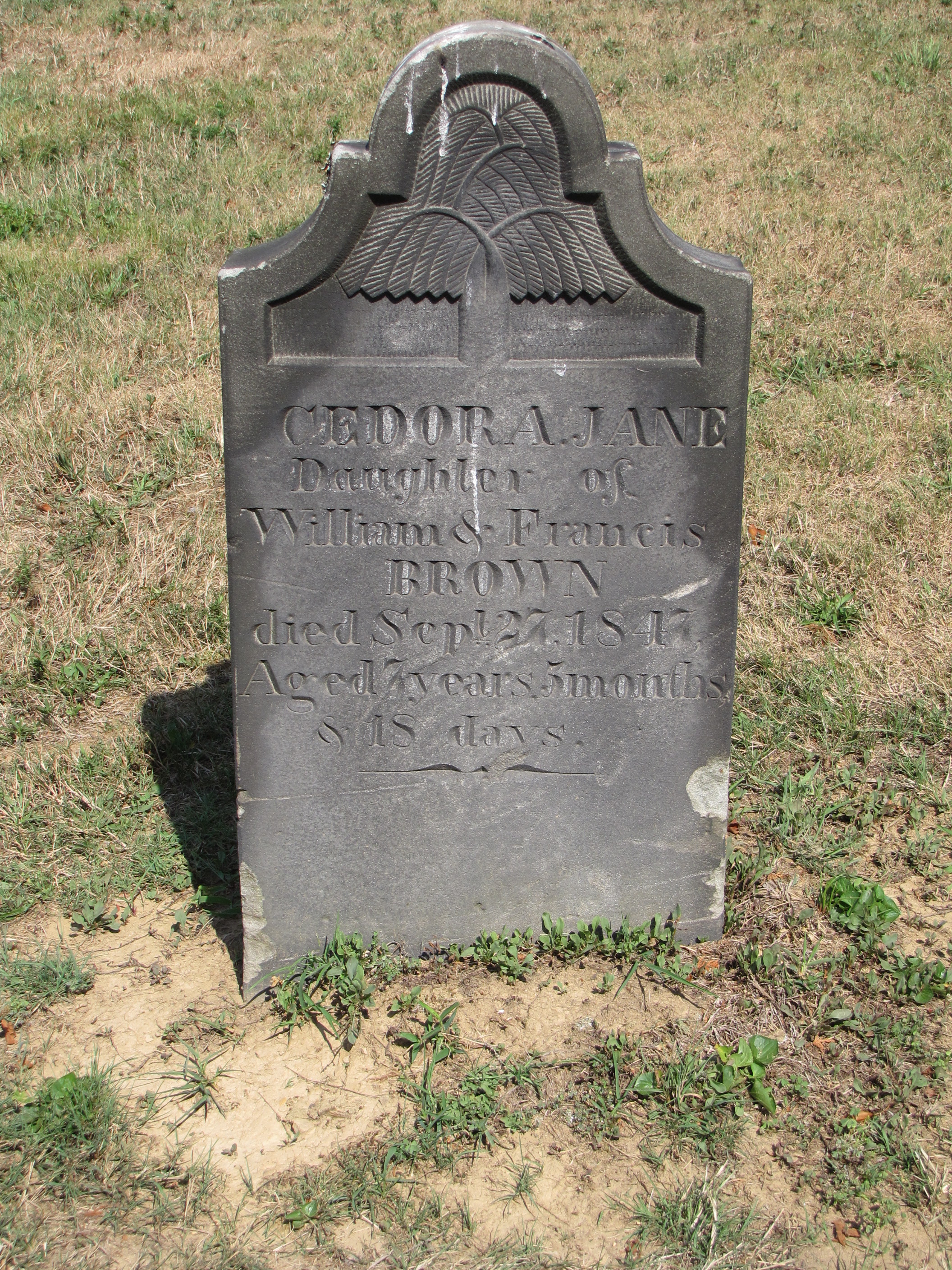
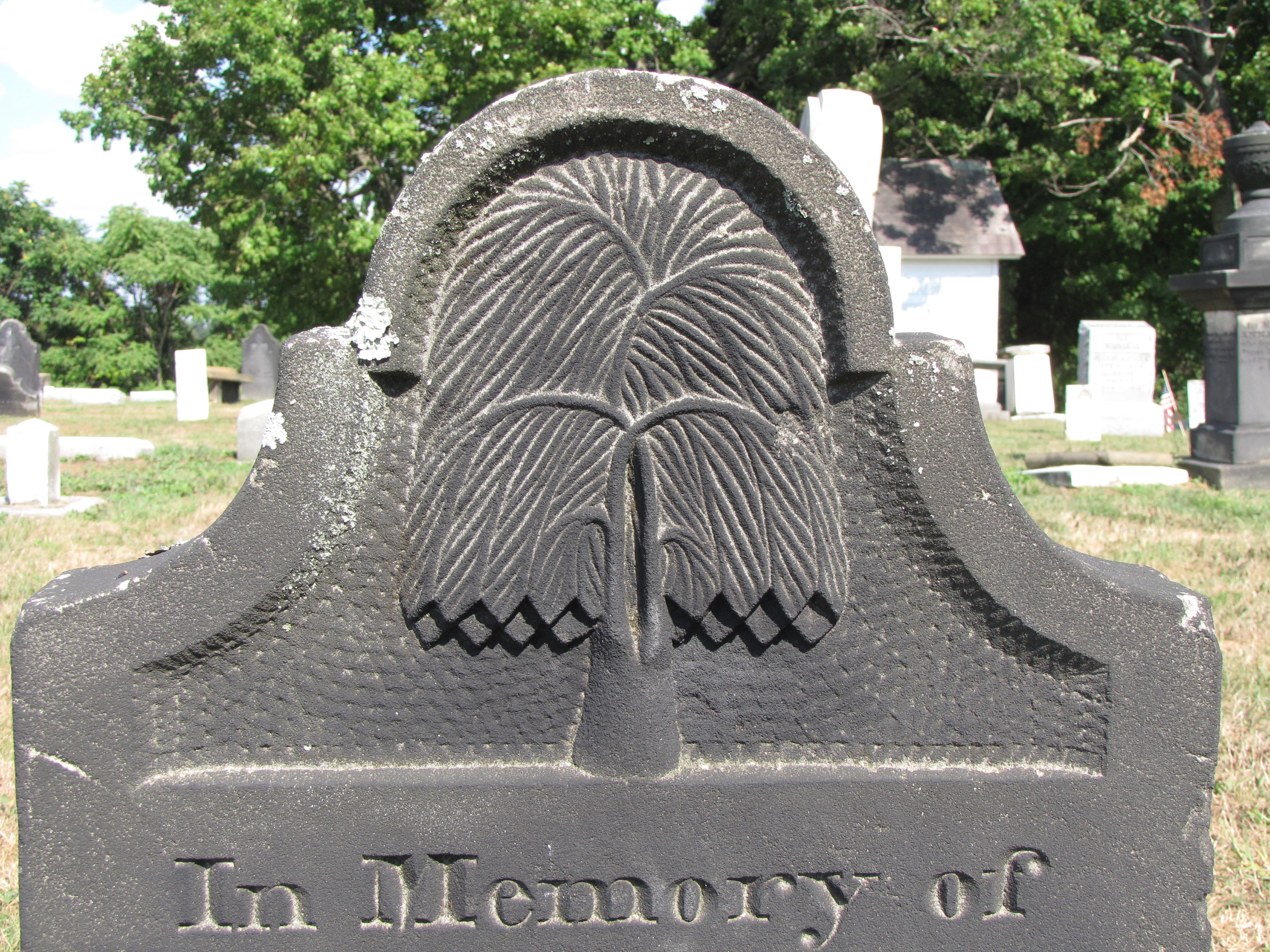
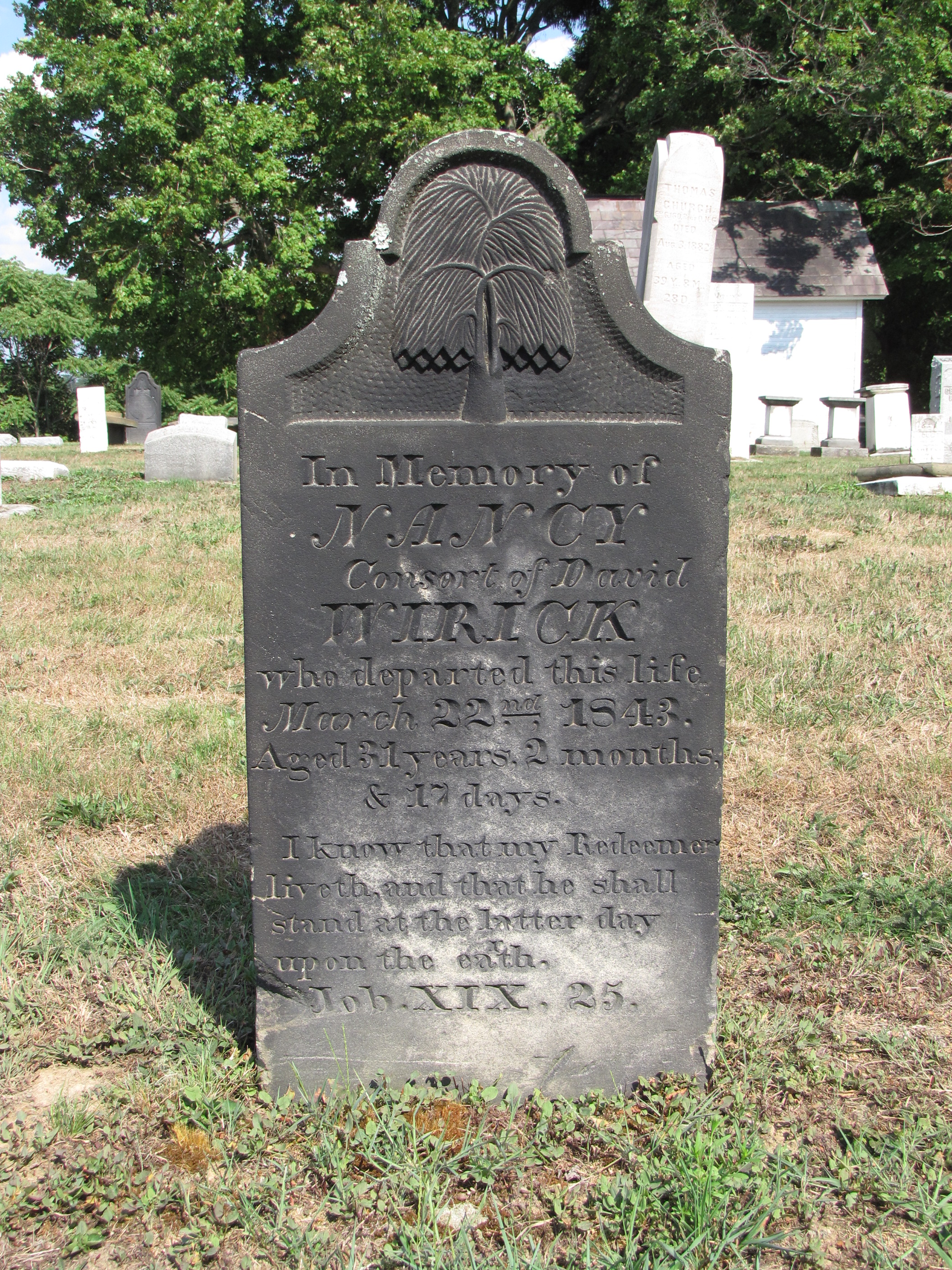
One of my favorite graveyard symbols is the willow.  The Somerset Cemetery at Somerset, Ohio, has many intricately carved examples of gravestones with the willow motif.

The willow as a symbol is sentimental and hints at the human emotions felt during grief.  The willow motif represents what one might expect; sorrow and grief, it is after all a “weeping” willow.

Somerset Cemetery, Somerset, Ohio

Somerset Cemetery, Somerset, Ohio

Another example:IMG_8022


IMG_8021

IMG_7987

IMG_7986

Posted in Uncategorized | Leave a comment

The Lamb and the Little Boy

Cave Hill Cemetery, Louisville, Kentucky

Cave Hill Cemetery, Louisville, Kentucky

Precious Boy

JOHN T.

SON OF

J.H. & K. L. ALDERSON

1894-1897.

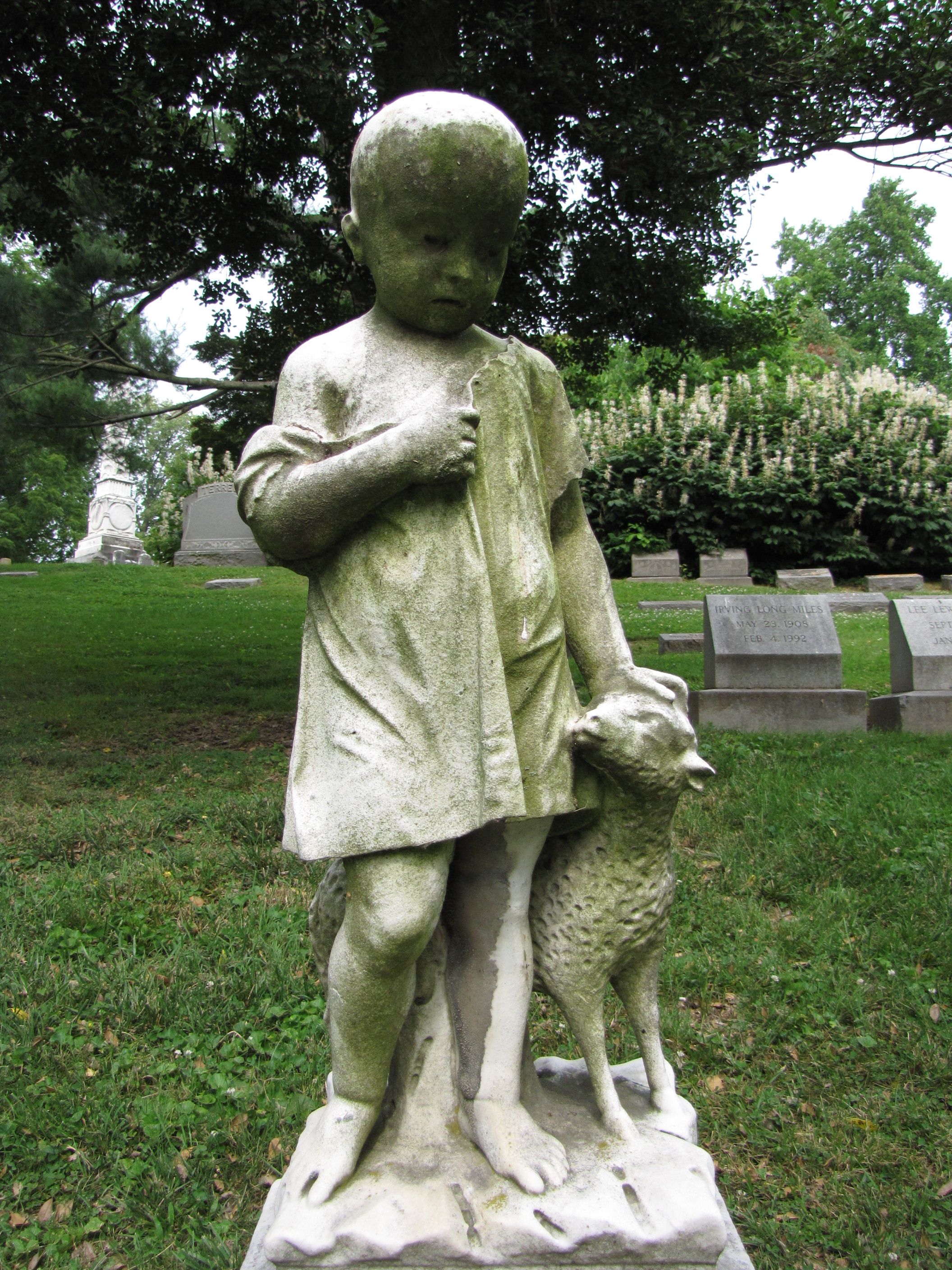
The gravestone of three-year old John Alderson depicts a boy in a dressing gown with his chubby little hand gently touching the head of a small lamb.  The lamb looks up and leans against the child as the boy wistfully looks down as he fidgets with his gown.  There is a sadness to the boy’s countenance, almost as if he is regretting the future lost by his early death.

Life-size representations of children as a funeral motif were common in the Victorian era.  The lamb, common Victorian funerary iconography, is the symbol of the Lord, the Good Shepherd.  The lamb also represents innocence, likely the reason why this motif most often adorns the tombstones of infants and young children, as in this case.  On gravestones where the lamb is a bas-relief it is most often depicted lying down, often asleep and sometimes with a cross behind the lamb.

Posted in Children's Graves, Symbolism | Leave a comment

A Tale of Two Birds

Woodland Cemetery, Des Moines, Iowa

Woodland Cemetery, Des Moines, Iowa

Wm. S. CLARK

MAY 24, 1854

Feb. 7, 1904

The zinc marker above marks the grave of a William Clark.  His marker is the tale of two birds.  On one side is bolted the eagle and the other a dove.

Clark was a member of the Improved Order of Redmen, which claims its beginnings with the patriots who were in the Sons of Liberty during the American Revolution.  The society models itself after the Iroquois Confederacy councils.  The society based their organization on the rites and rituals of the Native Americans.  Written on the shield on the chest of the eagle are the initials T.O.T.E which stands for Totem of Eagles.  According to their Website, the IORM “promotes patriotism and the American Way of Life, provides social activities for the members, and supports various charitable programs.”  The different clubs or chapters are divided into “tribes”.

IMG_6613

The other side of the zinc marker has bolted on it, the dove.  Several references in the Bible refer to the dove as a symbol of the Holy Spirit. Matthew 3:16 reads, “And Jesus, when he was baptized, went up straightway out of the water: and, lo, the heavens were opened unto him, and he saw the Spirit of God descending like a dove, and lighting upon him.” In Mark 1:10 the Bible says, “And Straightway coming up out of the water, he saw the heavens opened, and the Spirit like a dove descending upon him.” Again in John 1:32, the Bible reads, “And John bare record, saying, I saw the Spirit descending from heaven like a dove, and it abode upon him.”

Along with the dove symbolizing the Holy Spirit, the dove is also closely associated with peace, often depicted with a sprig of an olive in its beak. This, too, originated in the Bible. After the waters receded in the story of Noah, the dove appears. Genesis 8:11, “And the dove came in to him in the evening; and, lo, in her mouth was an olive leaf pluckt off; so Noah knew that the waters were abated from off the earth.”   It was a sign of God’s forgiveness.

The dove, with its white color, is also a symbol of purity and innocence and for that reason is often found the tombstones of children.

Thus the dove symbolizes the Holy Spirit, peace, and purity.

Posted in Uncategorized | Leave a comment

A calm and undisturbed repose

Walnut Hill Cemetery, Council Bluffs, Iowa

Walnut Hill Cemetery, Council Bluffs, Iowa

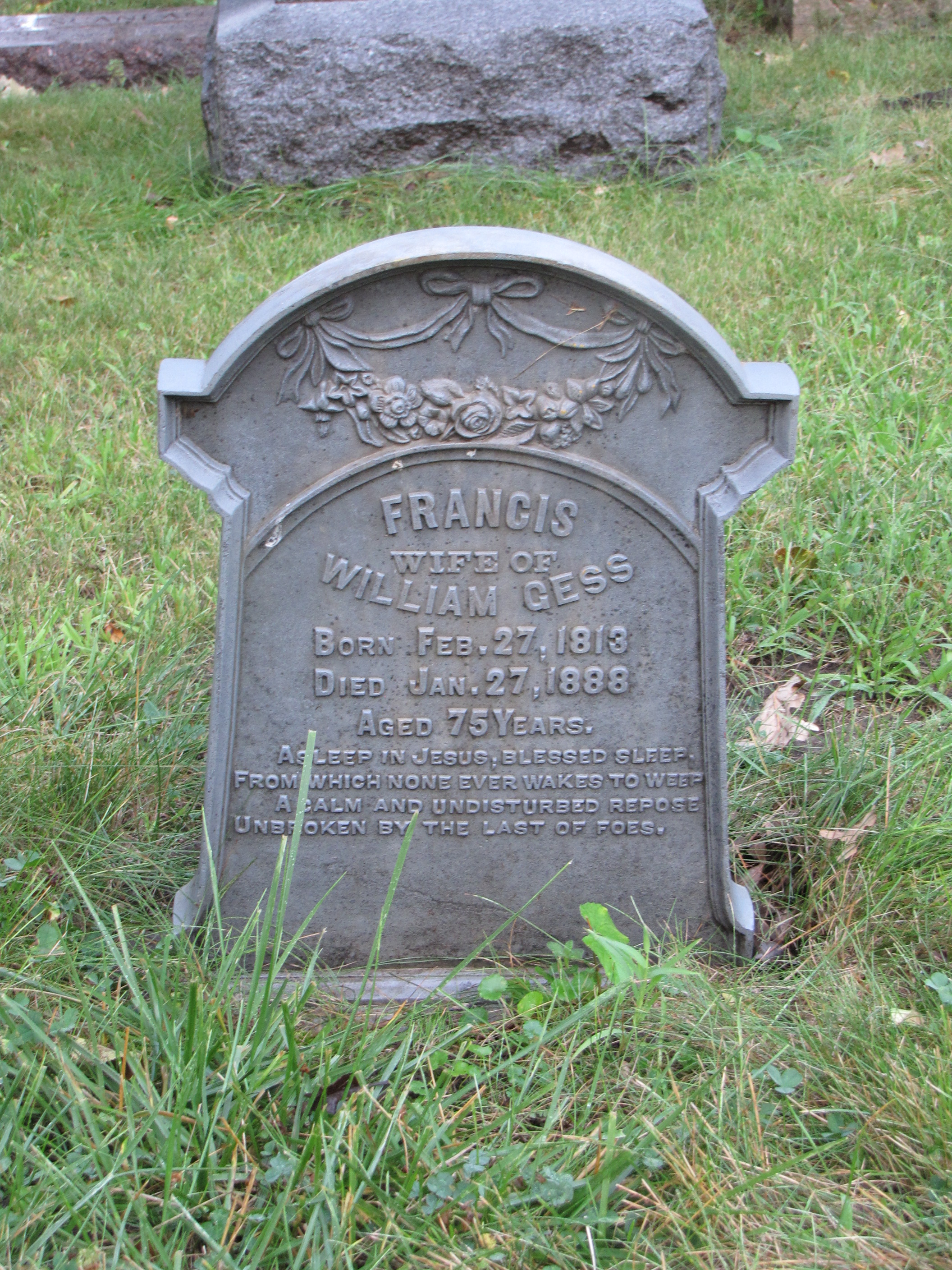
FRANCIS

WIFE OF

WILLIAM GESS

BORN FEB. 27, 1813

DIED JAN. 27, 1888

AGED 75 YEARS


Asleep in Jesus; Blessed sleep.

From which none ever wakes to weep

A calm and undisturbed repose

Unbroken by the last of foes.


Posted in Epitaphs, Zinc Markers | Leave a comment

The G.A.R. Badge

Woodland Cemetery, Des Moines, Iowa

Woodland Cemetery, Des Moines, Iowa

ALEXANDER ST. CLAIR

FEB. 24, 1828.

SEPT. 25, 1900.

2ND. LEUT. CO. I. 43, U.S. C. INF.

16TH. PENN. CAV.

No other event in the 19th Century had a larger affect on America than the Civil War.  It tore the country apart and involved people from every corner before it was over.  Over a million people were wounded and killed–625,000 from the North and over 400,000 from the South.

After the war, The Grand Army of the Republic (G.A.R), a veteran’s organization, was founded April 6, 1866, in Decatur, Illinois.  The organization admitted veteran’s who served honorably in the Union Army, Navy, or Marines between April 12, 1861, and April 9, 1865.

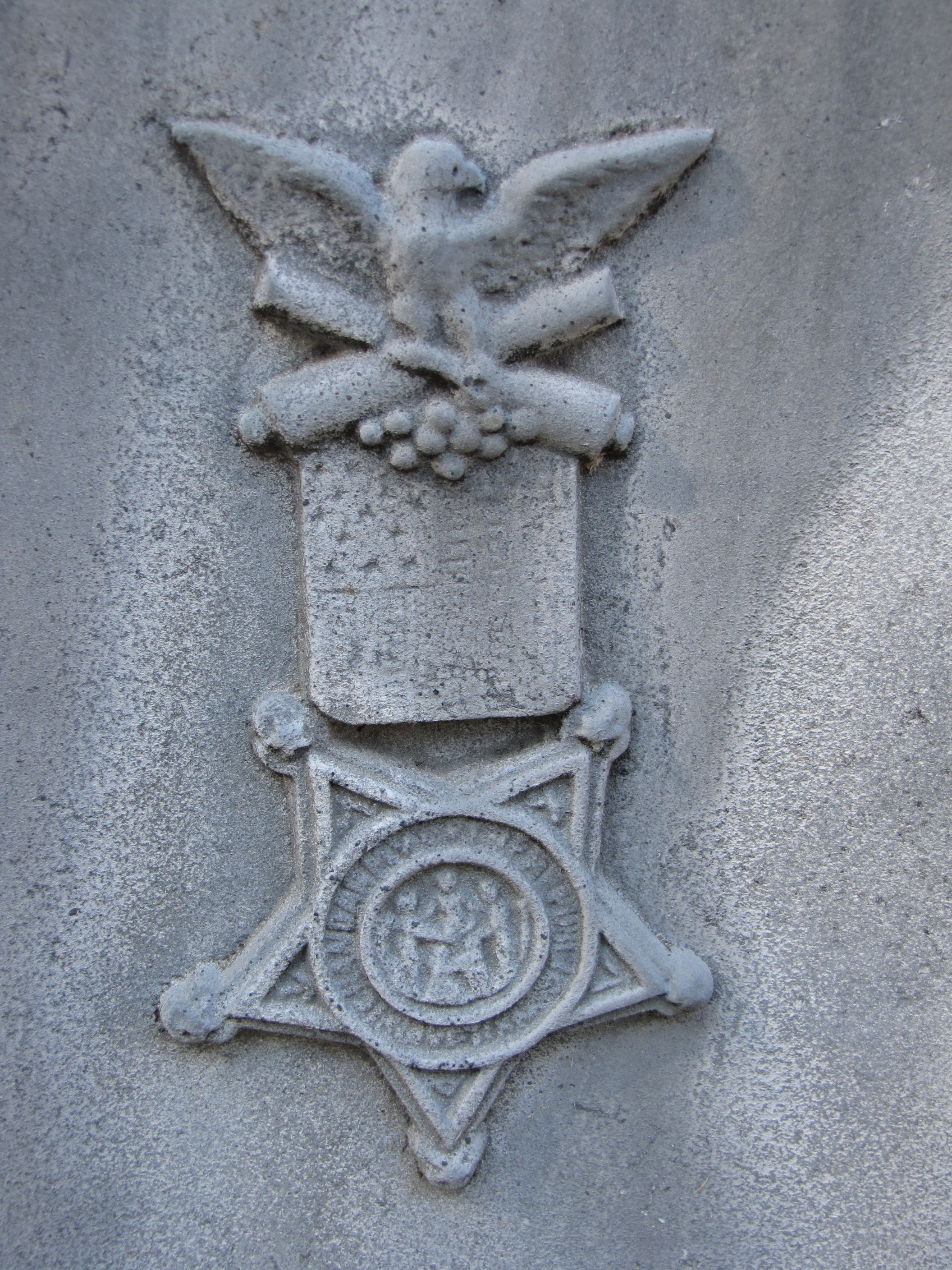
G.A.R. symbolism and markers can be found throughout American cemeteries marking the graves of the men and women who served during the war.  These take many forms.  In this case, the grave zinc marker recreates the G.A.R. badge worn by veterans of the North–the eagle mounted on crossed cannons and cannon balls, followed by a ribbon United States flag and the insignia of the G.A.R., which was a star.  Inside the star was a circle that depicted a sailor and a soldier clasping hands in front of a figure of liberty in the center looking on.

IMG_6761

Posted in Symbolism, Zinc Markers | 1 Comment