Art as the Memorial


Oakland Cemetery, Atlanta, Georgia

Oakland Cemetery, Atlanta, Georgia

McCLATCHEY

Devereaux Fore McClatchey III

June 1, 906 – August 30, 1993

Dorothy E. Methvin McClatchey

May 8, 1907 – June 1, 2009

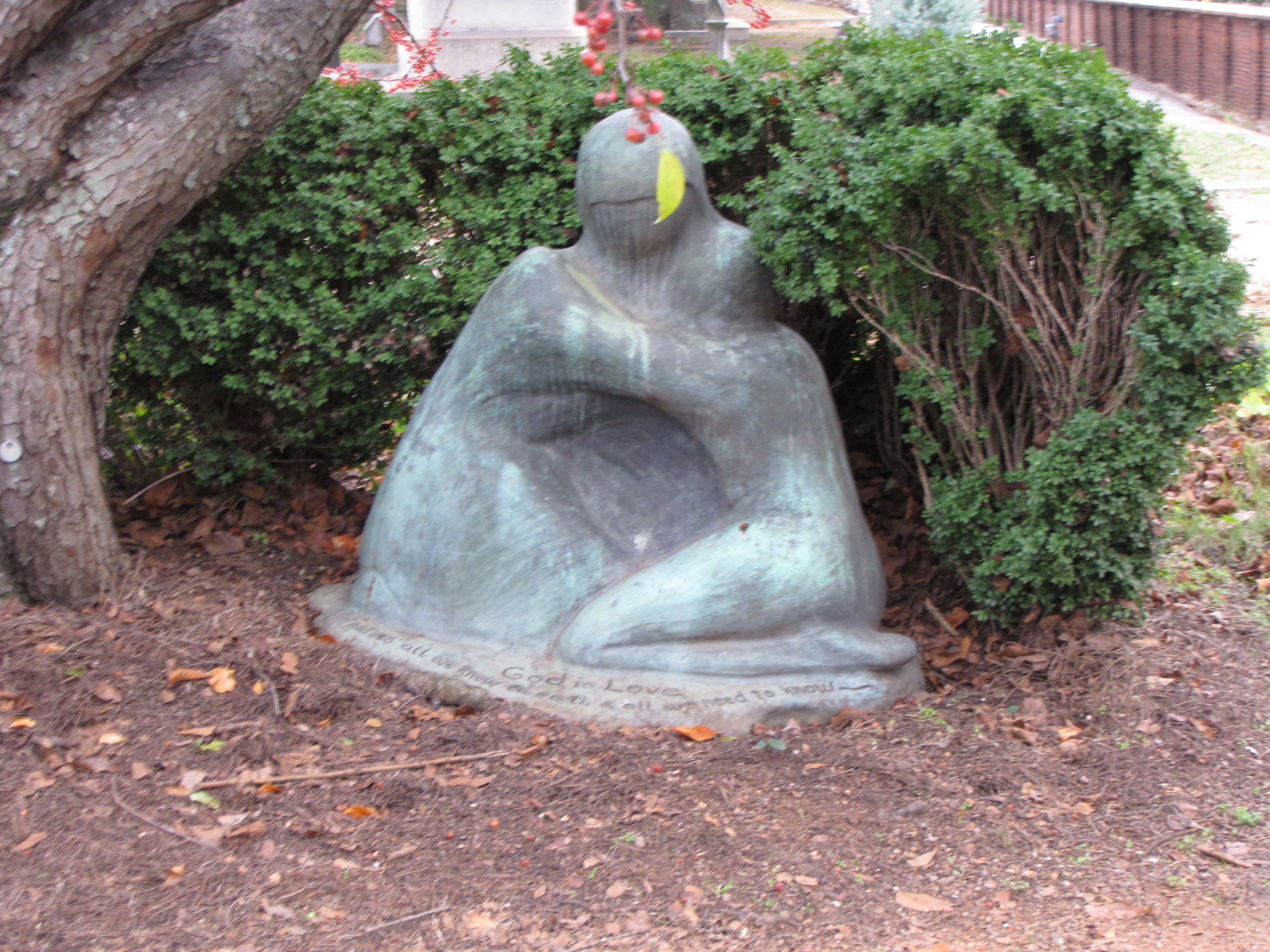
Devereaux and Dorothy McClatchey had a large art collection from their travels.  To grace their family plot they chose two statues.  One statue tucked under an evergreen on the plot depicts a mother and child with writing that says, “God is love.  That is all we know on earth and all we need to know—“.  The other is a woman with her arms clutched and her head bowed, possibly portraying sorrow and grief.

Oakland Cemetery, Atlanta, Georgia

Oakland Cemetery, Atlanta, Georgia

Posted in Uncategorized | 1 Comment

John Watts, a Tribute on a Pedestal

IMG_0697

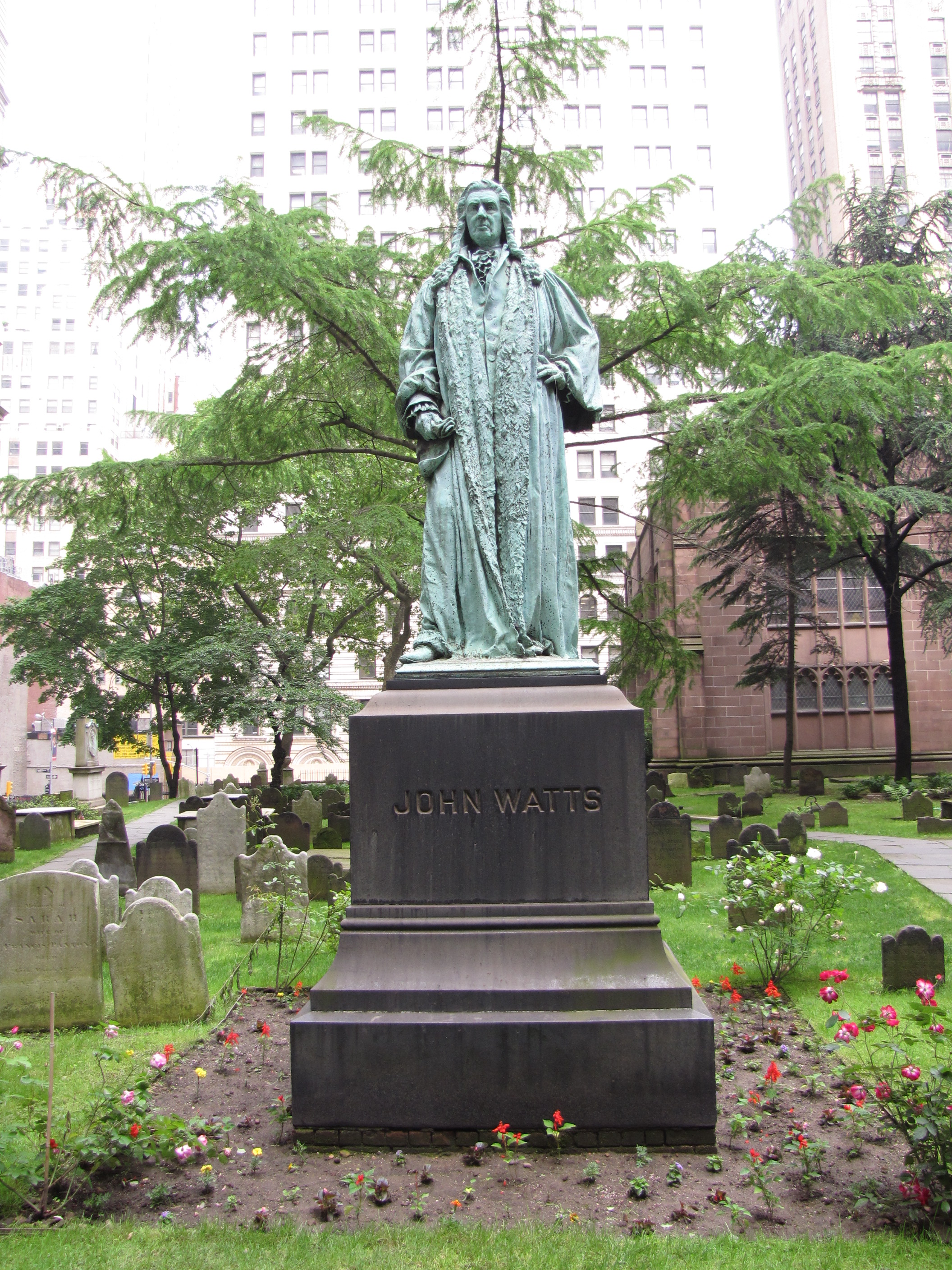
John Watts was a New York political figure who served not only under the Crown but as a member of Congress after the American Revolution. He served in several other official positions, too, which are listed on the backside of the marble pedestal upon which his imposing statue rests.   So his ancestor would not be forgotten, the larger-than-life bronze statue of Watts was commissioned by his namesake, Major General Watts de Peyster, and sculpted by George E. Bissell.  Watts is depicted wearing fur-trimmed robe and a judge’s wig and holding a scroll of paper.  His statue dominates the tiny Trinity Churchyard Cemetery in New York City.

IMG_0737

VIR AEQUANIMITATIS

JOHN WATTS,

BORN IN THE CITY OF NEW YORK AUGUST 27, 1749 [O.S.]

AND DIED THERE SEPTEMBER 3, 1836. [N.S.]

LAST ROYAL RECORDER OF THE CITY OF NEW YORK,

1774 – 1777. NO RECORDS DURING THE REVOLUTION;

SPEAKER OF ASSEMBLY OF THE STATE OF NEW YORK

JANUARY 5, 1791 – JANUARY 7, 1794.

MEMBER OF CONGRESS 1793 – 1795;

FIRST JUDGE OF WESTCHESTER CO. 1806;

FOUNDER AND ENDOWER OF THE LEAKE AND WATTS

ORPHAN HOUSE IN THE CITY OF NEW YORK; ONE OF

THE FOUNDERS AND AFTERWARDS, PRESIDENT OF

THE NEW YORK DISPENSARY 1821 – 1836. &C. &C. &C.

IMG_0701

Posted in Uncategorized | Leave a comment

A Soldier’s Hat, On a Pedestal

Oakland Cemetery, Atlanta, Georgia

Oakland Cemetery, Atlanta, Georgia

Owen F. Solomon

1829 – September 27, 1859

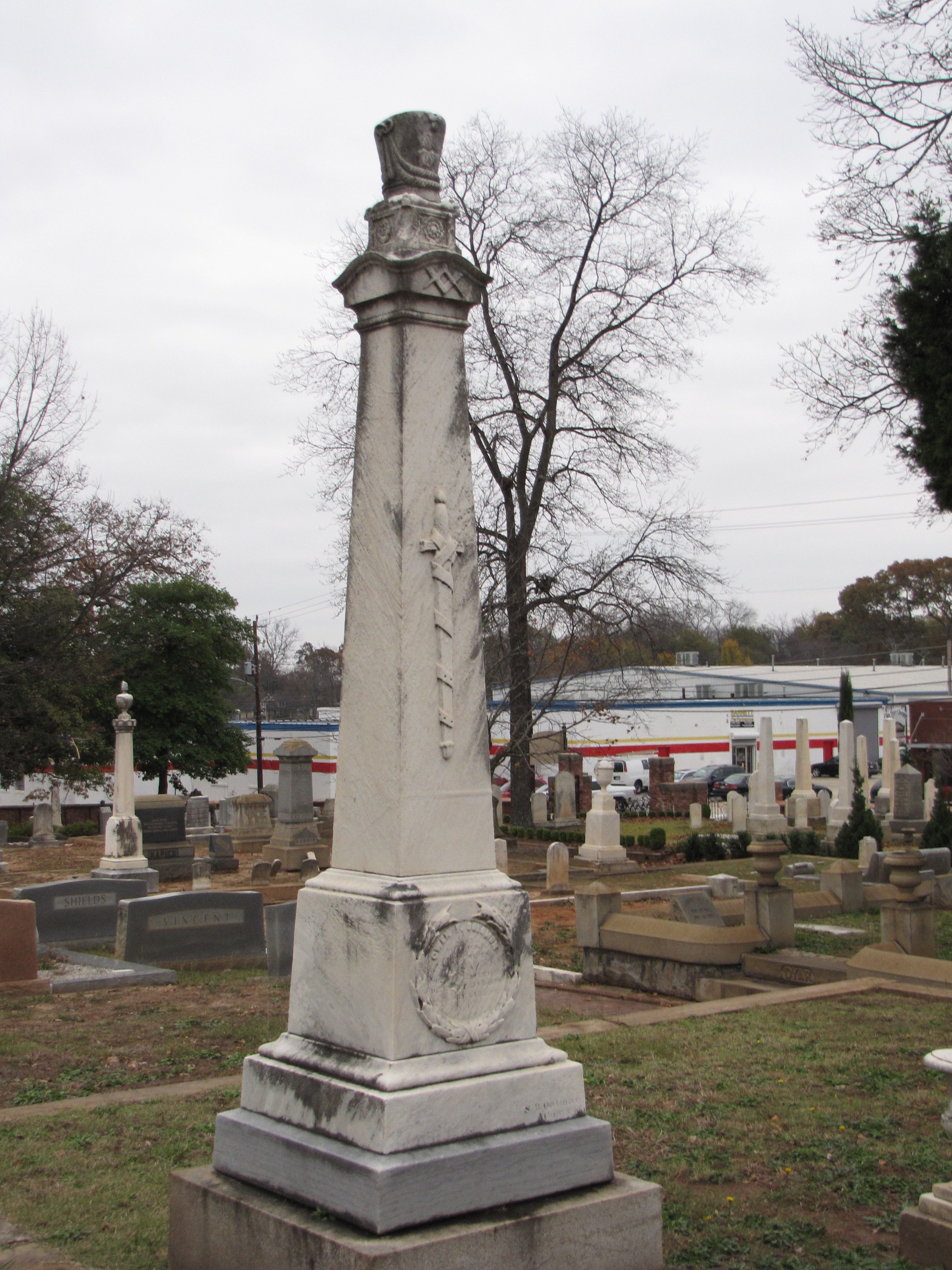
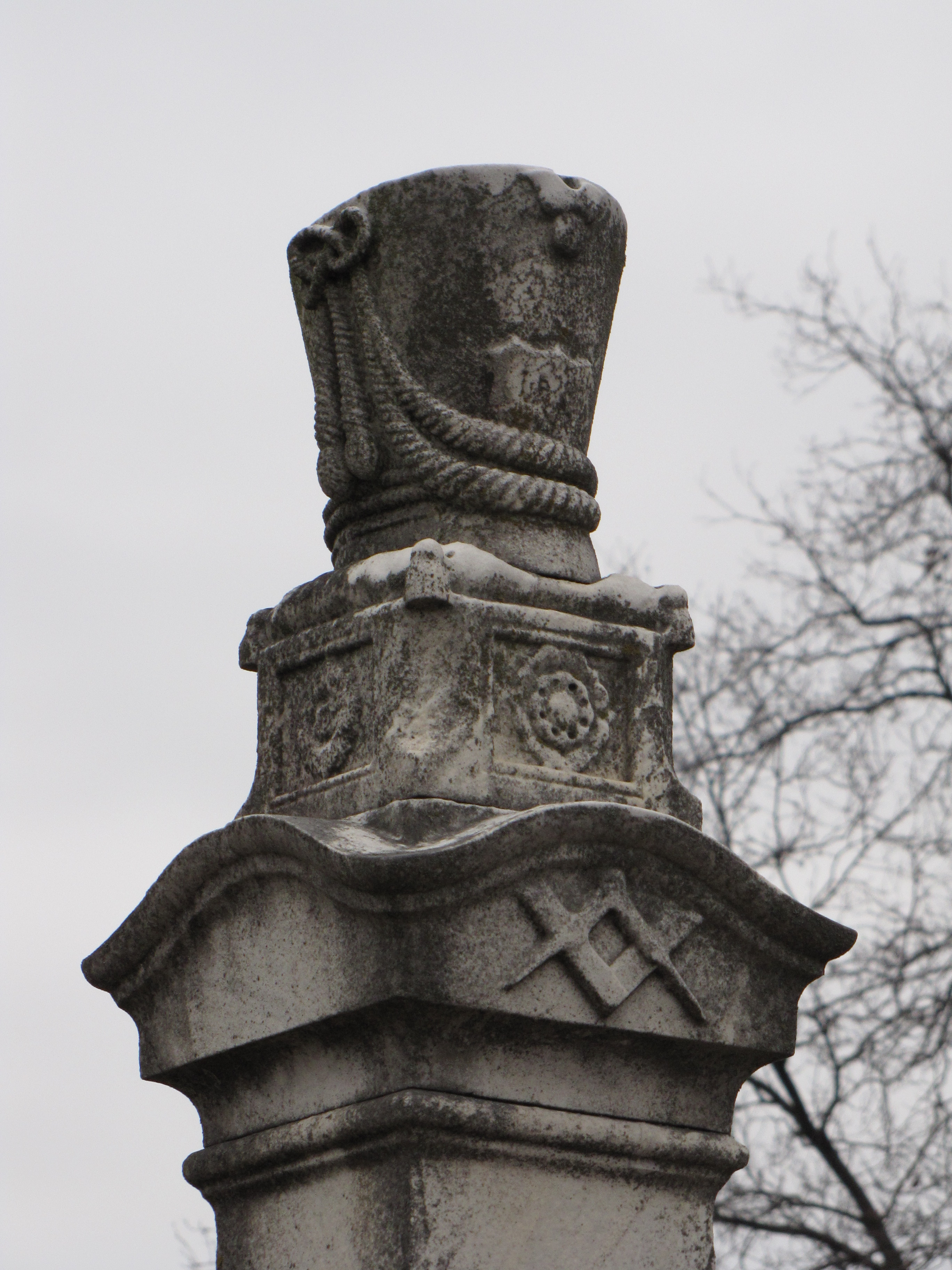
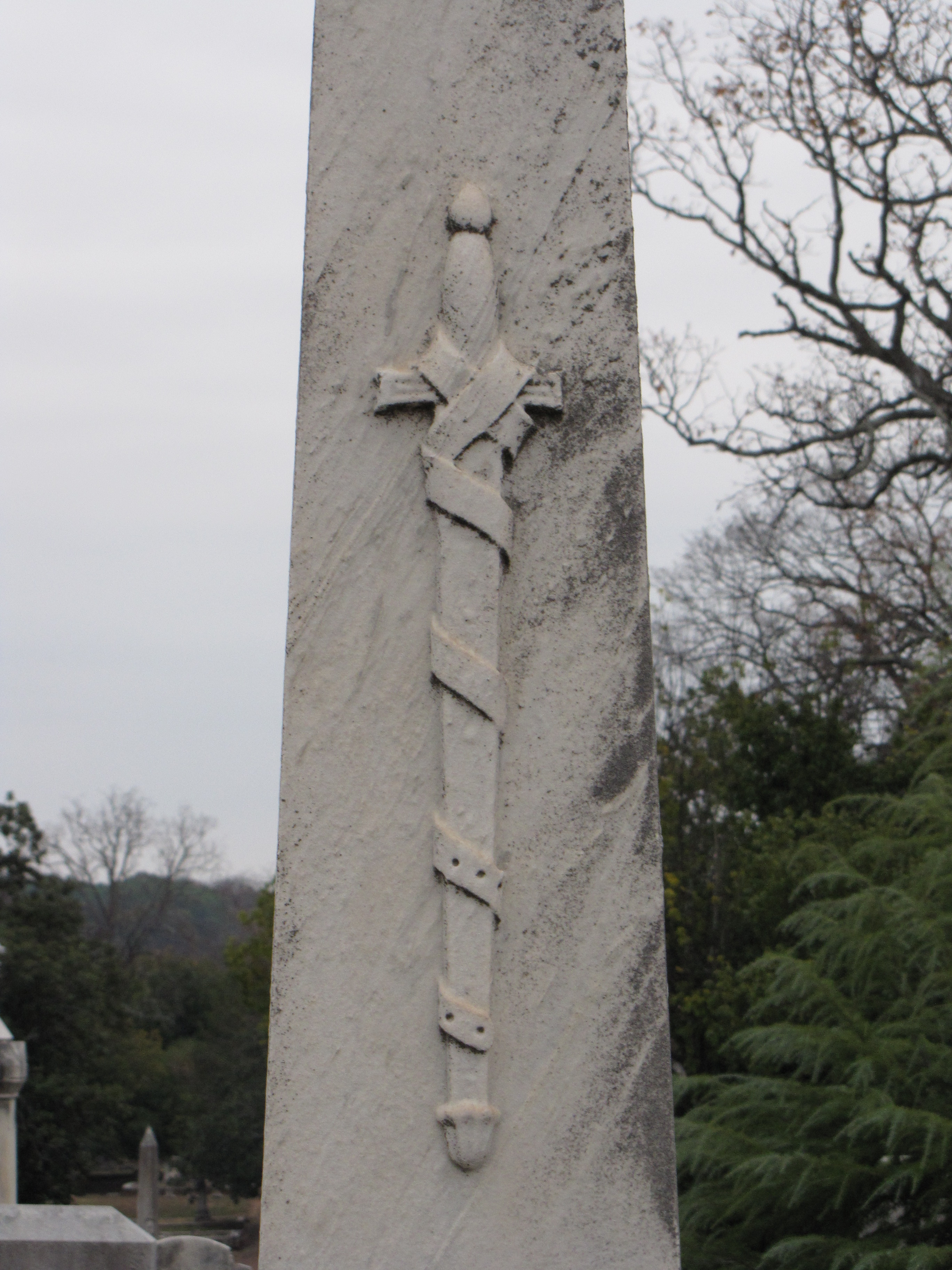
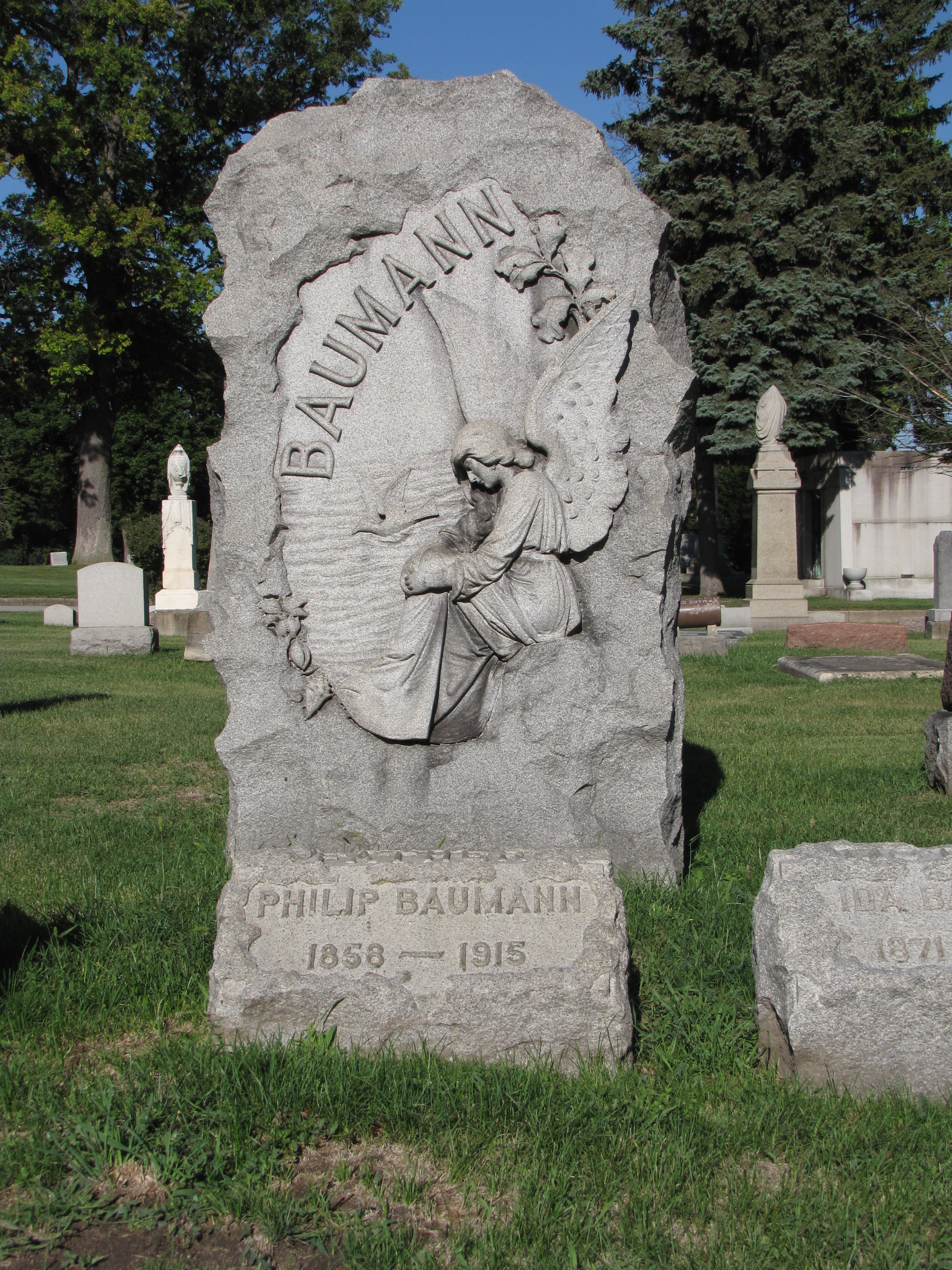
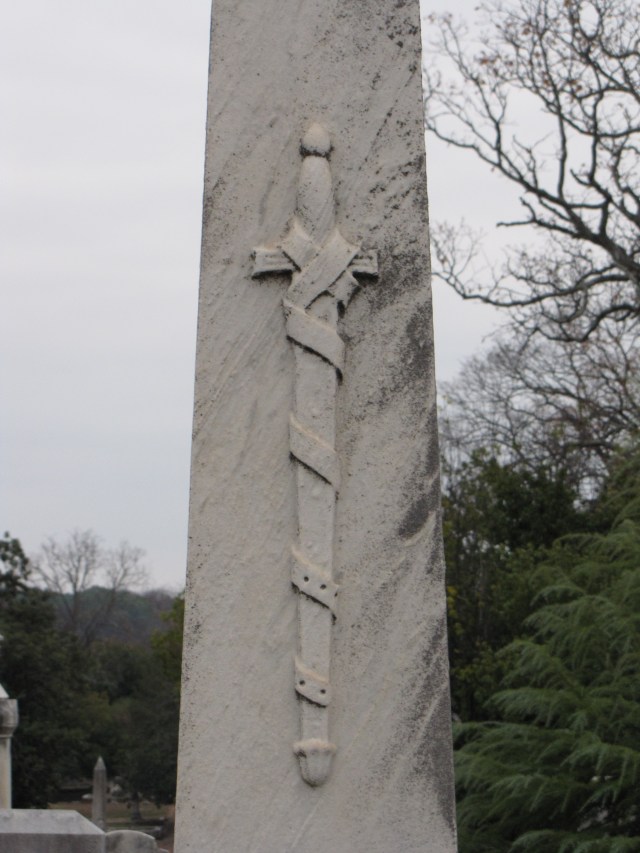
Carved atop a shaft of white marble rests a pillow with the hat of a soldier.  There are four symbols on this monument: the soldier’s hat, a sword, the laurel wreath, and the Masonic symbol.  With the exception of the later, the others refer to Solomon’s service in the Army.

IMG_1103

The entry (#1596) in Bvt. Major-General George Washington Cullum’s (Colonel, Corps of Engineers, U.S. Army) Biographical Register of the Officers and Graduates of the United States Military Academy at West Point, New York, from Its Establishment March 16, 1802 to the Army Reorganization of 1866-67, Second Edition, Volume 2 (published by D. Van Nostrand, 192 Broadway, New York, 1891) details his military career:

Military History:

Cadet at the Military Academy, July 1, 1849, to July 1, 1853, when he was graduated and promoted in the Army to

Bvt. Second Lieut. of Artillery, July 1, 1853.

Served: in garrison at Ft. Moultrie, South Carolina, 1853, — and Ft. Myers,

(Second Lieut., 4th Artillery, Nov. 25, 1853)

Fla., 1853‑54; on frontier duty at Ft. Brady, Michigan, 1854‑55, — and Ft. Brown, Texas, 1856; in garrison at Jefferson Barracks, Missouri, 1856‑57; (First Lieut., 4th Artillery, Oct. 31, 1856)

Florida Hostilities against the Seminole Indians, 1857‑58; and on frontier duty at Ft. Leavenworth, as Acting Asst. Adjutant-General, Feb. 6 to May 18, 1858, in quelling Kansas Disturbances, — and Ft. Laramie, Dakota Territory, 1858‑59.

Solomon died, Sep. 27, 1859, at Ft. Laramie, Dakota Territory.

Owen F. Solomon was 30 years old.  His body was brought to Atlanta, Georgia, and he was buried in the Oakland Cemetery.
IMG_1104

The monument bears his name within a laurel wreath but the other details are illegible.  The laurel wreath dates back to Roman times when soldiers wore them as triumphal signs of glory. The laurel was also believed to wash away the soldier’s guilt from injuring or killing any of his opponents. In funerary art the laurel wreath is often seen as a symbol of victory over death.

IMG_1101

Posted in Uncategorized | 1 Comment

A Hero, On a Pedestal

Green-Wood Cemetery, Brooklyn, New York

Green-Wood Cemetery, Brooklyn, New York

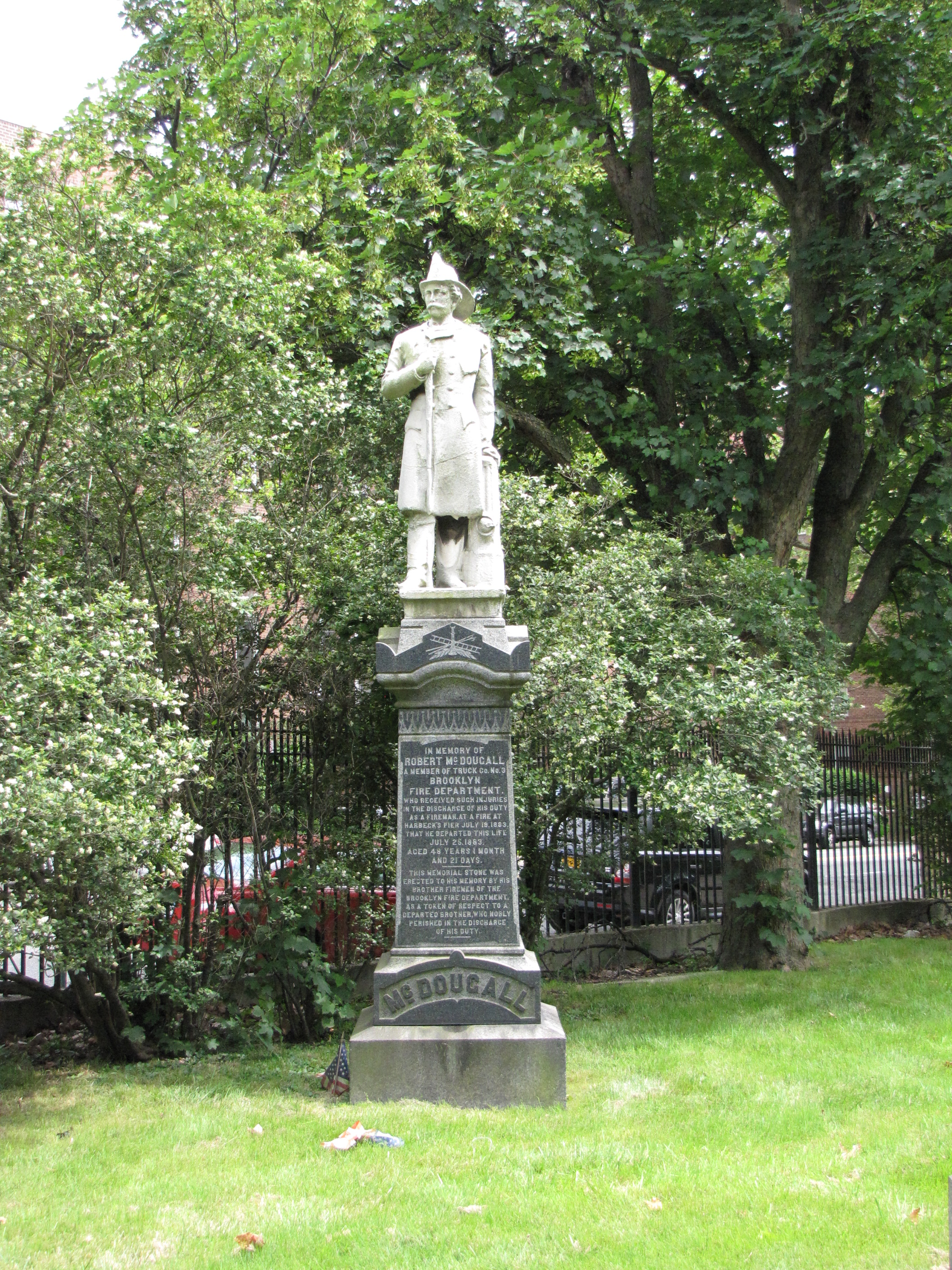
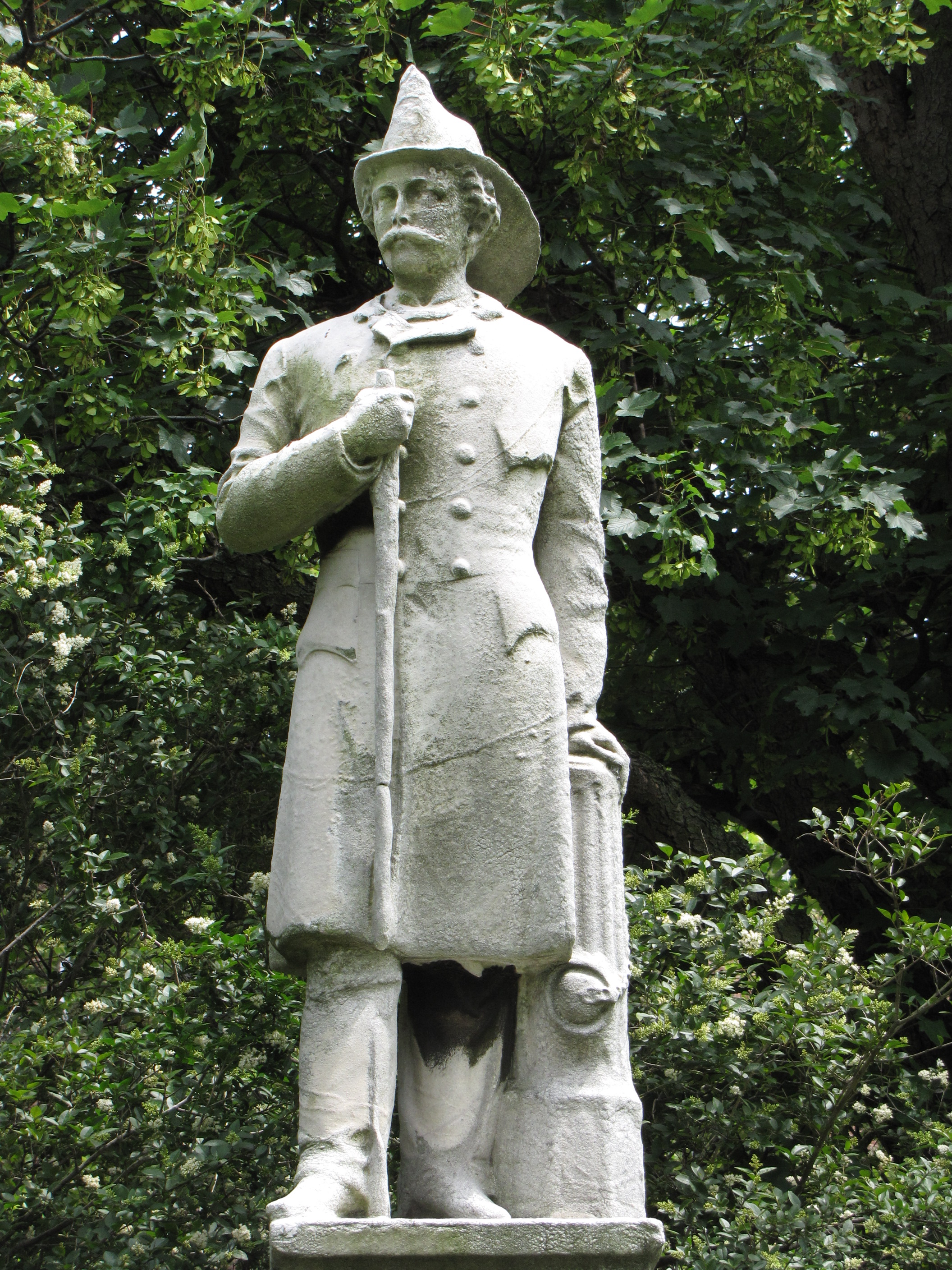
IN MEMORY OF

ROBERT McDOUGALL

A MEMBER OF TRUCK Co. No. 3

BROOKLYN

FIRE DEPARTMENT.

WHO RECEIVED SUCH INJURIES

IN THE DISCHARGE OF HIS DUTY

AS A FIREMAN AT A FIRE AT

HARBECK’S PIER JULY 19, 1883

THAT HE DEPARTED THIS LIFE

JULY 25, 1883.

AGED 48 YEARS 1 MONTH

AND 21 DAYS.

_ . _

THIS MEMORIAL STONE WAS

ERECTED TO HIS MEMORY BY HIS

BROTHER FIREMEN OF THE

BROOKLYN FIRE DEPARTMENT

AS A TOKEN OF RESPECT TO A

DEPARTED BROTHER, WHO NOBLY

PERISHED IN THE DISCHARGE

OF HIS DUTY

IMG_4314

Posted in Uncategorized | Leave a comment

Merlin, On a Pedestal


Forest Home Cemetery, Forest Park, Illinois

Forest Home Cemetery, Forest Park, Illinois

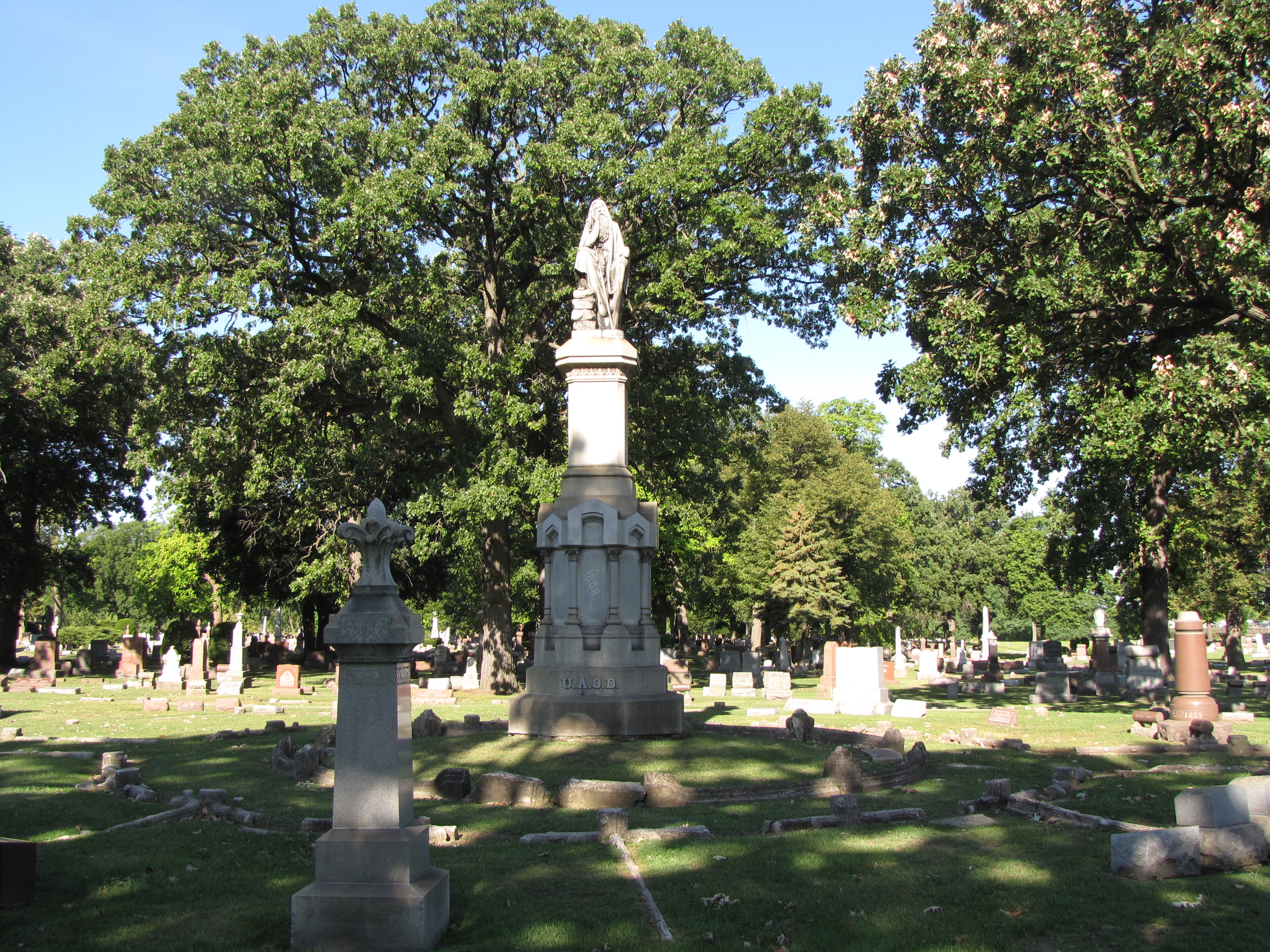
Merlin can be found perched high atop a monument in the Forest Home Cemetery at Forest Park, Illinois, a suburb of Chicago.  This is the centerpiece monument in a circle of burials of members of the United Ancient Order of Druids.  The United States branch, or grove, was founded in the United States in 1830 at New York.  From there it spread across the country gaining members as far west as California.

IMG_8280

The United Ancient Order of Druids is a fraternal society that was based on the principals and beliefs believed to be attributed to the ancient druids who lived and practiced their religion some 6,000 years ago.  The druids left no written records but some of the ancient Roman historians did write about them so a record of sorts does exist.  Merlin was considered to be the greatest Druid teacher.  The members observe the teachings of Merlin including the Seven Precepts of Merlin.

IMG_8283

According to an UAOD Website, The Seven Precepts of Merlin are:

“First: Labor diligently to acquire knowledge, for it is power.

Second: When in authority, decide reasonably, for thine authority may cease.

Third: Bear with fortitude the ills of life, remembering that no mortal sorrow is perpetual.

Fourth: Love virtue-for it bringeth peace.

Fifth: Abhor vice-for it bringeth evil upon all.

Sixth: Obey those in authority in all just things, that virtue may be exalted.

Seventh: Cultivate the social virtues, so shalt thou be beloved by all men”.

IMG_8289

Posted in Symbolism | 1 Comment

On a Pedestal, 3

Mount Peace Cemetery, Philadelphia, Pennsylvania

Mount Peace Cemetery, Philadelphia, Pennsylvania

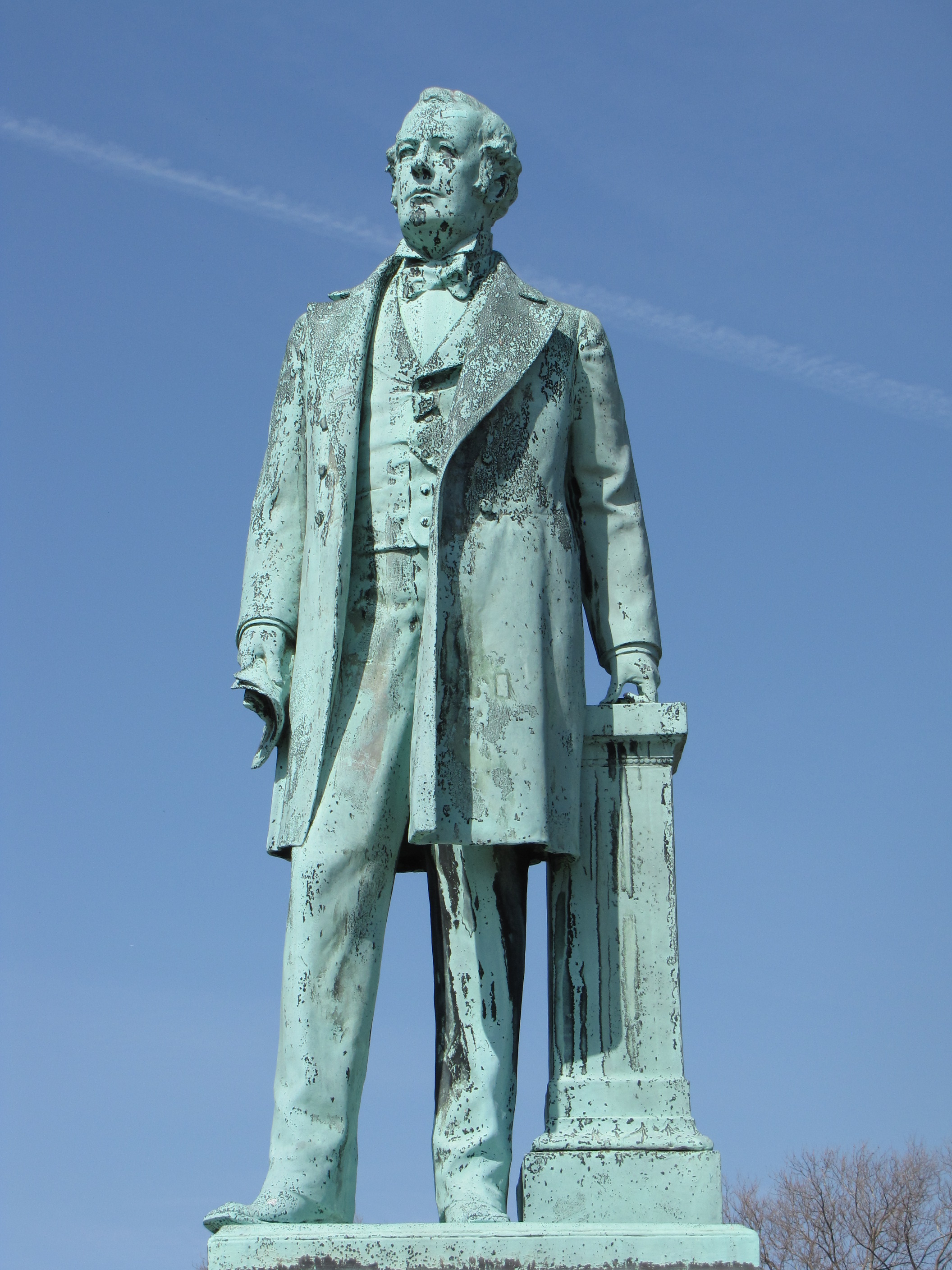
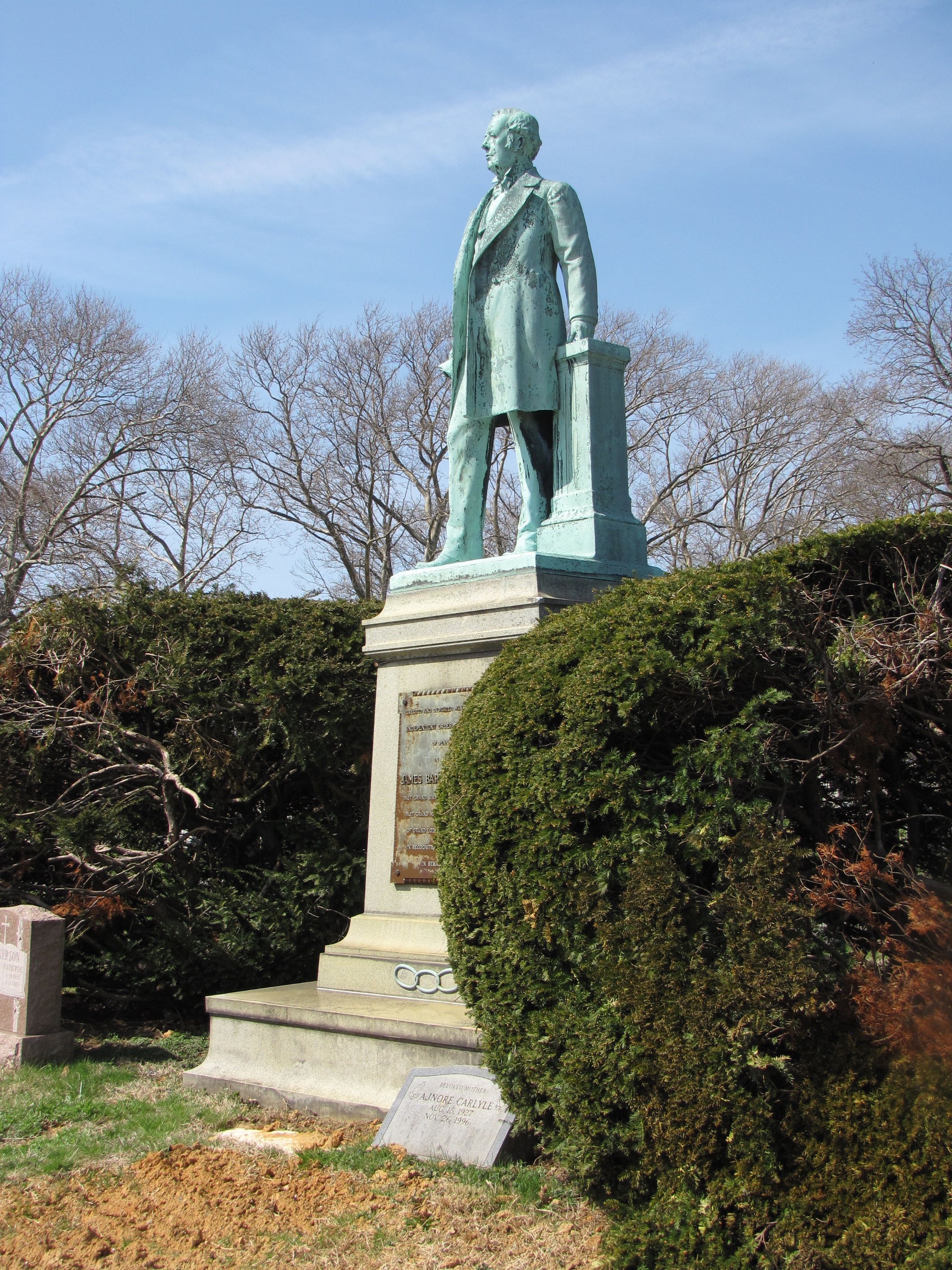
To the right of the gates of the Mount Peace Cemetery at Philadelphia, Pennsylvania, stands an impressive monument to James Bartram Nicholson.  The elegant bronze statue of Nicholson shows him wearing a long frock coat.  He holds papers in one hand.  The only symbol found on the monument are the three interlocking rings, one of the most common symbols for the Independent Order of Odd Fellows.  The reason for this impressive monument is spelled out on the plaques on the front and back of the granite base.

The plaque on the front of the monument reads:

ERECTED AND DEDICATED MAY 10, 1913 BY THE

INDEPENDENT ORDER OF ODD FELLOWS

OF PENSYLVANIA

IN MEMORY OF

JAMES BARTRAM NICHOLSON

PAST GRAND SIRE OF SOVEREIGN GRAND LODGE

PAST GRAND MASTER AND GRAND SECRETARY

OF GRAND LODGE OF 1.O.O.F. OF PENNSYLVANIA

IN RECOGNITION OF HIS VALUABLE SERVICES

IN BEHALF OF THE ORDER

 IMG_0599

The plaque on the backside of the monument reads:

JAMES BARTRAM NICHOLSON

BORN IN ST. LOUIS MISSOURI 1820

INITIATED INTO CHOSEN FRIENDS LODGE NO. 100

APRIL 8, 1845

RECEIVED THE PATRIACHAL DECREES

IN MOUNT OLIVE ENCAMPMENT 1848

ADMITTED INTO GRAND LODGE 1848

ADMITTED INTO GRAND ENCAMPMENT 1849

GRAND WARDEN OF GRAND LODGE OF PENNSYLVANIA

MAY 1851

DEPUTY GRANS MASTER OF THE GRAND LODGE

1852

GRAND MASTER OF THE GRAND LODGE 1853

GRAND REPRESNTATIVE TO THE

SOVERIGN GRAND LODGE 1859

GRAND SIRE OF THE SOVEREIGN GRAND LODGE OF THE UNITED STATES 1862

GRAND SECRETARY OF THE GRAND LODGE OF

PENNSYLVANIA JANUARY 1869

GRAND SCRIBE OF THE GRAND ENCAMPMENT OF

PENNSYLVANIA JANUARY 1869

DIED IN PHILADELPHIA PA MARCH 4 1901

IMG_0600

Posted in Uncategorized | Leave a comment

On a Pedestal, 2

Laurel Hill Cemetery, Philadelphia

Laurel Hill Cemetery, Philadelphia

James Dougherty

1815 – 1900

Atop the light pink granite Dougherty Mausoleum in the Laurel Hill Cemetery at Philadelphia, Pennsylvania, is a bronze statue of the bearded and handsomely dressed James Doughtery, an iron foundry owner, prominent citizen, and social reformer. He plied his trade in iron works and listed his occupation in the US Census as a machinist. Remnants of his trade are symbolized in his statue. He stands majestically next to a stand—the stem of which is fashioned to look like a very large screw with two large cogs leaning against it. On top of the stand are papers, presumably having to do with his work as a reformer—the Philadelphia House of Refuge (a house for wayward and delinquent boys and girls), The Franklin Institute (dedicated to science education), The Union League (founded in 1862 as a patriotic society to support the Union and the policies of President Abraham Lincoln), and the Historical Society of Pennsylvania.

IMG_0396

Doughtery worked as a machinist beginning his trade and steadily growing his business. His success is recorded in succeeding census records that, in 1860, show him living with his wife, Mary, and their daughter, Euretta (nick-named Rettles), with one servant in their household. Twenty years later, Dougherty is listed as a retired machinist living together with his wife, daughter, son-in-law, Frank Kirkbride, and their daughter, Mary, and 4 servants. An indication of the success of his foundry business.

Dougherty’s Philadelphia Inquirer obituary, which ran on May 12, 1900, two days after his death, also mentioned his contribution during the Civil War, “During the Civil War when General Lee invaded Pennsylvania Mr. Dougherty was among the first to respond to Governor Curtin’s call for troops and raised a company from the industrial works in which he was interested.

James Dougherty was 85 years old at the time of his death.

IMG_0395

Posted in Mausoleums | 1 Comment

On a Pedestal

Crown Hill Cemetery, Indianapolis, Indiana

Crown Hill Cemetery, Indianapolis, Indiana

HENRY W. HILDEBRAND

BORN FEB. 9. 1836

DIED AUG. 15. 1876.

WILLIAM H.

BORN JULY 25, 1860.

DIED SEPT. 3. 1860.

LOUISA E.

BORN OCT. 21, 1861.

DIED NOV. 9. 1861.


GEORGE H.

BORN NOV. 1, 1865.

DIED (illegible) 1866.

The Hildebrand monument in the Crown Hill Cemetery at Indianapolis, Indiana, is a tribute to Henry W. Hildebrand whose likeness was literally put on a pedestal. His life size statue tops the 18-foot tall white marble column. Even with the erosion of the white marble, it is clear that Hildebrand sports a mustache and is wearing a typical coat that was fashionable during his time. He is perched holding an anchor in one hand and his other raised upward.

IMG_1442

In traditional cemetery symbolism, a figure that holds an anchor would be a representation of the Virtue of Hope, which is a fairly common symbol found in American cemeteries.  Hope is most often portrayed as a woman leaning against an anchor.  Here it is difficult to know if that is the meaning or if it might be tied to Hildebrand’s occupation.

Woodland Cemetery, Des Moines, Iowa

Woodland Cemetery, Des Moines, Iowa

Though extensively searched nothing could be found out about his biography or clues to why this man has this monument. The monument’s base lists the births and death dates of Henry W. Hildebrand and his three children, William, Louisa, and George.

Posted in Symbolism | 1 Comment

A mistake in slate

Burial Hill, Plymouth, Massachusetts

Burial Hill, Plymouth, Massachusetts

Here lyes buried

The body of

Mrs. SARAH MORTON

Wife of Mr. LEMUEL MORTON

Who departed this Life

April 17th 1785 in ye 23

Year of her Age.

In Her. United all that’s fair & good,

Short was her Race yet Virtues Path she tred.

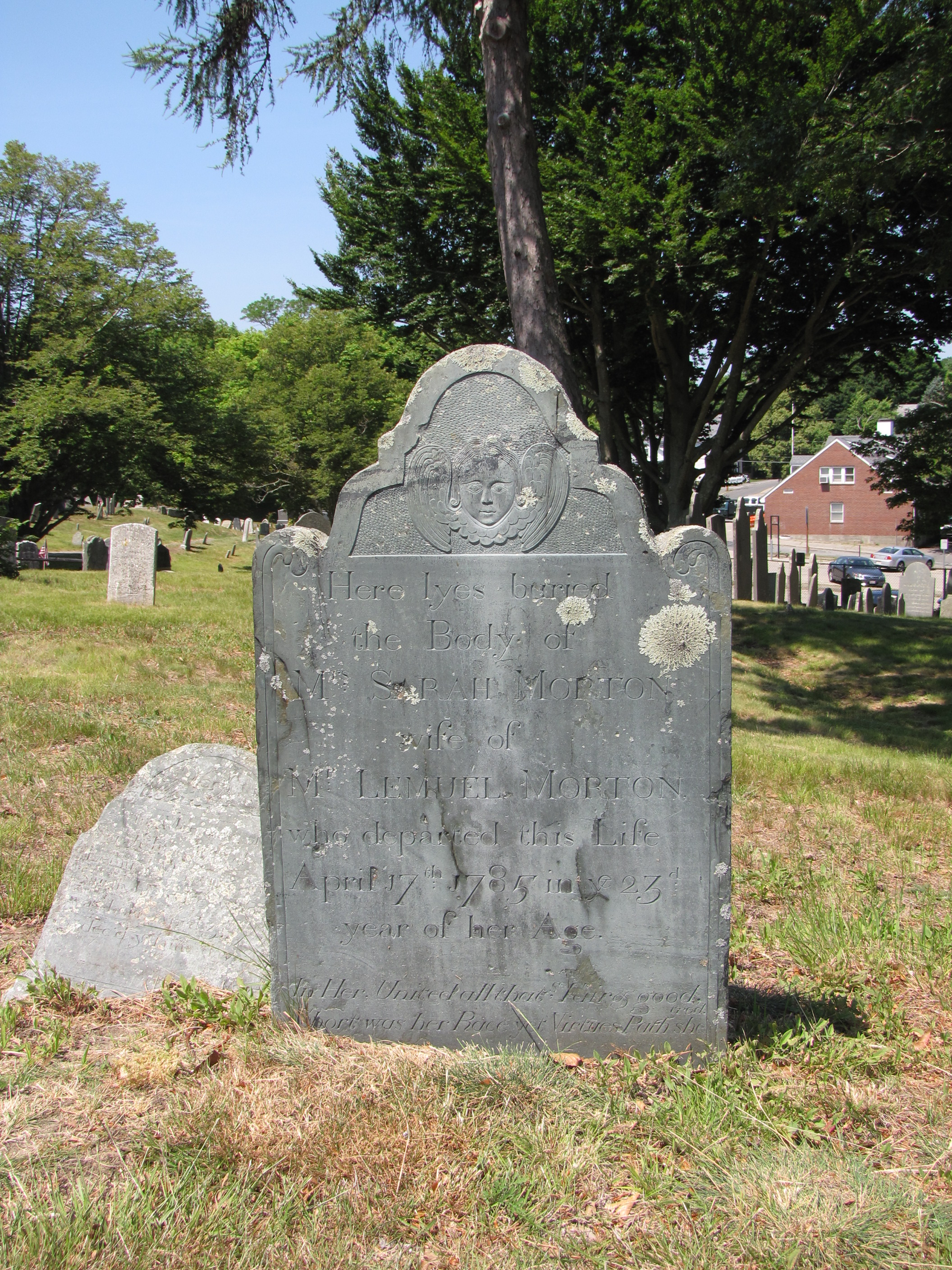
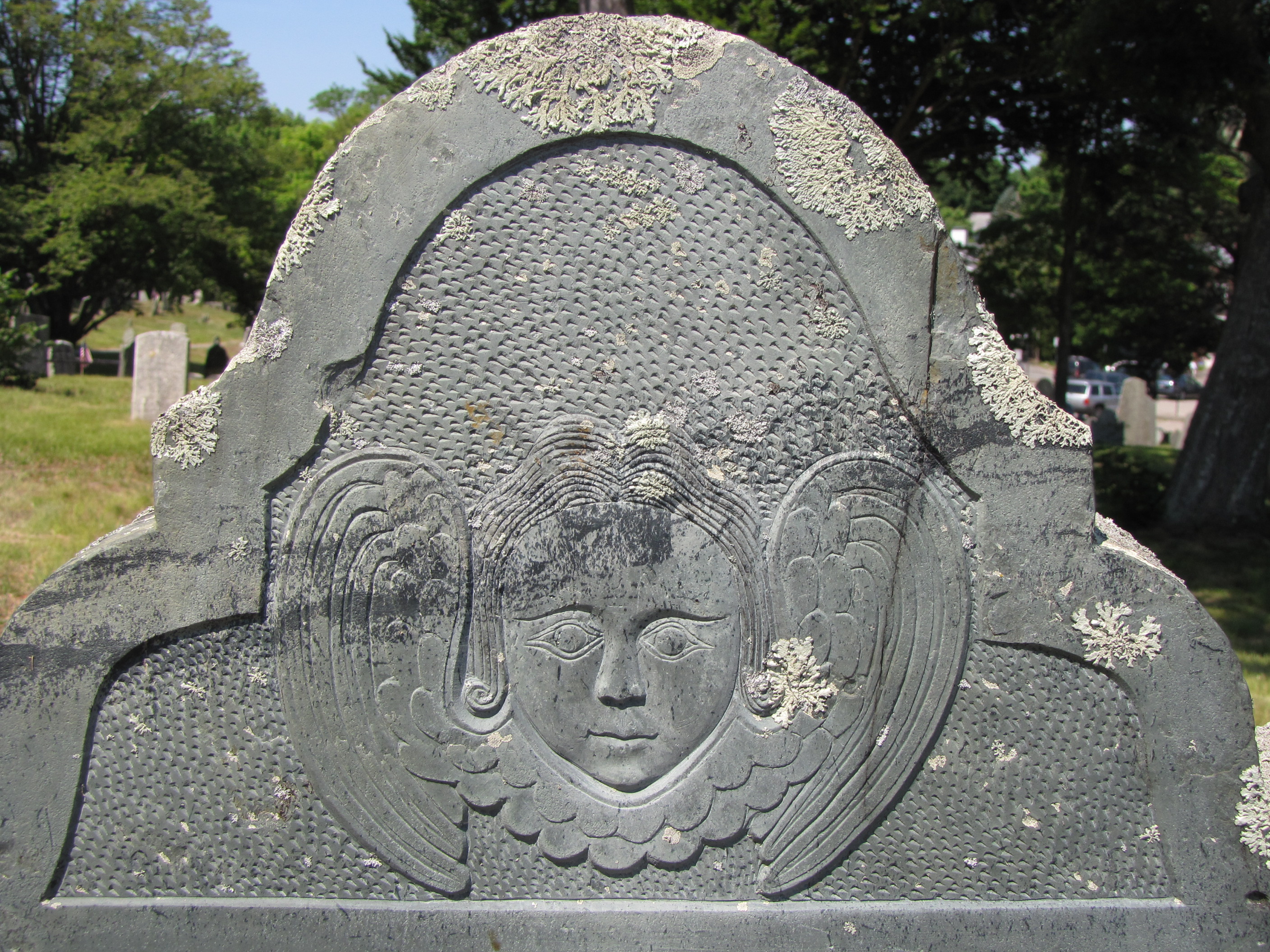
The gray slate gravestone of Mrs. Sarah Morton displays a youthful looking soul effigy, or winged cherub.  The wings curve down framing the face and the eyes stare blankly forward.  Here, the young bride of only 23 years old is buried on Burial Hill at Plymouth, Massachusetts, the home of the Mayflower passengers and their descendants.

The two-line epitaph extolls her virtues and gives a hint at the sadness of her early death by speaking of the shortness of her Race.  But, notice how the word tred in the second line of the epitaph is tucked in between the two lines indicating that the stone carver had not planned it out completely. What a reminder of so many art projects past. Not enough time to re-do the project. At least they weren’t in stone for all of posterity to see!

IMG_2916

Posted in Uncategorized | 1 Comment

The soul effigy with a wig

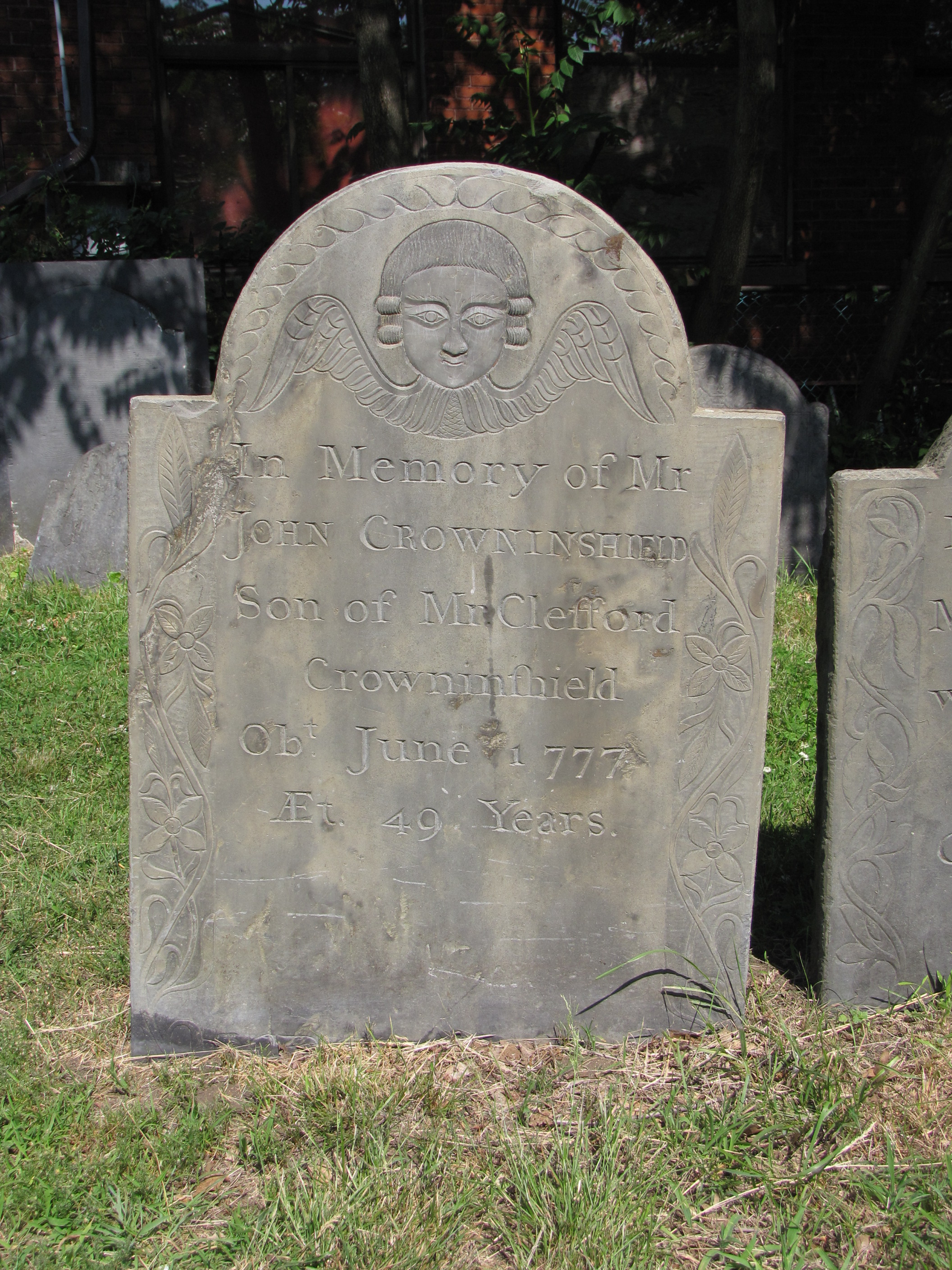
IMG_3016

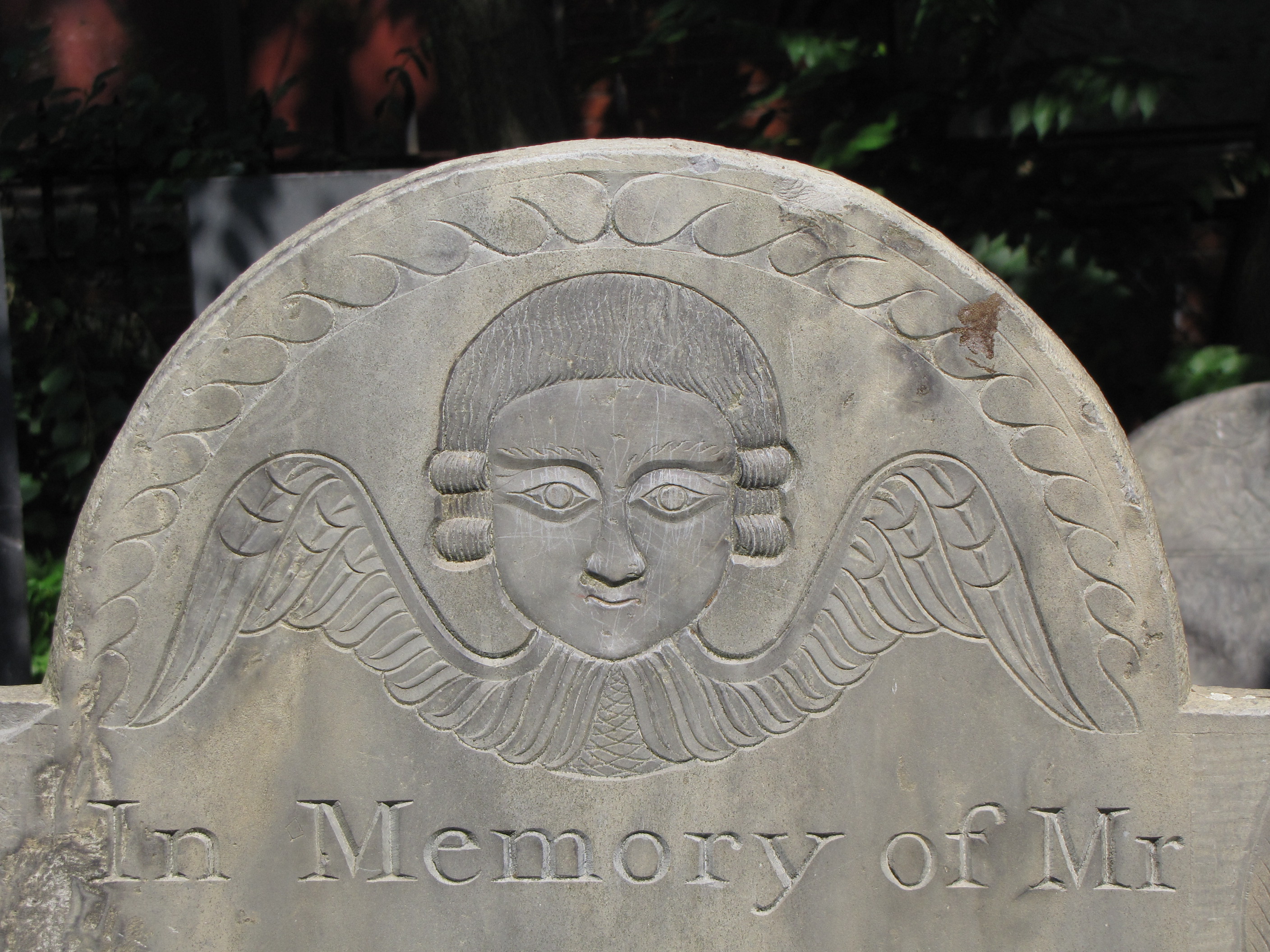
In Memory of Mr

JOHN CROWNINSHIELD

Son of Mr. Clefford

CROWNINSHIELD

Obt. June 1 1777

AE t. 49 Years.


Gr-Gr-Grandfather: Johann Caspar Richter

Gr-Grandfather: Johannes Caspar von Kronenschieldt  Gr-Grandmather: Elizabeth Allen

Grandfather: John Crowninshield 1696 – 1761 Grandmother: Antiss Williams

Father: Clifford Crowninshield 1699 – 1776  Mother: Martha Hillard 1700 – 1736

John Crowninshield Born in 1728 – died July 1, 1777  Wife:  Mary Ives  1730 – 1774

John Crowninshield was from a prominent seafaring and merchant family of Boston and Salem. The family immigrated from Germany and Denmark and settled in America to build a large and prosperous trading company. In Salem, they sailed from the wharf they built and traded for tea, Madeira wine, oranges, salt and iron. They were the first to engage in the pepper trade.

John Crowninshield’s gravestone can be found in the Burying Point Cemetery at Salem, Massachusetts.   A winged soul effigy is carved into the top of gray slate grave marker. The gravestone displays the image of a winged head, which is referred to as a “soul effigy.”

His winged effigy is wearing a wig, a sign of the prominence of the family.   It was the style at the time for upper class men to wear powdered wigs.  When bathing was not an everyday occurrence, men would shave their heads and sport the wig–reducing the chance of getting lice or other head vermin!

The soul effigy represents the flight of the soul from one realm to the other—from Earth to Heaven and symbolizes the transition the soul makes on that journey. This iconography represents a change from the harsh Puritan imagery of skulls, crossed bones, winged death’s heads, and the accoutrements of the grave, such as the casket, or coffin, and burial instruments, such as, the pick and axe.

IMG_3017

Posted in Symbolism | Leave a comment