Off the Rack

Elmwood Cemetery, Detroit, Michigan

Elmwood Cemetery, Detroit, Michigan

FAMILY

WM A. MOORE

WILLIAM A. MOORE, 1823 – 1906

LAURA J. MOORE, 1837 – 1911

Wm. V. MOORE, 1856 – 1925

JANE A. MOORE, 1859 – 1937

The William A. Moore family monument in the Elmwood Cemetery at Detroit is a large gray granite monument. It is exactly the same monument as the one marking the grave of President Benjamin Harrison in the Crown Hill Cemetery at Indianapolis, Indiana.

Harrison served admirably as a soldier in the Civil War, as a United States Senator, and as President.  Benjamin Harrison was also a highly successful lawyer, perhaps the most successful attorney to serve in our highest office. Though Harrison did not inherit a fortune from his father, his 18-year law practice was incredibly lucrative, even representing the government of Venezuela. In spite of this success, his family chose a monument that was “off the rack” so to speak, most likely from one of the many gravestone catalogs available at the time.

BENJAMIN HARRISON

AUGUST 20, 1833 – MARCH 13, 1901

LAWYER AND PUBLICIST

COL. 70th REG. IND. VOL. WAR 1861-1865

BREVETTED BRIGADIER GENERAL 1865 U.S. SENATOR 1881-1887

PRESIDENT 1889-1893

STATESMAN, YET FRIEND TO TRUTH OF SOUL, SINCERE IN ACTION, FAITHFUL

  AND IN HONOUR CLEAR
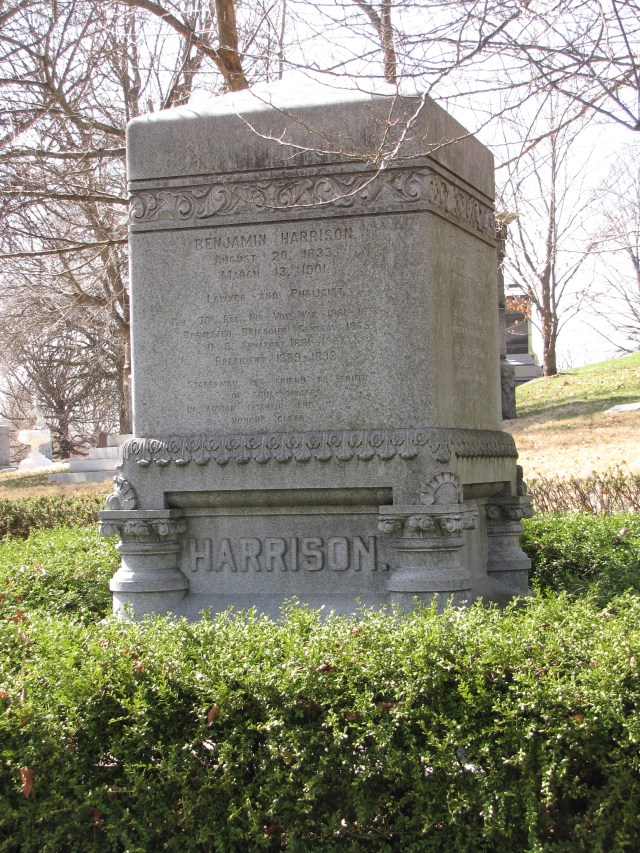
Crown Hill Cemetery, Indianapolis, Indiana

Crown Hill Cemetery, Indianapolis, Indiana

Posted in Presidential graves, Uncategorized | Leave a comment

Jesus Christ and the Cross

Christ Carrying the Cross by El Greco, circa 1578

Christ Carrying the Cross by El Greco, circa 1578

The Latin Cross is universally recognized as the symbol of Christianity. While it may look simple to the eye, the symbol is imbued with deep meaning to all Christians. After the trial, Christ is mocked by the Roman soldiers. He is forced to wear a crown of thorns and carry the cross, the very instrument of His suffering and death, to Calvary. Many works of art depict Christ carrying the cross.

Christ carrying the cross can also be found in the cemetery marking graves as does the monument found in the Mt. Elliott Cemetery at Detroit.

Mt. Elliott Cemetery, Detroit

Mt. Elliott Cemetery, Detroit

Many gravestones pay to tribute Christ carrying the cross without actually showing Christ in the depiction.

Mt. Olivet Cemetery, Chicago, Illinois

Mt. Olivet Cemetery, Chicago, Illinois

Posted in Symbolism | 2 Comments

A Christmas Classic

Hilldale Cemetery, Martinsville, Indiana

Hilldale Cemetery, Martinsville, Indiana

HELMS ROBERT “BOBBY” LEE

AUGUST 15, 1933

JUNE 9, 1997

—HERE LIES A LEGEND—

Mr. JINGLE BELL ROCK

BLESSED ARE THEY THAT MOURN

FOR THEY SHALL BE COMFORTED       MATTHEW 5:4

At this time of year, radio stations are playing classic holiday songs like Big Crosby’s “White Christmas”, “Holly Jolly Christmas” by Burl Ives, and “Santa Baby” by Eartha Kitt, among many others. Late in 1957, Decca records released “Jingle Bell Rock” by country singer, Bobby Helms. He had two country hits that same year with “Fraulein” and “My Special Angel” both of which hit number 1 on the country charts and became cross-over hits, as well, making their way into the Top 40. By Mid-December, “Jingle Bell Rock” was on nearly every radio station’s playlist and even being danced to on American Bandstand when it climbed to number 6 on the Top 40. Within five years “Jingle Bell Rock” sold over two million records and has become a holiday favorite.

The singer, Bobby Helms, was born in Helmsburg, Indiana, most likely settled and named for his ancestors. Helms picked up his musical bent from his parents, Fred and Hildreth Esther, and first started singing in a duo with his brother, Freddie, before he struck out on his own and headed to Nashville, Tennessee, to make a name for himself. Helms travelled round the country performing but spent most of his life living outside Martinsville, Indiana. Helms is buried in the Hilldale Cemetery at Martinsville; his light-gray granite gravestone marking his fame as the singer of the bouncy Christmas tune. He was inducted into the Rockabilly Hall of Fame, but his most fitting tribute is that “Jingle Bell Rock” has been on the holiday playlist since it was first released in the fall of ’57 and has remained there ever since.

IMG_9130

I want to give my colleague and friend, Mack, a shout out for giving me a heads up about this famous grave in his home town.

Posted in Famous graves | 1 Comment

The Mystery of Al Capone’s Vaults–The Burial Kind

Mt. Olivet Cemetery, Chicago, Illinois

Mt. Olivet Cemetery, Chicago, Illinois

ALPHONSE CAPONE

1899- – 1947

MY JESUS MERCY

MAE CAPONE

1897 – 1986

Gonzo reporter, Geraldo Rivera, had a two-hour television special which aired on April 21, 1986, titled, The Mystery of Al Capone’s Vaults. For a time, Capone had housed his operations in the Lexington Hotel in Chicago. A construction found a series of secret rooms and tunnels under the hotel, which presumably had been used to hide Capone’s prostitution, gambling, and alcohol operations. Rivera, responding to rumors of their discovery developed the idea to open the lost and secret vaults on live television. The much-hyped end of the show, the moment 30 million viewers had waited for, revealed a near empty vault—dust and a few empty gin bottles—leaving Geraldo looking somewhat flummoxed and empty handed.

The vaults that Rivera did not highlight on his special were the vaults of a different kind—Capone’s burial vaults. Al Capone died in Florida from the devastating effects of syphilis left untreated. After a large and elaborate funeral at the Philbrick Funeral Home and Chapel and St. Patrick’s Church in Miami Beach, Florida, Capone’s body was transported to Chicago. To avoid the press a decoy casket was transported by hearse to a train station and shipped to Chicago while the real casket containing Capone was loaded into the back of a station wagon and driven to Illinois. Al Capone’s body was laid to rest at the Mt. Olivet Catholic Cemetery, next to his father, Gabriele, and his brother, Salvatore. A large black polished granite stele was erected. Two oval porcelain photographs of his father and his brother adorned the stone.

QUI RIPOSA

GABRIELE CAPONE

NATO DEC. 29, 1865

MORTO NOV. 14, 1920

QUI RIPOSA

SALVATORE CAPONE

NATO LUGLIO 16, 1895

MORTO APRILE 1, 1924

AL CAPONE

1899 – 1947

There was a steady stream of gawkers to the gravesite and souvenir hunters pried off the photos of Gabreile and Salvatore. Vandals pushed the large stone over several times. After the death of Mae, the Capone family decided to move Grabeile, Salvatore, and Alphonse to the Mt. Carmel Cemetery in Hillside, Illinois. To throw off the sightseers, the large black gravestone was left in place, hoping the ruse would keep people away. This post is evidence the plan didn’t work.

Mt. Carmel Cemetery, Hillsdale, Ilinois

Mt. Carmel Cemetery, Hillside, Illinois

Posted in Famous graves | 4 Comments

The Soul Takes Flight

Mt. Elliott Cemetery, Detroit, Michigan

Mt. Elliott Cemetery, Detroit, Michigan

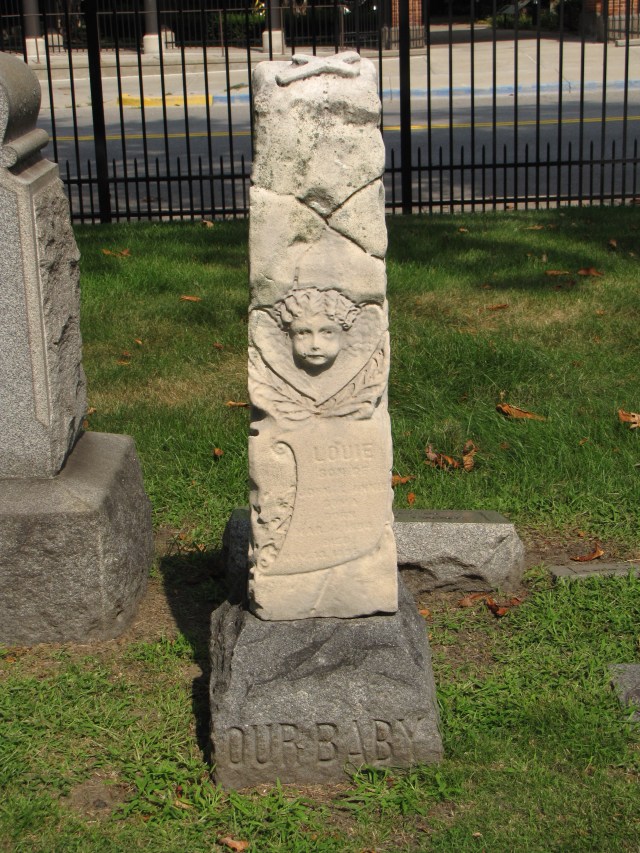
The limestone gravestone in the Mt. Elliott Cemetery at Detroit, Michigan of “Louie” is faded, erosion has taken a toll. The scroll below the cherub is hard to read—but it clearly says that Louie was the son of John and Annie.  The last name along with the birth and death dates are illegible. “OUR BABY” is carved into the base of the gravestone.  The gravestone is topped with a cross and adorned with a winged cherub.  The cherub’s face has a 1920s look to it with its ringletted curls in a bob. The wings that fold around the cherub’s face form a heart shape that has a sweetness and tenderness to it, though, the deep set pupils gives the image an almost haunting look.
The winged cherub was a symbol that became popular in the 18th Century.  Winged cherubs replaced the stark and morbid flying death’s heads from our Puritan forefathers.  The cherubs have a childlike countenance of innocence.  The iconography represents the flight of the soul from the body upward to Heaven and the hope of the resurrection.

IMG_4037

Posted in Angels, Symbolism | Leave a comment

Cemetery Hound

IMG_6355

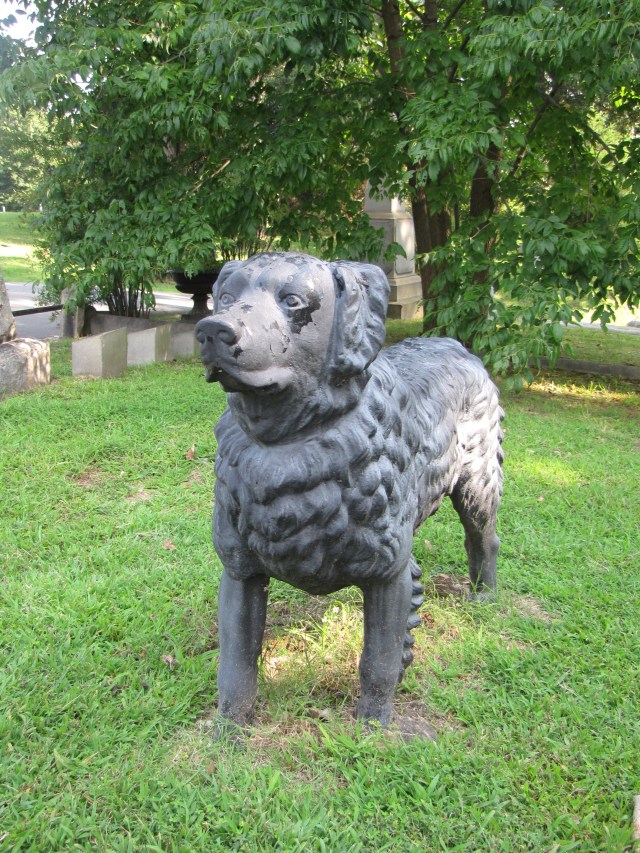
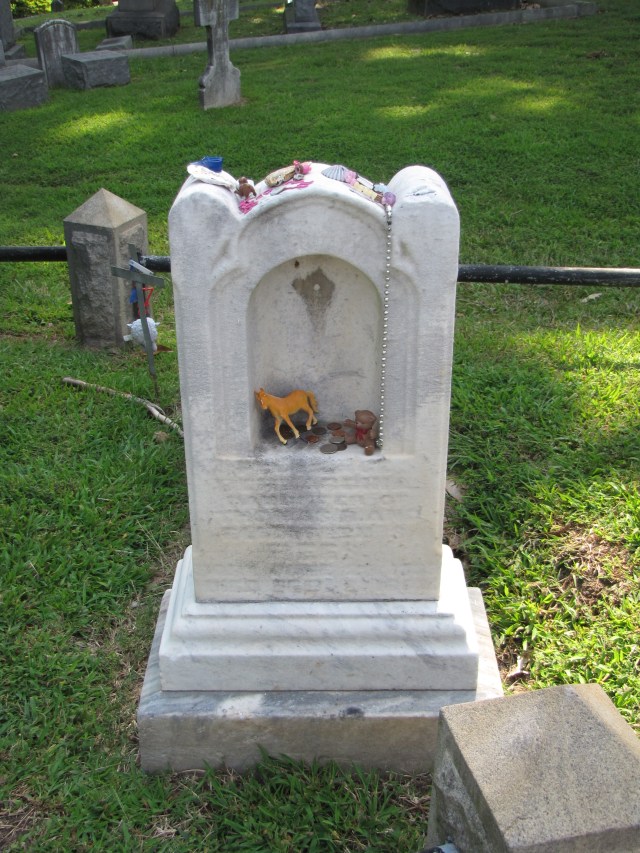
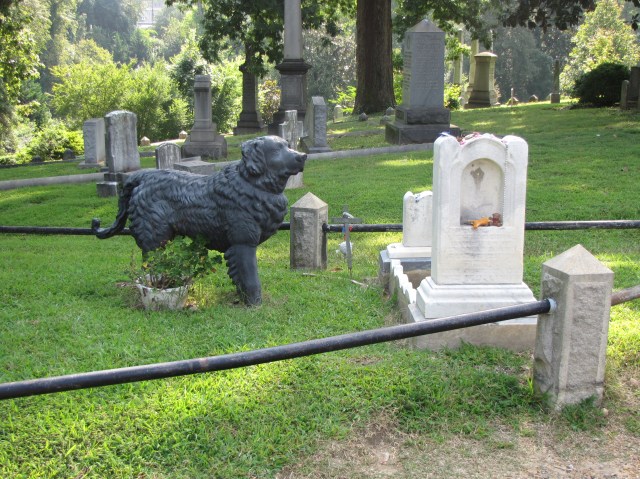
A cast iron Newfoundland stands guard over the grave of two-year old Florence Bernadine Rees, the daughter of Thomas B. and Elizabeth S. Rees, who died on February 7, 1862, of scarlet fever. Her obituary from the February 8th Richmond Dispatch reads: “DIED, On the morning of the 7th inst., of scarlet fever, FLORENCE BERNARDIN, an infant daughter of T.B. and E.S. Rees, aged 2 years, 7 months, and 14 days. The funeral will take place this (Saturday) afternoon, at 3 o’clock, from their residence on Main, between 9th and 10th streets. Relatives and friends are invited to attend without further notice”.

The gravesite has become an attraction in the sprawling and beautiful Hollywood Cemetery at Richmond, Virginia. Many visitors leave small trinkets in the alcove of the gravestone for the little girl and, oddly, for the dog.

IMG_6359

As the story goes, the dog was built in the 1850s, cast at a Baltimore foundry. The statue possibly stood in front of Charles Rees’ photography store. Little Florence loved to go to her uncle’s store and sit atop the Newfoundland. When she died, the cast iron sculpture was moved to her graveside—some say as a way of preserving it from being melted down during the Civil War for munitions—others say it was because the little girl loved it. Either way, the proud dog stands guard on what has become known as Black Dog Hill.

IMG_6352

Posted in Symbolism | 7 Comments

Furry Family Members

IMG_5538

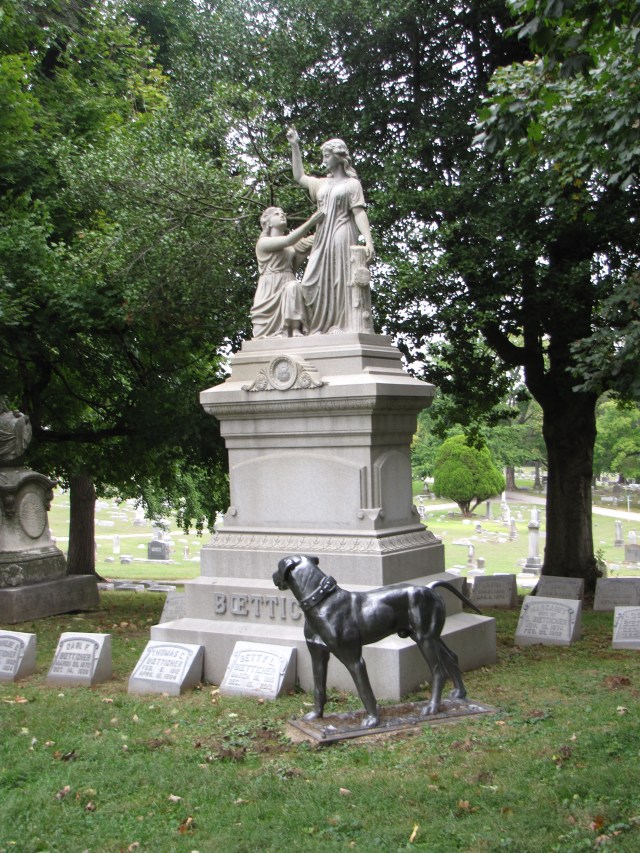
THOMAS C.

BOETTICHER

FEB. 9, 1912

APRIL 10, 1994


BETTY L.

BOETTICHER

MARCH 18, 1916

DEC. 18, 2013

 IMG_7978

Thomas Boetticher was a dog lover which becomes obvious by the monument marking the graves of the Boettichers in the Oak Hill Cemetery at Evansville, Indiana. The metal dog statue standing at the base of the monument is a German Rottweiler, a replica of Thomas Boetticher’s favorite pooch.

Both Boetticher’s were definitely dog lovers as indicated in Betty Lou Spry Boetticher’s Evansville Courier Press obituary which reported, “Her fondest memories … are of walks taken with her favorite dog, a chow with an attitude….” Mrs. Boetticher’s obituary went on further giving details that her memorial service was held at 1 p.m. on January 4, 2014 at First Presbyterian Church in Evansville. There was a reception following her service which was held at the Evansville Kennel Club, another testament to the family’s love of their furry family members.

IMG_7988

Posted in Symbolism | Leave a comment

Guard Dog

IMG_5825

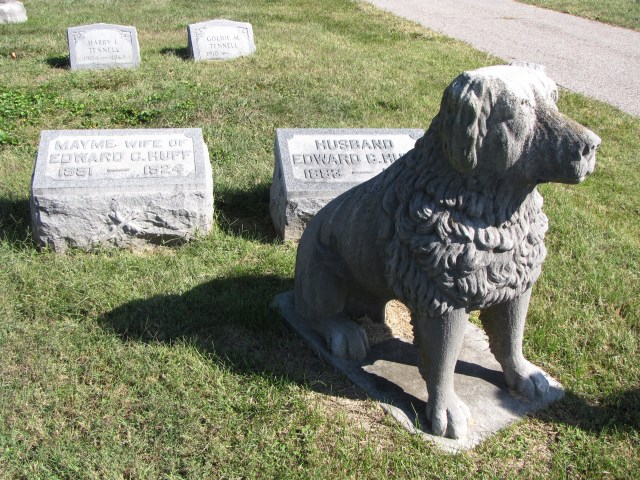
MAYME WIFE OF

EDWARD C. HUFF

1181 – 1924


HUSBAND

EDWARD C. HUFF

1883 – 1942

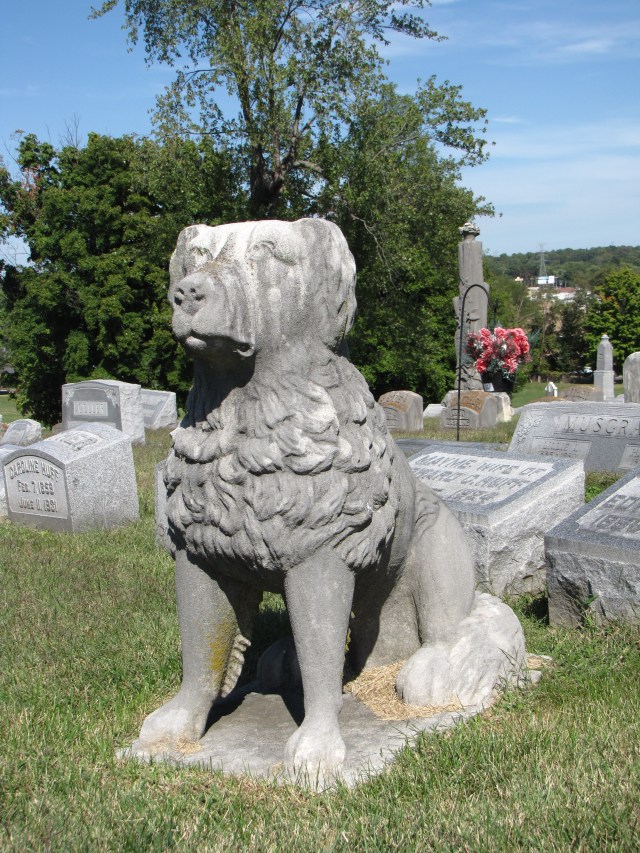
Just up the hill from the Edwin Miller gravestone in the Locust Hill Cemetery at Evansville, Indiana, a limestone dog stands guard over the graves of Edward and Mayme Huff. Here, their faithful companion sits, somber and ever watchful.

IMG_5827

Posted in Symbolism | 2 Comments

A Boy and His Dog

Locust Hill Cemetery, Evansville, Indiana

Locust Hill Cemetery, Evansville, Indiana

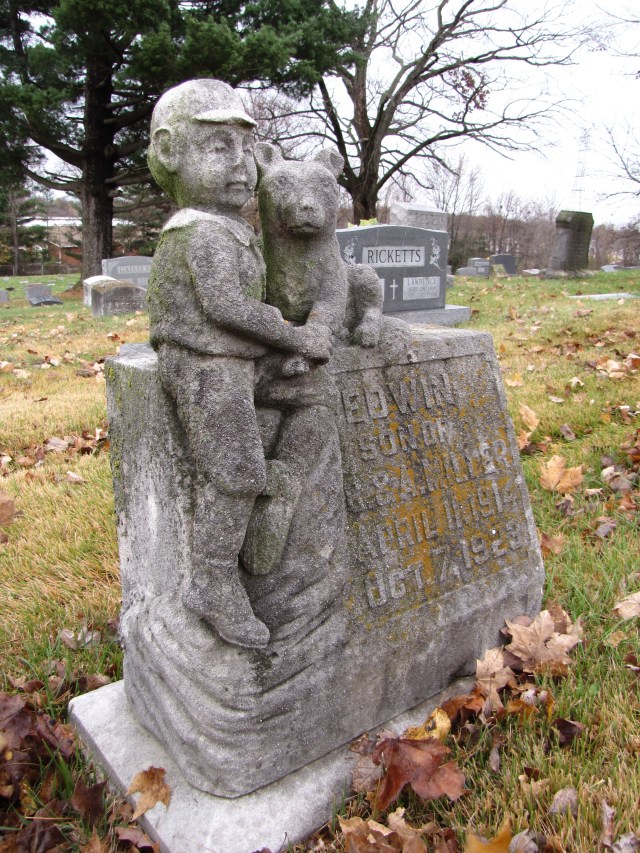
EDWIN

SON OF C. & A. MILLER

Apr. 11, 1914

Oct 7, 1923

Edwin, the 9-year old son of Clarence and Anna Miller, has a gray marble gravestone in the Locust Hill Cemetery at Evansville, Indiana, marking his grave. The gravestone depicts a little boy clad in what looks like a sailor suit complete with a cap and bow clutching a puppy. The little dog snuggled up next to Edwin is clearly his buddy, a role dogs have fulfilled for a very long time. And dogs have long been considered man’s best friend! In fact, way back in 1821, the New York Literary Journal ran a poem that extolled just that.

IMG_7952

The dog in this case most likely represents this little boy’s best friend, but traditional qualities attributed to dogs still come to mind—such as loyal and vigilant. The image of the boy and his pup depicts a happier, carefree time in Edwin’s short life.

(According to the latest pet ownership statistics from 2012, 36.5% of American households (43,346,000) own an average of 1.6 dogs. That adds up to a whopping 69,926,000 dogs living with families in the United States.)

IMG_7956

Posted in Children's Graves | 1 Comment

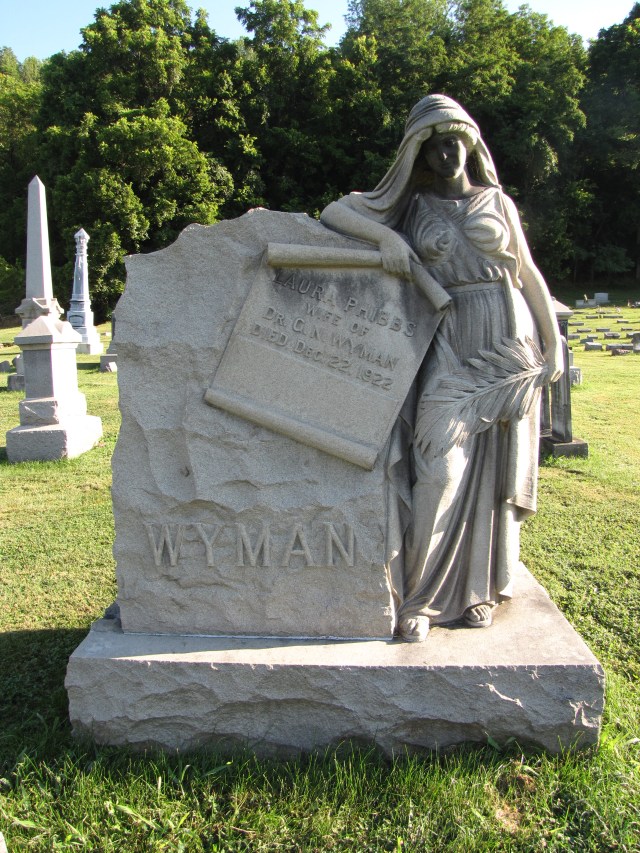
The Scroll and the Palm Frond

Springdale Cemetery, Madison, Indiana

Springdale Cemetery, Madison, Indiana

LAURA PHIBBS

WIFE OF

DR. C. N. WYMAN

DIED DEC. 22, 1922

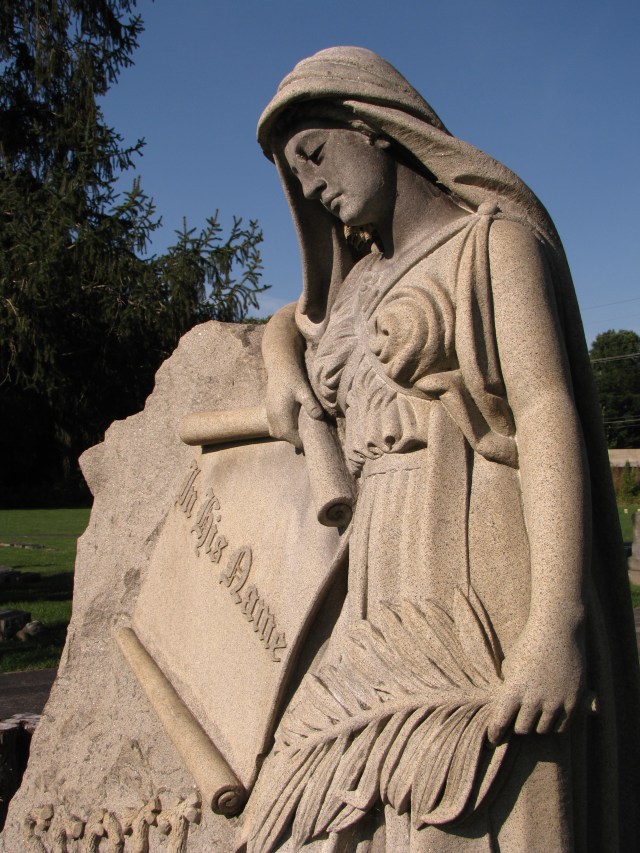
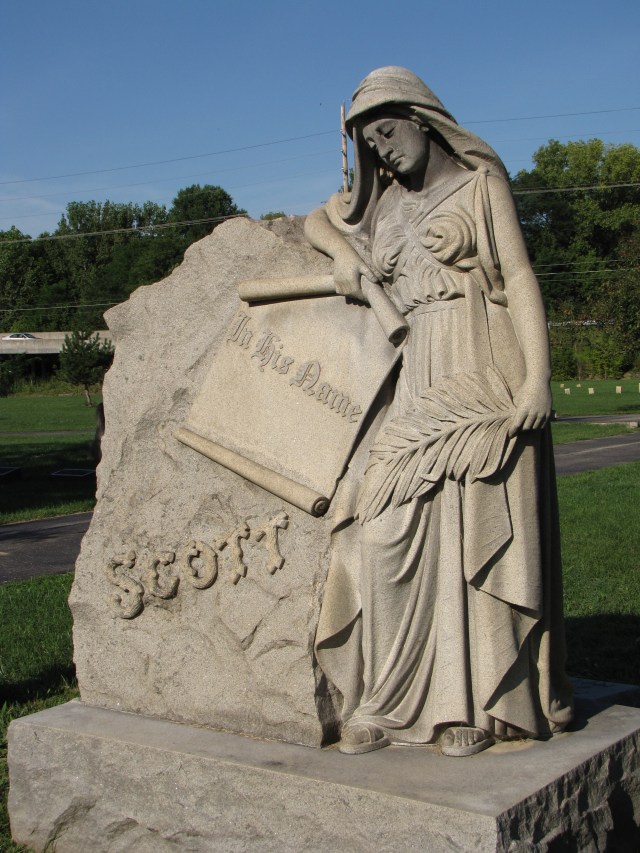
Two nearly identical monuments (The Scott Family monument and the Laura Phibbs monument) in the Springdale Cemetery at Madison, Indiana, both depict a mourning figure holding a scroll.

IMG_2631

The scroll represents the tapestry of one’s life—all of the good deeds and the not-so-nice written out on a roll of butcher paper, as it were. The scroll is not fully unfurled, thereby keeping the mystery of how long the life will be and what events will take place. Often the scroll is held by an angel—an indication that your life is being recorded by God’s messenger.

IMG_2640

On both of these monuments, the mourning figure, draped in mourning clothes, with her head bend downward as an expression of sorrow, is holding a palm frond in her other hand. The palm frond is an ancient symbol of victory, dating back to Roman times when victors were presented with palm fronds. The palm fronds were also laid in the path of Jesus as He entered Jerusalem. So, for many Christians, the palm represents righteousness, resurrection, and martyrdom, symbolizing the spiritual victory over death associated with the Easter story.

Springdale Cemetery, Madison, Indiana

Springdale Cemetery, Madison, Indiana

Posted in Saving Graces, Symbolism | Leave a comment