Expressing Beauty


harrison_gran_co_1918_bklet_p8_9

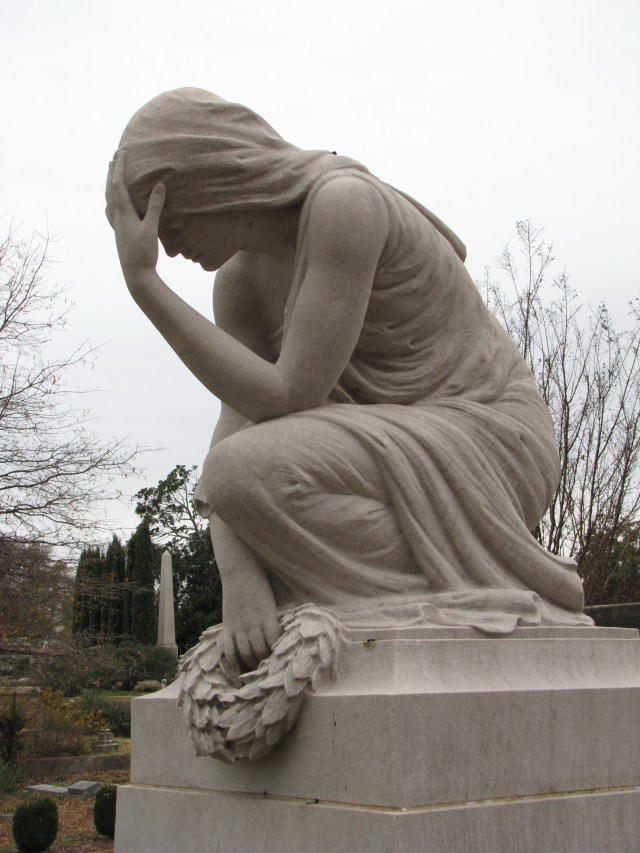
The Harrison Granite Company of New York City founded in 1845, had quarries and works at Barre, Vermont, mailed out brochures January of 1918, featured a sculpture of a kneeling woman with her head in her hand in grief. The brochure says, “Recommended for expressing beauty”. Several sources suggest that the sculpture is a representation of the Greek Goddess Niobe while another source says it is an expression of the “Morning Prayer”. The Harrison Granite Company brochure does not shed light on which is accurate. The mystery remains.

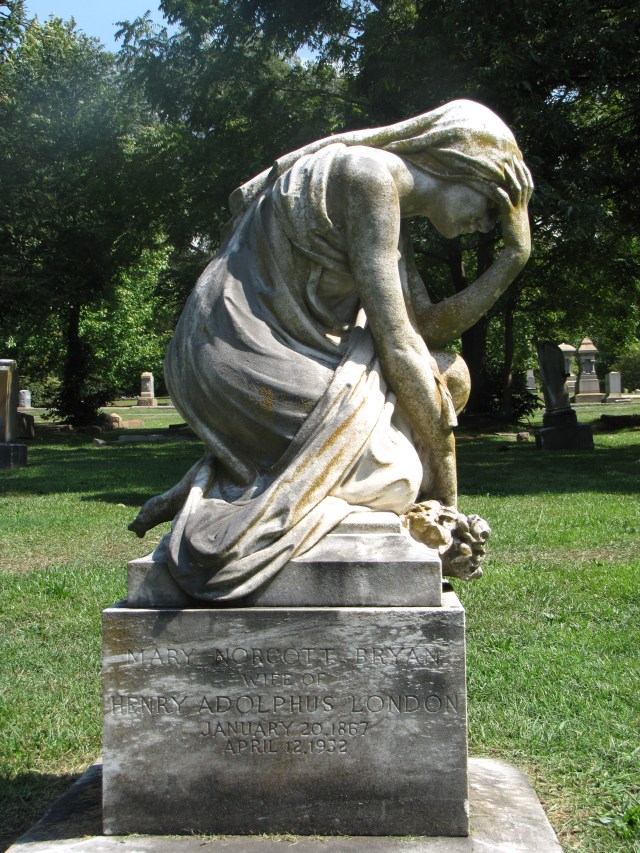
This sculpture has been found at least five time—the Gray Family Monument at the Oakland Cemetery at Atlanta, Georgia; the Haggard monument at the Mount Olivet Cemetery at Nashville, Tennessee; The Inez M. and James Dunn Family Monument at the Glendale Cemetery at Akron, Ohio; the Mary Norcott Bryan London Monument in the Elmwood Cemetery at Charlotte, North Carolina; and The Mary Salmen Monument at the St. Joseph Catholic Cemetery at Evansville, Indiana, are clearly look-a-likes.

Gray Family Monument at the Oakland Cemetery at Atlanta, Georgia

Gray Family Monument at the Oakland Cemetery at Atlanta, Georgia

The Haggard monument at the Mount Olivet Cemetery at Nashville, Tennessee
The Haggard monument at the Mount Olivet Cemetery at Nashville, Tennessee

The Mary Norcott Bryan London Monument in the Elmwood Cemetery at Charlotte, North Carolina

The Mary Norcott Bryan London Monument in the Elmwood Cemetery at Charlotte, North Carolina

The Mary Salmen Monument at the St. Joseph Catholic Cemetery at Evansville, Indiana

The Mary Salmen Monument at the St. Joseph Catholic Cemetery at Evansville, Indiana

The Inez M. and James Dunn Family Monument at the Glendale Cemetery at Akron, Ohio.

The Inez M. and James Dunn Family Monument at the Glendale Cemetery at Akron, Ohio.

This Harrison Granite Company catalog and many other gravestone and monument company brochures can be found at the Stone Quarries and Beyond Website: http://quarriesandbeyond.org/cemeteries_and_monumental_art/cemetery_stones.html.

The Stone Quarries and Beyond Website was created by Peggy B. and Patrick Perazzo. It focuses on historic stone quarries, stone workers and companies, and related subjects such as geology. Whenever possible links of finished products are provided on the Website. There is a “Quarry Articles” section that presents articles, booklets, and links from the late 1800s to early 1900s, including the 1856 “The Marble-Workers’ Manual.” The “Cemetery Stones and Monuments” section provides references and resources, including many old monument magazines, catalogs, price lists, and a photographic tour “From Quarry to Cemetery Monuments.”
Posted in Uncategorized | Leave a comment

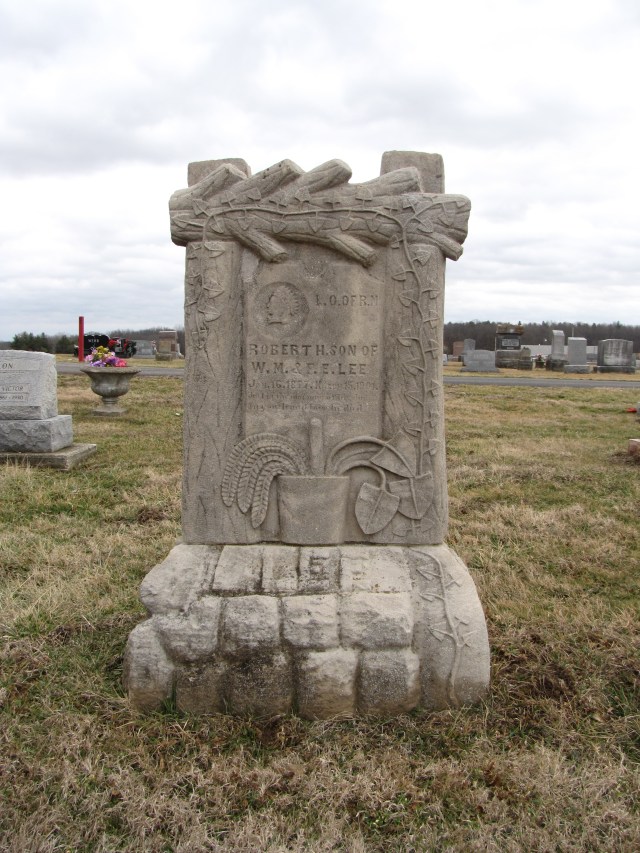
I. O. of R. M.

Fairview Cemetery, Linton, Indiana

Fairview Cemetery, Linton, Indiana


ROBERT H. SON OF

W. M. & F. E. LEE

JAN. 16, 1877. MARCH 15, 1901.

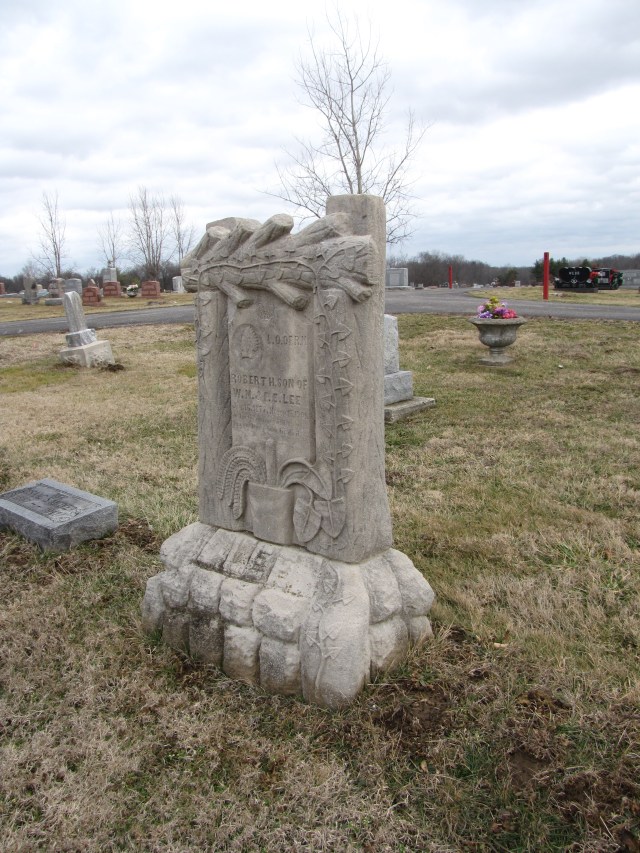
The gravestone of Robert H. Lee was carved in the rustic tradition. The gravestone is caved to like two logs on end are holding up a branch at the top. All of that sitting on a rock foundation. The rustic movement of the mid-nineteenth century was characterized by designs that were made to look like they were from the country. Elegant and slim curved lines in furniture gave way to bulkier and heavier forms made from pieces that came directly from the trees often with the bark still intact. In funerary art, tombstones took on the look of tree stumps. The gravestones were purposefully designed to look like trees that had been cut and left in the cemetery to mark a grave.
The rustic movement coincided with the rural cemetery movement. The rural cemeteries were often located on the outskirts of town and laid out as a park would be—with broad avenues and winding pathways, featuring picturesque landscaping such as ponds, abundant trees, and shrubs. The tree-stump tombstones were a funerary art contrivance mimicking the natural surroundings of the cemetery. The tree-stump tombstones were most popular for a twenty year-period from about 1885 until about 1905.

At the bottom of the gravestone, a flower pot sits in the middle with large stem without a bloom—a metaphor of an early death.

IMG_9693

Above Robert’s name and to the left is a circle with the silhouette of a Native American. The eroded bas-relief represents the symbol of the Improved Order of Redmen (I. O. of R. M.), which claims its beginnings with the patriots who were in the Sons of Liberty during the American Revolution.  The society models itself after the Iroquois Confederacy councils.  According to their Website, the I. O. of R. M. “promotes patriotism and the American Way of Life, provides social activities for the members, and supports various charitable programs.”  The different clubs or chapters are divided into “tribes”.

IMG_9694

Posted in Uncategorized | Leave a comment

In Service of His Country


IMG_9517

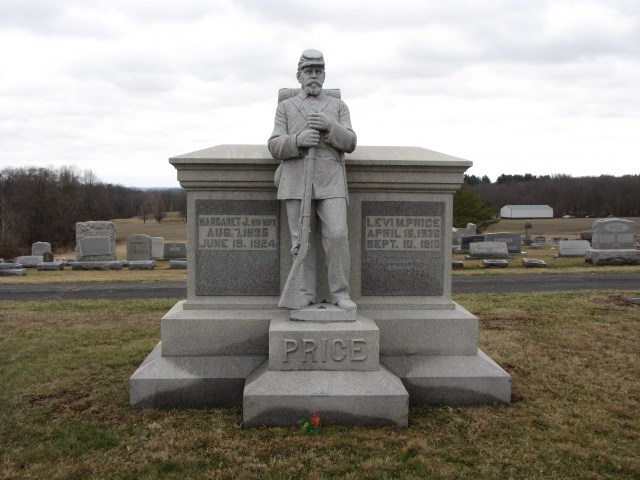
MARGARET J. HIS WIFE

AUG. 7, 1835

JUNE 19, 1924

LEVI M. PRICE

APRIL 15, 1836

SEPT. 10, 1910

59th IND. VOLUNTEERS

COMPAN Y E

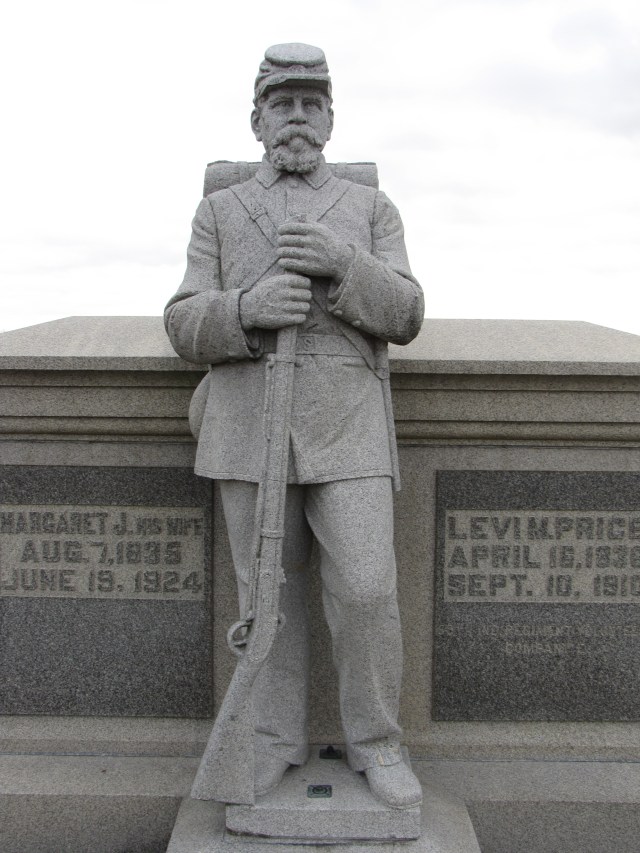
The monument in the Fairview Cemetery at Linton, Indiana, created for Levi Moss Price and his wife, Margaret Jane features a life-size granite statue of a Union soldier. According to Civil War Sites, Memorials, Museums and Library Collections: A State by State Guidebook to Places Open to the Public written by Doug Gelbert, the Union soldier is “standing at parade rest” and “was sculpted by Wilbur Wright Marbler”.

IMG_9521

The Green County, Indiana with Reminiscences of Pioneer Days, Volume III, published by B. F. Bowen & Company, Indianapolis, Indiana (1908), gives a brief but informative history of Levi Price:
Among the children of Aquilla Price was a son by the name of Levi M., whose birth occurred in Greene County, Indiana, in the year 1836, and who has been proud to call this section of the Hoosier state his home from that date to the present time. In his young manhood Levi Price married Margaret Hail, daughter of the Rev. Martin and Phoebe (Hickle) Hail, the father a popular minister of the Methodist Episcopal Church during the pioneer period in Greene County and a leader in religious affairs wherever his labors called him. He spent his declining years in Linton, where his death occurred at the advanced age of eighty-nine years, his faithful wife having also neared the century mark when summoned to the unseen world. Levi Price became one of the prominent farmers and stock raisers of Greene County, and after accumulating a handsome competency, retired from active life to enjoy the fruits of his labor and thrift. On the 27th day of October, 1907, he and his good wife celebrated the fiftieth anniversary of their marriage, on which occasion there assembled at their home in Linton, two hundred and fifty-five guests tow wish the worthy couple many returns of the memorable day and to rejoice with them in view of the many signal blessings by which their pathway has been best. Since retiring from active life Mr. and Mrs. Price has spent the winter seasons on the south Atlantic Coast and the rest of the year among the more familiar scenes of the home country, where many relatives and friends seem to vie with each other in doing them honor. Mrs. Price is a native of Clay County, Indiana, and the same age as her husband, having been born in 1836.”

[Chiseled into the granite is a different year of birth for Mrs. Price—1835]IMG_9525

From the THE BLOOMFIELD NEWS, Bloomfield, Greene County, Indiana, Thursday, September 15, 1910, Volume XXXIV, Number 14, Page 1, Column 2, “LINTON PIONEER DEAD. Levi M. Price, One of the First Mine Operators in Linton Field, Passes Away.”

Levi M. PRICE, one of the well-known business men and land owners of Greene County, died at the home of his daughter, Mrs. Clinton P. SHERWOOD, in Linton last Saturday night. He was seventy-four years old and was a pioneer of Stockton Township. Mr. PRICE had the distinction of being one of the first men to mine coal in this section of the country, sinking the old Summit mine on his farm west of Linton about thirty years ago. Through deals in coal lands he became a man of means and had wealth estimated at $60,000. Mr. PRICE was a civil war veteran having enlisted in COMPANY E, FIFTY-NINTH INDIANA {VOLUNTEER} INFANTRY and served until the close of the Civil War. He had been suffering with a fever which is thought to have caused his death. He was a member of the Methodist Episcopal Church where the funeral was held Monday afternoon. Besides his wife he left four children, namely Mrs. E. T. SHERWOOD, Mrs. Peter SCHLOOT, Mrs. C. T. SHERWOOD and I. O. PRICE. The funeral was largely attended. The services were conducted by Rev. F. A. STEELE, Rev. A. N. ELDROD and Rev. HENNINGER. Interment in the new cemetery. Burial under the ritual service of the G. A. R.”

IMG_9527

It is clear by the monument built in his honor that his service to his country in the Union Army was one of the seminal events of his life.

Posted in Uncategorized | Leave a comment

Bandwagon Advertising

harrison_gran_co_1918_bklet_p2_3

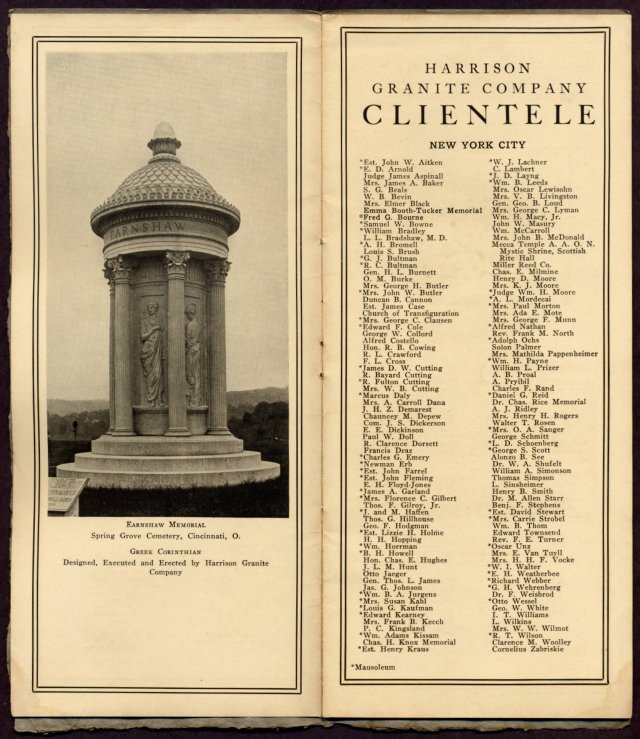
The Harrison Granite Company of New York City was founded in 1845.  It had quarries and works at Barre, Vermont.  The company mailed out brochures January of 1918, featuring the Earnshaw Memorial at the Spring Grove Cemetery at Cincinnati, Ohio.  the Earnshaw Monument was described as Greek Corinthian, and was “Designed, Executed and Erected by the Harrison Granite Company”.

The brochure states, “The interpretation of classic forms is the true expression of lasting tribute to the departed. Simplicity of treatment rather than ornateness has characterized the efforts of the company for the past 73 years. Ranging from monumental pieces of public interest to the simplest of private tributes this organization has achieved wonderful success in executing the conceptions of prominent sculptors and architects as well as the work of its own carefully selected staff of designers.” The Earnshaw Monument is a shining example of the interpretation of a “classic form for a lasting tribute.”

The brochure was prepared as an advertisement. Interspersed among pictures of magnificent monuments designed by Harrison Granite were lists of customers from across the United States as an inducement for others to purchase a monument from the company. This type of advertising is known as bandwagon advertising. That is, the advertisers use the fact that because many others like the product it is proof that you will like it, too.

 img_7564[1]

Joseph Earnshaw

September 16, 1831 – January 13, 1906

Neoclassical designed monuments can be found in many large urban cemeteries in the United States, including Spring Grove Cemetery at Cincinnati, Ohio.

img_7566[1]

The Joseph Earnshaw Grecian Corinthian-style monument was based on the Choragic Monument of Lysicrates which is located at the base of the Acropolis at Athens, Greece.  The Lysicrates monument was the first building to have Corinthian columns on its exterior.  The building was built by Lysicrates a wealthy patron of musical performances in the Theater of Dionysus.

img_2532[1]

This Harrison Granite Company catalog and many other gravestone and monument company brochures can be found at the Stone Quarries and Beyond Website: http://quarriesandbeyond.org/cemeteries_and_monumental_art/cemetery_stones.html.

The Stone Quarries and Beyond Website was created by Peggy B. and Patrick Perazzo. It focuses on historic stone quarries, stone workers and companies, and related subjects such as geology. Whenever possible links of finished products are provided on the Website. There is a “Quarry Articles” section that presents articles, booklets, and links from the late 1800s to early 1900s, including the 1856 “The Marble-Workers’ Manual.” The “Cemetery Stones and Monuments” section provides references and resources, including many old monument magazines, catalogs, price lists, and a photographic tour “From Quarry to Cemetery Monuments.”
Posted in Uncategorized | Leave a comment

Babies on the Half Shell

Page 106 from the 1906 Sears, Roebuck and Company catalog

Page 106 from the 1906 Sears, Roebuck and Company catalog

The Sears, Roebuck and Company catalog made its debut in 1893. The catalogs carried everything: shoes, watches, jewelry, sewing machines, musical instruments, baby carriages, saddles, bicycles, Edison’s gramophones. And, yes, they even carried gravestones.

In 1906, the catalog advertised a monument featuring a sleeping baby, nestled into a pillow tucked into a sea shell. This style came in two versions—The Acme Dark Blue Vein Marble priced at $38. 40 or the White Acme Rutland Italian Marble priced at $40.20 (shipping was additional, of course). Some Internet wags refer to this style as “babies on the half shell.”

This gravestone design very well could be a metaphor for the shell that contains a pearl, the shell that opens and reveals a precious jewel, in this case, a tiny baby.  The shell is also a symbol of baptism because of its obvious association to water.  In fact, a shell is often used to scoop up and sprinkle water during the baptismal ceremony.

The sea shell is also associated with Saint James, sometimes referred to as James the Greater, who was one of the Twelve Apostles.  In some church traditions, James’ mother is reported to be the sister to Jesus’ mother, Mary, making Jesus and James first cousins.  Tradition also has it that the remains of the Saint were taken to the Cathedral of Santiago de Compostela in Galicia, which is in the north of Spain.

Saint James became the patron saint of Spain during the re-conquest of the country from the Moors and the Cathedral of Santiago de Compostela became a popular site for Christian pilgrims.  Galicia, noted for delicious seafood, including scallops, drew thousands of Christian pilgrims who often carried a scallop shell back with them as a souvenir of the trip.  Before long, the sea shell became a symbol of Christian pilgrimage.

Samples of this style below:

img_0731[1]

This monument is in the Oakland Cemetery in Atlanta, Georgia.  Baby Maurine, the infant son of R. P. and Anna A. Robbins, was born January 7, 1896, and died April 1, 1896, just three months old.

??????????????????????????????????????

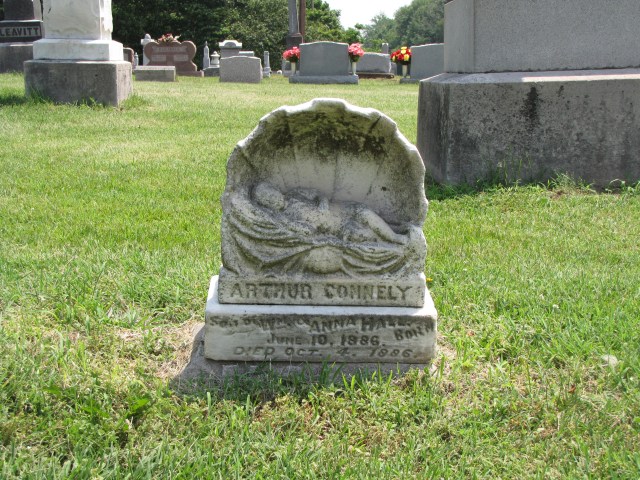
This sea shell gravestone is in the Oak Hill Cemetery on Highway 46 on the way to Terre Haute, Indiana.  It marks the grave of Arthur Connely, the son of William and Anna Hall.  Arthur was born June 10, 1886, and died October 4th of the same year.  Again, the baby, not quite four months old, is nestled comfortably into the sea shell, which serves as a bed.

????????????????????????????????????????

The image of a sleeping baby most likely offered comfort to the mourning parents of Adelheid Viola Becker, daughter of B. F. & M. C. Becker.  She was born November 27, 1881, and died February 19, 1884, just a few months past her third birthday.

This Sears, Roebuck and Company catalog and many other gravestone and monument company brochures can be found at the Stone Quarries and Beyond Website: http://quarriesandbeyond.org/cemeteries_and_monumental_art/cemetery_stones.html.

The Stone Quarries and Beyond Website was created by Peggy B. and Patrick Perazzo. It focuses on historic stone quarries, stone workers and companies, and related subjects such as geology. Whenever possible links of finished products are provided on the Website. There is a “Quarry Articles” section that presents articles, booklets, and links from the late 1800s to early 1900s, including the 1856 “The Marble-Workers’ Manual.” The “Cemetery Stones and Monuments” section provides references and resources, including many old monument magazines, catalogs, price lists, and a photographic tour “From Quarry to Cemetery Monuments.”
Posted in Children's Graves | 4 Comments

Heartless

IMG_9959

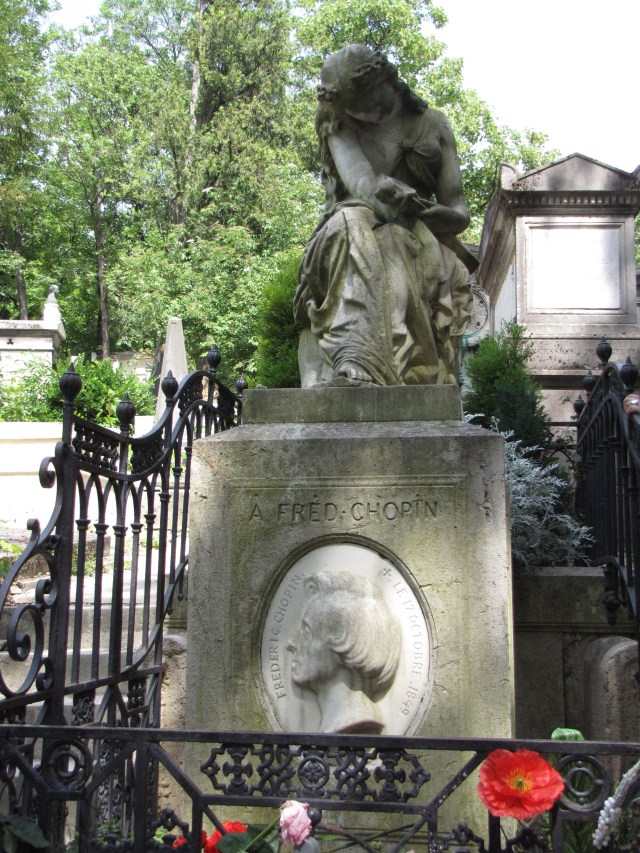
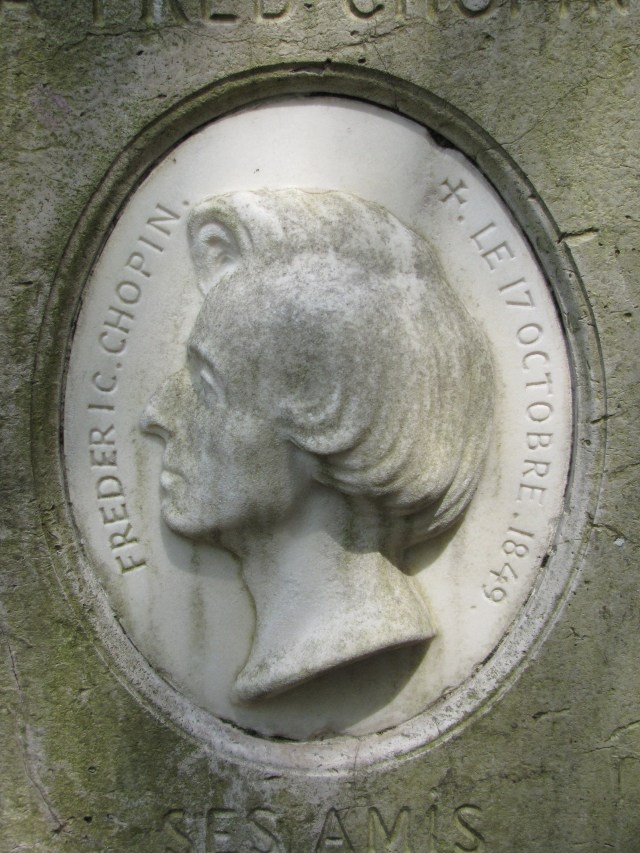
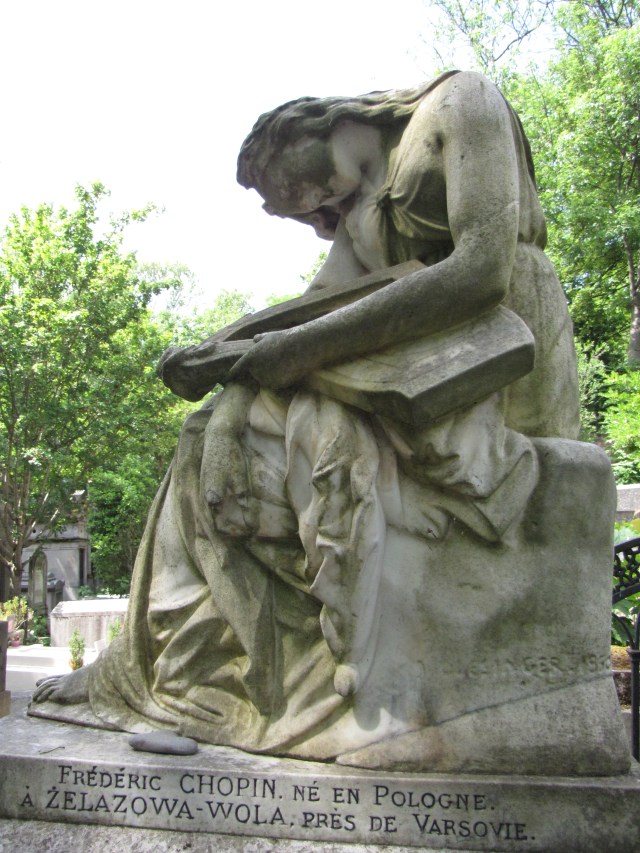
One of the most oft visited graves in the Père Lachaise Cemetery at Paris, France, is that of Frédéric François Chopin (February 22 or 1 March 1810 – October 17, 1849), the Polish composer and prodigy who was considered one of the greatest musicians of the Romantic Era.

Frédéric_Chopin_by_Bisson,_1849[1]

Chopin was born and raised in Warsaw, Poland, but at the age of 21 moved to Paris where he spent the rest of his short life composing and teaching piano. He gained enormous fame after Schumann touted Chopin as a musical genius elevating him to superstar status.

Chopin had a fragile constitution and was in declining health in his mid to late 30s. Most historians believe that Chopin died at the young age of 39 of tuberculosis. One of his dying wishes was to be buried in Paris, but to have his chest opened, so his heart could be removed and buried in the city of Warsaw. His sister, Ludwika, fulfilled her brother’s wishes returning his alcohol-preserved heart, in an urn to his homeland.

IMG_9960

His gravestone in Père Lachaise has a sculpture of Euterpe, the muse of music, sculpted by famed artist Jean-Baptiste Auguste Clésinger. Euterpe cries over a broken lyre, a probable metaphor for the loss of the great musician.

IMG_9962

Posted in Famous graves | Leave a comment

The Flint Granite Company


From the Flint Granite Company which can be found in its entirety on the Quarries and Beyond Website

From the Flint Granite Company which can be found in its entirety on the Stone Quarries and Beyond Website

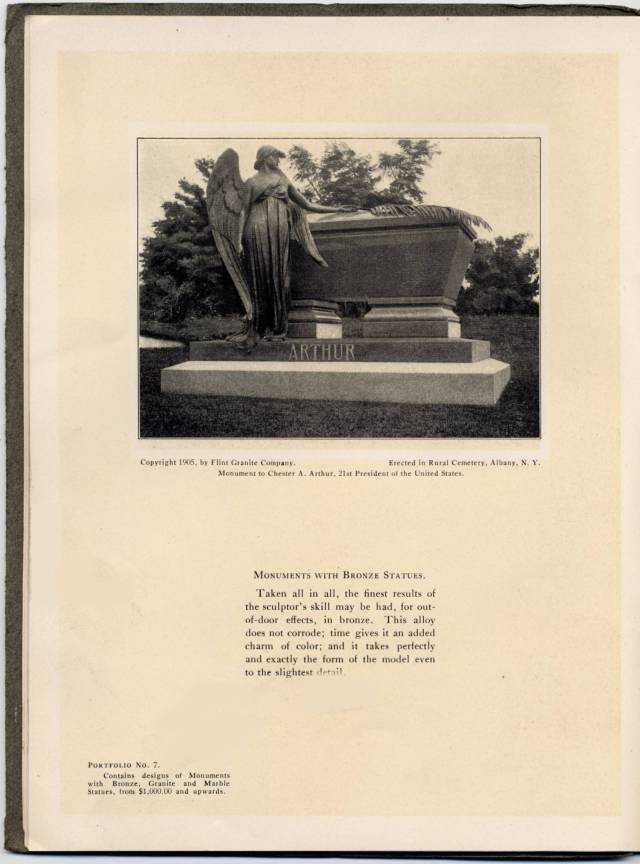
The Flint Granite Company of New York was, according to their brochure, “builders of artistic memorials in granite, marble and bronze.” Like many companies, The Flint Granite Company issued a catalog for potential customers showing the various sorts of monuments and memorials that could be purchased from them. The catalog that they published in 1905 pictures the grand memorial designed and built for President Chester A. Arthur, the 21st President of the United States, erected in the Rural Cemetery at Albany, New York. The caption says, “MOMUMENTS WITH BRONZE STATUES. Taken all in all, the finest results of the sculptor’s skill may be had, for out-of-door effects, in bronze. This alloy does not corrode: time gives it an added charm of color; and it takes perfectly and exactly the form of the model even to the slightest detail.” According to the booklet, PORTFOLIO NO. 7 contains “designs of Monuments with Bronze, Granite, and Marble Statues, from $1,000.00 and upwards.”

img_3382[2]

Chester Alan Arthur (b. October 5, 1829, Fairfield, Vermont – November 18, 1886) was the 21st President of the United States (1881–85). He assumed the office upon the death of James Garfield who was felled by an assassin’s bullet and a host of doctor’s who eschewed sanitary conditions when treating him. Arthur had been a political appointee in the New York City Republican political machine which meant expectations for him as president were low. To the surprise of many, Arthur stepped up and embraced the political reforms that he and Garfield campaigned on.

After his term, in poor health, Arthur only half-heartedly sought the re-nomination for the presidency in his own right in 1884. Grover Cleveland succeeded him. President Chester Arthur died two years later at the age of 57 years.

After a private funeral service in New York City, Arthur was laid to rest in the Albany Rural Cemetery at Menands, New York. In 1889, a large granite sarcophagus was created for his monument by the Flint Granite Company. Noted American sculptor Ephraim Keyser, created and cast a large bronze female angel that is depicted placing a palm leaf on the top of the tomb. The palm leaf represents victory over death.

img_3383[1]

img_9735[1]

Not long after the creation of Arthur’s memorial, Sidney Rowland Francis, brother and law partner of the Governor of Missouri died December 4, 1893, at St. Louis, Missouri. Francis was buried in the famed Bellefontaine Cemetery in that city. With the exception of the hand turned down as opposed to up and the absence of the palm leaf on the top sarcophagus the monument, angel and all, created for Francis’ grave appears to be a look-a-like of Arthur’s.

img_9737[1] 

The entire Flint Granite Company brochure can be found at the Stone Quarries and Beyond Website: http://quarriesandbeyond.org/cemeteries_and_monumental_art/cemetery_stones.html.

The Stone Quarries and Beyond Website was created by Peggy B. and Patrick Perazzo. It focuses on historic stone quarries, stone workers and companies, and related subjects such as geology. Whenever possible links of finished products are provided on the Website. There is a “Quarry Articles” section that presents articles, booklets, and links from the late 1800s to early 1900s, including the 1856 “The Marble-Workers’ Manual.” The “Cemetery Stones and Monuments” section provides references and resources, including many old monument magazines, catalogs, price lists, and a photographic tour “From Quarry to Cemetery Monuments.”

Posted in Presidential graves | Leave a comment

Cherubs

IMG_4823

FRANK F. JR.

BELOVED SON OF

FRANK F. & IRMA H. JONES

AUG. 5, 1916 – SEPT. 12, 1919

Sculptures of cherubs often adorn the graves of children. Here, two examples are found in the Elmwood Cemetery at Charlotte, North Carolina.

The chubby grief-stricken little angel above sits atop the gravestone of a three-year old Frank F. Jones, Jr. in the Elmwood Cemetery at Charlotte, North Carolina. The angel holds his face into one of his pudgy hands while the other holds a rose in the other. The rose symbolizes the messianic hope that Christ will return.

Cherubim are one of nine orders or choirs of angels which are organized into three spheres, with three choirs in each sphere.  According to Christian tradition, the first sphere, which is made up of the Seraphim, Cherubim, and the Thrones, are considered the closet to Heaven.  In Ezekiel 10:14, the Cherubim are described as having four likenesses or four faces, “And every one had four faces; the first face was the face of a cherub, and the second face was the face of a man, and the third the face of a lion, and the fourth the face of an eagle.”  The Cherubim were to be guardian angels.

The cherub pictured below does not have a name carved into the stone. The angel looks off into the distance with his hands crossed and resting on his knees, crossing his legs at the ankles. His head is slightly bent downward in a posture of sorrow.

IMG_4700

Posted in Angels | Leave a comment

Doppelganger Revisited

The Gray Family Monument at the Oakland Cemetery at Atlanta, Georgia

The Gray Family Monument at the Oakland Cemetery at Atlanta, Georgia

Doppelganger is a word that refers to two people who look the same.  Look-a-likes.   It is a German word that translates to “double goer”.  Popular television shows run photos next to each other showing actors and actresses together to show look-a-likes, such as, Christina Hendricks and Jessica Rabbit, Katy Perry and Zooey Deschanel, Morgan Freeman and Kofi Annan, Margot Robbie and Jaime Pressly, or Stephen Colbert and Bob Saget to name a few.  To poke gentle fun, some sites also match the faces of dogs to their look-a-like actors’ faces.

In this case, five gravestone sculpture doppelgangers—the Gray Family Monument at the Oakland Cemetery at Atlanta, Georgia; the Haggard monument at the Mount Olivet Cemetery at Nashville, Tennessee; The Inez M. and James Dunn Family Monument at the Glendale Cemetery at Akron, Ohio; the Mary Norcott Bryan London Monument in the Elmwood Cemetery at Charlotte, North Carolina; and The Mary Salmen Monument at the St. Joseph Catholic Cemetery at Evansville, Indiana, are clearly look-a-likes.

James Richard Gray – September 30, 1859-June 25, 1917

May Inman Gray – March 6, 1862-January 6, 1940

Gray Family Monument at the Oakland Cemetery at Atlanta, Georgia

Gray Family Monument at the Oakland Cemetery at Atlanta, Georgia

The Haggard monument at the Mount Olivet Cemetery at Nashville, Tennessee

The Haggard monument at the Mount Olivet Cemetery at Nashville, Tennessee

MARY LAURA CHAMPE-HAGGARD July 11, 1920

WILLIAM HAGGARD M.D. October 17, 1826 January 25, 1901

JENNIE DOUGLAS HAGGARD February 11, 1840 November 16, 1914

The Haggard monument at the Mount Olivet Cemetery at Nashville, Tennessee

The Haggard monument at the Mount Olivet Cemetery at Nashville, Tennessee

The Inez M. (March 16, 1852 – July 17, 1925) and James Dunn (January 17, 1854 – May 14, 1931) Family Monument at the Glendale Cemetery at Akron, Ohio.

The Inez M. and James Dunn Family Monument at the Glendale Cemetery at Akron, Ohio.

The Inez M. and James Dunn Family Monument at the Glendale Cemetery at Akron, Ohio.

The Mary Norcott Bryan, the wife of Henry Adolphus London (January 20, 1867 – April 12, 1932) Monument in the Elmwood Cemetery at Charlotte, North Carolina.

The Mary Norcott Bryan London Monument in the Elmwood Cemetery at Charlotte, North Carolina

The Mary Norcott Bryan London Monument in the Elmwood Cemetery at Charlotte, North Carolina

The Mary Salmen (1857 – 1987) Monument at the St. Joseph Catholic Cemetery at Evansville, Indiana.

The Mary Salmen Monument at the St. Joseph Catholic Cemetery at Evansville, Indiana

The Mary Salmen Monument at the St. Joseph Catholic Cemetery at Evansville, Indiana

According to a book about the Oakland Cemetery, the Gray Family Monument is adorned with a magnificent white-marble sculpture of the Niobe, the Greek mythological Queen of Thebes. All of these sculptures most likely originate from the same tradition and possibly from the same monument company. But, the sculpture commemorating the grave of Mary Salmen in the St. Joseph Catholic Cemetery at Evansville, Indiana, titled the funerary sculptural, “The Morning Prayer”. Perhaps Christian sensibilities did not want a mythological interpretation of the sculpture in their cemetery.

Posted in Symbolism | Leave a comment

The Lamb and the Sea Shell

IMG_4725

EULIS

CALLOWAY

FEB. 1, 1900

FEB. 27, 1932

Gone but not

forgotten.

This small square-top soft white marble tablet in the Elmwood Cemetery at Charlotte, North Carolina, shows a lamb, nestled into a sea shell.  The shell is a symbol of baptism because of its obvious association to water.  In fact, a shell is often used to scoop up and sprinkle water during the baptismal ceremony. The lamb is the symbol of the Lord, the Good Shepherd. It also represents innocence; usually this motif adorns the tombstones of infants and young children. In this case that narrative does not fit because this symbol is found on the gravestone for a 32-year old.

IMG_4726

Posted in Symbolism | 2 Comments