Black Agnes, Isn’t!

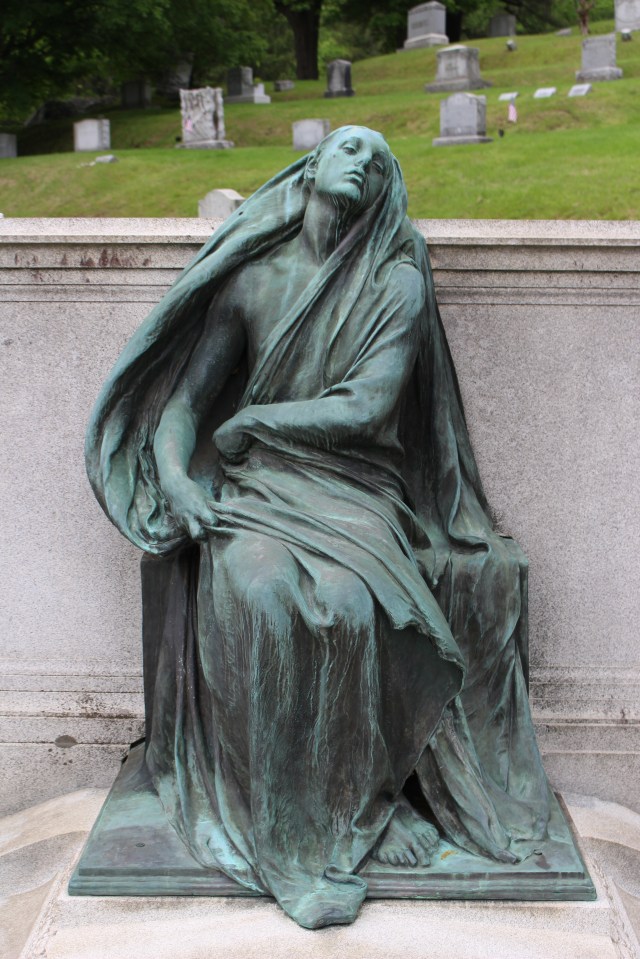
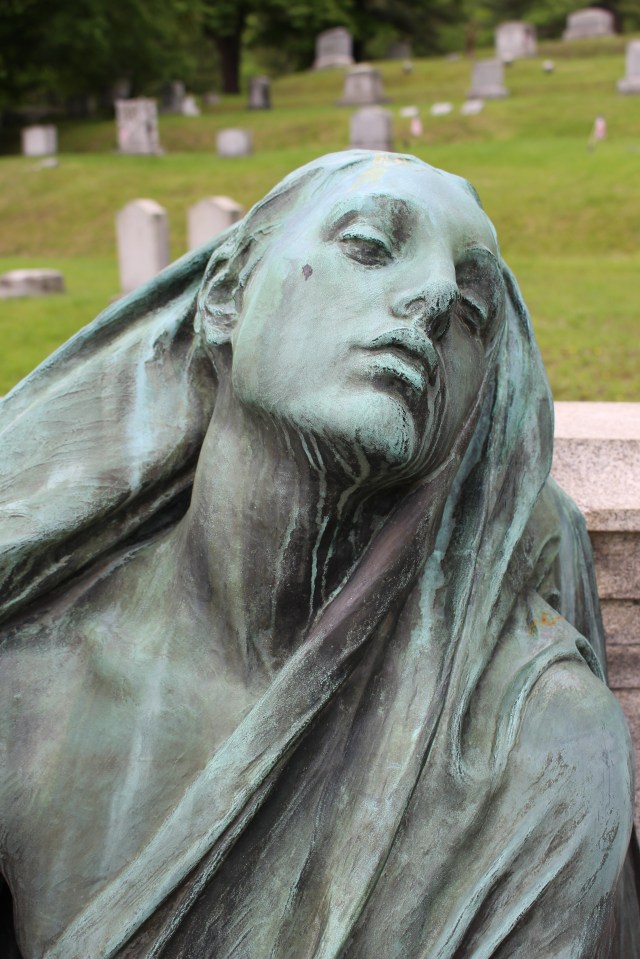
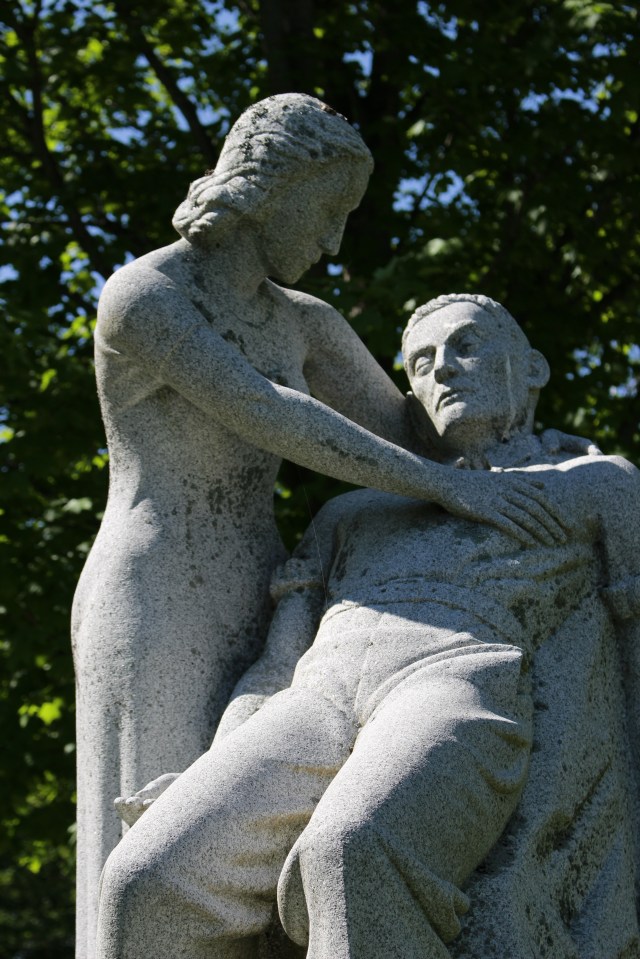
The John E. Hubbard monument in the Green Mount Cemetery at Montpelier, Vermont, features a statue of Thanatos created by famed sculptor, Karl Bitter.  The monument is neither black nor Agnes—it is green and it Thanatos.  Thanatos, in Greek mythology, was the personification of death.

Oddly, however, this monument has become known in local lore as Black Agnes.  The monument may have been given the name based on a sculpture that was erected for General Felix Agnus, the publisher of the Baltimore American who was buried in the Druid Ridge Cemetery, at Pikesville, Maryland, outside of Baltimore.  The seated sculpture, that became known as Black Agnus and once decorated General Angus’s monument, was a knock-off of the sculpture that Augustus Saint-Gaudens created for the Adams monument in the Rock Creek Cemetery at Washington, D.C.

What is plain from looking at the Hubbard monument is that the “she” is a “he.”  Nonetheless, the name, Black Agnes, persists and a mythology of its own has been created around the sculpture.  Supposedly, if you sit on the lap of the sculpture, something bad will happen to you—some say in seven hours, some say seven days, some say seven months; the amount of time varies depending on who retells the story of the curse. Locals also tell of screams coming from the cemetery at night in the vicinity of the monument.  Others report seeing the eyes of the sculpture turn to glowing red, though, no photographic evidence of that has surfaced.

Separating Fact and Myth

What we know to be true is that the monument was created for John Erastus Hubbard (1847 – 1899) who was a prominent businessman and citizen in Montpelier.  When his well-to-do Aunt passed away in 1890, she left the bulk of her fortune to the city of Montpelier.  John contested the will and won the fortune which he added to his own sizeable holdings.  It caused many in the city to see Hubbard as a bit of a scoundrel who cheated the city out the bequest—which some estimated the fortune at $300,000—which was a King’s ransom in the 19th Century.

Hubbard’s reputation was nearly instantly tainted, but when he died less than ten years later, he left the bulk of his fortune to the city—some believe to polish his tarnished legacy.

On either side of the statue that dominates his tomb are the following two stanzas from William Cullen Bryant’s poem, “Thanatopsis” which would seem to indicate that Hubbard did not believe he had anything to be ashamed of:

THOU GO NOT LIKE THE

QUARRY SLAVE AT NIGHT

SCOURGED TO HIS DUNGEON

BUT SUSTAINED AND SOOTHED

BY AN UNFALTERING TRUST


APPROACH THEY GRAVE

LIKE ONE WHO WRAPS THE

DRAPERY OF HIS COUCH

ABOUT HIM AND LIES DOWN

TO PLEASANT DREAMS.

As the French proverb goes, “There is no pillow so soft as a clear conscience”.

Posted in Uncategorized | 3 Comments

Knights Templar

Next to several gravestones in the Hope Cemetery at Barre, Vermont, are small metal markers imbued with an amazing amount of symbolism.  The marker has at its center a cross and crown laid upon a triangle that is resting upon downward pointing swords in saltire.

All of these symbols point to the marker commemorating the grave of a member of the Knights Templar—that and the fact that at the bottom of the cartouche, the words—“St. Aldemar Com. No. 11. K.T.” gives us several clues.  K. T. refers to the Knights Templar.  “Comm.” is an abbreviation for commandery, one of the organizing units in the Knights Templar, a fraternal order associated with Freemasonry.

Posted in Uncategorized | Leave a comment

The Benevolent Order of Scottish Clans

Next to several gravestones in the Hope Cemetery at Barre, Vermont, are small metal markers.  The markers have a shield displaying a rampart lion overlaid on two crossbars and atop another shield with thistle leaves and thistle flowers flanking the top shield.  The letters B. at the top of the marker and O. S. C. at the bottom of the marker are initials that stand for the Benevolent Order of Scottish Clans.

Several of the symbols on the metal marker are significant to the Scots.  The rampart lion is the same heraldic symbol displayed on the royal Banner of Scotland which was flown by Scottish Kings.  The crossbar represents St. Andrew, the patron saint of Scotland, who was martyred at Patras in Achaea in Greece.  St. Andrew believed himself unworthy to die in the same way as Christ and requested he be lashed to a Crux decussate or an x-shaped cross.  The thistle is the National Emblem of Scotland.

The Benevolent Order of Scottish Clans fraternal organization was founded in the late 1800s in St. Louis, Missouri, by James McCash to would provide insurance and mutual aid to its members.  The organization also promoted the Scottish heritage by sponsoring the replaying of Highland games, dancing, picnics featuring Scottish foods, and playing bagpipes.

Fittingly, the order was founded on St. Andrew’s Day.

Posted in Uncategorized | Leave a comment

The Bored Angel and the Tribute to a Stone Carver

LOUIS G. BRUSA

1886 – 1937

MARY

1890 — 1957

The Hope Cemetery at Barre, Vermont, features some of the best carved granite funerary sculptures in the United States.  The cemetery is a favorite on the rock of Ages granite tour.

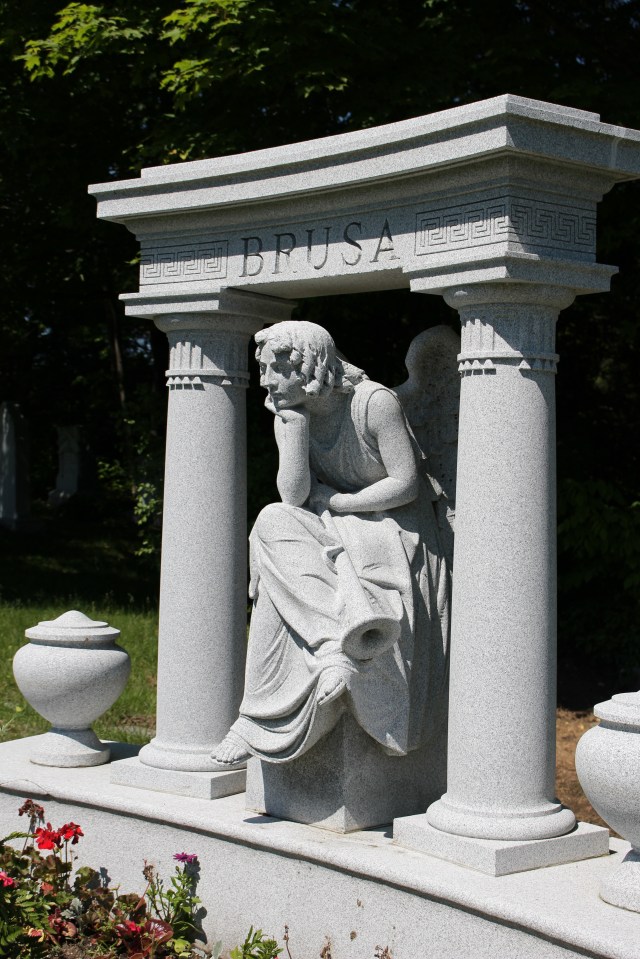
Two of the stand-out gravestones in a granite sea of expertly carved monuments center around Luigi Giovanni “Louis” Brusa, who was a master Barre stone carver.  One of the gravestone was carved by his expert hands, the other is a tribute to him.  Louis Brusa, born in Como, Italy, immigrated to the United States and settled in Barre, Vermont, widely recognized as the “Granite Capital of the World.”

The gravestone, known as the “Bored Angel” or as the “Sitting Angel,” was carved by sculptor Brusa for his parents, Ernesto Brusa (1851 – 1920) and Maria Brusa (1856 – 1934).  Unlike most cemetery angels who point upward to the Heavens or look down in solitary grief, this one, sits cross legged with her head resting on her palm, and nonchalantly holding the trumpet in her lap that sounds the Second coming.  She does all of this with a totally bored expression.  The gravestone demonstrates Brusa’s ability to capture a moment and a relaxed pose of the human body making it look lifelike or in this case angelic!

The other gravestone dubbed the “Dying Man” is Brusa’s own carved by his friend and fellow stone carver Don Coletti. Brusa was dying of silicosis, a long-term lung disease.  The disease often affects sculptors who inhale large amounts of crystalline silica dust, usually over the course of many years. No doubt Brusa worked in a cloud of dust and breathing in the airborne dust particles as he created sculptures throughout his illustrious career.  Before his death, Brusa commissioned Coletti to sculpt a dying man dying of silicosis.  Brusa wanted his monument to be a cautionary tale to other carvers.  The woman standing next to him is reportedly his wife, but some Barre wags whispered that she bore a stronger resemblance to his mistress.

Ventilation systems have been added to stone carver’s shops which have made it much safer for the artisans.

Posted in Angels | 1 Comment

Tender Sentiments Carved in Stone

Tender epitaphs from the North Conway Cemetery at North Conway, New Hampshire pay tribute to fallen loved ones.

Mrs. SUSAN K.

Wife of

Charles S. Whitaker

& daughter of

Capt. Nathaniel & S. Randell,

Died March 18, 1833

Aged 33 years 3 months

And 12 days.

Sweet wither’d rose, may thy pale doom

Call tears into the strangers eye,

Oh, may the prospect of this tomb

Remind us, all live must die.

JOHN McMILLAN

June 21, 1821

Dec. 5, 1899

Here neath the pines he loved

So well

That naught could lure him from

Their grateful shade

He sleeps to wake elsewhere

For God hath said.  Amen

In memory of

MRS. HANNAH EASTMAN

who died April 15, 1820

AE 62

Pause, Reader, pause! & on thy heart

Record what’s here recorded.

Charity like the sun,

Shines on the humble cottage of the poor

With beams no less intense than what are felt

On domes of regal splendor

Not soon provoked, she easily forgives

And much she suffers, as she much believes.

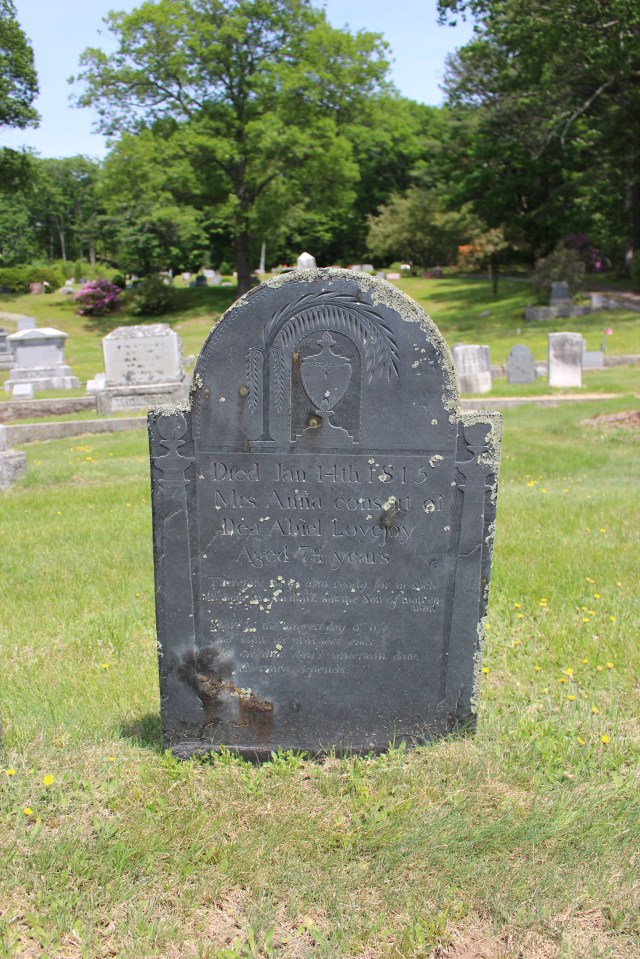
Died Jan. 14th, 1815

Mrs. Anna, consort of

Dea. Abiel Lovejoy

Aged 74 years.

Therefore be ye also ready for in such

an hour as you think not, the Son of man cometh.

short is the longest day of life

And soon its prospect ends

Yet on that days uncertain date

Eternity depends.

CAMILIUS E.

Died Nov. 15, 1872

Aged 8 yrs. 1 mo. 13 ds

MARY BELL

Died Dec. 22, 1872

Aged 4 yrs. 8 m 8 ds

FRED S.

Died Jan. 12, 1873

Aged 10 yrs. 10 ms.

NELLIE R.

Died Feb. 11, 1873

Aged 15 yrs. 9 ms 1 dy

Children of

George W. & Mary Ann

MUDGETT

Full many a flower is born to blush

unseen and waste its sweetness in

the desert air.

Posted in Epitaphs | Leave a comment

Kneeling Recording Angel


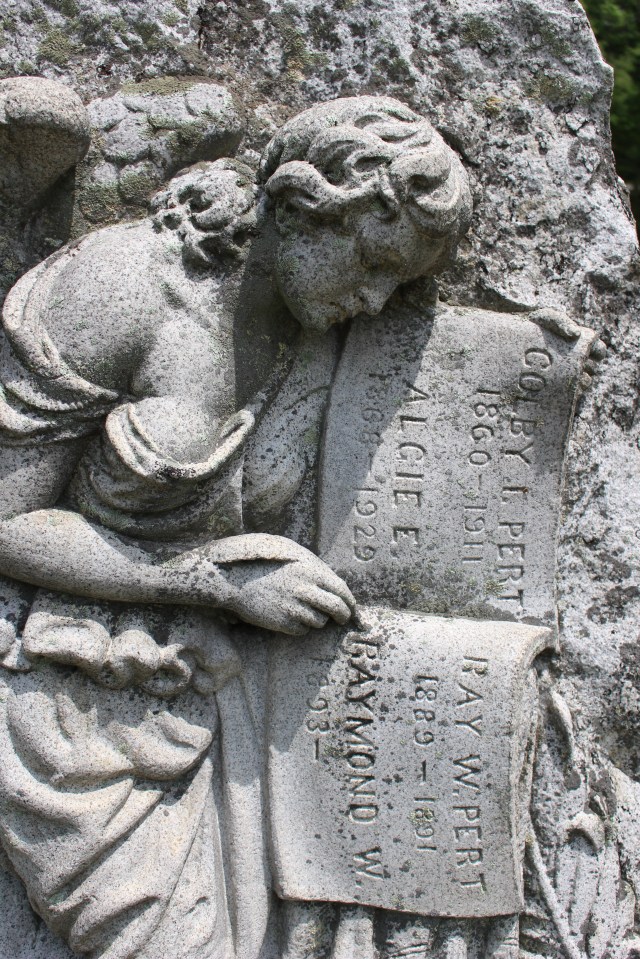
COLBY I. PERT

1860—1911

ALICIE E.

1868—1929

RAY W. PERT

1889—1891

RAYMOND W.

1893—

As Mentioned in several earlier blog posts, the article, “Embodying Immortality: Angels in America’s Rural Garden Cemeteries, 1850—1900”, pages 56 – 111, 2007 edition of Markers, XXIV, written by Elisabeth Roark, categorized the eight most commonly found types of graveyard angels—which included recording angels.

Winged figures in a cemetery are instantly recognize as angels–a messengers of God.  However, Christian art did not depict angels with wings until the fourth century.  Before then, angels were represented in several different forms–sometimes in human form, but also represented as a dove, or even just as a hand reaching down to Earth from the Heavens.  Beginning with the reign of Constantine, angels began being depicted with wings, as we commonly portray them today.  “Based on the winged Greco-Roman Nike or Victory, their form thus embodied Christianity’s promised triumph over death.  Medieval and Renaissance tombs often featured angels that attended images of the deceased.”

Here this buxom recording angel in the North Conway Cemetery at North Conway, New Hampshire, is depicted head tilted, practically resting on the pages, writing the names of the deceased into an open book.  This recording angel, carved out of gray granite, has an open book resting on her knee and a quill in her hand.  She is registering the names of the deceased into the Book of Life.  In Judaism and Christianity, the names of the righteous were recorded in the Book of Life; they were assured entry into Heaven.

The Book is referenced many times in the Bible (King James Version), including Revelations, Chapter 20,

Verse 12: “And I saw the dead, small and great, stand before God: and the books were opened: and another book was opened, which is the book of life: and the dead were judged out of those things which were written in the books, according to their works.”

Verse 13: “And the sea gave up the dead which were in it; and death and hell delivered up the dead which were in them: and they were judged every man according to their works.”

Verse 14: “And death and hell were cast into the lake of fire.  This is the second death.”

Verse 15: “And whosoever was not found written in the book of life was cast into the lake of fire.”

Posted in Angels | Leave a comment

His occupation is no mystery

CAPT.

JAMES HAMOR

DIED

Dec. 17, 1873,

AE. 79 yrs.

He’ll ride no more the billows _____

Nor o’er the rolling wave

He has performed life’s final voyage

And anchored in the grave.


CLARA B.

Wife of

CAPT. JAMES HAMOR

Died June 12, 1888,

AE. 84 yrs 6 mos.

& 7 days

I know that my redeemer

liveth.

Some gravestones display the occupation of the deceased as does this one from the Bar Harbor, Maine, Village Burying Ground.  The cemetery is just a block or so from the village green tucked between two great churches.  Toward the back of the cemetery is the gravestone of sea Captain James Hamor.

Even if his title of Captain was not engraved on his gravestone it would be easy to discern his occupation from the bas-relief carving of a great ship on the rolling sea.  And, even though, there is one word in his epitaph that is undecipherable, it confirms his occupation by defining his life and burial in seafaring terms.

Posted in Uncategorized | Leave a comment

The Improved Order

The metal markers above and below from the North Conway Cemetery at Conway, New Hampshire, mark the graves of a members of the Improved Order of Red Men, which claims its beginnings with the patriots who were in the Sons of Liberty during the American Revolution.  The society models itself after the Iroquois Confederacy councils.  In fact, some of the metal markers display images of Native Americans because the society based their organization on the rites and rituals of the Native Americans.

Written on each marker are the initials T.O.T.E which stands for Totem of Eagles.  According to their Website, the IORM “promotes patriotism and the American Way of Life, provides social activities for the members, and supports various charitable programs.”  The different clubs or chapters are divided into “tribes”.  The marker above is from “tribe” F.F. & C. 23, and the marker below represents the MISHA-MOKWA TRIBE No. 43.

Posted in Metal Markers | Leave a comment

Six Scoops Under


In 1978, two guys, Ben Cohen and Jerry Greenfield, in Burlington, Vermont, took a $5 ice cream-making course and rented out an abandoned gas station to start what has become one of the best and most well-known ice cream companies in the United States.  Ben and Jerry not only became famous for delicious ice cream but also for giving their flavors funky-sounding names—Cherry Garcia, Half Baked, Phish Food, Cookie Dough, Americone Dream, and Chunky Monkey—all with big, rich, robust flavors.

Many of those flavors have become iconic ice cream flavors recognizable all around the world.  But some of their flavors have been less successful—Wavy Gravy, Rain Forest Crunch, Fossil Fuel, and Vermonty Python.  But what is an ice cream company to do when a flavor isn’t successful and the roll out fails?  Ben and Jerry’s made the decision to not only discontinue making the flavor but to bury them!

That’s right, bury the flavors.  In the back of the factory past the second customer parking lot, on a hill is the Flavor Graveyard.  34 flavors have been killed off and now “rest” in the company cemetery.

And the attention to detail has been incredible.  The cemetery is surrounded by a white picket fence and inside are the tombstones—made of Vermont granite—and modeled after the Colonial Era gravestones with flying death’s heads and winged cherubs–like the example below from the cemetery at Concord, Massachusetts.

But instead of a winged skull of death’s head, each gravestone has a winged ice cream cone with a scoop of ice cream depicting the discontinued flavor.  Not only does the gravestone have the name of the flavor, the year of creation and the year of its discontinuation, but also a cleverly worded epitaph explaining the flavor’s demise—just as you might see on a slab of slate in a real cemetery!

For example, Economic Crunch was the first flavor to “die” and laid to rest in the Flavor Graveyard.  The ice cream flavor was vanilla with chocolate covered almond, pecans, and walnuts.  Sounds tasty, right?  Especially if you are a nut eater.  But for some reason this flavor didn’t make it and was put to rest the same year the flavor was launched.

Economic Crunch

1987-1987

A delightful mash,

This flavor we remember

For the stock market crash

On the sixth of November.

While there are many similarities between the Flavor Graveyard and one for—well, humans—there are big differences, too. For example, Ben and Jerry’s will bring a flavor back if enough people vote to do so.  Oh, if it were only that easy in real life!

Posted in Symbolism | 3 Comments

“Silent Cal”

CALVIN COOLIDGE

JULY 4, 1872

JANUARY 5, 1933

GRACE A. GOODHUE

WIFE OF

CALVIN COOLIDGE

JANUARY 3, 1879

JULY 8, 1957

The plain upright tablet displaying the Presidential Seal in the top in the Plymouth Cemetery at Plymouth, Vermont, marking Calvin Coolidge’s grave may be one of the simplest presidential gravestones.

As the President Calvin Coolidge State Historical Site brochure explains, “The serenity of the village and surrounding mountains is appropriately reflected in the simple granite headstone that marks the President’s grave.  Visitors are sometimes surprised that a president should be buried in such plain surroundings but when Coolidge left the White House he said, “We draw our Presidents from the people…I came from them.  I wish to be one of them again.”  The gravestone is indicative of the simple and frugal New England values that President Coolidge not only held dear but for which he was loved and admired.

His gravestone is also a testament to his reputation as laconic which won him the appellation, “Silent Cal.”  Like the gravestone itself, Coolidge was a man of few words.  The story that is often told of him was that a woman at a White House Party approached him and said that she had a bet with a friend that she could get him to say more than three words.  Coolidge, who also had a sardonic wit, turned to her and wryly said, “You lose.”

The cemetery at Plymouth Notch, Vermont, contains seven generations of the Coolidge family.

Posted in Presidential graves | 4 Comments