Cross Potent or Crutch Cross

The symbol carved into the black granite gravestone in the St. Nickolas Ukrainian Catholic Cemetery in Chicago is of a cross surrounded by a wreath.  This cross is known as a cross potent or crutch cross.  It is a heraldic cross with bars of equal length with crossbars at the four ends.  These crossbars were also known as “crutches” or “potent” which is from a bastardized version of an Old French word “potence” which meant “crutch.”

This form is also described as a cross made of four Tau crosses and still referred to as a Cross Potent.  The Tau cross looks like a capital “T.”  Some believe because the Cross Potent is made up of Tau crosses, which look like crutches, that it represents the healing power of Jesus Christ. In 1191 Emperor Henry VI formed the Teutonic Order using the Cross Potent as its symbol.  The order was founded as a hospital order.

Posted in Symbolism | Leave a comment

Seven Ages of Men

Samuel Hay Kauffmann

February 24, 1898

January 12, 1971

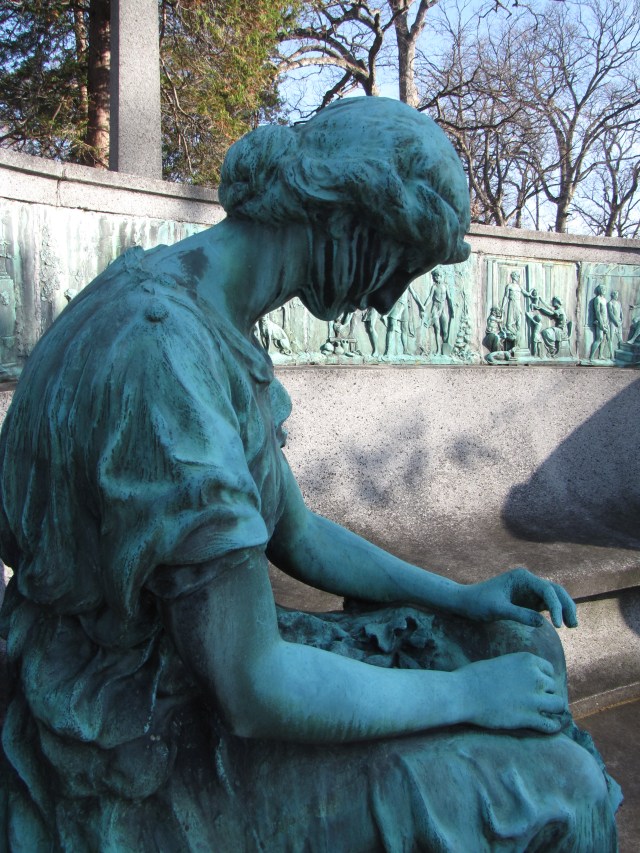
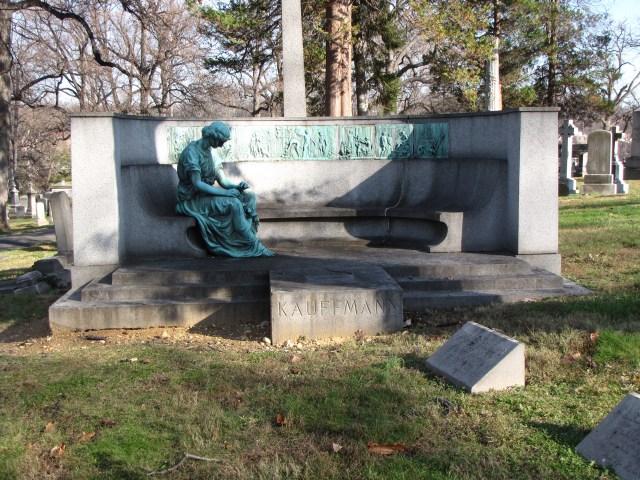
The memorial commissioned in St. Paul’s Rock Creek Cemetery and created by sculptor William Ordway Partridge (April 11, 1861 – May 22, 1930) for Samuel Kauffmann, long-time owner of the Washington Evening Star, is a classical Greek ode to life and to death with a Shakespearean addition.

The monument features an exedra, a semi-circular structure, often with a bench with a high back. Originally the exedra was designed in antiquity to facilitate philosophical discussion and debate. In cemetery architecture the exedra is usually part of a landscape design.

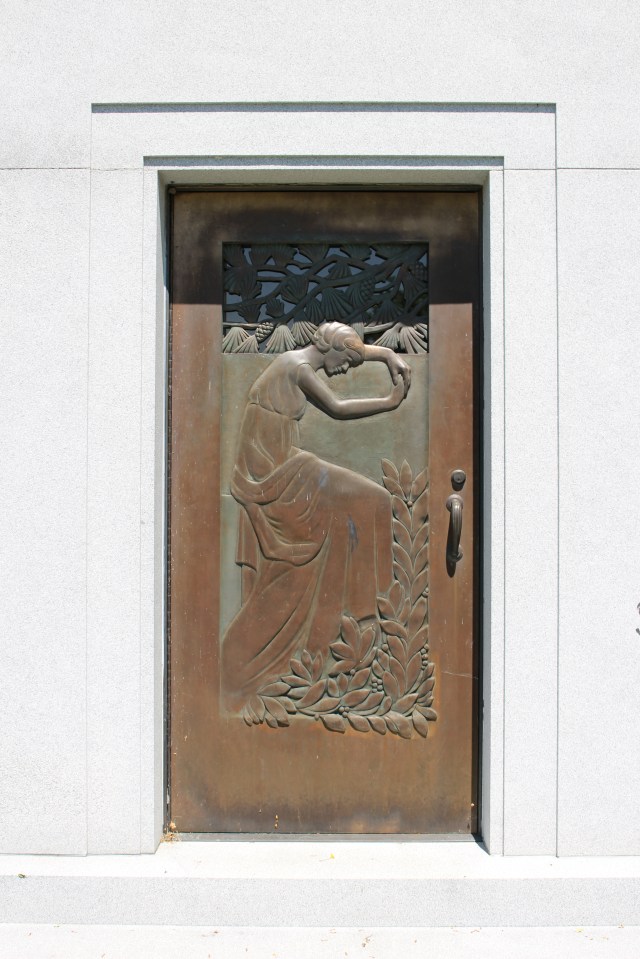
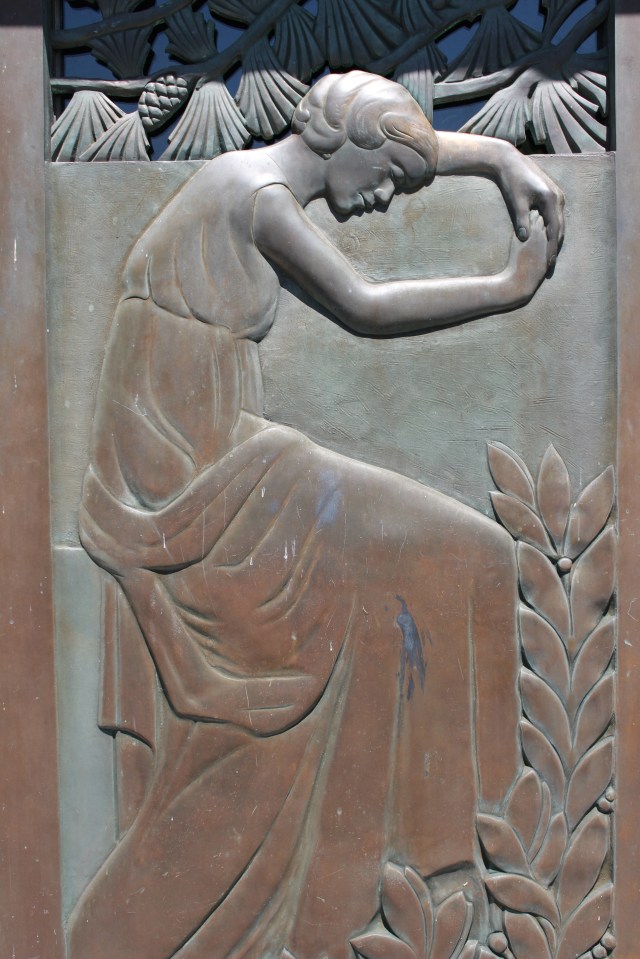
Continuing the classical design, the seated sculpture is of a woman dressed in classical clothing, flowing gown and sandals.  The allegorical figure represents “Memory.”

Her head is bent in sorrow and she is depicted holding an asphodel wreath.  The asphodel plant has been associated with the mythology of death and the afterlife since ancient Greek times.

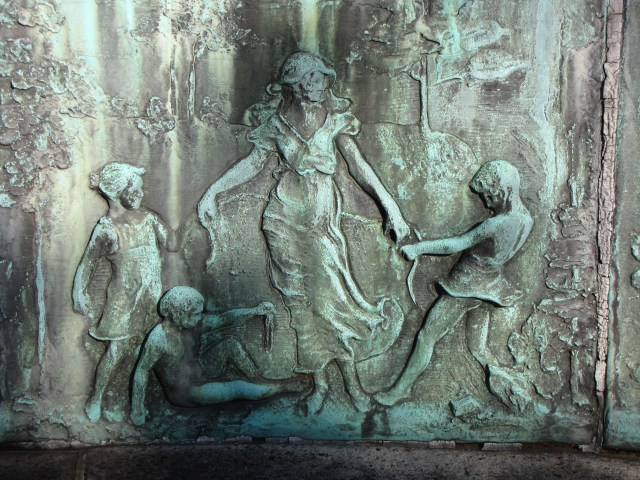
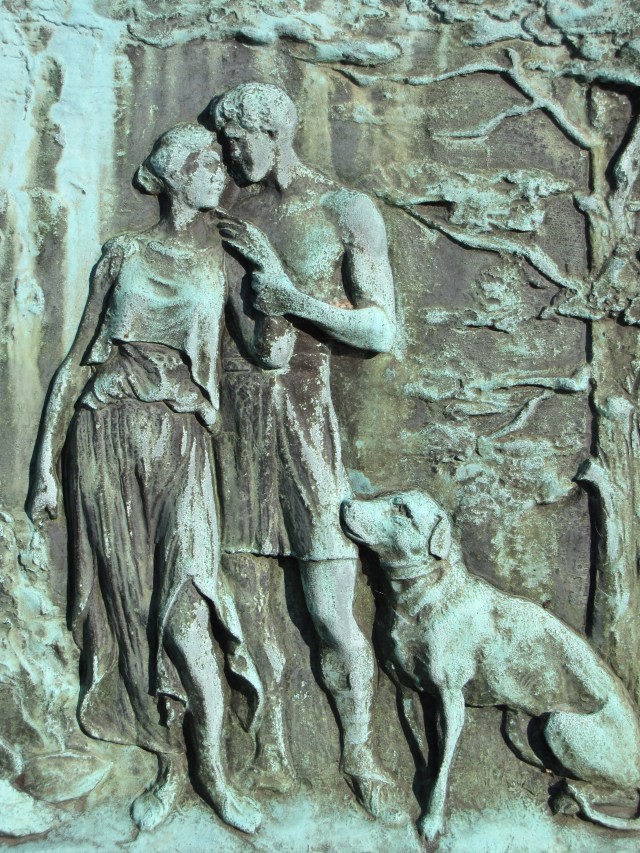
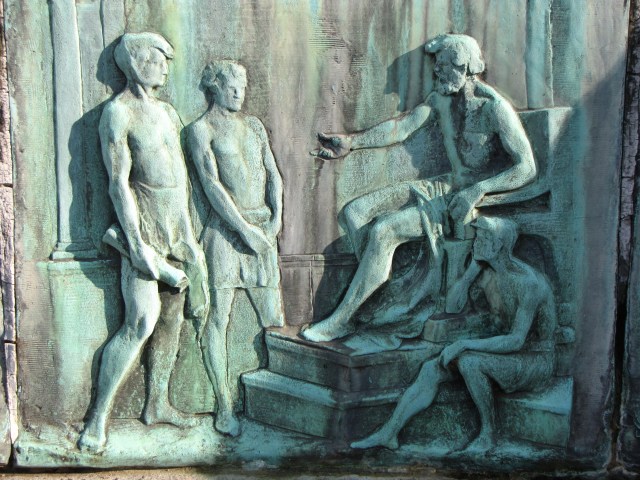
The centerpiece of the memorial, however, is pure Shakespeare.  Bronze panels on the back of the exedra illustrate the Seven Ages of Men from Jaques’ monologue in Act II of Shakespeare’s, As You Like It.  The phrase that begins the description, “All the world’s a stage,” is likely one of the most often quoted Shakespearean passages.  It would seem that that play has seven scenes according to Jaques.  The bronze panels depict the seven ages as described in As You Like It in italics below:

Infancy:

At first, the infant,

Mewling and puking in the nurse’s arms.”

In this first stage of life, the infant is helpless and knows nothing.

Schoolboy:

Then the whining schoolboy, with his satchel,

And shining morning face, creeping like snail,

Unwillingly to school.”

The school boy is unsure of himself and wants to stay in the close and protective comfort of home.

The Lover:

“And then the lover,
Sighing like furnace, with a woeful ballad
Made to his mistress’ eyebrow.”

Men at this stage of life is quick to express his love and share his feelings.

The Soldier:

Then a soldier,
Full of strange oaths and bearded like the pard,
Jealous in honor, sudden and quick in quarrel,
Seeking the bubble reputation
Even in the cannon’s mouth.

At this stage, man is quick tempered and willing to take risks, to build his reputation.

The Justice:

And then the justice,
In fair round belly with good capon lined,
With eyes severe and beard of formal cut,
Full of wise saws and modern instances;
And so he plays his part.

After gaining wisdom and social status, man strives to enjoy his gains and the finer things in his life.

Old Age:

The sixth age shifts
Into the lean and slippered pantaloon,
With spectacles on nose and pouch on side;
His youthful hose, well saved, a world too wide
For his shrunk shank, and his big manly voice,
Turning again toward childish treble, pipes
And whistles in his sound.

In old age, the once strong and vibrant man now becomes weak physically and mentally, literally shrinking.

Incapacity:

Last scene of all,
That ends this strange eventful history,
Is second childishness and mere oblivion,
Sans teeth, sans eyes, sans taste, sans everything.”

In this last stage, man reverts to the beginning at where he started in infancy—totally dependent on the care of others.  The ultimate end, of course, is death.

All the world’s a stage,
And all the men and women merely players;
They have their exits and their entrances,
And one man in his time plays many parts,
His acts being seven ages. At first, the infant,
Mewling and puking in the nurse’s arms.
Then the whining schoolboy, with his satchel
And shining morning face, creeping like snail
Unwillingly to school. And then the lover,
Sighing like furnace, with a woeful ballad
Made to his mistress’ eyebrow. Then a soldier,
Full of strange oaths and bearded like the pard,
Jealous in honor, sudden and quick in quarrel,
Seeking the bubble reputation
Even in the cannon’s mouth. And then the justice,
In fair round belly with good capon lined,
With eyes severe and beard of formal cut,
Full of wise saws and modern instances;
And so he plays his part. The sixth age shifts
Into the lean and slippered pantaloon,
With spectacles on nose and pouch on side;
His youthful hose, well saved, a world too wide
For his shrunk shank, and his big manly voice,
Turning again toward childish treble, pipes
And whistles in his sound. Last scene of all,
That ends this strange eventful history,
Is second childishness and mere oblivion,
Sans teeth, sans eyes, sans taste, sans everything.

Posted in Symbolism | Leave a comment

Monumental

IN MEMORY OF

CHARLES MATHER FFOULKE

1841-1909

SARAH CUSHING

HIS WIFE

1852-1926

AND THEIR CHILDREN

HORACE CUSHING FFOULKE

1876-1903

GWENDOLINE FFOULKE

1884-1904

CHARLES MATHER FFOULKE II

1889-1912


AND

HORACE CUSHING

BELOVED FATHER OF SARAH CUSHING

1819-1865

THE END OF BIRTH IS DEATH

THE END OF DEATH IS LIFE AND

WHERFOR MOURNEST THOU


John Gutzon de la Mothe Borglum (March 25, 1867 – March 6, 1941) was an American of Danish-American ancestry born in St. Charles, in the Idaho Territory.  His father, Jens Moller Haugaard Borglum, was a wood carver before he studied homeopathic medicine and became a doctor.  Both of the Borglum sons, Gutzon and Solon, were accomplished artists and sculptors.  Gutzon studied art in New York where he became well known for his work.  In fact, President Theodore Roosevelt displayed a sculpture of Abraham Lincoln created by Borglum in the White House.  In the early 1900’s Borglum was commissioned by the Cathedral of St. John the Divine in New York to sculpt saints and apostles.

Like many artists of his day, including Daniel Chester French, Augustus Saint-Gaudens, Aldabert Volck, Felix Weihs de Weldon, Karl Bitter, Martin Milmore, Alexander Milne Calder, T. M. Brady, Albin Polasek, Harriet Whitney Frishmuth, Edward V. Valentine, Sally James Farnham, Adolph Alexander Weinman, and others, Borglum was able to earn his living creating sculptures, public and private.

His best-known work is the iconic Mount Rushmore, which has become the symbol for the state of South Dakota.  Little known, however, is his preparatory work on the Stone Mountain Georgia monument to the Confederacy.  He started working on it, and even completed the design when he became embroiled in a disagreement.  He abandoned the job leaving another artist to complete it.  However, Stone Mountain gave him valuable experience for his later work sculpting presidents George Washington, Thomas Jefferson, Theodore Roosevelt, and Abraham Lincoln on a monumental scale on the side of a mountain.

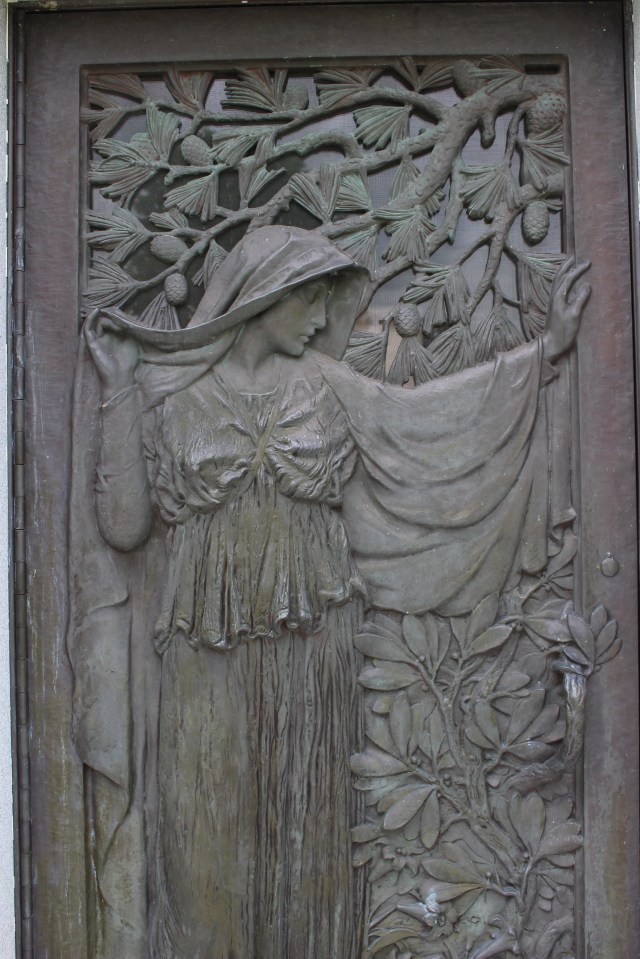
The Ffoulke family cemetery monument commissioned in 1909 was created by Borglum.   The life-size bronze sculpture depicts Mary Magdalene dressed in a flowing robe and raising her right hand at the moment she recognized that Jesus Christ had risen from the grave.  The biblical scene depicted by the bronze is from John 20:16, “Jesus saith unto her, Mary.  She turned herself, and saith unto him, Rabboni; which is to say, Master.”  RABBONI is carved in the base upon which the sculpture rests.  Rabboni is the Hebrew word for Rabbi.

Charles Mather Foulke was a well-known and successful banker in Washington, D.C., who initially made his fortune as a wool merchant in Philadelphia.  He also gained fame for his collection of world renowned tapestries including the 17th Century Barberini tapestries.


Posted in Uncategorized | Leave a comment

The Sarcophagus

LORETTA

RECKMEYER

1893 – 1959

WILLIAM F.

SANGER

1875 – 1955

CORNELIUS O.

SANGER

1869 – 1943

MARGARET

SCHULER – SANGER

1871 — 1929

The large sarcophagus of the Sanger family in the Calvary Cemetery in Milwaukee, Wisconsin, is a massive limestone tomb embellished with winged cherub heads, their eyes closed.

The sarcophagus is an ancient burial monument designed to look like a coffin.  Most often they are set on a platform or a base.  The tomb is often embellished with ornamentation and nearly always has feet, though this one does not.  But the “coffin” is empty–just an empty symbol of the receptacle.

The word, sarcophagus, is derived from two ancient Greek words, sarx, which meant flesh and phagein meaning to eat.  The two words together, sarkophagus, meant flesh eating.  The term came from the limestone used by the ancient Greeks to bury the dead which was thought to decompose the flesh of the deceased.

The winged cherub was a symbol that became popular in the 18th Century.  Winged cherubs replaced the stark and morbid flying death’s heads from our Puritan forefathers.  The cherubs on the Sanger family have their eyes closed as though they are sleeping.  The iconography represents the flight of the soul from the body upward to Heaven and the hope of the resurrection. In this motif the wings give flight not only to the soul but to time.

Posted in Symbolism | Leave a comment

She’s gone no more to greet you here


ELIZABETH P.

wife of CHAs. N. SHEPARD

& dau. Of

Col. Daniel Chase

DIED

Sept. 20, 1854.

AE. 29 yrs. 9 days.

She’s gone no more to greet you here

Husband, brothers, and sisters dear

But in that far off better land

She waits to give the welcome hand.

The rounded-top white marble tablet of Elizabeth Shepard’s epitaph in the Tomb Cemetery in Holden, Maine, is full of warm sentimentality for her family—though she is gone, she waits on the other side with her hands open to welcome them.

Posted in Epitaphs | Leave a comment

Celestial Smile

JOHN F. ROBINSON

DIED

Jan. 20, 1876

AE 54 yrs. 9 mos.


Go to thy rest and while

Thy absence we deplore,

One thought our sorrow shall beguile

For soon with a celestial smile

We meet to part no more.

The small, white marble segmented-top tombstone in the Tomb Cemetery in Holden, Maine, marks the grave for John Robinson.  This epitaph has two themes: “go to thy rest” and “we meet to part no more,” both of which are commonly found.  This eipitah, however, says that not only will they meet again to part no more, but with a “celestial smile.”

One aspect that is different with this epitaph is that it reads almost like a limerick.  The typical limerick which was popularized in 18th Century England, is five lines with rhyming pattern—a a b b a.  However, this epitaph’s rhyming pattern is—a b a a b, which is not typical.  One other convention is turned round.  Limericks usually have the first, second, and fifth lines long, with lines three and four being short and punchy.    The longest lines in this epitaph are three and four, again, breaking with convention.

Posted in Epitaphs | Leave a comment

Gone home! Gone home!

The tall columned monument in the Mt. Hope Cemetery in Bangor, Maine, marks the graves of Carlton and Amelia Bragg.  The stained white marble gravestone is topped with a botonee cross characterized by trefoil at the end of each arm of the cross which symbolizes the Holy Trinity.

Two of the sides of the monument are blank while the other two sides are carved with the names of Carlton and his wife, Amelia—one name on each of two sides.  Amelia has a twelve-line, heartfelt epitaph memorializing her.  In the first quatrain there is a reference to her inheriting a “heavenly mansion, a reference to the Biblical passage John 14.2, “In my Father’s House are many mansions; if it were not so, I would have told you.  I go to prepare a place for you.”

The epitaph also gives the passerby an idea about how very much she will be missed, presumably by her husband, who surely commissioned the monument and the epitaph to be carved in her memory.


AMELIA T.

Wife of

CARLTON S. BRAGG

DIED

Oct. 6, 1865.

AE 53 yrs.


Gone home! Gone home! Here earnest, active spirit

Her very playfulness, her heart of love!

The heavenly mansion now she doth inherit,

Which Christ made newly ere she went above.


Gone home! Gone Home! The door through which she vanished,

Closed with a jar, and left us here alone.

We stand without, in tears, forlorn and banished

Longing to follow where one loved has gone.

Gone home! Gone home! O human-hearted Saviour!

Give us a balm to soothe our heavy woes;

And if thou will, in tender, pitying favor,

Hasten the time when we may rise and go!

C. S. BRAGG

DIED

In Boston, Mass.

Oct. 30, 1876

AE 64.

On the opposite side on the monument is the simple inscription for Carlton Sylvanus Bragg, who died in Boston, 11 years after his beloved wife.  He has no epitaph.

Posted in Epitaphs, Symbolism | Leave a comment

Eschew Grief

ENOCH H. LELAND

DIED

Feb. 25, 1877,

AE 56 yrs. 7 mos.

& 27 days

Why lament the christian’s (sic) dying,

Why indulge in tears and gloom,

Calmly in his Lord relying,

He has met the opening tomb.


Hark the golden harps are ringing.

Sounds unearthly fill his ear;

Millions now in heaven are signing,

Greet his joyful entrance there.

In the Village Burial Ground in downtown Bar Harbor, Maine, a town once known as Eden, is the small, white marble gravestone of Enoch Leland.  On the back of his gravestone is the eight-line epitaph that tells the passerby to eschew grief because of his death and instead celebrate his entrance into the Kingdom of Heaven.

Posted in Epitaphs | Leave a comment

The Saviour’s Book

SACRED

to the memory

CHARLES CHRIS’r KEPPLER

who died April 18th 1839,

aged 5 years.

and

ELIZA CATHERINE KEPPLER

who died August 7th 1839

aged 18 months

Son and daughter of Henry and Eliza Keppler.

Weep not for us our Parents dear

But to the Saviour look,

Twas he that brought us here below

Our names were in his book.

This gray marble ornamented top tablet in St. Paul’s Rock Creek Cemetery marks the graves of two children.  The epitaph makes reference to the Saviour’s book.  Often graveyard sculptures of “recording angels” are depicted writing the names of the deceased into an open book.  The angels registered the names of the deceased into the Book of Life.  In Judaism and Christianity, the names of the righteous were recorded in the Book of Life; they were assured entry into Heaven.

The Book is referenced many times in the Bible (King James Version), including Revelations, Chapter 20,

Verse 12: “And I saw the dead, small and great, stand before God: and the books were opened: and another book was opened, which is the book of life: and the dead were judged out of those things which were written in the books, according to their works.”

Verse 13: “And the sea gave up the dead which were in it; and death and hell delivered up the dead which were in them: and they were judged every man according to their works.”

Verse 14: “And death and hell were cast into the lake of fire.  This is the second death.”

Verse 15: “And whosoever was not found written in the book of life was cast into the lake of fire.”

Posted in Epitaphs | Leave a comment

Heavenly friendship

In St. Paul’s Rock Creek Cemetery in Washington, D.C. stands the gray marble ornamented-top tablet of Thomas Sunderland with an interesting epitaph that attempt’s to comfort those grieving.


SACRED

To the memory of

THOMAS I. SUTHERLAND

departed this life

in the city of Washington D. C.

on the 12th of October 1827

in the 40th year of his age.

Mourning friends refrain from grief,

For he that wounds can send relief:

Your Heavenly Father’s pleasure ‘tis

To take your friends and make them his.

Posted in Epitaphs | 1 Comment