St. Peter and the Keys to Heaven

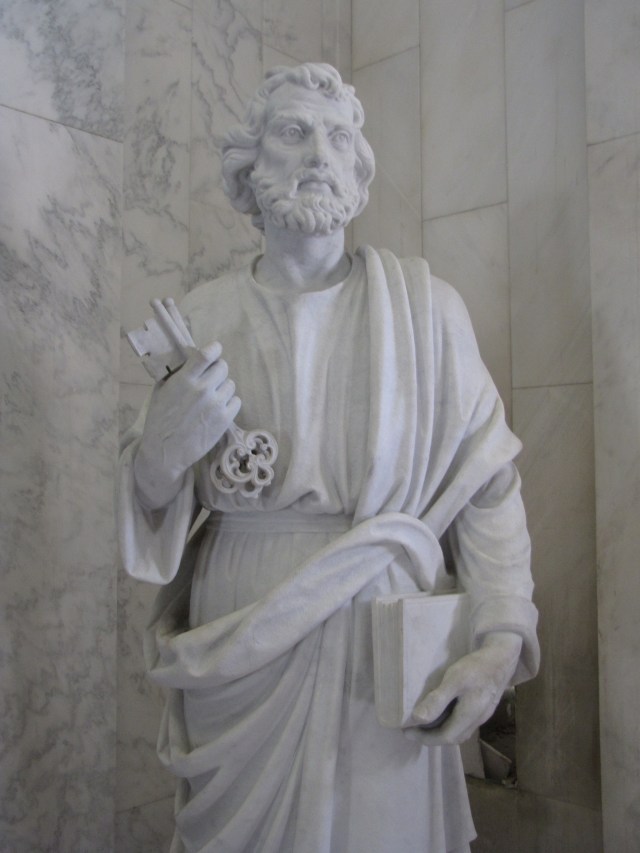
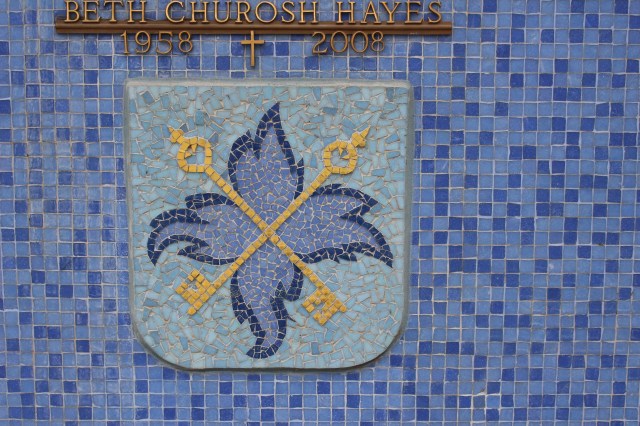
St. Peter, depicted in a statue in the columbarium in the Hollywood Forever Cemetery in Hollywood, California, holds a pair of keys.  The keys are a symbol used to represent the saint and have their origins in scripture, specifically in the book of St. Matthew, King James Bible Chapter 16: verses 16-19:

16:  And Simon Peter answered and said, Thou art the Christ, the Son of the living God.

17:  And Jesus answered and said unto him, Blessed art thou, Simon Barjona: for flesh and blood hath not revealed it unto thee, but my Father which is in heaven.

18:  And I say also unto thee, That thou art Peter, and upon this rock I will build my church; and the gates of hell shall not prevail against it.

19:  And I will give unto thee the keys of the kingdom of heaven: and whatsoever thou shalt loose on earth shall be loosed in heaven.

And it was so, the Lord built His church on St. Peter with St. Peter becoming the very first pope.  In art St. Peter is often shown standing in front of the gates of heaven.  In addition to keys as a symbol for St. Peter, an inverted cross is also used to represent the apostle.  According to the historian Eusebius, St. Peter was crucified upside down because he did not think he was worthy enough to be crucified in the same way as Jesus Christ.  According to tradition, St. Peter bound to a cross upside down, preached the word for two days until he died.

St. Peter was a simple fisherman born in Bethsaida near the Sea of Galilee.  Christ said that St. Peter would be a “fisherman of men.”  St. Peter’s feast day is June 29, shared with the apostle Paul.  St. Peter is the patron saint of fishermen, shipwrights, and stonemasons.

Mosaic from the columbarium in the St. Francis Cemetery in Phoenix, Arizona

Posted in Saints | Leave a comment

St. Simon the Zealot

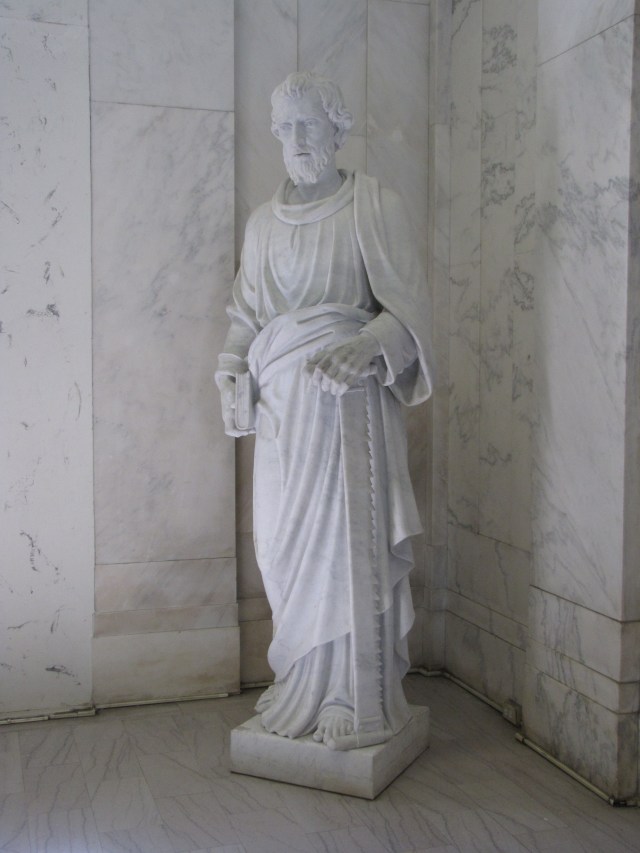
St. Simon the Zealot is one of the most obscure of all of the Apostles.  Little is known about him though it is thought that he was born in Judea.  In the Christian tradition, St. Simon is often considered part of an evangelizing team along with St. Jude.  In fact, they share the same feast day—October 28th.  Where the two actually preached the word is not certain—some believe it was Persia, Armenia, or Lebanon, while others believe they proselytized in the Middle East and Africa.  As debated is what eventually happened to St. Simon.  One tradition says that he was crucified in Persia, another makes the claim he died in his sleep peacefully, while another theory says he was martyred by being sawed in half—lengthwise.

The statue of him in columbarium in the Hollywood Forever Cemetery in Hollywood, California, depicts St. Simon with a saw, the symbol he is associated with because of his gruesome method of martyrdom.  St. Simon is the patron saint of curriers, tanners, and, ironically, sawyers.  A sawyer is defined as “one who saws.”

Posted in Saints | Leave a comment

St. Matthew–the Tax Man

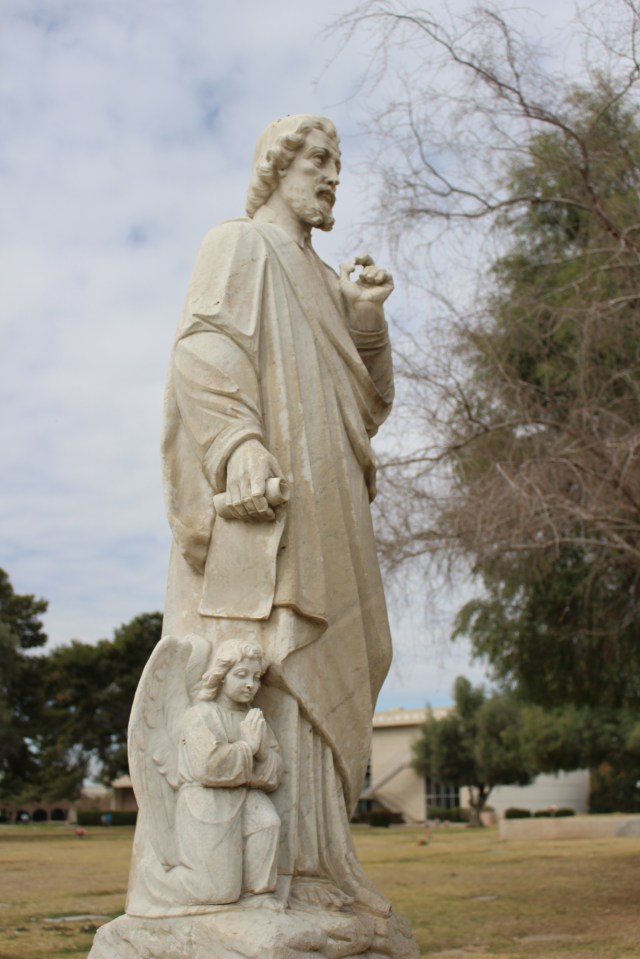
St. Matthew, in this statue found in the Evergreen Cemetery in Phoenix, Arizona, is depicted with a quill and a scroll representing his authorship of the First Gospel.  The statue of St. Matthew also has a small winged figure by his side in this sculpture.  This figure is often thought to be an angel but instead represents all humankind and the possibility that everyone has for divine inspiration.

In the mosaic from the columbarium in the St. Francis Catholic Cemetery in Phoenix, St. Matthew is depicted only as a winged man.  The symbols for the Four Evangelists are mentioned in the King James version of the Bible, Revelation 4:7, “The first beast was like a lion, and the second beast like a calf, and the third beast had a face as a man, and the fourth beast was like a flying eagle.”  When the Evangelists are shown together, they are often only depicted with those symbols.

St. Matthew’s feast day is September 21st.  St. Matthew was a Jewish tax collector, which then as now, was a profession that was disliked by most.  It is also the most likely the reason he is the patron saint of tax collectors.  St. Matthew is also the patron saint of bankers, accountants, stockbrokers, and customs officials.

Posted in Saints | Leave a comment

St. Luke

St. Luke, in this statue found in the Evergreen Cemetery in Phoenix, Arizona, is depicted with a quill and a scroll representing his authorship of the Third Gospel, which emphasizes the sacrificial work of Jesus Christ.  The statue of St. Luke also has an ox by his side in this sculpture.  The ox, an expensive animal, was sometimes used as a sacrifice.  The wings on the ox represent the Gospel of Jesus Christ which has traveled throughout the world.

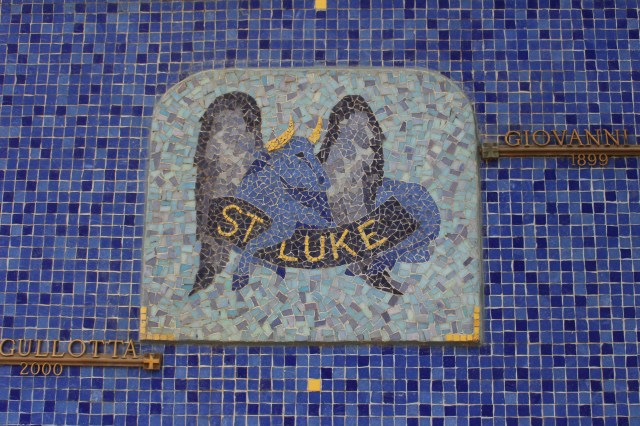
In the mosaic from the columbarium in the St. Francis Catholic Cemetery in Phoenix, St. Luke is depicted only as a winged ox.  When the Evangelists are shown together, they are often only depicted with the symbols by which they are represented.

St. Luke’s feast day is October 18th.  He is the patron saint of artists, physicians, surgeons, butchers, farmers, bachelors, and picture makers.

Posted in Saints | Leave a comment

St. John the Divine

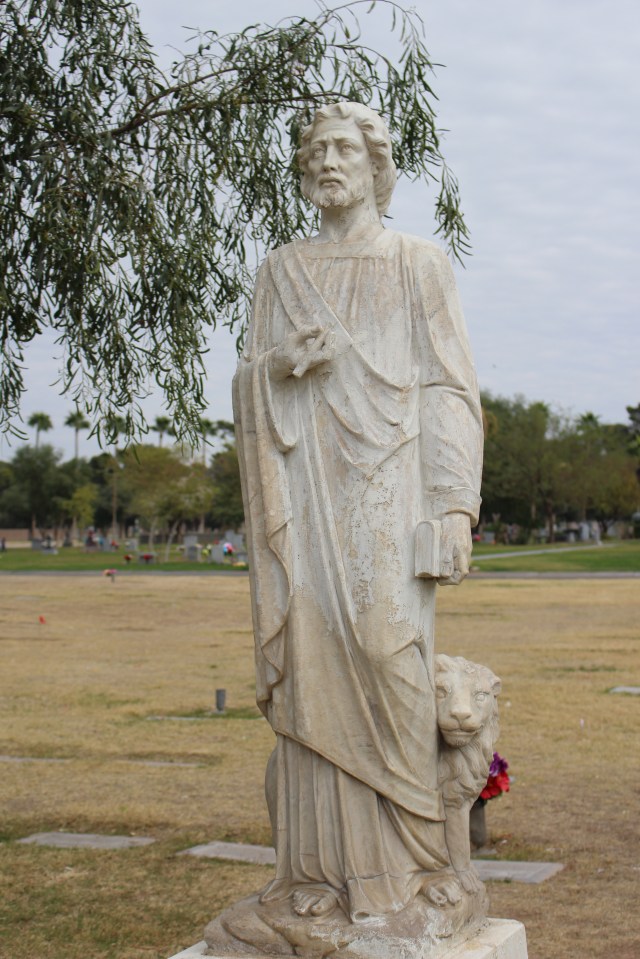
The Evergreen Cemetery in Phoenix, Arizona, has many tombs, gravestones, and markers imbued with Christian symbolism. One such monument in that cemetery is a statue of St. John.  St. John, who wrote the Fourth Gospel, three Epistles, and the Book of Revelation.  Because of these influential writings St. John is often referred to as John the Divine.

St. John is often depicted with a quill and a book representing his authorship of the Fourth Gospel.  He is also depicted as an eagle or standing with an eagle at his side.

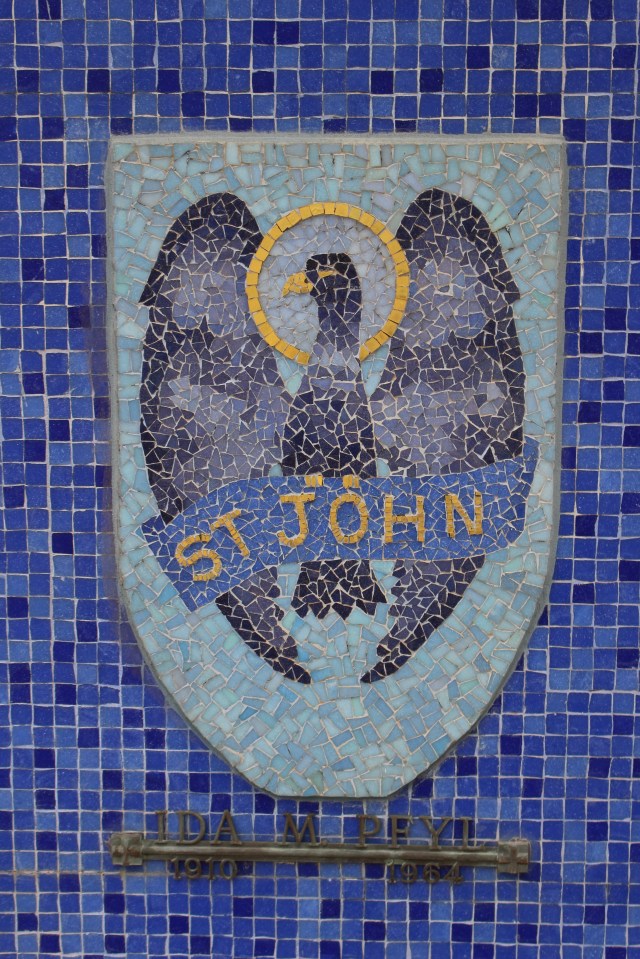
In the mosaic from the columbarium in the St. Francis Catholic Cemetery in Phoenix, St. John is depicted as an eagle.

St. John’s feast day is December 27th.  He is the patron saint of authors, editors, and all publishing professionals, “theologians, painters, engravers, art dealers, and victims of burns and poisonings.”


Posted in Saints | Leave a comment

St. Mark, the Winged Lion

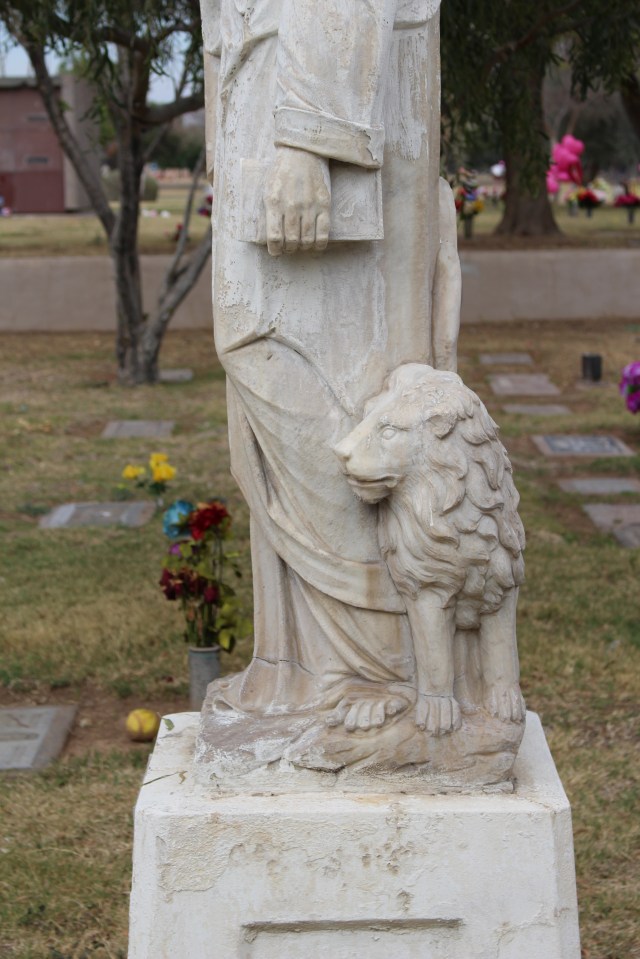
The Evergreen Cemetery in Phoenix, Arizona, has many tombs, gravestones, and markers imbued with Christian symbolism. One such monument in that cemetery is a statue of St. Mark.  St. Mark, who wrote the Second Gospel, is often depicted with a quill and a book representing his authorship of the Gospel.  He is also depicted either as a winged lion or with a lion.  This statue portrays him with a quill, book, and a winged lion at his feet.

Some Christians refer to St. Mark as “Saint Mark the Lionhearted” in keeping with the legend of him being thrown into a pit of lions.  Instead of the lions devouring St. Mark, they sublimated themselves at his feet.

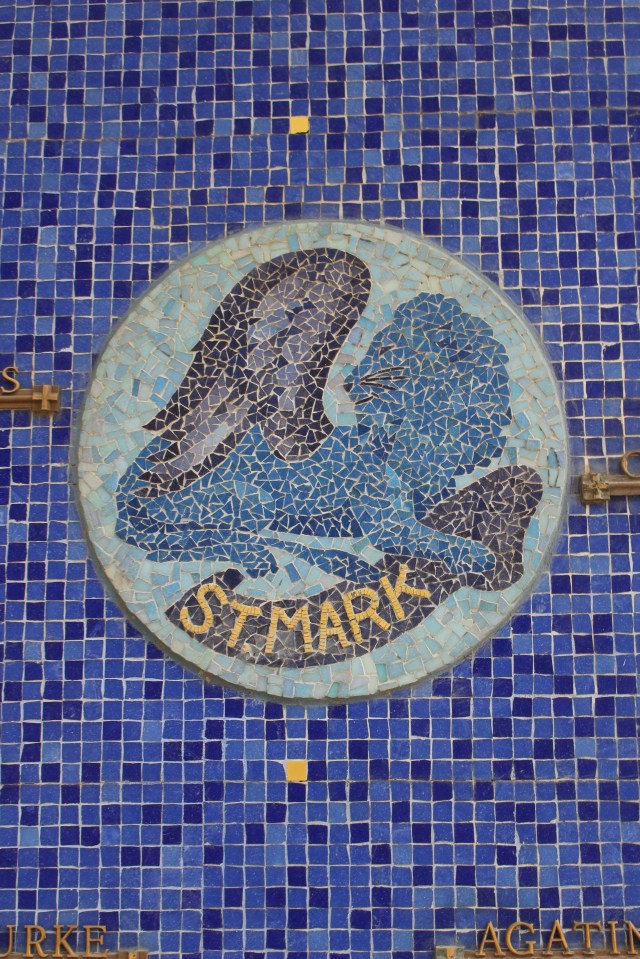
In the mosaic from the columbarium in the St. Francis Catholic Cemetery in Phoenix, St. Mark is depicted as a winged lion. The emblem refers to Christ’s power and regal dignity.

St. Mark’s feast day is April 25th.  He is the patron saint of notaries, lawyers, glassblowers, stain-glass window makers, the imprisoned, and sufferers from insect bites and those who suffer with goiters.

St. Mark depicted as a winged lion has become the symbol of the city of Venice, Italy.

Posted in Saints | Leave a comment

Her Soul Takes Flight with an Angel

St. Francis Catholic Cemetery, Phoenix, Arizona

Elisabeth L. Roark wrote an article about angels titled, “Embodying Immortality: Angels in America’s Rural Garden Cemeteries, 1850—1900”, pages 56 – 111, 2007 edition of Markers, XXIV, in which she wrote Catholics had embraced the concept of angels but Protestants were slow to. That changed in the second half of the 19th Century. She explains that there was an “invasion” of angels in rural garden cemeteries, which were for the most part Protestant graveyards. Roark explains in the article that Protestants accepted the concept of angels because they not only expressed a message of consolation but were also utilitarian—these angels performed tasks.

According the article, angels come onto the scene in rural garden cemeteries in a big way starting in 1850 and then throughout the rest of the century. Though angels come in many variations and forms, in her study of 14 rural cemeteries from each region of America, Roark found that the majority of angels fall into the following eight categories:

  1. Soul-bearing Angels
  2. Praying Angels
  3. Angels who decorate and watch over the grave
  4. Pointing angels
  5. Recording angels
  6. Trumpet angels
  7. Michael the archangel
  8. Child angels

In this example, a soul-bearing angel holding a woman by her side both with flowing gowns is carved into the white-marble .  In this category of angels, the angels are depicted carrying the soul to Heaven. In most of the examples the author found, the angels were carved in bas-relief because of the complexity of carving them in the round.  This intricately carved monument depicts the soul as a young woman.

Posted in Angels | Leave a comment

Help!

In Victorian times, flowers took on significance as a way to send coded messages; this was known as floriography from the Latin combining flora—“goddess of flowers” and graphein—“writing”.  Each flower had a meaning that was conveyed to the viewer or receiver of the flower or bouquet of flowers—the lily of the valley represented humility, the coral rose represented desire and passion, the white lily represented purity, and so on.

I took a large number of photos in the Mount Auburn Cemetery in Cambridge, Massachusetts.  Unfortunately, I cannot identify some of the flowers.  Please reply and leave the number on the picture and the flower you believe it is in the reply.  Then I can write about the meaning of each.  Let me know if you can identify any of the following:

1

2

3

4

5

Posted in Uncategorized | 4 Comments

A Sign Post

A sign outside the gates of the Old North Cemetery announces the burial of the most New Hampshire native son within its fencing.  The sign outlines the major accomplishments of Franklin Pierce:

FRANKLIN PIERCE

1804 – 1869

Fourteenth President of the United States

(1853 -1857)

Lies buried in nearby Minot enclosure.

Native son of New Hampshire,

Graduate of Bowdoin College,

Lawyer, effective political leader,

Congressman and U.S. Senator,

Mexican War veteran, courageous

Advocate of States’ rights,

He was popularly known as

“Young Hickory of the Granite Hills.”

While the sign outlines Pierce’s political accomplishments, there is nothing about his personal life.  Franklin Pierce was born in Hillsborough, New Hampshire.  He married Jane Appleton, the daughter of a Congregational minister.  Jane and Franklin were nearly polar opposites.  Franklin was outgoing and gregarious.  Jane was shy and suffered from depression.  Jane was pro-temperance and devoutly religious.  Jane was from a family that belonged to the Whig party and the Pierces were Democrats.  She eschewed the limelight, while Franklin thrived in it.

Their marriage and life together was punctuated with tragedy.  Franklin and Jane had three sons.  Franklin Pierce Junior, who was born in 1836, died just three days after his birth.  Their second son, Frank Robert, born in 1839 and died four years later from typhus.  Their third son, Benjamin, was killed in a tragic train accident two months before Pierce took office.  The family was traveling when the train they were riding in overturned and their son, Benjamin, was killed.

Pierce took the office of the presidency exhausted and bereft.

Pierce served one term.  His party did not re-nominate him.  He returned to private life but did not ever give up his zest for politics.  He stayed engaged but was not elected again to office.  His wife, Jane, died in 1863.  Franklin, a lifetime long heavy drinker, died in 1869 from cirrhosis of the liver.

President Franklin Pierce and his wife, Jane, were buried in the Old North Cemetery, the oldest cemetery in the Concord, New Hampshire.

The gravestone for President Franklin Pierce, his wife, Jane, and two of his three children, Frank and Benjamin, is constructed of unpolished gray granite and sits in a semi-circle of neatly-tended flowers and plantings.

The central portion of the monument consists of a block sitting on a platform.  A tall six-sided tapered column rises above the center block and is topped by a floriated or fleury cross, with a cloth draping it.  The empty cross with drapery is known by many different names—Risen Cross, Resurrection Cross, Draped Cross, Shrouded Cross—and symbolizes atonement and redemption. The center of the floriated cross features a circle.

On either side are flat blocks topped with a thin ledge flanking the central and main portion of the monument.  On the left side is the inscription:

JANE M. APPLETON

WIFE OF

FRANKLIN PIERCE

BORN MAR. 12. 1806

DIED DEC. 2. 1863

On the middle portion of the monument is the following inscription:

FRANKLIN PIERCE

BORN NOV. 23. 1804

DIED OCT. 8. 1869

14TH PRESIDENT

OF THE

UNITED STATES

1853 – 1857

On the right flank of the monument is the following inscription:

THEIR CHILDREN

FRANK R. PIERCE

BORN AUG. 27. 1839

DIED NOV. 14. 1843

BENJAMIN PIERCE

BORN APR. 13. 1841

DIED JAN. 6. 1853

Posted in Presidential graves | 3 Comments

Happy President’s Day, Happy Birthday George Washington

In 1885, Congress passed a law to recognize and celebrate George Washington’s birthday each February 22.  On June 28, 1968, Congress passed the Uniform Holiday Act (Pub.L. 90—363) and moved four holidays—Memorial Day, Veteran’s Day, Columbus Day and Washington’s birthday—to the nearest Monday to create more three-day weekends for American workers.  The bill took effect on January 1, 1971, though, Veteran’s Day was officially moved back to its original date on November 11, which reverted in 1978.

Most people have the misconception that by moving the date of the celebration of Washington’s birthday, that it combined the holiday to include Lincoln’s birthday with Washington’s (since they are both in February) or that the holiday was changed to include all presidents in the holiday.  Neither is true.  The holiday celebrates George Washington’s birthday.

So, today it NOT George Washington’s birthday—he was born February 22, 1732—and yet, we celebrate his birth.

In nearly every public poll, George Washington is listed as either the greatest president or polls in the second spot behind Abraham Lincoln.  He was, of course, our first president, and many of those at the Constitutional Convention that drafted the document believed and wanted George Washington as the first president.  He was described during those deliberations as the “first character.”

Washington set many precedents for the office and the country.  He was there to set up the American government after the devastating War of Independence.  His steady leadership guided our nation through the early years when our institutions were established.  Just as important to his legacy was he return to private life after two terms in office.  His old adversary, British King George III asked portrait artist Benjamin West what George Washington would do after the colonies won independence and West answered, “return to his farm.”  King George replied in near disbelief that that would make Washington “the greatest man in the world.”

After Washington left the office in 1797, he did, in fact, return to his beloved Mount Vernon.  Less than two years later he became ill after riding on horseback in freezing rain to inspect his plantation.  He awoke having difficulty breathing.  As was the practice, his doctor’s recommended bloodletting.  His condition weakened and on Saturday, December 14, 1799, George Washington died at Mount Vernon.  His last words were recorded as, “tis well.”

George Washington was buried on his plantation.  He now rests in a tomb beside his beloved Martha.  Henry “Light Horse Harry” Lee put it best George Washing was, “First in war, first in peace, and first in the hearts of his countrymen.”

Posted in Uncategorized | Leave a comment