Their Little Angel

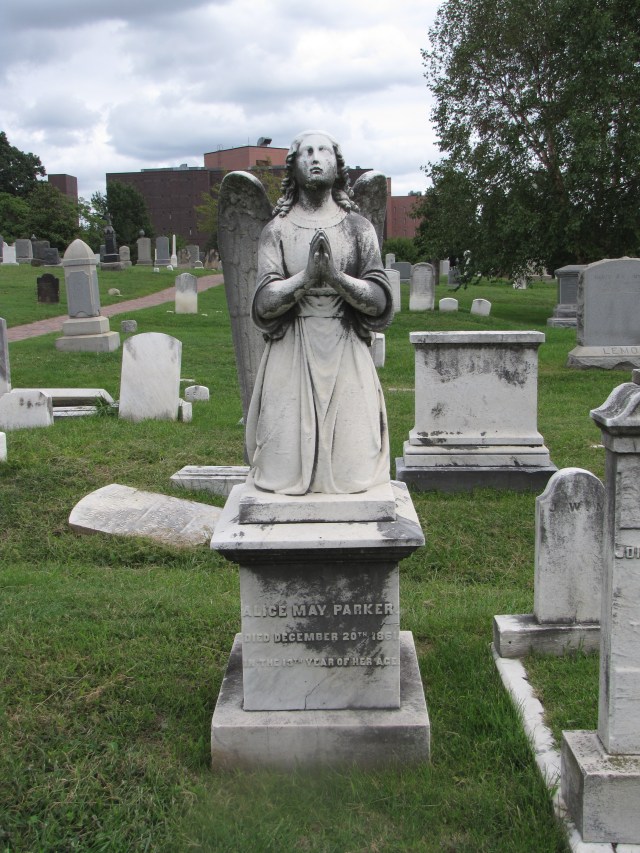
ALICE MAY PARKER

DIED DECEMBER 20TH 1861

IN THE 13TH YEAR OF HER AGE.

A friend of mine recently shared with me that her first husband passed away when she was 23.  Her husband was 24 and their daughter was only a year old.  It was a very tough for her emotionally, financially, and she felt alone.  She’d just lost her husband and now had to go on to raise their daughter by herself.  And, she had to attend to the funeral arrangements even as she dealt with waves of grief.

She told me that she took a long time to decide on the headstone.  While she was at the monument company, she also overheard a man picking out a headstone for his wife of 60 years.  Both experiences, like all experiences when someone is picking out a gravestone for a loved one, is deeply personal and fraught with emotion.  It is, after all, one of the last things you can do for your loved one.  Not only that, but it will be a reminder not only to you but to all who gaze upon the gravestone and think about the person buried beneath it.

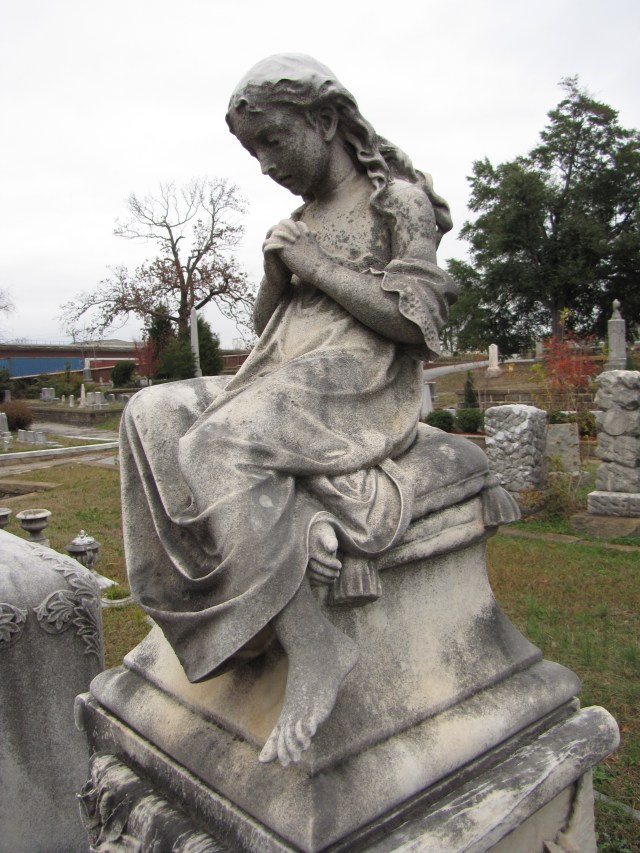
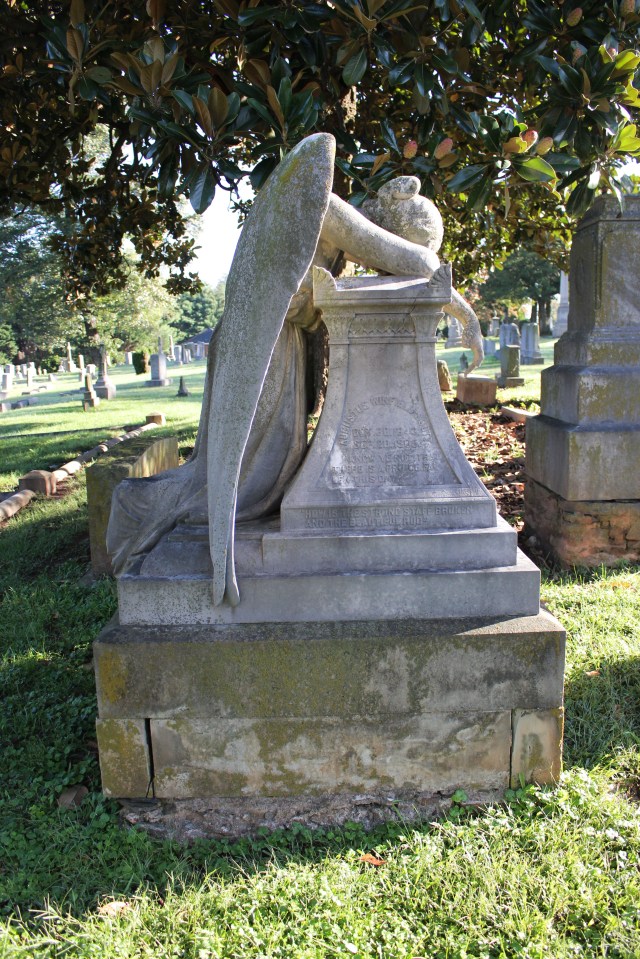
So, when I saw the kneeling angel that marks the grave of 13-year old Alice May Parker, I can’t help but think of the anguish her parents had when their daughter passed away.  She died of typhoid fever and must have suffered with the fever for a few days before she died.  I am sure they were by her bedside attending to her and hoping for the best results.  Then the end came.  The grief of a parent for a child is overwhelming.

When looking at gravestones, there is always room for interpretation.  Elisabeth L. Roark wrote an article about angels titled, “Embodying Immortality: Angels in America’s Rural Garden Cemeteries, 1850—1900”, pages 56 – 111, 2007 edition of Markers, XXIV, in which she categorized the eight most commonly found types of graveyard angels—grouped by the task they performed: soul-bearing; praying; decorating and guarding; pointing; recording; trumpeting; sword-bearing (archangel Michael); and child angels.

The winged protectors served to watch over the “soul while living, removed occasions of sin and provided protection when danger threatened, interceded on their charges’ behalf, attended at death, eased the transition to the next world, conducted the soul to Heaven, and looked after the grave site and the deceased’s remains until resurrection.”

These were busy angels. In addition to those duties, the praying angels served as an intercessor conveying messages from their charges to Heaven. These angels usually are looking upward toward the Heavens, hands clasped together in prayer, sometimes coupled with emblems of faith, such as, anchors and crosses, often clad in toga-like clothing.

But when I look at Alice May Parker’s monument in the Congressional Cemetery in Washington, D.C., I wonder if her parents, George and Sofia Parker, saw their little girl in that angel, to me the angel looks to be about the same age as Alice May when she died.   I wonder if her parents made the choice to mark her grave with an angel, not as a messenger from God, but as a memorial to their little angel.

Posted in Angels, Children's Graves | 2 Comments

Children

In the small Bethel Cemetery in rural Harrison County, Iowa, is a double tablet gravestone commemorating the graves of two children.

GEO MARQUIS

DIED NOV. 19, 1879

AGED

6 YEARS & 9

MONTHS


MINNIE M.

DIED

DEC. 29, 1879

AGED

5 YEARS & 15

DAYS

Children of

PETER C & AMANDA

HENDERSON

Tis hard to give them up

Yet we drink from the bitter cup in hope

That we shall meet again

Beyond this sphere of sin and pain.

In the top of the white marble marker in a double rounded inset mimicking the gravestone shape is a carved image of a boy and a girl holding hands depicting the Henderson’s children who died a little more than a month apart at the end of 1879.  The stone is a reminder of how high mortality rates were for infants and children in the 19th Century.

Posted in Children's Graves | 2 Comments

The Willows

IN

memory of

Eliza Hammond

who Departed

this life … 18th

1854, in the 17th

year of her

Remember friends as you pass by

As you are now, so once was I,

As I am now so you must be

Prepare for death and follow me.

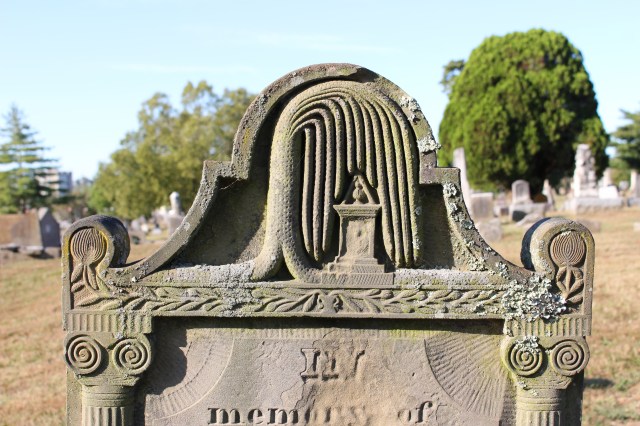
One of my favorite graveyard symbols is the willow.  The willows come in all sorts of the forms—some realistic, others highly stylized—and sometime they are combined with other objects, such as gravestones, weepers, and quite often, urns.  And, they can be found nearly everywhere—the willow motif is ubiquitous in 18th and 19th Century American cemeteries.

The willow represents a turning away from the harsh symbolism of death found on Puritan gravestones to a softened approach as America moved into the Romantic era.  In their groundbreaking article, “Death’s Head, Cherub, Urn and Willow,” James Deetz and Edwin S. Dethlefsen, wrote that the willow first made its appearance in cemeteries in the early 18th century. The motif represented a break from the stark and cold reminders that death would bring that the Puritans carved into their gravestones—flying death’s heads, skulls and crossbones, and gravedigger’s equipment. In addition to the grim reminders of the inevitability of death Puritan gravestones often accompanied the haunting imagery with blunt words such as, “Here lies the body.” Nothing subtle there. The willow and the urn, however, represented a more sentimental view of death. There was a softening of Puritan views during the Great Awakening and the beginning of the Romantic Era.  Often the willow motif is accompanied with words like, “In memory of” or “Sacred to the memory of.”  This represented a softer approach to the funerary arts.

Like many symbols found in the cemetery, they can have multiple meanings, and there can be disagreement about the meaning of the motif—including the willow. Christians saw the ability of the tree to live seemingly no matter how many of the branches were cut from the tree as a symbol of immortality. And, point to the Bible verse, Psalm 137.:2, “We hanged our harps upon the willows in the midst thereof.” As a reference to its Christian origins, though few biblical scholars believe that the willow was the tree quoted in the passages as the willow is not native to the Middle East.  Others suggest that the willow motif predates Christianity going back to the time of the Greeks. The willows in Greek mythology was associated with the Underworld. Orpheus carried a willow branch with him when he traveled there to rescue Eurydice from Hades. Whether Greek or biblical, the motif coincided with a neo-classical revival that took place in the mid-18th Century in America.

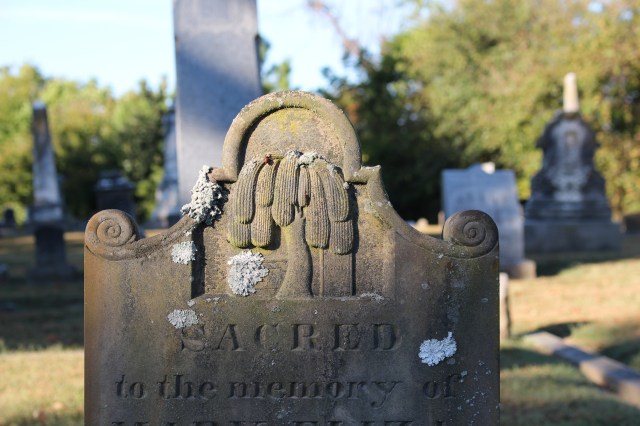
The two examples of willows on gravestones from the Fairview Cemetery in New Albany, Indiana, in this post display two of the many different styles of willows that can be found in graveyards.  In both cases the willow fills the tympanum and is intricately carved.

In the example above, the limestone tablet is elaborately carved with an architectural look to it—columns on the sides with Ionic capitals, holding up the top of the third of the stone.  Inside the arched tympanum is the willow which takes on almost human characteristics—it is bent over in grief and agony, its long thin branches enveloping the tombstone topped with an urn.  The tablet is weathered in an unusual way—with an effect in the lower third of the face of the stone with a bubbling like blur that meanders up through the inscription.

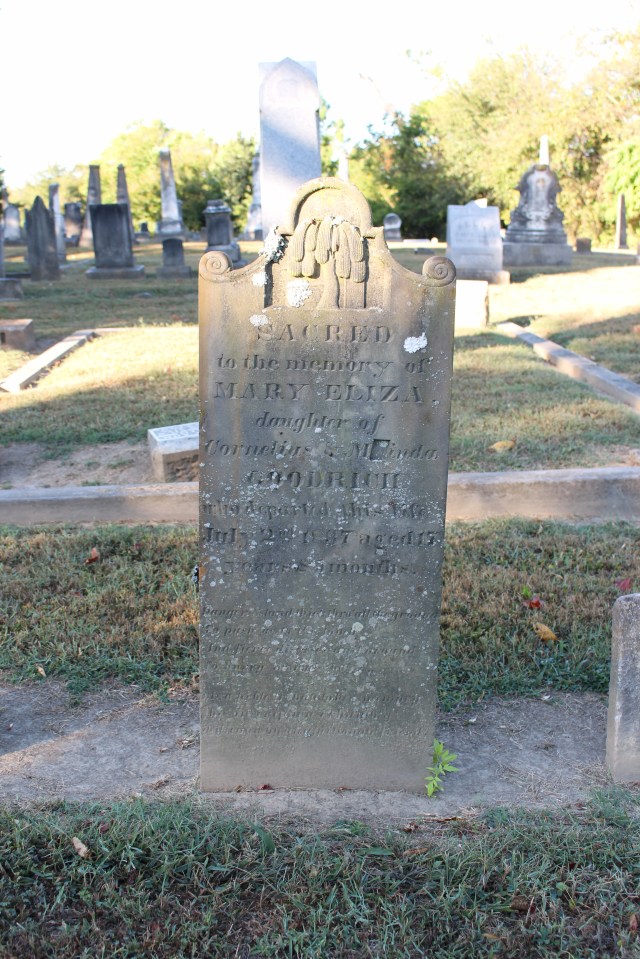
The example below, also from the Fairview Cemetery in New Albany, Indiana, also has a willow tree in the tympanum of the gravestone.  In this gravestone, the willow offers shade to the newly marked grave of Mary Eliza Goodrich.  The weathered gravestone is difficult to decipher.

SACRED

To the memory of

MARY ELIZA

Daughter of

Cornelius & M[ ]inda

GOODRICH

who departed this life

July 2nd 1887 aged 17

years & 5 months

Dangers stand thick thro’ all the ground

To push us to the tomb

And fierce diseases wait around

To hurry [to sorrow’s] home.


As a feeble tribute to her memory

This inscription is humbly

Dedicated by an affectionate friend.

Posted in Symbolism | Leave a comment

Weeping Angel, Additional Examples

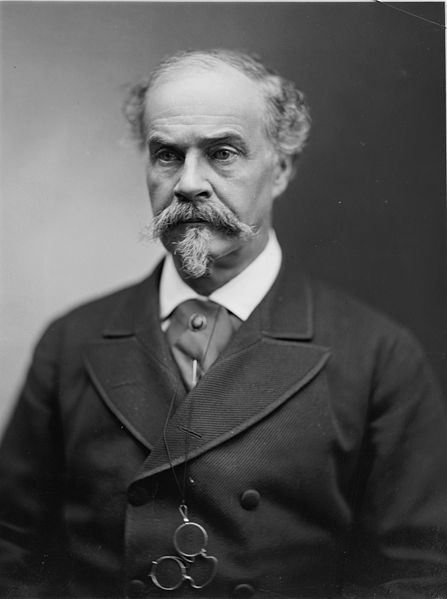
William Wetmore Story (February 12, 1819 – October 7, 1895), the son of Joseph Story—Supreme Court Justice from 1811—1845, was a multi-talented Renaissance man. Story was an editor, poet, art critic, and an incredible sculptor. Though trained as a lawyer at the Harvard Law School, he abandoned the legal profession to follow the arts.

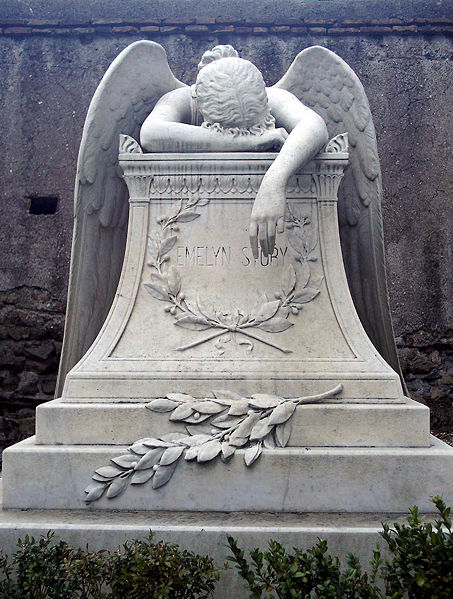
His body of art work includes among others, a sculpture of his father, Joseph Story, fittingly at the Harvard Law School and a statue of another famous jurist and judicial colleague of his father’s, Chief Justice John Marshall. But the sculpture that has become replicated and imitated in cemeteries in Europe and America is the monument that he carved for his wife’s grave in the Protestant Cemetery in Rome, Italy.

An article written in the Sept. 1896, issue of Cosmopolitan Magazine stated:

The loss of the wife of his youth whom he survived but a year, was a bitter blow; and with her passed his interest in affairs. It was only when his children suggested that he should make a monument to her memory that he consented to resume work; the design he chose was the “Angel of Grief”, and it is wrought to exquisite finish…When this was done he left the studio never to return.”

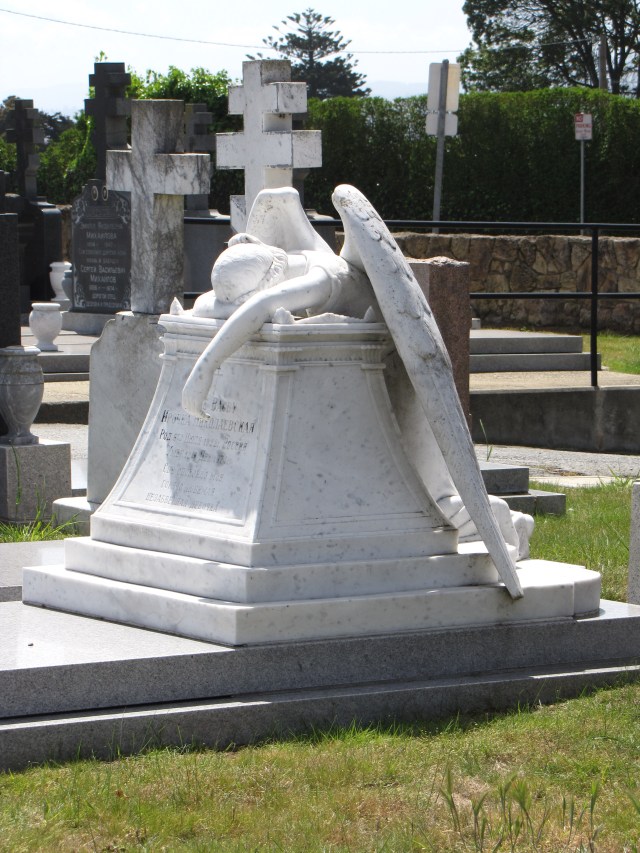
The statue marking Emelyn and William Wetmore Story’s grave depicts an angel collapsed and distraught in grief. The statue is dramatic and evokes the solemn loss of a loved one. The statue is known, aptly as the Angel of Grief perhaps because of its ability to capture devastating grief from departure due to death.

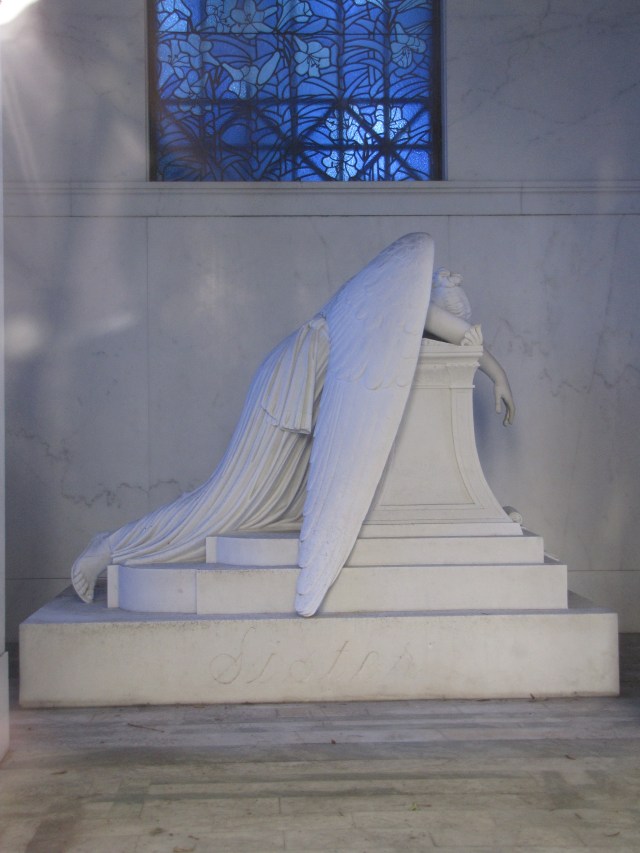
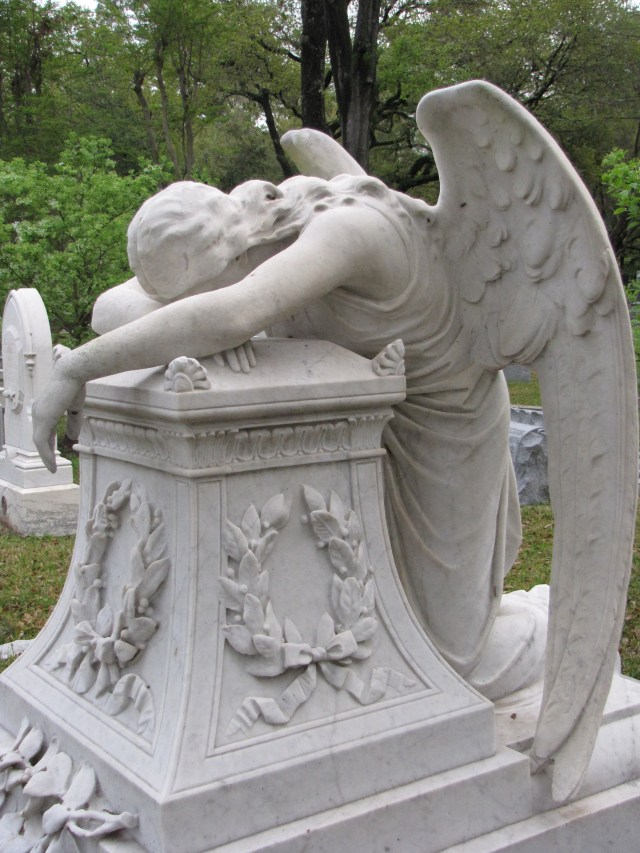
The statue’s imitators can be found in many cemeteries including the ones below:

Perhaps one of the most elegant examples can be found in the Metarie Cemetery at New Orleans in the Chapman H. Hyams mausoleum. In the picture above, the blue light from the stained glass showers the statue in a calming hue.

The example above is in the Mount Hope Cemetery at San Diego, California, and marks the grave of Marjorie Marie Pierce.

Marking the grave of the Hill Family in the Glenwood Cemetery at Houston, Texas, is a replica of nearly exacting quality.


Irene Bagby’s marker in the Serbian Cemetery at Colma, California.

Jennifer Roosevelt Pool’s monument in the Cypress Lawn Cemetery at Colma, California. Pool was the cousin of President Theodore Roosevelt.


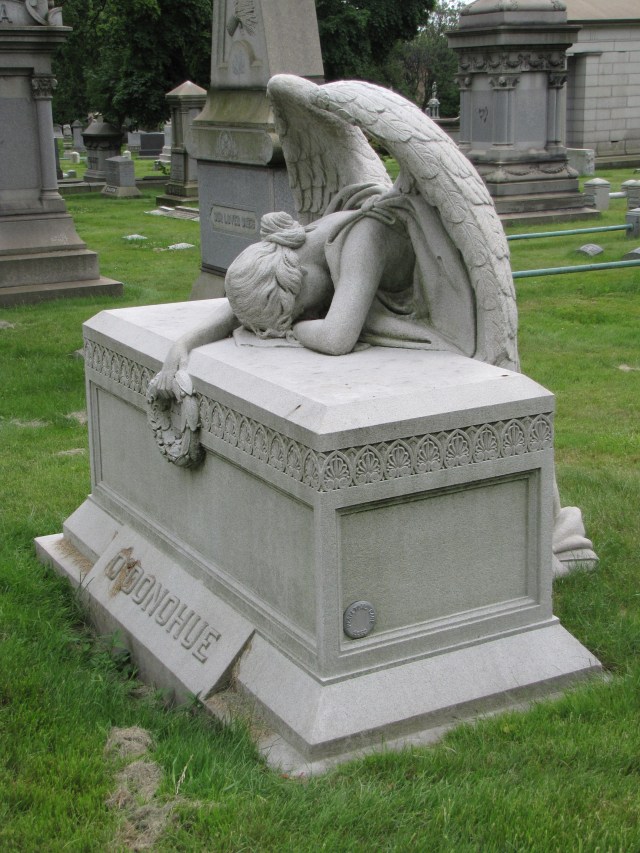
Two examples in the Green-wood Cemetery at Brooklyn, New York, have a slightly deviated design. In this version for the O’Donohue Family has the angel holding a wreath. The laurel wreath dates back to Roman times when soldiers wore them as triumphal signs of glory.  The laurel was also believed to wash away the soldier’s guilt from injuring or killing any of his opponents.  In funerary art the laurel wreath is often seen as a symbol of victory over death.

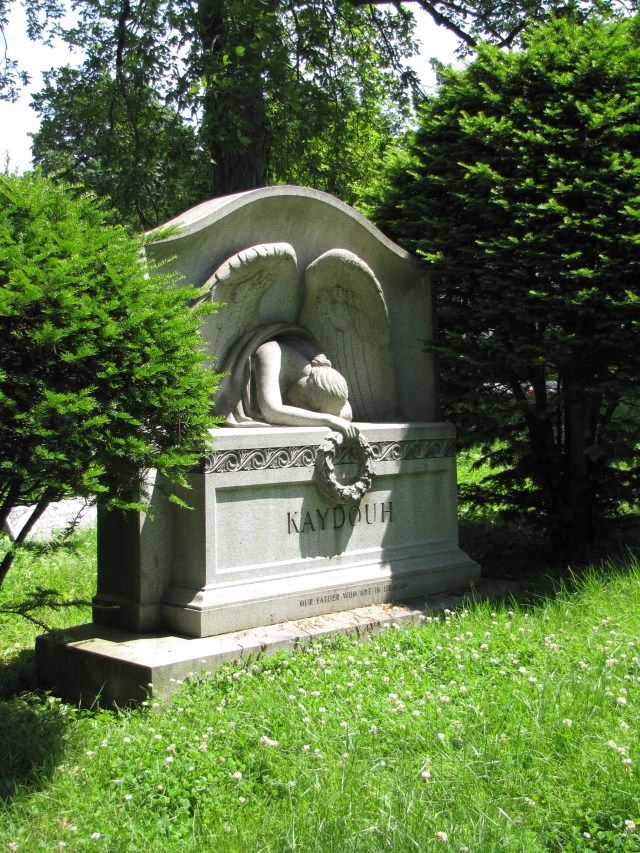
This example is also found in the Green-Wood Cemetery at Brooklyn. It marks the grave of Michael and Shamsi Kaydouh.

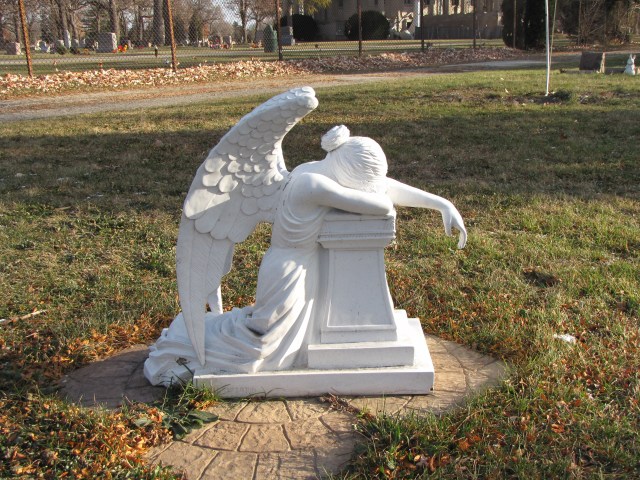
This example is found in the St. Luke Cemetery at Chicago. It is a small version and does not mark a grave but is used as a piece of artwork for the cemetery.  On the front of the monument is the poem:

The bud was spread, To show the rose

Our Savior smiled, The bud was closed. 
Anon.

The example below is from the Presbyterian Cemetery in Lynchburg, Virginia.  It is tucked under a tree.

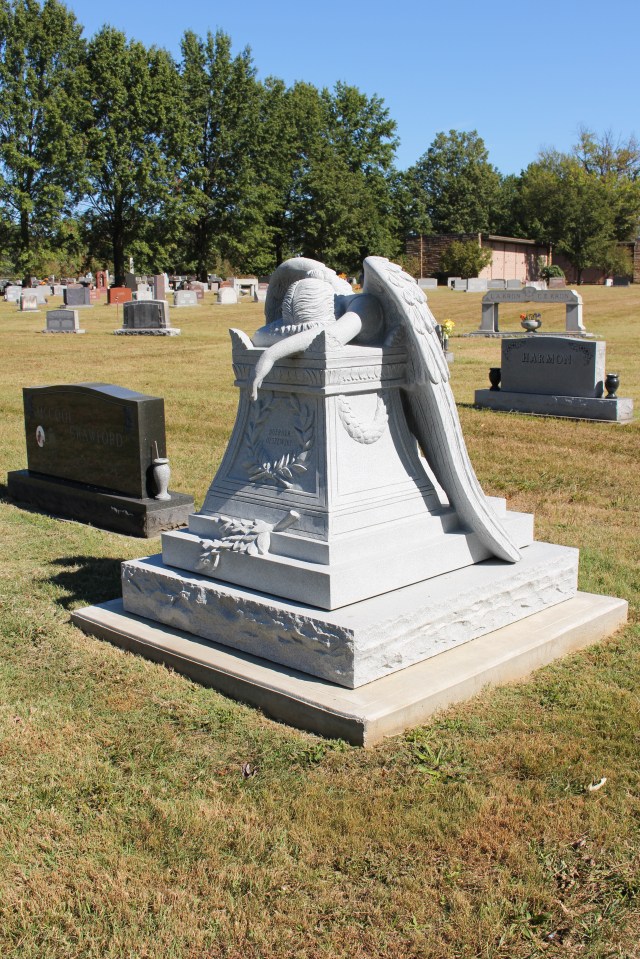
This example below was found at the Kraft-Graceland Memorial Park t New Albany, Indiana.

This last example is from the Stanford campus in California.

Posted in Angels | 5 Comments

Swan Song

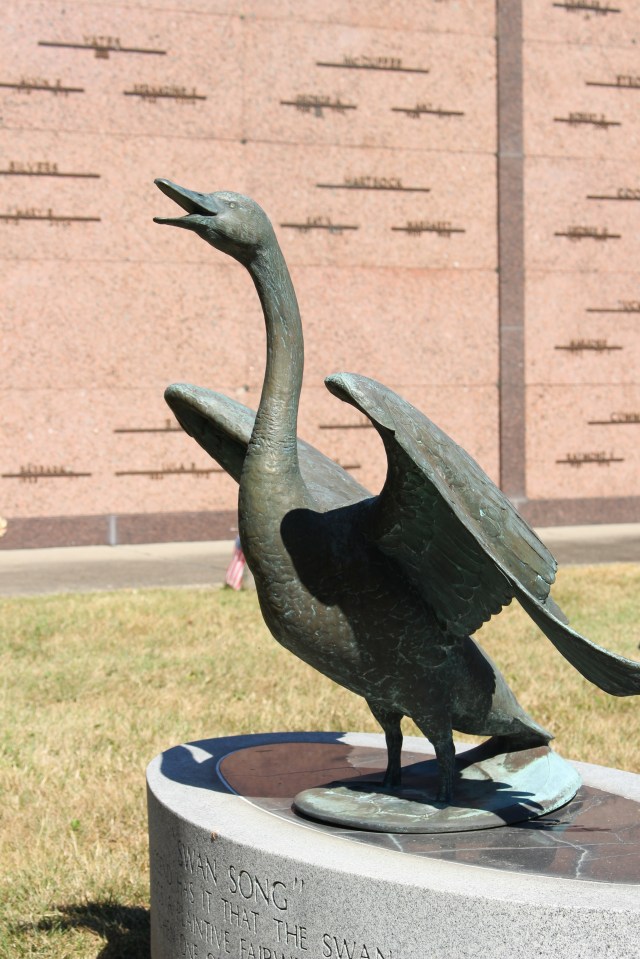
The intricately carved white swan set on a highly polished black granite base in the Kraft-Graceland Memorial Park in New Albany, Indiana, is only second such gravestone I have come across, likely carved by the same stone carver—the other in the White Oak Cemetery in Bloomington, Indiana.

An early legend from antiquity that extends as far back as Pliny the Elder in AD77 in his book on natural history credit the swan with singing a plaintive song as it dies.  Many other writers in ancient times wrote and believed this to be.  So, it became part of the vernacular and has come to mean, in modern day, as one last great performance.

In a courtyard in the Kraft-Graceland Memorial Park is a bronze statue dedicated to the legend.  The inscription on the base of the statue reads, ““Swan Song” Legend has it that the swan sings a plaintive farewell song when one of the birds die.”  That is a slight twist on the legend indicating that the fellow swans sing to the dying mate instead of the dying swan singing its last song.
The swan is also familiar to us all from Hans Christian Anderson’s story.  In the tale the poor duckling, mocked and ridiculed for being so ugly, magically transforms into an elegant and graceful adult swan–thereby becoming a symbol of transformation.  The swan in funerary art could possibly represent the metamorphosis from one form into the next.  Because the swan often pair for life, the swan is also a symbol of love.

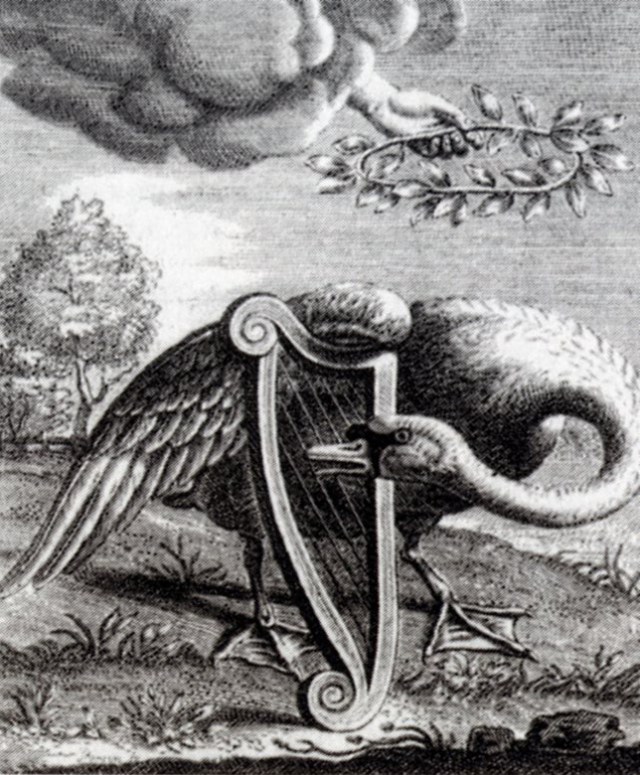
A n engraving by Reinier van Persijn depicts the legend of the swan song.

Posted in Symbolism | Leave a comment

The Church Window

Generally, I write about older gravestones from the 17th, 18th, and 19th centuries.  I usually find them to be more interesting with symbolism that is intriguing and sometimes forgotten or obscure.  Or I write about statuary found in graveyards that are works of art often by well-known artists who did commission work including funerary sculptures.

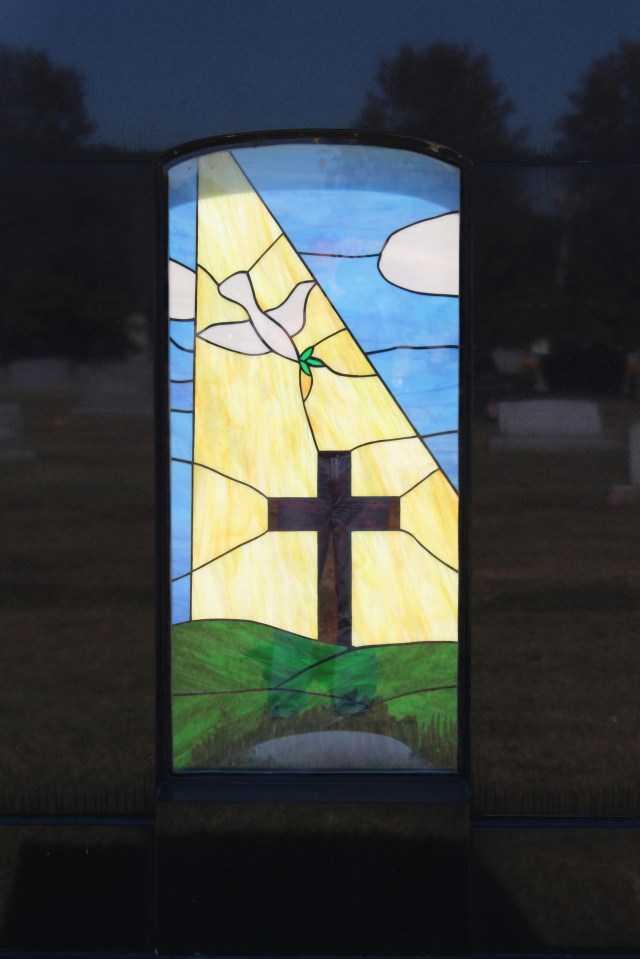
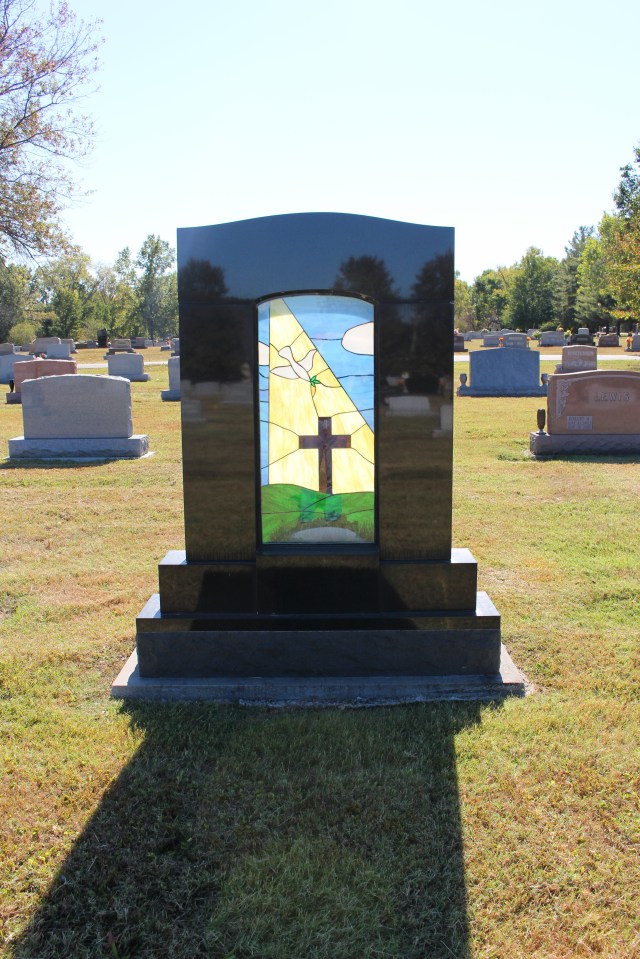
But as I was walking through the Kraft-Graceland Memorial Park in New Albany, Indiana, I was struck by a highly polished black granite gravestone with a stained-glass window inset.  The window depicts a ray of sunlight shining down on the Cross.  The gravestone was designed, I think, to look like a free-standing church window and is a stellar example of a modern design of mixed construction materials.

Within the ray is a dove with a sprig of three leaves in its beak—the number three likely representing the Holy Trinity.  Many symbols found on gravestones have multiple meanings. The dove is one of those.

Several references in the Bible refer to the dove as a symbol of the Holy Spirit. Matthew 3:16 reads, “And Jesus, when he was baptized, went up straightway out of the water: and, lo, the heavens were opened unto him, and he saw the Spirit of God descending like a dove, and lighting upon him.” In Mark 1:10 the Bible says, “And Straightway coming up out of the water, he saw the heavens opened, and the Spirit like a dove descending upon him.”

Again, in John 1:32, the Bible reads, “And John bare record, saying, I saw the Spirit descending from heaven like a dove, and it abode upon him.”

Along with the dove symbolizing the Holy Spirit, the dove is also closely associated with peace, often depicted with a sprig of an olive in its beak. This, too, originated in the Bible. After the waters receded in the story of Noah, the dove appears. Genesis 8:11, “And the dove came into him in the evening; and, lo, in her mouth was an olive leaf pluckt off; so, Noah knew that the waters were abated from off the earth.”   It was a sign of God’s forgiveness.

The dove, with its white color, is also a symbol of purity and innocence and for that reason is often found the tombstones of children.

Thus, the dove symbolizes the Holy Spirit, peace, and purity.

Posted in Uncategorized | Leave a comment

Grave Goods

When mementos such as, coins, pebbles, teddy bears, and whiskey bottles are left on a grave, they are referred to as “grave goods.”

Coins

Since ancient times, the imagery of the boat to ferry a soul from one realm to the other has been a part of the symbolism of death.  In Greek mythology, the River Styx wrapped its way around Hades (the Underworld) nine times.  To cross from this life to the next, the dead had to pay with a coin to be ferried from the realm of the living to the realm of the dead.  The toll was placed in the mouth of the deceased to pay Charon, the ferryman.  It was said that if the dead person did not have the coin, he was destined to wander the shores of the River Styx for a century.  The “boat” was one of the images found on Victorian graves to represent the crossing from one world to the next.  Leaving a coin on a gravestone, then, becomes a way to pay the ferryman and saving the spirit of the dead from the fate of wandering in the depths for a hundred years.

Pebbles

Grave goods have a long history which has its antecedents in Biblical times.  According to Genesis 35:20, (King James Version), the tradition started with Jacob— “And Jacob set a pillar upon her grave: that is the pillar of Rachel’s grave unto this day.”  For Christians and Jews leaving a pebble on top of a gravestone honor’s a loved one—building a pillar as Jacob did for Rachel.  Some Jewish cemeteries even have containers that hold stones so families visiting graves can choose a pebble to place on a family member’s gravestone.

Mementos

Along with pebbles and coins many other kinds of items are left at graves—toy cars and teddy bears on children’s graves, buckets of chicken at Colonel Sander’s grave, and sometimes, as in the case of Hoagy Carmichael, the great Tin Pan Alley composer, an empty bottle of booze—perhaps a nod to the lifestyle of many musicians and performers.

Posted in Symbolism | Leave a comment

Fame

John Gately Downey

Born June 24, 1827 – Castlesampson, Ireland

Died March 1, 1894 – Los Angeles, California


Maria Jacinta Guirado Downy

Born September 10, 1835 – Los Angeles, California

Died January 19, 1883 – Tehachapi, California


Rose Vincentcia Kelly Downey

Birth 1845 – Ireland

Died December 6, 1892 – Los Angeles, California


Governor Downey

Maria Downey

John Downey was the 7th Governor of California—the youngest to hold the office and only the second to be born outside the United States—he shares that distinction with Arnold Schwarzenegger.  He immigrated to the U. S. in 1842 at a young age.  He began work as an apothecary and was a successful businessman plying his trade first in Washington, D.C., then Ohio, and finally in San Francisco.  It was after he moved to Los Angeles that he became involved in Democratic politics.  He served for as Governor for two years at the outbreak of the Civil War.  Upon leaving politics he turned to business interests in banking.

In 1883 on a train trip, Downey, along with his wife, Maria, were involved in a violent train accident at Tehachapi Pass in Tehachapi, California, when their train jumped the tracks and plunged into a ravine. Governor Downey was pulled out of a railcar window by a porter, injured but alive, but Mrs. Downey was dead. She was pinned in the fiery wreckage and could not be saved.  Some reports indicate her body was never found while others indicate that her body was at first misidentified.  Whatever the facts, it is clear that the Governor never quite recovered from the accident.  Downey suffered for the rest of his life from what was described as “nervous shock.”  He did go on to remarry Rose Vincentcia Kelly some years later but she died a year and some months before the Governor.

Governor Downey died, March 2, 1894.  The Los Angeles Herald headline read, “JOHN G. DOWNEY DEAD. The Old Pioneer Passes Quietly Away. His Death Occurred Shortly After Noon, Yesterday.  His Demise Due to Pulmonary Apoplexy—…Ex-Gov. John Q. Downey died shortly after 12 o’clock yesterday noon at his residence, No. 345 South Main street. His death was a great surprise to the majority of people, many of whom had seen him but recently in perfect health. His fatal sickness dates from last Sunday. On that day, in company with an old-time friend, Maj. J. 11. Coleman, he took a carriage drive through East Los Angeles. The governor had a slight cold and it was thought the ride would benefit him. On the return Major Coleman remarked to the governor that his ride seemed to have helped him, to which the governor replied in the affirmative. In the evening while seated on the edge of his bed be was seized with an apoplectic fit and fell to the floor, hurting his head. For a time that night (Sunday) the governor wandered about the house, but was finally quieted and put to bed. On Monday Dr. K. D. Wise, bis family physician, was called. He found that Governor Downey was affected with both pulmonary and cerebral apoplexy. By repeated applications of ice the latter was reduced, but it soon became apparent to Dr. Wise that Governor Downey would be soon die. On Tuesday Father Fitzgerald told the’ governor to prepare for the worst, at which he expressed the desire to confess to Father Hartnett, the pastor of the Church of the Sacred Heart of East Los Angeles, and who has been bis favorite confessor. Accordingly, on the same day the sick man was beard by the priest. On Wednesday Governor Downey became very low and it was known that he had but a few hours to live. Up to the time of his death, however, he was rational and did not appear to be in a serious condition.

“Yesterday morning; when it was positively known that he would die then the members of the house gathered by the bedside. There were present Bernard Downey, his relative, Miss McElroy, the housekeeper, Mrs. Fallon, his sister-in-law, Peter Martin, his nephew, and Major Coleman, hit friend. A few minutes after the noon hour the governor fell into a quiet sleep from which he never rallied, passing away at 12:20. The remains were taken into the parlor where a few friends viewed them preparatory to embalmment. Dr. Wise stated yesterday that death was due to pulmonary apoplexy and that there might also have been a touch of pneumonia. The sisters of the deceased. Mrs. Donohue of San Francisco and Mrs. Martin of San Jose were at once notified of the death, and the burial will not be determined until their arrival here.”

The monument erected in the Holy Cross Catholic Cemetery in Colma is a cross built on a raised platform of black and white tile.  Just below the cross is a bronze medallion profile portrait of the Governor.  Above the medallion is an open book with two symbols—the Chi-Rho (XP), one of the oldest Christian symbols and form the first two letters of Christ’s name from the Greek alphabet.  The other Greek letters appear on the opposing page—alpha and omega between an anchor.  Alpha is the first letter of the Greek alphabet and Omega is the last.   These letters refer to the Biblical passages (Revelation 21:6, 22:13) where Christ is quoted as saying, “I am the beginning and the end.”  The anchor has long been a Christian symbol representing the Messianic hope that Christ will return.  All three Christian symbols are a nod to Governor Downey’s deep Catholic faith.  The Laurel leaves underneath the medallion portrait symbolize victory over death.

The sculpture was executed by Rupert Schmid who was a bit of a cause celeb as an artist of his day.  Schmid was born in Egg, Germany, and immigrated to the United States after art training at the Royal Academy in Munich.  He fast became a well-known sculptor completing well-publicized commissions for many private busts and sculptures of the well-healed of San Francisco.  Like many great artist’s works can be found in North American cemeteries, including those sculpted by Daniel Chester French, Augustus Saint-Gaudens, Aldabert Volck, Felix Weihs de Weldon, Karl Bitter, Martin Milmore, Alexander Milne Calder, T. M. Brady, Albin Polasek, Harriet Whitney Frishmuth, William Wetmore Story, Edward V. Valentine, Nellie Walker, Lorado Taft, Sally James Farnham, Adolph Alexander Weinman, Solon and John Gutzon Borglum, and Robert Aitken, among others—a veritable who’s who in the art world.  These artists were able to earn a living creating sculptures, public and private—thus the medallion portrait of Governor Downey’s for his funerary monument.

However, what brought Schmid his greatest fame was the contest he held to find the most beautiful woman in California—which he then sculpted for the World’s Exposition in Chicago in 1893.  The statue became known as the “California Venus.”  This not only brought a certain amount of fame to Schmid but also to 16-year Marian Nolan, the model for the sculpture.  That fame also brought admirers, including those who stalked her.

The Tuesday, October 21, 1902, San Francisco Chronicle top-of-the-page headline screamed, “MARIAN NOLAN, “THE CALIFONIA VENUS”, SHOT AND ALMOST INSTANTLY KILLED BY E. MARSHUTS, WHO COMMITS SUICIDE: Double Tragedy Is Enacted on O’Farrell Street a Few Minutes Before 6 O’ Clock Last Night.”

The article went on to describe the tragic incident, “MADDENED by jealousy and disappointment in his love, Edward Marshuts, formerly a stenographer, last evening shot and fatally wounded Marian Nolan, who for years was acknowledged to have been on of California’s most beautiful women. After wreaking vengeance on the woman, Marshuts turned the weapon on himself and fired a bullet into his own brain, killing himself instantly.  The double tragedy occurred on O’Farrelll street, between Jones and Leavenworth, and produced one of the most frightful scenes ever witnessed on the streets of this city.  A number of residents on O’Farrell street witnessed the shooting and rushed immediately to Miss Nolan’s assistance.  An Ambulance speedily summoned, but Marshut’s aim had been true and death ensued before she could be taken to the Central Emergency Hospital.

“…Miss Marian Nolan was formerly the wife of Senor Santiago Cabrara, a wealthy Mexican planter.  She was famed for her beautiful figure all over the United States.  During the World’s Fair in Chicago, Marian Nolan’s figure was sculptured by Rupert Schmid and exhibited in the White City as the “California Venus.”  She also acted as the model for the statue of liberty that crowns the dome of the San Francisco City Hall.” Yesterday afternoon Miss Nolan was returning to her home at 736 O’Farrell street when Marshuts met her and demanded that he be allowed to accompany her. She evidently did not desire his company, as the people who saw them walking up O’Farrell street heard them quarreling. After they passed Jones street Miss Nolan was seen to strike Marshuts on the head with her umbrella and to strike him with her fists. She was obviously in a great rage and did not want him with her. He followed her with his entreaties until they reached the middle of the block. At that point she broke her umbrella handle on his head.”

He then pulled his revolver from his hip pocket and shot her. The first shot, which he fired evidently without aim, went wild, but the second struck the unfortunate woman in front of the right ear, passed completely through her head and came out in front of the left ear. The man then turned his weapon on himself. The bullet struck him above the left ear and passed into his brain, bringing death instantly. So quickly did he wield his deadly pistol that it seemed to the witnesses that both the man and the woman were shot at the same instant, as both fell to the ground together.

Fame is a double-edged sword.

Posted in Famous graves, Symbolism | Leave a comment

Raphael’s Iconic Cherubs

Joseph T. Poheim

Born March 19, 1847 – Died December 1, 1905

Katherine D. Poheim

Born January 1858 – Died September 16, 1924

Hugo G. Poheim

Born December 22, 1880 – Died September 16, 1954

Arthur T. Poheim

Born September 10, 1883 – Died March 19, 1975

The Sistine Madonna is a magnificent painting by the Renaissance artist, Raffaello Sanzio “Raphael.”   Pope Julius II commissioned the painting for the San Sisto Church, at the Benedictine abbey, in Piacenza, Italy.  Raphael painted the work between 1513 and 1514 for the church’s altarpiece.

The scene opens with the deep emerald curtains drawn back to reveal the Madonna standing on swirling clouds is seen in the center of the painting holding the Christ child.  She is flanked by Pope St. Sixtus I (papacy from c. 115 to c. 124) and St. Barbara, martyr from the third century who was beheaded by her father for professing her Christian faith.  Just over St. Barbara’s shoulder is the indication of a tower—one of the symbols that she is associated with.  St. Sixtus, whose pontiff’s miter indicates his official authority, points the viewer’s eye out of the painting toward a crucifix that was hung near the painting on a choir screen.  A closer look at the expressions of the Madonna and the Christ reveals looks of concern and fear, as they both can see the fate that lies ahead for the Christ child.  St. Barbara looks serenely downward toward the chubby male cherubs or “putti” who stare back.

The painting is considered one of the greatest paintings of the Italian Renaissance and the last painting completed entirely by Raphael himself is now in the Gemaldegalerie Alte Meister in Dresden, Germany.  The monks at the abbey sold the painting in 1754 for twelve thousand zucchini to the King of Poland, Augustus III, who lived in Dresden.  A copy is now on display in the abbey.

As magnificent as are the four figures in the top two-thirds of the scene, it is the putti that have gained iconic status.  Their image can be seen on all sorts of commercial products.

Legend states that the two angels were modeled after two children Raphael saw wistfully looking up at a baker’s shop window, no doubt pining away for sweet confections.  Now that image can be seen on postcards, greeting cards, wrapping paper, stamps, and even bronze doors—such are the door on the Poheim family mausoleum in the Holy Cross Catholic Cemetery in Colma, California.

The door features poppies–long associated with eternal sleep–and the putti at the base of the door, looking contemplative–this time not looking for confections or looking back at St. Barbara, but toward the Heavens perhaps.

The door is signed by the sculptor, unfortunately, it is unreadable to me.  But the reproduction of Raphael’s cherubs is masterful.

Posted in Angels, Symbolism | 2 Comments

Exotic Revival Architecture

William Allen Rawson

Born November 2, 1810 – Craftsbury, Orleans County, Vermont

Died September 11, 1879 – Des Moines, Polk County, Iowa

.

Julia A. Root Rawson

Born January 21, 1818 – Montague, Franklin County, Massachusetts

Died July 31, 1865 – Columbus Muscogee County, Georgia

.

Florida Fort Rawson

Born April 1840

Died June 30, 1881

The honey-colored Rawson Family mausoleum was built in 1880 in the Oakland Cemetery in Atlanta, Georgia.  The initials “W. A.” above the doorway indicate the primogenitor of the family who is buried in the tomb long with several family members.  William A. Rawson was a prominent Atlanta merchant with extensive property holdings.

According to Images of America: Historic Oakland Cemetery by Tevi Taliaferro (Arcadia Publishing, 2001, page 44), the mausoleum is an “example of the Exotic Revival architecture, this structure has elements of Greek Revival, including pilasters, or flat piers, attached to the walls and a pediment.”

If you peer through the elaborate doors into the mausoleum there is a round stained-glass window featuring a dove carrying an olive.  The circle of yellow glass produces and halo effect around the vivid purple glass displaying the dove descending.

Many symbols found on gravestones have multiple meanings. The dove is one of those.  Several references in the Bible refer to the dove as a symbol of the Holy Spirit. Matthew 3:16 reads, “And Jesus, when he was baptized, went up straightway out of the water: and, lo, the heavens were opened unto him, and he saw the Spirit of God descending like a dove, and lighting upon him.” In Mark 1:10 the Bible says, “And Straightway coming up out of the water, he saw the heavens opened, and the Spirit like a dove descending upon him.” Again in John 1:32, the Bible reads, “And John bare record, saying, I saw the Spirit descending from heaven like a dove, and it abode upon him.”

Along with the dove symbolizing the Holy Spirit, the dove is also closely associated with peace, often depicted with a sprig of an olive in its beak. This, too, originated in the Bible. After the waters receded in the story of Noah, the dove appears. Genesis 8:11, “And the dove came in to him in the evening; and, lo, in her mouth was an olive leaf pluckt off; so Noah knew that the waters were abated from off the earth.”   It was a sign of God’s forgiveness.

Posted in Symbolism, Tombs | Leave a comment