Carrara Angel

LOUISA PORTER

BORN JULY 10TH 1807 DIED AUGUST 5TH 1888

Even though, many famous people are buried in the Laurel Grove Cemetery (North) in Savannah, Georgia, the Louisa Porter grave site is one of the most visited and photographed monuments in the graveyard. Porter was known to Georgians of her day for her philanthropy and generosity to organizations that aided children even though she had none of her own. Porter served on the Savannah Free School Board, as director of the Savannah Female Society, and was instrumental in the creation of the Industrial Relief Society and Home for the Friendless, which, upon her death, was renamed the Louisa Porter Home for Girls in her honor.

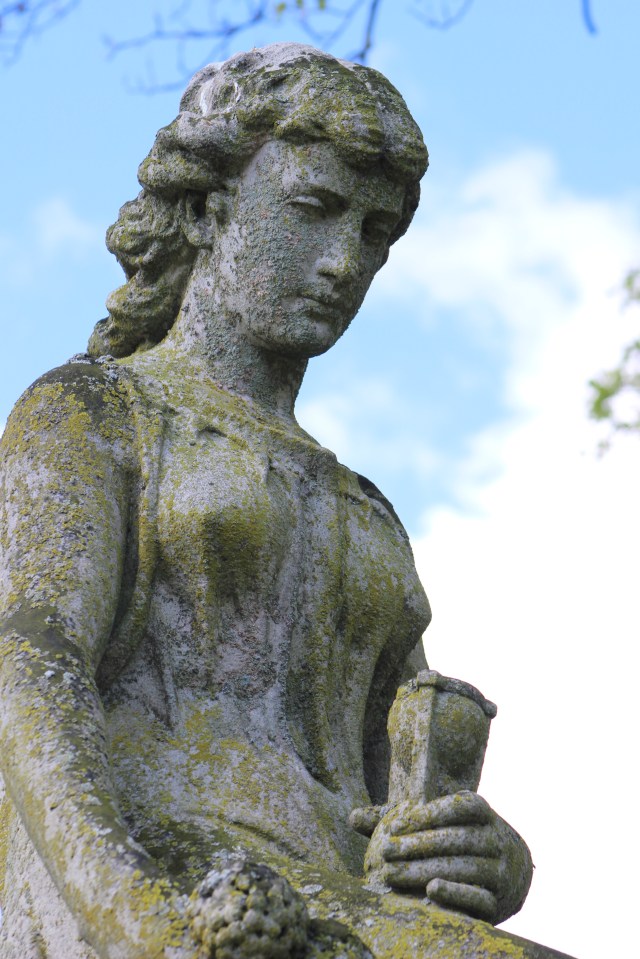
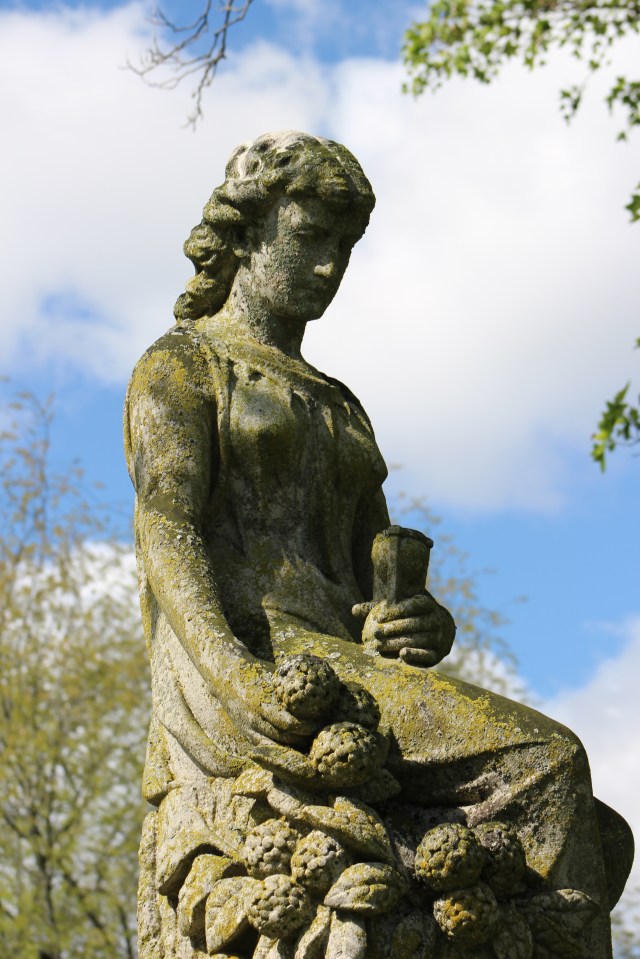
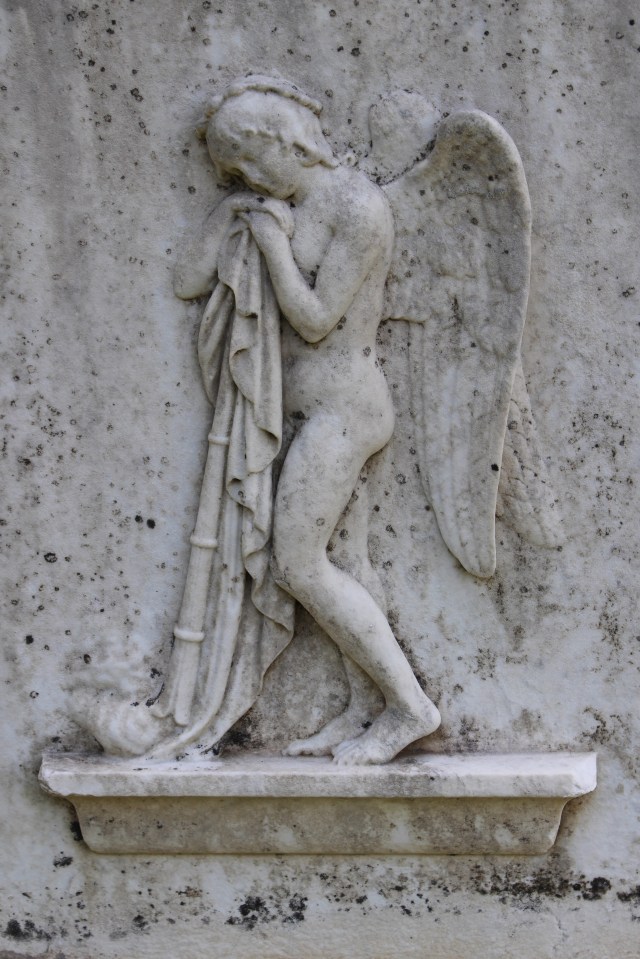
Her monument includes a full-length figure of a female winged angel bending over a marble table-top marker. A scroll rests on top of a cross which is laying atop the length of the top slab. The angel’s right hand is hovering over the scroll which has the inscription, “THE GIFT OF GOD IS ETERNAL LIFE THROUGH JESUS CHRIST OUR LORD.”  The top slab rests on four ornate columns which stand, as does the figure, on a larger base slab of granite. Each of the column capitals is adorned with lilies

The monument is intricately carved of Carrara marble by the Italian sculptor Antonio Caniparoli. While biographical details are difficult to discover it is known that his work can be found in the city cemetery in Palermo, Italy. A reference to his work on the Martha Thomas monument in Palermo lists Antonio Caniparoli as the “marble architect” and lists his birth and death dates as 1828-1914. From his studio he produced works that were sold in far-flung locations such as Ireland, England, America, Spain, and Australia. He not only produced funeral monuments but also elaborate fireplace mantels and statues.

A statue of Murillo in a square in Seville, Spain, rests on a carved Carrara marble base attributed to Caniparoli. His studio is also credited for the carving the high altar at St. Patrick’s Roman Catholic Church, County Armagh, Ireland.

Posted in Angels | 2 Comments

Happy Easter

Posted in Symbolism | 4 Comments

The “Hat” is the Clue.

CHARLES PETIT McILVAINE

BISHOP FOR FORTY YEARS OF THE DIOCESE OF OHIO

BORN JAN 18, 1799 DIED MAR 12, 1873 AGED 74 YEARS

THERE IS NO CONDEMNATION TO THEM THAT ARE IN CHRIST JESUS ROM. VIII.I


EMILY COXE WITH OF CHARLES P. McILVAINE

BORN FEB 19, 1801 DIED FEB 19, 1877

THINE EYES SHALL SEE THE KING IN HIS BEAUTY

JOSEPH HEATHCOTE McILVAINE

SON OF CHARLES P AND EMILY McILVAINE

BORN JULY 24, 1824 DIED APRI 4, 1870 AGED 16 YEARS

BLESSED ARE THE PURE IN HEART

EMILY HARRIET McILVAINE

DAUGHTER OF CHARLES P AND EMILY McILVAINE

BORN SEP 12, 1823 DIED MAY 1, 1836 AGED 8 YEARS


BLOOMFIELD HENRY McILVAINE

SON OF CHARLES P AND EMILY McILVAINE

BORN AUG 12, 1825 DIED MARCH 4, 1837

AGED 11 YEARS

The limestone monument that marks the grave of Charles Petit McIlvaine has a heavy architectural design.  From the front it looks like a heavy and plain Gothic building that is barren of detail except for the ivy that twines underneath the two-tier roof line and the ornamented and pointed arched alcove that contains the decaying bust of monument’s focus.

Except for the inscription there is not an indication of who the man was or his importance.  But once the side of the monument is studied the “hat” gives it away.  A mitre on an open Bible rests on a tufted and tasseled pillow.  The mitre has been worn by bishops of the church since the 11th Century with origins dating back much further.

Bishop Charles McIlvaine was born January 18, 1799 in Burlington, New Jersey, into a prominent political family.  His maternal grandfather, Bowes Reed, was the New Jersey Secretary of State and his father, Joseph McIlvaine, was a United States Senator.  McIlvaine himself served in the United States Senate twice as chaplain.  McIlvaine studied theology at the seminary in Princeton, New Jersey, and then went on to have a prestigious and impressive career as a clergyman and professor.

McIlvaine served as a chaplain and professor of ethics at the United States Military Academy at West Point.  Notably two of his students were Robert E. Lee and Jefferson Davis.  Held a number of other posts—minister to St. Ann’s Church in Brooklyn, professor of the evidences of revealed religion at the University of the City of New York, president of  Kenyon College in Gambier, Ohio, and the second Episcopal Bishop of Ohio.   McIlvaine also became a prolific and noted author who caught the attention of President Abraham Lincoln, who appointed him to act as a special envoy to dissuade the British from support the Confederacy during the Civil War.  His eloquent and persuasive writings and oratory gained him many influential friends and admirers.  So much so, that when McIlvaine died in Florence, Italy on March 14, 1873, his body was shipped to Ohio for burial.  However, on the long journey, his body was rested for four days in Westminster Abbey, the only American to ever lie-in-state to be so honored.

There is often a story behind the “hat” or should it be under the hat?

Posted in Famous graves, Symbolism | Leave a comment

The Baldwin Angel and the Artist

Verily I say unto you, whosoever shall not receive the Kingdom of God as a little child, he shall not enter therein.”

Saint Mark 10:15

Like many great artists, Frank Hering (February 15, 1874—January 15, 1949), took commissions that included funerary sculptures.  The Baldwin angel is one such work which was carved out of flawless white marble for the Baldwin family plot.  Hering was an art student of the famed Augustus Saint-Gaudens, also known as the American Michelangelo.

There are many recognizable Hering works of such as the Defense and Regeneration, on the southern bridgehouses of Michigan Avenue Bridge  in Chicago and the sculpture Pere Marquette  in the Marquette Park in Gary, Indiana.  Hering also sculpted a statue of Abraham Lincoln that can be found in University Park in Indianapolis.

Close by at the Indiana War Memorial in Indianapolis is his monumental work, Pro Patria which is a bronze he sculpted in 1929.  At the time it was the largest bronze statue cast in America up to that time.

The Baldwin angel, pictured below, was also sculpted by Henry Hering.  The enclosure for the angel was designed by Henry Bacon, who also designed the Lincoln Memorial in Washington, D.C.

The Baldwin angel has a doppelganger.  Doppelganger is a word that refers to two people who look the same.  Look a likes.   It is a German word that translates to “double goer”.  Popular television shows run photos next to each other showing actors and actresses together to show look a likes, such as, Christina Hendricks and Jessica Rabbit, Katy Perry and Zooey Deschanel, Morgan Freeman and Kofi Annan, Margot Robbie and Jaime Pressly, or Stephen Colbert and Bob Saget to name a few.  To poke gentle fun, some sites also match the faces of dogs to their look alike actors’ faces.

In this case, two gravestone sculpture doppelgangers can be found in two different cemeteries in Savannah, Georgia.  The magnificent white-marble angel that marks the Baldwin family plot.  The sculpture is one of the most beautiful and visited monuments in the Bonaventure Cemetery, the cemetery made famous by John Berendt’s novel, Midnight In the Garden of Good and Evil.

The young angel holds a shell.  Tradition has it that the remains of Saint James, one of the Twelve Apostles who was sometimes referred to as James the Greater, were taken to the Cathedral of Santiago de Compostela in Galicia, which is in the north of Spain.  Saint James became the patron saint of Spain during the reconquest of the country from the Moors and the Cathedral of Santiago de Compostela became a popular site for Christian pilgrims.  Galicia, noted for delicious seafood, including scallops, drew thousands of Christians pilgrims who often carried a scallop shell back with them as a souvenir of the trip.  Before long, the seashell became a symbol of Christian pilgrimage and Baptism.

The angel wears a loose gown with a belt of ivy wrapped around the waist.  Ivy being a symbol associated with immortality and fidelity.

Right next to the Bonaventure Cemetery, separated only by a chain-link fence, is the Forest Lawn Memorial Garden.  When you walk through that cemetery you come to the gates of yet another cemetery—the Greenwich Cemetery.  In that cemetery is a near replica of the Baldwin angel—except without wings.

She holds a large seashell, same loose-fitting gown, and ivy belt.  Only this sculpture is quite discolored and does not have the half-circle white marble backdrop.

The two sculptures could be siblings for sure—if not twins!  Though the wingless doppelganger in the Greenwich Cemetery has not been identified as having been sculpted by Henry Hering, the similarities are so striking that I believe both statues were his creations.

Posted in Angels, Famous graves | Leave a comment

Seated Hope

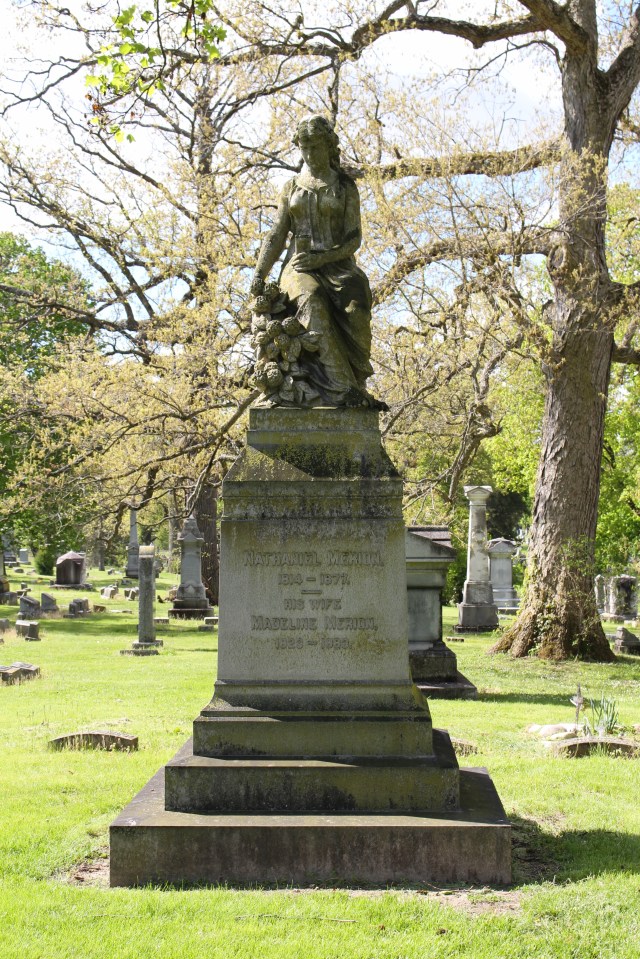
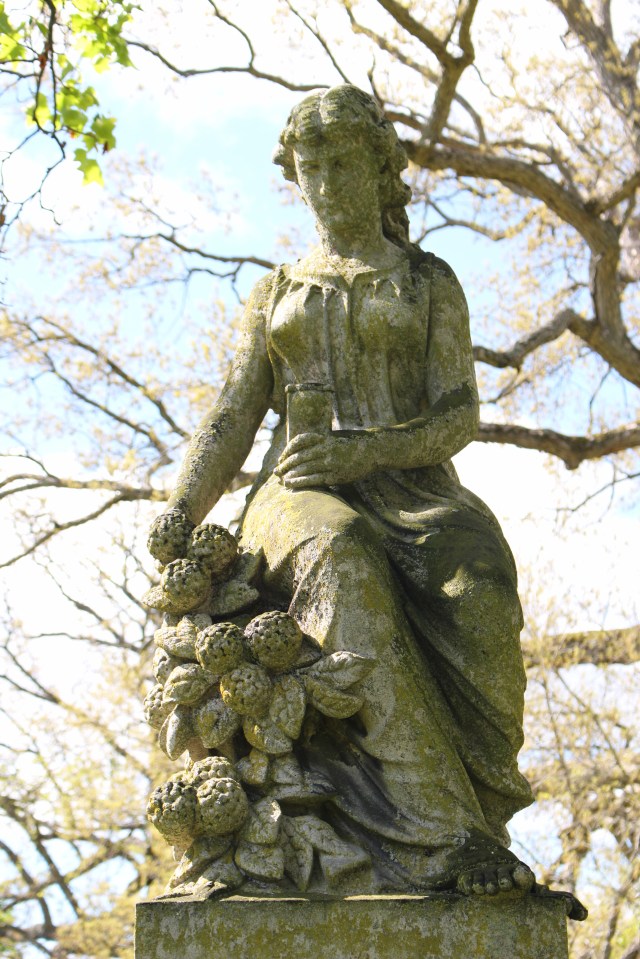
The representation of Hope can be easily found in American cemeteries.  Hope is most often portrayed as a woman standing and leaning against an anchor.  In these examples from the Spring grove Cemetery in Cincinnati, Ohio, Hope is seated. 


The anchor is an ancient Christian symbol that has been found in early catacomb burials.  The anchor was used by early Christians as a disguised cross.  The anchor also served as a symbol of Christ and his anchoring influence in the lives of Christians.  Just as an anchor does not let a moored boat drift, the anchoring influence of Christ does not allow the Christian life to drift.

Posted in Symbolism | Leave a comment

The Language of Flowers

The stained-glass window in the mausoleum in Westview Cemetery in Atlanta, Georgia, features a trellis of red roses.  In Victorian times, flowers took on significance as a way to send coded messages; this was known as floriography from the Latin combining flora—“goddess of flowers”—and graphein—“writing.”

In 1878, Kate Greenaway, a popular author and illustrator, gained fame for an illustrated children’s book of verse she wrote titled Under the Window, which delighted children.  Just six short years later, Greenaway published the Language of Flowers.  The book is a nearly complete listing of flowers along with their “secret” or symbolic meanings:

Azalea ………………………………… Temperance

Bell Flower (small white) ……… Gratitude

Carnation, Striped ……………….. Refusal

Carnation, Yellow ………………… Disdain

Foxglove ……………………………… Insincerity

Hollyhock ……………………………. Ambition.  Fecundity

Each flower had a meaning that was conveyed to the viewer or receiver of the flower or bouquet of flowers—the weeping willow represented mourning, the white lily represented purity, the Easter lily represented the Resurrection, and so on.

The rose? More than any other flower in the book, many colors are explained for their nuanced meanings.  The single rose meant “simplicity.”  The yellow rose symbolized a “decrease in love—and jealousy.” The Japanese rose meant that “beauty is your only attraction.”  But to Greenaway, the rose, in general, meant “love.”

What lovesick boy doesn’t know the meaning of a single rose, standing there on the front porch, at the beginning of his first date, nervously clutching the flower while he waits expectantly for the door to open and for his date to greet him?  Romantics have waxed poetic about the rose and the connection to love for centuries which has made the rose an undeniable symbol of love.

In funerary and religious art the rose also has a religious meaning, differing by color.  The white rose symbolizes purity while the red rose represents martyrdom and the messianic hope that Christ will return.

Posted in Symbolism | Leave a comment

Poet Laureate

1857 1827

FRANK LEBBY STANTON

THIS OLD WORLD WE’RE LIVIN’IN

IS MIGHTY HARD TO BEAT,

YOU GET A THORN WITH EVERY ROSE

BUT AIN’T THE ROSES SWEET!

The monument marking the grave of Frank Lebby Stanton is a massive rough-cut or rock-face granite monolith.  On the face of the stone is a bronze with a bas-relief of the poet.  The Atlanta Constitution issue on Friday, November 29, 1935, Page 3, tells the story:

“Memorial to Poet Dedicated at West View Cemetery Grave.

“The bronze tablet in memorial to Frank L. Stanton, first poet laureate of Georgia and for 40 years conductor of his column, “Just From Georgia,” on the editorial page of The Constitution, was unveiled yesterday morning at the grave in West View cemetery.

Little Emily McNelly, granddaughter of Dr. and Mrs. W. F. Melton, unveiled the marker in the absence of little Marcelle Stanton Magahee, granddaughter of the noted poet, who had been forbidden to leave the house by her doctor.

Dr. Melton presided as president of the Atlanta Writer’s Club.  Brief eulogies were spoken by Hugh Howell, chairman of the state democratic executive committee, and by by Dr. M. D. Collins, state superintendent of schools on behalf of the state.

R. L. Ramsey spoke for the Burns Club, while Mrs. Melton, president of the Atlanta Woman’s Club, paid a brief tribute on behalf of that organization.

Tarleton Collier spoke for Hearst’s Atlanta Georgian and Sunday American and Ralph T. Jones on behalf of The Constitution. Other speakers included Thomas J. Flanagan, negro poet, who was a protégé of Mr. Stanton’s.

The bronze marker is the work of Dr. Joseph Klein, Atlanta Sculptor.  It carries a remarkable fine bas-relief likeness of Stanton, a book of verse and the laurel wreath symbolizing the poet laureate, while at the bottom are the lines which perhaps of all his writings, best typify Stanton’s philosophy of life:

“This old world we’re livin’ in

Is mighty hard to beat;

You get a thorn with every rose,

But ain’t the roses sweet?”

Posted in Famous graves, Saving Graces | 1 Comment

Presidential Recognition for a Storyteller

JOEL CHANDLER HARRIS

BORN EATONTON, GA. DEC. 9TH 1849.  DIED ATLANTA, GA. JULY 3RD 1908

“I SEEM TO SEE BEFORE ME THE SMILING FACES OF THOUSANDS OF CHILDREN SOME YOUNG AND FRESH, AND SOME WEARING THE FRIENDLY MARKS OF AGE.  BUT ALL CHILDREN AT HEART AND NOT AN UNDFRIENDLY FACE AMONG THEM.  AND WHILE I AM TRYING HARD TO SPEAK THE RIGHT WORD I SEEM TO HEAR A VOICE LIFTED ABOVE THE REST SAYING YOU HAVE MADE SOME OF US HAPPY AND SO I FEEL MY HEART FLUTTERING AND MY LIPS TREMBLING AND I HAVE TO BOW SILENTLY AND TURN AWAY AND HURRY BACK INTO THE OBSCURITY THAT FITS ME BEST.”

ESTHER LAROSE HARRIS

OCTOBER 1854  OCTOBER 1936

WIFE OF JOEL CHANDLER HARRIS

Joel Chandler Harris was a famous writer who started his work in publishing as a “printer’s devil”—someone who apprenticed in a print shop performing non-technical assistance such as mixing ink and fetching materials for the journeyman printers.  Eventually, Harris worked as a journalist for newspapers, The Countryman, the Monroe Advertiser, the Savannah Morning News, and The Atlanta Constitution.  He also gained fame and as author and storyteller best remembered for his collection of Uncle Remus and Brer Rabbit stories.  Harris received acclaim and awards from many quarters but few spoke words of praise as glittering as those from President Theodore Roosevelt, who invited him to the White House to be honored for his contribution and said, “Presidents may come and presidents may go, but Uncle Remus stays put. Georgia has done a great many things for the Union, but she has never done more than when she gave Mr. Joel Chandler Harris to American literature.”

The Joel Chandler Harris gravestone can be found in the Westview Cemetery in Atlanta, Georgia.  The monument is a rough-cut granite stone with a bronze bas-relief portrait of Harris.  The bronze relief was sculpted by Allen George Newman III (August 28, 1875 – February 2, 1940) who gained fame for his sculpture, the Hiker, which depicted a soldier from the Spanish-American War.

Posted in Famous graves | Leave a comment

Marble and Bronze

The same sculpture appears in three cemeteries very far apart—Greenwood Cemetery in Phoenix, Arizona, Crest Lawn Cemetery in Atlanta, Georgia, and Kraft-Graceland Memorial Park in New Albany, Indiana.  They are all have the exact same statue of a man standing next to a woman with his arm around her.

In Greenwood the statue sits atop a columbarium which is a place where urns are “stored” in a cemetery.  The word “columbarium” has a Latin root and comes from the word “columba.” Columba referred to housing for doves that was divided into compartments for their housing.

In Crest Lawn the statue sits atop a sarcophagus mausoleum.  A ‘sarcophagus” is defined as a stone coffin and, generally, these structures do not have windows and are partially above ground.  The word, sarcophagus, is derived from two ancient Greek words, sarx, which meant flesh and phagein meaning to eat.  The two words together, sarkophagus, meant flesh eating.  The term came from the limestone used by the ancient Greeks to bury the dead which was thought to decompose the flesh of the deceased.

The Kraft-Graceland Memorial Park statue is made of bronze and is in an inset highlighting the name of the cemetery.

No markings on the bronze statue give any clues revealing the sculptor or the name of the foundry who produced it.


Posted in Uncategorized | 2 Comments

A Tiny Hand Print

Alice Hattie

Wilkinson

Born May 20, 1879

Died July 15, 1880

In the front row of the Brick Chapel United Methodist Church cemetery just outside of Greencastle in rural Putnam County Indiana, is a small, highly ornate monument with a bluish tint characteristic of markers made of zinc.  The marker, manufactured by the Monumental Bronze Company of Bridgeport, Connecticut, is dedicated to Alice Hattie Wilkinson, daughter of Jehu and Louisa Wilkinson.

The monument does not give her date of birth or death or her age at death. But, like the other zinc markers, this one has panels that were customized with symbols chosen by the family.  One of those panels displays a chubby little hand print, a poignant clue that Alice was a very small child.  A little digging reveals that Alice was about 14 months old.  She is buried next to her mother, Louisa, who died on March 5, just a few months before Alice died.

Another panel on the marker display a cross and crown.  The crown is a symbol of glory and victory over death.  The reward awaits in Heaven where the victor will receive a crown of victory. The cross represents the suffering of Jesus.

The marker is topped with a dove. Many symbols found on gravestones have multiple meanings. The dove is one of those.  Several references in the Bible refer to the dove as a symbol of the Holy Spirit. Matthew 3:16 reads, “And Jesus, when he was baptized, went up straightway out of the water: and, lo, the heavens were opened unto him, and he saw the Spirit of God descending like a dove, and lighting upon him.” In Mark 1:10 the Bible says, “And Straightway coming up out of the water, he saw the heavens opened, and the Spirit like a dove descending upon him.” Again, in John 1:32, the Bible reads, “And John bare record, saying, I saw the Spirit descending from heaven like a dove, and it abode upon him.”

Along with the dove symbolizing the Holy Spirit, the dove is also closely associated with peace, often depicted with a sprig of an olive in its beak. This, too, originated in the Bible. After the waters receded in the story of Noah, the dove appears. Genesis 8:11, “And the dove came into him in the evening; and, lo, in her mouth was an olive leaf pluckt off; so, Noah knew that the waters were abated from off the earth.”   It was a sign of God’s forgiveness.

The dove, with its white color, is also a symbol of purity and innocence and for that reason is often found the tombstones of children.  Thus, the dove symbolizes the Holy Spirit, peace, and purity.

Posted in Children's Graves, Symbolism | 1 Comment