Murder in the Courtroom!


NATHANIEL PARKER WILLIS

AUGUST 21, 1868

JULY 27, 1909

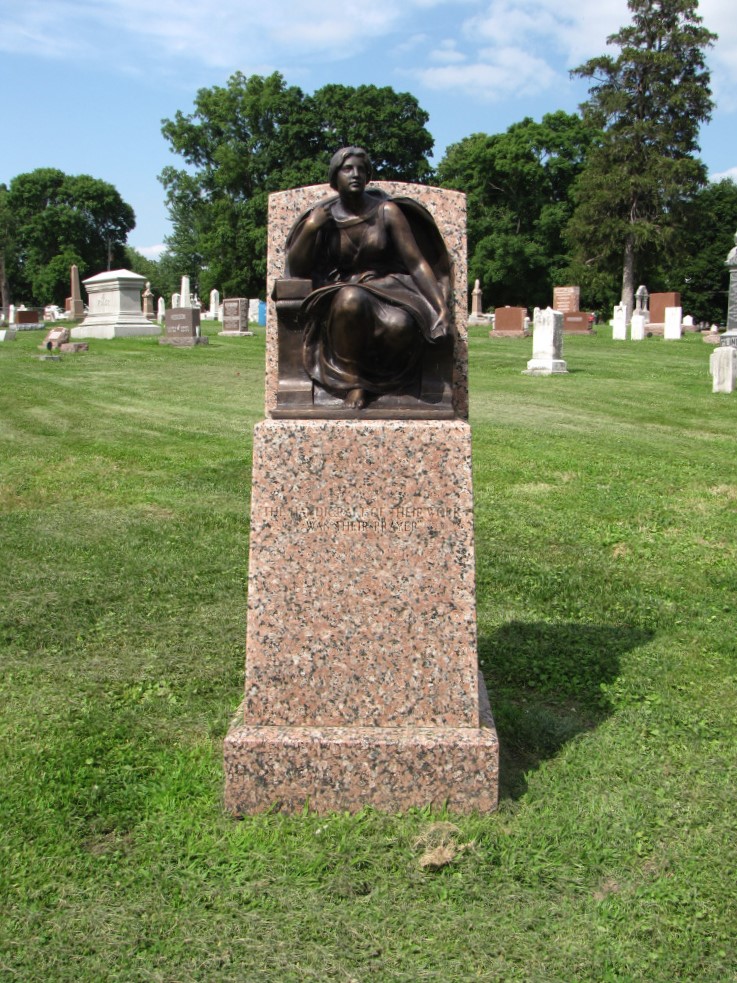
“TRIED AND TRUE”

GREATER LOVE HATH NO MAN THAN THIS – – THAT HE LAY DOWN HIS LIFE FOR HIS FRIEND (CHILD) JOHN 15:13

MURDERED IN A COURT OF JUSTICE, IN LITTLE ROCK, ARK. WHERE HE HAD GONE BY PREMISSION OF THE COURT TO SEE HIS WON DAUGHTER, MARY FRANCES LAURA WILLIS, WHOM HE LOVED AND FROM WHOM HE HAD BEEN SEPARATED BY THE FALLACIES OF THE COURT.

THERE IS ONE LAW-GIVER WHO IS ABLE TO SAVE AND TO DESTROY, WHO ART THOU THAT JUDGETH ANOTHER?  James 4:12

TO RECONSTRUCT TIMID JUSTICE AND PLACE THE FACT ABOVE THE FALSEHOOD IS THE WORK OF TIME.

The inscription on the Nathaniel Parker Willis tombstone refers to his tragic murder.  Parker Willis, the oldest son of Abner Willis and Frances Ellen Willis, was born in Crawfordsville on August 21, 1868.  He was a bright student and a fast study graduating from Crawfordsville High School with a scholarship to Wabash College which he turned down.  Instead he went into the printing business as a apprentice at the local newspaper office, the Crawfordsville Review as a compositor.  Having mastered it, he took a job as a mail carrier, but quickly changed careers again to take over his father’s photography business, which became a huge success, winning him local, state, and national prizes and accolades for his artistic photographic abilities.  Again, Parker Willis changed careers, this time setting up in Chicago where he began selling a cure for the “liquor habit.”

Unlucky in Love

While Parker Willis was in Chicago he fell in love and married but his wife of only a few weeks died.  Several years later he met and married Hattie Bell.  Reportedly, the marriage was not a happy one, but they did produce a daughter, Mary Frances, who Parker Willis adored.  The couple moved from Chicago to Cincinnati and then to Indianapolis.  The moves did not seem to help the relationship and Hattie and Parker Willis divorced.  Hattie moved from various places often secreting the daughter away from Parker Willis without telling him where she was.  Eventually Hattie took Mary Frances to Little Rock, Arkansas, where she married W. Y. Ellis.  Parker Willis stayed devoted to his daughter and worked tirelessly to secure visitation rights.  But on July 27, 1909, when he was petitioning the court to allow Mary Frances to stay with him for a two-week period, he was cut down.  Suddenly, without warning or provocation, W. Y Ellis stood up and shot Parker Willis to death in the courtroom.  In the murder trial that followed, letters from the deceased man revealed him to be a tender and devoted who longed to be able to spend time with his only child.

The Indianapolis Star, August 2, 1909, Monday Edition, page 3, gave a brief accounting of his funeral:

“CRAWFORDSVILLE HONORS N. P. WILLIS IN LAST RITES

“Citizens Pay Last Tribute to Former Resident, who Was Shot Down In Arkansas Courtroom.

“CRAWFORDSVILEE, Ind. Aug. 1.—The body of Nathaniel Parker Willis of Indianapolis, who was murdered in the Court House at Little Rock, Ark., last Tuesday afternoon; was brought here by a special traction car Sunday, accompanied by many Indianapolis friends and relatives.  The body was taken to the lodgeroom of the Crawfordsville Commandery No. 19, Patriotic Order of Sons of America.  The lodgeroom was thrown open to the public and hundreds of people viewed the remains, which lay in a casket banked with flowers.  The public was then excluded from the lodge services, only the immediate friends and relatives and the members of the P.O.S. of A being permitted to remain.

“Marion E. Clodfelter delivered the funeral oration, in which he told of the life of Parker Willis and ended with the reciting of the story of his death.  At the conclusion of the funeral services the body was escorted to Oak Hill Cemetery, where it was interred by the side of the murdered man’s father, under the ritualistic burial ceremonies of the order.

“The pallbearers with Howard E. Griffith, Sam Billman, Parker Lofland, Jon Brown, Avery Barnes, Claud Griffith, Will Layne, Ralph Steele, O. C. Jarvis, and Samuel D. Symmes.

“The funeral procession was one of the longest ever seen in Crawfordsville, there being at least 100 carriages line.”

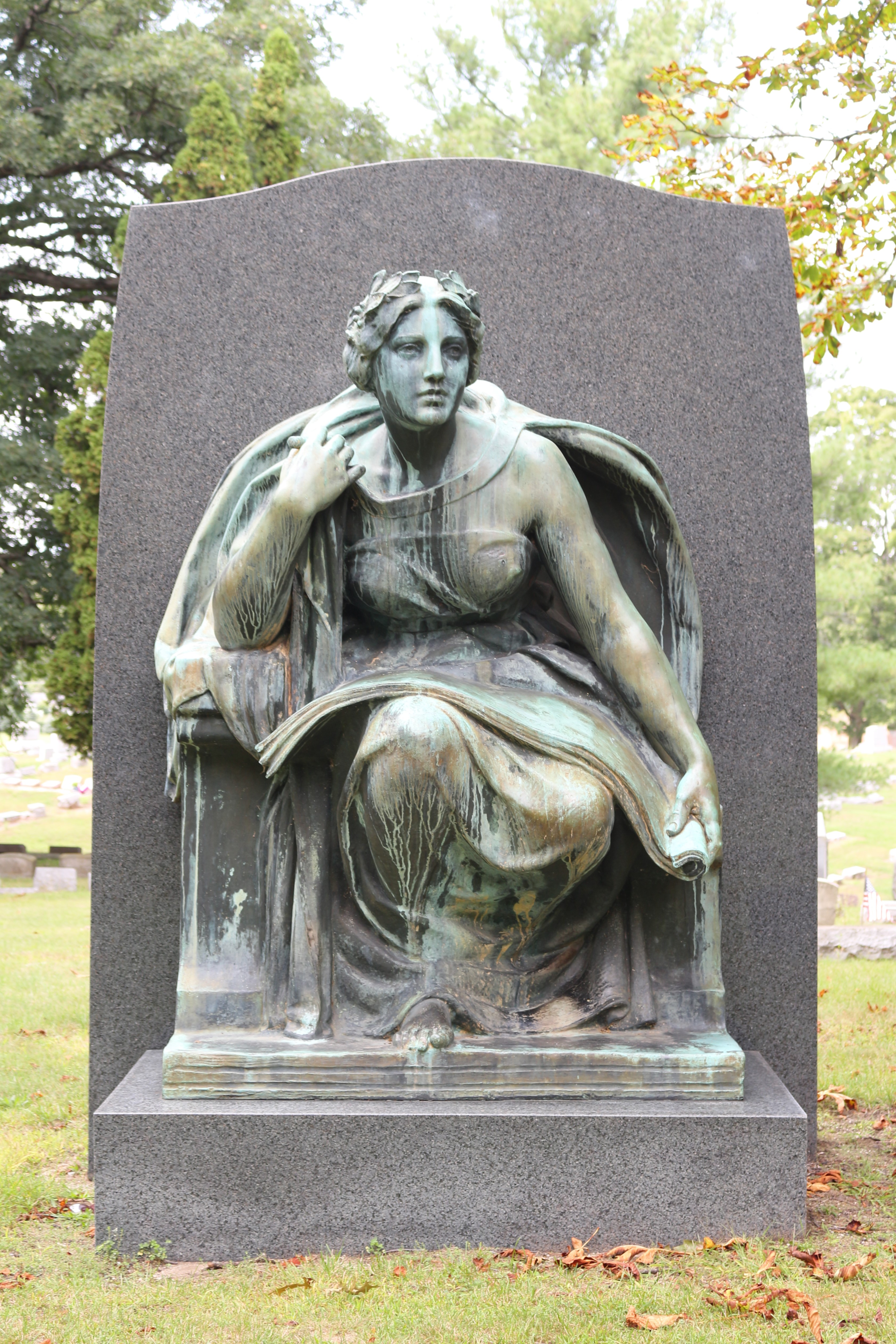
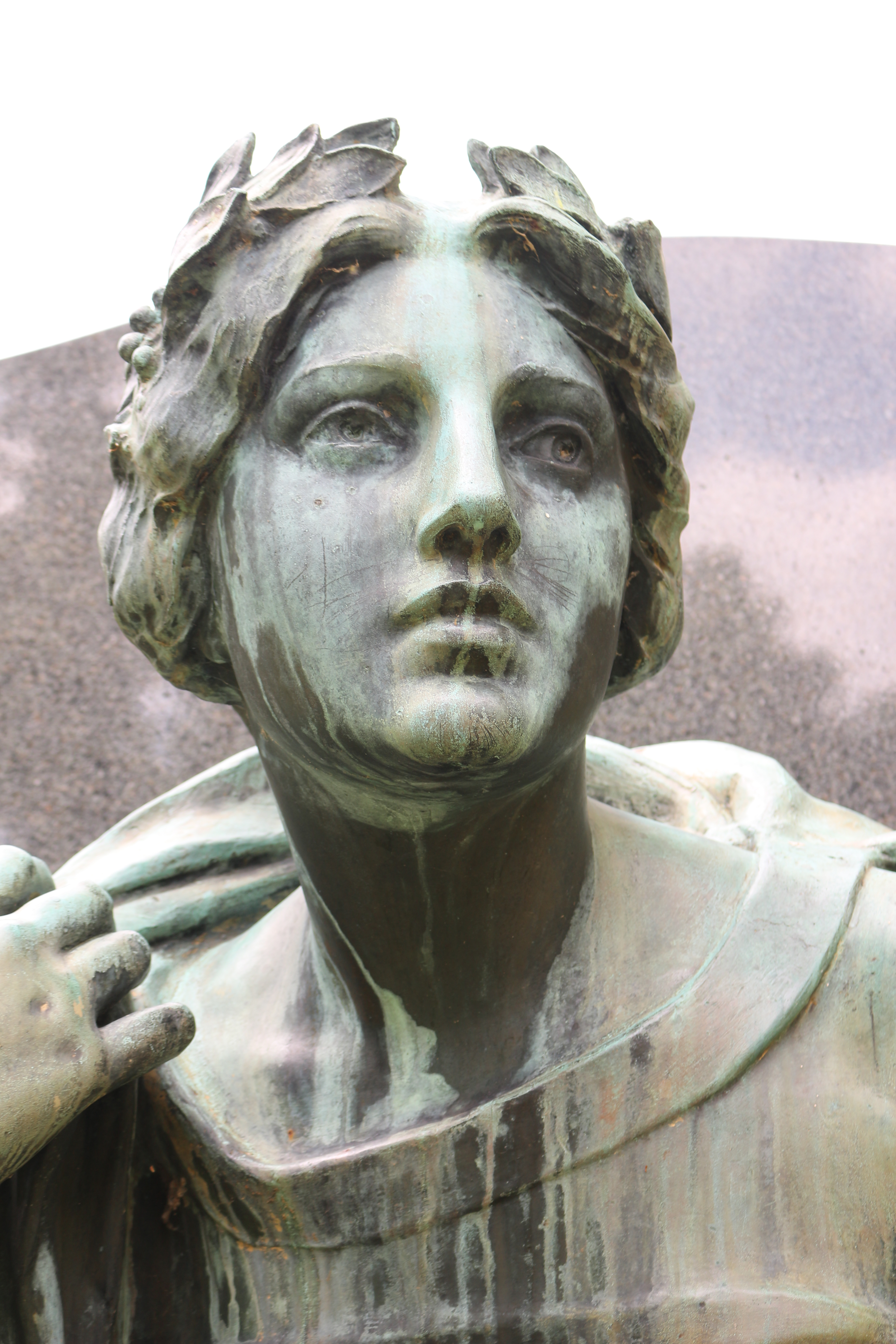
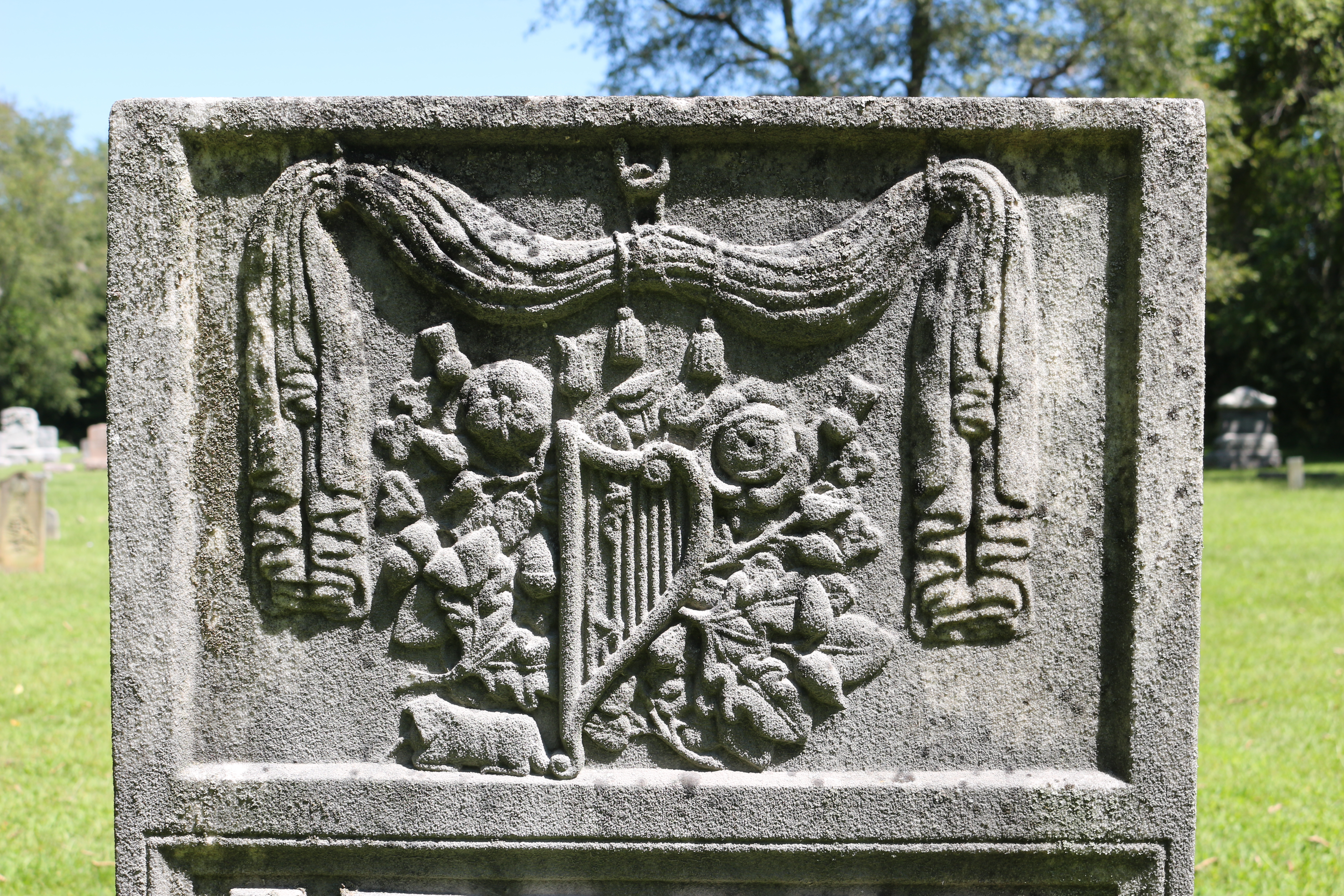
The tombstone in the Oak Hill Cemetery in the city of his birth,  Crawfordsville, Indiana, features a bas-relief that commemorates the love between the father and his daughter.  The commissioned bronze was created by George Julian Zolnay.

The Hungarian-born sculptor Zolnay (July 4, 1863 – May 1, 1949) created monumental works of arts including the memorial at the edge of Centennial Park in Nashville, Tennessee, for fallen World War I soldiers. This sculpture shows the full force and emotion of his work. A young soldier, still clutching his rifle lies in the lap of a young woman who cradles him as he dies. Her cape covers them.

Just like other great artists of the time, Zolnay was commissioned to create cemetery memorials. The seated mourning figure was commissioned by David Rowland Francis (October 1, 1850 – January 15, 1927), who served in various political posts such as, Mayor of St. Louis, Governor of Missouri, United States Secretary of the Interior, and Ambassador to Russia. Zolnay’s mourning figure in the Bellefontaine Cemetery, at St. Louis, Missouri, wears a cloak that casts a shadow over her face giving the statue a haunting look.

The sculpture Zolnay created for Confederate President Jefferson Davis (June 3, 1807 – December 6, 1889) in the Hollywood Cemetery, at Richmond, Virginia, shows a proud and unrepentant man. Davis was a graduate of the U.S. Military Academy at West Point served six years in the United States Army and fought in the Mexican American War (1846–1848). From 1853 to 1857 under President Franklin Pierce, Davis served as Secretary of War. He was also elected as the Democratic U.S. senator from Mississippi. But, Davis, a believer in each states’ right to secede from the Union, was inaugurated as the President of the Confederate States of America on February 18, 1861. He became inextricably linked to the Confederacy and a symbol of the lost cause.

Posted in Artists, Uncategorized | Leave a comment

The Coded Messages of Flowers

NATHANIEL MERION.

1814 – 1877.

HIS WIFE

MADELINE MERION,

1823 – 1883.

The gravestone for Nathaniel and Madeline Merion can be found in the Green Lawn Cemetery in Columbus, Ohio.  Atop the base is the statue of a mourning figure.  In David Robinson’s book, Saving Graces, depicts photographs of mourning figures from some of the most famous cemeteries in Europe depicting sculptures of beautiful, young, and voluptuous women often wearing revealing clothing as they mourn the dead. However, unlike her European counterparts, the Victorian “weeper” was usually not voluptuous and often portrayed as androgynous, dressed modestly in a diaphanous gown loosely fitted and flowing beyond her feet.

Often these sepulchral figures are referred to “saving graces” and often as “weepers,” and are intended to represent mourning and sorrow.  Since ancient times, women have been the ones in our families and in our society, who showed grief and shed tears over those lost to death. Like the women in ancient times, these sculptures are depicted as standing over the graves in sorrow.

Robinson identified four categories of “saving graces”–first, women completely overcome by grief, often portrayed as having collapsed and fallen limp on the grave. Second, are the women who are portrayed reaching up to Heaven as if to try to call their recently lost loved one back to Earth.  Third, are the women who are immobile, and grief stricken, often holding their head in their hands distraught with loss.  Lastly, he describes the last category of “saving graces” as the mourning figure who is “resigned with the loss and accepting of death.”  The mourning figure on the Merion monument appears to be in the last category.

In this example the figure is holding an hourglass in one hand and what looks to be a large bouquet of hydrangea in the other.  The symbolism of the hourglass is obvious—time is fleeting, as the long-running soap opera, Days of Our Lives, reminded us with their catchphrase,  “Like sands through the hourglass, so are the days of our lives.” The meaning of that catchphrase is clear–life passes by very quickly.  Life measured by the grains of sand slip through one side of the hourglass to the other in a flash.  The hourglass symbol on a gravestone, often shown with wings, represents the same thought of time fleeting by quickly.

The hydrangea, if that is what it is, is a bit of a mystery.  In Victorian times, flowers took on significance as a way to send coded messages; this was known as floriography from the Latin combining flora—“goddess of flowers”—and graphein—“writing.”

In 1884, Kate Greenaway, a popular author and illustrator published a book titled, the Language of Flowers.  According to her book, each flower had a meaning that was conveyed to the viewer or receiver of the flower or bouquet of flowers—for instance, the weeping willow represented mourning, the white lily represented purity, the Easter lily represented the Resurrection, and so on.

The book is a nearly complete listing of flowers along with their “secret” or symbolic meanings.  On page 22, she describes the meaning behind the hydrangea as “a boaster, Heartlessness.”  So, what could that cryptic message symbolize to the viewer of the monument?  Does Death, in this coded message, represent heartlessness?

Posted in Saving Graces, Symbolism | 2 Comments

Honoring Those Who Served

Not far outside Bloomington, Indiana, is a small country cemetery.  Like many of the cemeteries in Indiana, the stone carvers’ unique work can be found on the gravestones.  The Mt. Ebal Cemetery has two such stones marking the graves of two soldiers—one who fought in the Civil War and one who fought in World War I.

SARAH ANN

MEADOWS

JULY 6, 1846

SEPT. 14, 1930


WILLIAM M.

MEADOWS

OCT. 20, 1844

MAY 17, 1943

CO. B. IND VOL INF.

The William Meadows gravestone has an inset with a bas-relief of a Union soldier carved into it.  Even without knowing what war Meadows fought in the skill and detail of the stone carver makes it clear that it was the Civil War.  Meadows stands as if he is ready to march into battle, clutching his Springfield rifle, bayonet hanging from his belt, and his Haversack and bed roll on his back.  Meadows died just five months short of his 99th birthday and the one memory he wished to preserve for all to know and see was his service to his country—carved into his gravestone as an image and recording the unit in which he served.

JAMES A.

BUTCHER

BORN 1889

DIED 1938

FIRST DIV.

16th INF.

The bas-relief carving of the World War I soldier on the front of the gravestone most likely represents James Butcher himself.  In the sculpture, the solider appears to be marching forward possibly through water that is splashing up on both sides of him.  He is wearing the uniform of the day—steel helmet with chin strap, the brown woolen uniform with the knee breeches and carrying a rifle with the bayonet attached.  Peaking up from his shoulders is the rolled up anti-gas cape and loosely hanging around his neck is a respirator made necessary by the gas that was used during WW I.  The determined look on his face expresses a soldier ready to take the fight to the enemy.

On this day, we give thanks to all those soldiers who served and protected America and most especially to those who gave the ultimate sacrifice.

Posted in Uncategorized | 2 Comments

Neo-Classical Angel

The neo-classical angel on this white marble gravestone in the Green Lawn Cemetery in Columbus, Ohio, looks downward with a sorrowful expression as she leans against the torch, the flames curling at its base.   The beautifully carved bas-relief angel is on a gravestone from the 1850s.  Unfortunately the name of the deceased is difficult to discern.

The flame on the gravestone is symbolic of the soul.  The inverted torch represents a life that has been extinguished.  Angels are popular images found in cemeteries throughout the world.  The English word “angel,” is derived from the Greek word “aggelos” meaning messenger or herald.  Here the angel brings the news that a life has been lost.

Posted in Angels, Symbolism | 3 Comments

COVID-19 Strikes

During a bad bout of cabin fever, I decided to drive the four hours to Green Lawn Cemetery in Columbus, Ohio, 317 landscaped acres of gravestones, mausoleums, and memorials.  The famous, such as Eddie Rickenbacker and James Thurber, as well as, the not-so-famous are buried in this beautifully planned garden cemetery.

I knew that I would be far from the maddening crowds and safe from the virus—cemeteries are naturally practicing social distancing.  All the residents are six feet away, or well, six feet under.

As you drive down the long lane into the cemetery, on the left side is a life-sized sculpture of a Native American, tomahawk and all, marking the Gabriel Family plot.  Unfortunately, the day I visited the cemetery, safety practices for COVID-19 had been put in place and the sculpture was wearing a red paisley handkerchief mask—as they say, “Mask-it or Casket”, so I didn’t have a chance to see the full face of the sculpture, which I imagine to be stern and regal.  I hope my next trip the cemetery will be after the virus has been wrangled to the ground and stamped out and the face of the sculpture will be revealed in all of its glory!

Posted in Uncategorized | Leave a comment

The Crown and the Angel

Elisabeth L. Roark wrote an article about cemetery angels titled, “Embodying Immortality: Angels in America’s Rural Garden Cemeteries, 1850—1900”, pages 56 – 111, 2007 edition of Markers, XXIV, in which she categorized the eight most commonly found types of graveyard angels—grouped by the task they performed: soul-bearing; praying; decorating and guarding; pointing; recording; trumpeting; sword-bearing (archangel Michael); and child angels.

Angels are popular images found in cemeteries in America and throughout the Christian world.  The English word “angel,” is derived from the Greek word “aggelos” meaning messenger or herald.  Angels can be found in cemeteries in all shapes and sizes and in many different mediums including carved stone bas-reliefs on gravestones, full sculptures, and even in glass.

The stained-glass window angel in a John Beals Brown Neo-classical mausoleum in the Green Lawn Cemetery in Columbus, Ohio, does not fit nicely into one of the eight categories of most-commonly found angels outlined in Roark’s article.  She holds a crown in one hand—presumably to crown the deceased members buried in the tomb and a palm frond in the other–both symbols of victory over death.

The crown is a symbol of glory and reward and victory over death.  The reward comes after life and the hard-fought battle on Earth against the wages of sin and the temptations of the flesh.  The reward awaits in Heaven where the victor will receive a crown of victory.  The crown also represents the sovereign authority of the Lord.

The palm frond is an ancient symbol of victory, dating back to Roman times when victors were presented with palm fronds. The palm fronds were also laid in the path of Jesus as He entered Jerusalem. So, for many Christians, the palm represents righteousness, resurrection, and martyrdom, symbolizing the spiritual victory over death associated with the Easter story.

Posted in Angels, Mausoleums, Symbolism | 2 Comments

Ben-Hur

In 1959, MGM (Metro-Goldwyn-Mayer) released the epic film, Ben-Hur, which was the most expensive motion picture produced up to that time—costing slightly over 15 million dollars!  As the expression goes, it had a cast of thousands, literally.  10,000 extras were used in the making of the movie, along with over 200 camels and 2,500 horses.  The movie starred Charleton Heston, who had already played a bigger-than-life Moses in the production of The Ten Commandments.  With a marketing budget that was nearly as much as it cost to produce the movie, it was soon the second highest-grossing film at the time, second only to Gone with the Wind.  The Academy Award-winning movie was a remake of a 1925 silent film also based on Lew Wallace’s book, Ben-Hur: A Tale of the Christ.

The book, Ben-Hur: A Tale of the Christ, was published in 1880, and was a best-selling novel that secured the Wallace family’s fortunes.  While Lewis “Lew” Wallace (April 10, 1827 – February 15, 1905) born in Brookville, Indiana, is widely remembered for the novel, which has been called “the most influential Christian book of the nineteenth century,” he had a career that included the law, military, and diplomatic service.  He served in the Mexican-American War and the Civil War.  He served as Governor of the New Mexico Territory and as Ambassador to the Ottoman Empire.  Wallace eventually returned to Crawfordsville, Indiana, where he made his last home, where he continued to write and publish.  He died in 1905, and was buried in the Oak Hill Cemetery in Crawfordsville—his grave marked by the tallest monument in the cemetery—a light gray granite obelisk that is carved with an American flag draped over the point.

In 1928, the Georgia Marble Company of Tate, Georgia, produced a marketing piece in the form of a book titled, Memorials: To-Day for To-Morrow written by William Henry Deacy. The book was designed to showcase their memorial designs by highlighting them in the book with lush full-color watercolor illustrations of the various memorials. Along with the illustrations the book provided explanations of the symbolism found in the memorials. The book also coupled an architectural drawing of how the memorial is to be made. The monument they chose to highlight on pages 62-64 was the obelisk.

After the French and British occupations of Egypt, there was a renewed interest in Egyptian architecture and symbolism in America, including the obelisk, those tall thin four-sided columns that tapered upward and then end in a pyramid at the top.  The obelisk is a ubiquitous gravestone shape found in American graveyards.

The author, Mr. Deacy, makes the following claim in the Georgia Marble Company book (page 63), “The steeple of the Church symbolizes the spiritual and uplifting power of religion and the moral aspiration of man. It was evolved from the obelisks which stood before Egyptian temple—emblems of the sun god Ra and the regeneration of man. It has long been a favored form for the civic and private memorial. Towering heavenward from a sightly (sic) location, the obelisk probably ranks among the most simple and impressive of all monuments.”

The book goes on to say that the obelisk is highlighted best when it is featured by itself, with no other monuments nearby to distract from its elegant and graceful shape. It also says that, “various pedestal forms are used to support the shaft or spire…and while they attain a rather graceful continuity of line, nevertheless, no type of base or support rivals the simple three steps, which if properly subordinated in scale, tend to increase the effect of height….

The entire book can be found at the Quarries and Beyond Website: http://quarriesandbeyond.org/cemeteries_and_monumental_art/cemetery_stones.html.

The Quarries and Beyond Website was created by Peggy B. and Patrick Perazzo. It focuses on historic stone quarries, stone workers and companies, and related subjects such as geology. Whenever possible links of finished products are provided on the Website. There is a “Quarry Articles” section that presents articles, booklets, and links from the late 1800s to early 1900s, including the 1856 “The Marble-Workers’ Manual.” The “Cemetery Stones and Monuments” section provides references and resources, including many old monument magazines, catalogs, price lists, and a photographic tour “From Quarry to Cemetery Monuments.”


Posted in Famous graves, Symbolism | 1 Comment

The Ultimate Tree Stump Family Plot

T. S. LLOYD

SEPT. 26, 1860 – Jan. 14, 1916

Frances C. Lloyd

Feb. 28, 1855 – June 15, 1924

A fellow graveyard enthusiast and reader of the blog reminded me of the Lloyd Family Plot in the famed Hollywood Cemetery in Richmond, Virginia.  It may be the ultimate in tree-stump design.  From the “logs” and “stumps” that mark the family plot to the individual gravestones all carved with the same motif, it is a full-on display of the rustic movement.  In the center of the plot is a towering tree carved with the family name.   A leafed-out tree in the corner of the plot has branches that surround the top of the carved tree almost giving it a life-like look.

The primogenitor–J. S. Lloyd and his wife, Frances–have the largest individual stone in the plot.  It is carved to look as if two tree stumps are intertwined around a rock faced stone with a scroll lashed at the top of the marker with branches displays their names, birth and death dates.

The individual markers are of the same tree stump design but are of a single stump.  The scroll is lashed to the marker by a heavy rope.  At the end of the scroll is a spray of flowers. The scroll represents both the life of the deceased and the time spent on Earth.

Posted in Treestump gravestones | 3 Comments

A Union Soldier’s Tree Stump Monument

JACOB S. McCANN

BORN NOV. 26, 1831.

DIED SEPT. 8, 1893.

MEMBER OF CO H. 196 OHIO VOL.

A friend to his country, and a believer in Christ.

No other war was like the American Civil War for Americans because every sailor or soldier, every collateral death, every field or railway yard that was destroyed, every city or town devastated by artillery was American.  And, more Americans were killed in the Civil War than any other war that in which Americans have fought.

The total American deaths by war: Civil War 625,000; World War II 405,399; World War I 116,516; Vietnam 58,151; Korean War 36,516; Revolutionary War 25,000; War of 1812  20,000; Mexican American War 13,283; War on Terror 6,280; and the Spanish American War 4,196.

During the Civil War Americans were fighting against Americans—brother against brother—cousin against cousin. The war tore the country apart and threatened the existence of the Republic.

Cemeteries throughout the United States pay tribute to the soldiers that fought to preserve the Union, often with special sections where soldiers are buried.  War memorials were erected across America in town squares and cemeteries.  But this monument is dedicated to an individual—Jacob S. McCann who fought in the 196th Ohio Volunteer Infantry.  The 196th Ohio Infantry was organized at Camp Chase in Columbus, Ohio, and served for a year, mustering out March 25th, 1865.

The monument for Jacob McCann in the city cemetery of Plainville, Indiana, is an indication that his service in the Union Army was a seminal event in his life.  The tree-stump gravestone marks that service with the accouterments of a soldier which are carved into the limestone—the greatcoat hanging from an upper branch, the tin canteen and cartridge box draped over one of the lower branches—the leather straps still in place and the belt displaying his US Army issue buckle, though weathered and barely visible.  Leaning against the stump is the Springfield rifle.  On the back of the gravestone is his bed roll and haversack.

This monument is carved in limestone and is another example of the rustic style tree stump gravestone that was popular in the late 19th Century and is a tribute to the soldier buried beneath with the simple epitaph, “A friend to his country, and a believer in Christ.”

Posted in Treestump gravestones | 5 Comments

The Rustic Movement and the Tree Stump Gravestone

JAMES H. HALL

BORN OCT. 8, 1814 – DIED SEPT. 14, 1891

EMMA WIFE OF J. H. HALL

BORN APR. 17, 1817 – DIED AUG. 24, 1903

CLAY HALL

BORN MAR. 1, 1844 – DIED NOV. 10, 1900

CATHERINE B. WIFE OF H. C. HALL

BORN 8. 1847 – DIED APR. 16, 1891

SARAH E. HALL

NOV. 14, 1841 – SEPT. 11. 1933

Tree stump tombstones were a part of the rustic movement of the mid-nineteenth century which was characterized by designs that were made to look like they were from the country. The rustic movement complemented the rural cemetery movement which began in the United States in 1831 with the opening of Mt. Auburn Cemetery in Cambridge, Massachusetts. The rural cemeteries were often located on the outskirts of town and laid out as a park would be—with broad avenues and winding pathways, featuring picturesque landscaping such as ponds, abundant trees, and shrubs. The tree-stump tombstones were a funerary art contrivance mimicking the natural surroundings of the cemetery. The tree-stump tombstones were most popular for a twenty year-period from about 1885 until about 1905.

In funerary art, tombstones took on the look of tree stumps. The gravestones were purposefully designed to look like trees that had been cut and left in the cemetery to mark a grave. Most of these tree-stump tombstones were carved from limestone, which is easier to carve, though some are made from marble and even a few from granite. Often, the gravestones were carved to look like rustic furniture. Benches and chairs can be found in many cemeteries. The creativity of the carvers was boundless. Thousands of tree-stump tombstones exist in nearly as many designs.

This tree stump tombstone in the Oak Hill Cemetery in Crawfordsville, Indiana, created for the Hall Family is a great example of the unique designs that the stone carvers used to display the individual tastes and interests of the persons they memorialized with their craft.  This example has many different motifs carved into it:

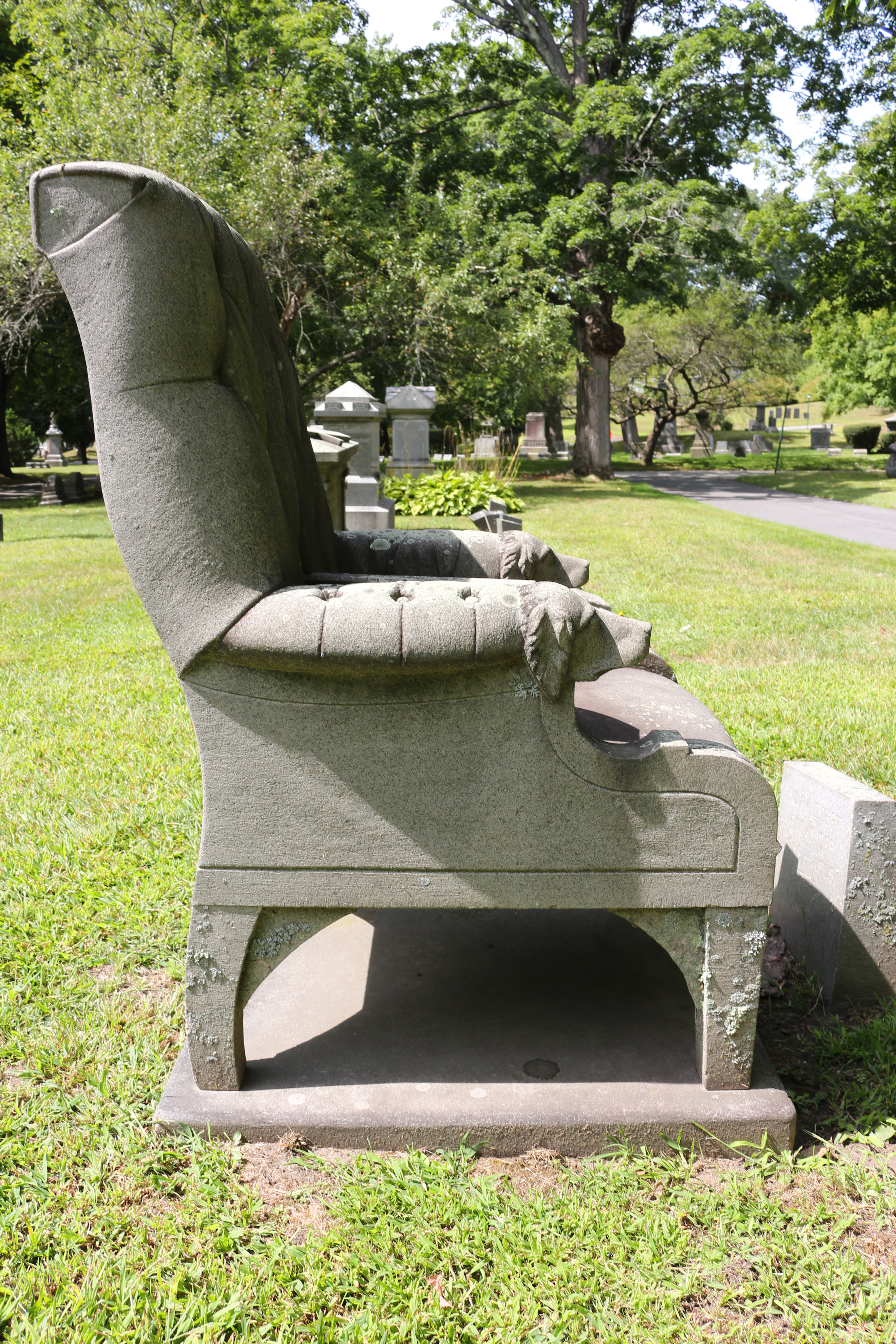
The Empty Chair

In funerary symbolism, the vacant chair usually symbolizes the loss of a loved one. This motif gives the feeling that the vacant chair is just waiting for the lost member of the family, who just stepped out for a moment, to return, but it stands empty, never to be sat in again. This example is different in that the chair has the words “REST HERE” carved on the front as an invitation for those strolling by to take a seat. The chair, in this tree stump monument is a rustic design, made to look like it was from the country. Elegant and slim curved lines in furniture from the fluid Art Nouveau period gave way to bulkier to heavier forms made from pieces that came directly from the trees often with the bark still intact. Homes, cabins, and garden houses were designed in the rustic style eschewing classic designs. In decorative furniture this often took the form of chairs made from rough tree limbs curved to form arms and chair backs, chair legs made from tree roots growing upwards. In cabins, railings and the siding were made from un-hewn logs with the bark still in place.

The Shock of Wheat

Carved on the side of the monument is a great shock of wheat. Wheat’s origins are unknown but is the basis of basic food and a staple in many cultures. Because of wheat’s exalted position as a mainstay foodstuff, it is viewed as a gift from Heaven. Wheat also symbolizes immortality and resurrection.  But, like many symbols found on gravestones, they can have more than one meaning.  For instance, because wheat is the main ingredient of bread, the sheaf of wheat can represent the Body of Christ.  Wheat can also represent a long life, usually more than three score and ten, or seventy years.

The Calla Lily

The calla lily is a stunner with its long slender stem, brilliant white flowers, and broad leaves seen on this gravestone growing from a pot.  Though it is called a lily it is not in the flower family liliacea.  The South African native is a cousin to the jack-in-the pulpit and is in the family of araceae. In Africaans the calla lily is called the Varkoor, or pig’s ear, because that is what they believed it resembled. The calla lily was imported out of South Africa in the later part of the nineteenth and early twentieth century.  It almost immediately became associated with Easter and is sometimes referred to as an Easter lily. The calla lily represents majestic beauty and purity and is often used on gravestones to symbolize marriage.  In some cases, the calla lily can also represent the resurrection.

The Lyre

Here, carved on the back of the tree stump monument is an example of a lyre, traditionally seen as a symbol of Apollo, the Greek god of music. In Christian symbolism it can represent harmony and Heavenly accord and song in praise of the Lord.  In funerary art, however, the lyre can also represent the end of life. It is also found on the graves of musicians.

The Tree Stump

The tree-stump gravestones themselves were imbued with symbolism. The short tree stump usually marks the grave of a person who died young—a life that had been “cut” short.  This tree-stump, however, is very tall—hardly a stump. The Halls, James and Emma, lived to be 76 and 86 respectively, both having lived long lives.

Posted in Treestump gravestones | Leave a comment