Profusion of Symbols

JULIET.

Wife of

ELISHA RODGERS

Died

June 8, 1849:

AGED

29 ys 7m & 8 ds.

I recently went looking for the Upper Mound Cemetery just to the West of Covington, Indiana.  Even though I located it on the map, I could not seem to find it.  I stumbled upon the small and very well-kept Lower Mound or Mound Cemetery—but not what I was looking for.  However, I did find a gentleman in the cemetery who gave me explicit directions to the Upper Mound Cemetery which, as it turned out, was only a mile or so away.  In fact, on my way to Lower Mound, I had passed right by it.  If it had not been for the directions from the stranger, I never would have located it.  There is no signage and the side of the lane next to the county road that takes you up to the cemetery is tree-lined and overgrown, completely obscuring a view of the graveyard.  It isn’t until you pull off the county road and look directly up the lane that you get a glimpse of gravestones that you know you are on the right track.

I was specifically looking for the gravestone of Juliet Rodgers.  I had seen a photo of the stone posted on one of the cemetery groups that I follow on Facebook and wanted to see the gravestone for myself.  The gray marble, square-top tablet is extraordinary.  A variety of lettering styles cut deeply and intricately, record the sad details of a far-too-young life cut short.

The top of the tablet depicts a curtain drawn back to reveal an elaborate tableau with a profusion of symbols rich with meaning. The curtain almost looks like it is pulled back as a stage curtain might be.   However, in funerary art the lifted curtain represents the passage from one realm to another; the veil that exists between the Earthly realm and the Heavenly one.

The lyre, the main symbol in the center of the tableau, is an u-shaped stringed instrument that was found in ancient Greece. The lyre was traditionally seen as a symbol of Apollo, the Greek god of music. In Christian symbolism it can represent harmony and Heavenly accord and song in praise of the Lord.  In funerary art, however, the lyre can also represent the end of life.  The lamb, seen here in the bottom left and laying down, is the symbol of the Lord, the Good Shepherd. It also represents innocence, often adorning the tombstones of infants and young children.

Twinning through the motif is a thistle.  The thistle is characterized by a purple or red flower that rests in a cup-shaped part of the stem and has prickly leaves and thorns that protect it from plant-eating animals. This flower, like so many symbols in funerary art, represents many different things. For instance, for Christians, the thistle, with its thorns, can symbolize the Passion of Christ—a reminder of Christ’s crown of thorns. It is also a symbol of earthly sorrow. After Adam ate of the Tree of Life, God said to Adam that the ground was cursed to him for disobeying Him and that Adam would eat in sorrow. God said that, “Thorns also and thistles shall it bring forth to thee….”  The thistle is also the floral symbol of Scotland most likely adopted by the Scots because, as legend has it, a Norse army was about to attack a Scottish army encampment when an opposing soldier stepped on a thistle. The soldier cried out alerting the Scots to the presence of the Norsemen. This legend is also likely to be the origin of the Scottish motto, Nemo me impune lacessit, which is translated as, “No one attacks me with impunity” or “No one can harm me unpunished.” The motto is a fitting slogan for the thistle, as well, because to eat it or pick it, one must overcome the thorns.

With everything that is carved into the stone, it is difficult to spot but there are also oak leaves and acorns to be found.  Because of the hardness of the oak tree, it is traditionally thought of as a symbol of strength.

On opposite sides at the top of the lyre is an apple and a rose giving the motif balance as both are cylindrical.  The apple is a symbol of sin, representing the Fall of Man when Adam ate the from the forbidden tree in the Garden of Eden.  However, some see the apple, because of the round shape as a symbol of eternity—the circle.  In the context of the apple being held by Jesus Christ, the apple represents salvation.

Maybe fittingly, the last symbol to note, is the rose—that represents love.  Romantics have waxed poetic about the rose and the connection to love for centuries which has made the rose an undeniable symbol of love.  On this gravestone, it is likely Elisha was expressing his love for his young, 29-year-old wife, Juliet.  The rose also has a religious meaning, differing by color.  The white rose symbolizes purity while the red rose represents martyrdom and the messianic hope that Christ will return.

Posted in Symbolism | 1 Comment

INRI

In Covington, Indiana, there are two small cemeteries at the North edge of town—Prescott Grove Cemetery and St. Joseph’s Cemetery.  The two are on the same plot of land but separated by a common road that leads into the cemeteries and cuts them in half.  Like many Catholic cemeteries the focal point of the cemetery is a crucifix.  In the case of the St. Joseph Cemetery, the figure of Jesus Christ is painted which has the effect of giving the sculpture a lifelike appearance.  Above the head of Christ is a small rectangular plaque which is called a titulus, or title, with the initials “INRI.”  In Western Christianity, many artists depicted the crucifix with a parchment or plaque, though, some did carve the initials directly into the cross.  The initials, INRI, represent the Latin inscription IESVS NAZARENVS REX IVDÆORVM which in English translates to “Jesus the Nazarene, King of the Jews.”

Posted in Symbolism | Leave a comment

The Gift of a Pineapple

North Bend, Ohio, is where the tomb of William Henry Harrison is located across from the Congressional Green Cemetery which draws the odd history buff to its grounds in search of the ninth president’s grave.  As a president, Harrison is known for two things, his campaign slogan, “Tippecanoe and Tyler, too” and the fact that he only served 31 days in office before he died of pneumonia.  He gave his inaugural address in the rain, as a macho demonstration that, even though, he was 68, he was still a tough man.

But not far from there, the village of Cleves has its own cemetery, Maple Grove.  That cemetery has some obvious aliases, it is also known as the Miami Township Cemetery (so called for the Township in which it lies) and the Valley Junction Cemetery (named for the road that travels south of Highway 50 and leads to its gates).  The cemetery has five or six sections within the gates.  Generally, the most interesting sections are the older ones—displaying a variety, in this case, of symbols that were popular during the Victorian era when there was an explosion of motifs that replaced the grim and dour Puritan symbols of death and mortality.

However, a gravestone in one of the newer sections stood out.  It is a gray, unpolished granite stone built in several pieces.  The entire gravestone is topped with a pineapple, beautifully carved—nearly good enough to pull off the stone, slice and eat.  That pineapple carving rests on the cap—the piece that looks like the roof of a house.  The piece of stone that looks like a solid block is called the die and on one side has the names of the two people being remembered carved into it, and on the other features a incised design depicting James Earle Fraser’s “End of the Trail” sculpture.  That block or die rests of the plinth which has the family name carved on to it on one side and an epitaph on the other.  And that rests on the base.   That is a lot to decipher.  One thing at a time, so, let’s start at the top.

The pineapple is not a common motif in cemetery art.  Sometimes you will see it on metal work around a family plot but less often on an actual gravestone.  After checking several sources, including various books and websites on the topic, the consensus is that the pineapple represents “hospitality and a good host.” According to those in the know, the pineapple came to symbolize hospitality because seafarers often gave it as a gift after returning from a long journey.  These days, you are most likely to find the motive in tropical hotels.  The exotic fruit, in the context of a cemetery, seems curious.  If that is true, that it represents “hospitality and a good host,” who is the host?  Who is showing the hospitality?  Does it mean that the deceased was a good host?  Or that Heaven welcomes the deceased with open and hospitable arms?

On one side of the marker is a bas-relief replica of the sculpture, The End of the Trail, which was created as a powerful tribute mourning the loss of the Sioux people, by the famous western sculptor, James Earle Fraser, also recognized for the art he created for the United States Mint, for the “Indian Head” Nickel.  Fraser created the sculpture for the Panama Pacific Exposition held in 1915 in San Francisco.  The End of the Trail is also a fitting metaphor for the end of one’s life.

Lastly is a memorable and cautionary epitaph:

When you were born, you cried

And the world rejoiced.

Live your life so that when you die,

The world cries and you rejoice.

Even though, for the most part, newer gravestones don’t seem as interesting, make sure not to overlook what at first appears to be the mundane.  You never know when you will find a hospitable old sea captain’s gift of welcome!

Posted in Symbolism | 6 Comments

Memorializing Victorian Children

This gravestone in the Oak Grove Cemetery in Washington, Indiana, is illegible and the boy’s name is lost, his birth and death years appear to be 1888 – 1895.

The gravestones of children are the ones that are uniquely poignant.  It is not natural for  parents to have a child die before they do—children are the future.  The loss is devastating and leaves the parents bereft.  A hole is left in their hearts and their lives.  Gravestones for children take many forms displaying a multitude of symbols—lambs, booties, broken buds, and doves with broken wings, for example. Another way that children were memorialized during the Victorian era was to have their image carved into a monument for the child’s grave.  In many cases the likeness was reproduced from a photograph or painting of the child.  This was done for sons and daughters and continue to be some of the saddest gravestones found in cemeteries.

EDNA MIRIAM PAUL

BORN AUG. 23, 1897 — DIED MAY 2, 1907.

Many hopes are buried here

The likeness of 9 ½ year old Edna Miriam Paul in the St. Luke Cemetery in Chicago, Illinois, was created in the Victorian style of memorializing children in funerary statuary.  The realism of the statue is remarkable as her funerary statue is a recreation of the photograph on the front of the base of her monument.  Edna is depicted in her finest clothing and, as in the photograph, she is wearing a necklace. Her curly hair cascades to her shoulders accentuated by a bow, matching the bow on her dress. True to the image, even her stance is the same in the statue as in the picture.  The epitaph on the gravestone, “Many hopes are buried here,” speaks to the sadness and loss her parents felt.

GEORGE A.

SON OF E.J. &S.A. BLOUNT

BORN SEPT. 26, 1867.

DIED FEB. 14, 1873.

The following can be found on a plaque in the Green Lawn Cemetery in Columbus, Ohio: ““Georgie” Blount was five when he fell from a banister in the family owned American House Hotel on February 7th, 18873, striking his head on an iron stove.  He passed on February 14th.  The community mourned the loss of this well-known and well-loved child, and this monument was made from a portrait painted shortly before his death.”

Mary Ella McGinnis

Born December 15, 1869

Died August 6, 1875

The likeness of Mary Ella McGinnis was created in the Victorian style of memorializing children in funerary statuary.  The realism of the statue is remarkable.  Mary Ella is depicted in her finest clothing, the eyelet lace still visible in the bottom of her skirt.  She is portrayed holding flowers in her apron with one hand and a single flower in her other hand.  Because of the weathering of the soft marble, the kind of flower is not discernible.  The act of placing the single flower on a grave is a common motif and expresses the transitory nature of life. The flower she holds in one hand is a floral metaphor for a young flower that did not have time to fully bloom on Earth, a poignant visual message coupled with the image of this young girl.

Corliss Randle Ruckle

Born Dec. 19, 1877

Died Dec. 4, 1889

One of the most sought out monuments in the sprawling Crown Hill Cemetery at Indianapolis, Indiana, is that which was carved for Corliss Randle Ruckle, who was born December 19, 1877, and died of diphtheria December 4, 1889, just shy of his 12th birthday.  Corliss was the only son of Nicholas R. Ruckle, who had been a captain in the Civil War in Company E in the 11th Indiana Volunteer Infantry. He was promoted to Colonel of the 148th Rec’t Indiana Infantry.  His mother was Jennie Moore Ruckle.  Corliss Randle Ruckle is depicted in a white-collared shirt tied with a bow, wearing knee breeches, button-up shoes, while sitting on a spiral staircase, with an open book and a small bouquet of flowers.  His family memorialized young Corliss in a lifelike statue.

ANISE E. HART

DEAR PARENTS WITH A

REVERENT HAND,

THIS TO THY MEMORY GIVEN

WHILE ONE BY ONE THY

HOUSEHOLD BAND,

GOD REUNITES IN HEAVEN.

(On the front of the gravestone)

Anise E. Hart

September 28, 1897

July 28, 1909

This gravestone is in St. Peter’s Cemetery in Montgomery, Indiana, dedicated to Anise E. Hart, the twelve-year old daughter of James and Alice Hart.  This example was carved by Bedford, Indiana, stone carver Ira Correll. According to the Smithsonian Save Outdoor Art, Indiana Survey, the limestone statue of the young girl was carved by Correll from a photograph of Anise.  The description from the Smithsonian survey describes the statue as “wearing a dress, a layered blouse with fluffed sleeves, a belt, high-laced shoes, and a bracelet on her proper left wrist. Her hair is in long ringlets, caught with a bow in the back. She holds a small bunch of roses in her proper right hand.”  The limestone figure stands upon a red granite base decorated with small Corinthian columns, and a cross.

Posted in Uncategorized | 1 Comment

A Small Stairway to Heaven

There is a weathered marble gravestone with the words, “Children of H. A. and S. A. Smith” carved into the plinth.  The small white marble gravestone is in the Oak Grove Cemetery in Washington, Indiana.  Unfortunately, the marble is so badly eroded that the names of the children, which appeared on the top of the gravestone, are no longer legible—they are lost to history.

The symbolism on the marker is badly weathered, too, but easily discernible.  The most dominate motif on the marker—open gates—is very common in American cemeteries.  In this example, the gates are attached to rounded columns with what appears to be Corinthian capitals, holding up an arch.  The arch represents a triumph of life over death, victory over the darkness of the grave.

The open gates, which are central to the Last Judgment, are open.  The gates here represent a passageway from one realm to the next.  The gates are the portal for saved souls to make their passage from the Earthly realm to the Heavenly realm upon Christ’s return.

This example also has a dove.  Many symbols found on gravestones have multiple meanings—the dove is one of those.  Several references in the Bible refer to the dove as a symbol of the Holy Spirit. Matthew 3:16 reads, “And Jesus, when he was baptized, went up straightway out of the water: and, lo, the heavens were opened unto him, and he saw the Spirit of God descending like a dove, and lighting upon him.” In Mark 1:10 the Bible says, “And Straightway coming up out of the water, he saw the heavens opened, and the Spirit like a dove descending upon him.” Again in John 1:32, the Bible reads, “And John bare record, saying, I saw the Spirit descending from heaven like a dove, and it abode upon him.”

Along with the dove symbolizing the Holy Spirit, the dove is also closely associated with peace, often depicted with a sprig of an olive in its beak. This, too, originated in the Bible. After the waters receded in the story of Noah, the dove appears. Genesis 8:11, “And the dove came into him in the evening; and, lo, in her mouth was an olive leaf pluckt off; so Noah knew that the waters were abated from off the earth.”   It was a sign of God’s forgiveness.

The dove, with its white color, is also a symbol of purity and innocence and for that reason is often found the tombstones of children, most likely why it was carved on this stone, in honor the Smith family children.  Thus, the dove symbolizes the Holy Spirit, peace, and purity.

Less often seen in connection with the open gates motif is the staircase leading up to the open gates—the stairway, albeit small, to Heaven.  I have always envisioned it much longer and grandiose!

Posted in Symbolism | 3 Comments

Tragedy at Winter Quarters

The Pioneer Mormon Cemetery in Florence, now a northern suburb of Omaha, Nebraska, was not far from where I grew up.  And depending on how I went to or came home from elementary school, the tiny cemetery was on my way.  So, I did peak in a time or two when I was a kid.

After the Mormon leader, Joseph Smith and his brother, Hiram, were killed in the Carthage jail in Carthage, Illinois, the Mormons decided, under the leadership of Brigham Young, that they needed to abandon Nauvoo, Illinois, and head further West.  In June of 1846, the band of exiles landed on the west side of the Missouri River and encamped there in what became known as the Winter Quarters.  My great-great-great grandparents, Ezra and Catherine Vincent, were part of that migration.  But Catherine was “great with child” so they crossed back over the river and settled in what later became Harrison County, Iowa.  Their daughter, Julia, was the first female child of European descent born in the county.  They stayed put in Western Iowa to farm and escaped the losses that many others experienced as they buried their loved ones along the journey to Utah.  For many, the Winter Quarters where their journey ended.

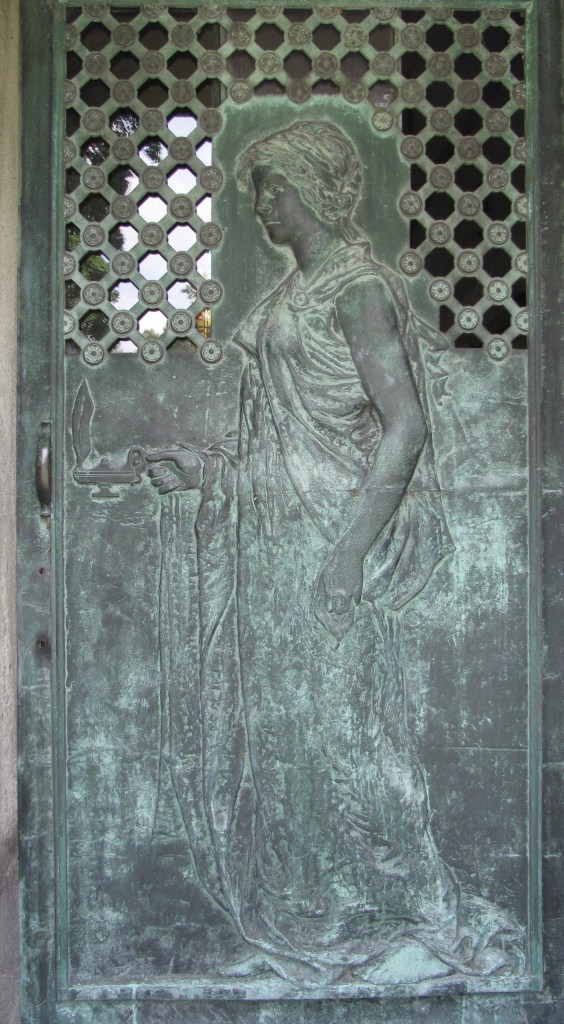
Marking the portal to many small country cemeteries are simple gates made of metal letters stretched between two metal poles. But, the gate into the Pioneer Mormon Cemetery is more like a garden gate, except there are two exceptional bronze plaques flanking the gate memorializing the nearly 600 Mormons who are buried there in unmarked graves.

The plaque to the left, depicts a cloaked mourning figure hovering over the words inscribed for passersby to read, “IN LOVING MEMORY OF THE SIX THOUSAND DEVOTED PIONEERS WHO DIED ON THE PLAINS BETWEEN 1846 – 1869.  THE BODIES OF NEARLY SIX HUNDRED OF THOSE BRAVE SOULS WERE BURIED WITHIN THIS SACRED ENCLOSURE.”

The bronze plaque to the right of the gate features a bas-relief depicting a woman leaning slightly back with both hands raised seemingly in awe with the rising sun behind her.  Her feet indicate that she floats above the Earth.  The inscription circling around the sun, reads, “I AM THE RESURRECTION AND THE LIFE, THIS MORTAL BODY IS RAISED TO AN IMMORTAL BODY.”  Running down the side of the plaque is a Biblical passage, “THE DEAD SHALL HEAR THE VOICE OF THE SON OF GOD AND THEY THAT HEAR SHALL LIVE. JOHN V:25.  Underneath that, “FOR THEY SHALL REST FROM THEIR LABORS HERE AND SHALL CONTINUE THEIR WORKS.” DOCTRINE AND COVENANTS, SEC.: 124:86.

Both bronze plaques were the work of J. Leo (1878-1946) and Avard Tennyson Fairbanks (1897 – 1987). J. Leo and Avard Fairbanks were the sons of artist John Fairbanks and Lilly Annetta Huish.  Both sons were born in Utah.  J. Leo was a painter, sculptor, and art educator in high school and college.  Avard Fairbanks, the youngest of the eleven children in the Fairbanks family, was also a trained sculptor who started his art training at the age of 13, studying under the famed James Earle Fraser at the Art Students League of New York.  He also studied in Paris at the Ecole Nationale Superieure des Beaux-Arts, the Academie de la Grande Chaumiere, The Academie Colarossi and the Ecole Moderne.  Avard had a long career as a professor of sculptor teaching at the Art Institute of Seattle, The University of Michigan, The University of Utah, and the University of North Dakota.

While teaching he also took commission and created sculptures that can be seen throughout the country, including St. Anthony’s Doughboy in Keefer Park in Idaho, the bas-relief panels on the bronze doors to the United States National Bank Building in Portland, Oregon, and a statue of George Washington for the Washington State Capitol.  Fairbanks created several statues of the Angel Moroni for Latter Day Saints temples and many other sculptures commissioned by the LDS Church, including the centerpiece of the Pioneer Mormon Cemetery in Florence—a sculpture titled, “Tragedy at Winter Quarters,” created in 1936, which depicts grief-stricken parents who have just buried their infant child.

In a circle at the base of the statue is another plaque that features what appears to be an angel in the middle with her arms outward.  On either side of her are the names of the Mormons who died and were buried in the cemetery during the Winter Quarters.  This, too, was sculpted by Avard Fairbanks, as part of a moving memorial to the Mormons who lost their lives on the journey to Salt Lake City.

Posted in Artists | 2 Comments

Tribute to a Fisherman

EMIL AMBOS

Born April 22, 1844

Died March 26, 1898

Along one of the winding avenues in the serene and park-like Green Lawn Cemetery in Columbus, Ohio, is the statue of Emil Ambos, a well-regarded and celebrated bon vivant in his day.  Emil Louis Ambos was the son of Peter and Dorothea (Jaeger) Ambos.  Peter was a German immigrant who prospered and built a fortune as a restaurateur and chocolate confectioner, eventually going into banking, as well.  Dorothea’s family were large and owners and owned much of the land in what is now known as Germantown in Columbus.

Emil and his siblings grew up in luxury and in time inherited the family fortune.  Emil also was a success as a saloon keeper and liquor wholesaler but made the decision to retire at the ripe old age of 39, so he could spend more time following his true passions—philanthropy and fishing.  Emil donated money to the Columbus area orphanages.  But he also took a personal interest in the children—making sure that poor children had winter coats and often inviting them to his home for lavish Christmas dinners.  Often he could be seen with several children heading to a pond with him on an afternoon fishing trip.

When Emil died in 1898, he left a quirky will that satisfied both of his passions—money for orphans and $5,000 set aside for a monument to be erected over his grave that “shall be enduring, attractive, creditable and first class in all respects.” It should be, he wrote, a “life size figure of myself in fishing costume, according to a photograph taken by L.M. Baker about three or four years ago.”  John Francis Brines, a well-known sculptor from Westerly, Rhode Island, was commissioned to create a bronze statue of Emil Ambos for his monument, which was completed in 1901.

A survey document of important sculptures in the Green Lawn Cemetery by the Smithsonian described the bronze statue: “This life-sized sculpture of a mustachioed Emil Ambos depicts him sitting on a rock and wearing a coat, vest, dress shirt with a bow tie, boots, and a fishing hat. In his right hand he holds a fly rod that may appear to be broken but is actually supposed to be that way to represent it as being partially un-joined. In his left hand he holds a stringer that originally held two small mouth bass; however, one was stolen years ago so only one fish remains. Near his left foot is bait bucket with a small cup or can hanging from it. The statue is set in a way that makes it appear that Emil is looking out over a pond in the cemetery.”

The bronze sculpture was cast by the JNO Williams Foundry in New York City.  The foundry was established in 1875 by John Williams who had been an employee of Tiffany & Company who left to start his own enterprise.  The foundry worked with some of the most influential and well-known sculptors of the late 19th and early 20th Centuries, such as, Louis Amateis, Karl Bitter, Gutzon Borglum, Pompeo Coppini, Daniel Chester French, Harriet Frishmuth Carl Augustus Heber, Anna Hyatt Huntington, Charles Keck, Edward Kemeys, Samuel Kilpatrick, Augustus Lukeman, Frederick MacMonnies, R. Tait McKenzie, Percival J. Morris, Allen George Newman, Charles Niehaus, Roalnd Hinton Perry, J. Massey Rhind, Andrew O’Connor, Alexander Phimister Proctor, Augustus Saint Gaudens, Anton Schaaf, Francois Tonetti, Gaetan Trentanove, J. Q. A. Ward, Olin Levi Warner, Albert Weinert, and George Julian Zolnay.

The foundry manufactured architectural pieces, such as bronze doors, for the Boston Public Library, the Library of Congress, and the United States Capitol building, as well as, sculptural pieces, such as, the tigers in front of Nassau Hall at Princeton University.

In 2019, the Smithsonian designated the statue as historically significant but in danger.  The bronze had turned green and the bronze was slowly deteriorating.  On top of that, vandals had shot the statue of Emil Ambos in the head and the fish he was holding had been stolen.  The cemetery trustees reached out to Mike Major of Urbana to restore Emil’s statue, an effort costing a whopping $30,000 and more than two and a half months of painstaking and tedious work.  Now, the statue of Emil can look out amid the gravestones of Green Lawn as a reminder of one of his passions—fishing.

NOTE: The JNO. Williams advertisements were all from an industry publication, The Monumental News, and were researched and provided by Peggy Perazzo who shares her vast collection of gravestone catalogs and resources at her Website: http://quarriesandbeyond.org/cemeteries_and_monumental_art/cemetery_stones.html.

The Quarries and Beyond Website was created by Peggy B. and Patrick Perazzo. It focuses on historic stone quarries, stone workers and companies, and related subjects such as geology. Whenever possible links of finished products are provided on the Website. There is a “Quarry Articles” section that presents articles, booklets, and links from the late 1800s to early 1900s, including the 1856 “The Marble-Workers’ Manual.” The “Cemetery Stones and Monuments” section provides references and resources, including many old monument magazines, catalogs, price lists, and a photographic tour “From Quarry to Cemetery Monuments.

Posted in Artists | 3 Comments

Grave Marker Erector Set

DR. WILLIAM HANNA

DIED JANUARY 8, 1878

AGED 33 YRS. 9 MOS. 22 DAYS

HUSBAND & FATHER, WE MISS THEE.

WE SHALL NOT MEET AGAIN, GONE, BUT NOT FORGOTTEN.

BLESSED ARE THE DEAD WHICH DIE IN THE LORD.

The tallest grave marker in the tiny Center Grove Cemetery, along Highway 46, is a 10 or 12-foot zinc marker.  These markers were produced and sold by the Monumental Bronze Company of Bridgeport, Connecticut.  Though the company billed the markers as “white bronze” they were actually cast zinc.  The markers are distinguishable by their bluish-gray tint.

The company set up their first subsidiary in Detroit, Michigan. Others followed in Philadelphia, New Orleans, St. Thomas, Ontario, Des Moines, and Chicago. Enterprising salesmen carried a catalog door-to-door with them to show customers the many styles and price ranges of the product line. In many cemeteries you can find evidence of highly successful salesmen who sold a large number of the markers. The zinc markers were produced beginning in the 1870s until the company closed shop in 1912.

These grave markers came in a wide assortment of sizes and shapes and were somewhat like grave marker erector sets. The more elaborate markers had a shell of sorts and then various panels could be attached according to the tastes of the family ordering the grave marker. In this way, each marker could be “customized” to the tastes of the individual.

Urn

This monument has a two-handle urn inside an architectural feature that is part of a spire topped with a finial. The urn is an ubiquitous funerary motif symbolizing death and mortality.  The irony of the urn being such a popular 19th Century funerary symbol is that very few people were cremated when the urn motif was at the height of its popularity.  For instance, during the eight years from 1876 until 1884, only 41 Americans were cremated.  Though the number of cremations in the United States slowly increased, by the 1950s only less 4% of our dead were cremated.  Cremation, though, has been increasing each decade: 1960–3.56%; 1970–4.59%; 1980–9.72%; 1990–17.13%; 2000–26.24%; 2010–35.93%.  Some are predicting that by 2025, almost half of our dead will be cremated.  Maybe the urn will re-emerge as a symbol for the 21st Century.

Clasping Hands

Another common motif found in American cemeteries are—clasping hands.  The clasping hands on this gravestone likely represents holy matrimony, symbolizing the holy union between a man and a woman. Often one hand of the motif is clearly the hand of the female, her cuff ruffled, with the hand on the other side depicting a shirt’s cuff barely visible from underneath a suit jacket, though neither hand displays a cuff male or female in this example.  Clasping hands can also represent the brotherhood of the union symbolizing the brethren of workers clasped in the making of something together, sharing their labor bonded by common work.  Lastly, the motif can also signify a farewell handshake life on earth and the welcome to Heaven, leaving behind what they have known on earth for the sublime pleasures of Heaven.

Cross and Crown

The crown is a symbol of glory and victory over death.  The reward awaits in Heaven where the victor will receive a crown of victory. The cross represents the suffering of Jesus.

Masonic symbol

Inside the shield on one of the four sides of this marker is the most recognizable emblem of the Freemasons, the square and compasses.  In this example the letter “G” appears in the middle of the emblem.  Often the emblem is seen without the letter “G”. Each component of the symbol represents a different Masonic orthodoxy, though, these are not hard and fast: The compasses represent the boundaries of wisdom a person should have the strength to circumscribe and stay within. The square symbolizes virtue in all actions, just as the expression “square deal” means treating people with fairness. The letter “G” seems to have more than one meaning.  It could possibly mean God, as in the creator of the universe; or Gimel, which is the word for the third letter of many Semitic languages.  The number three is significant to many Masonic rituals and beliefs.  Some also believe the “G” may represent geometry.

Broken Chain

In the cemetery, much of the iconography represents a life ended—the winged death’s head, the hanging bud, the broken wheel, the incomplete circle, the column that is broken. This grave marker has a chain that formed into a circle that has a broken link.  This motif essentially combines two symbols representing the end of life—the broken chain and the broken circle.  The symbolism of the broken chain dates dating to Medieval times when people believed that the soul could be held to the body by a “golden chain.” Once the chain was broken, the soul took flight and rose from the body leaving Earth and ascended to Heaven.

Broken bud or flower

The broken bud represents the flower that did not bloom into full blossom, the life that was cut short before it had a chance to grow to adulthood.  The broken flower represents an adult that did grow to maturity but has died—yet another mortality symbol.  The flower in this case is a rose, which is the universal symbol of love.

Kneeling Angel

When looking at gravestones, there is always room for interpretation.  Elisabeth L. Roark wrote an article about angels titled, “Embodying Immortality: Angels in America’s Rural Garden Cemeteries, 1850—1900”, pages 56 – 111, 2007 edition of Markers, XXIV, in which she categorized the eight most commonly found types of graveyard angels—grouped by the task they performed: soul-bearing; praying; decorating and guarding; pointing; recording; trumpeting; sword-bearing (archangel Michael); and child angels. The winged protectors served to watch over the “soul while living, removed occasions of sin and provided protection when danger threatened, interceded on their charges’ behalf, attended at death, eased the transition to the next world, conducted the soul to Heaven, and looked after the grave site and the deceased’s remains until resurrection.”  These were busy angels. In addition to those duties, the praying angels served as an intercessor conveying messages from their charges to Heaven. Though not in this example, these angels are often looking upward toward the Heavens, hands clasped together in prayer, sometimes coupled with emblems of faith, such as, anchors and crosses, often clad in toga-like clothing.

Posted in Symbolism, Zinc Markers | Leave a comment

A Bow and an Arrow

JAKOB ZONDLER

Geb. J. 28, Dec. 1829

Gest. J. 25. Marz 1873

Aged 43 Jahre 3 mo. & 27 Tag.

The small rounded-top tablet of Jakob Zondler, a German American buried in the Congressional Green Cemetery in North Bend, Ohio, displays a bow and arrow in the tympanum or top of the gravestone.  The bow appears to be loaded but while the bowstring is drawn back it is not actually in the arrow’s nock (notch). This is made clear by the fact that the fletching (fins) are outside the bowstring.  Inside the bow are the most common and widely recognized symbols for the Independent Order of Odd Fellows fraternal society, that is, the three-chain links and the letters F, L, T, which signify the organizations motto: Friendship, Love, and Truth.

According to Stacy C. Hollander, curator of the American Folk Art Museum in New York, “These bow and arrow props were used by American Odd Fellows lodges to teach the lessons of friendship in the First Degree of the group’s rituals. The biblical story of the friendship between David and Jonathan, related in the Book of Samuel, was adapted and recounted, explaining that the bow and arrows were used by Jonathan to warn David of danger in returning to King Saul’s court. After 1882, when the group revised its degree structure, the Odd Fellows used the bow and arrows and quiver as symbols in the Second, or Love, Degree. The bow is understood as an emblem of authority, and the arrows symbolize uprightness and truthfulness.”

Posted in Symbolism | Leave a comment

Idealized Beauty

DOMENICO CAFFERATA

FATHER

1870 – 1968

MARIA T. CAFFERATA

MOTHER

1878 – 1952

The white marble gravestone for the Cafferata Family in the New St. Joseph’s Cemetery in Cincinnati, Ohio, depicts a mourning figure draped across the top of the stone.  The description of a mourning figure found on a door in the Woodlawn Cemetery in the Bronx and described in Sylvan Cemetery: Architecture Art & Landscape at Woodlawn, is fitting for the Cafferata monument: the “flowing figure of a grieving woman, seen… with drapery slipping down to revel a long and sinuous form, a play of curved and angular contour lines.…Her head is bowed and her face hidden from our view signifying the ravages of grief works on the harmony and beauty of the human face.”

These mourning figures are referred to as “weepers.”  Since ancient times, it has been the women who have been the ones in our families and in our society, who showed grief and shed tears over those lost to death. Like the women in ancient times, these sculpted mourning figures are depicted as standing over the graves in sorrow.  In funerary art the women often are depicted as beautiful, young, and voluptuous women wearing revealing clothing as they mourn the dead.

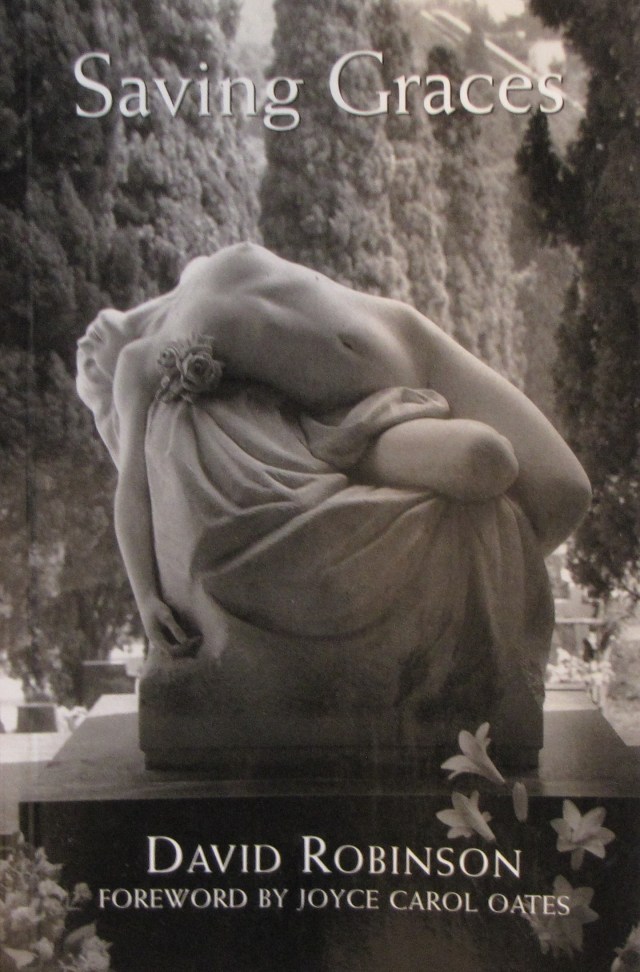
In David Robinson’s book, Saving Graces, which has been referenced many times in this blog, he describes these figures as “grieving women who signify how deeply the deceased is missed.  As symbolic mourners, their idealized beauty is spiritual, representing purity, passion, and commitment…But these women also serve as escorts on the journey ahead.  As designated companions in eternity, they are posted there to watch over and take care of the deceased.  Forever present, they are also forever young…these women symbolize the aspiration of eternal life, not the acceptance of death.  They may grieve, but they also comfort, and in this role, their beauty is more sensual than spiritual.”  Robinson notes that these mourning figures are “Pure on the one hand, sensual on the other, idealized yet lifelike…a very human combination of spiritual devotion and earthly desire.”

The Victorian “weeper” was usually not voluptuous and often portrayed as androgynous, dressed modestly in a diaphanous gown loosely fitted and flowing beyond her feet.

Posted in Saving Graces | 2 Comments