Fast Mail

Rose Hill Cemetery, Chicago

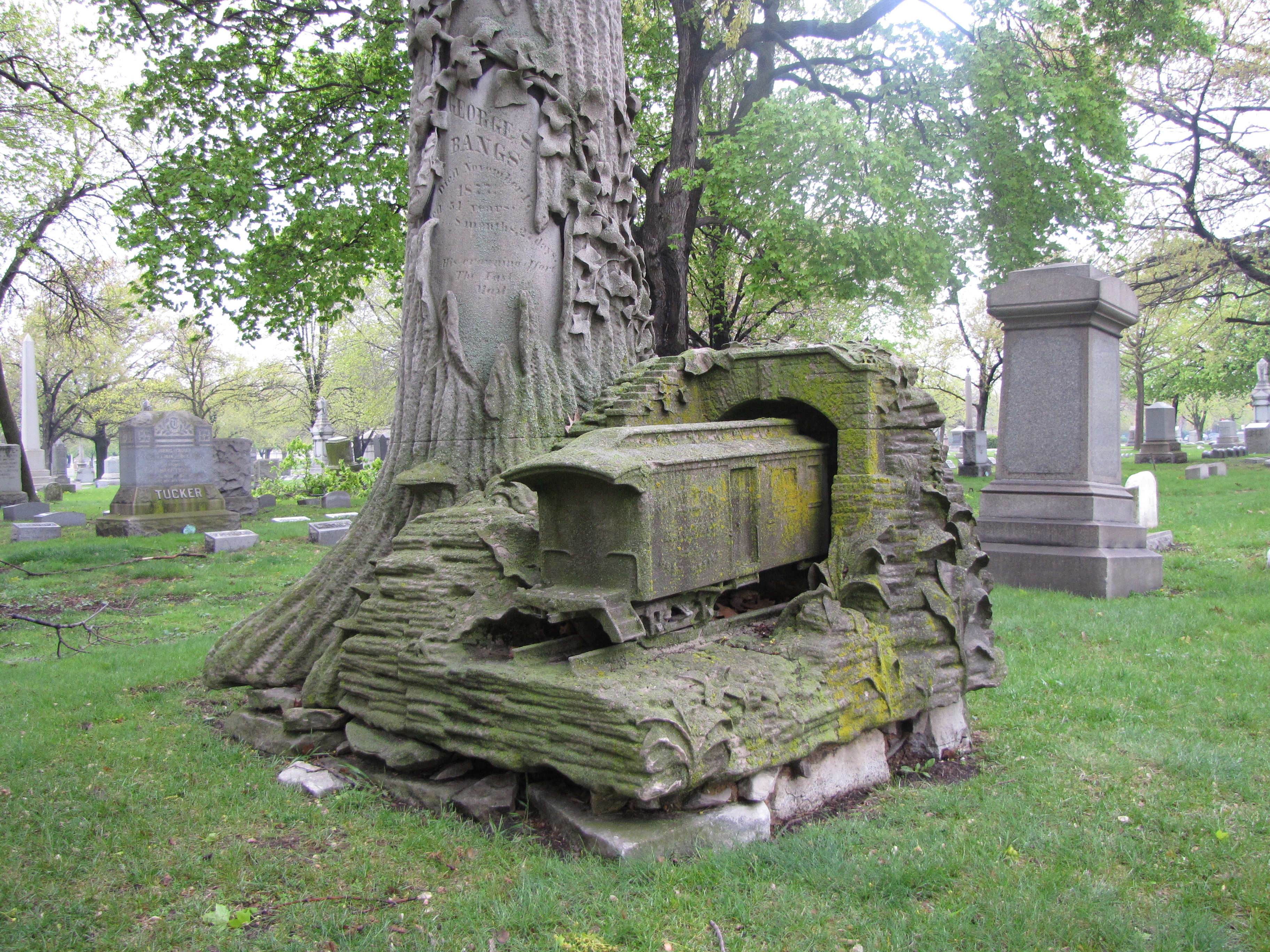
GEORGE S. BANGS

Died November 17, 1877

Aged 51 Years  8 months 27 days

His crowning effort The Fast  Mail

Some people want to be remembered for who they are, some for what they did.  This “treestump gravestone”, so called because it looks like a treestump is the monument of George S. Bangs.  If you look closely you can see a rail car entering into a tunnel at the base of the treestump.  On the side of the rail car were the words, “UNITED STATES RAILWAY POST OFFICE.”

Posted in Treestump gravestones, Uncategorized | 5 Comments

Lamb


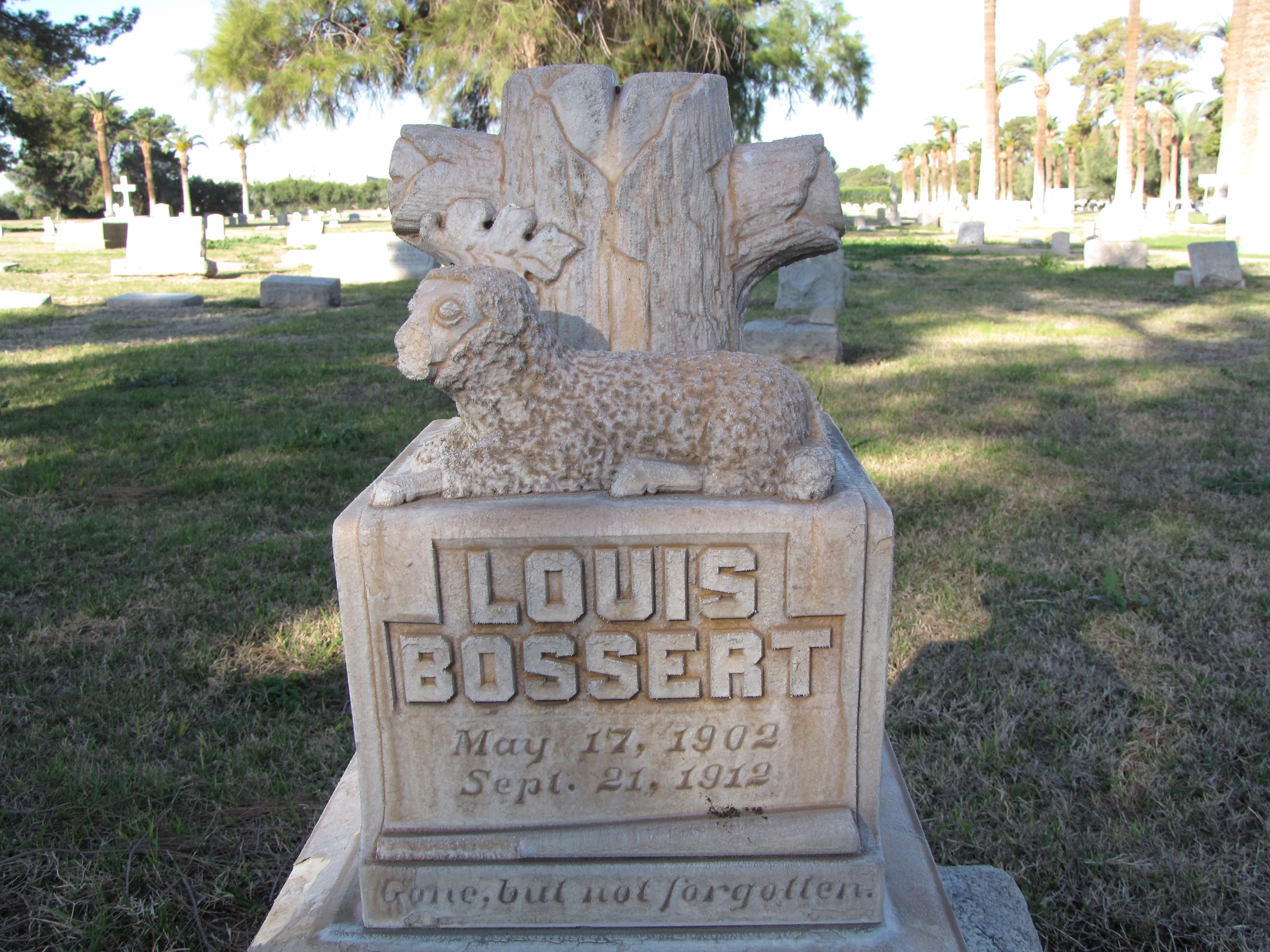
Greenwood Cemetery, Phoenix, Arizona

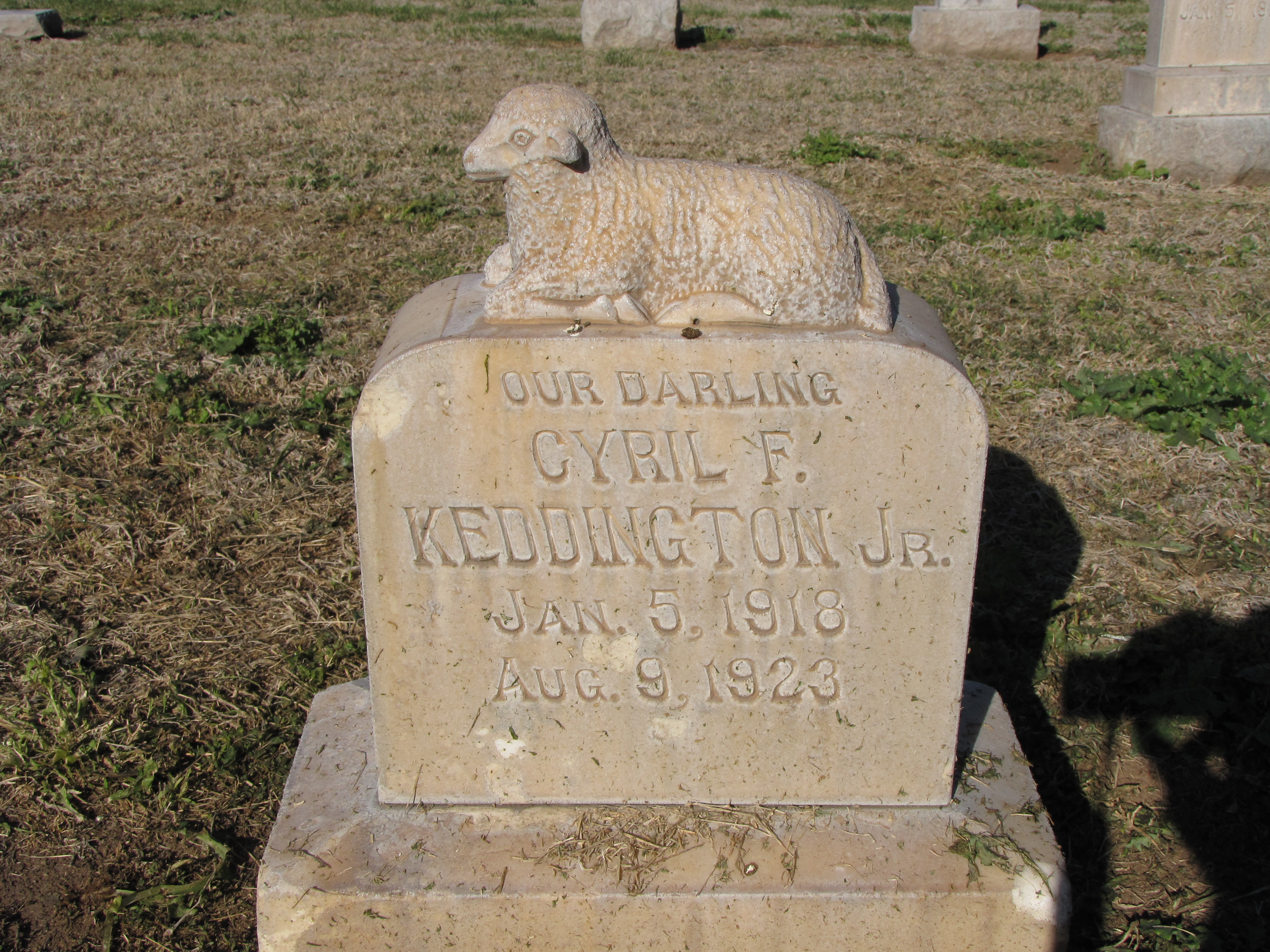
Greenwood Cemetery, Phoenix, Arizona

The lamb is the symbol of the Lord, the Good Shepherd.  It also represents innocence, likely the reason why this motif usually adorns the tombstones of infants and young children.  Most often the lamb is lying down, often asleep and sometimes with a cross behind the lamb.

Posted in Symbolism | Leave a comment

Eternal Silence

Eternal Silence, The Dexter Graves Monument, Graceland Cemetery, Chicago

Lorado Taft was one of the premier sculptors of his day.  He was a widely published scholar on the topic and his work was highly sought after.  He was commissioned to produce many public works including the The Soldier’s Monument in Oregon, Illinois, The Solitude of the Soul Scupture at the Art Institute of Chicago, and The Fountain of Time in Chicago.

Taft was commissioned in 1909 by Henry Graves, of Chicago, to create a monument for his father, Dexter Graves.  The Graves family had long been in America, their first ancestor, Thomas Graves, crossed the Atlantic and settled in Connecticut in 1645.  Dexter Graves [1789-1844] himself was a pioneer and was one of the earliest settlers in Chicago who, according to the inscription on the back of the monument, “brought the first colony to Chicago, consisting of 13 families, arriving here July 15, 1831 from Ashtabula, Ohio, on the schooner Telegraph.”

The bronze figure that Taft created is named Eternal Silence, an obvious metaphor for death.  The forboding cloaked figure stands against solid black granite–black being the traditonal color representing mourning and death.  The figure has his eyes closed and gathers the shroud to his lips preventing him from speaking. 

The bronze has an eerie feel to it, in part, because of the way the patina has formed on the statue.  The shroud has a greenish blue unnatural color.  Except for a highlight on the nose, most of the face has remained dark and recedes from the hood, making it appear more menacing and mysterious. 

Posted in Symbolism, Uncategorized | 3 Comments

Lightning Strike

Green Hill Cemetery, Bedford, Indiana

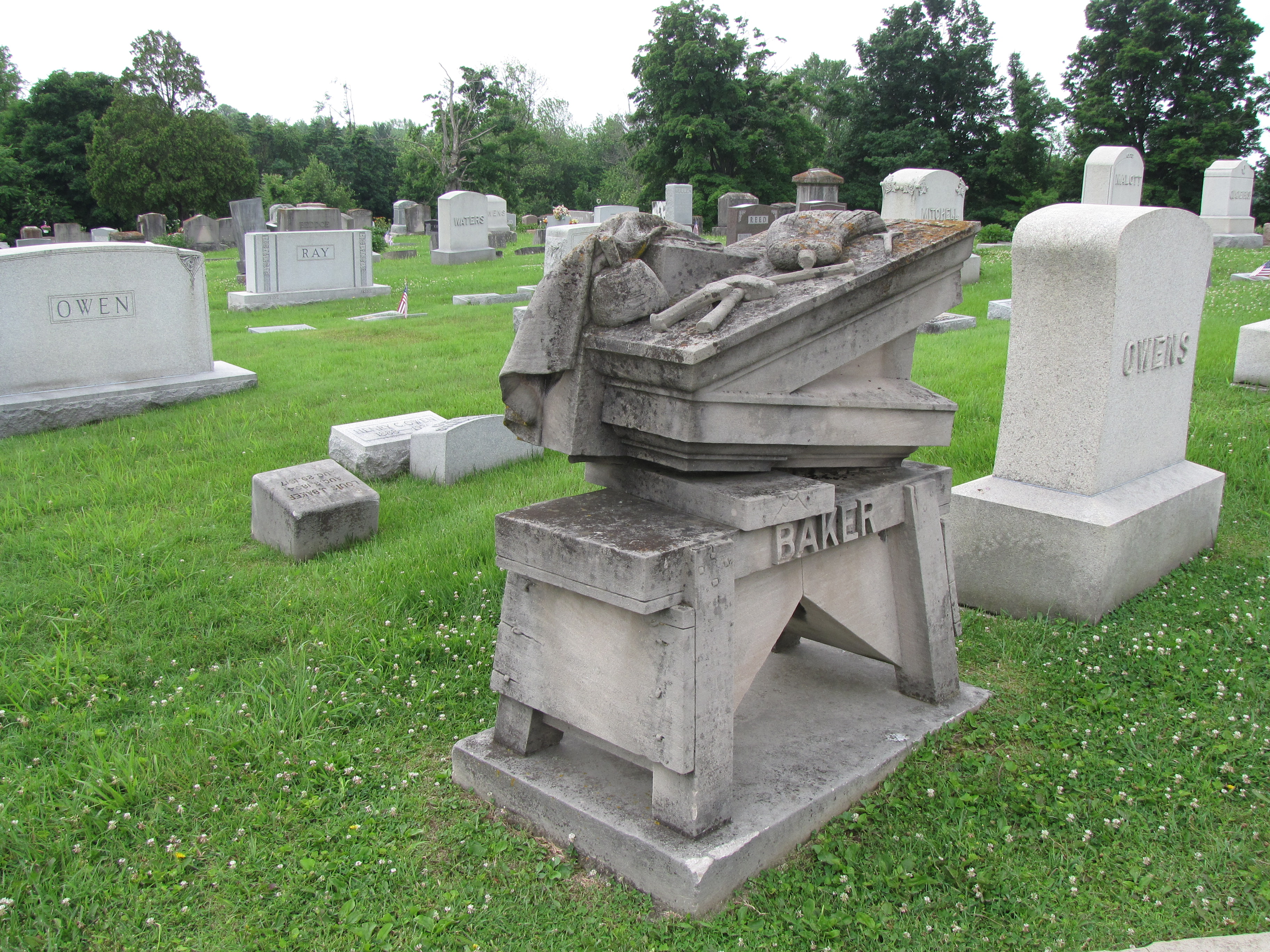
Louis J. Baker, August 3, 1894, August 29, 1917
 
Indiana has a large number of quarries throughout the state because some of the richest limestone deposits in the country are found in this region.  Indiana limestone has been used in many significant buildings in the United States, including Empire State Building and the Pentagon.  Thousands of craftsmen were needed to cut, quarry, and carve the limestone.  One such apprentice carver was well-liked Louis J. Baker, a young 23-year old who lived in Bedford, Indiana.  On the fateful night of his death, he was walking home during a thunder and lightning storm when he was struck by a fiery lightning bolt and killed.
 
The men with whom he worked busied themselves to pay tribute to their young and popular colleague by replicating his workbench exactly as it had been the day he left it when the quitting whistle blew.  As described in Wobblies, Pile Butts, and Other Heroes: Laborlore Explorations by Archie Green, page 357, “His fellow carvers made an exact replica of his workbench, or “banker” as stone carvers call it.  On the banker is the piece of architectural stone, unfinished, exactly as he left it….Atop this stone appear his tools; a mallet, a hammer, a pitching tool, chisels, a square, a head of a broom, and his apron.  The fidelity of this work is amazing; the wood grain of the bench is clearly shown as are the bent-over nails holding the bench together and the straw in the broom.”
 
Here was a sincere outpouring of love for one of their fellow stone carvers.  They carved a fitting and poignant monument to one of their own, far more moving than most.
Posted in Famous graves | 1 Comment

Door Number One

James Irving Holcomb Mausoleum, Crown Hill Cemetery, Indianapolis

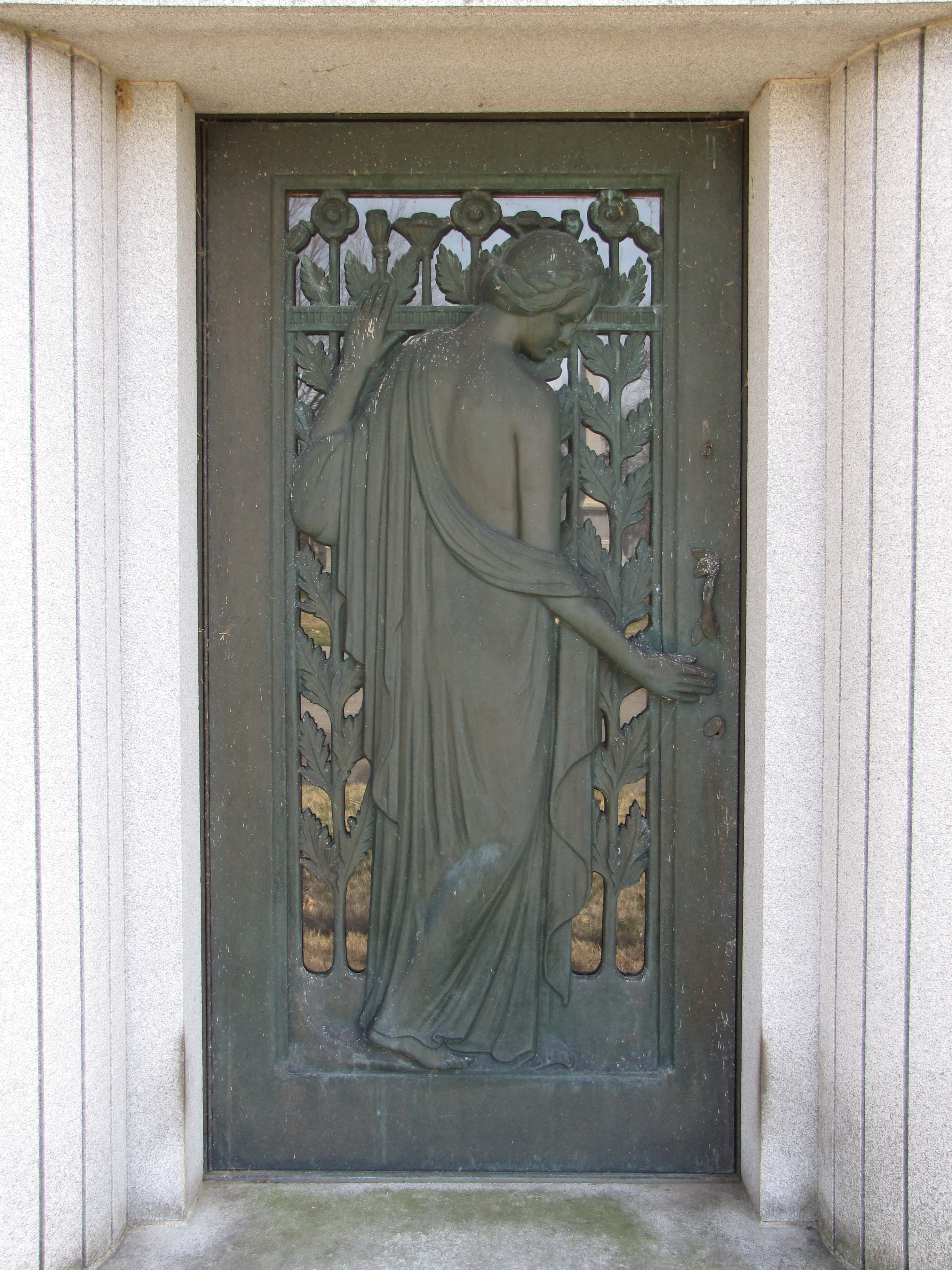
When I was a kid there was a game show on telelvision called Let’s Make a Deal hosted by Monte Hall.  The game revolved around the contestants wagering that the prize they had in their hand was not as good as one of the prizes behind door number one, two, or three.  The great mystery was what was behind the door. 

In the same way, the door as a motif in funerary art symbolizes mystery.  The door is the pathway from the earthly realm to the next.  In Christianity, however, this is almost always viewed with hope, charity, and faith.  The next life will be better.

Posted in Symbolism | Leave a comment

G.A.R.

Civil War Monument, Mt. Olivet Cemetery, Hanover, Pennsylvania

No other event in the 19th Century had a larger affect on America than the Civil War.  It tore the country apart and involved people from every corner before it was over.  Over a million people were wounded and killed–625,000 from the North and over 400,000 from the South. 

After the war, The Grand Army of the Republic (G.A.R), a veteran’s organization, was founded April 6, 1866, in Decatur, Illinois.  The organization admitted veteran’s who served honorably in the Union Army, Navy, or Marines between April 12, 1861, and April 9, 1865.

Various metal grave markers can be found throughout American cemeteries marking the graves of the men and women who served during the war.  These take many forms.

Posted in Metal Markers | 4 Comments

Egyptian Revival, Part 3

During the rural cemetery movement designers created park-like cemeteries.  The first such cemetery was Mt. Auburn, which opened in 1831, at Cambridge, Massachussetts.  The ideal was to fuse the utility of having a place to bury the dead but design the cemeteries so they were pleasing to the eye with an open park design.  Funerary art and architecture was designed to illicit emotions, such as the finality of death and the Christian ideal of eternity.

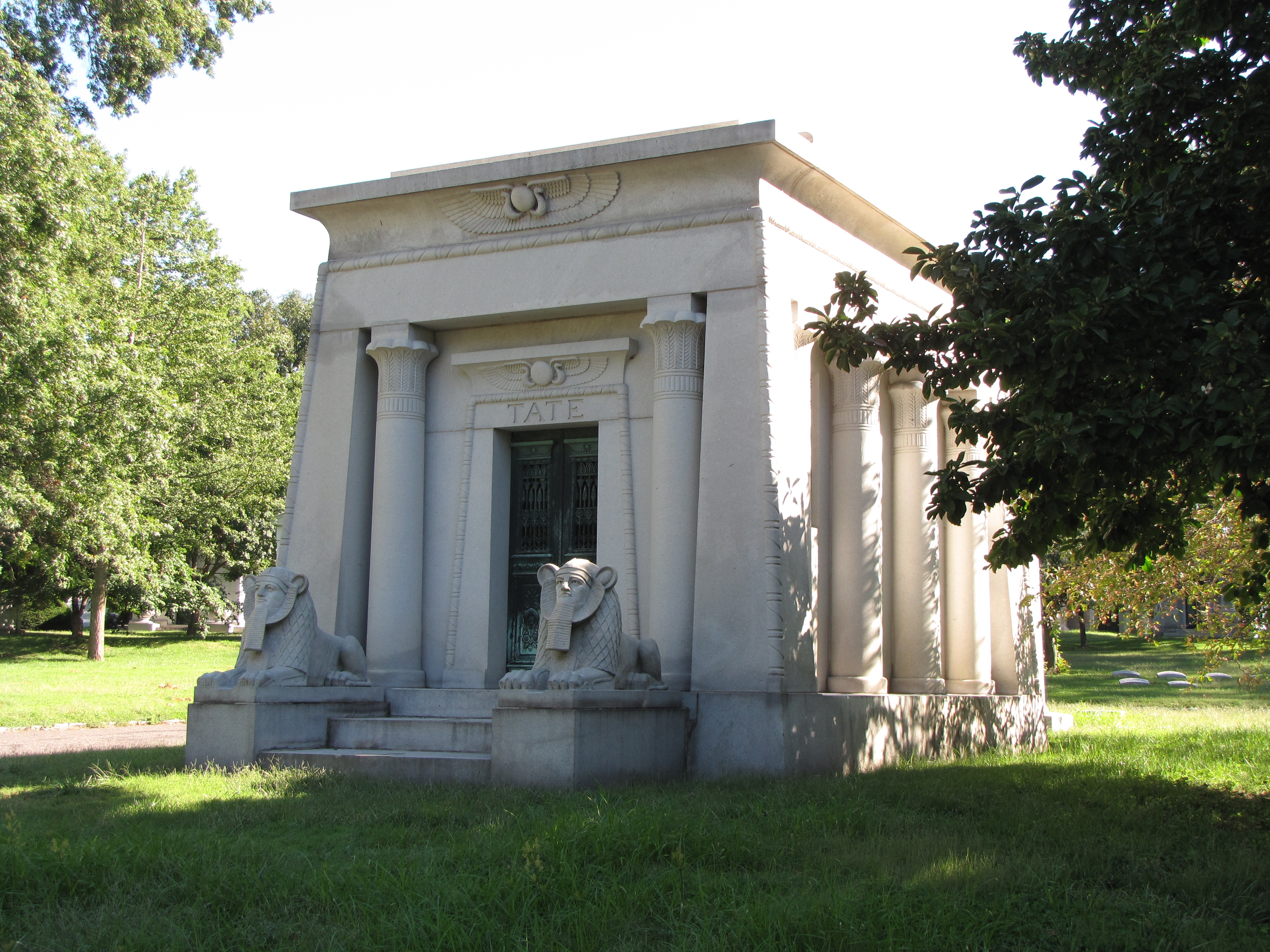
The Tate Mausoleum in the Bellefontaine Cemetery in St. Louis, Missouri, is an example of the Egyptian Revival architecture found in many large urban cemeteries.  The mausoleum has many features of Egyptian temples–the cavetto cornice that curves into a half circle at the top of the tomb and above the doorway, the torus molding at the bottom of the cornice, around the door, and the corners of the mausoleum that are designed to emulate long bundled plants, and the heavy columns with the palm leaves at the top. 

The Tate Tomb also features two winged globes with uroei.  In this example, there are three sets of falcon wings that are a symbol of the king, the sun, and the sky.  The globe represents the Egyptian god, Horus.  The uroei, snakes, are waiting to strike.  They symbolize the king’s ability to ward off evil spirits. 

Three steps lead up to a pair of bronze doors that feature lotus flowers and buds, the entryway guarded by two large sphinxes.  The massive tomb gives one the sense of solominity and a sense of eternity, just as the temples of the pharaohs.

Posted in Mausoleums, Symbolism | 1 Comment

Egyptian Revival, Part 2

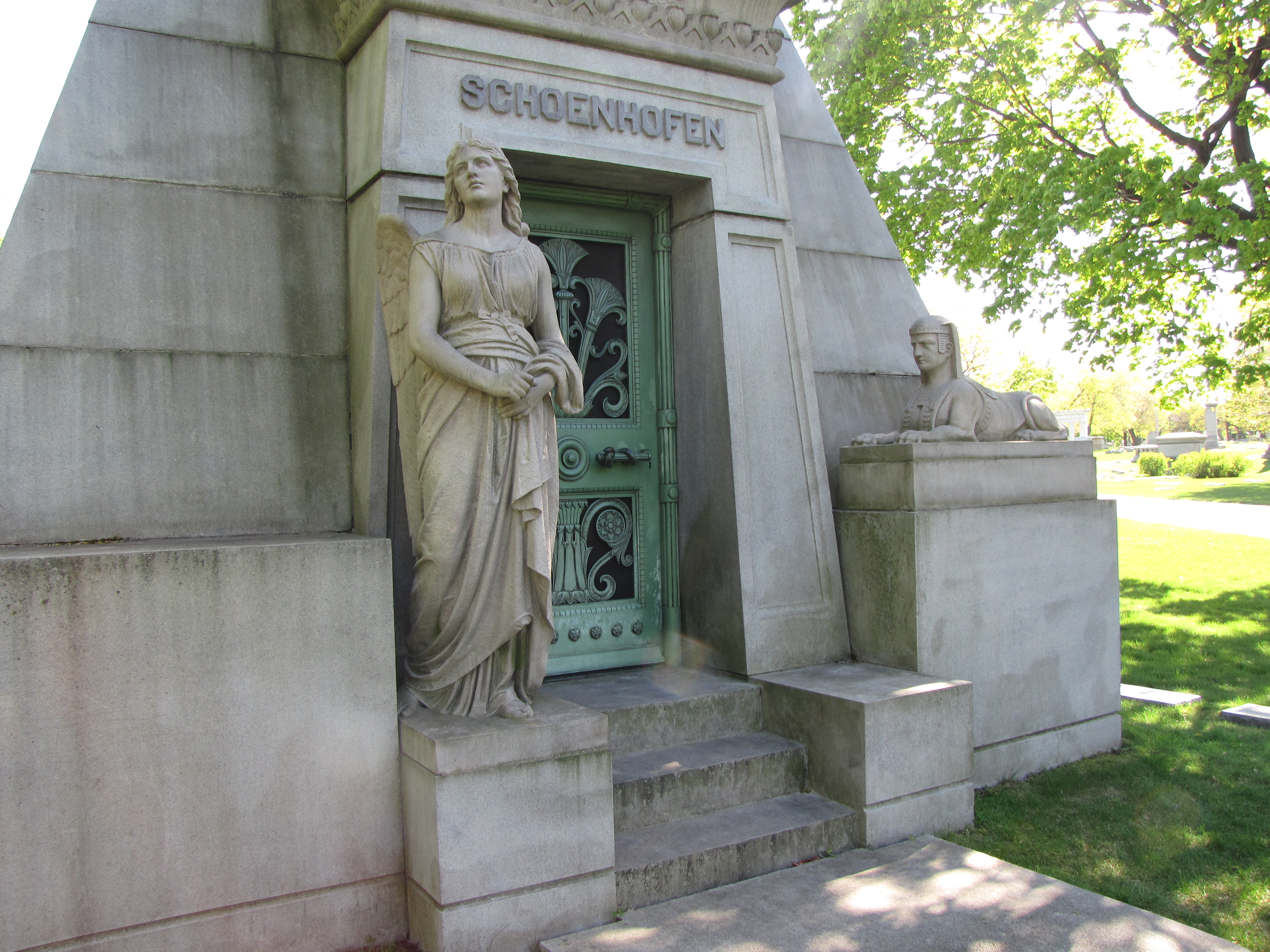
The Schoenhofen Mausoleum in the Graceland Cemetery at Chicago, Illinois, is another grand example of Egyptian Revival Funeary Architecture.  The Egyptian and Christian symbolism share an uncomfortable coexistence.  The mausoleum displays images of the ancient pharaonic religion including the sphinx, the scarab, and the uroei.  Many Christians objected to Egyptian motifs and their non-Christian origins.  To soften the impact, designers often included Christian symbolism.  In this case an angel looks up toward Heaven opposite the spinx standing guard by the doorway.

Posted in Mausoleums, Symbolism | Leave a comment

The Egyptian Revival

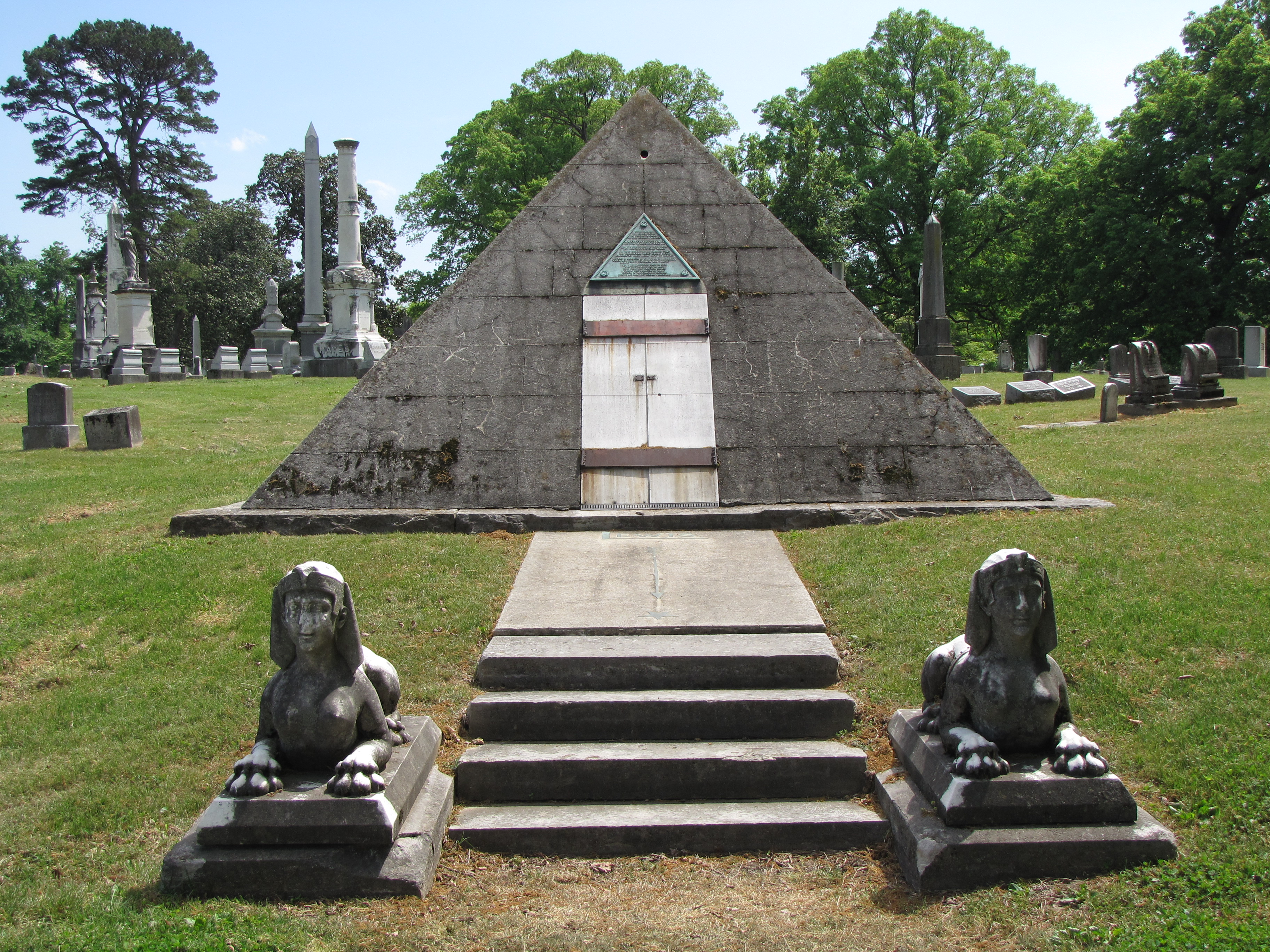
Major Eugene C. Lewis Mausoleum, Mt. Olivet Cemetery, Nashville, Tennessee

After the French and British occupations of Egypt, there was a renewed interest in Egyptian architecture and symbolism.  The Egyptian symbol that is most commonly found in American cemeteries is the obelisk.  And the most famous obelisk in America is the Washington Monument in Washington, D.C. But the pyramid is by far the epitome of Egyptian funerary architecture, the tomb of the pharaohs.  The oldest pyramid is the Pryamid of Djoser built over four thousand years ago from 2630 BC to 2612 BC.  The largest of the Egyptian pyramids is the Pyramid of Khufu at Giza built between 2589 and 2566 BC.

Here Major Eugene C. Lewis is buried in a pyramid.  A sphinx on each side of the sidewalk leading up to the pyramid stands guard.  Lewis was a Nashville, Chattanooga, and St. Louis Railway official who championed the construction of the Parthenon replica for the Tennessee Centennial Exposition of 1897 for the 100 anniversary of the statehood.

THIS TABLET

IS PLACED HERE

IN LOVING MEMORY

OF OUR FATHER

MAJOR EUGENE C. LEWIS

BORN JUNE 21, 1845 DIED FEB. 13, 1917

A MAN WHOM POSTERITY WILL KNOW

AND HONOR BY HIS GOOD WORKS

HE GAVE FREELY OF HIS TALENTS THAT

HIS FELLOWMAN MIGHT ENJOY MORE

ABUNDANTLY GOD’S GREAT GIFTS OF NATURE

HE WAS A LABORER IN HIS BUILDING OF A LIFE

WHICH LED TO THE ATTAINMENT OF THE HIGHEST

IDEALS — TRUTH — HONOR AND PURITY

NOW THE LABORER’S TASK IS O’ER

NOW THE BATTLE DAY IS PAST

NOW UPON THE FARTHEST SHORE

LANDS THE VOYAGE AT LAST

FATHER IN THY GRACIOUS KEEPING

LEAVE WE NOW THY SERVANT SLEEPIING

Posted in Mausoleums, Symbolism | 1 Comment

Draped Urn

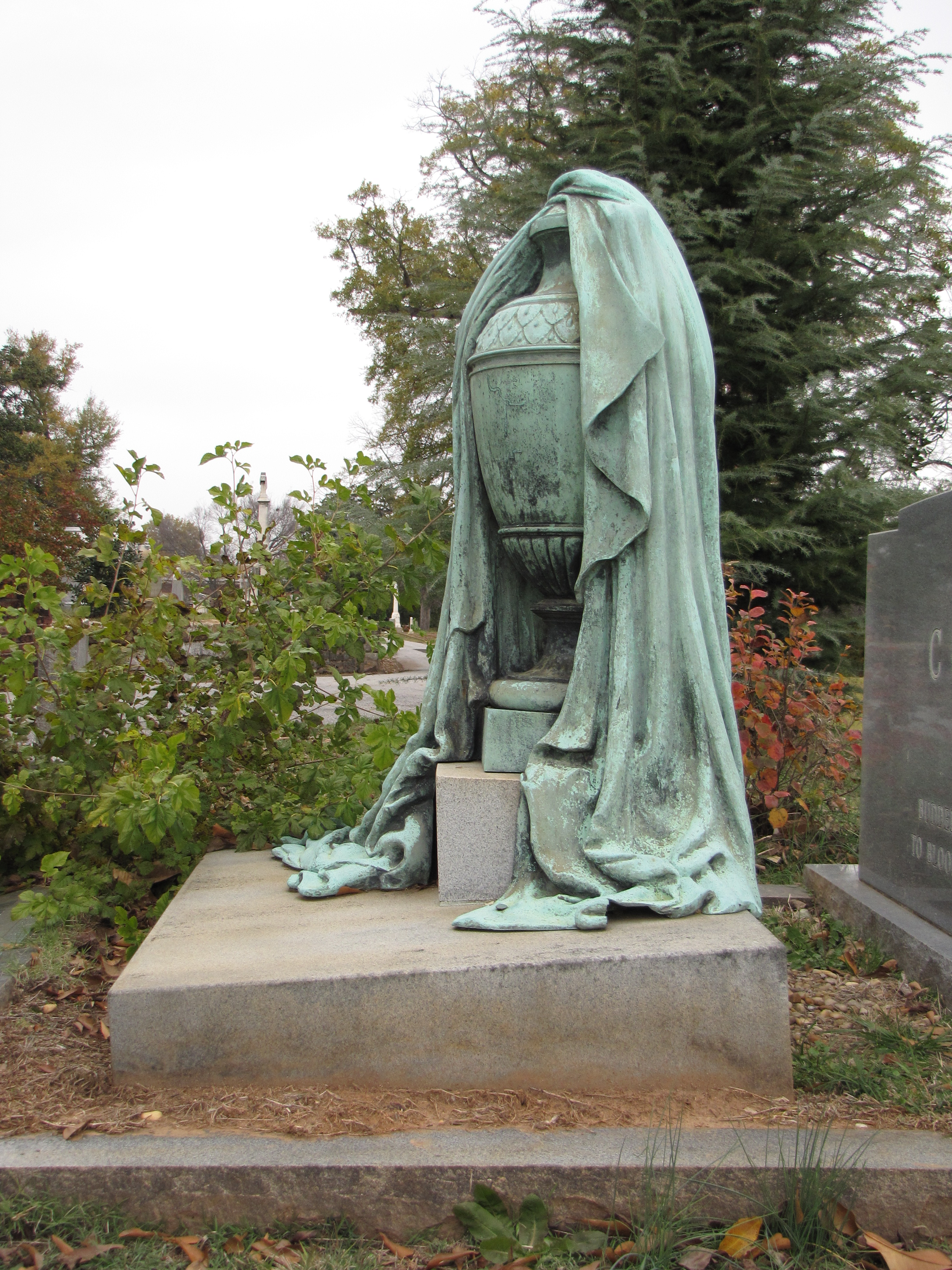
The William Remy Cole Monument, Oakland Cemetery, Atlanta, Georgia

The monument in the photograph is of a draped urn.  This particular urn is a dramatic example of this symbol, cast in bronze and freestanding.  For the most part, the urns are found on top of columns and mausoleums, ornaments. 

The urn, of course, is a container used to hold the ashes or the cremated remains of the dead.  In this case, the urn is draped.  The drapery either represents a shroud representing death and sorrow, or can also be a motif that reperesents a veil that separates the earth and Heaven.  The urn was an almost ubiquitous 19th Century symbol found in nearly every American cemetery. 

The irony is that very few people were cremated during the 19th Century when the draped urn motif was at the heighth of its popularity.  For instance, during the eight years from 1876 until 1884, only 41 Americans were cremated.  Though the number of cremations in the United States slowly increased, by the 1950s only less 4% of our dead were cremated.  Cremation, though, has been increasing each decade: 1960–3.56%; 1970–4.59%; 1980–9.72%; 1990–17.13%; 2000–26.24%; 2010–35.93%.  Some are predicting that by 2025, almost half of our dead will be cremated.  Maybe the urn will re-emerge as a symbol for the 21st Century.

Posted in Symbolism | 2 Comments