Palm Fronds, Poppies, and Floral Wreaths

IN MEMORIAM

MARGARET McK. MUNHALL

MARCH 8, 1925

JOHN MUNHALL

1833 – 1904

HETTY MUNHALL

1837 – 1875

“BLESSED ARE THE PURE IN HEART”

The massive rock face gray granite Munhall Family monument in the Allegheny Cemetery in Pittsburgh, Pennsylvania, features a seated angel framed by a rounded arch supported with two composite columns.  The classically draped angle holds a palm leaf and a floral wreath.

The palm frond is an ancient symbol of victory, dating back to Roman times when victors were presented with palm fronds. The palm fronds were also laid in the path of Jesus as He entered Jerusalem. So, for many Christians, the palm represents righteousness, resurrection, and martyrdom, symbolizing the spiritual victory over death associated with the Easter story.

The floral wreath. This is a common Victorian funerary symbol expressing the transitory nature of life.  In this example, the flowers in the wreath are roses and can symbolize love and beauty or the messianic hope that Christ will return.

The composite capitals on the columns feature poppies.  In cemetery symbolism the poppy represents eternal sleep.  Just as it was portrayed in the movie, The Wizard of Oz, the main characters lie down in a field of poppies where they fall into a deep sleep.  That same imagery is used here.  The angel sits in front of a portal suggesting the entryway to Heaven and eternal sleep. 

Posted in Uncategorized | Leave a comment

A Man’s Home Is His Castle

Edwin William MacAllister

December 8, 1895 – January 7, 1977

Hilda Lydia Elsie Yakle MacAllister

March 17, 1897 – June 1992

There is an old saying that a man’s home is his castle which has its origins in English law first expressed in 1644, by English judge Sir Edward Coke.  Coke was quoted as saying, “For a man’s house is his castle”.
 

That sentiment is found in Book 4, Chapter 16 of Blackstone’s Commentaries on the Laws of England, “And the law of England has so particular and tender a regard to the immunity of a man’s house, that it stiles it his castle, and will never suffer it to be violated with immunity: agreeing herein with the sentiments of ancient Rome, as expressed in the works of Tully; quid enim sanctius, quid omni religione munitius, quam domus unusquisque civium?” Loosely translated: “For what is more holy, what is more fortified against all religion, than the house of every citizen?

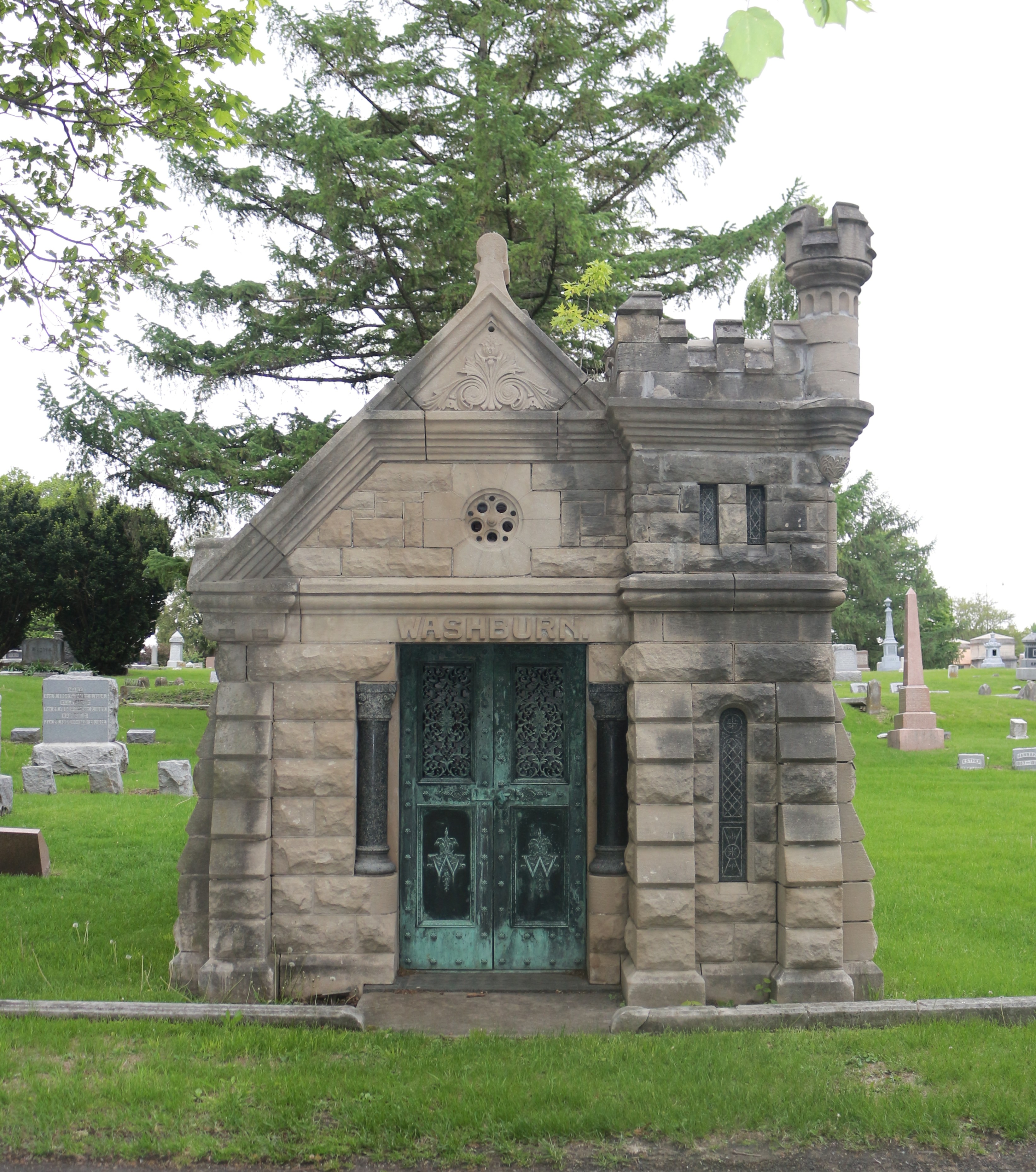
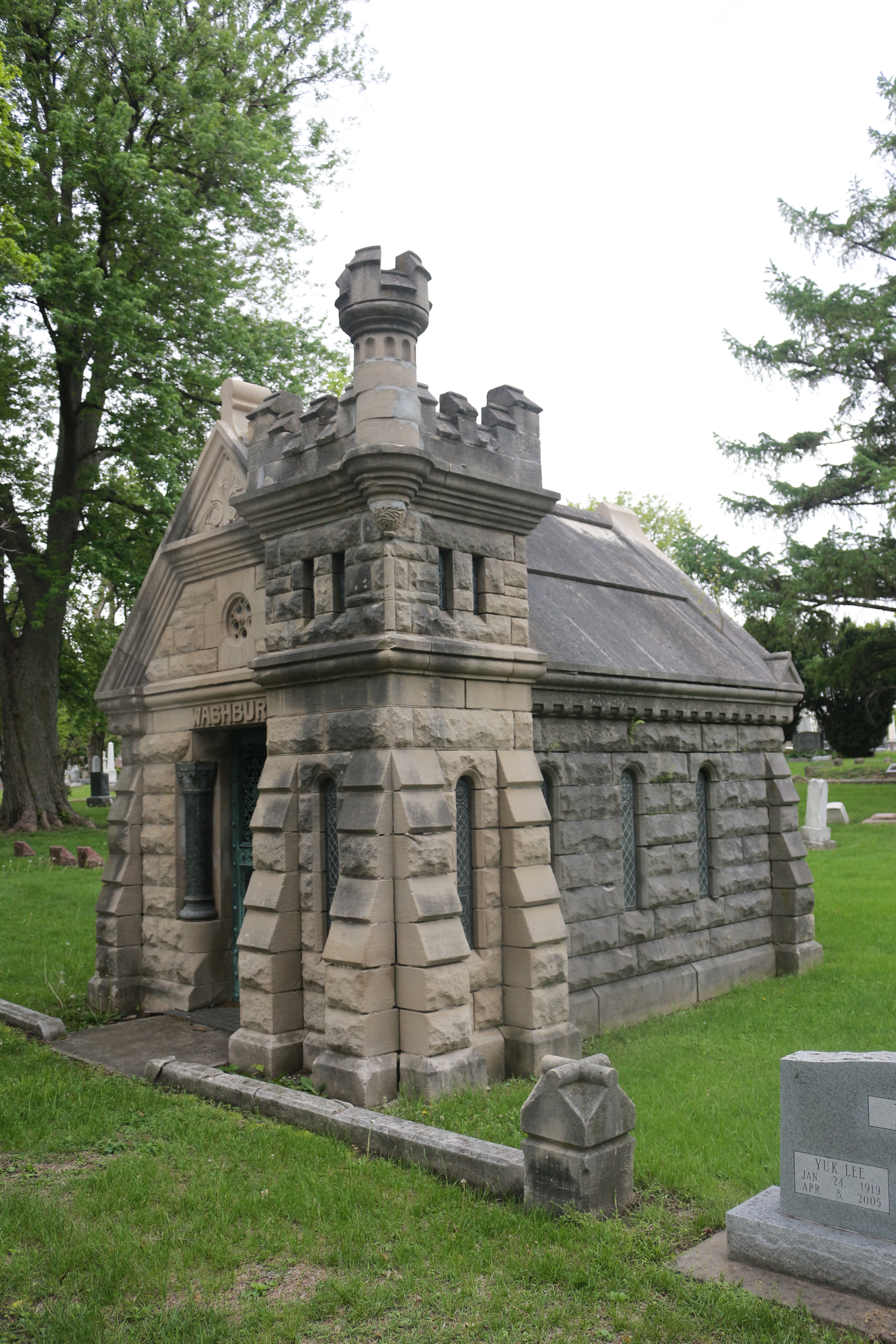
In the case of the McAllister Mausoleum in Crown Hill Cemetery in Indianapolis, Indiana, a man’s mausoleum is his castle—literally—complete with castellated tower and battlements and a drawbridge!

Posted in Uncategorized | Leave a comment

Student, Lawyer, Senator, and Historian

ALBERT J. BEVERIDGE

1862 — 1927

CATHERINE BEVERIDGE

1881 — 1970

ALBERT J. BEVERIDGE JR

1908 — 1965

In 1942, Catherine Beveridge, second wife of Albert Jeremiah Beveridge, commissioned famed sculptor John Clements Gregory (1879 – 1958) to create a funerary sculpture to represent four stages of Beveridge’s life. Gregory sculpted a towering white marble monument with four classical figures to represent Beveridge as a Student, Lawyer, Senator, and Historian.

Beveridge received his law degree from Indiana Asbury University (now DePauw University) and practiced law in Indianapolis until he was appointed in 1899 to the United States Senate where he advocated for progressive policies such as child labor legislation and the Federal Meat Inspection Act of 1906.  After he lost his Senate seat in 1910, he wrote a Pulitzer Prize winning biography of Chief Justice John Marshall. 

Each of four stages of his life is commemorated in a relief panel which sits on a hilltop in the Crown Hill Cemetery in Indianapolis.

Posted in Uncategorized | 2 Comments

Do Not Pass GO!

KERRY SHANE SHECKLES

Born September 11, 1973, Winchester, Indiana  

Died February 4, 2005, Avon, Indiana

Palmer’s Prairie Church of Christ in rural Sullivan County, Indiana, is no longer, but the church graveyard is, a testament to the congregation that once worshipped there.  Several hundred tombstones mark the graves of former congregants, but one stands out above all the others, the unusual and unique gravestone of Kerry Shane Sheckles dubbed the “Candy Kid” by his Grandparents.

Sheckles’s gravestone, which stands over five feet tall and as wide reproduces the Monopoly gameboard, a best-selling game familiar to nearly all Americans since it was first introduced by Parker Brothers in 1935.  But instead of the traditional spaces marked by street names such as Boardwalk and Park Place, the spaces are marked with events straight out of Sheckles’s life, such as his attendance at Fairbanks Elementary or Fulton Junior High or Ben Davis High School.  The railroad spots on a traditional board are replaced by modes of transportation from his life, including a Muncie Bike, a red Hyundai Excel, or the Mack Trucks which he sold. According to Find a Grave, Sheckles was an avid and champion Monopoly player, and his gravestone is a tribute to his devotion and love of the game.

What is apparent is that he was a person adored by his family.  He is survived by his wife, Jennifer, his daughters Karley and Riley, and numerous other relatives.  What also survives is his outrageous humor and sense of fun for which is Sheckles is lovingly remembered. His gravestone is going to make all that see it smile, even if they didn’t know him, but wish we could have.

Posted in Uncategorized | Leave a comment

The Unicorn

The unicorn, carved into a gravestone in the Clear Creek Cemetery in rural Indiana, represents purity, steadfastness, and the incarnation and resurrection of Jesus Christ.  In Medieval times unicorns were depicted as protectors of divine sacrifice.

Posted in Uncategorized | Leave a comment

The Buffalo

C. PENN WETTLAUFER

OCT. 9, 1935

JAN. 11, 2000

AGE QUOD AGIS

Conrad Penn Wettlaufer was a native son of Buffalo.  He hailed from a proud lineage descended from a signer of the Declaration of Independence and of William Penn, the namesake of the State of Pennsylvania.  According to his obituary, Wettlaufer was a “well-known local businessman, economic-development consultant, professor, and a member of a prominent Buffalo family.  He was also a “certified emergency medical services provider and an instructor in paramedic for many years.”

Wettlaufer’s light gray unpolished granite serpentine topped gravestone in the Forest Lawn Cemetery in Buffalo, New York, features a bas-relief sculpture of a lone standing buffalo.  The only mention I can find in connection with funerary symbolism regarding a buffalo is found in the International Journal of Religion, 5(8), 179-190, where the indigenous Toraja people of Indonesia consider the buffalo as a marker of a person’s nobility or social status determined by how many buffalo are sacrificed at a person’s funeral.  It is doubtful that there is any connection between Mr. Wettlaufer and the indigenous people of Indonesia.  More likely the sculpture reflects his deep involvement in his community and his pride in his birthplace.

His obituary also mentions that Wettlaufer was a ferocious squash player.  So much, so, in fact, his fellow competitors referred to him as “The Czar.”  His epitaph, “Age Quod Agis” which roughly translates to “do what you are doing, concentrate on the task at hand, most likely refers to not only his intense focus on his community, but his fierce play on the squash court!

Posted in Uncategorized | 1 Comment

The Lowly Fern

JOHN F. GROW

NOV. 10, 1873—Oct. 2. 1923

IDA, HIS WIFE

JUNE 19, 1880—SEPT. 11, 1962

The John and Ida Grow open book tombstone can be found in the Beech Grove Cemetery, in Bedford, Indiana. The open book is a common symbol found on gravestones. The motif can represent the Word of God in the form of the Bible or, likely in this case, symbolize the Book of Life with the names of the just registered.

This small tree-stump tombstone of 33-year-old Melia Baxter Roberts in the Knightsbridge Cemetery in rural Bloomington, Indiana, represents a tree not fully grown in width or height.  This tree-stump tombstone is a metaphor in limestone, representing a life that has been cut short. 

In both tombstones, three fern fronds are twinning up the front of their gravestones.  Numbers are significant in the Bible and the number “three” may represent the Trinity—the Father, Son, and Holy Ghost. 

The fern itself is a plant that thrives in shade underneath trees and wooded areas.  The ferns in both cases are secondary to the main gravestone symbolism—the open book and the tree-stump.  The fern, often not first noticed in nature, represents humility, solitude, and sincerity.

MELIA BAXTER ROBERTS

1895—1928

Posted in Uncategorized | 2 Comments

Gender?

We don’t often think of the classical orders—Doric, Ionic, and Corinthian—as having gender, but the ancients did.

Allegheny Cemetery, Pittsburgh

The Doric Order, associated with the Greek god of Apollo, represents masculinity which can be seen with its sturdy columns.  The height to diameter ratio of the column is an average of 7 to 1, giving the column a stout robust appearance.  The capital consists of a simple square abacus—top plate—and a rounded echinus which is a cushion shaped element directly below the top plate.  The shaft is often plain but if is fluted it traditionally has 20 grooves per column running vertically. The column sits directly on the stylobate without a base.

Crown Hill Cemetery, Indianapolis

The Ionic Order, associated with the Greek goddess Athena, represents femininity which can be seen with its more slender columns.  The height to diameter ratio of the column is 9 to 1 giving the column a delicate appearance.  The most distinctive feature of the Ionic column is that it is topped with a scroll-shaped volute on either side, connected by a horizontal band called the canalis, often decorated with an egg-and-dart motif.  The volutes were inspired by natural forms such as seashells and ram’s horns.  The fluted shaft has 24 grooves per column running vertically.  Unlike the Doric column, Ionic columns rest on a base.

Spring Grove Cemetery, Cincinnati

The Corinthian Order, associated with the Greek god Asclepius, represents the young maiden which can be seen with its even more slender columns.  The height to diameter ratio of the column is 10 to 1 giving the column an elegant appearance.  The most distinctive feature of the Corinthian column is that it is topped with a highly decorated capital featuring intricately layers of carved acanthus leaves among other floral motifs.  The fluted shaft has 24 grooves per column running vertically.  Like the Ionic column, Corinthian columns rest on a base.

Posted in Uncategorized | Leave a comment

Gravestones to Order

The Monumental Bronze Company of Bridgeport, Connecticut sent out enterprising door-to-door salesmen armed with a catalog to show customers the full range of “white bronze” markers the company produced. These grave markers came in a wide assortment of sizes and shapes and were somewhat like grave marker erector sets. The more elaborate markers had a shell of sorts and then various panels could be bolted on according to the tastes of the family ordering the grave marker. In this way, each marker could be “customized” to the tastes of the individual.  Though the company billed the markers as “white bronze” they were cast zinc.  The markers are distinguishable by their bluish-gray tint. Many of the designs mimicked designs that were commonly found carved from stone.  The company set up their first subsidiary in Detroit, Michigan. Others followed in Philadelphia, New Orleans, St. Thomas, Ontario, Des Moines, and Chicago.

Another way to order a gravestone was directly from the Sears Roebuck catalog, which was mailed directly to households across America.  Founded by Richard Sears and Alvah Roebuck in 1893, the company, the Amazon of its day, offered a wide array of household merchandise and became one of the largest retailers in the country, even offering a large selection of gravestones.  The company mailed separate catalogs featuring their wide array of gravestones to order at relatively inexpensive prices, plus shipping, of course.

Posted in Uncategorized | 1 Comment

Emerging Stones

Michelangelo once said, “The sculpture is already complete within the marble block, before I start my work. It is already there, I just have to chisel away the superfluous material.” The great artist was merely helping the sculpture emerge.

The Schulze monument in the Hermann Sons Cemetery in San Antonio, Texas is an example of an “emerging gravestone.”  That is, the gravestone is not finished being carved with part of the stone still rough cut.  The entire sculpture beneath has not been completely revealed. Here, however, the unfinished stone is not waiting for the sculpture to be completed but is actually part of the message.  Emerging stones are often believed to mirror the unfinished life of the person for whom the stone is dedicated, perhaps an indication that their life was cut short.

Posted in Uncategorized | Leave a comment