
Queen of Pin Ups
Bettie Mae Page
Apr. 22, 1923 – Dec. 11, 2008
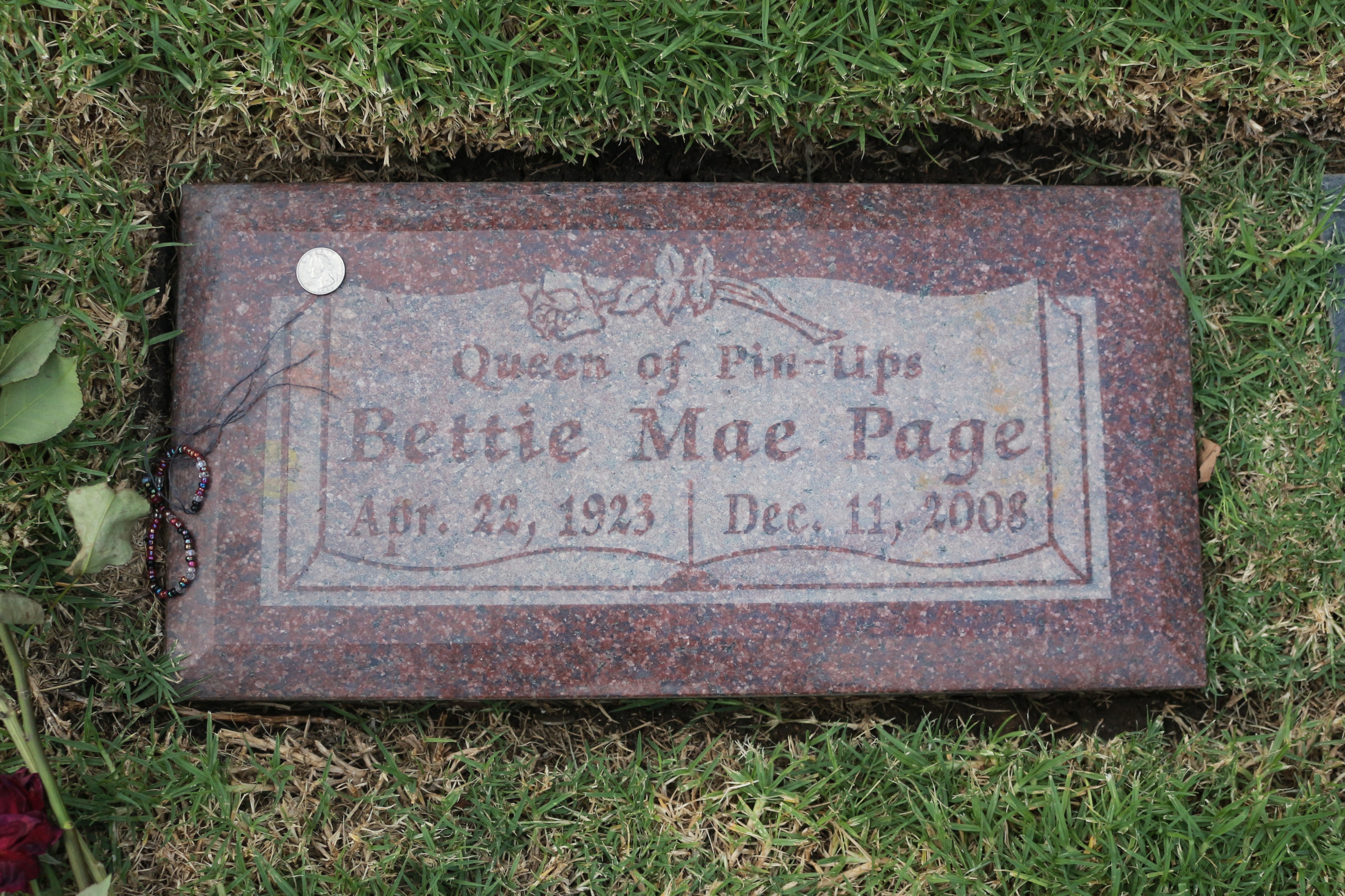
Pierce Brothers Westwood Village Memorial Park and Mortuary was originally established as Sunset Cemetery in 1905. The small, elite cemetery is tucked in between parking lots and commercial buildings and without knowing it was there you’d drive right past it. But the cemetery has scores of luminaries buried there including business giants such as Armand Hammer, literary cognoscenti such as Truman Capote, and A-list actors such as Peter Falk, Donna Reed, and many others. It also the burial grounds for one of the most famous “pin ups” of the 20th Century—Bettie Page, who later became known as “Queen of Pin Ups.”
Bettie was born in Nashville, Tennessee, in 1923. She grew up in a dysfunctional family, her father spent time in prison and abused Bettie. Her mother worked several jobs but couldn’t make ends meet and eventually put her three daughters, including Bettie, in an orphanage for a year. In spite of a turbulent home life, Bettie was a bright girl and a good student and was voted by her class as the girl most likely to succeed. Bettie graduated from Hume-Fogg Hish School as class salutatorian and with a scholarship in hand she attended and graduated from George Peabody College. In 1944, Bettie received a Bachelor of Arts degree.
In the 50s, after several unsuccessful jobs, Bettie became a model. She had an unmistakable look—jet-black hair, sparkling blue eyes, and bangs, first suggested to her so her forehead wouldn’t shine in photographs. Her distinctive look became her trademark. She soon began appearing in various men’s magazines including Wink, Wink, Eyeful, and Beauty Parade. She also started starring in black-and-white erotic bondage films though they were not sexually explicit or displayed any nudity. Bettie appeared in two burlesque films, Teaserama and Varietease. At about the same time, Bettie appeared on television in The United States Steel Hour and The Jackie Gleason Show. She also had roles in Off-Broadway productions of Time Is a Thief and Sunday Costs Five Pesos. During this time, Page, only wearing a Santa hat, was selected as Playboy’s Playmate of the Month for the January 1955 centerfold. That same year Page won the title “miss Pinup Girl of the World.”
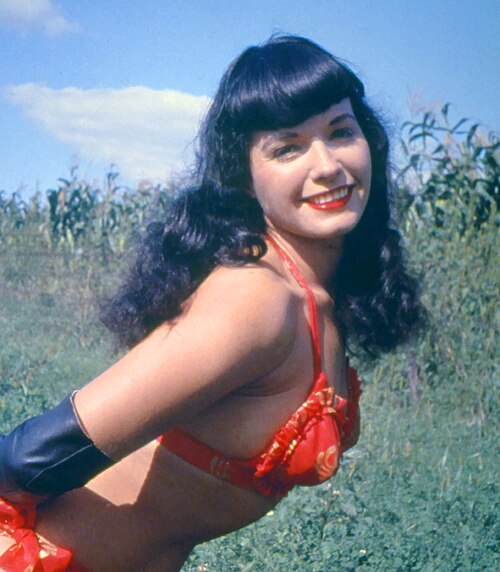
By the end of the 50s, Bettie turned away from modeling and turned to religion when she converted to evangelical Christianity. By 1959, Page was working for Billy Graham with the hope of becoming a missionary. Over the next decades, she lived and worked in obscurity with few knowing about her background. In the late 80s and early 90s, however, her early photographs became popular again and part of pop culture. Her images were popping up in artists’ paintings, photo retrospectives, and books. In addition, Bettie was receiving requests for interviews. She was back in the spotlight, recognized as a cultural icon.
On December 6th, 2008, Bettie Page, aged 85, suffered a heart attack and died December 11th and was laid to rest in Los Angeles at the Westwood Cemetery. Current musicians and actresses sport her distinctive bangs and copy some of her costumes evidence that her influence. Pin Up to Icon.


