The Curse of King Tut

IMG_5963

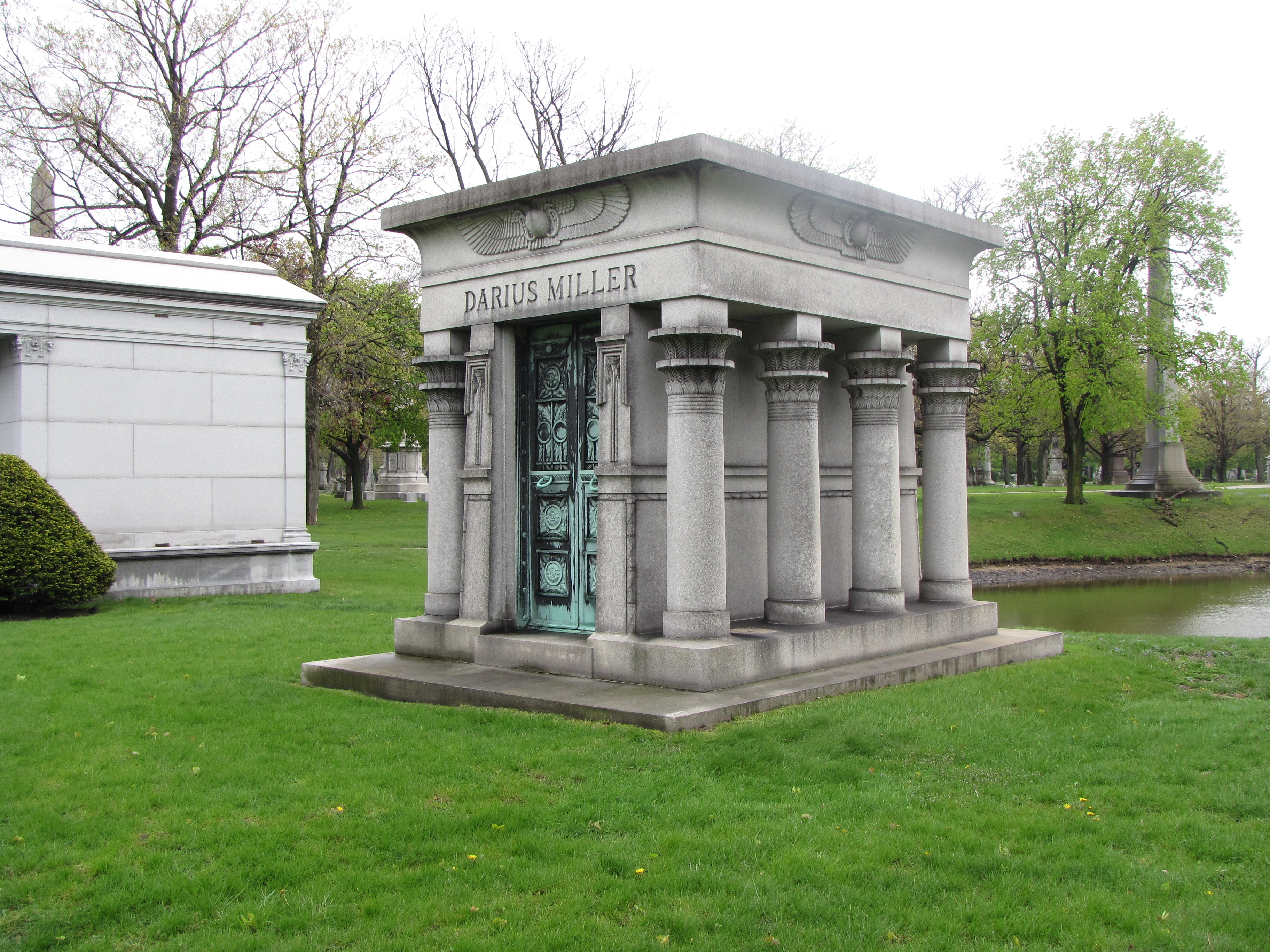
The Darius Miller Mausoleum in the Rosehill Cemetery at Chicago, Illinois, is a magnificent example of Egyptian Revival architecture found in many large urban cemeteries. Egyptian ornamentation can be divided into three categories—architectural, geometric, and natural.  The mausoleum features–the cavetto cornice that curves into a half circle at the top of the tomb and above the doorway which is an example of architectural ornamentation; the torus molding that trails around the middle of the tomb, and the corners of the mausoleum that are designed to emulate long bundled papyrus; and the eight heavy columns with the highly stylized papyrus leaves at the top of each bell column are all examples of natural ornamentation.

The Darius Miller Tomb also features two winged globes with uroei above the doorway and on the side of the tomb in the cornice. In this example, there are three sets of falcon wings that are a symbol of the king, the sun, and the sky. The globe represents the Egyptian god, Horus. The uroei, snakes, are waiting to strike. They symbolize the king’s ability to ward off evil spirits. The tomb gives one the sense of solemnity and a sense of eternity, just as the temples of the pharaohs.

The story told on several Websites was that Darius Miller was fascinated with Egyptian art and architecture and that he supposedly had his tomb modeled after the Egyptian Temple of Anubis, the god of the underworld.  Also, because of Miller’s Egyptian obsession, Darius Miller was at the historic opening of the King Tut Tomb in Egypt.

Much has been made of the “curse of King Tut.”  Those who opened the tomb of King Tut and disturbed the contents would be susceptible to the curse, “Death comes on wings to he who enters the tomb of a pharaoh.”  Lord Carnavon, who funded the expedition to find and excavate King Tut’s tomb was, according to the legend of the curse, the first to die.  And many of the believers in the supernatural claim to this day that an eerie blue light emanates from the Darius Miller Tomb every May 1st and that he, too, was felled by the curse.

The problem with the assertion that Darius Miller died as a result of the curse is absolutely false.  First of all, Darius Miller died August 23, 1914, at Glacier Park, Montana, and King Tut’s burial chamber was not opened until February 17, 1923, a difference of roughly nine years.  Furthermore, Lord Carnavon did not die from the curse either—a mosquito got him!

The myth and mystery surrounding Darius Miller and his tomb, though debunked quite some time ago, was seemingly more interesting than the real story of a young Midwestern man born April 3, 1859, at Princeton, Illinois, who started out in the railroad business at the bottom and worked his way to the top.  By all accounts, Darius Miller did it by being a hard worker and by being nice to all those he came in contact with.  Darius began working in the railroad industry in late 1877.  He held many positions at many different railway companies–stenographer in general freight office at the Michigan Central Railroad; clerk in the general freight office St. Louis Iron Mountain and Southern Railway; chief clerk to general manager and general freight and ticket agent at the Memphis and Little Rock Railroad; general freight and passenger agent and then traffic manager at the St. Louis Arkansas and Texas Railway; traffic manager on the Queen and Crescent Route; traffic manager and then vice-president at the Missouri Kansas and Texas Railway. From November 15, 1898, to Dec. 31, 1901, Darius served as second vice-president at the Great Northern Railway.   On January 1, 1902, he was appointed first vice-president at the Chicago Burlington and Quincy Railway.

By the time of his death, Darius Miller had risen through the ranks to become the President of the Burlington Railroad.  The August 26, 1914, issue of the Lincoln Daily News, flashed the headline, “Tribute Paid to Memory of R. R. Official: Railroad men and other citizens of Lincoln who knew Darius Miller, president of the Burlington road, express keen regret over his death.  Two weeks ago President Miller and several other high officials of the road stopped for a short time in Lincoln on their way west in a private car.  At that time President Miller appeared to be in the best of health.

“Secretary W. S. Whitten of the Lincoln Commercial club knew him well.  When Whitten was chief clerk to the traffic manager of the Eastern Minnesota railway, a part of the Great Northern system, Miller was in the same building at St. Paul where Mr. Whitten was employed.

“Darius Miller was a grand, good man.” Said the secretary.  “He was modest and unassuming. It was no trouble to see him.  The door of his office was always open and it required no red tape to reach him.

“He was a great friend of young men.  I may say that he was like a father to the young railroad men under his jurisdiction.  H was ready any time with a word of encouragement and was never to busy to be helpful.  He was a remarkable judge of men and picked out his subordinates with rare skill and judgment.  He placed them on their mettle and when they made good they were rewarded with commendation and with advancement in the service.  He was a big, brainy and genial and was the ideal railroad official.  He belonged to the modern type of railroad executives who made friends for the railroad.  Matters of traffic taken up with him were easily adjusted when they has merit to them.  During the time I have been secretary of the Commercial club it has been necessary to seek the adjustment of vexing traffic problems affecting the commercial welfare of Lincoln with the Burlington and Mr. Miller has always been fair in his treatment.  It was a pleasure to do to him with such matters because of his broad understanding of traffic conditions.  The last time I saw President Miller was during the latter part of June when he came to the Commercial club in company with Vice President Byram.  At that time he looked at the corner room on the first floor with a view to renting it for the district freight department.  It was but a short time after this that the contract was closed with the railroad for the room.  When I happened in Chicago and dropped in to see him he was very friendly and courteous and was never too busy to see me.  I think no railroad official in a high place will be missed more keenly than Mr. Miller.”

B. N. Loverin, a passenger conductor on the Burlington running between Lincoln and Omaha was a schoolmate and boyhood friend of Darius Miller.  Both lived in Princeton, Illinois.  Loverin graduated from the high school of Princeton just a year before Miller.  After his graduation the latter went railroading.  President Miller always has a warm spot for his boy friend.  And when Mr. and Mrs. Loverin were in Chicago three years ago they called at the C. R. & Q. headquarters to see President Miller.  He had felt sure that Mr. Miller would get well.  Mr. Bignell said that Mr. Miller had endorsed himself to all classes of railroads employees by his kindness and consideration for them and his winning personality.

The Oakland Tribune August 24 1914, ran the headline, “RAILROAD PRESIDENT IS CALLED BY DEATH.”  Their article went on, “Glacier Park, Mont. Aug. 24—Darius Miller, president of the Burlington Railway, died here yesterday following an operation for appendicitis.  Miller was touring the park when taken ill and returned to the hotel for treatment.  Special trains brought physicians and nurses and the operation was performed Saturday afternoon.  Hope was held out for Miller’s recovery until late this morning when he quietly passed away.  Mrs. Miller, Louie M. Hill, Miller’s lifelong friend, and Hale Holden vice president of the Burlington route were at the bedside when the end came.”

Posted in Mausoleums, Symbolism | 6 Comments

Classical Mourning Figure

IMG_2823

In the center of the Greenbush Cemetery at Lafayette, Indiana, is a monument erected to commemorate the dedication and founding of the cemetery association on February 12, 1848.  The pedestal is topped with a classical bronze mourning figure. The figure holds an urn in her hand.  The long narrow neck on the urn indicates that it may have been for collecting her tears; it could also be a cinerary urn. The cinerary urn is a container used to hold the ashes or the cremated remains of the dead. The urn was an almost ubiquitous 19th Century symbol found in nearly every American cemetery.

With her other hand the mourning figure is lifting part of her garment over her head to form a veil.  The veil represents the partition that exists between the Earthly realm and the Heavenly one–between life and death.


Posted in Saving Graces | Leave a comment

The Square and the Compasses

IMG_8515

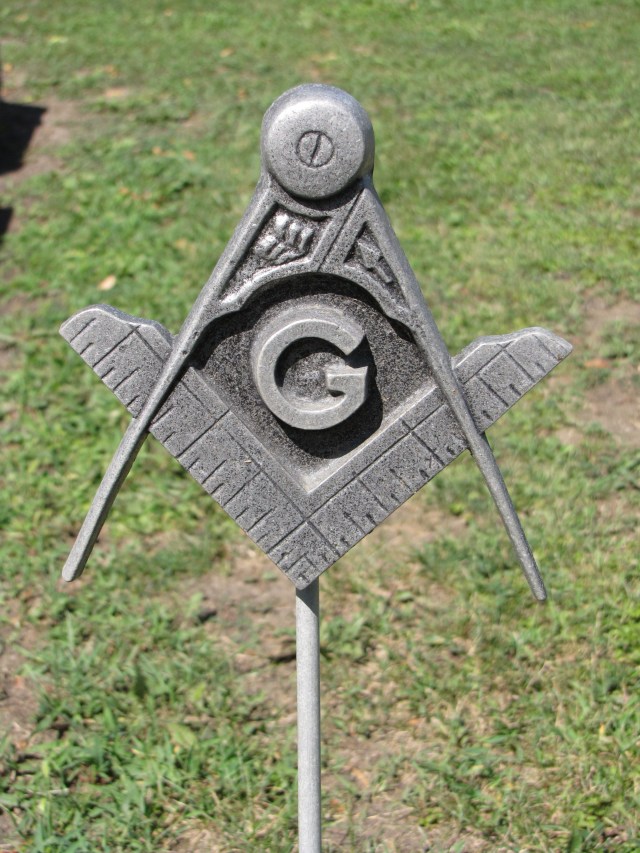
The metal marker from the Forest Home Cemetery at Forest Park, Illinois, marks the grave of a Mason.  It is the metal reproduction of what is perhaps the most recognizable emblem of the Freemasons, the square and two compasses.  In this example the letter “G” appears in the middle of the emblem.  Often the emblem is seen without the letter “G”.

Each component of the symbol represents a different Masonic orthodoxy, though, these are not hard and fast:

The compasses represent the boundaries of wisdom a person should have the strength to circumscribe and stay within.

The square symbolizes virtue in all actions, just as the expression “square deal” means treating people with fairness.

The letter “G” seems to have more than one meaning.  It could possibly mean God, as in the creator of the universe; or Gimel, which is the word for the third letter of many Semitic languages.  The number three is significant to many Masonic rituals and beliefs.  Some also believe the “G” may represent geometry.

Posted in Metal Markers, Symbolism | 1 Comment

Victorian Angel

Mt. Calvary Cemetery, Columbus, Ohio

Mt. Calvary Cemetery, Columbus, Ohio

The young female figure, head looking down in reflection and sorrow, while holding a flower in one hand and clutching her breast with the other is a common Victorian funerary symbol. This marker at the Mt. Calvary Cemetery at Columbus, Ohio, is a traditional mourning symbol expressed as an angel.  Unfortunately, the flower is weathered beyond knowing what it is, though, it is likely a rose. This mourning figure is expressing the transitory nature of life. The statue is a floral metaphor for a young flower that did not have time to fully bloom on Earth, a poignant visual message.

OUR FATHER

THOMAS FOLEY

BORN IN

COUNTY, KERRY IRELAND

DIED APR. 20, 1900,

AGE 68 YRS.

ELLEN HIS WIFE

DIED AUG. 10, 1861,

AGE 38 YRS.

MARY HIS WIFE

DIED MAY 30, 1903,

AGE 68 YRS

Posted in Saving Graces | Leave a comment

Winged Cherub’s Head

St. Joseph Cemetery, Lafayette, Indiana

St. Joseph Cemetery, Lafayette, Indiana

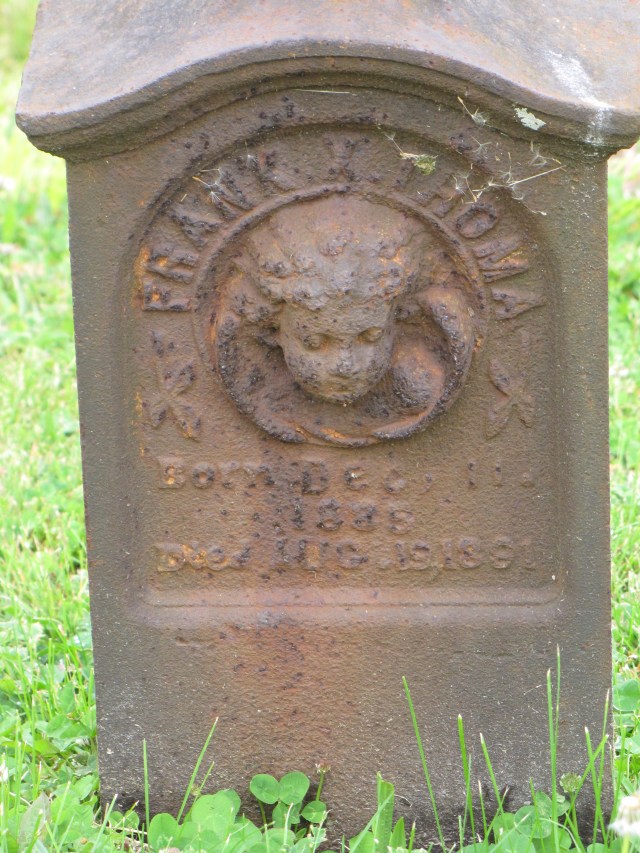
Several small cast-iron markers can be found in the St. Joseph Cemetery at Lafayette, Indiana.  These tiny headstones mark the graves of young children and are characterized by a cross and a winged cherub.  The cross, of course, is a universal symbol of Christianity.  The image of a cherub’s face with curled wings circling downward forming a circle is a winged cherub, a symbol that became popular in the 18th Century.  The winged cherubs replaced the stark and morbid flying death’s heads from our Puritan forefathers.  The cherubs have a childlike countenance of innocence.  The iconography represents the flight of the soul from the body upward to Heaven and the hope of the resurrection.

Frank X. Thoma

Born Dec. 11,

1889

Died Aug. 19, 1891

IMG_2958


Posted in Symbolism | 4 Comments

Tree-stump open book

Forest Home Cemetery, Forest Park, Illinois

Forest Home Cemetery, Forest Park, Illinois

Tree stump tombstones, generally carved from limestone, were a part of the rustic movement of the mid-nineteenth century which was characterized by designs that were made to look like they were from the country. The gravestones are purposefully designed to look like trees that had been cut and left in the cemetery which was part of the movement to build cemeteries to look like parks. In funerary art, the tree-stump tombstones were varied—the stonecutters displayed a wide variety of carvings.

The tree-stump gravestones themselves were imbued with symbolism. The short tree stump often marks the grave of a person who died young—a life that had been “cut” short.  There is an ivy trailing up the front of the stump.  The ivy represents friendship and, like many symbols found in the cemetery, immortality.

This example is topped with an open book. The open book is a fairly common symbol found on gravestones. The motif can represent the Book of Life with the names of the just registered on its pages. This book, like any book in a cemetery, can also symbolize the Word of God in the form of the Bible.

Posted in Symbolism, Treestump gravestones | Leave a comment

Commerce and Victory

Grunow Mausoleum in the Forest Home Cemetery at Chicago, Illinois

Grunow Mausoleum in the Forest Home Cemetery at Forest Park, Illinois

The second largest mausoleum in the Forest Home Cemetery at Forest Park, Illinois, was built for  life-long Chicago resident, William Grunow, (born April 30, 1893; died July 6, 1951) a partner in the Majestic Radio Company.

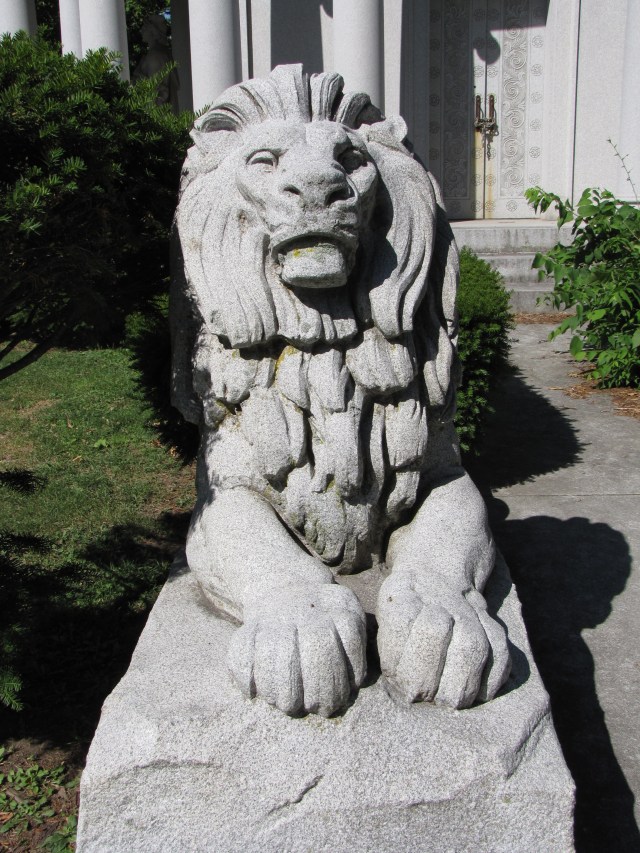
The pathway to the mausoleum is flanked by lions.  The lion has long been a symbol of bravery, strength, and majesty. In popular culture, the lion is known for its power and is called King of the Jungle and King of the Beasts.  The lion is often used as a royal emblem, found eight times in the Royal Arms for the Queen of England alone!

IMG_8393

The lion in funerary art symbolizes the power of God. It is often depicted flanking the entrance of a tomb, as it is here, to guard against evil spirits to the passageway to the next realm. It also represents the courage of the souls the lions guard. There is also a connection of the lion to the Resurrection. It was once believed that lion cubs were born dead but would come to life after three days when the cubs were breathed upon by a male lion. The three days is significant because it is the number of days Jesus was in the tomb before he was Resurrected.

The mausoleum design is of the Ionic order, one of the three organizational systems of Greek architectural design. The Ionic order is characterized by the use of a capital (the top of the column) that uses volutes, a spiral scroll-like ornamentation. In this example, the capital is enriched with an egg and dart design. The Ionic column is slender and is often fluted.  The entablature (architectural composition resting on the columns) is composed of an architrave (lentil or beam) which is plain and divided into two or three bands and rests directly on the column; a frieze (the widest band between the capital and the cornice); and the cornice. The acroterion, an acanthus stone work, is placed at the apex of the pediment and at the corners of the tomb which completes solemn tomb.

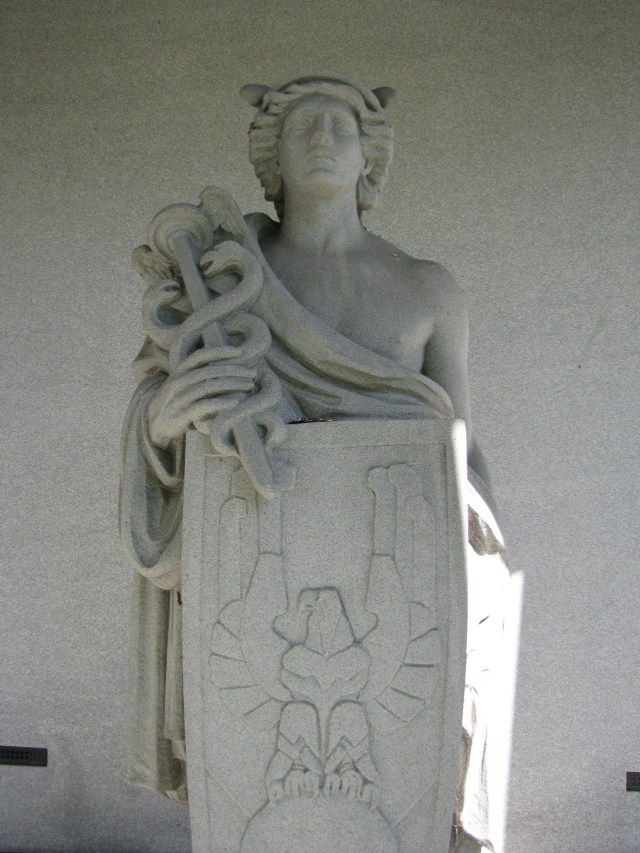
Two striking features of the tomb are the statues on either portico.  One statue is of the Greek god, Mercury, which among his many roles, was the god of commerce.  Here he holds the caduceus, his symbol which has become synonymous with the medical profession.   The base of the statue is inscribed with the words, “The Spirit of Commerce.”

IMG_8387

Underneath the opposite portico, is the statue of the Greek goddess of victory, Nike, carrying the palm leaf.   The base of her statue reads, “The Spirit of Radio”.

IMG_8392

Both statues honor what made Grunow his fortune.

Posted in Mausoleums, Symbolism | Leave a comment

Marshall Field

IMG_6359

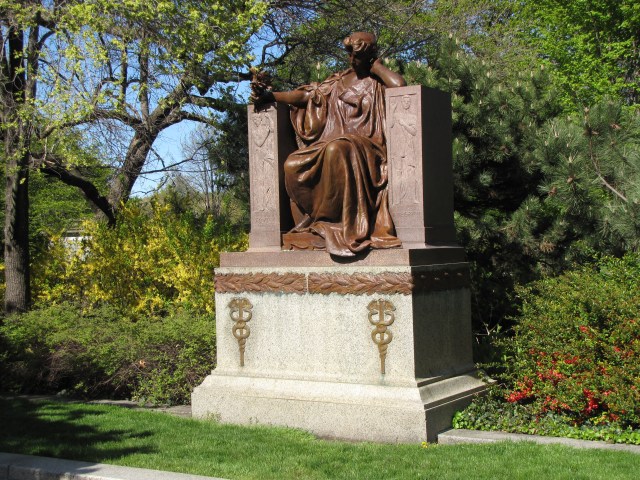
In a rags-to-riches story suitable for Horatio Alger, Marshall Field, who started as a clerk in a dry goods store, ended up buying the store in which he worked in 1865.  By the time Field died in 1906, he was the wealthiest man in Chicago.

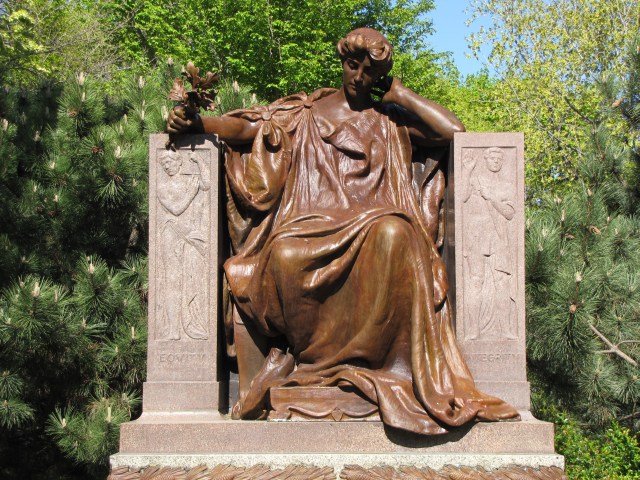
The Field Family Monument in the Graceland Cemetery at Chicago, Illinois, is suitable for a man of Field’s station.  The dramatic 7 foot tall seated bronze figure, Memory, has her bowed, in her right hand she is holding a sprig of oak leaves—a symbol of strength and courage.  The fronts of the arms on the large granite chair have carved upon them the statues of Integrity and Equity.  The base of the monument has a bronze band adorned with pine and pine cones signifying immortality or everlasting life. Also displayed on the base are a pair of caduceus, traditionally recognized as the symbol of medicine.  However, the staff of Mercury is also an ancient symbol of commerce, a nod to the Field’s success as a merchant.

The monument was designed by Henry Bacon, a prominent New York architect, and famed sculptor Daniel Chester French.  It is not difficult to look at the seated figure as a precursor to the most famous sculpture of French’s career—another seated figure—Abraham Lincoln showcased in the Lincoln Memorial.

The Lincoln Memorial, like the Marshall Field Family Monument, was also a partnership between Bacon and French, with architect Henry Bacon designing the Memorial and French carving the iconic statue of Lincoln.

IMG_6358

Posted in Famous graves, Symbolism | 1 Comment

Crossing the narrow stream

IMG_3925

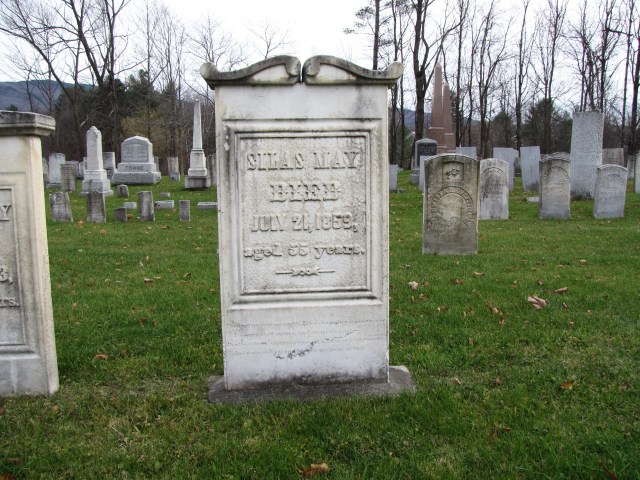
The epitaph on the Silas May gravestone in the Waterbury Cemetery in Waterbury, Vermont, uses the age-old metaphor of crossing the river.  Since ancient times, the imagery of the soul crossing a river was created to explain how the soul went from one realm to the other.  This vivid imagery has long been a part of the symbolism of death in iconography and word.

In Greek mythology, the River Styx wrapped its way around Hades (the Underworld) nine times.  To cross from this life to the next, the dead had to pay with a coin to be ferried from the realm of the living to the realm of the dead.  The toll was placed in the mouth of the deceased to pay Charon, the ferryman.  It was said that if the dead person did not have the coin, he was destined to wander the shores of the River Styx for a century.

SILAS MAY

DIED

JULY 21, 1859

Aged 55 years

Thou art no more on earth – Life’s changing scenes are o’re

Its cares, its sorrows, and its trials past

Deaths narrow stream is crossed, and thou hast gained the shore

And peace, and joy, and heaven are thine at last.

Posted in Epitaphs | Leave a comment

Victorian Mourning Figure

Mount Olivet Cemetery, Nashville, Tennessee

Mount Olivet Cemetery, Nashville, Tennessee

Many Victorian cemetery monuments are imbued with a multitude of symbolism.  In David Robinson’s book, Saving Graces, mourning figures from some of the most beautiful and famous cemeteries in Europe show sculpted beautiful, young, and voluptuous women often wearing revealing clothing mourning the dead.

Robinson identified four categories of ”Saving Graces”–first, women completely overcome by grief, often portrayed as having collapsed and fallen limp on the grave. Second are the women who are portrayed reaching up to Heaven as if to try to call their recently lost loved one back to Earth.  Third, are the women who are immobile and grief stricken, often holding their head in their hands distraught with loss.  Lastly, he describes the last category of “Saving Graces” as the mourning figure who is “resigned with the loss and accepting of death.”

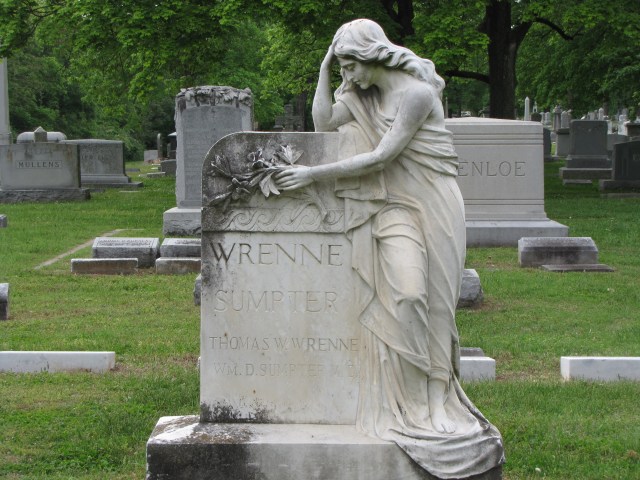
In this example from the Mount Olivet Cemetery at Nashville, Tennessee, the monument of prominent philanthropist and investor Thomas Wrenne and his son-in-law Dr. William Sumpter, displays a young female figure, with her forehead leaning against one hand, looking down in reflection and sorrow, while she is placing an  Easter lily on the monument. This mourning figure seems to be a combination of the last two categories that Robinson mentions, head in her hands stricken with grief but resigned.  The act of placing the flower is also a recurring funerary motif which is designed to remind the viewer that life is short. The Victorian funerary symbolism associated with flowers used the Easter lily to represent the resurrection.

Posted in Saving Graces, Symbolism | Leave a comment