Classical Mourning Figure

IMG_2823

In the center of the Greenbush Cemetery at Lafayette, Indiana, is a monument erected to commemorate the dedication and founding of the cemetery association on February 12, 1848.  The pedestal is topped with a classical bronze mourning figure. The figure holds an urn in her hand.  The long narrow neck on the urn indicates that it may have been for collecting her tears; it could also be a cinerary urn. The cinerary urn is a container used to hold the ashes or the cremated remains of the dead. The urn was an almost ubiquitous 19th Century symbol found in nearly every American cemetery.

With her other hand the mourning figure is lifting part of her garment over her head to form a veil.  The veil represents the partition that exists between the Earthly realm and the Heavenly one–between life and death.


Posted in Saving Graces | Leave a comment

The Square and the Compasses

IMG_8515

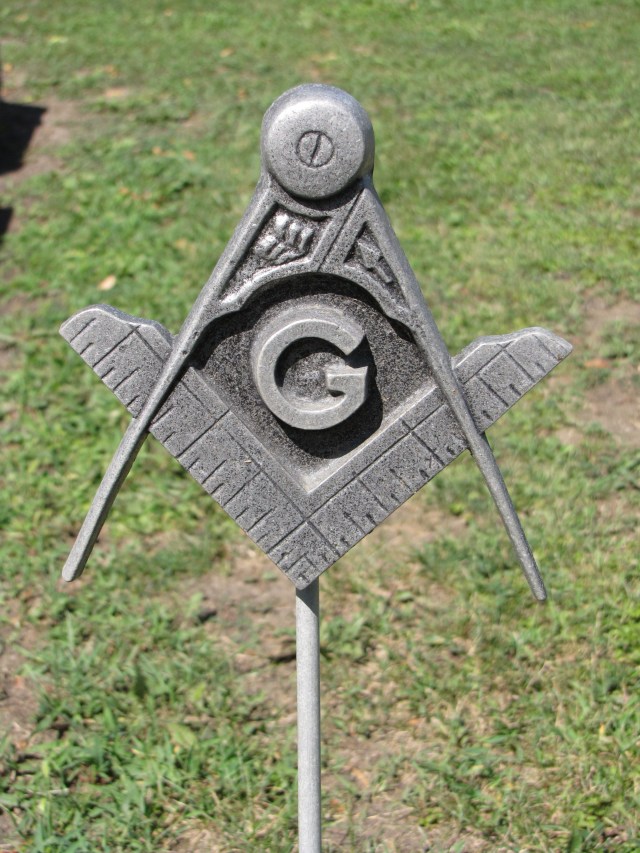
The metal marker from the Forest Home Cemetery at Forest Park, Illinois, marks the grave of a Mason.  It is the metal reproduction of what is perhaps the most recognizable emblem of the Freemasons, the square and two compasses.  In this example the letter “G” appears in the middle of the emblem.  Often the emblem is seen without the letter “G”.

Each component of the symbol represents a different Masonic orthodoxy, though, these are not hard and fast:

The compasses represent the boundaries of wisdom a person should have the strength to circumscribe and stay within.

The square symbolizes virtue in all actions, just as the expression “square deal” means treating people with fairness.

The letter “G” seems to have more than one meaning.  It could possibly mean God, as in the creator of the universe; or Gimel, which is the word for the third letter of many Semitic languages.  The number three is significant to many Masonic rituals and beliefs.  Some also believe the “G” may represent geometry.

Posted in Metal Markers, Symbolism | 1 Comment

Victorian Angel

Mt. Calvary Cemetery, Columbus, Ohio

Mt. Calvary Cemetery, Columbus, Ohio

The young female figure, head looking down in reflection and sorrow, while holding a flower in one hand and clutching her breast with the other is a common Victorian funerary symbol. This marker at the Mt. Calvary Cemetery at Columbus, Ohio, is a traditional mourning symbol expressed as an angel.  Unfortunately, the flower is weathered beyond knowing what it is, though, it is likely a rose. This mourning figure is expressing the transitory nature of life. The statue is a floral metaphor for a young flower that did not have time to fully bloom on Earth, a poignant visual message.

OUR FATHER

THOMAS FOLEY

BORN IN

COUNTY, KERRY IRELAND

DIED APR. 20, 1900,

AGE 68 YRS.

ELLEN HIS WIFE

DIED AUG. 10, 1861,

AGE 38 YRS.

MARY HIS WIFE

DIED MAY 30, 1903,

AGE 68 YRS

Posted in Saving Graces | Leave a comment

Winged Cherub’s Head

St. Joseph Cemetery, Lafayette, Indiana

St. Joseph Cemetery, Lafayette, Indiana

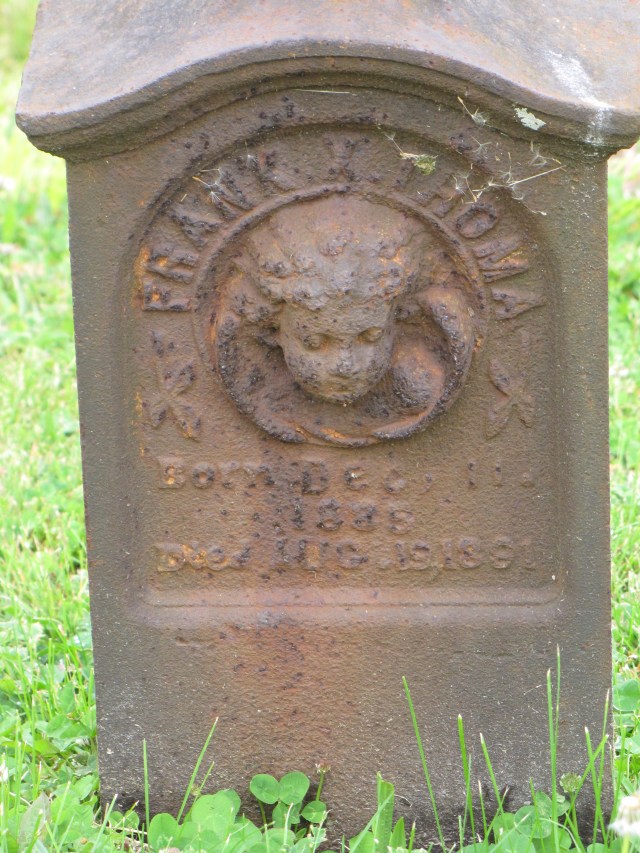
Several small cast-iron markers can be found in the St. Joseph Cemetery at Lafayette, Indiana.  These tiny headstones mark the graves of young children and are characterized by a cross and a winged cherub.  The cross, of course, is a universal symbol of Christianity.  The image of a cherub’s face with curled wings circling downward forming a circle is a winged cherub, a symbol that became popular in the 18th Century.  The winged cherubs replaced the stark and morbid flying death’s heads from our Puritan forefathers.  The cherubs have a childlike countenance of innocence.  The iconography represents the flight of the soul from the body upward to Heaven and the hope of the resurrection.

Frank X. Thoma

Born Dec. 11,

1889

Died Aug. 19, 1891

IMG_2958


Posted in Symbolism | 4 Comments

Tree-stump open book

Forest Home Cemetery, Forest Park, Illinois

Forest Home Cemetery, Forest Park, Illinois

Tree stump tombstones, generally carved from limestone, were a part of the rustic movement of the mid-nineteenth century which was characterized by designs that were made to look like they were from the country. The gravestones are purposefully designed to look like trees that had been cut and left in the cemetery which was part of the movement to build cemeteries to look like parks. In funerary art, the tree-stump tombstones were varied—the stonecutters displayed a wide variety of carvings.

The tree-stump gravestones themselves were imbued with symbolism. The short tree stump often marks the grave of a person who died young—a life that had been “cut” short.  There is an ivy trailing up the front of the stump.  The ivy represents friendship and, like many symbols found in the cemetery, immortality.

This example is topped with an open book. The open book is a fairly common symbol found on gravestones. The motif can represent the Book of Life with the names of the just registered on its pages. This book, like any book in a cemetery, can also symbolize the Word of God in the form of the Bible.

Posted in Symbolism, Treestump gravestones | Leave a comment

Commerce and Victory

Grunow Mausoleum in the Forest Home Cemetery at Chicago, Illinois

Grunow Mausoleum in the Forest Home Cemetery at Forest Park, Illinois

The second largest mausoleum in the Forest Home Cemetery at Forest Park, Illinois, was built for  life-long Chicago resident, William Grunow, (born April 30, 1893; died July 6, 1951) a partner in the Majestic Radio Company.

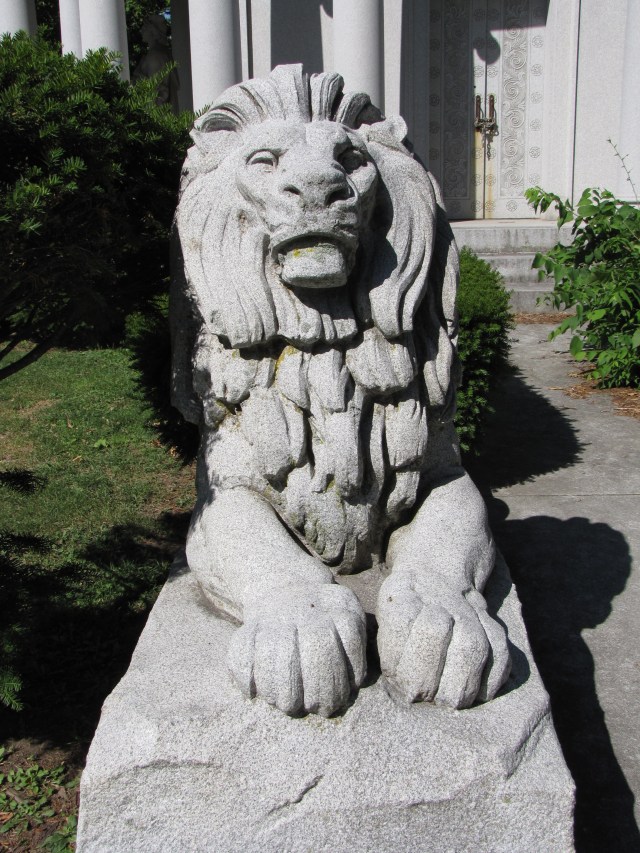
The pathway to the mausoleum is flanked by lions.  The lion has long been a symbol of bravery, strength, and majesty. In popular culture, the lion is known for its power and is called King of the Jungle and King of the Beasts.  The lion is often used as a royal emblem, found eight times in the Royal Arms for the Queen of England alone!
IMG_8393

The lion in funerary art symbolizes the power of God. It is often depicted flanking the entrance of a tomb, as it is here, to guard against evil spirits to the passageway to the next realm. It also represents the courage of the souls the lions guard. There is also a connection of the lion to the Resurrection. It was once believed that lion cubs were born dead but would come to life after three days when the cubs were breathed upon by a male lion. The three days is significant because it is the number of days Jesus was in the tomb before he was Resurrected.

The mausoleum design is of the Ionic order, one of the three organizational systems of Greek architectural design. The Ionic order is characterized by the use of a capital (the top of the column) that uses volutes, a spiral scroll-like ornamentation. In this example, the capital is enriched with an egg and dart design. The Ionic column is slender and is often fluted.  The entablature (architectural composition resting on the columns) is composed of an architrave (lentil or beam) which is plain and divided into two or three bands and rests directly on the column; a frieze (the widest band between the capital and the cornice); and the cornice. The acroterion, an acanthus stone work, is placed at the apex of the pediment and at the corners of the tomb which completes solemn tomb.

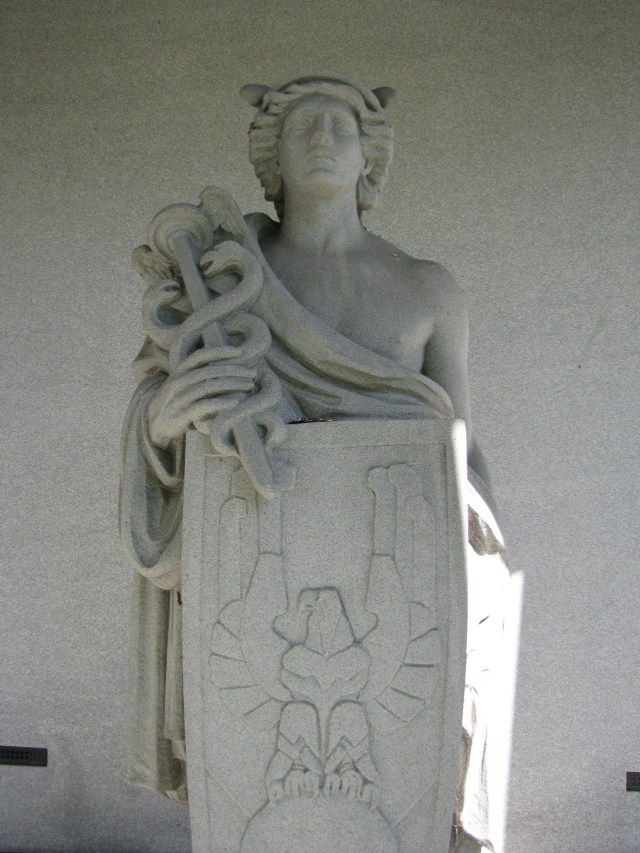
Two striking features of the tomb are the statues on either portico.  One statue is of the Greek god, Mercury, which among his many roles, was the god of commerce.  Here he holds the caduceus, his symbol which has become synonymous with the medical profession.   The base of the statue is inscribed with the words, “The Spirit of Commerce.”
IMG_8387

Underneath the opposite portico, is the statue of the Greek goddess of victory, Nike, carrying the palm leaf.   The base of her statue reads, “The Spirit of Radio”.

IMG_8392

Both statues honor what made Grunow his fortune.

Posted in Mausoleums, Symbolism | Leave a comment

Marshall Field

IMG_6359

In a rags-to-riches story suitable for Horatio Alger, Marshall Field, who started as a clerk in a dry goods store, ended up buying the store in which he worked in 1865.  By the time Field died in 1906, he was the wealthiest man in Chicago.

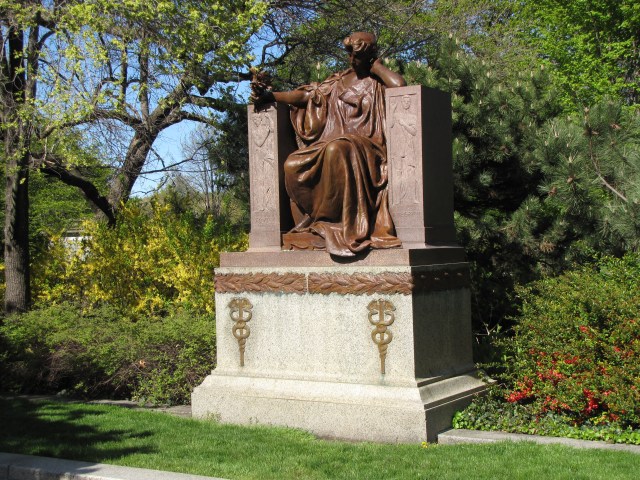
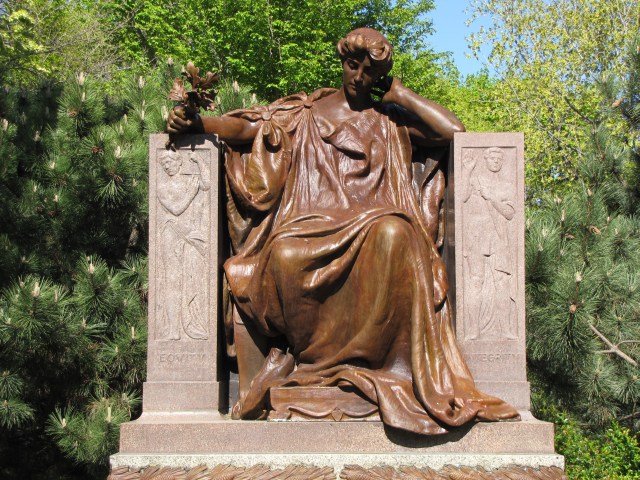
The Field Family Monument in the Graceland Cemetery at Chicago, Illinois, is suitable for a man of Field’s station.  The dramatic 7 foot tall seated bronze figure, Memory, has her bowed, in her right hand she is holding a sprig of oak leaves—a symbol of strength and courage.  The fronts of the arms on the large granite chair have carved upon them the statues of Integrity and Equity.  The base of the monument has a bronze band adorned with pine and pine cones signifying immortality or everlasting life. Also displayed on the base are a pair of caduceus, traditionally recognized as the symbol of medicine.  However, the staff of Mercury is also an ancient symbol of commerce, a nod to the Field’s success as a merchant.

The monument was designed by Henry Bacon, a prominent New York architect, and famed sculptor Daniel Chester French.  It is not difficult to look at the seated figure as a precursor to the most famous sculpture of French’s career—another seated figure—Abraham Lincoln showcased in the Lincoln Memorial.

The Lincoln Memorial, like the Marshall Field Family Monument, was also a partnership between Bacon and French, with architect Henry Bacon designing the Memorial and French carving the iconic statue of Lincoln.

IMG_6358

Posted in Famous graves, Symbolism | 1 Comment

Crossing the narrow stream

IMG_3925

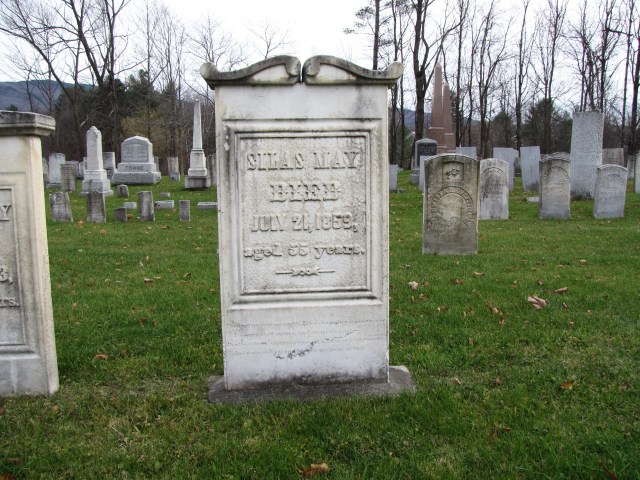
The epitaph on the Silas May gravestone in the Waterbury Cemetery in Waterbury, Vermont, uses the age-old metaphor of crossing the river.  Since ancient times, the imagery of the soul crossing a river was created to explain how the soul went from one realm to the other.  This vivid imagery has long been a part of the symbolism of death in iconography and word.

In Greek mythology, the River Styx wrapped its way around Hades (the Underworld) nine times.  To cross from this life to the next, the dead had to pay with a coin to be ferried from the realm of the living to the realm of the dead.  The toll was placed in the mouth of the deceased to pay Charon, the ferryman.  It was said that if the dead person did not have the coin, he was destined to wander the shores of the River Styx for a century.

SILAS MAY

DIED

JULY 21, 1859

Aged 55 years

Thou art no more on earth – Life’s changing scenes are o’re

Its cares, its sorrows, and its trials past

Deaths narrow stream is crossed, and thou hast gained the shore

And peace, and joy, and heaven are thine at last.

Posted in Epitaphs | Leave a comment

Victorian Mourning Figure

Mount Olivet Cemetery, Nashville, Tennessee

Mount Olivet Cemetery, Nashville, Tennessee

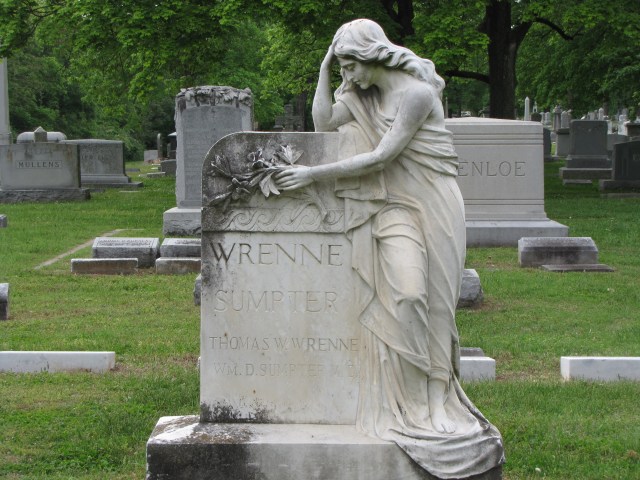
Many Victorian cemetery monuments are imbued with a multitude of symbolism.  In David Robinson’s book, Saving Graces, mourning figures from some of the most beautiful and famous cemeteries in Europe show sculpted beautiful, young, and voluptuous women often wearing revealing clothing mourning the dead.

Robinson identified four categories of ”Saving Graces”–first, women completely overcome by grief, often portrayed as having collapsed and fallen limp on the grave. Second are the women who are portrayed reaching up to Heaven as if to try to call their recently lost loved one back to Earth.  Third, are the women who are immobile and grief stricken, often holding their head in their hands distraught with loss.  Lastly, he describes the last category of “Saving Graces” as the mourning figure who is “resigned with the loss and accepting of death.”

In this example from the Mount Olivet Cemetery at Nashville, Tennessee, the monument of prominent philanthropist and investor Thomas Wrenne and his son-in-law Dr. William Sumpter, displays a young female figure, with her forehead leaning against one hand, looking down in reflection and sorrow, while she is placing an  Easter lily on the monument. This mourning figure seems to be a combination of the last two categories that Robinson mentions, head in her hands stricken with grief but resigned.  The act of placing the flower is also a recurring funerary motif which is designed to remind the viewer that life is short. The Victorian funerary symbolism associated with flowers used the Easter lily to represent the resurrection.

Posted in Saving Graces, Symbolism | Leave a comment

Eclectic design in cast iron

The Reynolds Family Tomb, Metarie Cemetery, New Orleans

The Reynolds Family Tomb, Metarie Cemetery, New Orleans

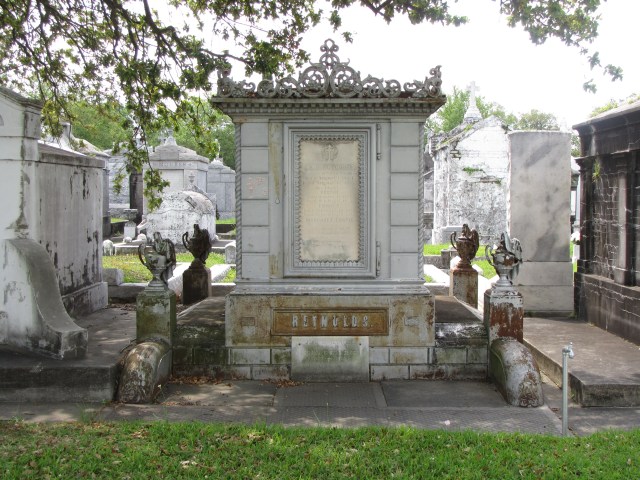
Cast iron became much less expensive in the second half of the 19th Century coupled with the ease of making more intricate patterns and designs.  Simple wrought iron adorning many of the homes, commercial buildings, and apartment buildings in New Orleans was ripped out and replaced with more intricate cast-iron railings and fencing.

The choice of cast iron for the building instead of marble or granite for the tomb of William H. Reynolds, however, was likely due to the fact that he owned the Reynolds foundry at New Orleans.  His family tomb is the only cast-iron tomb in the Metarie Cemetery.  Built in 1877, the tomb is an eclectic design featuring Byzantine-style twisted corner columns, an Italianate cornice, and a highly-decorative iron work adorning the top.

Also symbolism further decorates the tomb—inverted torches on the sides of the tomb and the draped urns on the four corners of the plot.  Inverted torches with the flames curling out from the bottom are molded into the side panels of the tomb.  The flame or fire is symbolic of the soul. Here the inverted torch represents a life that has been extinguished.

The urn, an almost ubiquitous 19th Century symbol, was found in nearly every American cemetery. The urn is a container used to hold the ashes or the cremated remains of the dead.  The urns surrounding the Reynolds Family Tomb are draped. The drapery represents a shroud symbolizing death and sorrow.  It can also be a motif that represents a veil that separates the two realms—Earth and Heaven.

Wm. H. REYNOLDS

A native of Columbus, Ohio

Born August 1, 1831

Died August 17, 1877

His Children

GEORGE

Born October 17, 1874

Died October 17, 1874

EMMA P.

Born February 12, 1877

Died September 8, 1878

Margaret TORPIE

Wife of Wm. H. Reynolds

Born June 9, 1842

Died June 30, 1885

WILLIAM H. REYNOLDS

1866-1929

Posted in Tombs | Leave a comment