Exedra

Green-Wood Cemetery, Brooklyn, New York

Green-Wood Cemetery, Brooklyn, New York

Conrad Stubenbord  Nov. 23, 1848 July 22, 1913

Ernestine Stubenbord Sept 12, 1847 Dec 21, 1936

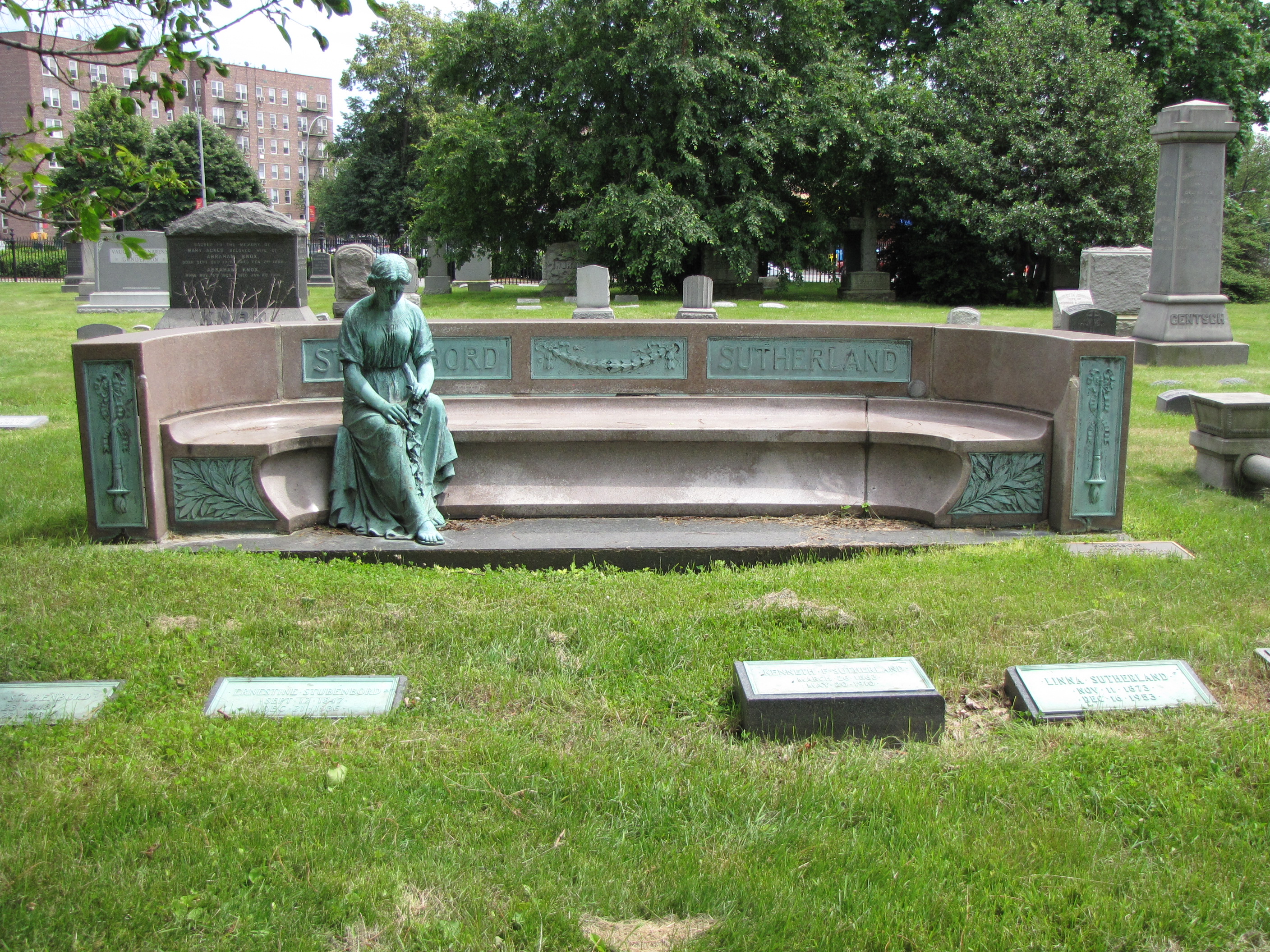
The Stubenbord-Sutherland rose-colored polished granite monument in the Green-Wood Cemetery at Brooklyn, New York, is an example of an exedra.  An exedra is a semi-circular structure, often with a bench with a high back. This type of classical architectural device was designed in antiquity to facilitate philosophical discussion and debate. In cemetery architecture the exedra is usually part of a landscape design.

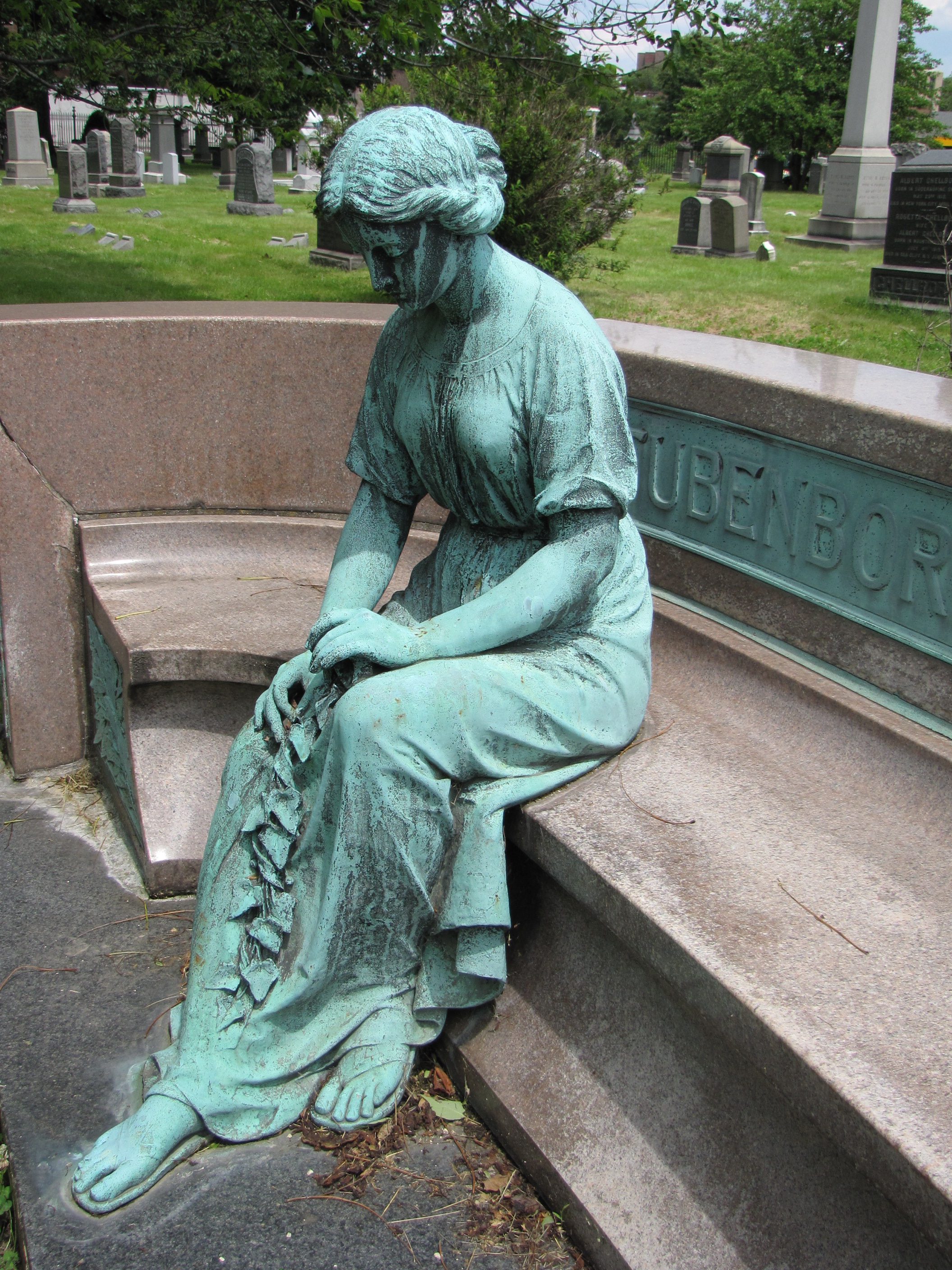
This monument also has a mourning figure sitting in the exedra, holding a sprig of ivy, a symbol of fidelity and immortality.  On the corners of the exedra in bronze insets are inverted torches. The flames coming from the bottom of the torches are symbolic of the soul. Here the inverted torches represent a life that has been extinguished.  The other bronze insets feature palm leaves a common symbol of victory over death.

IMG_4342

Posted in Tombs | 1 Comment

The Caldwell Sisters of Louisville

Cave Hill Cemetery, Louisville, Kentucky

Cave Hill Cemetery, Louisville, Kentucky

Mary Elizabeth Breckenridge Caldwell—Baroness Von Zedtwitz

December 26, 1865—December 16, 1910 

Mary Guendaline Byrd Caldwell—Marquise Des Monstiers Merinville

October 21, 1863—October 5, 1909

“Know the truth and the truth shall make you free”

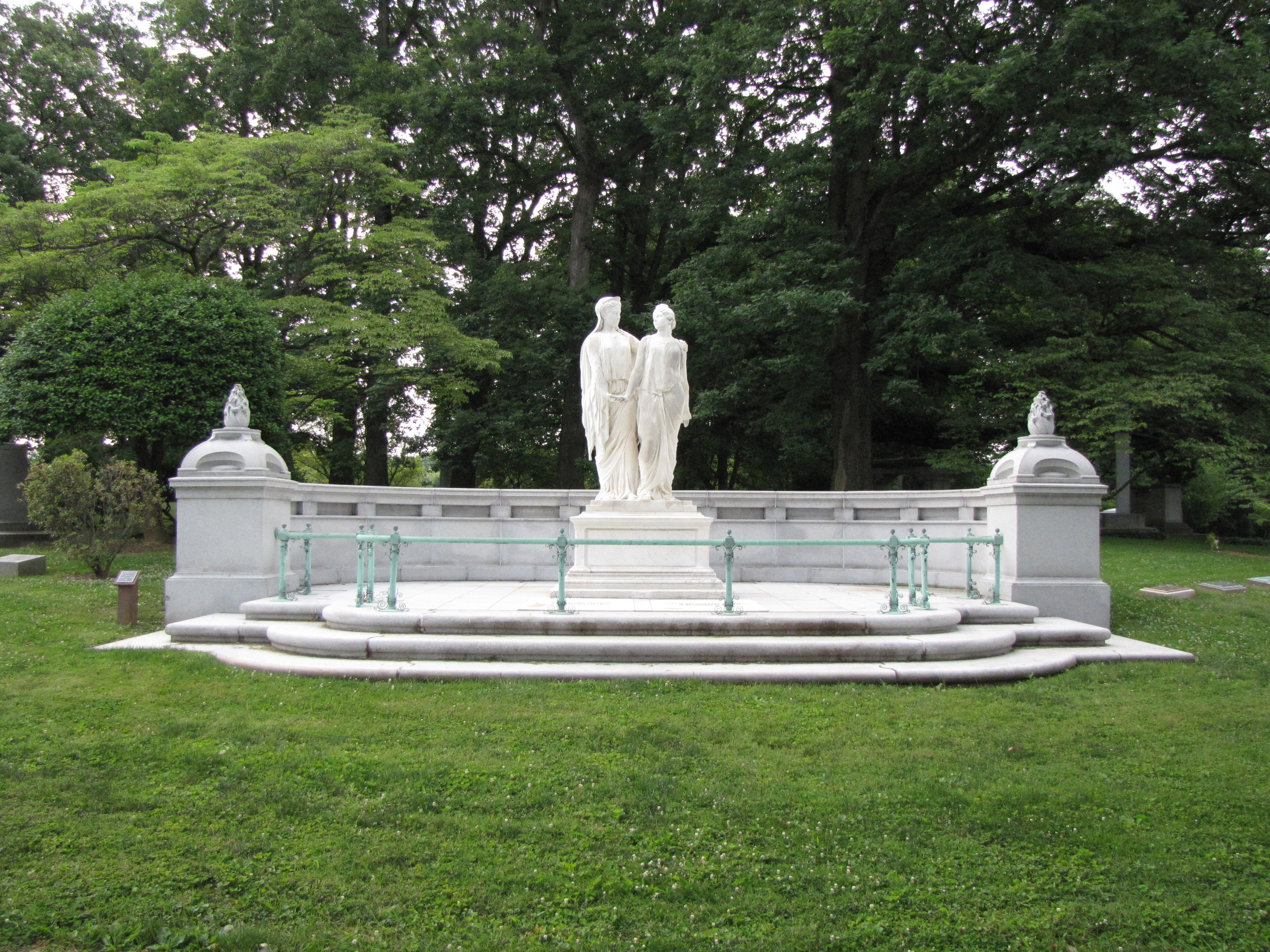
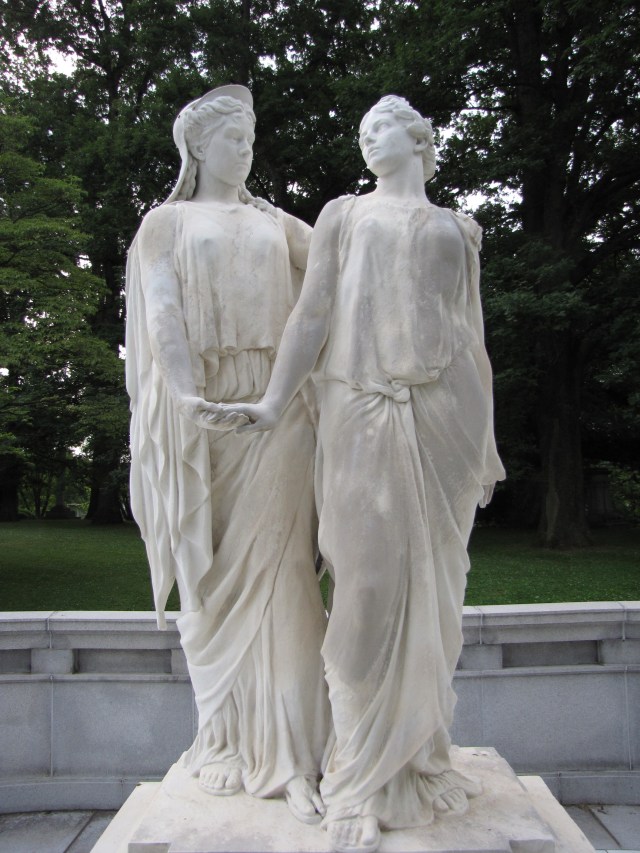
Positioned at the center of an exedra in Section 13 of the Cave Hill Cemetery at Louisville, Kentucky, stands two Greek marble statues.  An exedra is a semi-circular structure, often with a bench with a high back.  This type of classical architectural device was designed in antiquity to facilitate philosophical discussion and debate.  In cemetery architecture the exedra is usually part of a landscape design.  Here it adds to the classical design of the Caldwell monument that has as its focal point, two classical statues.

The portrait statues are of Mary Elizabeth Breckenridge and Mary Guendaline Byrd Caldwell, daughters of William Shakespeare Caldwell who made his fortune building and operating gas plants throughout the Midwest.

IMG_5121

Both daughters married titled European aristocrats.  Mary Guendaline was first engaged to the Prince Joachim Murat, the grandson of the King of Naples, who was not only twice her age but an invalid.  The engagement went awry when the couple could not agree on how much of Miss Caldwell’s fortune was to be given to the Prince.

The heiress’ wedding announcement was reported in newspapers from around the country including The Saint Paul Globe, Tuesday, on October 20, 1896, with the headline, MARRIED IN FRANCE: Titled Gathered in by a Well-Known American Woman, (spellings are as they appear in the article) Paris, Oct. 19—Miss Mary Gwendolin Caldwell founder of the divinity school of the Catholic university at Washington, D. C. was married today at St. Joseph’s church, Avenue Hoche, this city, to the Marquis des Monstriers-Merenville.  Bishop Spaulding, of Peoria, Ill., the guardian and administrator of the estate of Miss Caldwell, assisted by Father Cooke, officiated.  Punctually at noon the pair entered the church and occupied seats beneath a canopy of flowers.  After a complimentary address, Bishop Spaulding performed the marriage ceremony, which was followed by a mass, celebrated by the Chanoene Father Dufort, superior of St. Phillippe de Roula a friend of the bridegroom.  The music was superb.  The witnesses for the groom were Counts Henri and Pierre Des Monstreiers-Merenville, and the bride’s witnesses were Mr. John Carter and Bishop Spaulding.  Among the guests presents were the duke and duchess Doudeaville, the marquis and marquise de Dimecourt, the Court de Turenne and the marquis de Vogne.

The Marquise’ health declined and the couple separated.  She suffered from paralysis and was unable even to speak only communicating through writing. The Marquise des Monstiers died aboard the German ocean liner Kronprinessin Cecile in her stateroom on her way to America.

The New York Sun, October 6, 1909, headline and story told the story:

MARQUISE DIES ON LINER SHE HAD HOPED TO REACH AMERICA BEFORE END CAME: The Marquise Monstiers-Merenville Was Miss Caldwell of Kentucky—She Got The Order of the Rose From Pope Leo XIII., but Later Renounced the Church.

When the North German Lloyd liner Kronprinzessin Cecilie was within sight of Sandy Hook early yesterday morning one of her most distinguished passengers, the Marquise des Monstiers-Merinville who had expressed a wish to die on American soil when she boarded the liner on the other side, breathed her last in the presence of her private physician: Dr. R. Ohle, the ship’s surgeon; her secretary, an Italian courier and three nurses.  She had requested all of them to be with her at the end.

            She had hoped when she sailed that she would arrive here well enough to see her old physician, Dr. Allen Starr, and some of her friends.  The Kronprinzessin Cecille made one of the fastest trips in her history, beating all German records for a day’s run by reeling off 604 miles on the day before the Marquise died, but the special effort of her commander to bring in the Marquise alive failed by about six hours.

            The Marquise was originally Mary Gwendolin Caldwell and she attracted public notice about twenty years ago by her engagement to Prince Murat, grandson of the King of Naples.  The engagement was broken because she refused to settle on him half her fortune then estimated at about $2,000,000.  Her father, William Shakespeare Caldwell made his money building gas works.

            The Marquise was born in Kentucky and was of Breckinridge stock.  She and her sister, Lina Caldwell, who married the Baron von Zedwitz, were educated at the Convent of the Sacred Heart at Manhattanville.  Her father, who was originally a Protestant, had been converted to Catholicism by Archbishop Spalding.  The father left all his fortune to the girls, entrusting it to the care of Bishop Spalding of Peoria, Ill., a relative of the Archbishop.

            The Marquise donated $300,000 to found the Catholic University at Washington, giving eighty-eight acres of land on the outskirts of the city and erecting three of the university’s largest buildings.  Her interest in the Church inspired Pope Leo XIII to confer on her the Order of the Rose, a distinction never before given to a woman.

            She was married in Paris on October 19, 1896, to the Marquis des Monstiers-Merinville by Bishop Spalding.  The union brought unhappiness to her and she separated from her hsuband after her health had broken down.  She became paralyzed below the waist and partially blind and deaf.

            In 1904 before these afflictions came she renounced the Church and published a statement about her decision that caused a sensation in Catholic circles.  In December 1904, and effort was made to have her reconsider her renunciation, the Pope receiving her in special audience, but she did not change her decision.  At her request the trustees of the university removed her portrait from the wall of the main parlor of Divinity or Caldwell Hall and sent it to her home.  The portrait of Cardinal Martinelli was hung in its place.  The Marquise’s friends said she did not embrace any other faith after she gave up the Catholic Church.  She asked for not priest or minister before she died.

            The Baroness von Zedwitz, who is a widow, her husband having been killed in 1896 in a coalition between his yacht and that of the Emperor William, was notified of the Marquise’s death.  Word was also sent to the Marquis, who is living in Paris.  The Marquise was 48 years of age.

Mary Elizabeth Breckenridge Caldwell married the German nobleman and diplomat, Baron von Zedtwitz (1851-1896).  Baron von Zedtwitz served his country as secretary to the Russian, then American embassies.  He then served as Minister to Mexico.  He died in a tragic yachting accident at the Royal Albert Regatta when his yacht, the Isolde, collided with German Emperor Wilhelm’s yacht the Meteor leaving the Baroness a widow.

The New York paper announced the death of Elizabeth Caldwell:

Baroness Von Zedtwitz Dead.

News reached this city yesterday that the Baroness von Zedtwitz, who was formerly Miss Elizabeth Caldwell of Louisville, Ky., died on Dec. 16 from heart disease at the Carlton Hotel, Frankfort, Germany, at the age of 43.

Once distinguished for her lavish gifts to the Roman Catholic Church, the Baroness von Zedwitz achieved even more prominence six years ago by writing a book attacking it.

She was the daughter of William Shakespeare Caldwell, a wealthy resident of Louisville, who had originally been a Protestant, but who had been converted to Catholicism.  Both Mary Elizabeth and her sister, Gwendolyn Caldwell, were brought up in the latter faith.  Both girls inherited several millions from their father, and for years gave large sums for the erection of Catholic institutions.  Fourteen years ago Mary Elizabeth married Baron von Zedtwitz, a member of the German Diplomatic Corps at Washington.  The Baron immediately, after the marriage, was appointed the German Minister to Mexico.  Within a year after the marriage, however, he was killed by the fall of the mast of his private yacht, the Isolde, which came into collision with the yacht Meteor off Southsea.

            The Baroness, after her husband’s death, gave still more lavishly to Catholic institutions.  She had residences in New port and Louisville, but she spent most of her time abroad.  In 1904, greatly to the surprise of her friends, she announced her intention of renouncing Catholicism.  Her reasons were afterward published in a book entitled “The Double Doctrine of the Church of Rome.”  Her sister, who shared her views and had become the Marquise Monstiers-Merinville, died last October.  The Baroness leaves a fourteen-year-old son, Waldemar Zedtwitz.  She will probably be buried in Louisville.

The Caldwell sisters are depicted in classical clothing giving them a regal appearance.  The patina of the marble makes the statues look translucent, almost as if light is emanating from within.  The monument was erected between 1910 and 1912 by the Harrison Granite Company of New York City and the statues were designed and executed by famed London artist and sculptor Gilbert Bayes (1872-1953).  Bayes was associated with the British New Sculpture Movement which had architectural sculpture as its main focus, though; he is most likely best remembered for his association with the Royal Doulton Company and for his stint as President of the Royal British Society of Sculptors (1939-1944).
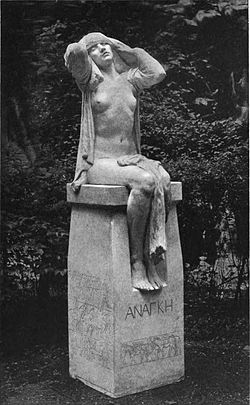
Destiny, sculpted by Gilbert Bayes, a war memorial at Albion Gardens, Ramsgate, Kent, England

Destiny, sculpted by Gilbert Bayes, a war memorial at Albion Gardens, Ramsgate, Kent, England
 

Posted in Famous graves | 7 Comments

Winged Cherub’s Head

Forest Lawn Cemetery, Buffalo, New York

Forest Lawn Cemetery, Buffalo, New York

The bronze gravestone of Harry Albright is adorned by a winged cherub.  The patina on the cherub’s face gives the image an almost haunting look.  The winged cherub was a symbol that became popular in the 18th Century.  Winged cherubs replaced the stark and morbid flying death’s heads from our Puritan forefathers.  The cherubs have a childlike countenance of innocence.  The iconography represents the flight of the soul from the body upward to Heaven and the hope of the resurrection.

HARRY ALBRIGHT

SON OF

JOHN JOSEPH ALBRIGHT

AND

HARRIET ALBRIGHT

BORN JUNE 22, 1874

DIED SEPTEMBER 3, 1874

Forest Lawn Cemetery, Buffalo, New York

Forest Lawn Cemetery, Buffalo, New York

Posted in Symbolism | 1 Comment

Oval Chest Tomb

Christ Church Burial Ground, Philadelphia, Pennsylvania

Christ Church Burial Ground, Philadelphia, Pennsylvania

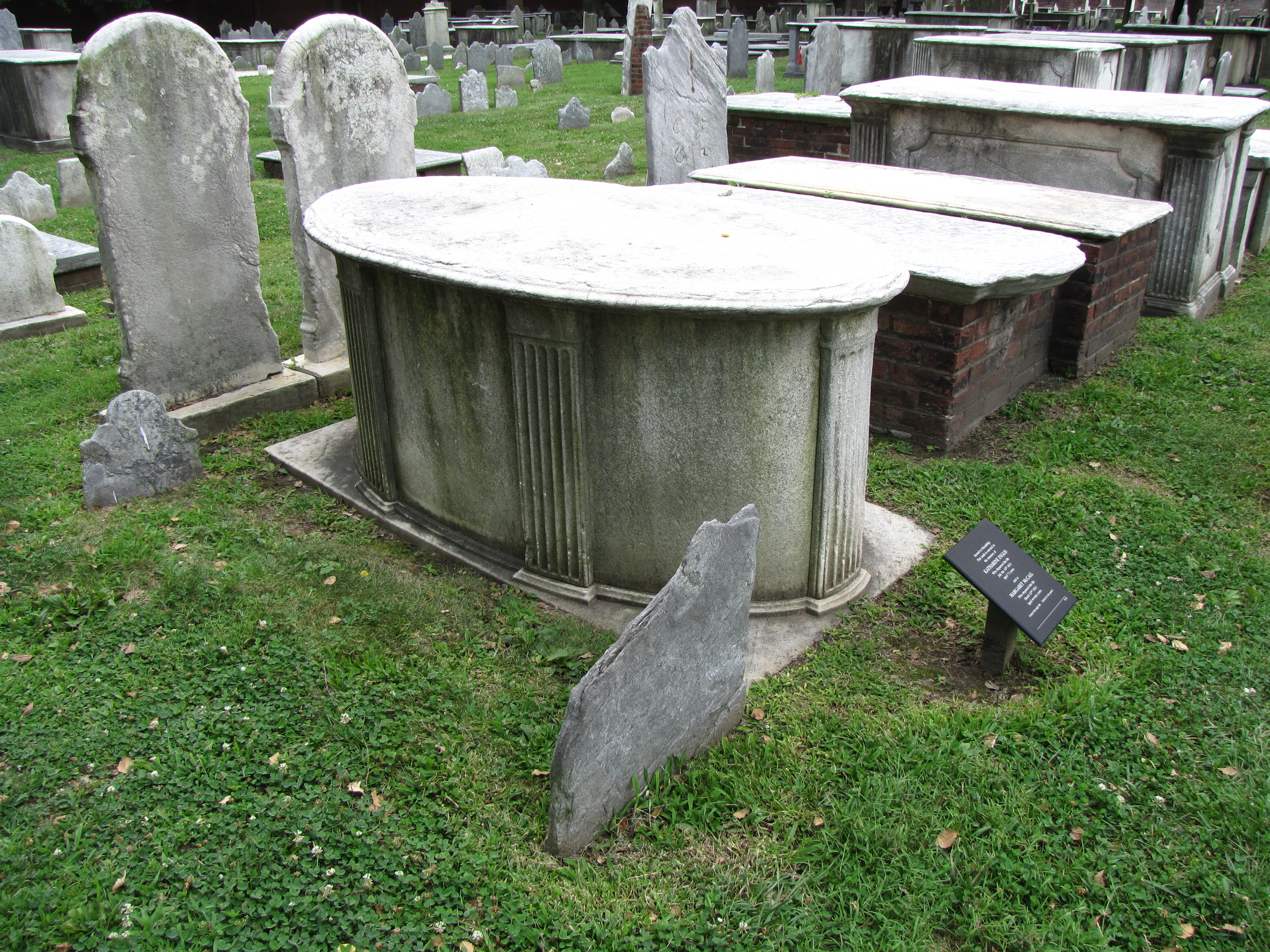
Chest tombs which were common in 19th Century American graveyards were also referred to as false crypts because the coffin was not inside the chest tomb, but buried underneath underground.  This chest tomb is not in the traditional box-shaped false crypt but an oval.  As the chest tombs to the right show, they were constructed of many different materials, shapes, and sizes.

Sacred to Friendship

This tomb is erected to

the memory of

KATHERINE INGLIS

Who departed this life

July the 10th 1821

Aged 71 years.

And to

MARGARET McCALL

Who departed this life

March 22nd 1824

Aged seventy years.

United through life.  United in the grave.

Posted in Tombs | Leave a comment

Chest Tomb

Vasco de Gama's Tomb at Lison, Portugal

Vasco de Gama’s Tomb at Lison, Portugal

Chest tombs were first popularized in Europe.  The tombs resembled a chest or trunk, often with an effigy of the deceased lying in repose on top.  The Tomb of Vasco de Gama (c.1460-1524) buried at the Monastery of Jeronimos at Lisbon, Portugal, is an example of this type of tomb.  The great navigator is shown in effigy in a prayerful position on top of the embelished chest tomb–ornamented with a sailing ship, his vehicle to fame.

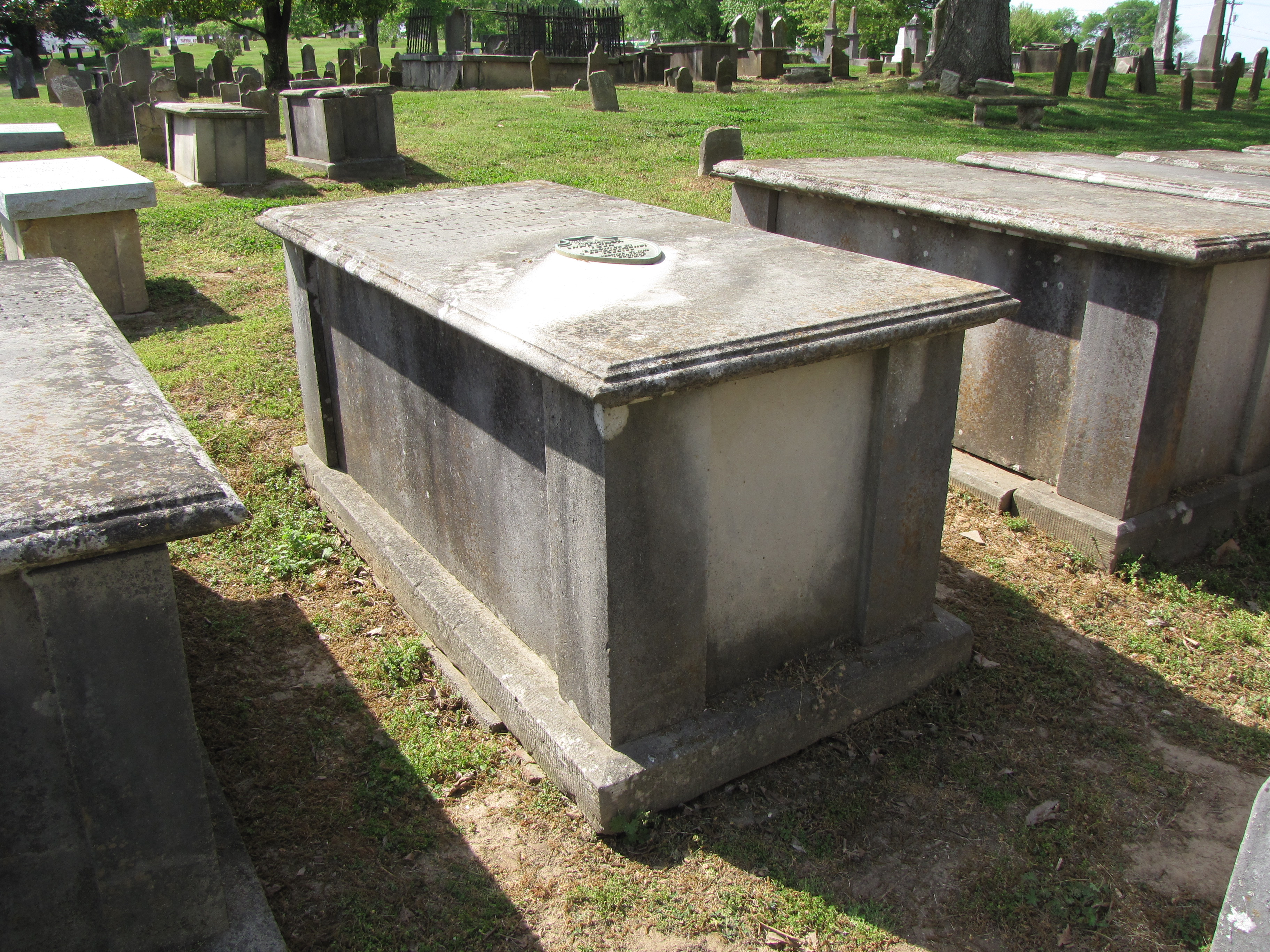
Chest tombs are fairly common in 19th Century American graveyards but were built without the effigy.  They were also referred to as false crypts because the coffin was not inside the chest tomb, but buried underneath underground.  The example in the photograph below is from the Greenwood Cemetery at Franklin, Tennessee.  The tomb marks the grave of Jane Knox Polk, the Mother of President James Knox Polk.

Greenwood Cemetery, Franklin, Tennessee

Greenwood Cemetery, Franklin, Tennessee


Posted in Tombs | Leave a comment

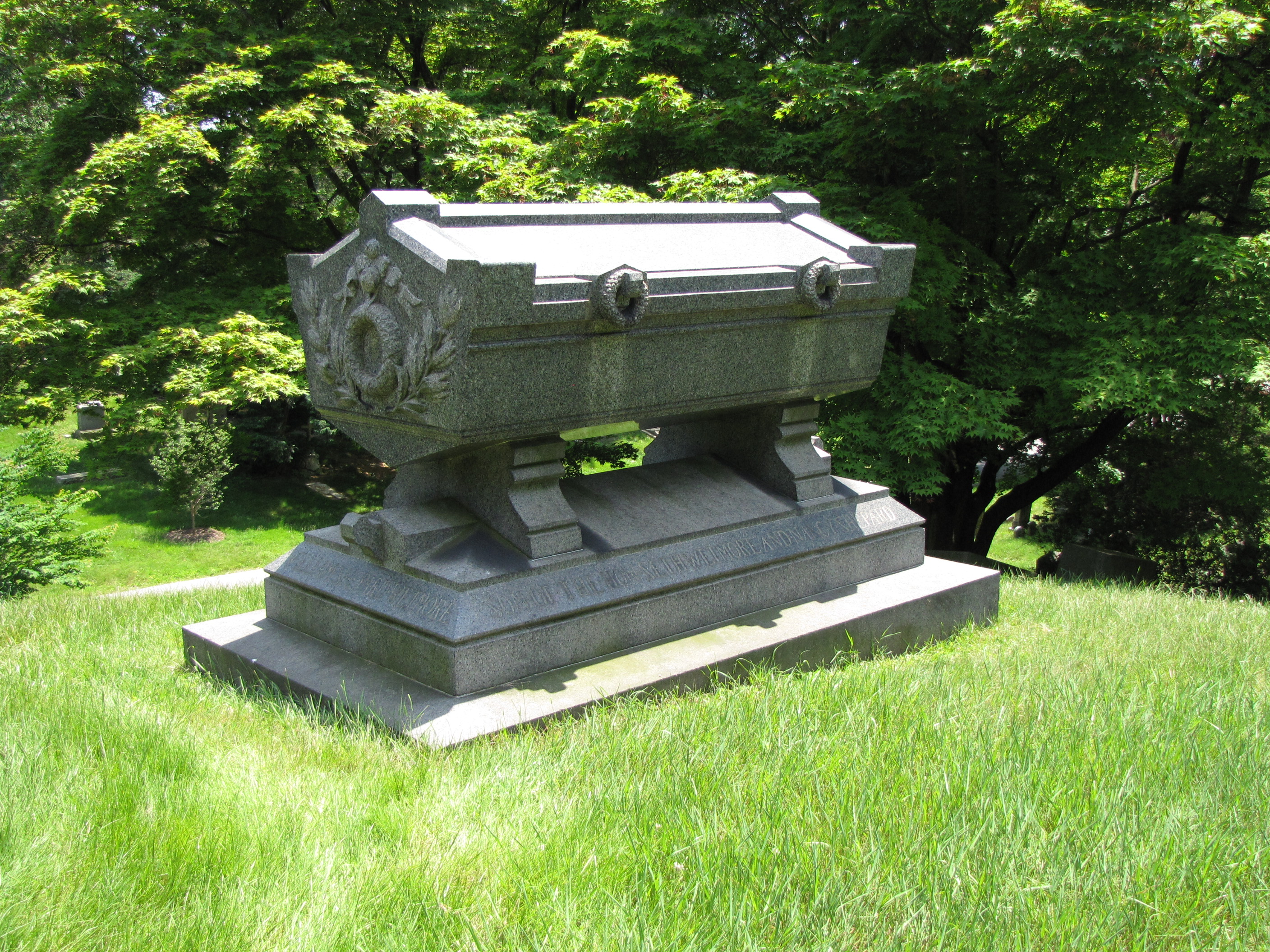
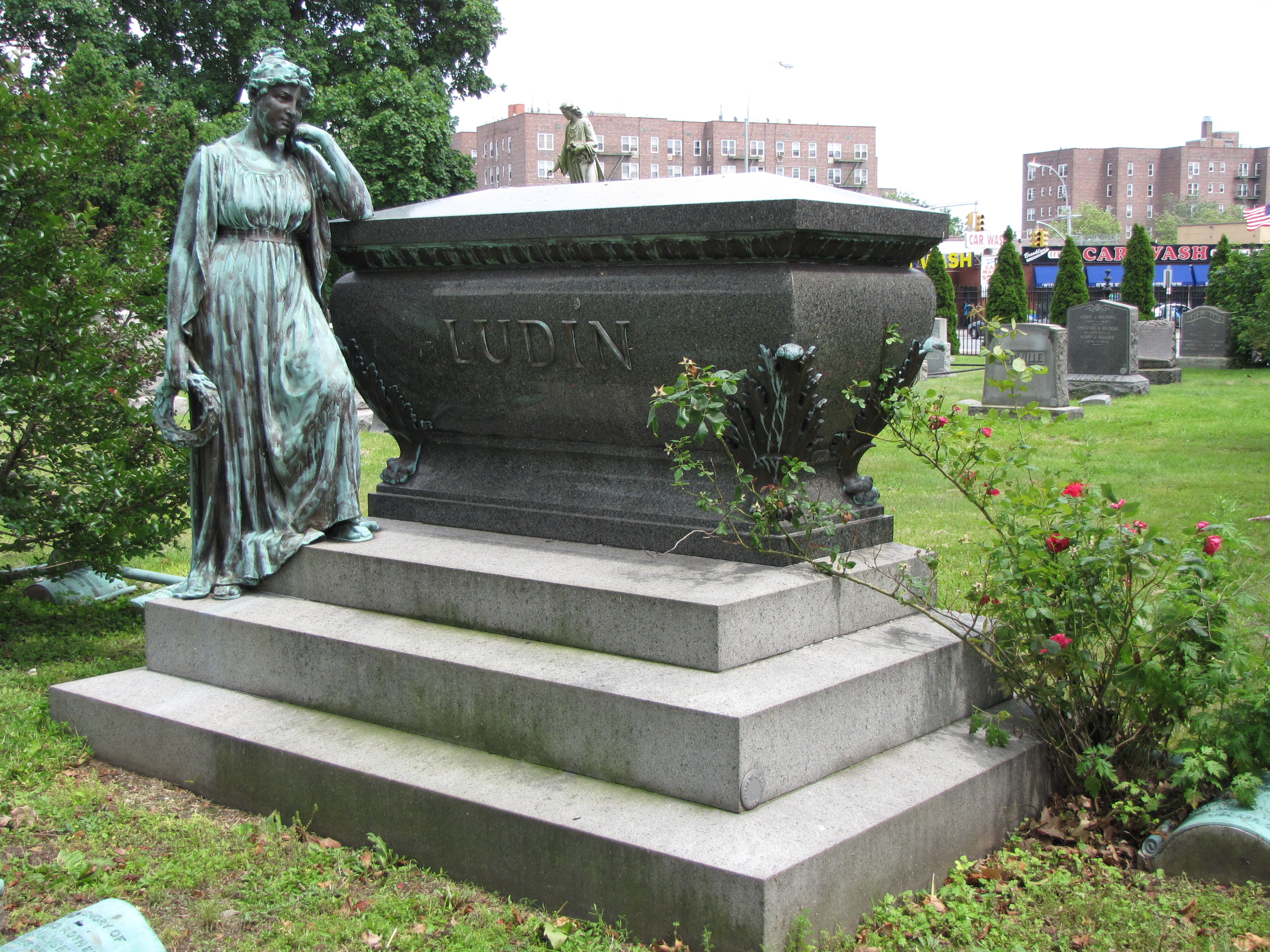
The Sarcophagus Tomb

Green-Wood Cemetery, Brooklyn New York

Green-Wood Cemetery, Brooklyn New York

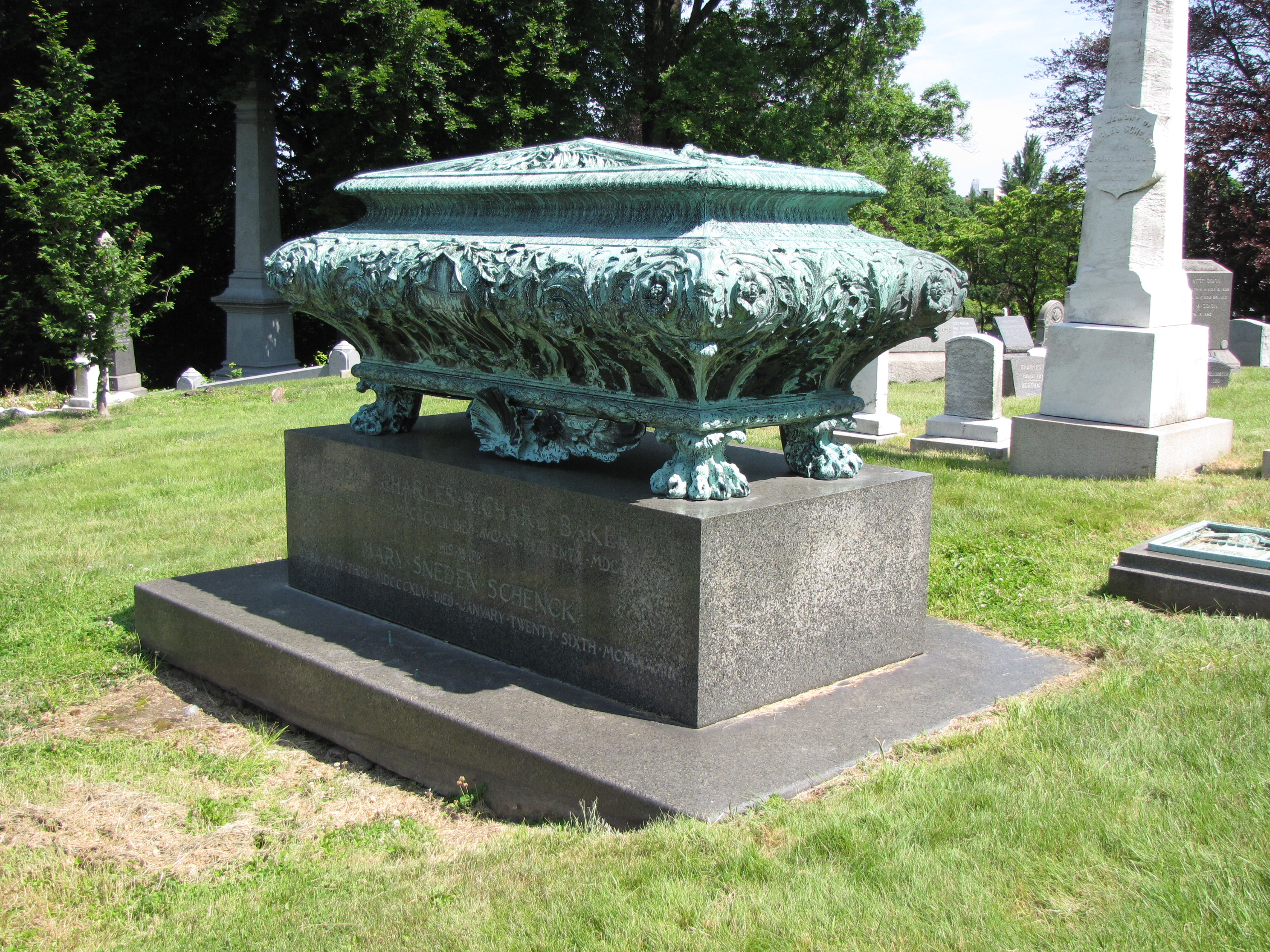
Sarcophagus tombs are designed to look like coffins.  Most often they are set on a platform or a base.  The tomb is often embellished with ornamentation and nearly always has feet–but the “coffin” is empty–just an empty symbol of the receptacle.  This style of burial monument is ancient.

Green-Wood Cemetery, Brooklyn, New York

Green-Wood Cemetery, Brooklyn, New York

The word, sarcophagus, is derived from two ancient Greek words, sarx, which meant flesh and phagein meaning to eat.  The two words together, sarkophagus, meant flesh eating.  The term came from the limestone used by the ancient Greeks to bury the dead which was thought to decompose the flesh of the deceased.

Green-Wood Cemetery, Brooklyn, New York

Green-Wood Cemetery, Brooklyn, New York

Posted in Tombs | 3 Comments

Venetian Gothic

Cave Hill Cemetery, Louisville, Kentucky

Cave Hill Cemetery, Louisville, Kentucky

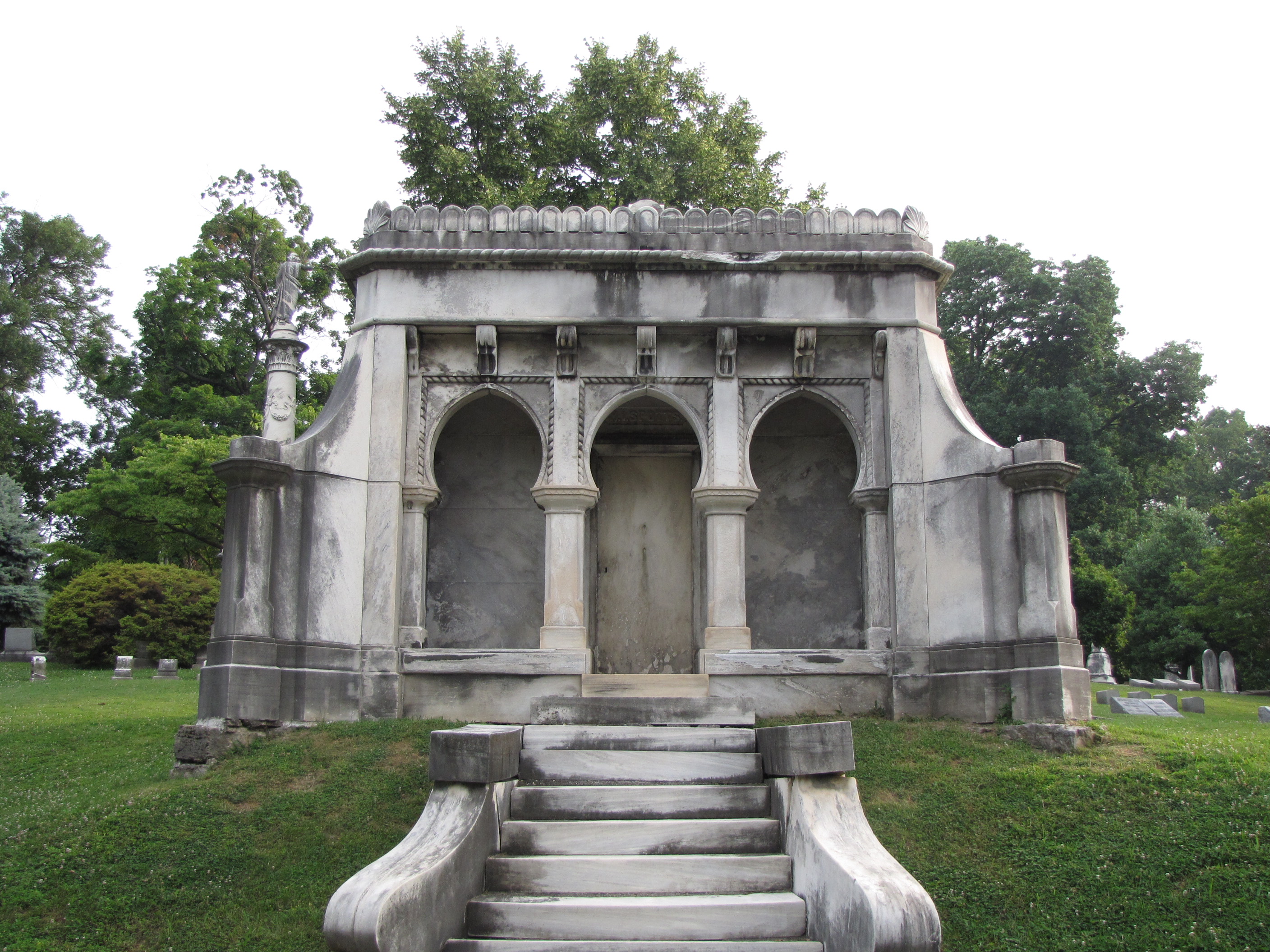
With the exception of the ornamentation on the top of the Spotts Mausoleum, two nearly identical mausoleums, one in the Cave Hill Cemetery at Louisville, Kentucky, and the other in the Mt. Olivet Cemetery at Nashville, Tennessee, were designed and built in the Venetian Gothic style.

Owner of the St. Nicholas Hotel and Steamboat Captain Harry Innes Spotts was laid to rest in a mausoleum (above) designed by John Baird (1820-1894) who was the proprietor of the Steam Marble Works at Philadelphia which cut marble with steam power.   Baird’s shop gave customers standard designs to pick from.  Daniel Franklin Carter (1808-1874), a prominent Nashville banker, was buried in a mausoleum in the Mt. Olivet Cemetery at Nashville, Tennessee.

Both mausoleums are designed in the Venetian Gothic style.  Venetian Gothic architecture combined several architectural styles—Moorish, Gothic, and Byzantine—into a single style reminiscent of the building designs that brought a confluence of cultures together to create a flourish and lightness to the canals of Venice.  During the Victorian era, several architects drew from the Venetians for creative building designs that was part of a larger revival that intertwined several styles into one pleasing to the eye.

When the Spotts Mausoleum was erected in the Cave Hill Cemetery the local newspaper, the October 14, 1866 issue of the Louisville Daily Democrat wrote, “It is of Moorish style architecture…this mausoleum is one of the most permanent and tasteful structures yet erected in our far-famed ‘city of the dead.'”

Mt. Olivet Cemetery, Nashville, Tennessee

Mt. Olivet Cemetery, Nashville, Tennessee

Posted in Mausoleums | Leave a comment

The Crown

Cave Hill Cemetery, Louisville, Kentucky

Cave Hill Cemetery, Louisville, Kentucky

The crown on the gray granite block gravestone of Cornelia McDonald in the Cave Hill Cemetery at Louisville, Kentucky, represents victory.  The crown is a symbol of glory and reward and victory over death.  The reward comes after life and the hard-fought battle on Earth against the wages of sin and the temptations of the flesh.  The reward awaits in Heaven where the victor will receive a crown of victory.

The crwon also represents the sovereign authority of the Lord.

IMG_5402

Posted in Symbolism | Leave a comment

Egyptian or Greek?

Ararat Cemetery, Fresno, California

Ararat Cemetery, Fresno, California

The most famous sculpture of a sphinx is the Great Sphinx of Giza outside of Cairo, Egypt.  In the Egyptian tradition the benevolent mythological creature has the head of a man and the body of a lion.  The Greek sphinx, however, is usually depicted as a woman and sometimes with wings.  In addition to the gender difference, the Greek sphinx is also malevolent.

In the example in the photograph above, a couchant sphinx guards an Egyptian-style mausoleum at the Ararat Cemetery at Fresno, California.  It is clear that the sphinx in the photograph is female, albeit a homely one, because a deviant vandal has highlighted the areola with a smudge of pink paint on each of the breasts on the statue.  Even though this sphinx is partially modeled in the Greek tradition, it has the headress of a pharaoh.

The example below from the Forest Lawn Cemetery at Buffalo, New York, is a clear example of the Egyptian-style sphinx with the head of a man and the body of a lion.

Forest Lawn Cemetery, Buffalo, New York

Forest Lawn Cemetery, Buffalo, New York

Posted in Symbolism | Leave a comment

The Curse of King Tut

IMG_5963

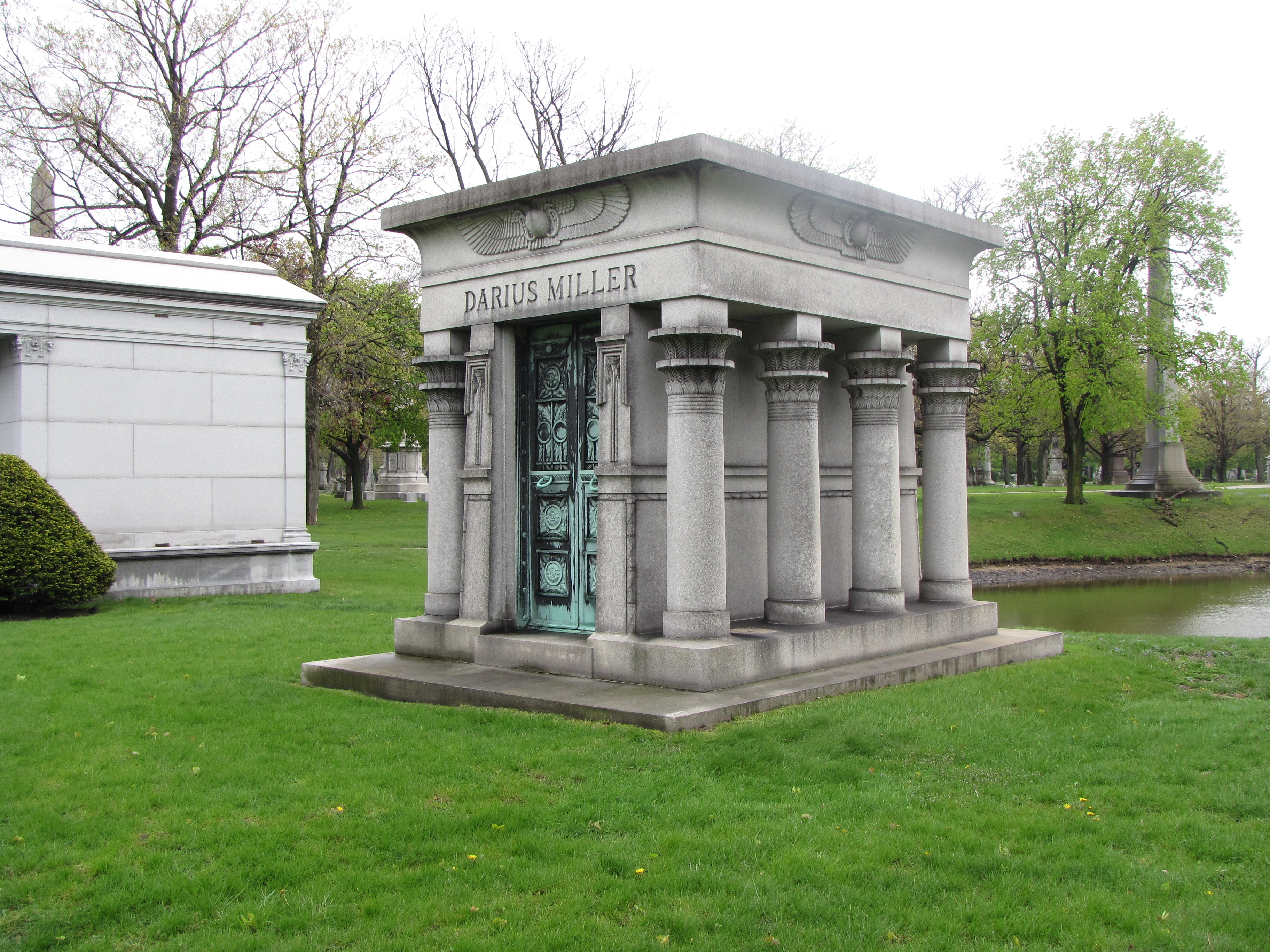
The Darius Miller Mausoleum in the Rosehill Cemetery at Chicago, Illinois, is a magnificent example of Egyptian Revival architecture found in many large urban cemeteries. Egyptian ornamentation can be divided into three categories—architectural, geometric, and natural.  The mausoleum features–the cavetto cornice that curves into a half circle at the top of the tomb and above the doorway which is an example of architectural ornamentation; the torus molding that trails around the middle of the tomb, and the corners of the mausoleum that are designed to emulate long bundled papyrus; and the eight heavy columns with the highly stylized papyrus leaves at the top of each bell column are all examples of natural ornamentation.

The Darius Miller Tomb also features two winged globes with uroei above the doorway and on the side of the tomb in the cornice. In this example, there are three sets of falcon wings that are a symbol of the king, the sun, and the sky. The globe represents the Egyptian god, Horus. The uroei, snakes, are waiting to strike. They symbolize the king’s ability to ward off evil spirits. The tomb gives one the sense of solemnity and a sense of eternity, just as the temples of the pharaohs.

The story told on several Websites was that Darius Miller was fascinated with Egyptian art and architecture and that he supposedly had his tomb modeled after the Egyptian Temple of Anubis, the god of the underworld.  Also, because of Miller’s Egyptian obsession, Darius Miller was at the historic opening of the King Tut Tomb in Egypt.

Much has been made of the “curse of King Tut.”  Those who opened the tomb of King Tut and disturbed the contents would be susceptible to the curse, “Death comes on wings to he who enters the tomb of a pharaoh.”  Lord Carnavon, who funded the expedition to find and excavate King Tut’s tomb was, according to the legend of the curse, the first to die.  And many of the believers in the supernatural claim to this day that an eerie blue light emanates from the Darius Miller Tomb every May 1st and that he, too, was felled by the curse.

The problem with the assertion that Darius Miller died as a result of the curse is absolutely false.  First of all, Darius Miller died August 23, 1914, at Glacier Park, Montana, and King Tut’s burial chamber was not opened until February 17, 1923, a difference of roughly nine years.  Furthermore, Lord Carnavon did not die from the curse either—a mosquito got him!

The myth and mystery surrounding Darius Miller and his tomb, though debunked quite some time ago, was seemingly more interesting than the real story of a young Midwestern man born April 3, 1859, at Princeton, Illinois, who started out in the railroad business at the bottom and worked his way to the top.  By all accounts, Darius Miller did it by being a hard worker and by being nice to all those he came in contact with.  Darius began working in the railroad industry in late 1877.  He held many positions at many different railway companies–stenographer in general freight office at the Michigan Central Railroad; clerk in the general freight office St. Louis Iron Mountain and Southern Railway; chief clerk to general manager and general freight and ticket agent at the Memphis and Little Rock Railroad; general freight and passenger agent and then traffic manager at the St. Louis Arkansas and Texas Railway; traffic manager on the Queen and Crescent Route; traffic manager and then vice-president at the Missouri Kansas and Texas Railway. From November 15, 1898, to Dec. 31, 1901, Darius served as second vice-president at the Great Northern Railway.   On January 1, 1902, he was appointed first vice-president at the Chicago Burlington and Quincy Railway.

By the time of his death, Darius Miller had risen through the ranks to become the President of the Burlington Railroad.  The August 26, 1914, issue of the Lincoln Daily News, flashed the headline, “Tribute Paid to Memory of R. R. Official: Railroad men and other citizens of Lincoln who knew Darius Miller, president of the Burlington road, express keen regret over his death.  Two weeks ago President Miller and several other high officials of the road stopped for a short time in Lincoln on their way west in a private car.  At that time President Miller appeared to be in the best of health.

“Secretary W. S. Whitten of the Lincoln Commercial club knew him well.  When Whitten was chief clerk to the traffic manager of the Eastern Minnesota railway, a part of the Great Northern system, Miller was in the same building at St. Paul where Mr. Whitten was employed.

“Darius Miller was a grand, good man.” Said the secretary.  “He was modest and unassuming. It was no trouble to see him.  The door of his office was always open and it required no red tape to reach him.

“He was a great friend of young men.  I may say that he was like a father to the young railroad men under his jurisdiction.  H was ready any time with a word of encouragement and was never to busy to be helpful.  He was a remarkable judge of men and picked out his subordinates with rare skill and judgment.  He placed them on their mettle and when they made good they were rewarded with commendation and with advancement in the service.  He was a big, brainy and genial and was the ideal railroad official.  He belonged to the modern type of railroad executives who made friends for the railroad.  Matters of traffic taken up with him were easily adjusted when they has merit to them.  During the time I have been secretary of the Commercial club it has been necessary to seek the adjustment of vexing traffic problems affecting the commercial welfare of Lincoln with the Burlington and Mr. Miller has always been fair in his treatment.  It was a pleasure to do to him with such matters because of his broad understanding of traffic conditions.  The last time I saw President Miller was during the latter part of June when he came to the Commercial club in company with Vice President Byram.  At that time he looked at the corner room on the first floor with a view to renting it for the district freight department.  It was but a short time after this that the contract was closed with the railroad for the room.  When I happened in Chicago and dropped in to see him he was very friendly and courteous and was never too busy to see me.  I think no railroad official in a high place will be missed more keenly than Mr. Miller.”

B. N. Loverin, a passenger conductor on the Burlington running between Lincoln and Omaha was a schoolmate and boyhood friend of Darius Miller.  Both lived in Princeton, Illinois.  Loverin graduated from the high school of Princeton just a year before Miller.  After his graduation the latter went railroading.  President Miller always has a warm spot for his boy friend.  And when Mr. and Mrs. Loverin were in Chicago three years ago they called at the C. R. & Q. headquarters to see President Miller.  He had felt sure that Mr. Miller would get well.  Mr. Bignell said that Mr. Miller had endorsed himself to all classes of railroads employees by his kindness and consideration for them and his winning personality.

The Oakland Tribune August 24 1914, ran the headline, “RAILROAD PRESIDENT IS CALLED BY DEATH.”  Their article went on, “Glacier Park, Mont. Aug. 24—Darius Miller, president of the Burlington Railway, died here yesterday following an operation for appendicitis.  Miller was touring the park when taken ill and returned to the hotel for treatment.  Special trains brought physicians and nurses and the operation was performed Saturday afternoon.  Hope was held out for Miller’s recovery until late this morning when he quietly passed away.  Mrs. Miller, Louie M. Hill, Miller’s lifelong friend, and Hale Holden vice president of the Burlington route were at the bedside when the end came.”

Posted in Mausoleums, Symbolism | 6 Comments