Corn Stalk


Walnut Hill Cemetery, Council Bluffs, Iowa

Walnut Hill Cemetery, Council Bluffs, Iowa

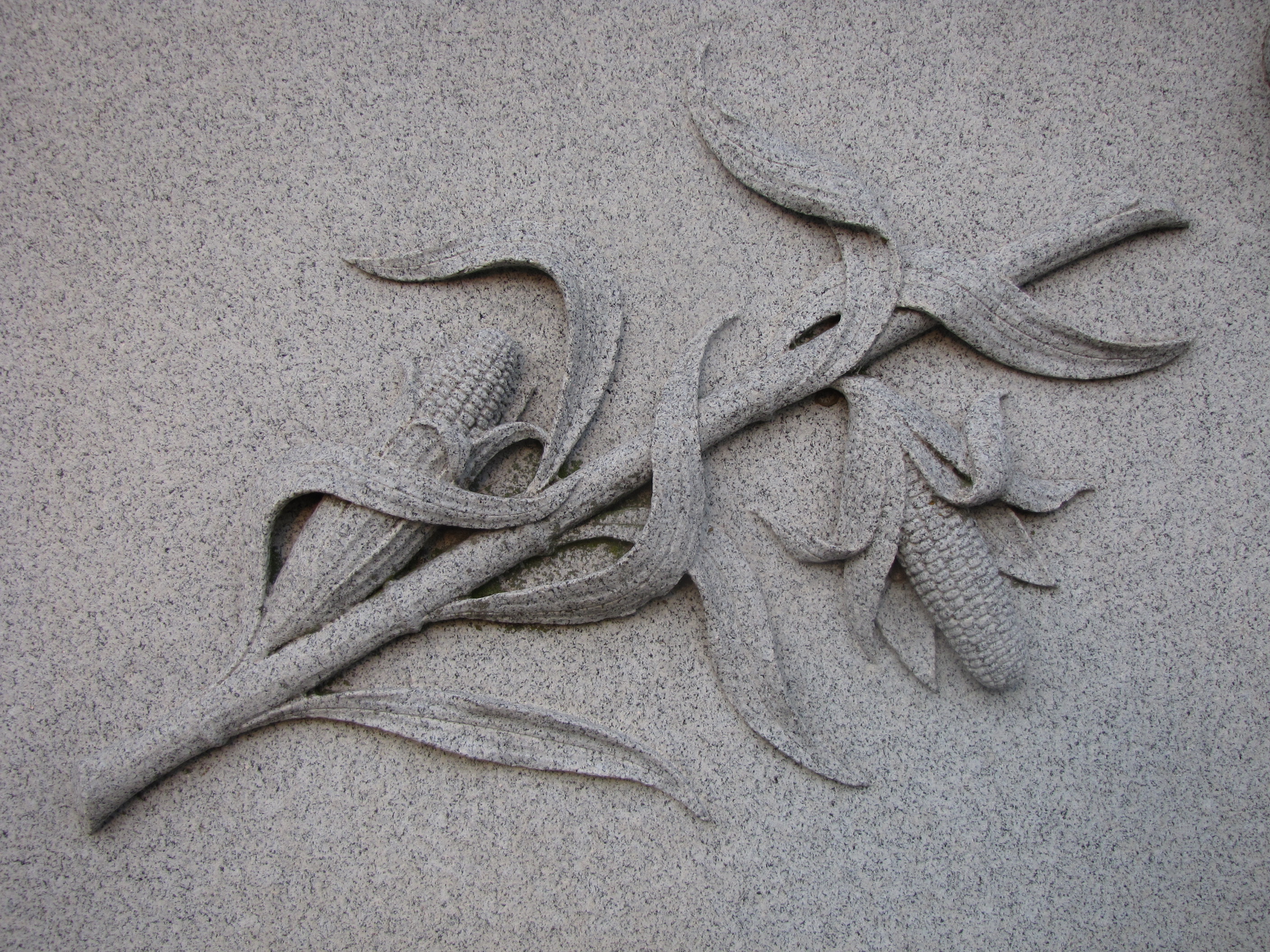
A stalk of corn is carved into the Bone Family gravestone in the Walnut Hill Cemetery at Council Bluffs, Iowa.

Corn is an ancient American crop that has been exported to all corners of the world.  More than 300,000 million tons of corn are grown in the United States every year.  It is not only ubiquitous in our Midwestern fields but corn syrup is in nearly every food on the grocery store shelf.

It is right and fitting then that corn represents fertility since its abundance is obvious.  It also represents rebirth in funerary art.

IMG_7261

Posted in Uncategorized | Leave a comment

The Bigelow Sphinx

IMG_5547

A large sphinx sets across the grass circle from the Gothic chapel in the Mount Auburn Cemetery at Cambridge, Massachusetts.  The statue, sculpted by Martin Milmore, is a massive eight feet tall and fifteen feet long.

Carved into the sides of the base of the sculpture is a Latin inscription:

AMERIC CONSERVATA,

AFRICAN LIBERATA,

POPULO MAGNO ASURGENTE,

HEROUM SANGUINE FUSO.

Which translates to:

AMERICAN UNION PRESERVED,

AMERICAN SLAVERY DESTROYED

BY THE UPRISING OF A GREAT PEOPLE

BY THE BLOOD OF FALLEN HEROES.

The creation of the sphinx was funded by Dr. Jacob Bigelow, one of the founders of the great cemetery.   It was commissioned to commemorate the end of the American Civil War.  This sphinx is a fusing of symbolism—Egyptian and American.  The face of the sphinx is an Anglo-American woman mounted on the powerful body of an African lion.  She wears the Egyptian royal headdress embellished with an American bald eagle.  And her necklace is a six-pointed star military medal.  Dr. Bigelow’s idea was to combine the symbolism in a way to symbolize how postwar white and black America would work together to build an American future with “illimitable progress.”

Bigelow’s sphinx to commemorate the Civil War eschewed the conventions of the day regarding public monuments in the North and the South.  While the enigmatic sphinx is well within the Egyptian Revival movement that was popular during the 19th Century, it certainly was outside what most communities built as Civil War memorials. Most communities erected memorials of statues of Union or Confederate volunteers and bas-reliefs of battles.  The sphinx represented a break from the traditional.  While monumental in scale, as was the Lion of Lucerne, the sphinx does not extoll martial valor, courage, or strength.  The face of the sphinx was an allegorical representation of Freedom, Liberty, or Hope.  The message of the sphinx itself was that while it was looked upon as a figure of antiquity, was now a figure looking forward—a new nation breaking the bonds of the past and rising from the bloodshed to a new greatness.

Unfortunately, for Bigelow, the meaning of the statue was almost immediately misunderstood, and now his monument is more of a curiosity today than what he had intended.

For a more in-depth read about the Bigelow sphinx read “The Americanized Sphinx” written by Dr. Joy M. Giguere, Assistant Professor of History at Ivy Tech Community College at Fort Wayne, Indiana and the Indiana State Chairperson for the Association of Gravestone Studies.

IMG_5549

Posted in Uncategorized | 2 Comments

The Confederate Memorial Pyramid

Hollywood Cemetery, Richmond, Virginia

Hollywood Cemetery, Richmond, Virginia

After the French and British occupations of Egypt, there was a renewed interest in Egyptian architecture and symbolism.  That Egyptian Revival was never more evident than in America’s cemeteries, especially large garden cemeteries.  The Egyptian symbol that is most commonly found in American cemeteries of all sizes is the obelisk.  The obelisk is said to represent a single ray of sunlight, petrified from sunlight into stone.  It was thought that the Egyptian sung god Ra lived within the obelisks.  These towering monuments were often placed flanking the entrance to temples.  The most famous obelisk in America is the Washington Monument in Washington, D.C.

But the pyramid, the tomb of the pharaohs, is by far the epitome of Egyptian funerary architecture.  The oldest pyramid is the Pryamid of Djoser built over four thousand years ago from 2630 BC to 2612 BC.  The largest of the Egyptian pyramids is the Pyramid of Khufu at Giza built between 2589 and 2566 BC.

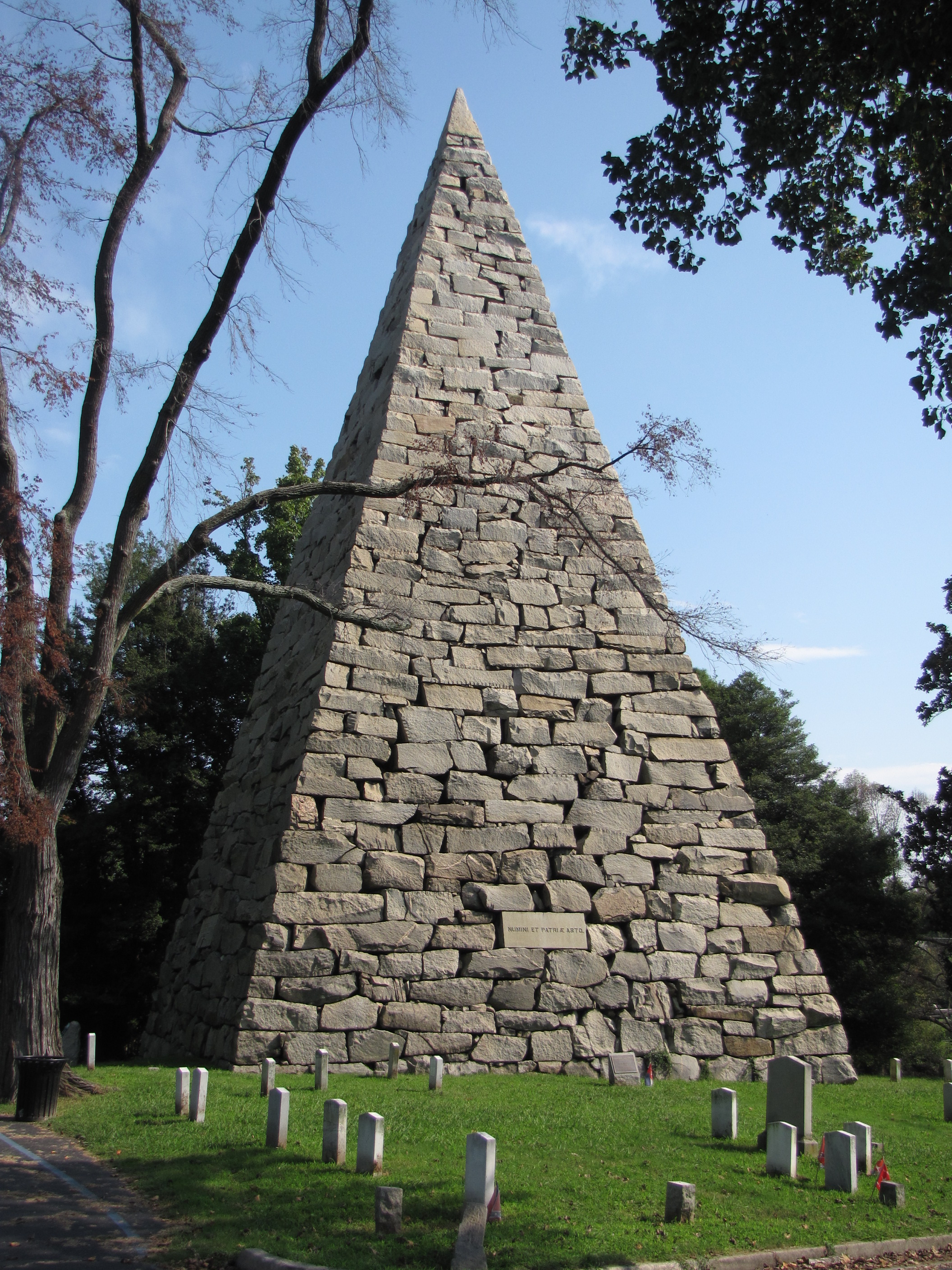
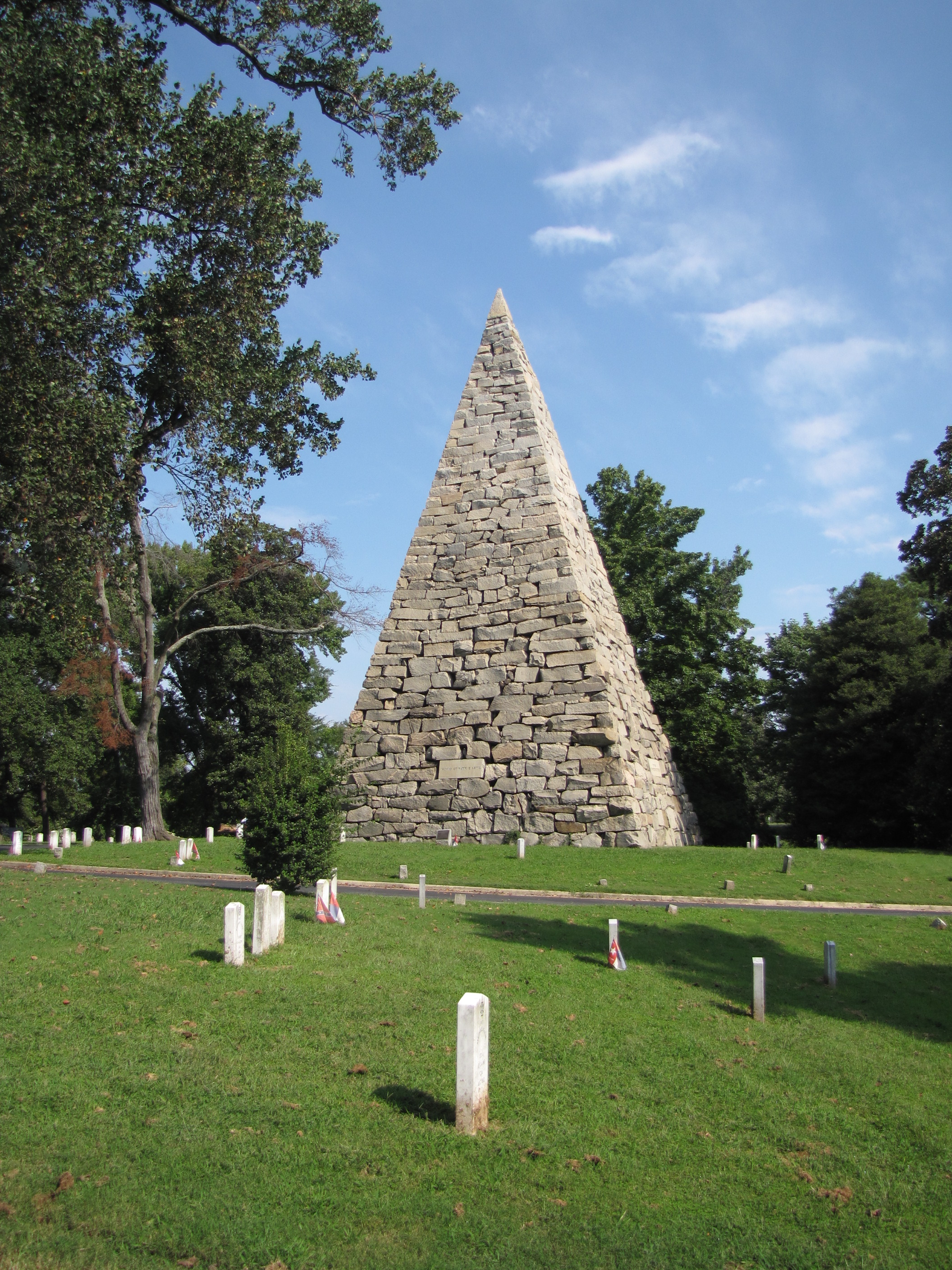
Most likely the largest pyramid found in an American cemetery is the pyramid dedicated to the 18,000 Confederate war dead in the Hollywood Cemetery at Richmond, Virginia. Designed by Charles H. Dimmock, a civil engineer of the Confederate Army, it has a base of 45 square feet and a height towering at 90 feet tall.  The pyramid is built from granite stones pulled from the nearby James River.  The pyramid was begun on December 3, 1866, and built by prisoners in just short of three years—the capstone was laid into place on November 8, 1869.  The pyramid encapsulates several artifacts that were dear to Confederate soldiers, including a button from General Stonewall Jackson’s coat, a Confederate flag, and a lock of President Jefferson Davis’ hair.

Large granite blocks on the four sides of the pyramid read, “MEMORIA IN ACTERNA”, “NUMINI ET PATRIAC ASTO”, “ERECTED BY THE HOLLY-WOOD MEMORIAL ASSOCIATION A.D. 1869”, and “TO THE CONFEDERATE DEAD.”  The Latin translates to “in eternal memory of those who stood for God and country”.

IMG_6344

Posted in Uncategorized | 1 Comment

Southern War Memorials

Frankfort Cemetery, Frankfort, Kentucky

Frankfort Cemetery, Frankfort, Kentucky

Throughout the South, war memorials were erected to honor the Confederate war dead.  Just as in the North, commemorative statues, often of a soldier perched on a pedestal, give voice to the loss and sorrow felt in the country after the Civil War.  In this example at the Frankfort Cemetery at Frankfort, Kentucky, the soldier is mounted on top of a pedestal.  Confederate soldiers are buried circled around the statue.  The statue pedestal contains the following poem:

They sleep—What need to question now

If they were right or wrong?

They know ere this whose cause was

Just in God the father’s sight

They wield no warlike weapons now

Return no foeman’s thrust

Who but a coward would revile

An honored soldier’s dust?

Oakland Cemetery, Atlanta, Georgia

Oakland Cemetery, Atlanta, Georgia

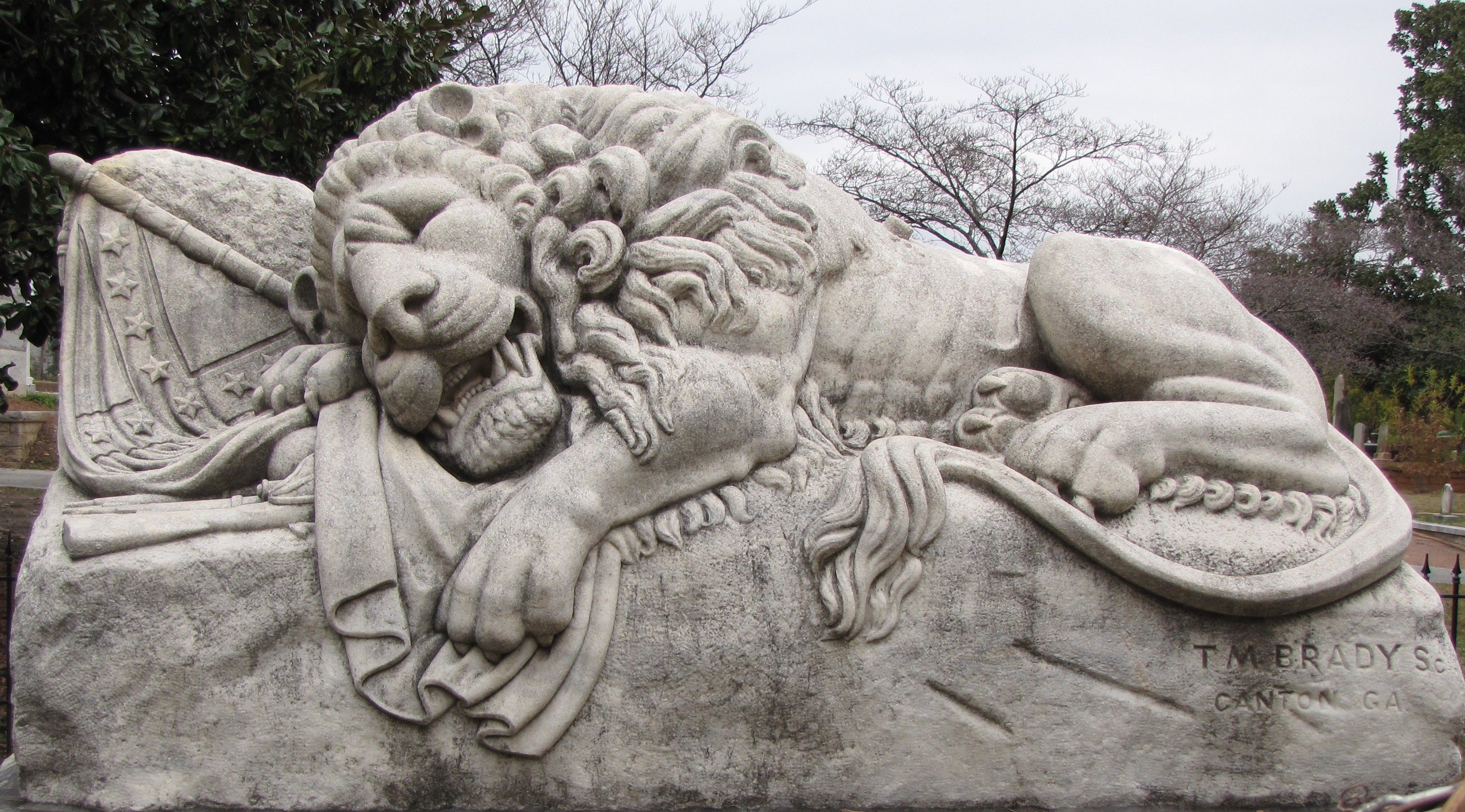
One of the great war memorials in the South, is in the Oakland Cemetery at Atlanta, Georgia, commissioned by the Ladies Memorial Association dedicated to nearly 7,000 Confederate soldiers buried there.  T. M. Brady of Canton, Georgia, created a monument to the unknown Confederate war dead buried in Oakland Cemetery.  The sculpture was commemorated on April 26, 1894.  The great dying lion has a pained expression on its face as his heroic body rests on the Star and Bars battle flag and a rifle.  The inspiration for the Lion of Atlanta was Bertil Thorvaldsen’s colossal Lion of Lucerne (Switzerland), which Mark Twain called “the most mournful and moving stone in the world.”  

Posted in Uncategorized | 1 Comment

The Civil War

Forest Lawn Cemetery, Omaha, Nebraska

Forest Lawn Cemetery, Omaha, Nebraska

Many memorials and commemorative statues were erected to honor the Civil War dead in cemeteries and town squares across America.  These statues most often include the statue of a soldier perched on a pedestal, often with the war dead buried beneath it.

Forest Lawn Cemetery, Omaha, Nebraska

Forest Lawn Cemetery, Omaha, Nebraska

No other war  was like the American Civil War for Americans because every sailor or soldier, every collateral death, every field or railway yard that was destroyed, every city or town devastated by artillery was American.  And, more Americans were killed in the Civil War than any other war that Americans have fought in.

Total American Deaths by War

Civil War                        625,000

World War II                  405,399

World War I                   116,516

Vietnam                            58,151

Korean War                      36,516

Revolutionary War           25,000

War of 1812                      20,000

Mexican American War    13,283

War on Terror                      6,280

Spanish American War       4,196

During the Civil War Americans were fighting against Americans. Brothers against brothers—cousins against cousins, every casualty and every fatality was an American. The war tore the country apart and threatened the existence of the Republic.  Cemeteries throughout the United States pay tribute to the soldiers that fought to preserve the Union, often with special sections where soldiers are buried.

Union Cemetery, Uhrichsville, Ohio

Union Cemetery, Uhrichsville, Ohio

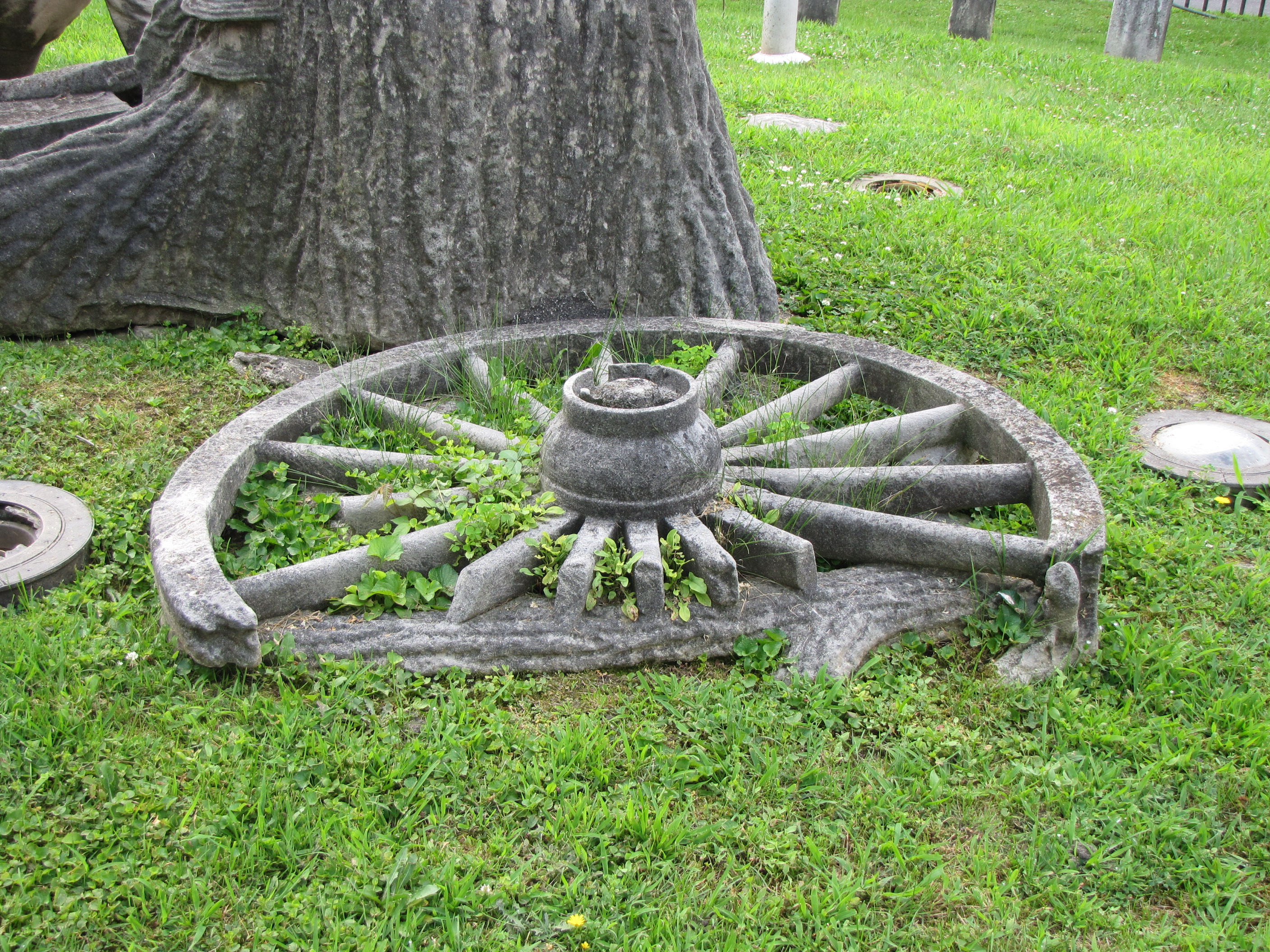
The example of the Civil War Memorial in the Union Cemetery at Uhrichsville, Ohio, is a dramatic example.  It is carved in limestone in the rustic style that was popular in the late 19th Century.  The main element is the large tree-stump in the center of the memorial, which is a symbol of a life cut short.  In this memorial, too, are two soldiers, one who appears to have been wounded.

In addition to that, that memorial features other symbols of interest.

IMG_4706

At the base of the tree, lies a broken wagon wheel.   The wheel is broken, the circle is incomplete at the bottom with spokes hanging freely.  The wheel is a metaphor for the circle of life which is broken by death.  Many symbols, like the hanging and broken bud, the broken column, and the broken wheel represent the end of life’s journey.

IMG_4703

Also, in the crouch of the tree is a squirrel holding an acorn.  The symbolism behind the squirrel is a bit confusing.  Some sources say that if the squirrel is holding a nut, it is a sign of religious meditation and spiritual striving.  Other sources say that the squirrel is an animal devoted to the devil, noted by its red color; red–the color of Satan.

Note: I first saw the gravestone above on the Website: www.graveaddiction.com.  Beth Santore, the Webmaster has photographs of hundreds of cemeteries posted on her site.  I highly recommend her Website, especially for those tramping around Ohio graveyards!

Posted in Symbolism | 1 Comment

The Eternal Flame

IMG_3963

50 years ago today, Jacqueline Kennedy lit the eternal flame marking the grave of the fallen president, John F. Kennedy, who lies buried in Arlington National Cemetery.  The flame was requested by Mrs. Kennedy who was inspired by several sources including Candle in the Wind, the fourth book in the series by T. H. White, which was the inspiration for the musical Camelot.

Posted in Presidential graves | Leave a comment

Caboose Re-do

Union Cemetery, Uhrichsville, Ohio

Union Cemetery, Uhrichsville, Ohio

When I first wrote about Charles Witting’s gravestone, I had not seen his name or inscription on his gravestone.  It is faint and faded and completely slipped by me.  But a reader, Athyna, wrote to me to tell me that I had, in fact, missed Charles Witting’s name, death date and age at the time of his death, which were all carved on the gravestone.  She agreed to go back to the cemetery and get the information and I agreed to see if I could do some more research on the person buried beneath this one-of-a-kind tombstone.

Athyna wrote and gave me the following information:

Charles E. Witting

Died May 4, 1900

Aged 27 YR 6 MO 4 DA

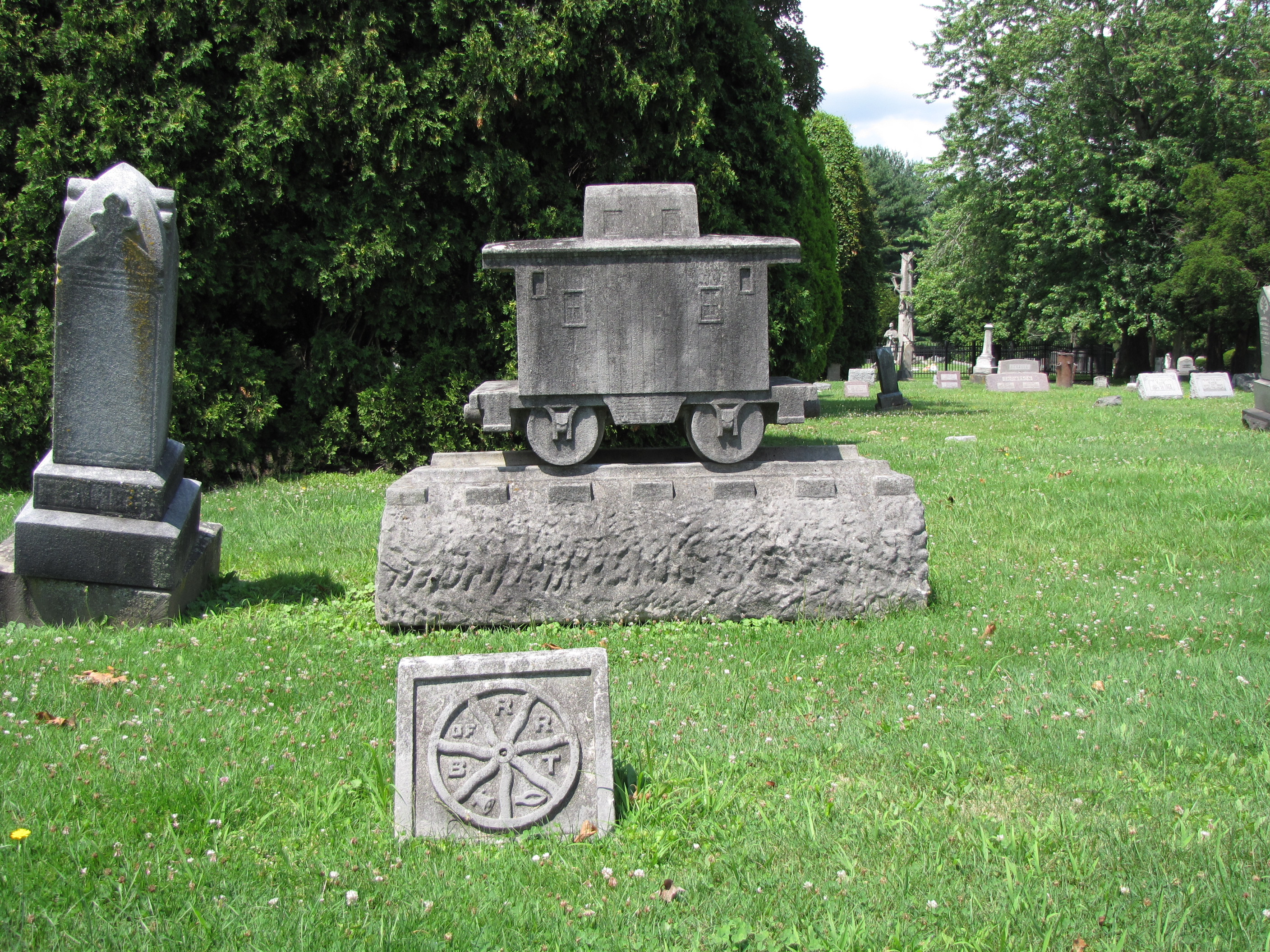
As I wrote earlier, “this intricately carved gray marble caboose, track, and wheel displaying the letters: B of RRT can be found in the Union Cemetery at Uhrichsville, Ohio.  The tale told by the cemetery maintenance crew about the marker is that the man buried under the railroad car was killed by a wheel that came off the train, which is displayed in front of the car.”

Besides being a cruel joke to show the weapon of one’s demise at one’s graveside, the story is only partially true. The wheel depicted in front of the caboose commemorates Witting’s membership in the Brotherhood of Railroad Trainmen.  BUT, it was the caboose that actually killed Witting NOT the wheel.

In an ironic twist, the very thing that killed Charles E. Witting became the image for his gravestone.  The caboose sculpture marking his grave also represented the job he loved and held for 8 years–again, the thing he loved, killed him.

According to the Ohio Democrat and Times, Thursday, May 10, 1900, Witting was crushed by a caboose, “One of the saddest accidents of its kind was that which occurred just west of Coshocton on Friday evening last, in which one of the best men in the employ of the Pan Handle railway company suddenly met death. Charles E. Witting of Columbus, acting as a flagman until his promised promotion to conductor, was crushed to death by an overturned caboose. The breaking of the axle on the front truck of the car next to the caboose caused part of the train to be derailed while going at the regular rate of speed. Witting and two others, one of whom was the conductor were in the overturned portion of the train. Witting jumped from the platform of the swaying car. The others who were in the caboose went over with it and received only bruises while Wittings lifeless body was extricated with difficulty from under the overturned car. He leaves his wife and infant son, a twin brother, William E. Witting, an aged father and mother who live in Frazeysburg and other relatives. Charles was only 27 years of age and had been in the employ of the Pan Handle railway company continuously for more than eight years. The funeral was held Monday at 2 p.m. from the home of his father-in-law Frank Davis in Uhrichsville and Charles Witting is now quietly sleeping away the years of his promising manhood in the beautiful Union Cemetery at that place.”

Charles Witting, at only 27, died leaving a pregnant widow, Margaret (Davis) Witting, with a small son, Charles E. Witting, named for his father.  Just 5 months after the tragic accident, Margaret gave birth to a second son, William, named for Charles’ twin brother.

According to an article printed by the Modern Mechanix, March, 1937, it was reported that Witting’s tombstone was, “designed after the old-fashioned type of freight caboose, the headstone is mute evidence of the work Witting so much loved.  Members of the Uhrichsville chapter of the Brotherhood of Railroad Trainmen, of which Witting was a member, helped to erect the marker.”

Note: I first saw the gravestone above on the Website: www.graveaddiction.com.  Beth Santore, the Webmaster, has photographed hundreds of cemeteries in Ohio, as well as, making photo forays into neighboring states.  I highly recommend her Website, especially for those tramping around Ohio graveyards!

Posted in Uncategorized | 4 Comments

Descending Dove

Paschall Mausoleum, Mt. Olivet Cemetery, Nashville, Tennessee

Paschall Mausoleum, Mt. Olivet Cemetery, Nashville, Tennessee

Through the hazy blue dim light of the interior of a mausoleum the dove carrying an olive sprig appears in the stained-glass window.

Many symbols found on gravestones have multiple meanings. The dove is one of those.

 Several references in the Bible refer to the dove as a symbol of the Holy Spirit. Matthew 3:16 reads, “And Jesus, when he was baptized, went up straightway out of the water: and, lo, the heavens were opened unto him, and he saw the Spirit of God descending like a dove, and lighting upon him.” In Mark 1:10 the Bible says, “And Straightway coming up out of the water, he saw the heavens opened, and the Spirit like a dove descending upon him.” Again in John 1:32, the Bible reads, “And John bare record, saying, I saw the Spirit descending from heaven like a dove, and it abode upon him.”

Along with the dove symbolizing the Holy Spirit, the dove is also closely associated with peace, often depicted with a sprig of an olive in its beak. This, too, originated in the Bible. After the waters receded in the story of Noah, the dove appears. Genesis 8:11, “And the dove came in to him in the evening; and, lo, in her mouth was an olive leaf pluckt off; so Noah knew that the waters were abated from off the earth.”   It was a sign of God’s forgiveness.

The dove, with its white color, is also a symbol of purity and innocence and for that reason is often found the tombstones of children.

Thus the dove symbolizes the Holy Spirit, peace, and purity.

Posted in Uncategorized | 1 Comment

The Easter Lily

IMG_2696

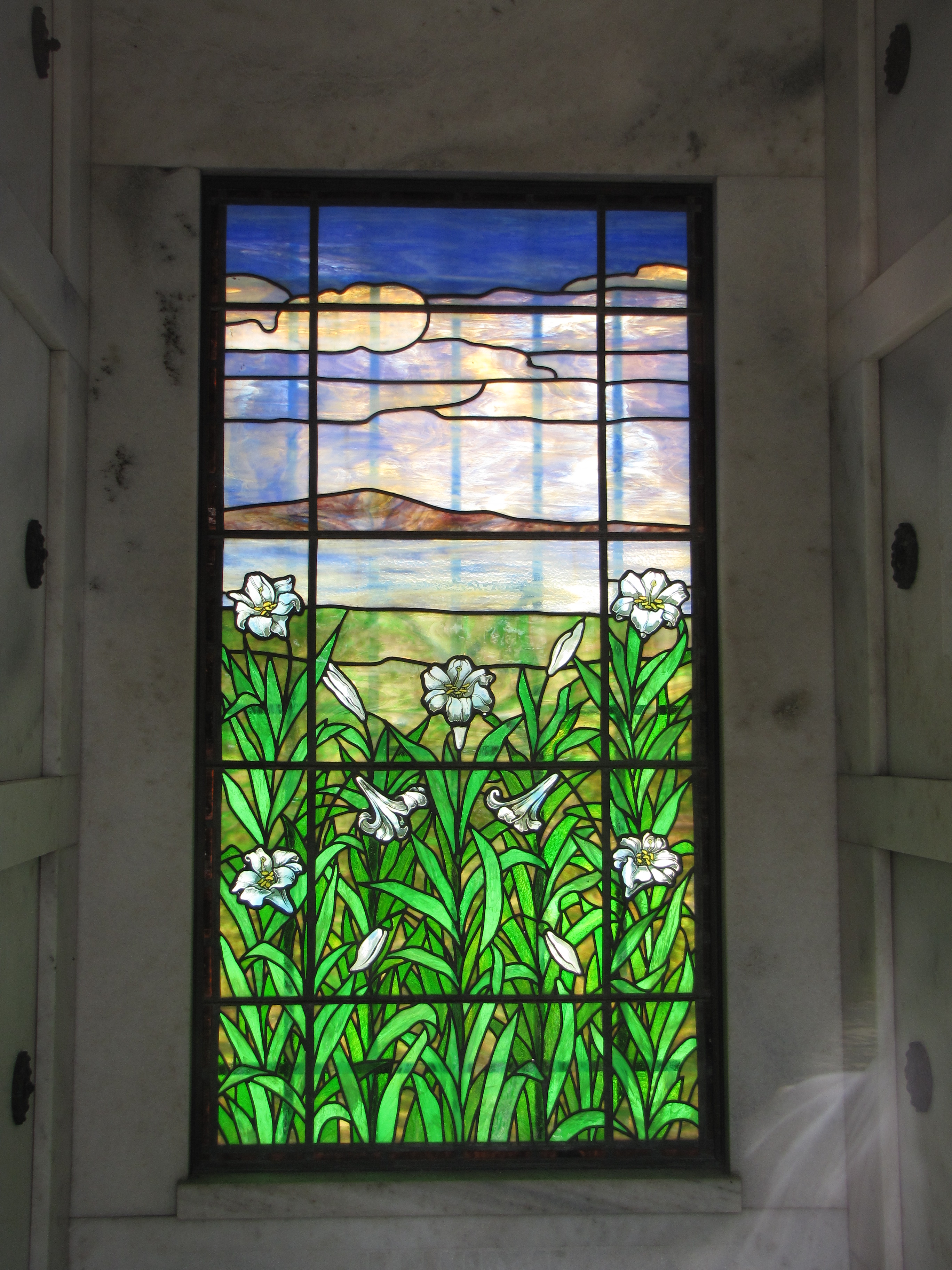
The lily, as a funerary symbol, has many meanings including purity, innocence, virginity, heavenly bliss, majestic beauty, and Christ’s resurrection.  Christians believe that the trumpet-shaped blossoms announce the Resurrection of Jesus Christ. As pictured in the stained-glass window above in the Charles Buck Mausoleum in the Metairie Cemetery at New Orleans, Louisiana, the white lilies symbolize the hope of eternal life.

The Easter Lily has long been associated with the Christian religion, commonly referred to as “White-Robed Apostles of Christ.” Early Christians believed that lilies sprouted where Jesus Christ’s sweat fell to the ground in the Garden of Gethsemane.

White has typically been a color associated with virtues of purity and innocence.  Often the lily can be found on the grave of a child, the epitome of purity and innocence.

The white lily is also associated with virginity and marriage, in particular relationship to women.  On one hand, the lily represents virginity and innocence, which is an appropriate symbol for a young unmarried woman.  On the other hand, it is symbolic of majestic beauty and marriage, which makes it an appropriate symbol for all married women regardless of their age.

Posted in Uncategorized | Leave a comment

Calla Lily in Glass

Folsom Family Mausoleum, Crown Hill Cemetery, Indianapolis

Folsom Family Mausoleum, Crown Hill Cemetery, Indianapolis

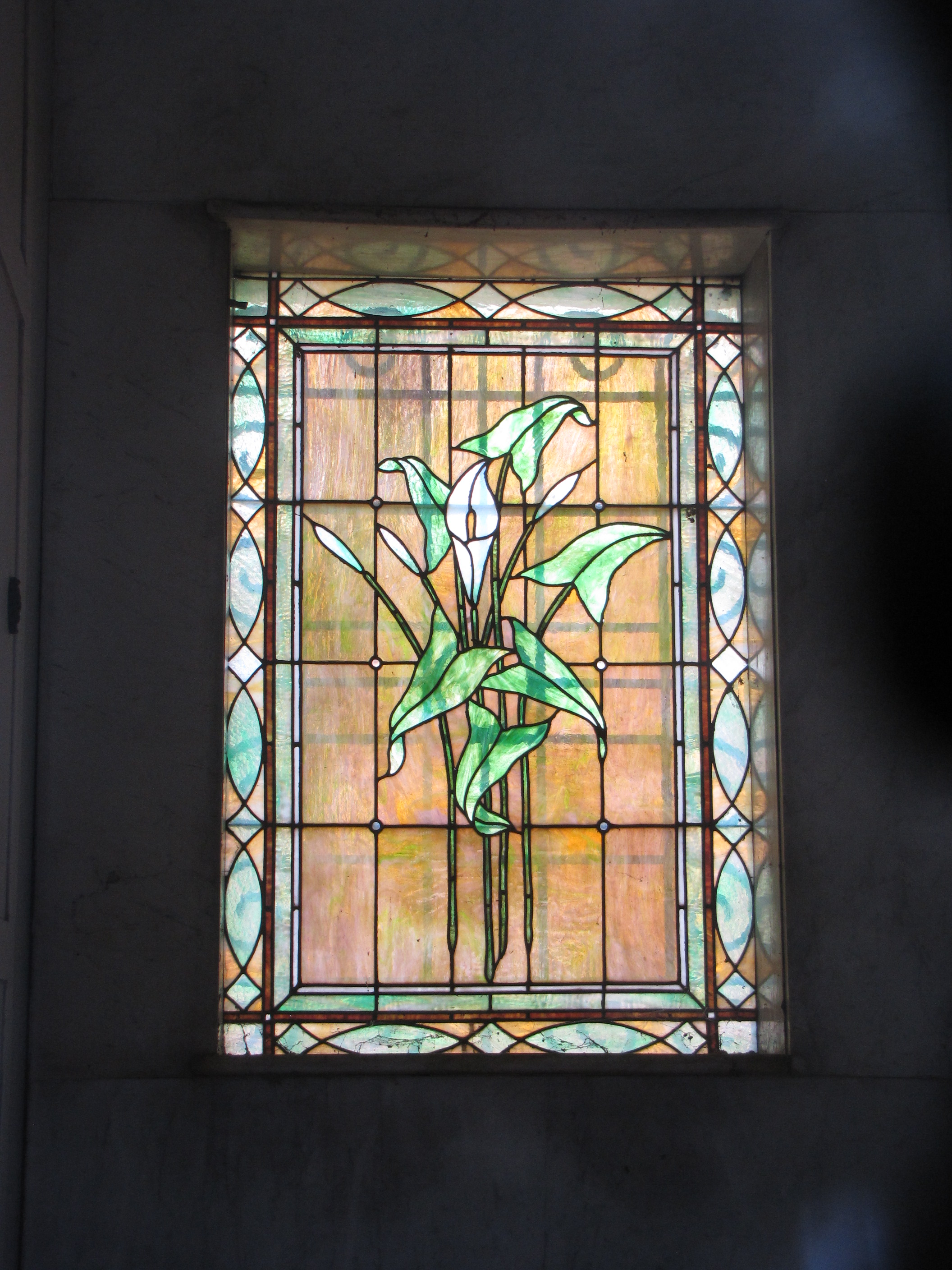
The stained glass window in this Crown Hill Cemetery mausoleum at Indianapolis features a single white calla lily in full blossom surrounded by three stems with buds. The calla lily is a stunner with its long slender stem, brilliant white flowers, and broad leaves.  Though it is called a lily it is actually not in the flower family liliacea.

The South African native is actually a cousin to the jack-in-the pulpit and is in the family of araceae.  In Africaans the calla lily is called the Varkoor, or pig’s ear, because that is what they believed it resembled. The calla lily was imported out of South Africa in the later part of the nineteenth and early twentieth century.  It almost immediately became associated with Easter and is sometimes referred to as an Easter lily.

The calla lily represents majestic beauty and is often used on funerary art to symbolize marriage.  In some cases, they can also represent the resurrection.

Posted in Uncategorized | Leave a comment