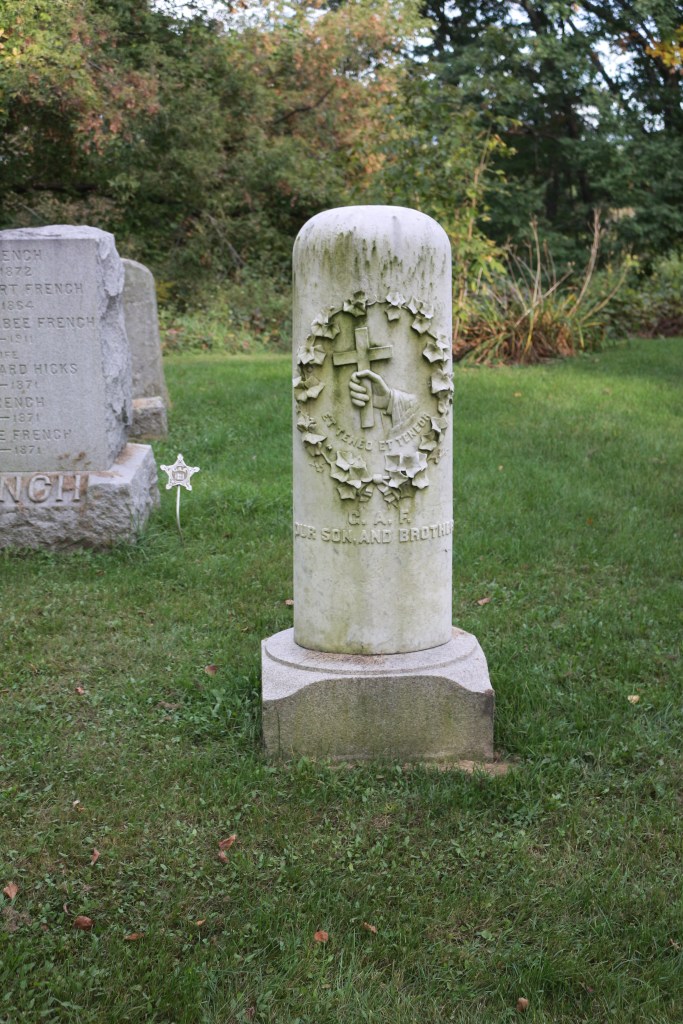
On the large gray granite family stone behind the white marble round top column, G.A.F. is listed:
George Albert French 1841 – 1864
The column dedicated to George Albert French has two main symbols dominating the marker—the ivy tied with a bow into a wreath and, in the middle of the wreath, a hand holding a Latin cross. Both symbols, like many symbols found in cemeteries, have several different meanings.
Ivy leaves are a common motif in American cemeteries and Victorian art. Because of ivy’s ability to survive in harsh weather and dry conditions, it has become associated with immortality and rebirth. Ivy leaves twinning up a gravestone can also represent friendship. Because of its ability to “hang on” the symbol has come to represent undying attachment.
The hand holding the cross is a obvious symbol of a person’s Christian faith. It can also represent the hope for eternal life.
Lastly the Latin epitaph, ET TENEO ET TENEOR, translates in English to “And I hold and I hold”. “I hold” is repeated twice for emphasis and conveys hanging on or not giving up–determination.
Gravely Speaking and Syngrammata have decided to dig deep into our photo collections in order to bring you pairs of images drawn from our many years combing through American cemeteries. Each pair will be linked by a theme which we are free to interpret. Suggestions of future themes to follow are welcome in the comments! This week’s theme is humor.
Gravelyspeaking writes:
Nothing is as final as death. The quote, “Dead men tell no lies” reminds us of the silence of the grave. However, the dead can speak one last time in wills, diaries, letters, and epitaphs. Though many epitaphs are chosen for the person after he or she has passed away, some people do choose their own. Mel Blanc’s epitaph signs off with his signature Porky Pig closing at the end of the Looney Tunes cartoon, “That’s All Folks!” One wonders if Mr. Blanc was also making a larger statement on the afterlife.
In the case of Barry Becher, the advertising guru who pioneered late-night infomercials hawking Ginsu Knives who just recently died, his family has announced that his epitaph will read, “But wait, there’s more!” This is his famous catch phrase that has been mimicked by nearly every infomercial now. Again, this epitaph could be read as a double entendre referring to the hereafter.
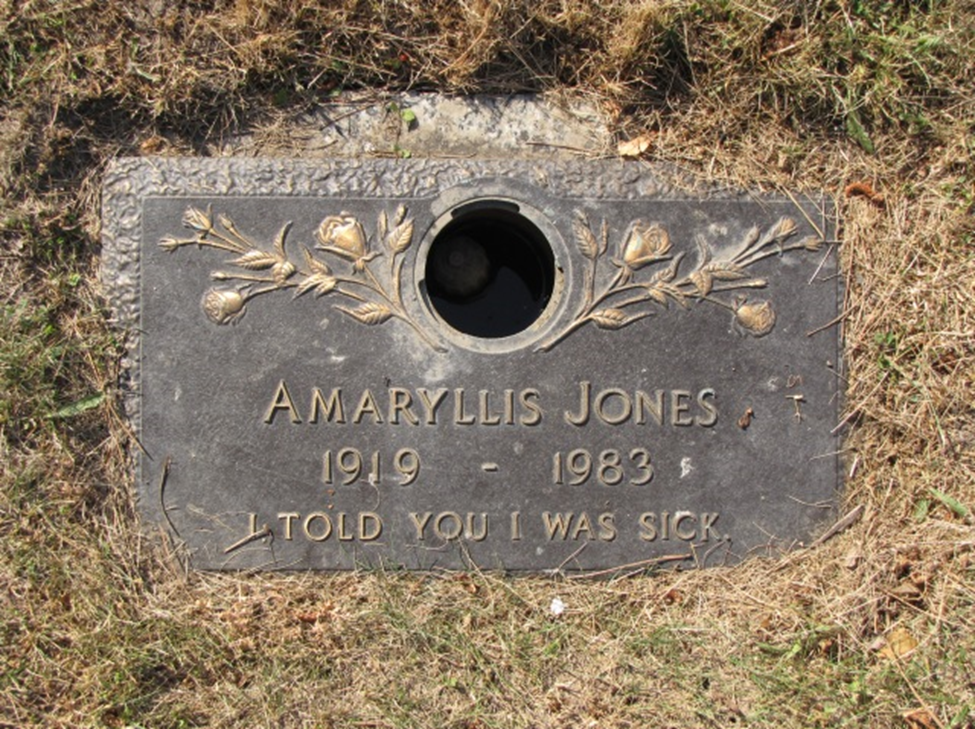
Amaryllis Jones, who is buried in the Forest Lawn Cemetery in Buffalo, New York, also had the last word. Her epitaph reads, “I told you I was sick.” No mistaking that message; she wanted to remind those who she left behind that she was not complaining, this was not the typical ailment, that she was RIGHT, she was sick! Or, she had a good sense of humor.
Syngrammata writes:
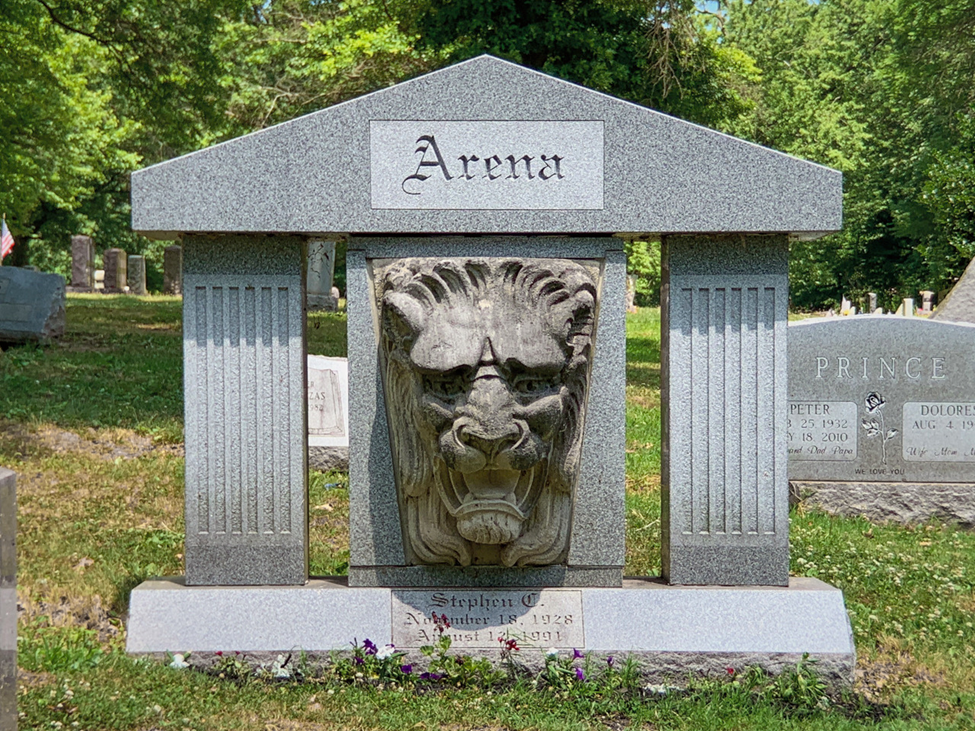
In Riverside Cemetery in Norristown, Pennsylvania, Stephen C. Arena has built a notable monument for himself, embedding an architectural fragment within a newly carved granite framework. The architectural fragment is the keystone of an arch in the form of a lion’s head. One imagines Mr. Arena rescued or collected it in the Robert Moses era when older American buildings were being torn down for the sake of beltways and modernization. Ours is a fierce lion, threatening us with a wide-mouthed snarl. The modern framework for the old lion’s head is worth paying attention to. The pillars are decorated streamlined fluting, and above all rests a pediment like an ancient temple. As I read the monument, it is a classical setting, an “arena,” if you will, which features a lion as a part of the entertainment. Which made me laugh out loud when I first saw it!
There is an unassuming gravestone in the Mount Hope Cemetery in Rochester, New York—the unadorned rounded-top white marble marker for Susan B. Anthony.
On Election Day, as a tribute to Anthony’s efforts to secure voting rights for women, voters trek to her grave to place their “I VOTED” stickers on her gravestone. Even though women could not legally vote, Anthony actually did in 1872. She was arrested for that act of defiance, but it did not dampen her mission of gaining suffrage for women. Anthony devoted her energy and her life to it. Unfortunately, she died fourteen years before the 19th Amendment granted women the right to vote in 1920. However, she is still recognized and remembered for that fight.
I wonder what she’d think of this election?
The cemetery officials post signs asking visitors to her grave to not place the stickers on her grave, though, some years her entire marker has been covered with them anyway. Now some paste their stickers on the post close to her grave.
Gravely Speaking and Syngrammata have decided to dig deep into our photo collections in order to bring you pairs of images drawn from our many years combing through American cemeteries. Each pair will be linked by a theme which we are free to interpret. Suggestions of future themes to follow are welcome in the comments! This week’s theme is Día de los Muertos.
Gravely Speaking writes:
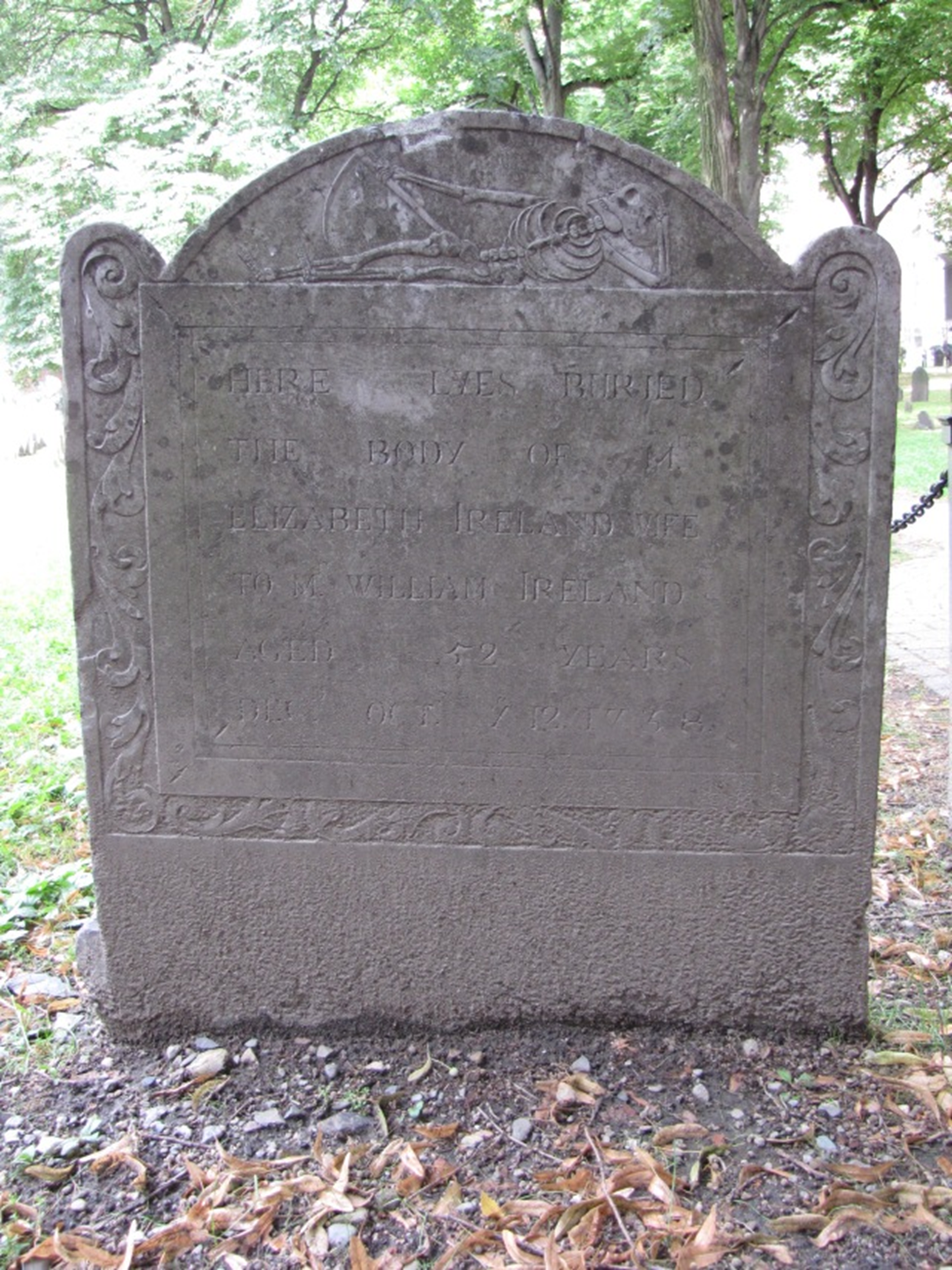
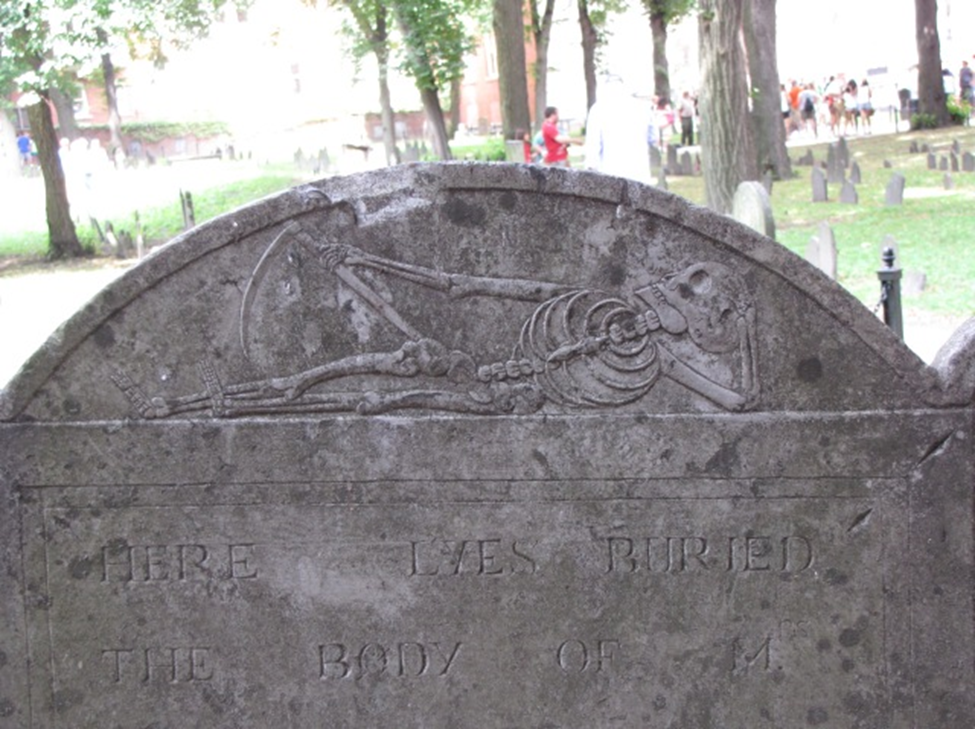
The King of Terrors takes a rest
HERE LYES BURIED THE BODY OF MRS. ELIZABETH IRELAND WIFE TO MR. WILLIAM IRELAND AGED 52 YEARS DEC’D. OCT. Ye 12, 1738.
Many symbols in the graveyard are meant to remind passersby that life is short and that all will die. These images are called Memento Mori and are a call to “remember death“. The skeleton is one of these symbols. The skeleton above is holding a scythe, a weapon with which the lives are cut down in the Divine Harvest. When the skeleton is depicted with a scythe, arrow, spear, or darts, the figure is referred to as the “King of Terrors”. Here, on this gravestone in the Granary Burial Ground at Boston, the King of Terrors is depicted reclining, either taking a respite from the exhausting work of harvesting lives or resting up before his brutal work begins.
Syngrammata writes,
Death and the Maiden
In Spring Forest Cemetery in Binghamton, New York, Oliver C. and Clarissa Crocker erected this columnar monument for their son, John K. Crocker.
JOHN K. CROCKER SON OF OLIVER C. AND CLARISSA CROCKER DIED OCT. 4, 1862, AGED 23 YEARS
Death, in the guise of Father Time, creeps up on an unsuspecting maiden. His scythe and the hourglass tell us what we need to know about him. The maiden represents Crocker only in a indirect way: death follows us all. In fact, this is a rare version of the story of ‘Death and the Maiden’. She represents sensuality and life, and she is distracted from noticing death creeping up on her by the vanities she contemplates: posies, a book, the cup. The broken column she rests upon is itself a constant symbol of life cut off short. This monument encourages us to look over our shoulders and ready ourselves for that final moment, and as such this image, like Gravely Speaking’s astounding skeleton, falls into an even larger category: the memento mori: “remember that you will die.”
Gravely Speaking and Syngrammata have decided to dig deep into our photo collections in order to bring you pairs of images drawn from our many years combing through American cemeteries. Each pair will be linked by a theme which we are free to interpret. Suggestions of future themes to follow are welcome in the comments! This week’s theme is: the most unusual gravestone, fitting for Halloween.
Gravely Speaking writes:
Indiana limestone is abundant in the state. Some of the most flawless limestone can be found in a rich trough between Bedford and Bloomington referred to as Salem limestone. The Pentagon, the soaring National Cathedral and the solemn Lincoln Memorial in Washington, D.C., New York City’s Empire State Building, the Biltmore Mansion is Ashville, North Carolina, and 35 of the 50 state capitol buildings were built with Indiana limestone. It is a beautiful, rich cream-colored stone that is fairly easy to work. Generations of talented carvers learned their craft in this state, and it continues to be a place of gifted and creative carvers.
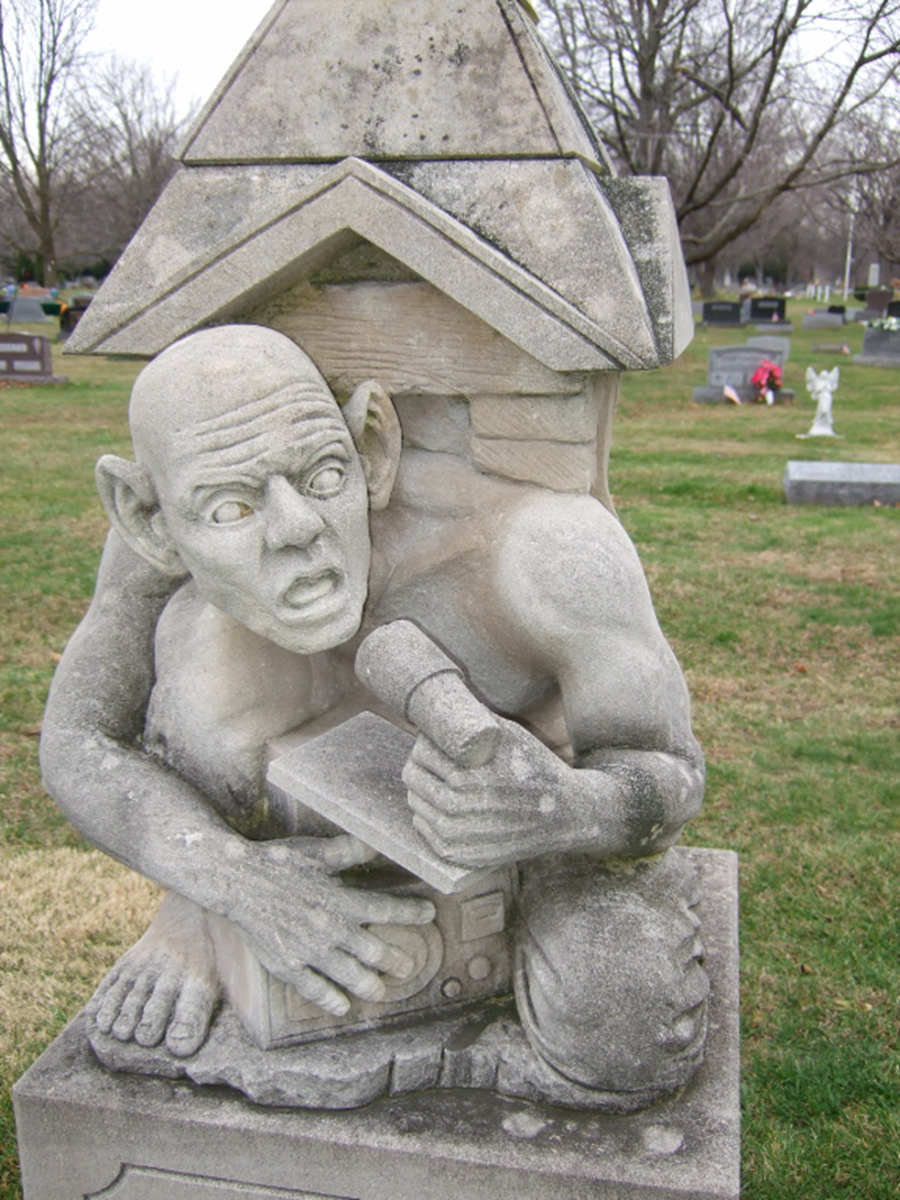
Not only can the stone carvers’ talents be seen in spectacular buildings but even in modest tombstones across the state. Indiana has thousands of tree-stump tombstones that dot cemeteries through the entire state and exported throughout the country. The carvers have also created one-off works of art. One such marker, photographed by my friend and neighbor, Doug Parker, is the tombstone of Charles Jacob Affelder in the Chesterton Cemetery in Chesterton, Indiana, in the Northwest corner of the state.
The tombstone has a figure that some people on various Web sites refer to as a Gollum-like creature from Tolkien’s The Hobbit, crouching under a gothic roof. The bare-chested man has his right hand resting on the top of a ham radio and his other hand is clutching a microphone. Carved on the front of the tombstone is, “Charles Jacob Affelder, N3AYU.” The tombstone is a curious sight, in an otherwise average Midwestern cemetery.
Further investigation of the deceased Affelder reveals that he was born August 5, 1915, in Allegheny County, Pennsylvania. He was an avid ham radio enthusiast. The mix of letters and numbers, A3AYU, listed underneath his name was his ham radio callsign. Affelder had been a ham operator since 1933. He held several patents for improvements to the radio microphone, perhaps memorialized in stone on his marker. Affelder also worked for KDKA in Pittsburgh and for the Voice of America behind the scenes as an engineer. Affelder’s tombstone is a tribute to his love of the radio world to which he dedicated so much of his life and career. Charles Jacob Affelder died on January 10, 1994, at Chesterton, Porter County, Indiana.
Syngrammata writes,
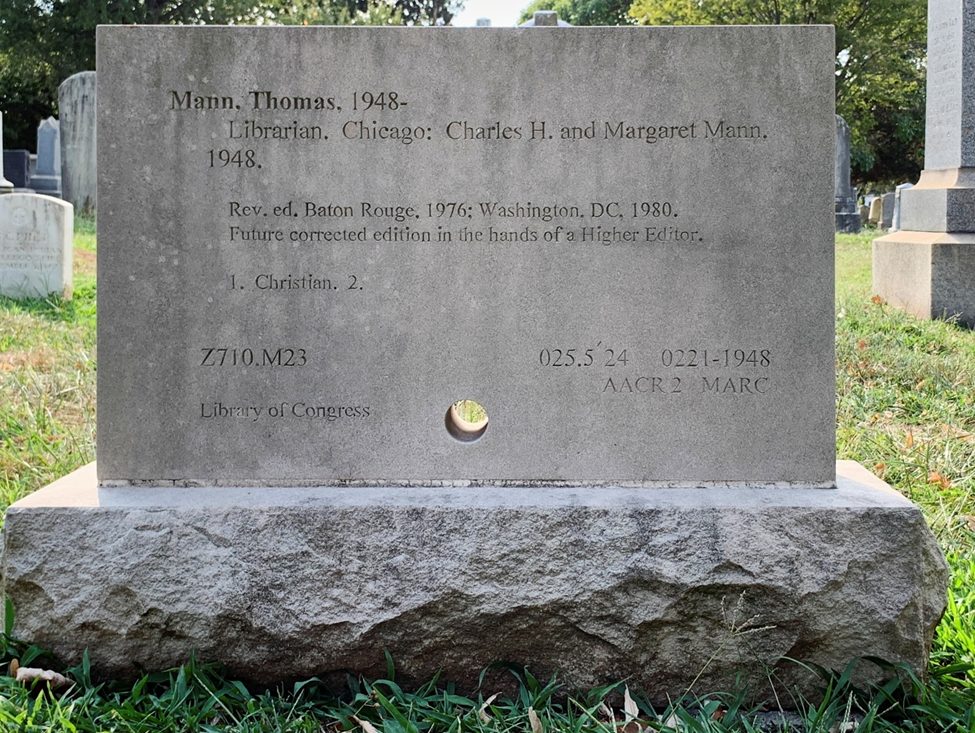
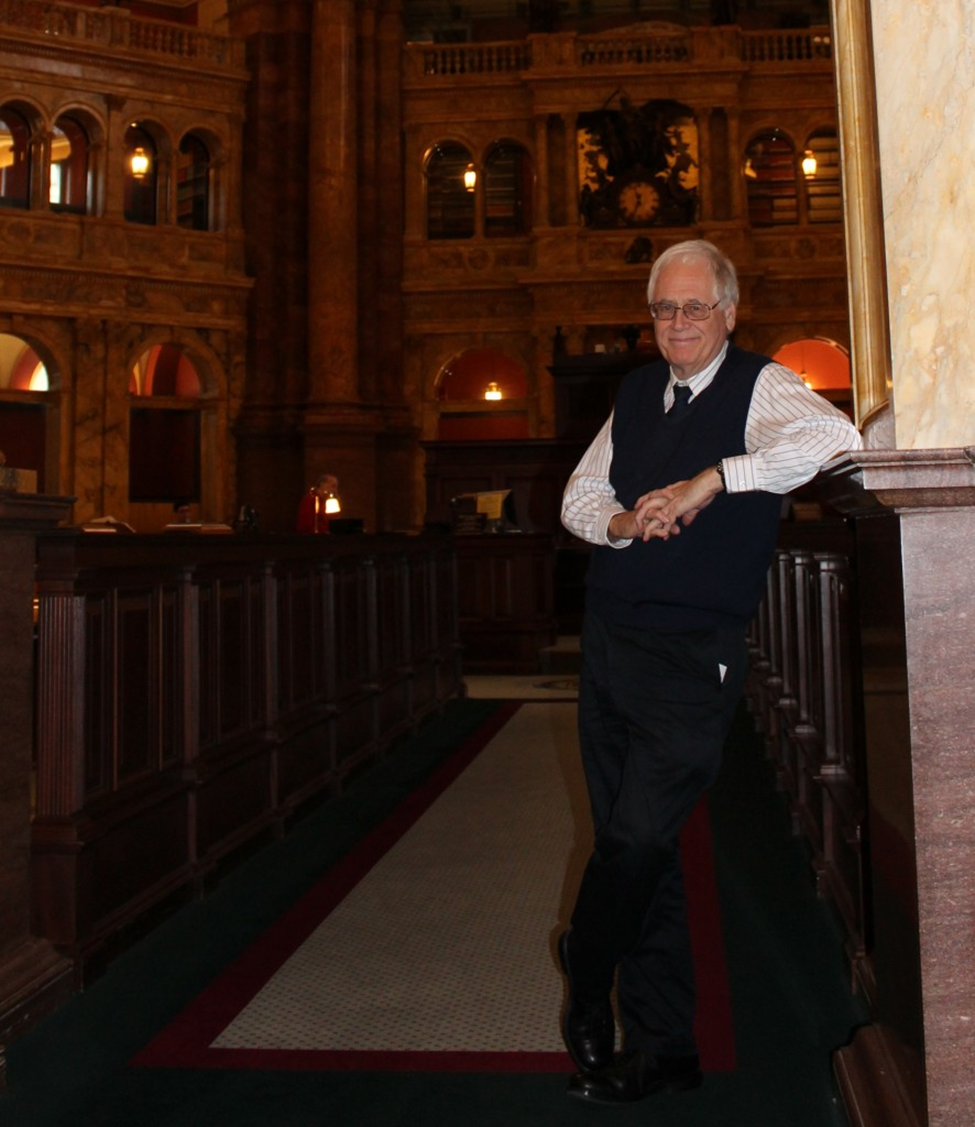
In the Congressional Cemetery in Washington, D.C., Thomas Mann has created for himself a monument in the form of a library’s catalog card, little paper cards that were used in olden tymes to allow library users to find books and do research. They were secured in long little drawers by metal rods that went through a hole in the bottom of each card. An elegant cataloging method for a more civilized age, these cards held a sophisticated series of symbols and texts arranged in standardized ways in order to convey crucial bibliographical information as efficiently as possible.
Mann’s monument reveals a lot about his professional interests as one of the librarians of Congress. His endgame is good, too: where better for a librarian of Congress to end up than the Congressional Cemetery?
Mann gives his name and birth year at the top: Mann, Thomas, 1948-; then comes his profession, Librarian. He was “published” in Chicago by parents Charles H. and Margaret Mann, in 1948. The Revised editions came out in Baton Rouge, 1976, and Washington, DC, 1980. Perhaps these marked turning points in his life, like the births of children; perhaps these mark his moving to Baton Rouge to pursue the Master of Library Science degree from Louisiana State University, and his subsequent move to Washington, D.C., where he took up employment at the Library of Congress in 1981.
He advises us of a Future corrected edition in the hands of a Higher Editor, an inside joke referring to Benjamin Franklin’s epitaph:
“The Body of B. Franklin, Printer; Like the Cover of an old Book, Its Contents torn out, And stript of its Lettering and Gilding, Lies here, Food for Worms. But the Work shall not be lost; For it will (as he believ’d) appear once more, In a new and more perfect Edition, Corrected and amended By the Author.”
Returning to Mann’s stone, he has the conventional subject headings section, which on his stone read: 1. Christian. 2. The lack of a subject header number 2 seems to me to indicate that being a Christian was (after library science, perhaps) his first and defining identity.
The symbols in the bottom third of the stone pose the stubbornest challenges. Z710 .M23 is a section and cutter number within the Library of Congress catalog. Z710 is where to find “bibliographies, reference works, and materials related to library science”: precisely Mann’s professional area. Within Z710 the cutter .M23 specifies books on these topics by . . . Thomas Mann! His well-received final book, the 2015 Oxford Guide to Library Research, 4th edition, has the Library of Congress call number Z710 .M23 2015. Put another way, the code Z710 .M23 is a unique proxy for Thomas Mann, his name, if you will, in the specialized argot of library science. Under that code we fittingly find Library of Congress.
025.5’24 perplexed me, but it turns out to be the Dewey Decimal System code for Mann’s above-mentioned Oxford Guide. The Dewey number would normally be written 025.5/24. The final numerical string is 0221-1948. This resolves itself pretty quickly into a date, 02 (February) 21 1948, which is listed at one site as Mann’s birthday.
AARC 2 stands for Anglo-American Cataloguing Rules, second edition, which codifies the conventions for determining how information is structured and recorded. MARC, by contrast, stands for Machine-Readable Coding. It’s a standard governing the digital registration of bibliographic and cataloging information to make sure that one computer can talk to another about this data. Nicely tying it all together is the typewriter font, since in said olden tymes these cards were all manually typed out. The Mann himself:
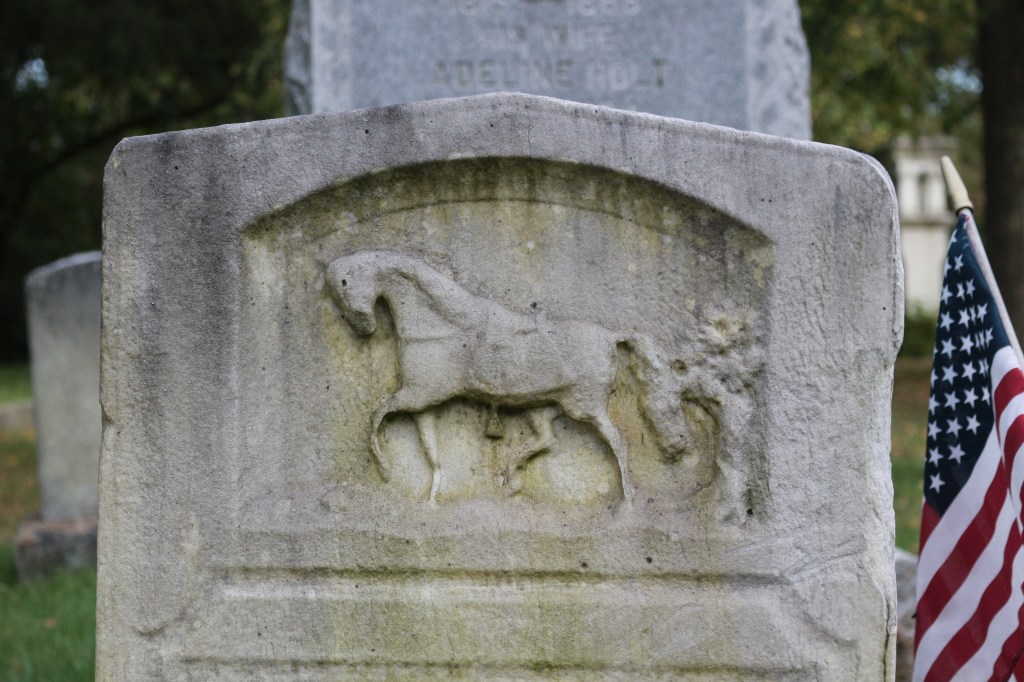
The eroded white marble gravestone of George Duncan in the Greenmount Cemetery in Burlington, Vermont, is a tribute to the sacrifice many young men made in service of preserving the Union. The battle was bloody and horrific with an estimated 165,000 Union and Confederate soldiers facing each other. After three days, General Lee’s forces had been defeated with an estimated 28,000 Confederate casualties. Even though the Union forces prevailed, more than 23,000 soldiers were wounded or dead—one of whom was Sargent George H. Duncan, only 22 years old.
The sculpture in the inset, at the top of the marker, is eroded but two images tell a story. The riderless horse indicates that the soldiers buried beneath this grave did not return from battle. The horse trots ahead of a tree with a major limb bent indicating an early death. Though faded the symbolism on this gravestone is a stark reminder of the cost of freedom.
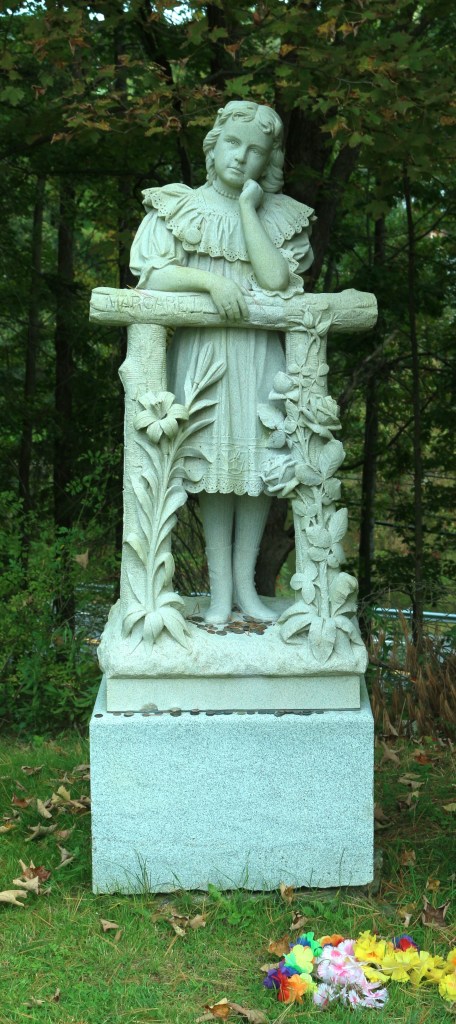
The monument in the Green Mount Cemetery in Montpelier, Vermont, commissioned by Margaret’s parents, Carroll Perley and Mary A. Devine Pitkin, was to be an exact replica of a photograph that her parents cherished. Harry J. Bertoli, a Barre, Vermont, statuary artist and sculptor, was enlisted for the daunting task of creating the granite look-a-like.
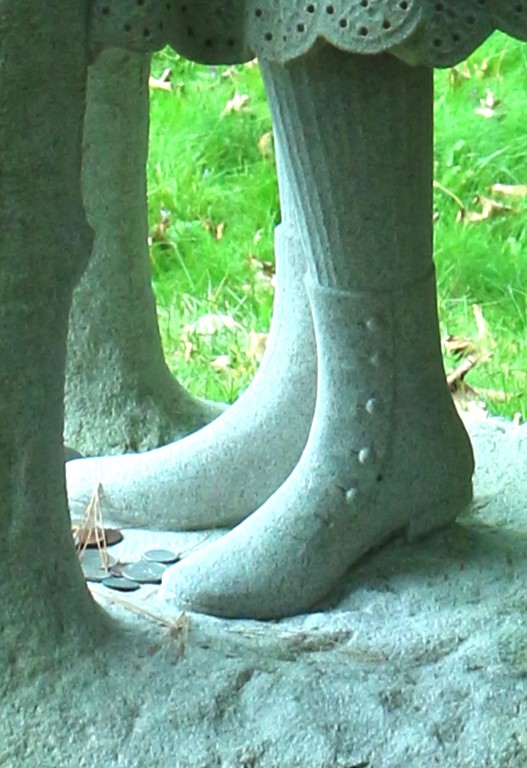
According to a brochure published by the cemetery, “Local legend has it that the Pitkin family initially refused to pay for the statue because a button was missing on one of her boots.” At closer inspection of the photograph, the Pitkins realized that indeed, the left shoe that Margaret was wearing in the photograph was missing the button and they immediately paid the debt.
They asked for an exact replica, and that is what Bertoli created.
Gravely Speaking and Syngrammata have decided to dig deep into our photo collections in order to bring you pairs of images drawn from our many years combing through American cemeteries. Each pair will be linked by a theme which we are free to interpret. Suggestions of future themes to follow are welcome in the comments! This week’s theme is: the most impressive mausoleum.
Gravely Speaking writes:
The Belmont Mausoleum, in the Woodlawn Cemetery in the Bronx, is a near replica of the Chapel of Saint Hubert; the original is in Amboise, France, the final resting place of Leonardo da Vinci.
Alva Smith Vanderbilt Belmont (1853-1933) commissioned the architectural firm of Hunt and Hunt to build the tomb after the death of her second husband Oliver Hazard Perry Belmont (1858-1908) in 1908. The mausoleum was completed in 1913 and is a masterpiece of late-fifteenth-century French Gothic architecture.
The front façade displays two intricately carved sculptures. The lintel—or horizontal block above the door—features a sculpture depicting the legend of Saint Hubert from which the chapel is named. According to the legend, while hunting Hubert saw a stag with a crucifix between his anthers. After the vision, Hubert converted to Christianity. Because of his humane treatment of the animals he hunted, Saint Hubert became the patron saint of hunters. That was particularly fitting for a focal point for the Belmont Mausoleum because of the Belmont family’s association with horse racing—the Belmont Racetrack and the world-famous Belmont Stakes, the oldest prize in the Triple Crown.
The sculpture in the pointed arch above the door depicts a scene with King Charles VIII and his wife, Anne of Brittany, kneeling in deference to the Madonna and Child.
The chapel has many architectural features that were common to Gothic design: Gargoyles—The spouts that were designed to divert rainwater away from the building were often elaborately designed to look like grotesque animals and human forms known as gargoyles. These figures became popular in France during the Middle Ages, though they can be found in other countries during that time, as well. Hood molding—If you look above the scene of the stag, there is a three-sided molding, also known as a drip molding. Pinnacles—These ornamented structures are usually pointed and are found on the corners of the Saint Hubert Chapel. They are often found on the buttresses of Gothic buildings. Stepped buttresses—in the chapel, the stepped buttresses can be seen of the front of the building’s sides. These are a mass of masonry built against a wall to give the building additional support and strength. The buttresses on the chapel are stepped, meaning in this case, the buttress has a wider segment, then on top of that is a smaller one, and still one more smaller buttress on top of that. Topping the buttress is a gargoyle. Trefoil window—In the middle of the gable on the front of the chapel is a roundel, a small circular frame. Inside the roundel is a trefoil—three-lobed form—in this case, a window. Spire—the tall, oxidized copper structure tapering up from the roof is a steeple or a spire.
Syngrammata writes:
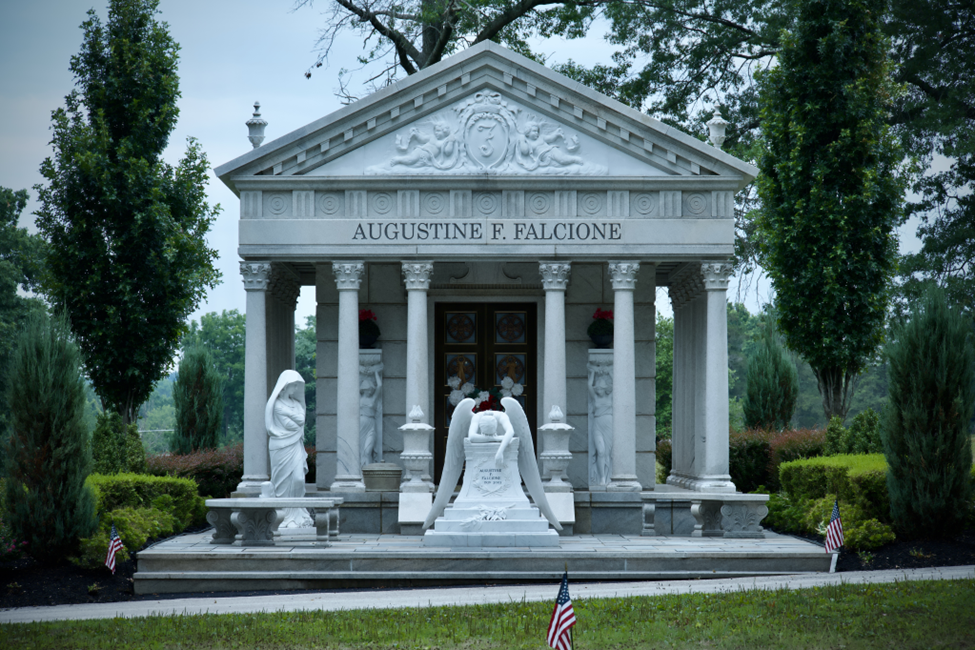
The Falcione mausoleum misappropriates Greek architecture in a dozen ways, but impresses nevertheless. One of the disappointments of my life is that the doors of the mausoleum are opaque, because I’m sure the interior is as stunning and lively as the exterior. Frankly, a preservation order should be slapped on this mausoleum: it’s that good.
I’m impressed by a rigorous commitment to symmetry which is even carried through the landscaping. The landscaper had real talent, playing effectively with the heights, shapes, colors, and brightness of the shrubs in order to create a dazzling frame for the structure. There must be a ‘perpetual care’ fund to keep everything so neatly trimmed.
A statue of the Madonna (?) on the left and a fine reproduction of William Wetmore Story’s 1894 Angel of Grief at center might be proxies for Falcione’s widow, who has humbly refused to place her name on the exterior of this complex so that it can be entirely about her beloved husband.
Gravely Speaking and Syngrammata have decided to dig deep into our photo collections in order to bring you pairs of images drawn from our many years combing through American cemeteries. Each pair will be linked by a theme which we are free to interpret. Suggestions of future themes to follow are welcome in the comments! This week’s theme is: interesting/significant mausoleum windows.
Gravely Speaking writes:
In a mausoleum in the Metairie Cemetery in New Orleans, the stained-glass window in the back of the tomb depicts an angel with vibrant red wings, an ochre gown, against a bright blue background. Angels are known as God’s messenger from the Hebrew root word meaning “send”.
This angel is thought to be a Seraphim. Seraphim are one of nine orders or choirs of angels which are organized into three spheres or orders, with three choirs in each. According to Christian tradition, the First Order, is made up of the Seraphim, Cherubim, and Thrones; the Middle or Second Order is made up of Dominions, Virtues, and Powers; and the Lowest or Third Order is made up of Principalities, Archangels and Angels.
Seraphim are mentioned in Isaiah 6:2-3 (King James Version): 2) “Above it stood the Seraphim; each one had six wings; with twain he covered his face, and with twain he covered his feet, and with twain he did fly.” 3) “And one cried unto another, and said, Holy, holy, holy, is the Lord of hosts: The whole earth is full of His glory. According to tradition, the Seraphim have red wings because they are the closet to God.
Syngrammata writes
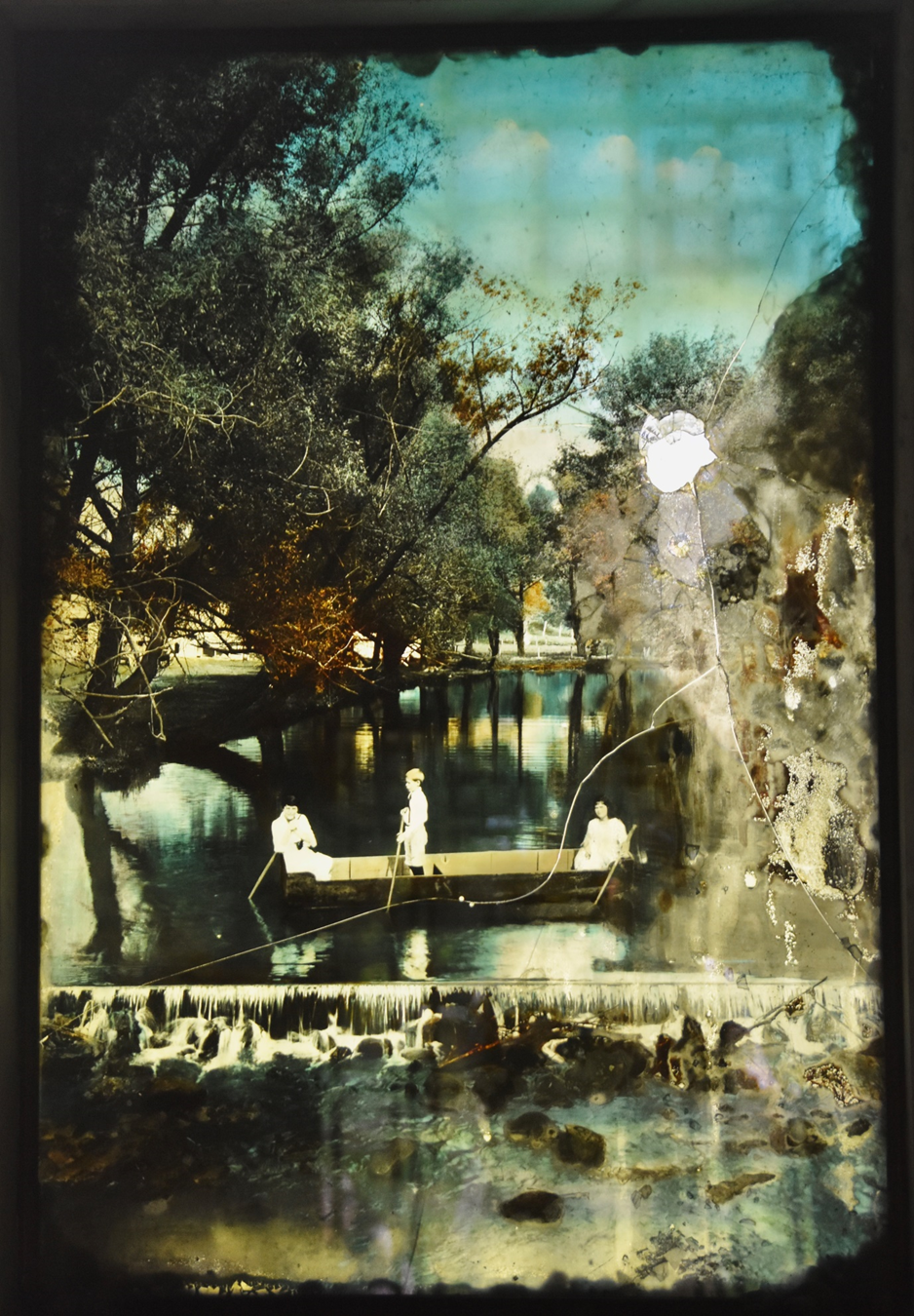
The image shows the wondrous 3’ x 2’ glass plate used as the rear window of the Mathews mausoleum in Nisky Hill Cemetery, in Bethlehem, Pennsylvania. It bears a photograph of the family made by patriarch James Mathews II (†1935) and depicts a little boat bearing his wife Carolyn (1878-1920), son James III (1908-1938), and daughter Martha (1907-1985) on a small artificial lake on a summer day. The black and white photograph has been painted with colors to render it more lifelike. Carolyn’s presence points to a date before 1920.
On that hot day when this image was created, none of these people in the flourishing prime of their lives could have imagined that it would one day illuminate their cold tomb! Someone has put a bullet through the window, and the moisture leaking in is slowly eating away both emulsion and color in a reminder that nothing is permanent.
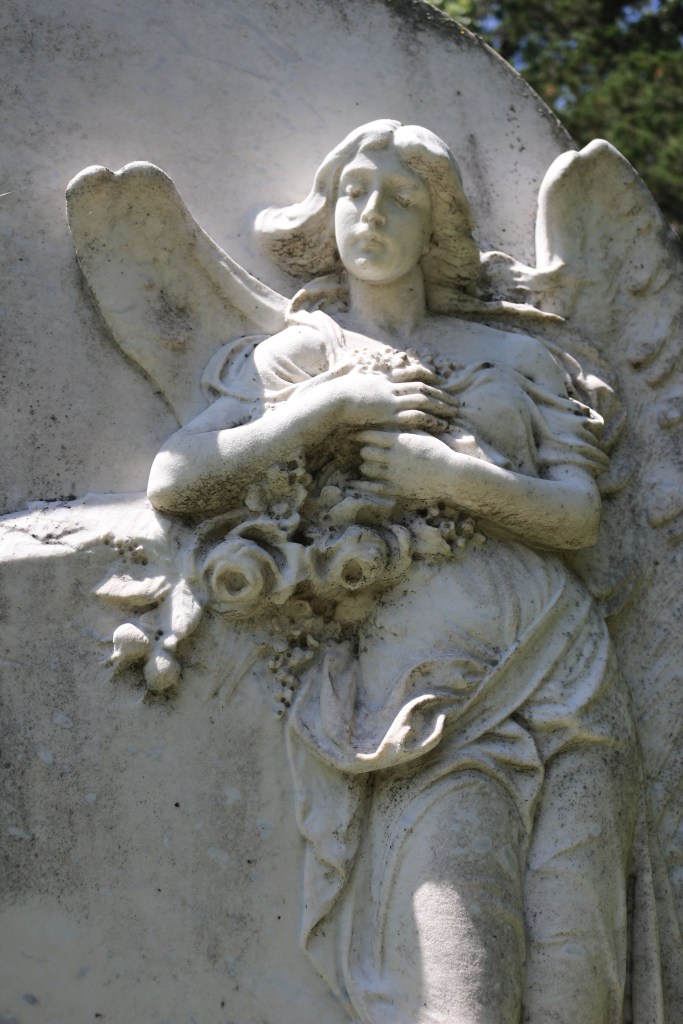
The Williams-Beachly family monument in the Wyuka Cemetery in Lincoln, Nebraska, depicts an angel clutching a garland of flowers as she looks downward toward the grave. The white marble rounded-top monument with the angle sculpture is mounted on a granite plinth atop a large flat granite base with the surnames WILLIAMS and BEACHLY etched into the facade.
The angel carrying the garland of flowers to decorate and watch over a grave is a common “angel type” found in American cemeteries. In the 2007 edition of Markers, XXIV, published by the Association for Gravestone Studies, Greenfield, Massachusetts, Elisabeth L. Roark wrote an article about angels titled, “Embodying Immortality: Angels in America’s Rural Garden Cemeteries, 1850—1900”, pages 56 – 111. Roark argues that angels were not “Romantic attempts to beautify death.” She writes, “while this was part of their appeal, angel monuments are far more complex in meaning and can act to reveal manifestations of popular Christian beliefs.”
According to the article, angels come onto the scene in rural garden cemeteries in a big way starting circa 1850 and then throughout the rest of the century. Though angels come in many variations and forms, in her study of 14 rural cemeteries from each region of America, Roark found that most angels fall into the following eight categories:
Soul-bearing Angels
Praying Angels
Angels who decorate and watch over the grave
Pointing angels
Recording angels
Trumpet angels
Michael the archangel
Child angels
Angels are mentioned over 270 times in the Bible but of the eight categories of angels that Roark describes in her article, Angels who decorate and watch over the grave are the only type not specifically defined in the Bible. Roark notes that decorating graves with flowers originates with the ancient Greeks, this type of symbolism, however, is something newly found in graveyards of the 19th Century.
After the Civil War, it became popular to decorate graves lavishly with flowers. Roark writes, “Like their live counterparts, the angels’ sculpted flowers suggest the parallels drawn at this time between the cyclical nature of plant life and human birth, death, and resurrection.”











 Gravely Speaking