Mario Korbel

Mario Joseph Korbel (March 22, 1882 – March 31, 1954) was a noted Czech-American sculptor who worked on several commissions for monuments that are found in cemeteries in Illinois and Iowa. Like many artists, including Daniel Chester French, Aldabert Volck, Felix Weihs de Weldon, Karl Bitter, Martin Milmore, Alexander Milne Calder, T. M. Brady, Augustus Saint-Gaudens, Albin Polasek, Harriet Whitney Frishmuth, Edwin Blashfield, Edward V. Valentine, Sally James Farnham, and others, Korbel was able to earn his living creating sculptures, public and private.

Korbel was born at Osik, Bohemia, the son of a clergyman. At the age of 18 he immigrated to the United States where he continued his art studies.  Korbel also studied sculpture in Paris at the Julian Academie and at the Royal Academy at Berlin. In 1909, Korbel opened a studio in Chicago.

img_0672[1]

The first Korbel monument I became aware of was the famous Black Angel of Iowa City, Iowa. Diana Brace, a friend who graduated from Iowa University had known about the statue and related some of the stories surrounding it. The commission is to be found in the Oakland Cemetery at Iowa City.  This statue has become famous locally for the stories that have sprung up surrounding the memorial. Local lore has it that this black angel has a dark story which probably began to swirl when the bright bronze statue turned black.  Instead of oxidation being the reason for the color change, rumors began to emerge about the “mysterious” woman buried beneath the angel.

img_0677[1]

Teresa Dolezal and her son, Eddie, emigrated from Bohemia to America where she continued her practice as a midwife.  Eddie died at the age of 18 with meningitis and was buried underneath a tree-stump gravestone in the Oakland Cemetery.  After her son’s death, Teresa moved to Eugene, Oregon, where she met and married Nicholas Feldevert.  Not long after their marriage, Nicholas died.  Teresa moved back to Iowa City.

Teresa hired Bohemian artist, Mario Korbel, of Chicago, to create an angel for her husband’s grave.  She also gave instructions that the angel was to hover over the body of her son’s grave, too.  Korbel created the angel with one wing spread open over Eddie’s grave.  Teresa died in 1924 and her ashes were placed underneath the grave ledger next to her husband’s remains.

No one remembers for sure when the angel turned color but that is when the rumors started.  The stories about the reasons why range from fanciful to evil and suggest that the color change was due to the nature of the woman buried beneath the angel.  One story goes that on the dark and stormy night of Teresa’s burial a lightning bolt struck the angel and turned it black instantly.  Another rumor suggests that the angel itself portends of the evil—most graveyard angels, they say, look upward with their wings lifted toward Heaven, but this one looks downward.  Ominous.
IMG_5037

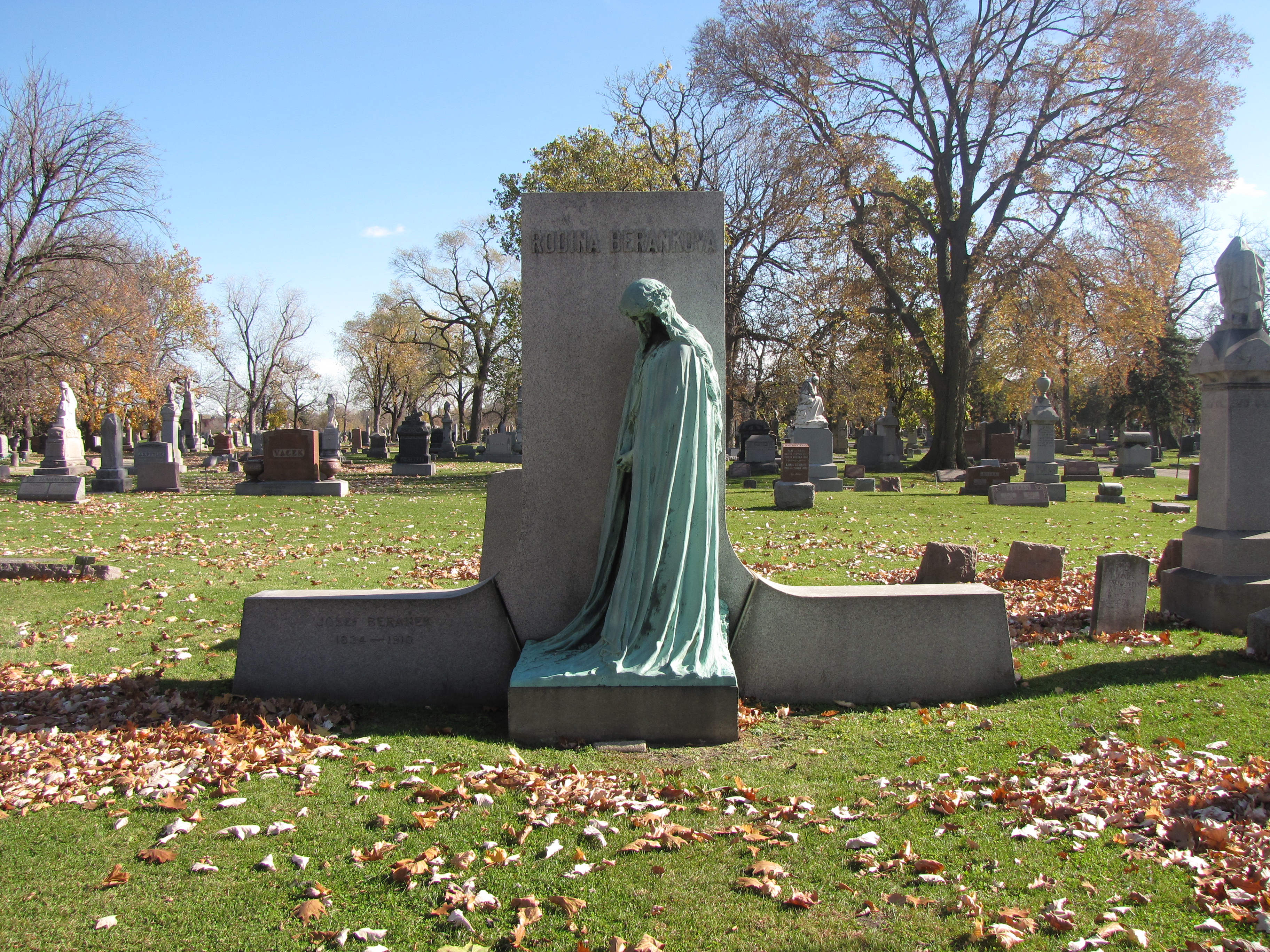
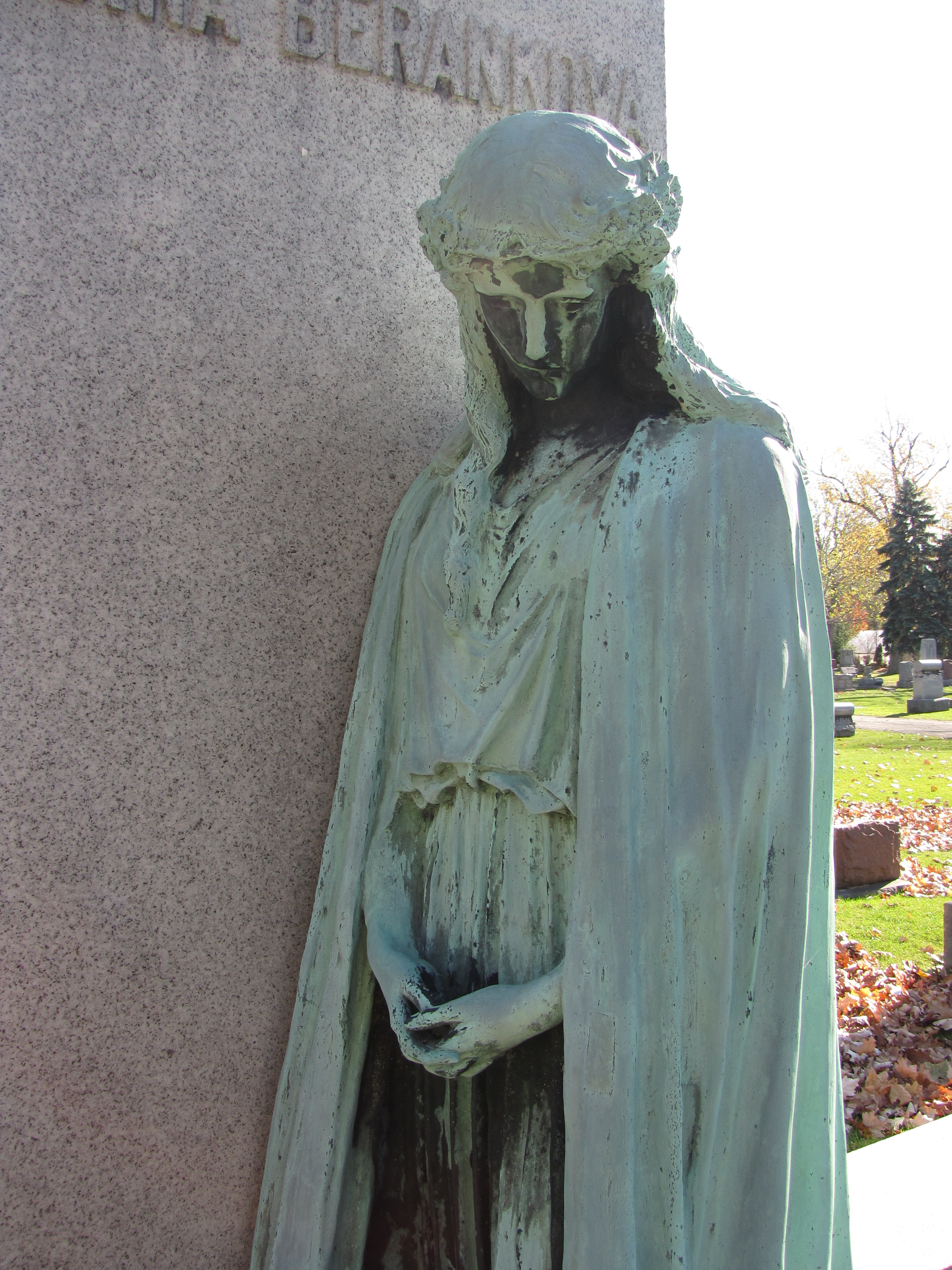
The second commission is in the Bohemian National Cemetery at Chicago, Illinois. A bronze statue was commissioned in 1910 by Emanuel Beranek upon the death of his father, Josef Beranek. The mourning figure that Korbel sculpted is titled Resignation.

IMG_5040

The cloaked woman looks downward, holding her clasping hands together in meditation.
IMG_5043

The figure stands in front of a large sweeping gray granite gravestone with the words “RODINA BERANKOVA” carved into the stone. “RODINA” is Czech meaning “family”. An inscription on the left side of the monument notes Emanuel’s father’s inscription: “Josef Beranek 1834 – 1910.”

IMG_4468

The third commission I found by chance. I was walking around the Rose Hill Cemetery at Chicago, Illinois. I took a closer look at the door on the Louis M. Stumer mausoleum which depicts a seated mourning figure. Mario Korbel’s name was carved at the bottom of the door.

IMG_4477

The door as a motif in funerary art symbolizes mystery.  The door is the portal from the Earthly realm to the next. In Christianity, the door is usually viewed with hope, charity, and faith.  The next life in the hereafter will be better than the one experienced here on Earth.

IMG_4472


Posted in Uncategorized | 8 Comments

I.N.R.I.

St. Martin's Parish Cemetery, Whitefield, Indiana

St. Martin’s Parish Cemetery, Whitefield, Indiana

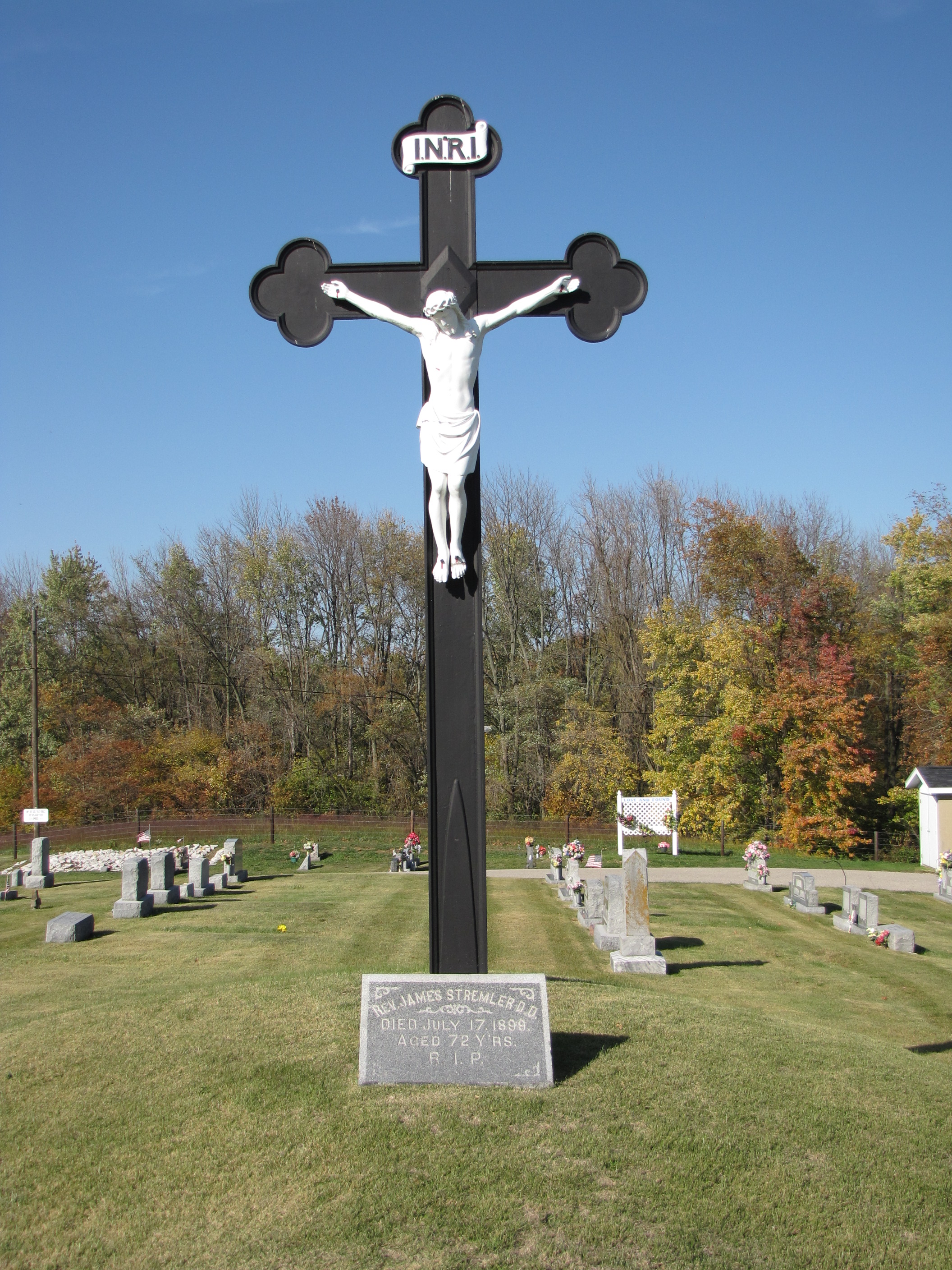
In many cemeteries, especially Catholic cemeteries, one is likely to find the crucifixion as part of the symbols adorning the gravestones.  In this case in the St. Martin Cemetery at Whitefield, Indiana, the letters “I.N.R.I” are written above the crucified Christ.  The letters stand for the initials of the Latin words, Iesvs Nazarenvs Rex Ivdaeorvm.  The English translation is “Jesus of Nazareth, the King of the Jews.” Latin was the language of the ancient Romans, who ruled over Judea at the time Jesus lived.  In Latin “I” was used instead of the English “J”, and “V” instead of “U”.

This markers honors Reverend James Stremler D.D., who died July 17, 1899, at the age of 72 years.

IMG_8845

Posted in Symbolism | 1 Comment

Look-a-likes

Albany Rural Cemetery, Menands, New York

Albany Rural Cemetery, Menands, New York

IMG_3383

Chester Alan Arthur (b. October 5, 1829, Fairfield, Vermont – November 18, 1886) was the 21st President of the United States (1881–85). He assumed the office upon the death of James Garfield who was felled by an assassin’s bullet and a host of doctor’s who eschewed sanitary conditions when treating him. Arthur had been a political appointee in the New York City Republican political machine which meant expectations for him as president were low. To the surprise of many, Arthur stepped up and embraced the political reforms that he and Garfield campaigned on.

After his term, in poor health, Arthur only half-heartedly sought the re-nomination for the presidency in his own right in 1884. Grover Cleveland succeeded him. President Chester Arthur died two years later at the age of 57 years.

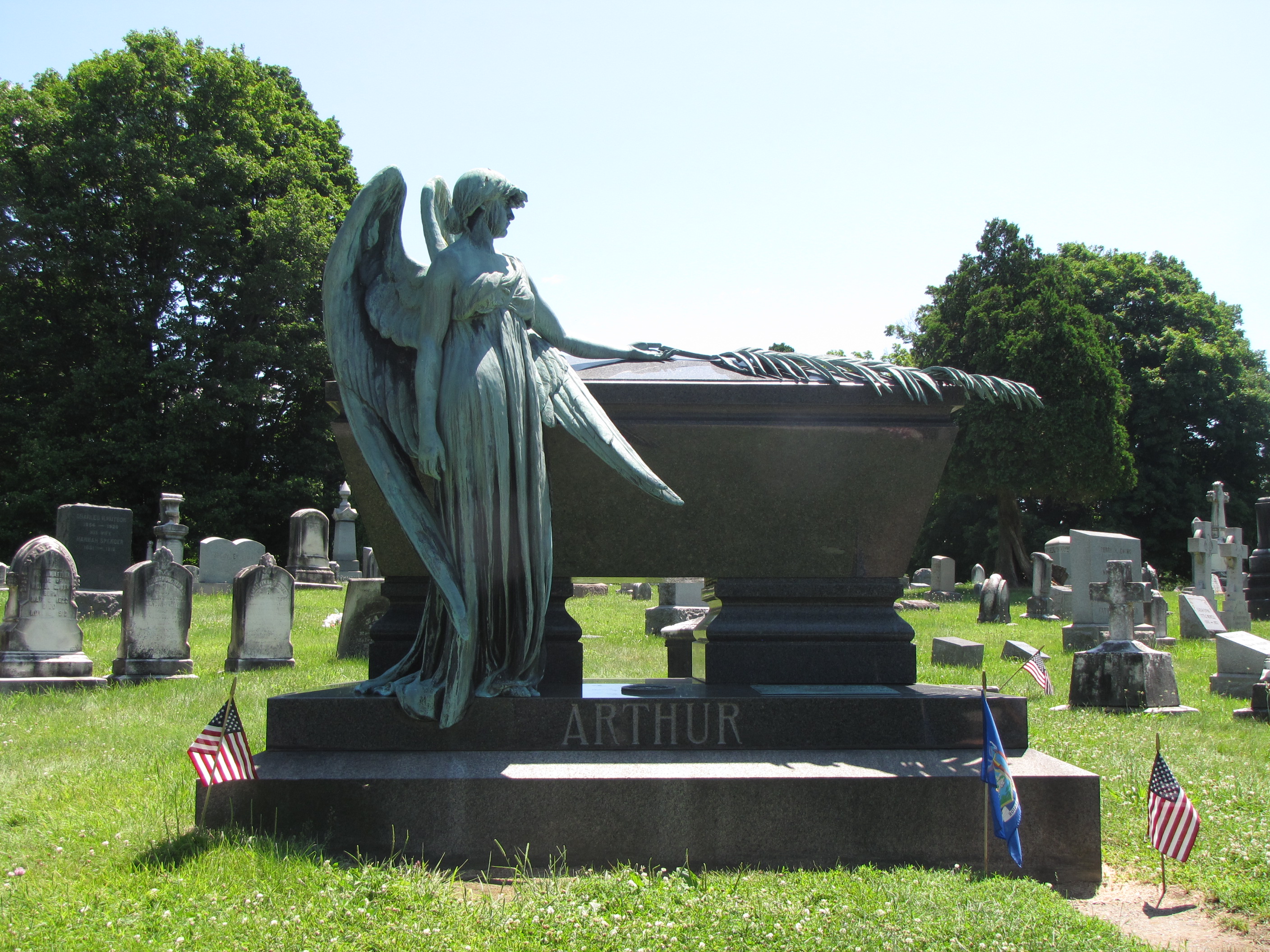
After a private funeral service in New York City, Arthur was laid to rest in the Albany Rural Cemetery at Menands, New York. In 1889, a large granite sarcophagus was designed for his monument. Noted American sculptor Ephraim Keyser, created and cast a large bronze female angel that is depicted placing a palm leaf on the top of the tomb. The palm leaf represents victory over death.

Not long after the creation of Arthur’s memorial, Sidney Rowland Francis, brother and law partner of the Governor of Missouri died December 4, 1893, at St. Louis, Missouri. Francis was buried in the famed Bellefontaine Cemetery in that city. With the exception of the hand turned down as opposed to up and the absence of the palm leaf on the top sarcophagus the monument, angel and all, created for Francis’ grave appears to be a look-a-like of Arthur’s.

IMG_9735

Bellefontaine Cemetery, St. Louis, Missouri

Bellefontaine Cemetery, St. Louis, Missouri

Posted in Presidential graves | Leave a comment

Edna Miriam Paul

St. Luke Cemetery, Chicago, Illinois

St. Luke Cemetery, Chicago, Illinois

EDNA MIRIAM

PAUL

BORN AUG. 23, 1897

DIED MAY 2, 1907.

Many hopes are buried here

The likeness of 9 ½ year old Edna Miriam Paul in the St. Luke Cemetery at Chicago, Illinois, was created in the Victorian style of memorializing children in funerary statuary.  The realism of the statue is remarkable as her funerary statue is a recreation of the photograph on the front of the base of her monument.

IMG_5533

IMG_5532

Edna is depicted in her finest clothing and, as in the photograph, she is wearing a necklace. Her curly hair cascades to her shoulders accentuated by a bow, matching the bow on her dress. True to the image, even her stance is the same in the statue as in the picture.

The epitaph on the gravestone, “Many hopes are buried here”, speaks to the sadness and loss her parents felt.


Posted in Children's Graves | Leave a comment

Improved Order of the Red Men

Ancient Cemetery, Yarmouth Port, Massachusetts

Ancient Cemetery, Yarmouth Port, Massachusetts

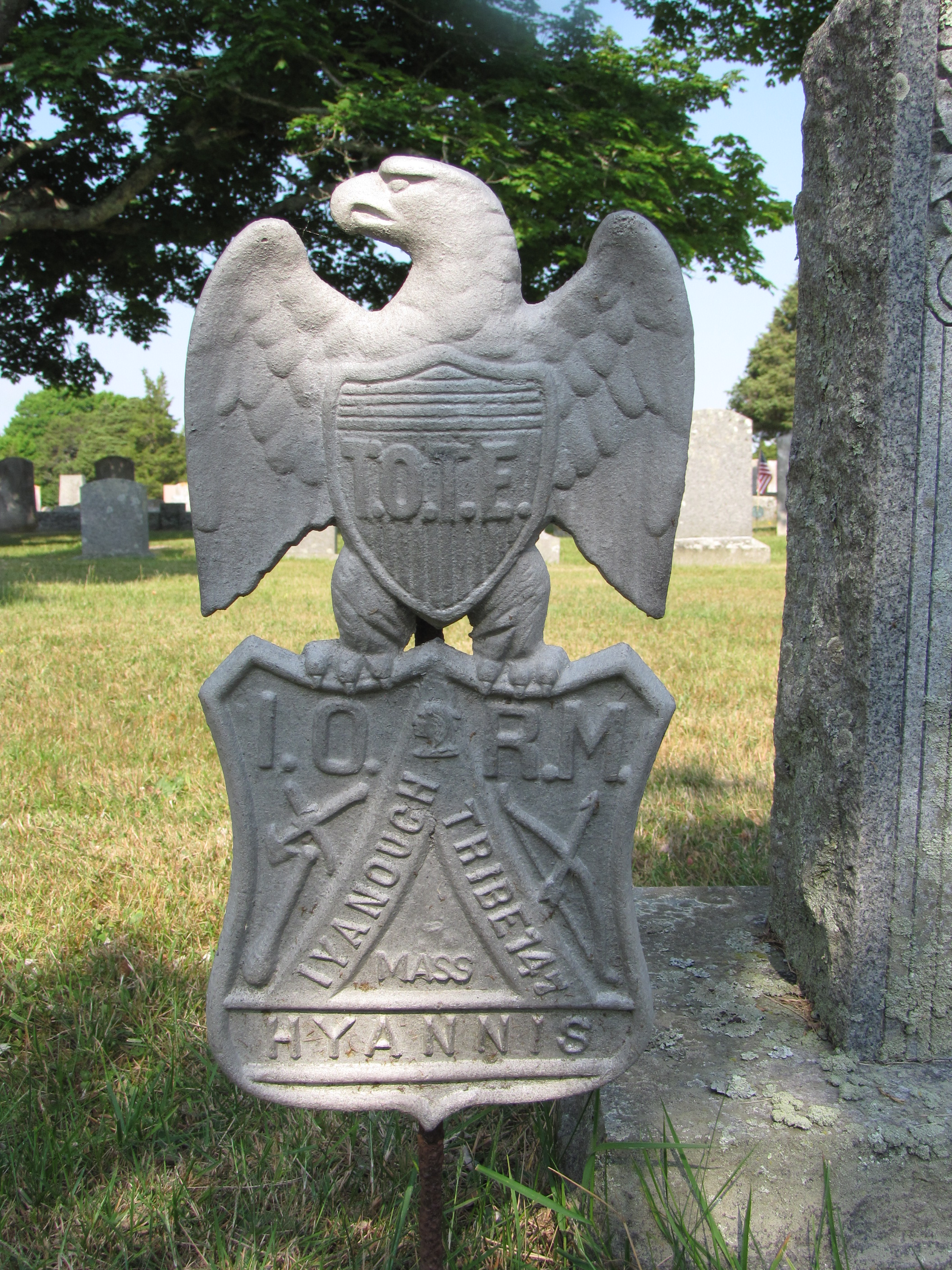
The metal marker found in the Ancient Cemetery at Yarmouth Port, Massachusetts, marks the grave of a member of the Improved Order of Red Men (I.O.R.M.), which claims its beginnings with the patriots who were in the Sons of Liberty during the American Revolution.

This particular marker is for a member of the IYANOUGH TRIBE 147 at Hyannis, Massachusetts.  The different clubs or chapters are divided into what the organization called “tribes”.

The society models itself after the Iroquois Confederacy councils.  In fact, some of the markers display images of Native Americans because the society based their organization on the rites and rituals of the Native Americans.  This marker displays a native American in profile, presumably an Iroquois, on the shield on which the eagle is perched.

Written on the shield on the breast of the eagle are the initials T.O.T.E which stands for Totem of Eagles.  According to their Website, the IORM “promotes patriotism and the American Way of Life, provides social activities for the members, and supports various charitable programs.”

Posted in Metal Markers | 1 Comment

Happy Halloween

Graceland Cemetery, Chicago, Illinois

Graceland Cemetery, Chicago, Illinois

To commemorate Halloween, I wanted to revisit two monuments that I have written about earlier.

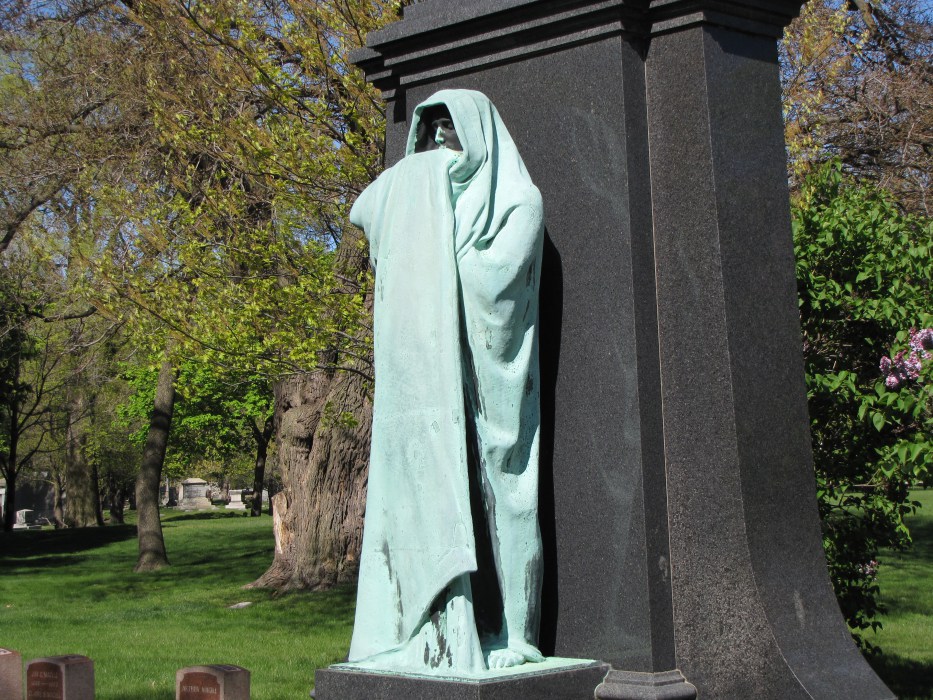
The monument above, sculpted by Lorado Taft, one of the premier sculptors of his day, was created to honor Dexter Graves, an early Chicago pioneer.  The bronze figure that Taft created is named Eternal Silence, an obvious metaphor for death.  The foreboding cloaked figure stands against solid black granite–black being the traditional color representing mourning and death.  The figure has his eyes closed and gathers the shroud to his lips preventing him from speaking.

img_6296[1]

The bronze has an eerie feel to it, in part, because of the way the patina has formed on the statue.  The shroud has a greenish blue unnatural color.  Except for a highlight on the nose, most of the face has remained dark and recedes from the hood, making it appear more menacing and mysterious.

The second monument is tucked away in the Forest Lawn Cemetery at Omaha, Nebraska, dedicated to Josiah and Alma Wasserburger.  The monument features a seated and cloaked figure.  The inscription divulges no clues about who the figure represents, but leaves behind a message about the body’s decay but not of the soul’s.

Forest Lawn Cemetery, Omaha, Nebraska

Forest Lawn Cemetery, Omaha, Nebraska

These are the kind of monuments give cemeteries a reputation for being scary.  I have to admit, even though, I have had an affinity for cemeteries for as long as I can remember, had I spied either of these monuments as a kid a long about dusk, I would have been creeped out and probably run outta there as fast as I my squat fat legs would have propelled me.  However, one thing my Dad always said has made me feel completely at ease in a cemetery.  “Son, its not the dead ones you have to worry about!”


Posted in Uncategorized | 1 Comment

A Pioneer

Hollywood Forever Cemetery, Hollywood, California

Hollywood Forever Cemetery, Hollywood, California

Inscription at the base of the monument:

THE ATLAS AS SHOWN HERE,

IS TO THE EXACT SCALE OF THE

ORIGINAL MISSILE

THE PIONEER ATLAS

(INTO ORBIT WITH 122-POUND

PAY LOAD, DECEMBER 18, 1958)

 Inscription on the back of the monument:

  • FIRST INTERCONTINETAL BALLISTIC MISSILE OF THE UNITED STATES
  • FIRST TO FLY 5500 NAUTICAL MILES, NOVEMBER 28, 1959
  • FIRST TO LIFT A UNITED STATES CAPSULE INTO SPACE
  • FIRST SATELLITE TO BROADCAST A MESSAGE TO“THE FREE WORLD”
  • FIRST TO RECORD A MESSAGE IN SPACE AND BROADCAST IT TO EARTH

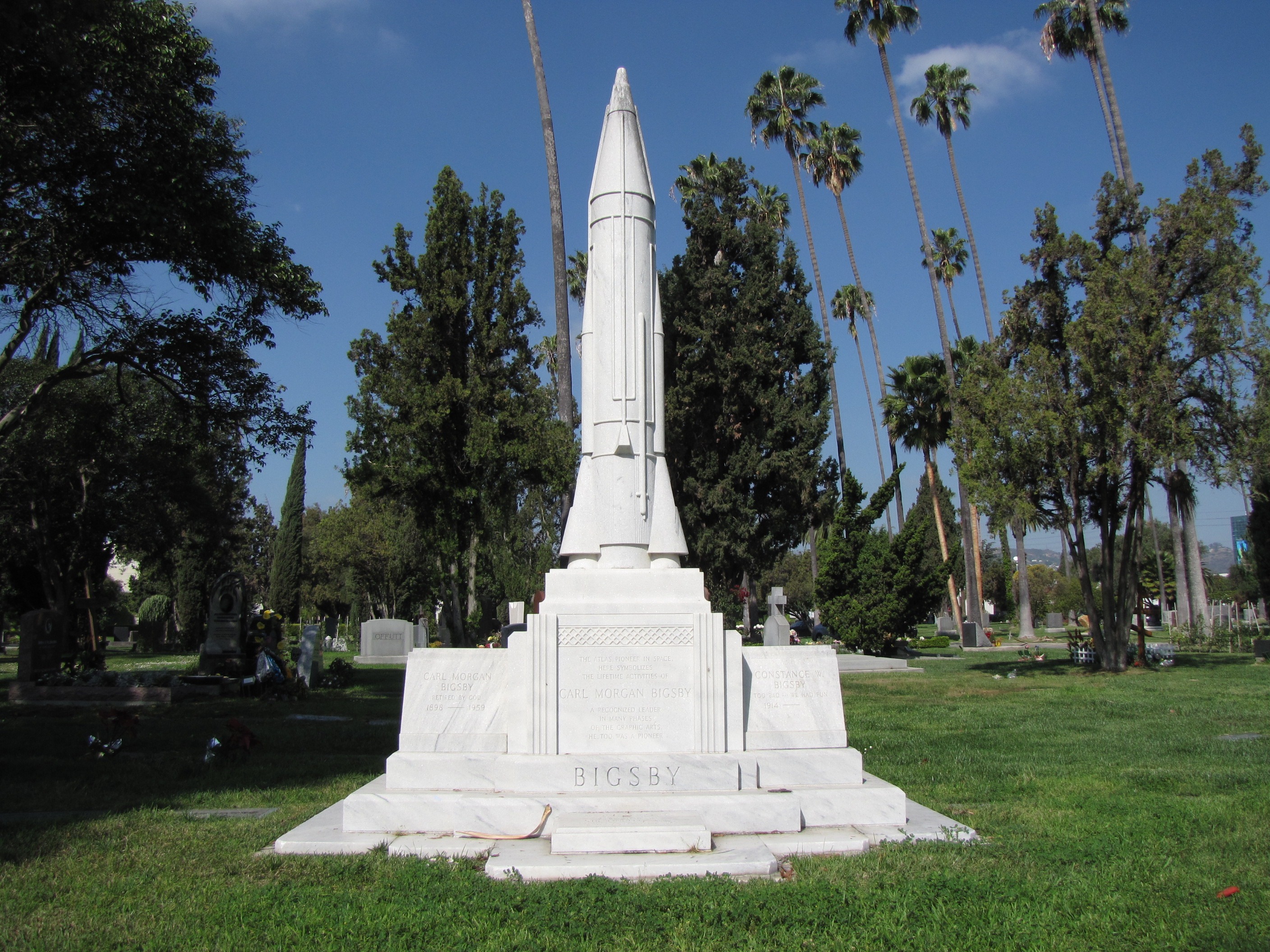
Things are not always what they seem. At first blush when looking at this monument in the Hollywood Forever Cemetery at Hollywood, California, you see the reproduction of the Atlas missile built to scale in glimmering white granite which was launched into space on December 18, 1958. This was part of the United States’ reaction to Sputnik, which had previously been sent into space to the embarrassment of our government. The space race was on in the mid to late 50s and the US was losing. This successful launch helped our country catch up.

320px-Atlas-B_with_Score_payload[1]

The Atlas was launched with a one hundred and fifty pound payload, a communications satellite that was part of Project SCORE (Signal Communications by Orbiting Relay Equipment). The satellite carried an on-board tape recorder that carried a Christmas message from President Dwight Eisenhower that was broadcast, “This is the President of the United States speaking. Through the marvels of scientific advance, my voice is coming to you from a satellite circling in outer space. My message is a simple one: Through this unique means I convey to you and to all mankind, America’s wish for peace on Earth and goodwill toward men everywhere.”

So, does this monument mark the grave of Roy Johnson, the ARPA (Advanced Research Projects Agency) project leader? Nope. Does it mark the grave of anyone who worked on the missile project? Nope. The monument marks the grave of Carl Morgan Bigsby and his wife, Constance W. Bigsby. The connection to the rocket:

Inscription on the front of the monument—center panel:

THE ATLAS PIONEER IN SPACE

HERE SYMBOLIZES

THE LIFETIME ACTIVITIES OF

CARL MORGAN BIGSBY

A RECOGNIZED LEADER

IN MANY PHASES

OF THE GRAPHIC ARTS.

HE, TOO, WAS A PIONEER


CARL MORGAN

BIGSBY

RETIRED BY GOD

1898 – 1959

CONSTANCE W.

BIGSBY

TOO BAD…WE HAD FUN

1914 –

IMG_8788 (2)


Posted in Famous graves, Uncategorized | 1 Comment

“That’s All Folks”

Hollywood Forever Cemetery, Hollywood, California

Hollywood Forever Cemetery, Hollywood, California

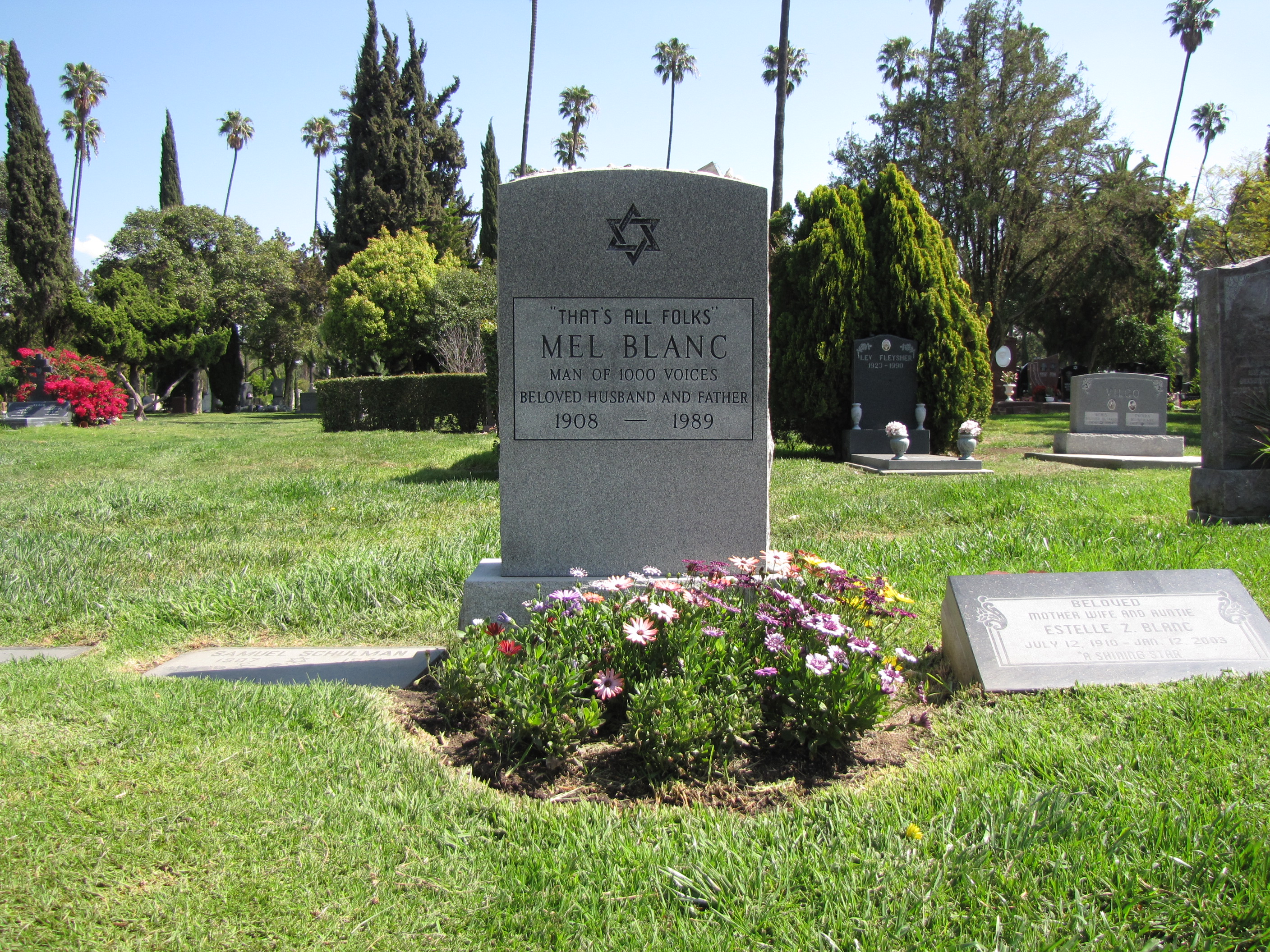
What Lon Chaney, master of makeup, was to faces, Mel Blanc was to voices. That is, Blanc was the man of a thousand voices. Voices every child knows instantly—the wisecracking Bugs Bunny chewing on the end of a carrot with his famous question, “What’s up Doc?” Or the voice of the frenetic Daffy Duck, or the hoarse and rowdy Yosemite Sam. These voices filled the Saturday morning cartoon lineup for decades and his voice still rings in children’s ears through re-runs.

Mel Blanc was born on May 30, 1908, Melvin Jerome “Mel” Blank at San Francisco, California. Blanc claimed that he changed the spelling of his name because of a chance remark a teacher made, who said to him, with that last name he would amount to nothing. He dropped the “k” and added the “c” and changed the spelling of his name. That one letter change evidently was providential enough to make a difference, because Mel Blanc will be remembered and the name of the teacher who made the remark has been long forgotten.

In 1927, Blanc began his career as a voice actor on a radio program, The Hoot Owls, on KGW where he did several different voices. For the next 62 years, Blanc performed as some of the most beloved Warner Brothers characters ever animated for the movies and television—including the Foghorn Leghorn, Sylvester the Cat, Speedy Gonzales, Wile E. Coyote, and the Tasmanian Devil. Blanc was also the voice for notable Hanna-Barbera characters, too, such as Barney Rubble in The Flintstones and Mr. Spacely in The Jetsons. As if the list wasn’t long enough, Blanc was also the original Woody the Woodpecker, a smash-hit cartoon for Universal.

But, the most famous voice was probably that of Porky Pig, the hapless and chubby pig who never bagged the “silly rabbit”. His was also the last voice you’d hear in a Warner Brothers Cartoon at the close of the cartoon a circle would draw around Porky and he would stutter and stammer, “That’s All Folks”.

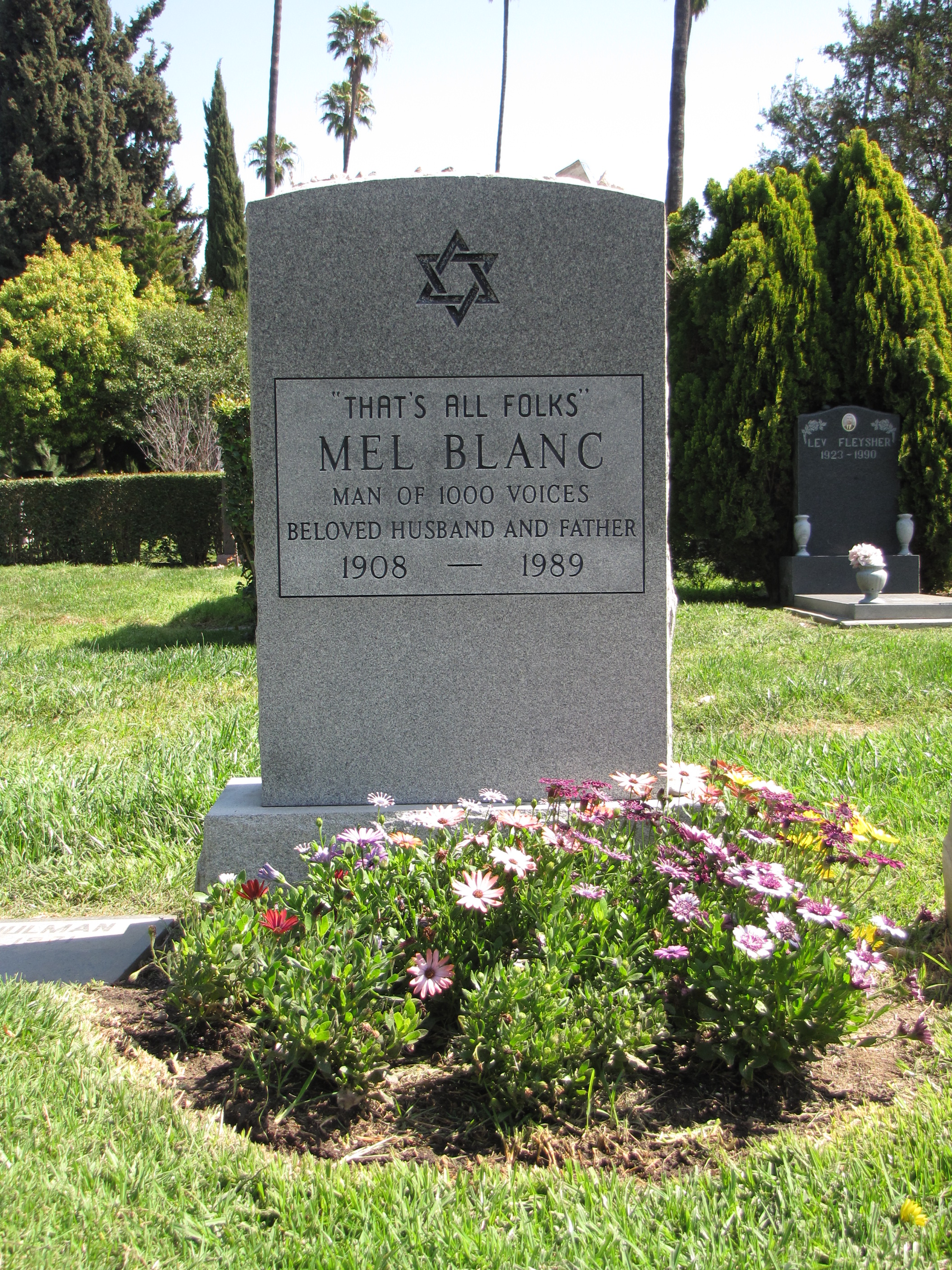
The trademark phrase, “That’s All Folks”, at the direction of Blanc’s will was carved into his gravestone. We’ll never know if that was just a nod to his famous cartoon character’s sign off or if it was a deeper sentiment about life itself.

IMG_8980

Posted in Famous graves | Leave a comment

The Pyramid: Monumental Architecture

This is my 500th post. So, to commemorate the occasion, I wanted to write about something monumental. When it comes to funerary sculpture and architecture, nothing is more monumental than the pyramid.  The Egyptians knew how to bury their dead, especially when it came to burying the pharaohs.

After the French and British occupations of Egypt, there was a renewed interest in Egyptian architecture and symbolism.  The Egyptian symbol that is most commonly found in American cemeteries is the obelisk.  And the most famous obelisk in America is the Washington Monument in Washington, D.C.

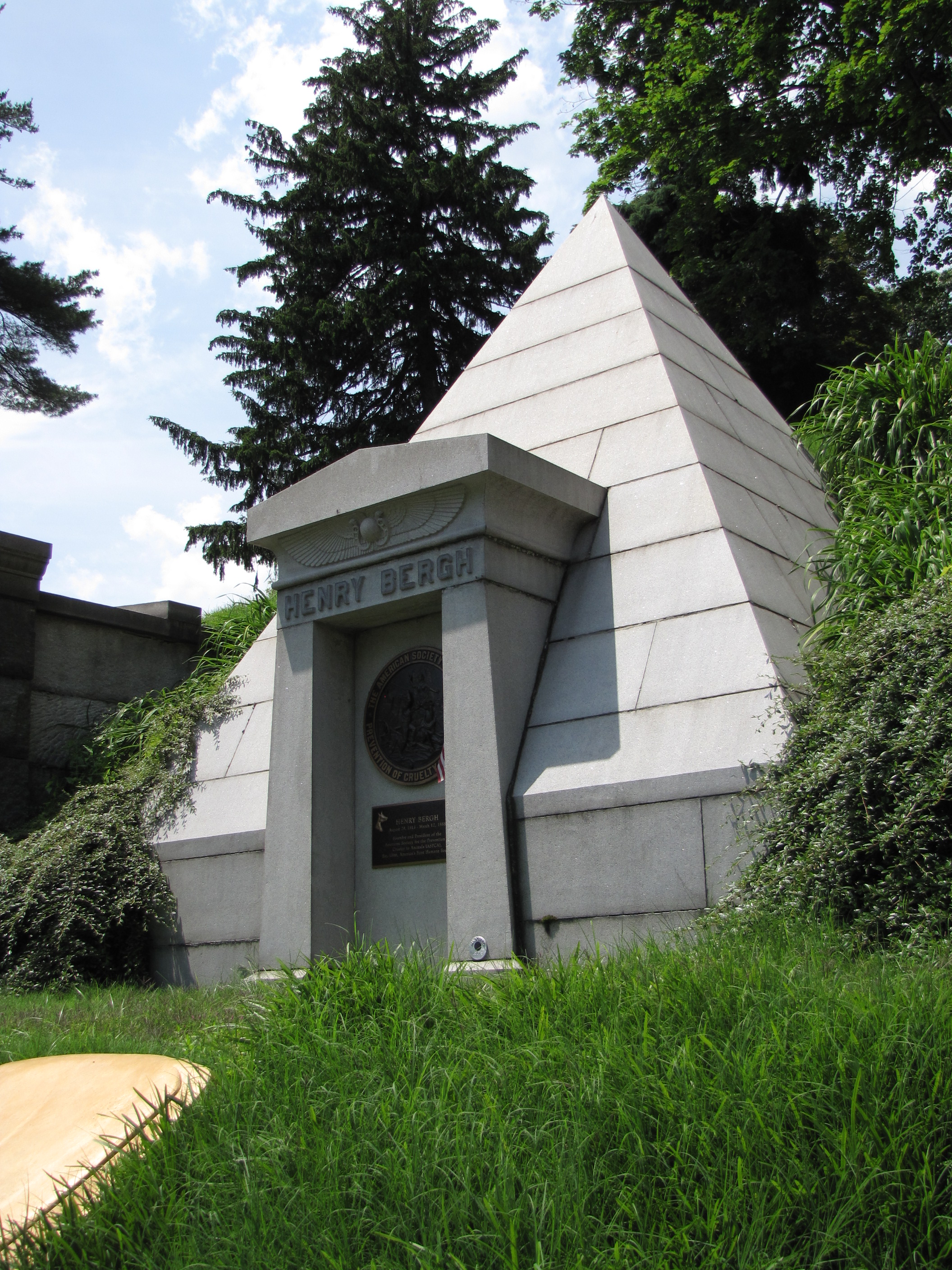
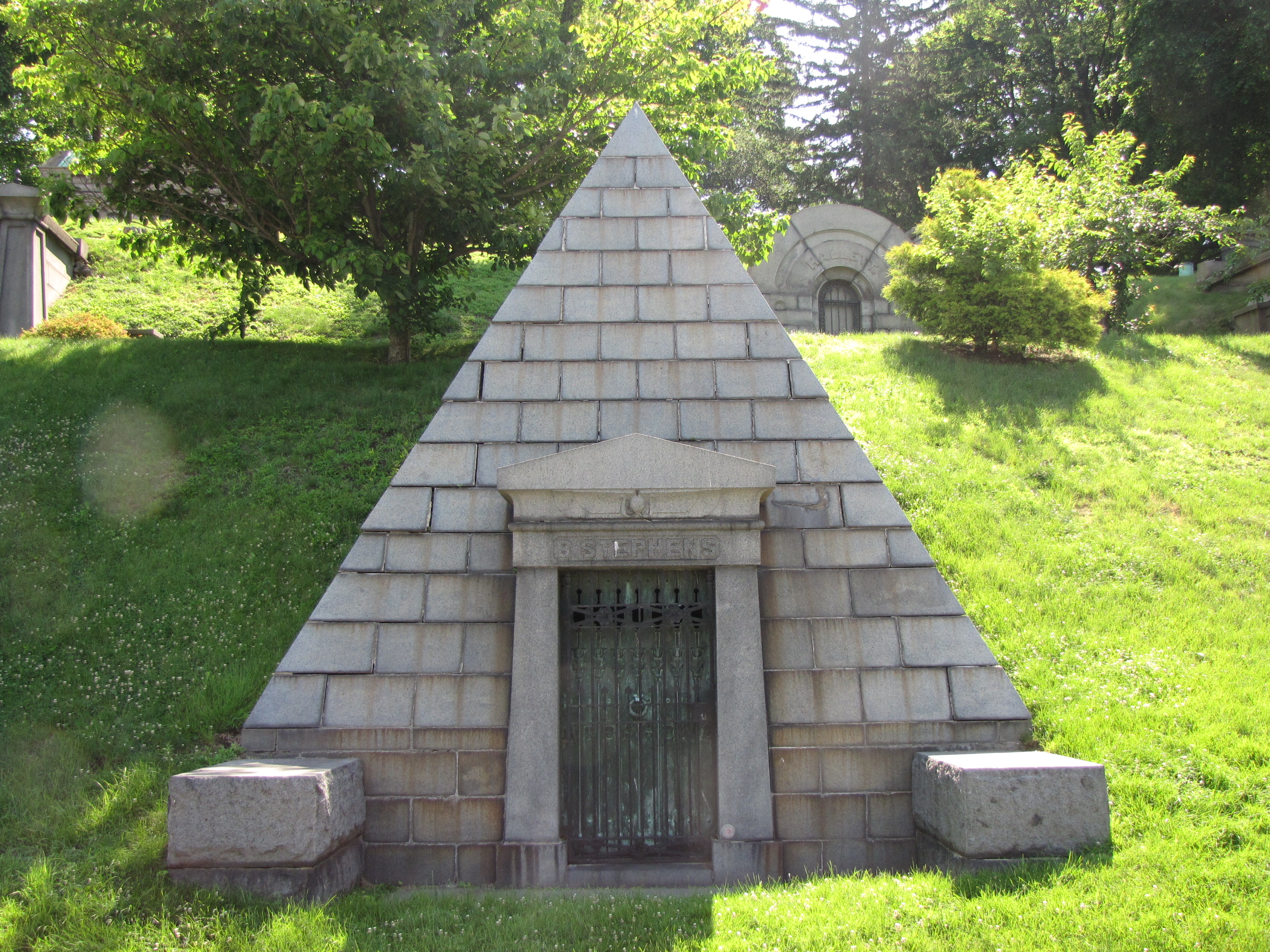
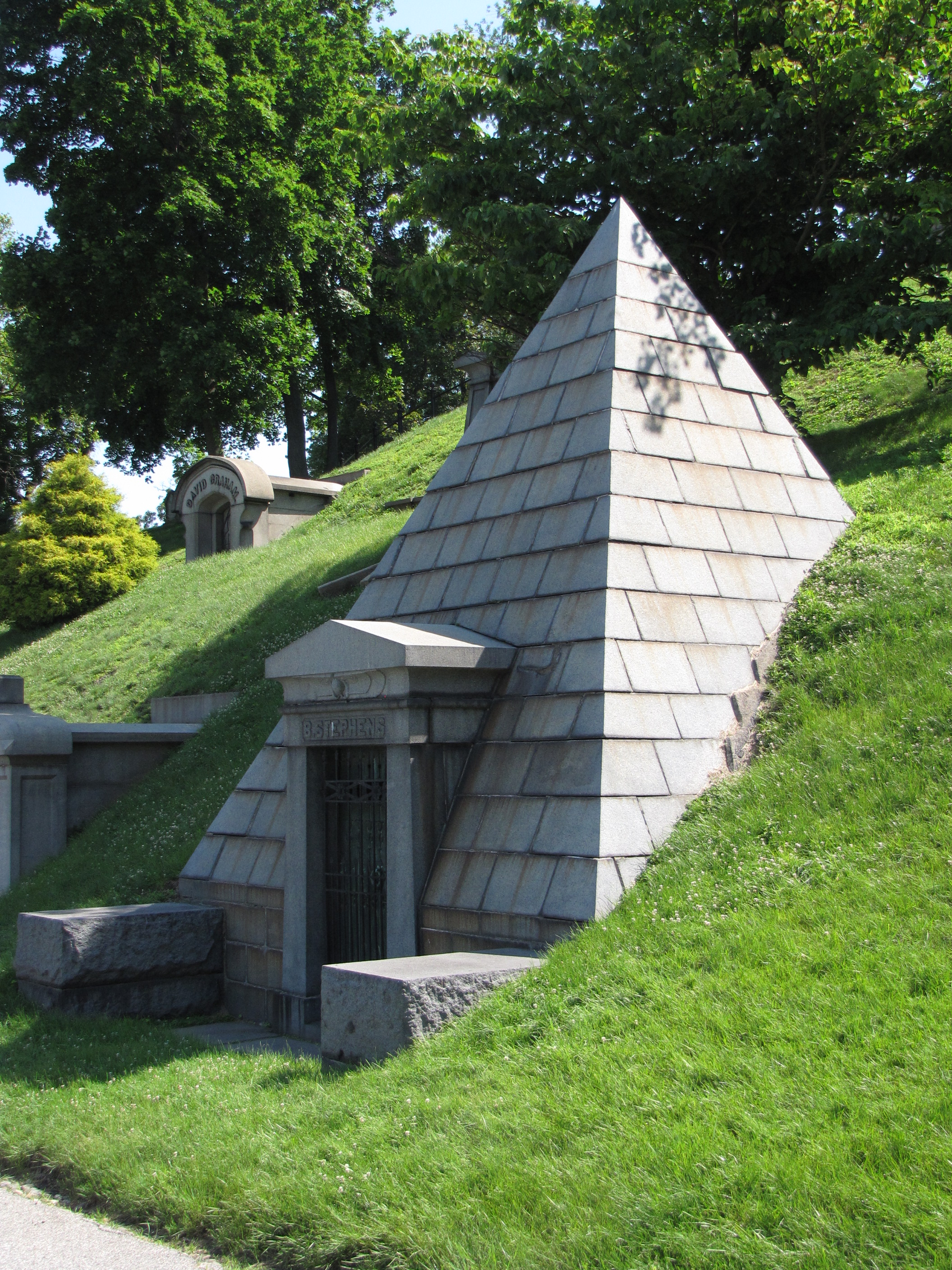
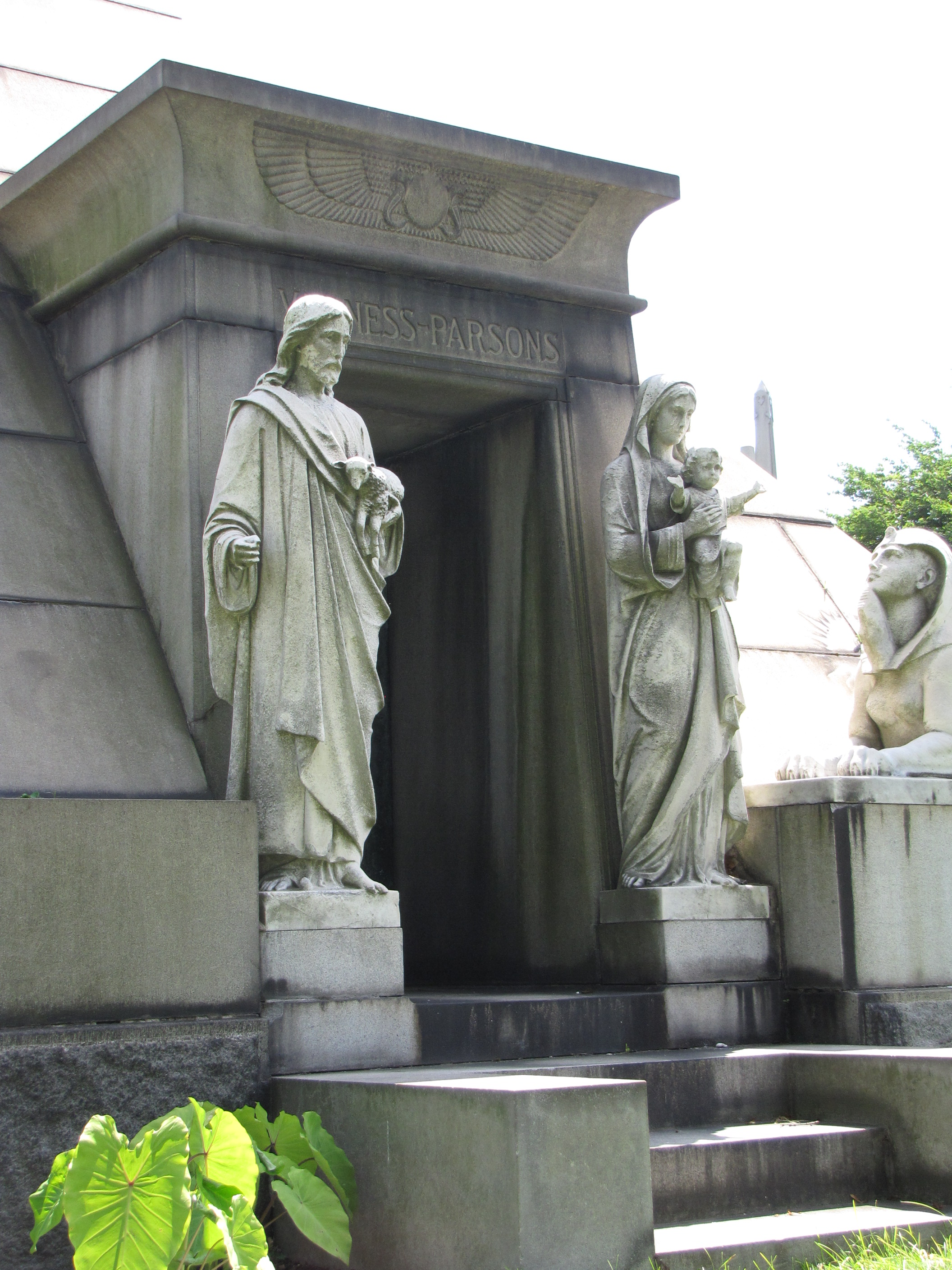
But the pyramid is by far the epitome of Egyptian funerary architecture, the tomb of the pharaohs.  The oldest pyramid is the Pyramid of Djoser built over four thousand years ago from 2630 BC to 2612 BC.  The largest of the Egyptian pyramids is the Pyramid of Khufu at Giza built between 2589 and 2566 BC. This later pyramid was the inspiration for many of the pyramids found in American cemeteries, three of which can be found in the Green-Wood Cemetery at Brooklyn, New York, which I will write briefly about today: The Van Ness-Parson Monument, the Henry Bergh Mausoleum, and the Benjamin Stephens pyramid mausoleum.

The Henry Bergh Pyramid:

The pyramid mausoleum of Henry Bergh was built in 1888. It is an imposing structure. As far as mausoleums go, it is relatively unadorned except for the winged globe surrounded by two rearing snakes—the uroei—above the doorway. In this example, there are three sets of falcon wings that are a symbol of the king, the sun, and the sky. The globe represents the Egyptian god, Horus. The uroei, snakes, are waiting to strike. They symbolize the king’s ability to ward off evil spirits. On the entryway of the mausoleum is a large round bronze insignia of the ASPCA which displays a man lifting a club to beat an horse.  An angel comes between the man and the horse interceding to stop the cruelty.

IMG_4234

The Benjamin Stephens Pyramid:

The Stephens pyramid, built in 1890, is very much like the Bergh pyramid in that the only ornamentation is above the doorway. Again, the winged globe is carved onto the lintel. The Stephens pyramid, though, while having the same base width is taller.

IMG_3694

As Elizabeth Broman writes in her article, “Egyptian Revival Funerary Art”, Markers XVIII, 2001, pages 30-66, “The Bergh pyramid is angled lower and has a block-like shape that seems more firmly planted on the ground. The Stephens’ sides are more steeply pitched and it presents a loftier appearance because there is more surface area between the top of the lintel and the pyramidion: it appears to be reaching skyward, whereas the Bergh monument seems to have a solid, heavy center of gravity that is firmly planted in the ground.”

IMG_3697

The Van Ness-Parsons Pyramid

This pyramid was built in 1931 for Albert Parsons. It is broader than the Bergh and the Stephens pyramids and is adorned with Christian and Egyptian symbolism.

IMG_3811

The Egyptian and Christian symbolism share an uncomfortable coexistence.  The mausoleum displays images of the ancient pharaonic religion including the sphinx, the winged globe, and the uroei.  It also displays Joseph holding a lamb and Mary holding the baby Jesus. Many Christians objected to Egyptian motifs and their non-Christian origins.  To soften the impact, designers often included Christian symbolism.  In this case, however, the designer of the mausoleum believed there was a “long-standing identification between Americans, Christianity, and ancient Egypt.”

IMG_3838

Note: For a more complete analysis of the Egyptian Revival architecture found in the Green-Wood Cemetery, check out Elizabeth Broman’s article, “Egyptian Revival Funerary Art”, Markers XVIII, 2001, pages 30-66. In her article she writes not only about the pyramids but other Egyptian Revival-style mausoleums found in Green-Wood.

Posted in Mausoleums, Symbolism | 3 Comments

Cross and the Crown

Glendale Cemetery, Akron, Ohio

Glendale Cemetery, Akron, Ohio

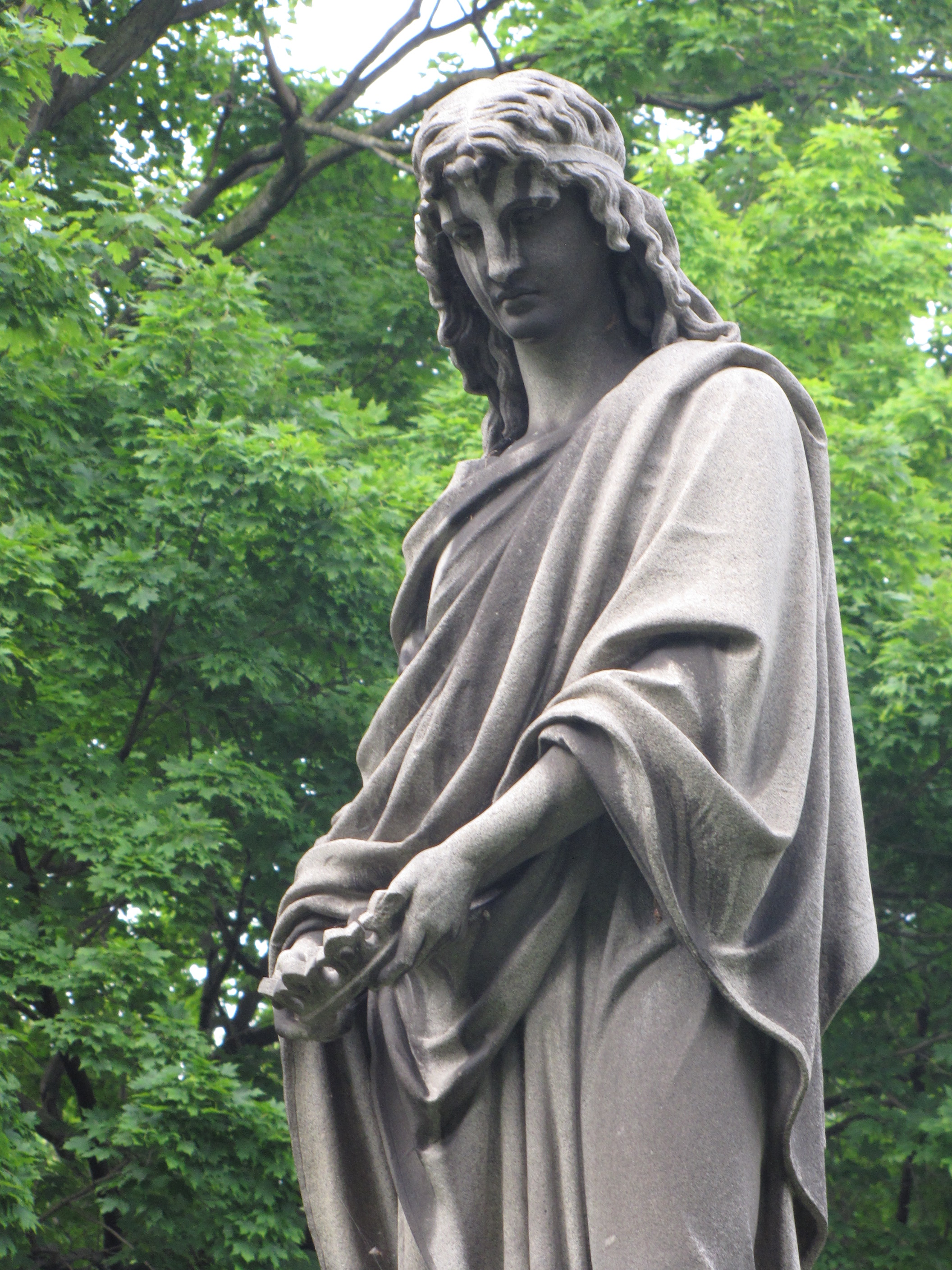
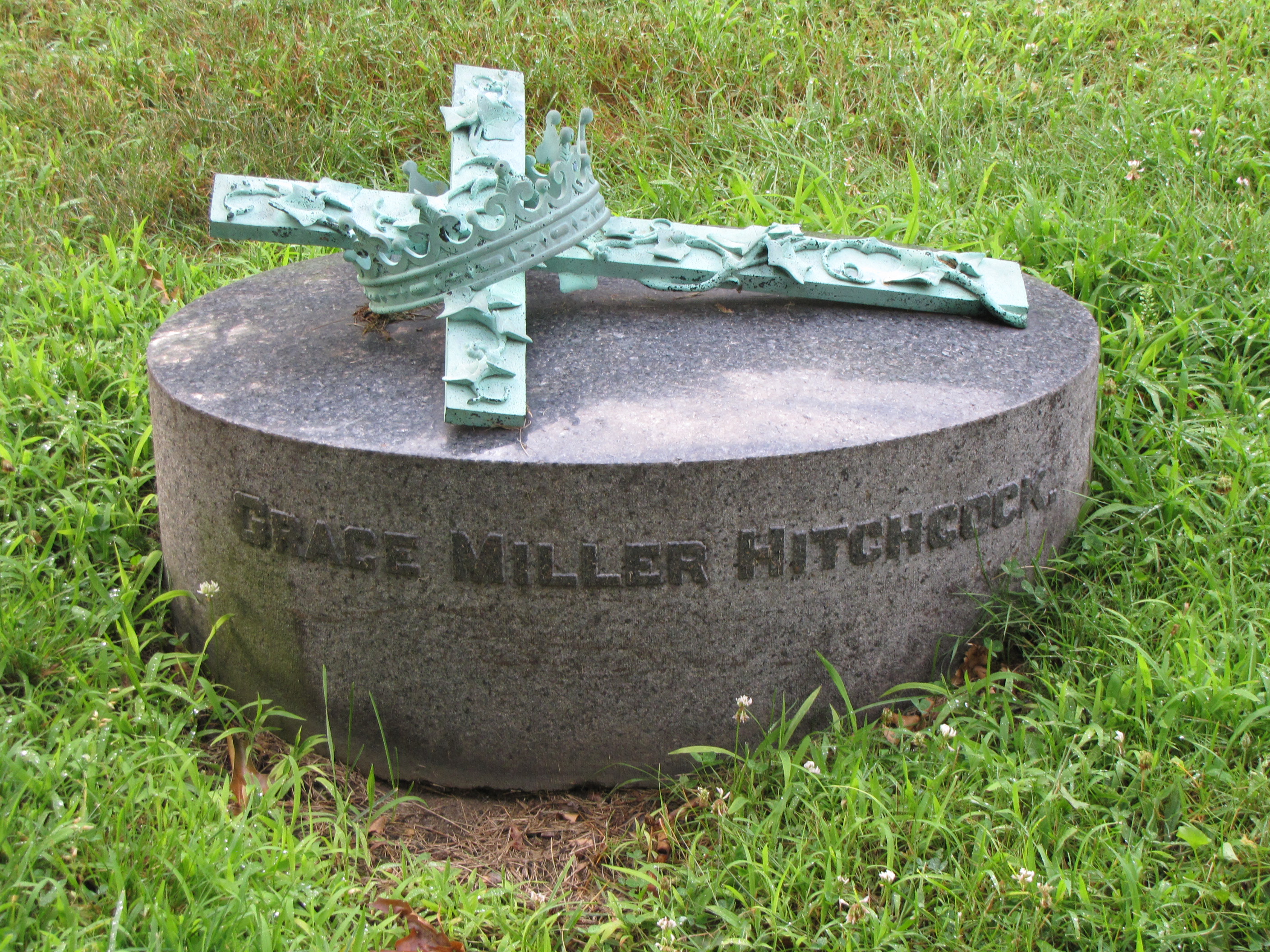
The Gothic-style Miller family monument in the Glendale Cemetery at Akron, Ohio, is inscribed, “Be Thou Faithful Unto Death and I Will Give Thee a Crown of Life”. That message is further reinforced by the mourning figure atop the monument of a woman holding a crown in her hands.

IMG_3663

The crown is a symbol of glory and victory over death.  The reward awaits in Heaven where the victor will receive a crown of victory.

The crown symbol is found again resting on top of a cross found on each of the individual family headstones. The cross and crown symbols are green oxidized copper bolted to each of the family members’ headstones.

IMG_3664

The cross represents the suffering of Christ.

Posted in Symbolism | Leave a comment