Sarcophagi

You say sarcophagi, I say sarcophaguses. Whichever way you say it, it means more than one sarcophagus.

Sarcophagus tombs are designed to look like coffins.  Most often they are set on a platform or a base.  The tomb is often embellished with ornamentation and nearly always has feet–but the “coffin” is empty–just an empty symbol of the receptacle.  This style of burial monument is ancient.

The word, sarcophagus, is derived from two ancient Greek words, sarx, which meant flesh and phagein meaning to eat.  The two words together, sarkophagus, meant flesh eating.  The term came from the limestone used by the ancient Greeks to bury the dead which was thought to decompose the flesh of the deceased.

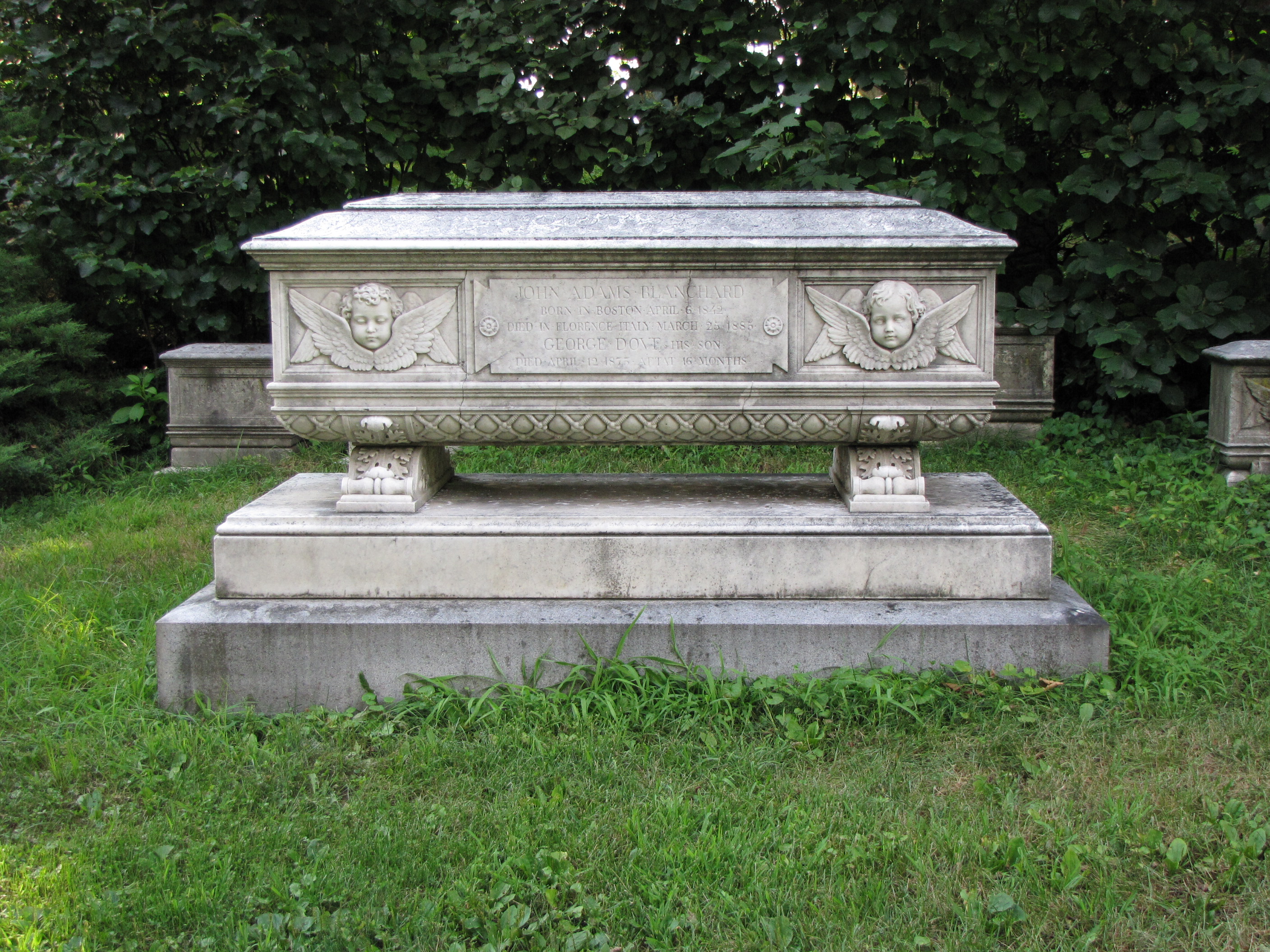
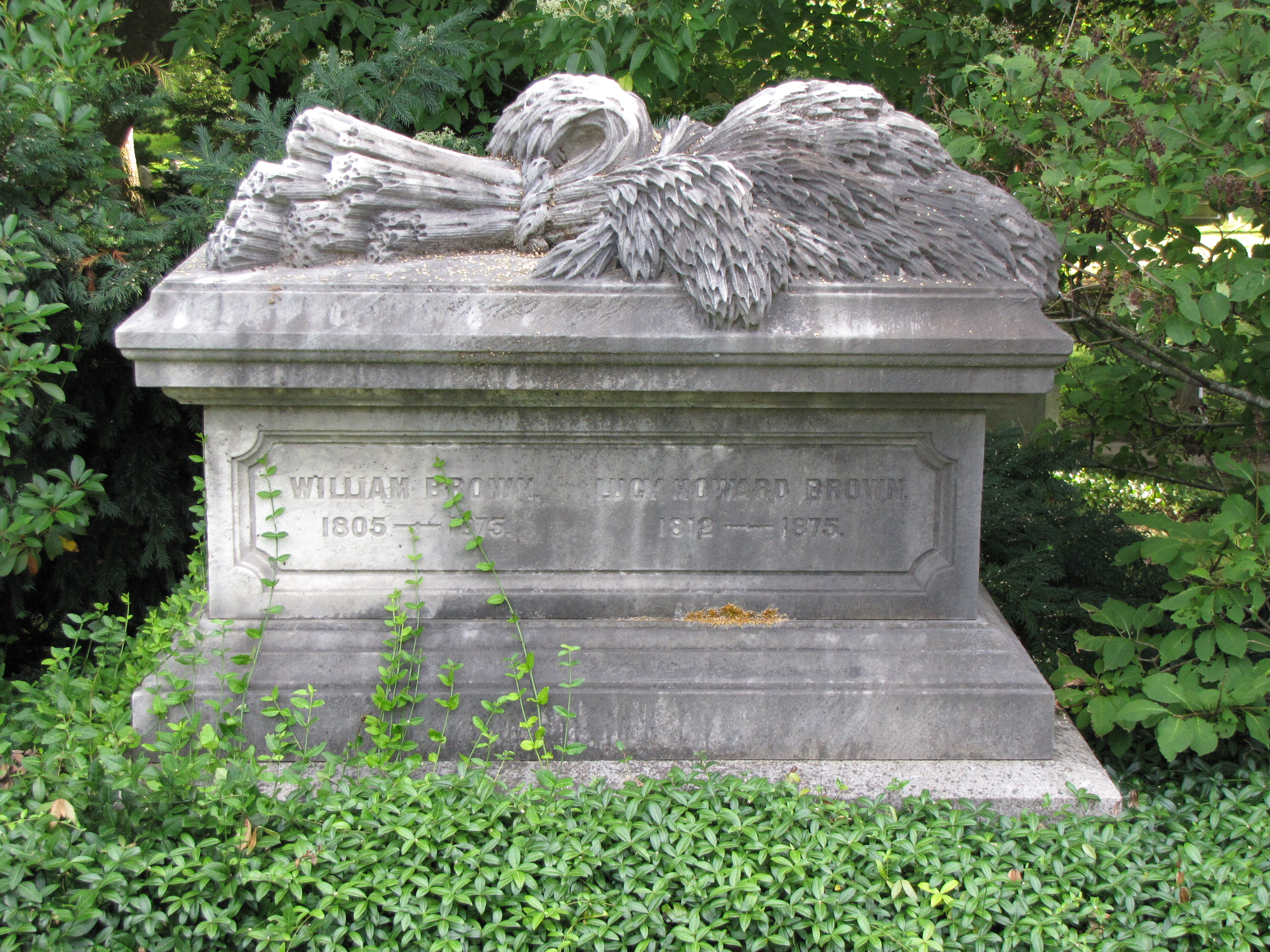
The sarcophagi shown here are from the Mt. Auburn Cemetery at Cambridge, Massachusetts.

The John Adams Blanchard sarcophagus features four winged cherubs, two on each side, embellish the footed tomb.  The winged cherub was a symbol that became popular in the 18th Century.  Winged cherubs replaced the stark and morbid flying death’s heads from our Puritan forefathers.  The cherubs have a childlike countenance of innocence.  The iconography represents the flight of the soul from the body upward to Heaven and the hope of the resurrection.
IMG_5574

Carved on top of the William and Lucy Howard Brown white marble sarcophagus is a great shock of wheat. Wheat’s origins are unknown but is the basis of basic food and a staple in many cultures. Because of wheat’s exalted position as a mainstay foodstuff, it is viewed as a gift from Heaven. Wheat symbolizes immortality and resurrection.  But, like many symbols found on gravestones, they can have more than one meaning.  For instance, because wheat is the main ingredient of bread, the sheaf of wheat can represent the Body of Christ.  Wheat can also represent a long life, usually more than three score and ten, or seventy years.
IMG_5530


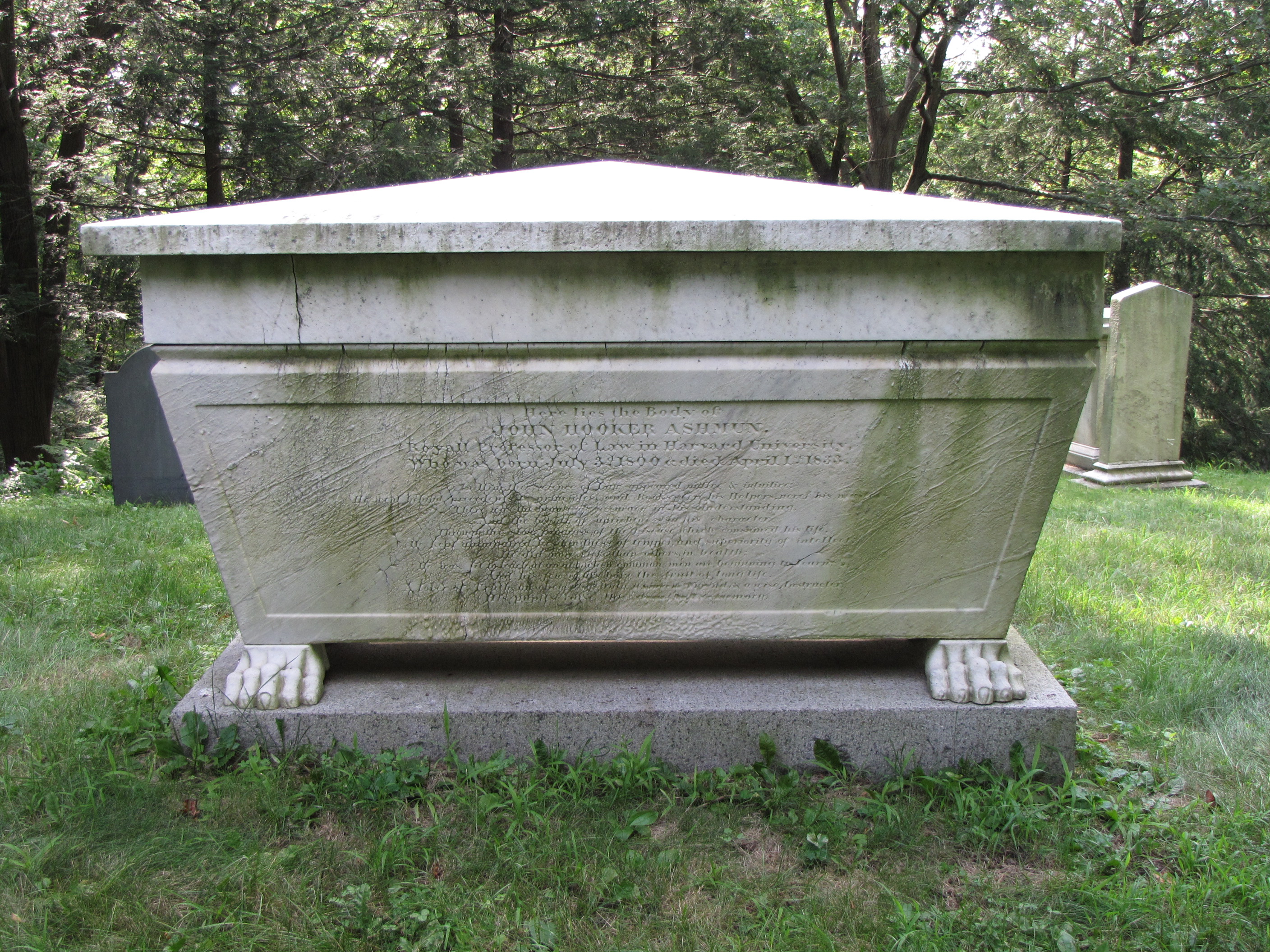
This sarcophagus was erected by the students of Professor John Hooker Ashmun, a testament to his connection to his teaching ability and personality. The tomb rests upon four lion’s feet, giving it an imposing feel.
IMG_5412

Here lies the Body of

JOHN HOOKER ASHMUN

Royall Professor of Law in Harvard University

Who was born July 3d. 1800 & died April 1, 1833


In him the science of law appeared native and intuitive.

He went behind precedents to principles, and books were his helpers, never his masters.

There was the beauty of accuracy in his understanding,

And beauty of uprightness in his character.

Through the slow progress of the disease which consumed his life,

He kept unimpaired his kindness of temper and superiority of intellect.

He did more work sick than others in health.

He was fit to teach at an age when common men are beginning to learn,

And his few years bore the fruit of long life.

A lover of truth, an obeyer of duty, a sincere friend, and a wise instructor.

His pupils raise this stone to his memory.

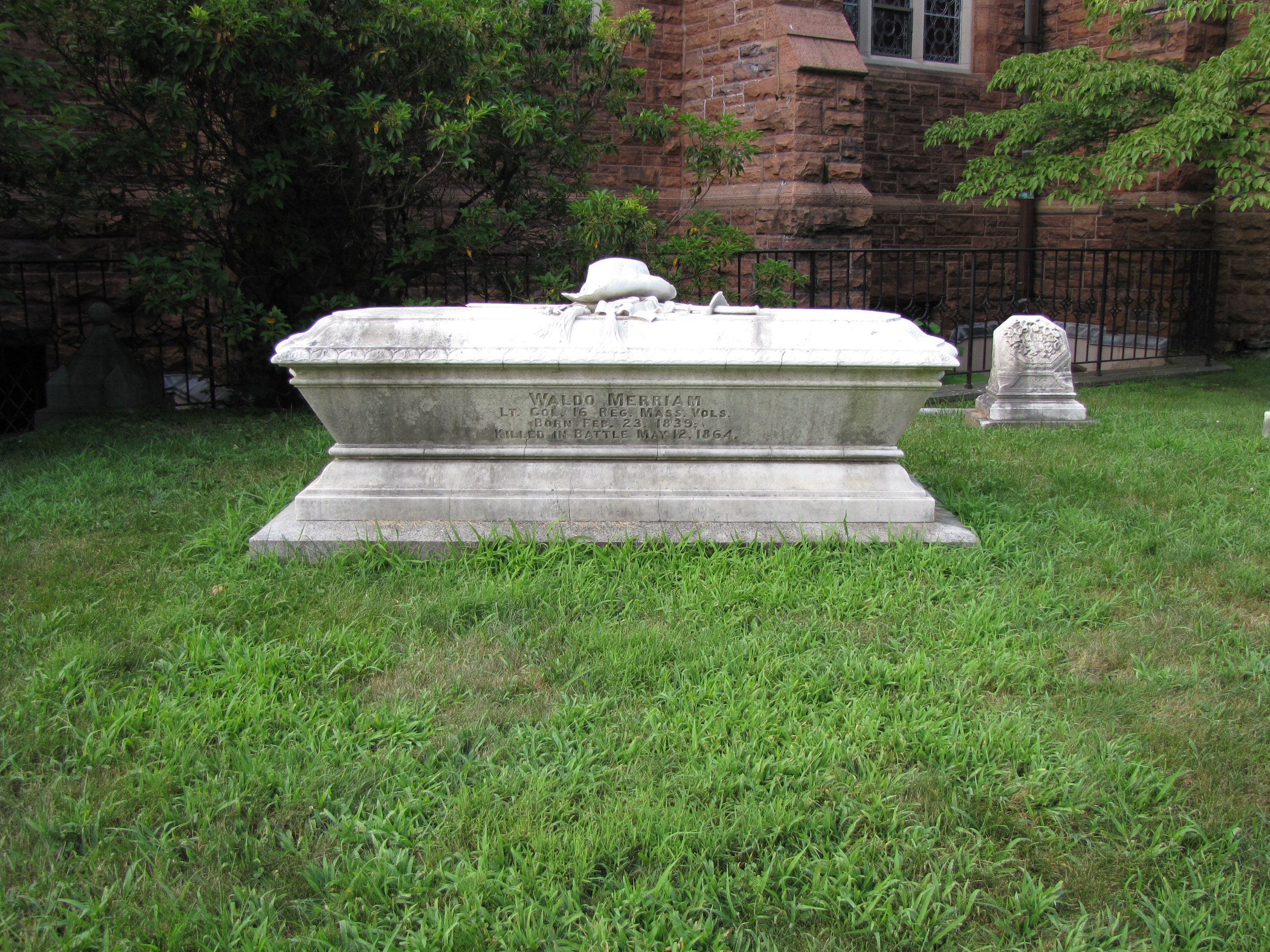
This white marble sarcophagus was built for Waldo Merriam, a soldier who was killed in a battle. The top of the monument features the soldier’s hat and sword.
IMG_5671

WALDO MERRIAM

LT. COL. 16 REG. MASS. VOLS.

BORN FEB. 23, 1839;

KILLED IN BATTLE MAY 12, 1864.

Posted in Uncategorized | 3 Comments

A Bouquet

Fairmont Cemetery, Denver, Colorado

Fairmount Cemetery, Denver, Colorado

JENNIE

BELOVED WIFE OF

RUFUS E. GAMBLE

BORN

JULY 21, 1847.

DIED NOV. 19, 1871.

AGED 24 YRS. 3 MS.

& 28 DAYS

“ASLEEP IN JESUS”

There are many symbols that represent death in funerary art—the broken bud, the sleeping lamb, baby shoes, the flying death’s head, and, here, a broken pot of flowers turned on its side.  The bouquet spilling out of the pot may be reminiscent of the one the young bride carried down the aisle.

IMG_6778

Posted in Symbolism | Leave a comment

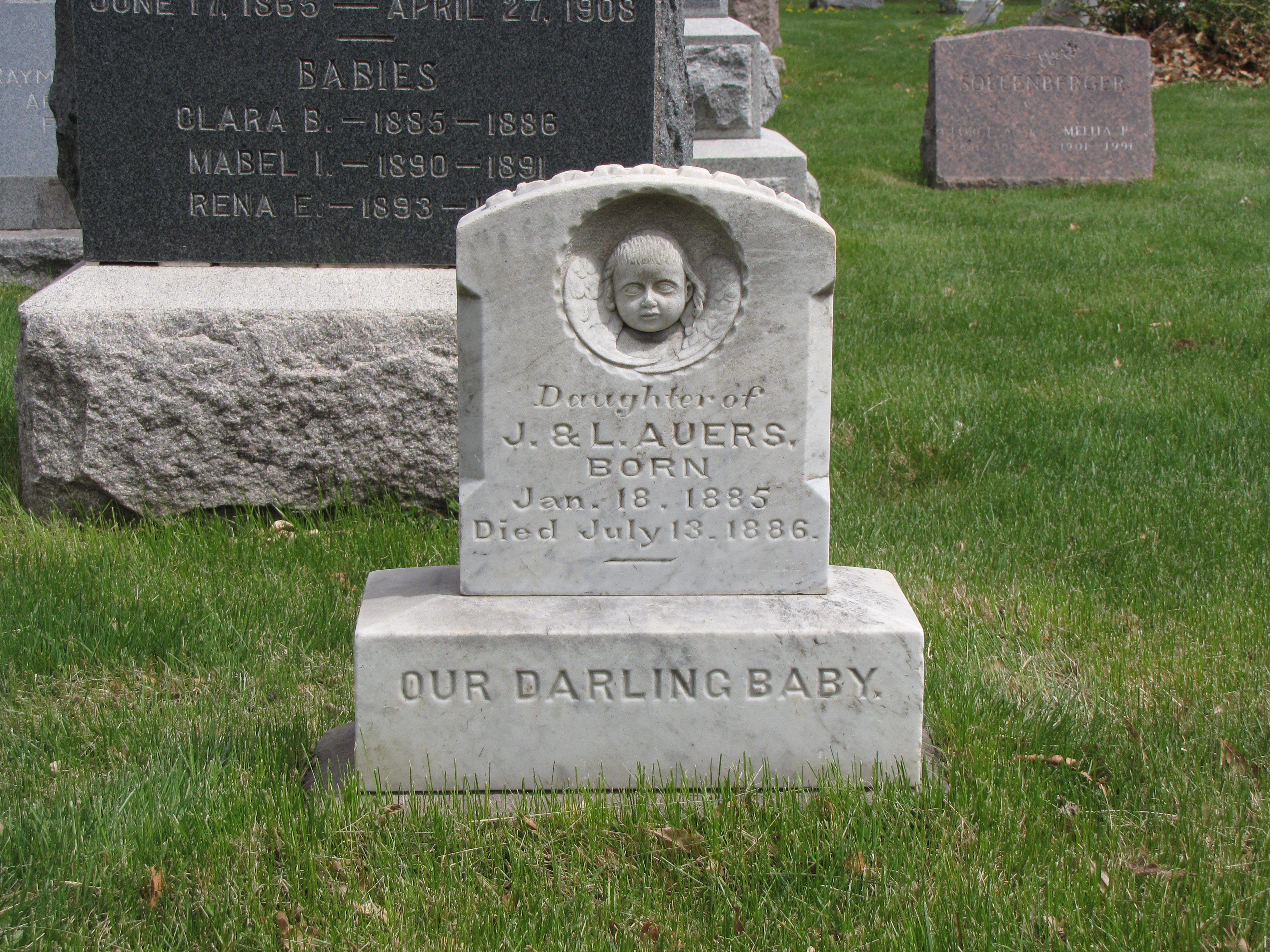
Clara Bell

Fairmont Cemetery, Denver, Colorado

Fairmount Cemetery, Denver, Colorado

Clara Bell

Daughter of

J. & L. AUERS

Born

Jan. 18. 1885

Died July 13. 1886.

OUR DARLING BABY

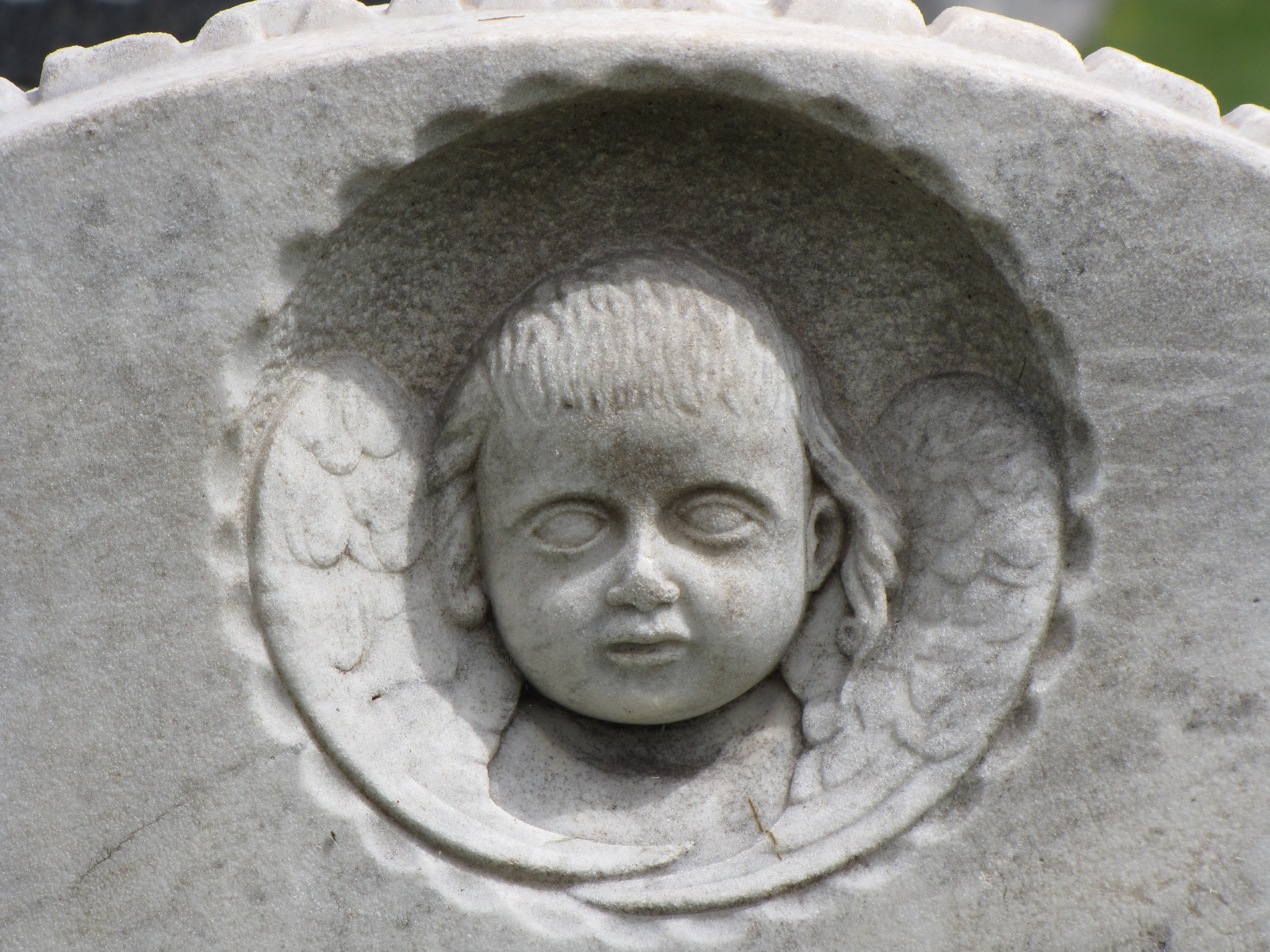
The gravestone of this little girl is haunting with those hollow eyes. Only 18 months months after she was born, she died. Her gravestone features a winged cherub that may be a portrait.

The winged cherub was a symbol that became popular in the 18th Century.  Winged cherubs replaced the stark and morbid flying death’s heads from our Puritan forefathers.  The cherubs have a childlike countenance of innocence.  The iconography represents the flight of the soul from the body upward to Heaven and the hope of the resurrection.

IMG_6760

Posted in Symbolism | 2 Comments

The Good Samaritan

IMG_6695

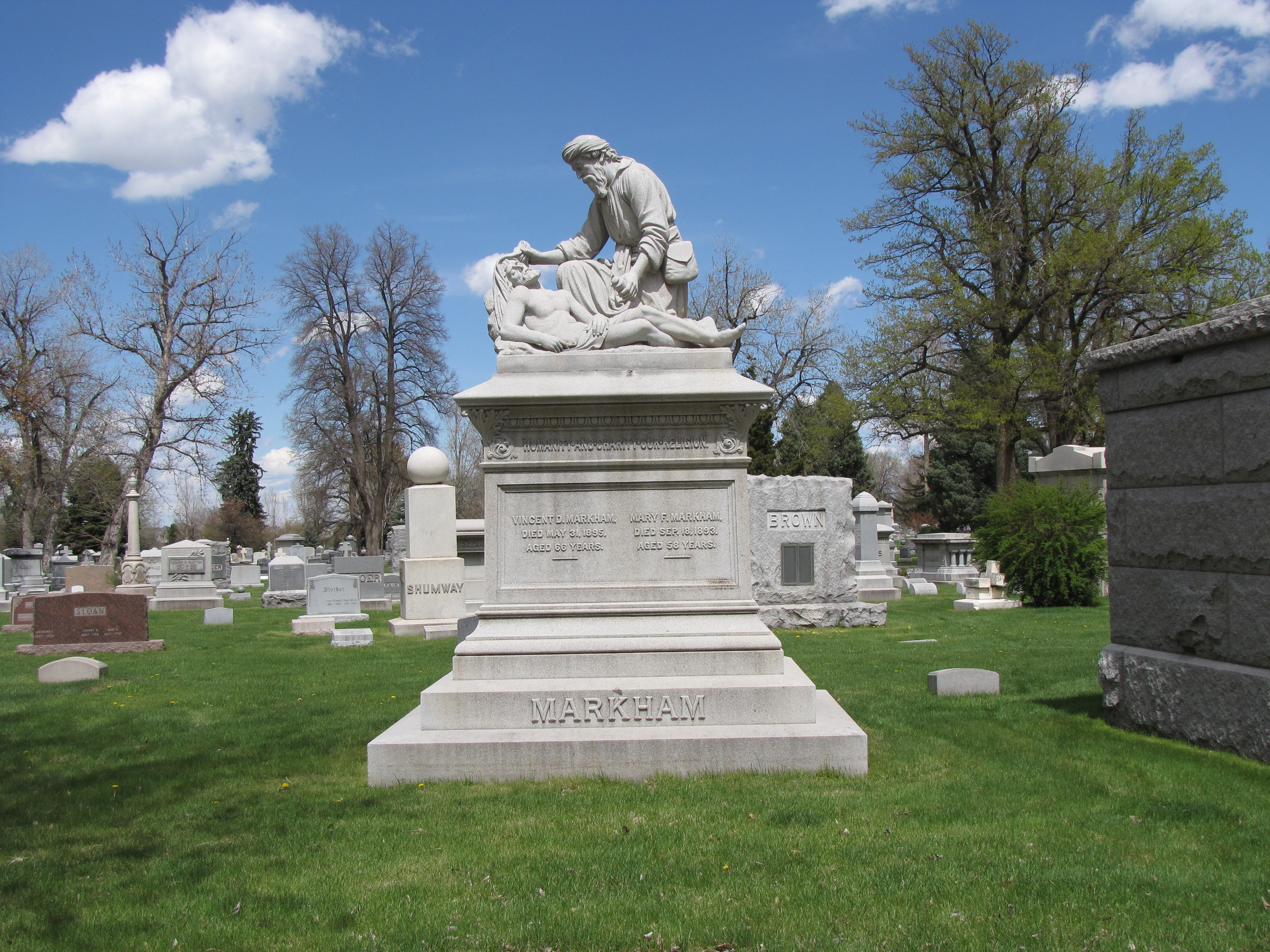
HUMANITY AND CHARITY OUR RELIGION

VINCENT D. MARKHAM

DIED MAY 31, 1895

AGED 66 YEARS


MARY F. MARKHAM

DIED SEP. 18, 1893

AGED 58 YEARS

IMG_6696

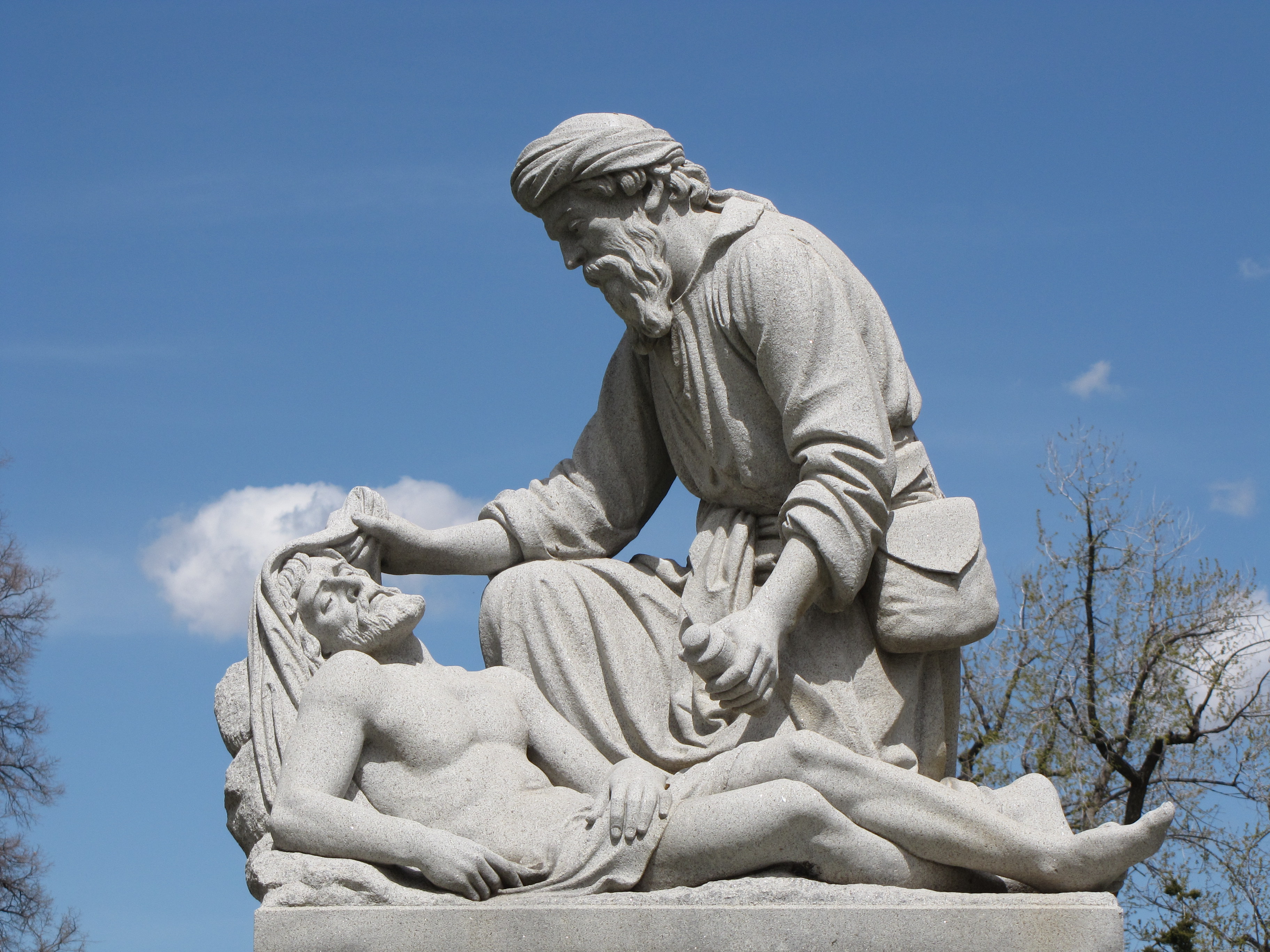
Nearly everyone knows the term “good Samaritan” but many might not know of its origins from Luke and more specifically that it is a parable told by Jesus:

Luke 10:25-37King James Version (KJV)

25 And, behold, a certain lawyer stood up, and tempted him, saying, Master, what shall I do to inherit eternal life?

26 He said unto him, What is written in the law? how readest thou?

27 And he answering said, Thou shalt love the Lord thy God with all thy heart, and with all thy soul, and with all thy strength, and with all thy mind; and thy neighbour as thyself.

28 And he said unto him, Thou hast answered right: this do, and thou shalt live.

29 But he, willing to justify himself, said unto Jesus, And who is my neighbour?

30 And Jesus answering said, A certain man went down from Jerusalem to Jericho, and fell among thieves, which stripped him of his raiment, and wounded him, and departed, leaving him half dead.

31 And by chance there came down a certain priest that way: and when he saw him, he passed by on the other side.

32 And likewise a Levite, when he was at the place, came and looked on him, and passed by on the other side.

33 But a certain Samaritan, as he journeyed, came where he was: and when he saw him, he had compassion on him,

34 And went to him, and bound up his wounds, pouring in oil and wine, and set him on his own beast, and brought him to an inn, and took care of him.

35 And on the morrow when he departed, he took out two pence, and gave them to the host, and said unto him, Take care of him; and whatsoever thou spendest more, when I come again, I will repay thee.

36 Which now of these three, thinkest thou, was neighbour unto him that fell among the thieves?

37 And he said, He that shewed mercy on him. Then said Jesus unto him, Go, and do thou likewise.

That story is illustrated in stone upon the monument for Vincent and Mary Markham in the Fairmount Cemetery at Denver, Colorado. Neither of them, however, chose it for themselves. Vincent had a clause in his will that his executors should choose an appropriate monument to honor him and his wife, Mary. It also needed to display in some way, their values, which, in part, are carved in the stone, “Humanity and Charity are our Religion”.

By all accounts the Marhams were generous people who shared their wealth and prosperity with their community. When Vincent Markham died, the Arizona Weekly Citizen, June 15, 1895, edition of the paper wrote this, JUDGE MARKHAM. Colorado papers of June 1st contain announcements of the death of Judge Vincent D. Markham, in the city of Denver. …The Denver Republican editorially says of the distinguished jurist: By the death of Judge Vincent D. Markham, Colorado has lost one of its most distinguished and honorable citizens.” They went on to say, “Respected and loved while he lived, he will be mourned now that be is dead. He always will have an honorable place in the history of Colorado, a state which remembers with gratitude the service of the men who did its pioneer work, strengthening it by their example to others and promoting its interests by all they did.”

The Markham were active philanthropically in Denver throughout their adult lives. They contributed to many charities and were instrumental in founding Denver’s Humane Society. Though they never had children of their own though they were generous with the neighborhood children and godparents to many.

The monument was designed by William Greenlee who owned and operated the Denver Marble and Granite Company, who won a competition held by the executors. The design was an original design from the New England Granite Company of Hartford, Connecticut.

It appears that the statue atop the monument was a fitting tribute to the Markhams.

IMG_6698

Posted in Symbolism | 1 Comment

A Victorian Folly


IMG_2528

The Metarie Cemetery at New Orleans is by most accounts one of the great garden cemeteries in the United States, if such things are rated. The famous, the rich, the infamous, the highly decorated, and the obscure are all buried in this place. Some in modest graves, others in elaborate tombs fit for kings potentates, and even madams!

IMG_2532

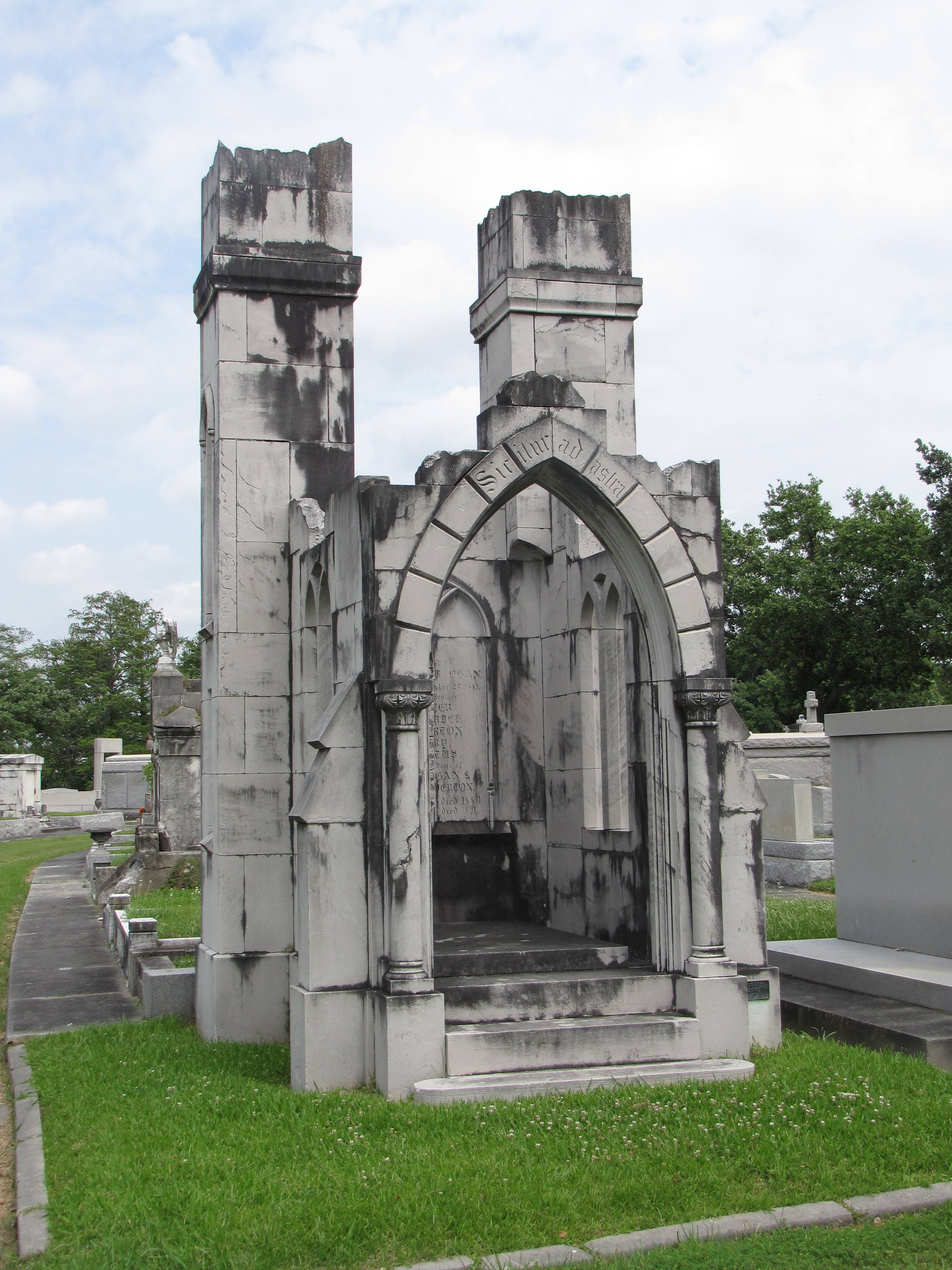
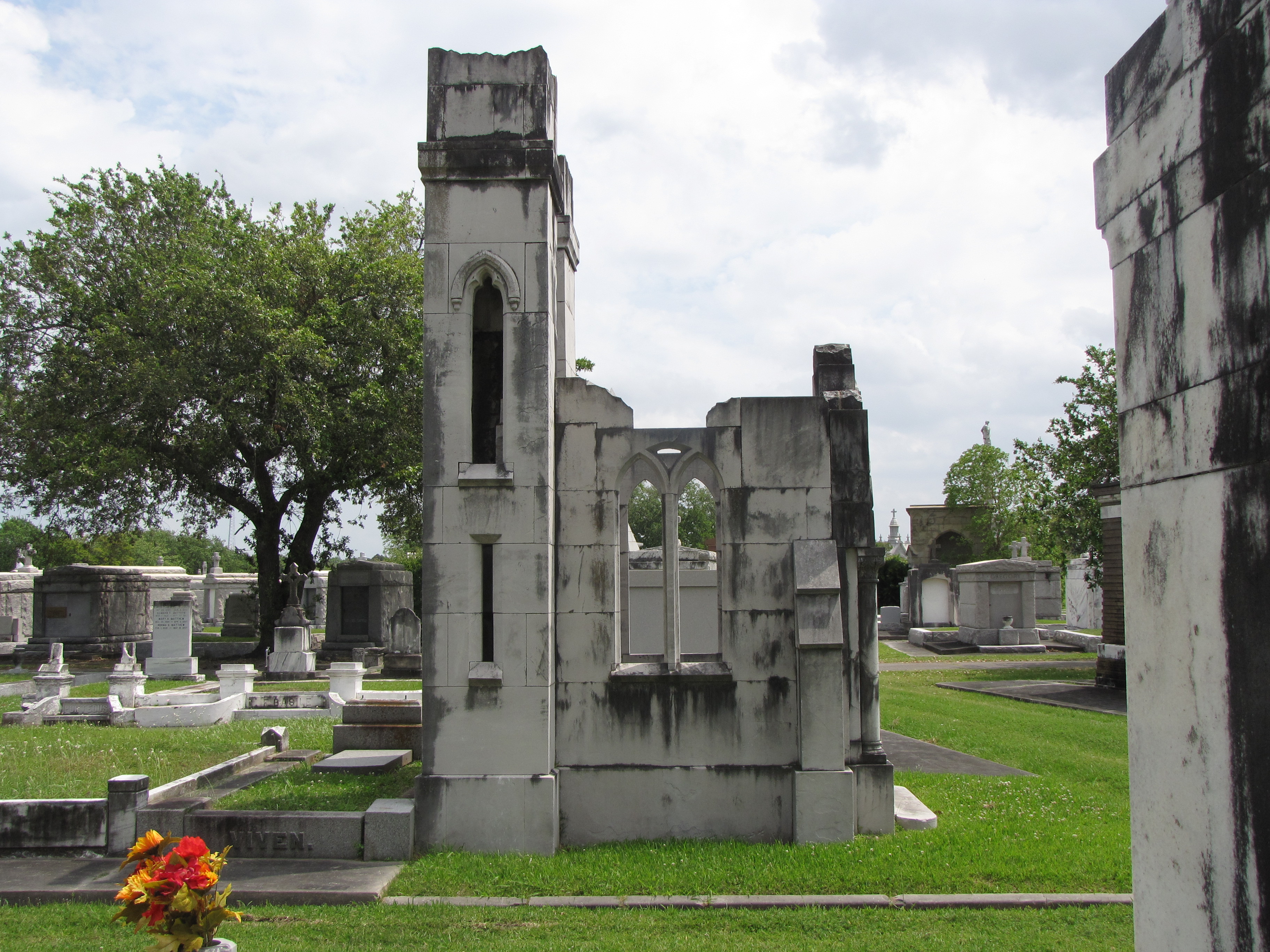
One of the most interesting monuments was built for Henry J. Egan, a Confederate Lieutenant Colonel, who was killed April 6, 1865, at Amelia Springs, Virginia, during General Robert E. Lee’s retreat. The monument was built to appear like a ramshackle Gothic Revival-style Church. It is a sham. The ruin was designed by Charles A. Orleans, one of the leading monument builders in New Orleans at the time, who was at the height of his fame when it was built in 1881. The Victorian folly, built to look like one thing when it is actually another, is a marble monument complete with mock cracks and crumbling stone to deceive the passerby.

Carved above the arched doorway into the tomb are the words, “Sic itur ad astra” – Latin which translates to “Thus to the stars”.

Goth Gardener, who has an impressive blog pointed, out that this monument actually marks the graves of several Egan family members. Their names have been added to the description of the monument. Goth Gardener also wrote a blog post about the Egan monument in Metarie Cemetery which can be found at this URL: http://goth-gardening.blogspot.com/2015/05/southern-cemetery-faux-ruins.html

(Inscription on the back wall of the church)

In Memory of

Bentinck Egan

Who died Dec. 27, 1881

And his brothers

Walter

Frederock

Yelverton

Henry

Augustus

The Good Sons of

Dr. J. S. Egan and I. M. Yelverton

Mother died 1884

Father died 1891

(on the floor )

Lieutenant Colonel Henry I. Egan

Killed at Amelia Springs, Va.

While in command of

Sharpshooters, Gordon’s Division,

Covering Retreat of Lee’s Army

April 6, 1865, Aged 24 years.

Dr. Yelverton B. Egan

Killed at the Battle of Sharpsburg

September 17, 1863, aged 24 years.


Letitia M. Yelverton Egan

Their mother

Died in London England 1884

Mary Louisa Egan

Only daughter of

James and Letitia Egan

Died Dec. 26, 1920

Buried with them in

Fulham Cemetery, London

Cecilia Maria Egan

Died Jan. 2, 1941

Frederick Egan and his wife

Julia Wilkinson Egan

 (inscription on the back of the building)

 BENTINCK

IMG_2534

Posted in Mausoleums | 4 Comments

The Maker of the Modern Mall

IMG_6825

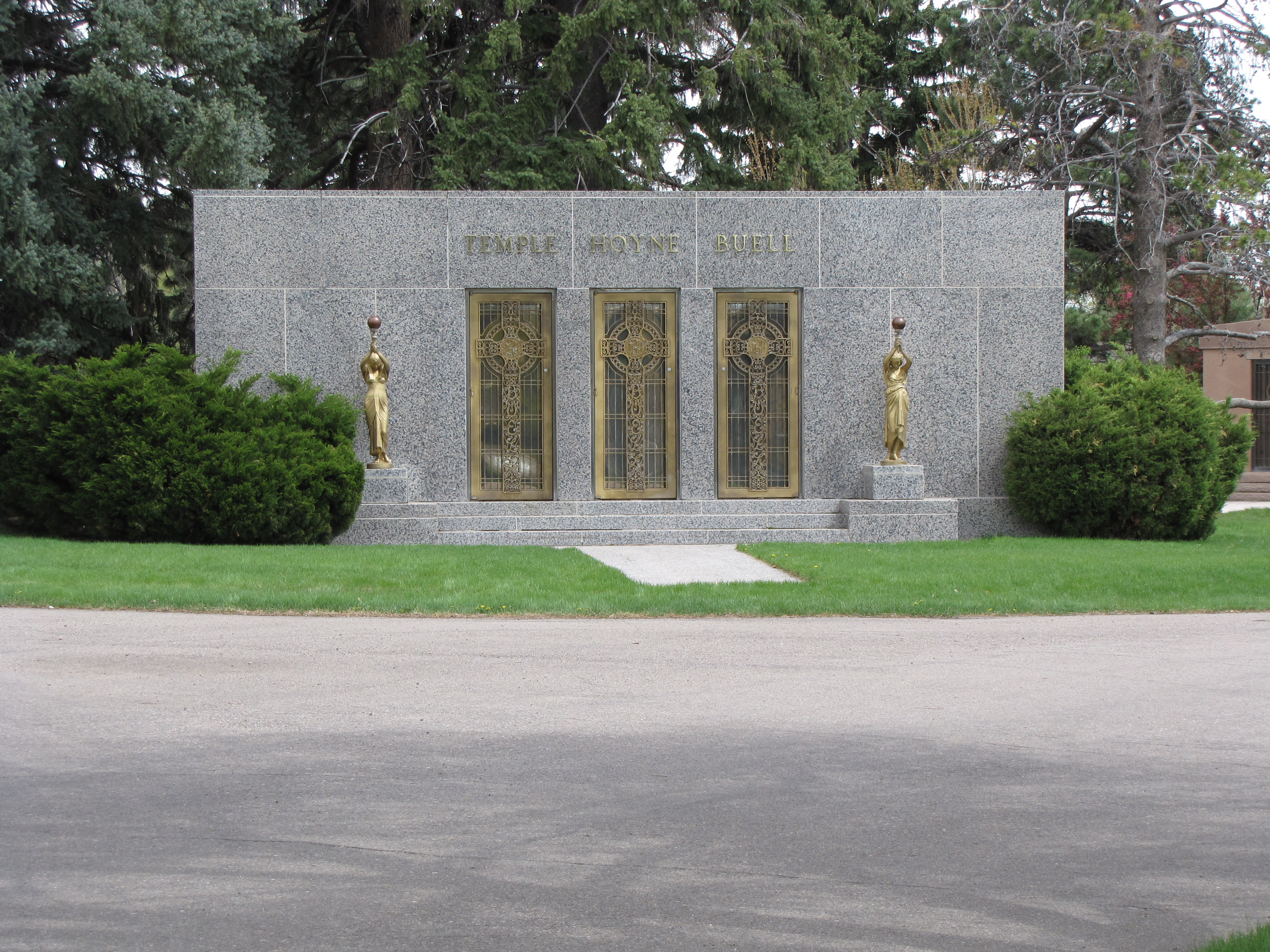
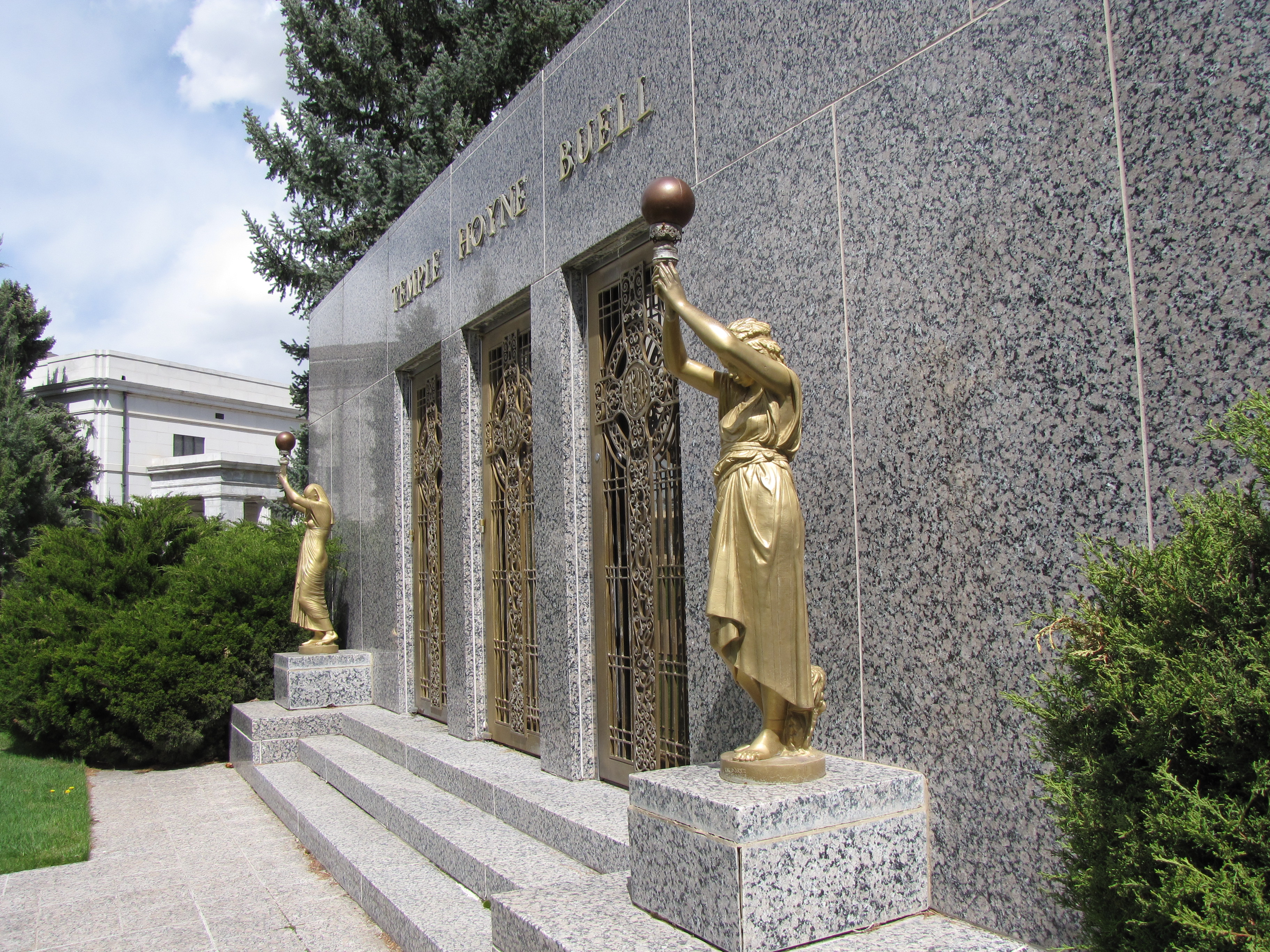
The modern-style polished-granite mausoleum in the Fairmount Cemetery at Denver, Colorado, was designed by and built for Temple Hoyne Buell (1895–1990) a noted architect who gained lasting fame for designing the first-ever American shopping mall. Buell was a prolific and highly successful architect who designed over 300 buildings in Colorado.

IMG_6833

IMG_6829

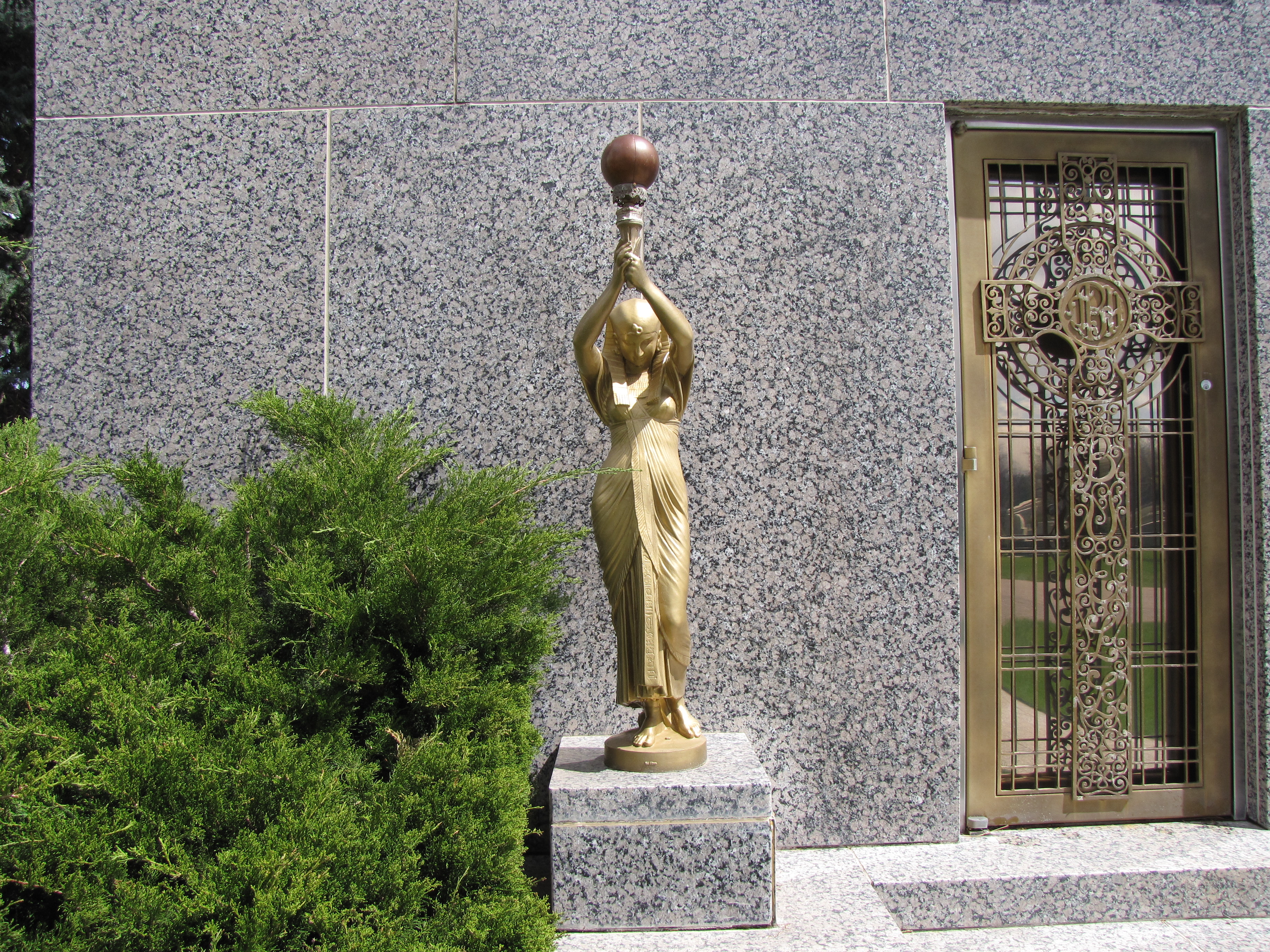
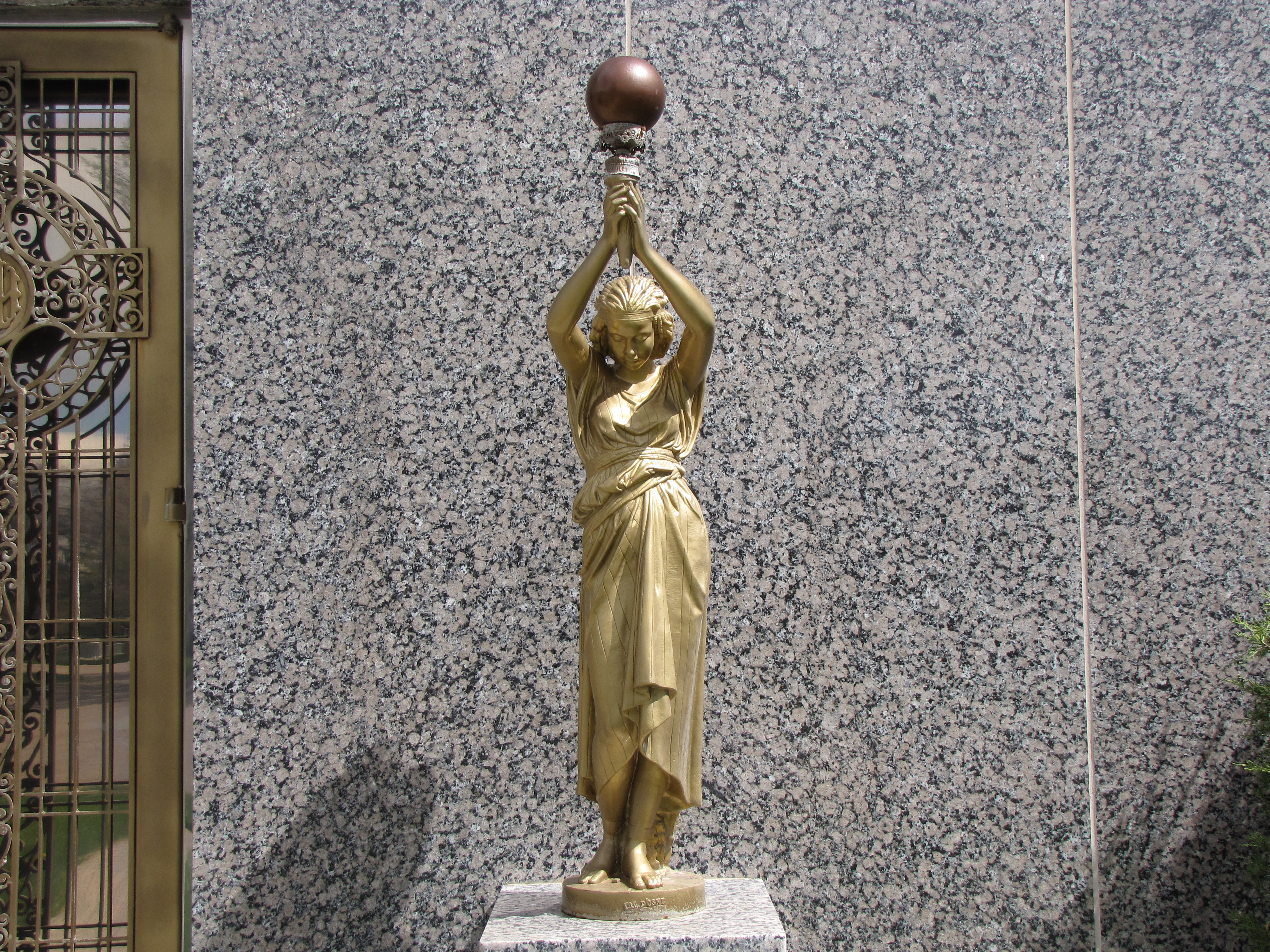
The Buell mausoleum is a modern architectural confection that combines Christian symbolism highlighted in the highly-elaborate Latin crosses on three brass doors that dominate the face of the building with golden goddesses flanking the entrance to the tomb–one Egyptian and one Greek. The mausoleum merges the holy symbolism of the Christian cross with statues that represent ancient Egypt and Greece, a juxtaposition of cultures and religions.

IMG_6830

Posted in Mausoleums, Uncategorized | Leave a comment

The Stele

memorials_today_for_tomorrow_p30-b_georgia_marble_co-1928_rr

In 1928, the Georgia Marble Company of Tate, Georgia, produced a marketing piece in the form of a book titled, Memorials: To-Day for To-Morrow written by William Henry Deacy. The book was designed to showcase their memorial designs by highlighting them in the book with lush full-color watercolor illustrations of the various memorials. Along with the illustrations the book provided explanations of the symbolism found in the memorials. The book also coupled an architectural drawing of how the memorial is to be made.

memorials_today_for_tomorrow_p32_georgia_marble_co-1928_rr

The stele, a stone or wooden slab generally taller than it is wide and designed as a funeral commemorative, dates back many centuries and is one of the oldest forms of gravestones.  Many examples of steles can be found in the National Archaeological Museum of Athens, Greece. This example of a stele was created for Daisios, son of Euthias on the east coast of Attica in Southern Greece.  The stele dates to the middle of the 4th Century B.C. and has two rosettes on the shaft and is topped with an acroterion motif. The acroterion motif is a stylized palm leaf, which can be found on classical Roman and Greek architecture.  The word acroterion comes from the Greek meaning summit.  This motif has its origins in Egyptian art and architecture.

img_3715[1]

The elegant 14 and a half foot tall Stony Creek granite stele below commemorating the graves of President William Howard Taft and his wife Helen Herron Taft was designed by James Earl Frazer.  Gold lettering states their names on the marker.

Arlington National Cemetery, Arlington, Virginia

Arlington National Cemetery, Arlington, Virginia

The stele below, found in the Green-Wood Cemetery, at Brooklyn, New York, was designed for A. H. Stobiber, the son of Felix and Helene Roux Stoiber. Stobiber was a New York resident born September 24, 1853, and died in Lausanne, Switzerland, on March 9, 1916. While this stele does not have the proportions of a classical stele it does have the other elements—rosettes and the acroterion motif.

Green-Wood Cemetery, Brooklyn, New York

Green-Wood Cemetery, Brooklyn, New York

The entire booklet can be found at the Quarries and Beyond Website: http://quarriesandbeyond.org/cemeteries_and_monumental_art/cemetery_stones.html.

The Quarries and Beyond Website was created by Peggy B. and Patrick Perazzo. It focuses on historic stone quarries, stone workers and companies, and related subjects such as geology. Whenever possible links of finished products are provided on the Website. There is a “Quarry Articles” section that presents articles, booklets, and links from the late 1800s to early 1900s, including the 1856 “The Marble-Workers’ Manual.” The “Cemetery Stones and Monuments” section provides references and resources, including many old monument magazines, catalogs, price lists, and a photographic tour “From Quarry to Cemetery Monuments.”


Posted in Uncategorized | Leave a comment

The Obelisk

memorials_today_for_tomorrow_p62-b_georgia_marble_co-1928_rr

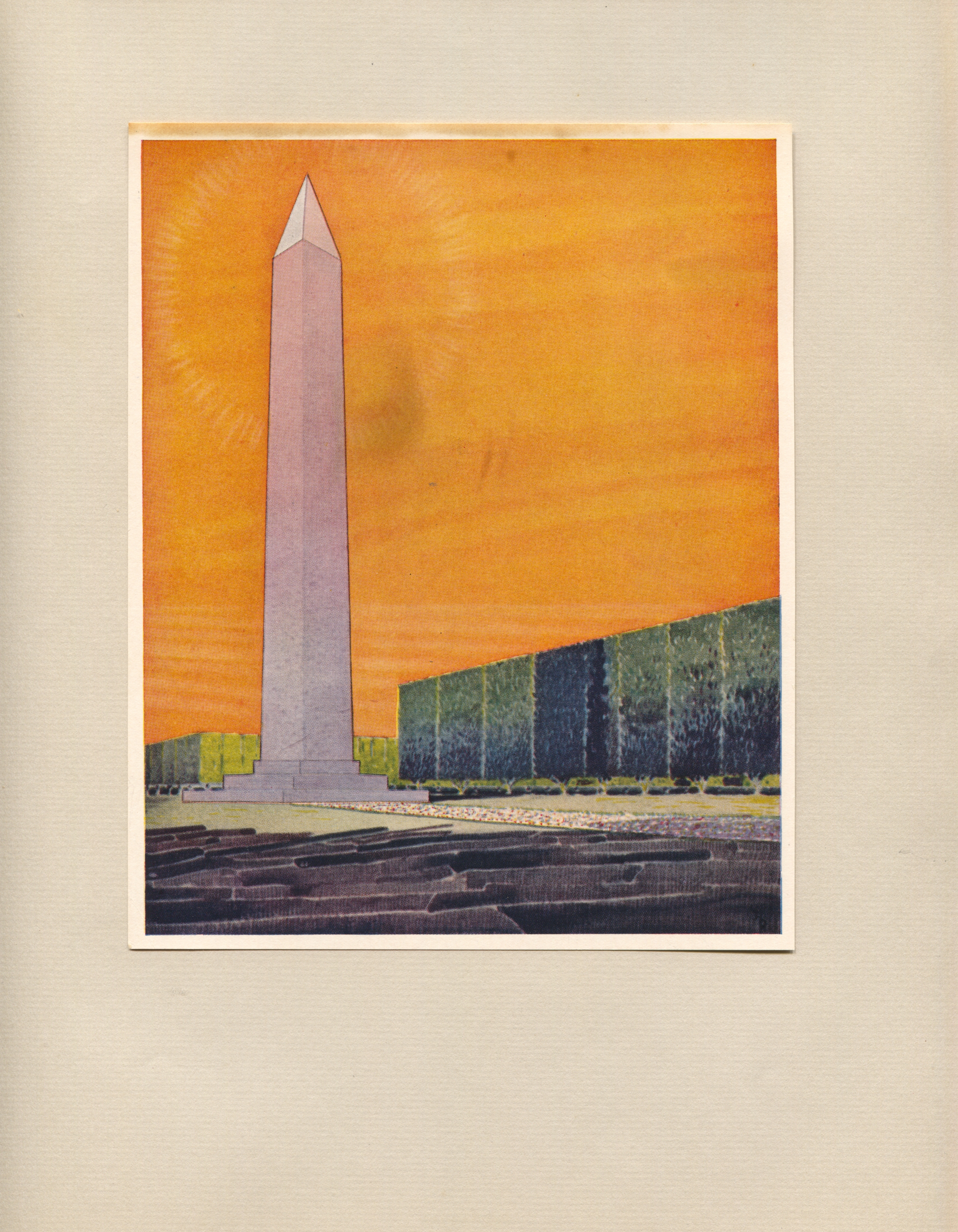
In 1928, the Georgia Marble Company of Tate, Georgia, produced a marketing piece in the form of a book titled, Memorials: To-Day for To-Morrow written by William Henry Deacy. The book was designed to showcase their memorial designs by highlighting them in the book with lush full-color watercolor illustrations of the various memorials. Along with the illustrations the book provided explanations of the symbolism found in the memorials. The book also coupled an architectural drawing of how the memorial is to be made. The monument they chose to highlight on pages 62-64 was the obelisk.

memorials_today_for_tomorrow_p64_georgia_marble_co-1928_rr

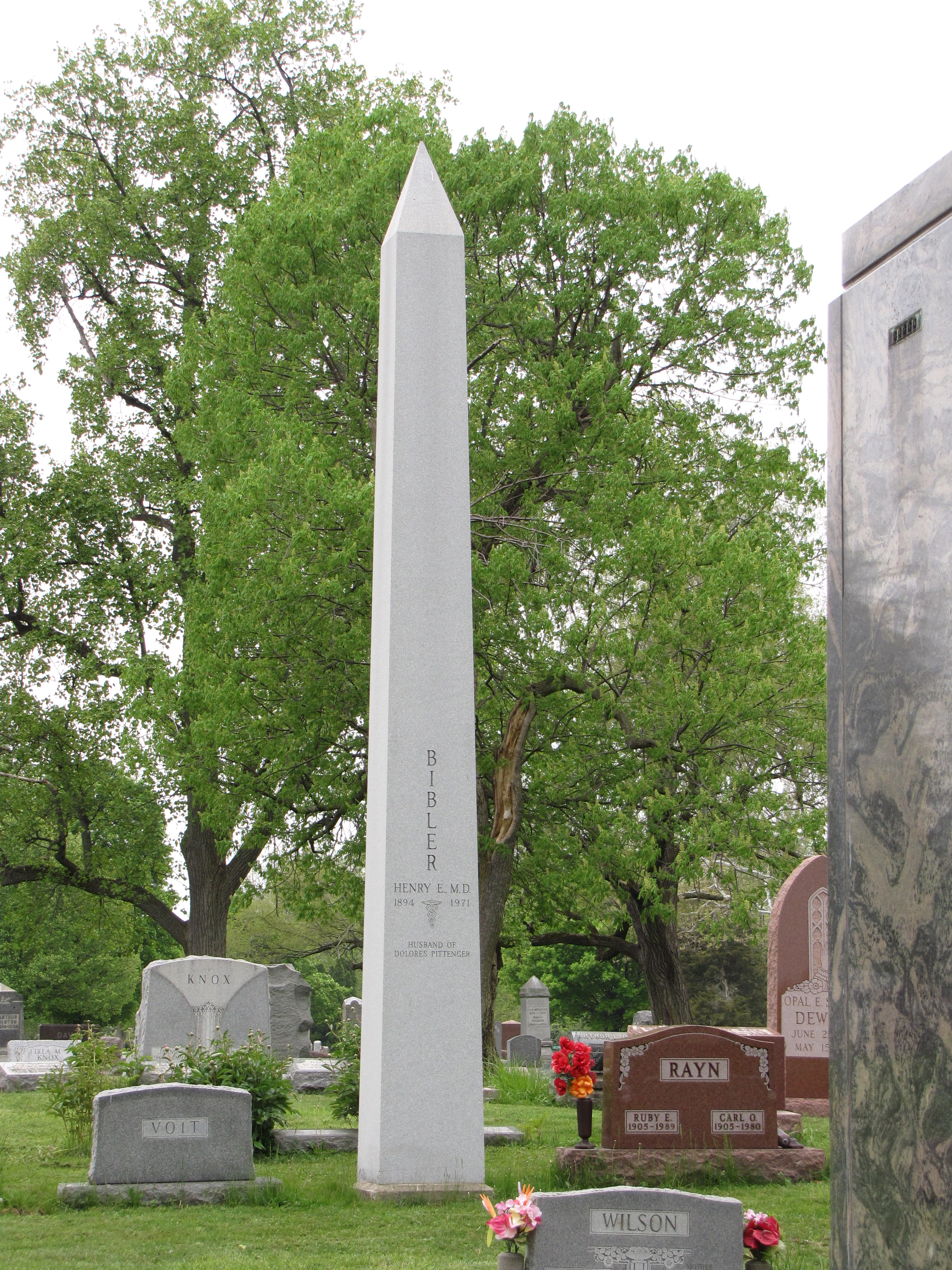
After the French and British occupations of Egypt, there was a renewed interest in Egyptian architecture and symbolism in America, including the obelisk, those tall thin four-sided columns that tapered upward and then end in a pyramid at the top.  The obelisk is a ubiquitous gravestone shape found in American graveyards.

Beach Grove Cemetery, Muncie, Indiana

Beach Grove Cemetery, Muncie, Indiana

The author, Mr. Deacy, makes the following claim in the Georgia Marble Company book (page 63), “The steeple of the Church symbolizes the spiritual and uplifting power of religion and the moral aspiration of man. It was evolved from the obelisks which stood before Egyptian temple—emblems of the sun god Ra and the regeneration of man. It has long been a favored form for the civic and private memorial. Towering heavenward from a sightly (sic) location, the obelisk probably ranks among the most simple and impressive of all monuments.”

The book goes on to say that the obelisk is highlighted best when it is featured by itself, with no other monuments nearby to distract from its elegant and graceful shape. It also says that, “various pedestal forms are used to support the shaft or spire…and while they attain a rather graceful continuity of line, nevertheless, no type of base or support rivals the simple three steps, which if properly subordinated in scale, tend to increase the effect of height….

Lakewood Cemetery, Minneapolis, Minnesota

Lakewood Cemetery, Minneapolis, Minnesota

The entire book can be found at the Quarries and Beyond Website: http://quarriesandbeyond.org/cemeteries_and_monumental_art/cemetery_stones.html.

The Quarries and Beyond Website was created by Peggy B. and Patrick Perazzo. It focuses on historic stone quarries, stone workers and companies, and related subjects such as geology. Whenever possible links of finished products are provided on the Website. There is a “Quarry Articles” section that presents articles, booklets, and links from the late 1800s to early 1900s, including the 1856 “The Marble-Workers’ Manual.” The “Cemetery Stones and Monuments” section provides references and resources, including many old monument magazines, catalogs, price lists, and a photographic tour “From Quarry to Cemetery Monuments.”

Posted in Uncategorized | Leave a comment

The Latin Cross

memorials_today_for_tomorrow_p34-b_georgia_marble_co-1928_rr

In 1928, the Georgia Marble Company of Tate, Georgia, produced a marketing piece in the form of a book titled, Memorials: To-Day for To-Morrow written by William Henry Deacy. The book was designed to showcase their memorial designs by highlighting them in the book with lush full-color watercolor illustrations of the various memorials. Along with the illustrations the book provided explanations of the symbolism found in the memorials. The book also coupled an architectural drawing of how the memorial is to be made.

memorials_today_for_tomorrow_p36-a_georgia_marble_co-1928_rr

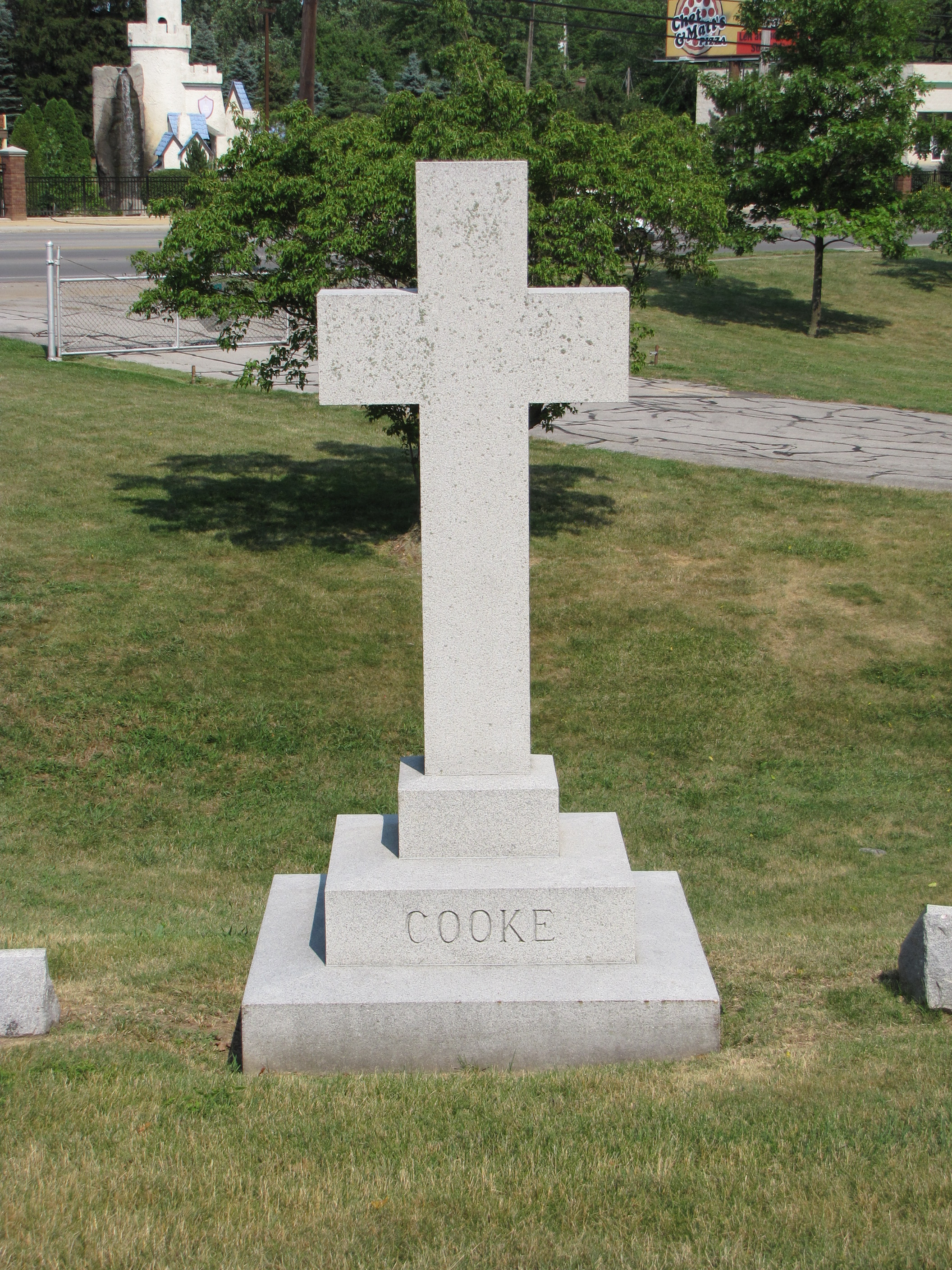
The example here, is of the cross—the plain Latin Cross, universally recognized as the symbol of Christianity. But, while it may look simple to the eye, the symbol is imbued with deep meaning to all Christians. As the book says, “Faith had brought Him to Calvary. The Betrayal, the Trial, the piercing Crown of Thorns, the tortuous road to Golgotha, the cruel weight of the Cross, the hour of Crucifixion—through all these Faith had led Him on. What wonder, therefore, that he Cross of Calvary, instrument of the Passion, has been throughout the ages a memorial of the Faith, the Chosen Symbol?” (page 34).

The Latin Cross, however, is not the only symbolism in the monument, which may be lost on many viewers. In this monument, the cross rests on a foundation of three progressively larger stones as a base. Each represents a different virtue—“Faith in the will of God…Hope for the dawn of that yet more glorious day and Charity toward all men.”

Oakland Cemetery, Sandusky, Ohio

Oakland Cemetery, Sandusky, Ohio

The entire book can be found at the Quarries and Beyond Website: http://quarriesandbeyond.org/cemeteries_and_monumental_art/cemetery_stones.html.

The Quarries and Beyond Website was created by Peggy B. and Patrick Perazzo. It focuses on historic stone quarries, stone workers and companies, and related subjects such as geology. Whenever possible links of finished products are provided on the Website. There is a “Quarry Articles” section that presents articles, booklets, and links from the late 1800s to early 1900s, including the 1856 “The Marble-Workers’ Manual.” The “Cemetery Stones and Monuments” section provides references and resources, including many old monument magazines, catalogs, price lists, and a photographic tour “From Quarry to Cemetery Monuments.”


Posted in Symbolism | Leave a comment

Sleeping Children

St. Ambrose Cemetery, Seymour, Indiana

St. Ambrose Cemetery, Seymour, Indiana

IMG_0264

JOHN CLAIR MALONE

BORN OCT 10, 1890

DIED FEB 16, 1894

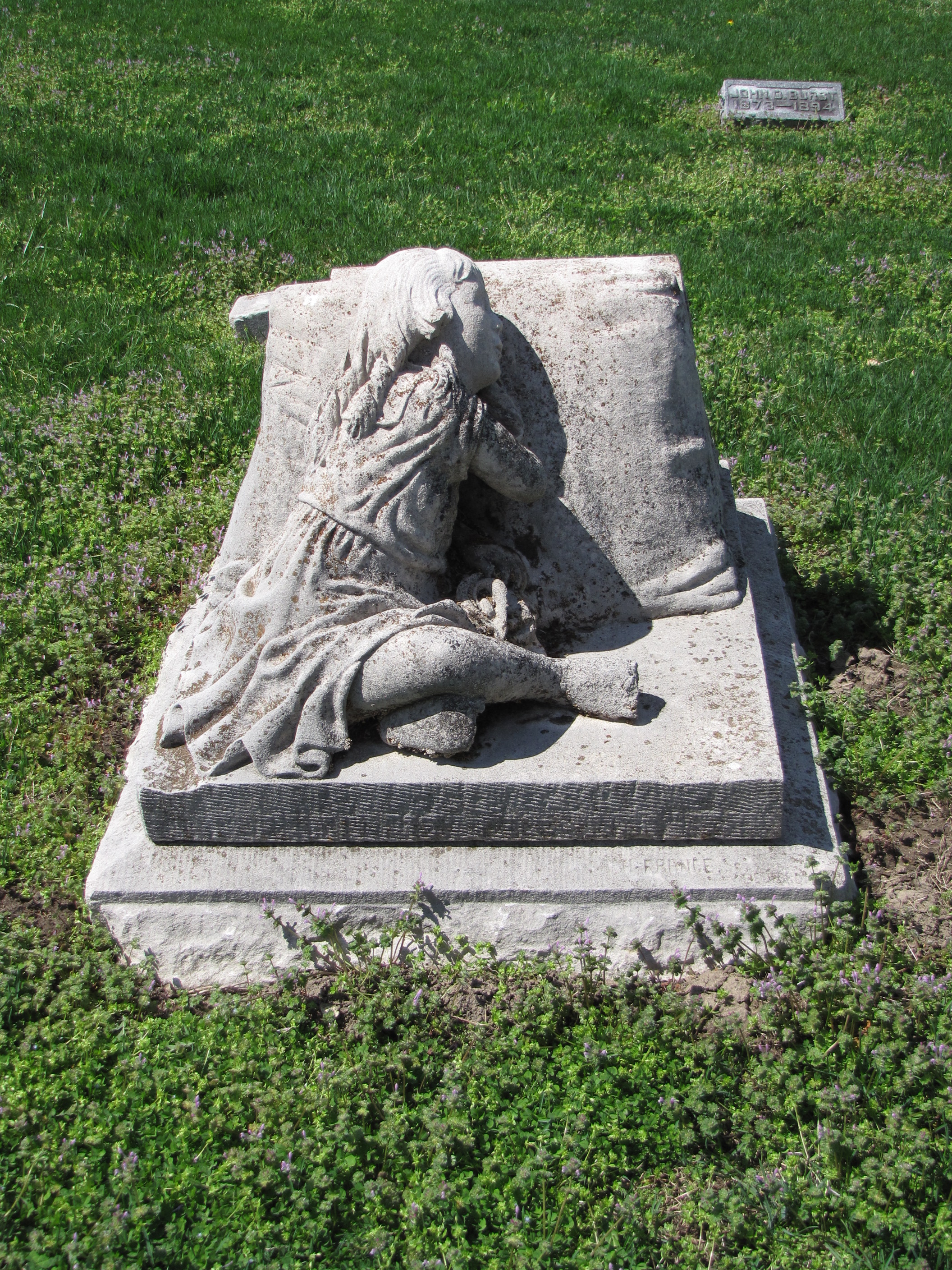
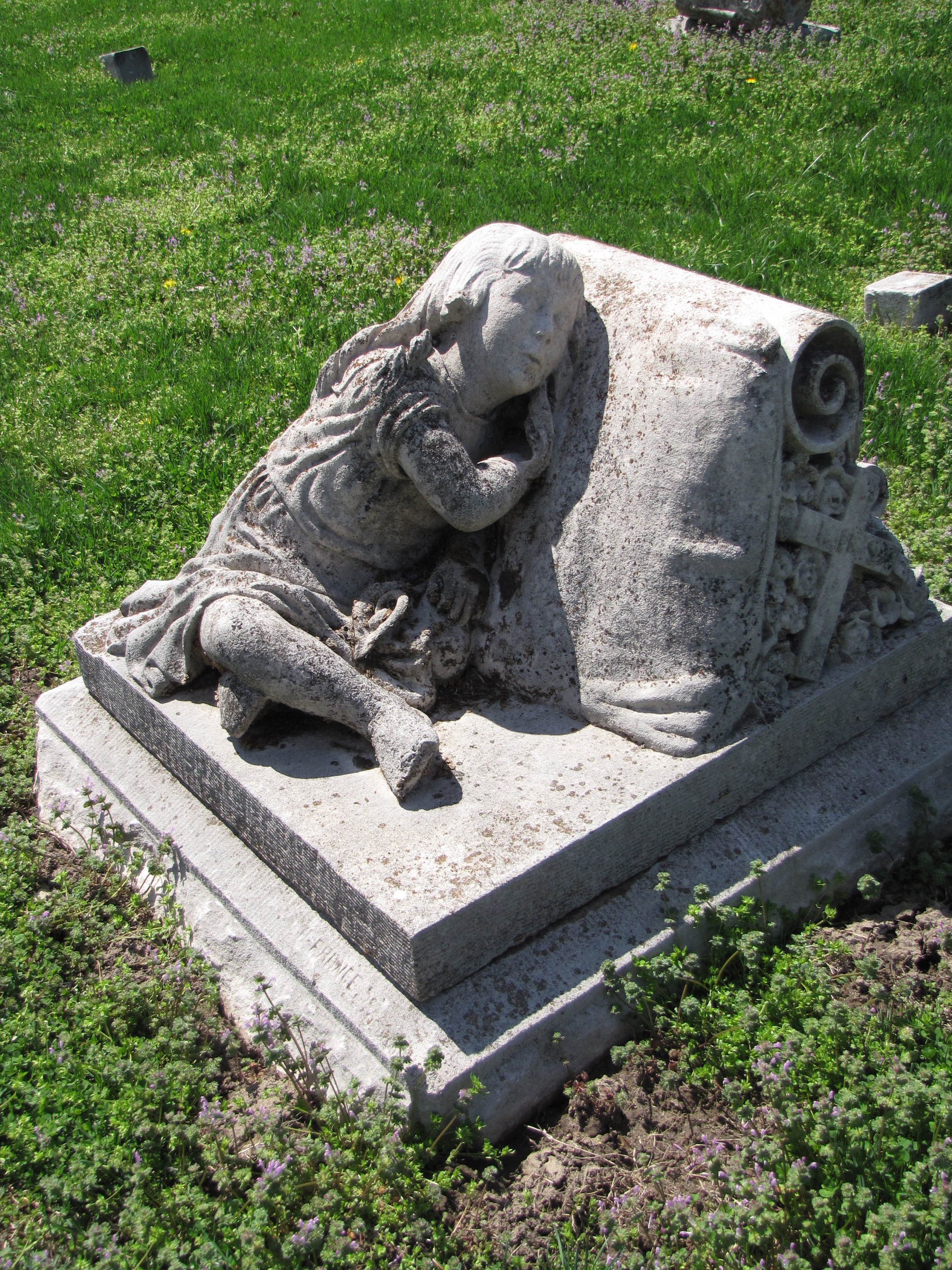
 [This gravestone has a girl resting against a pillow carved on the front of the gravestone but the gravestone marks the grave of four-year old John Clair Malone.  His name and birth and death dates appear on a scroll on the back of the memorial.]

St. Ambrose Cemetery, Seymour, Indiana

St. Ambrose Cemetery, Seymour, Indiana

IMG_0272

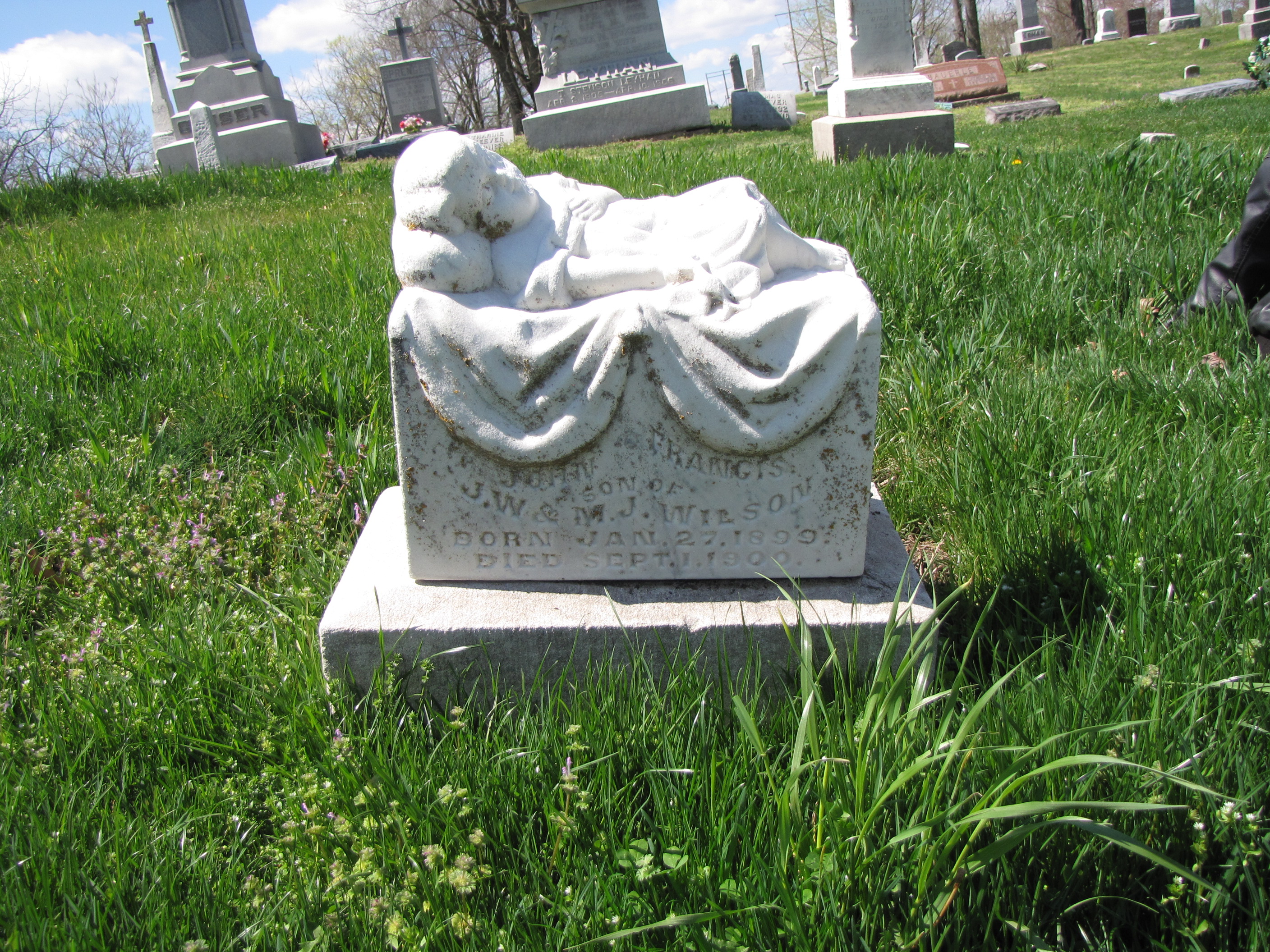
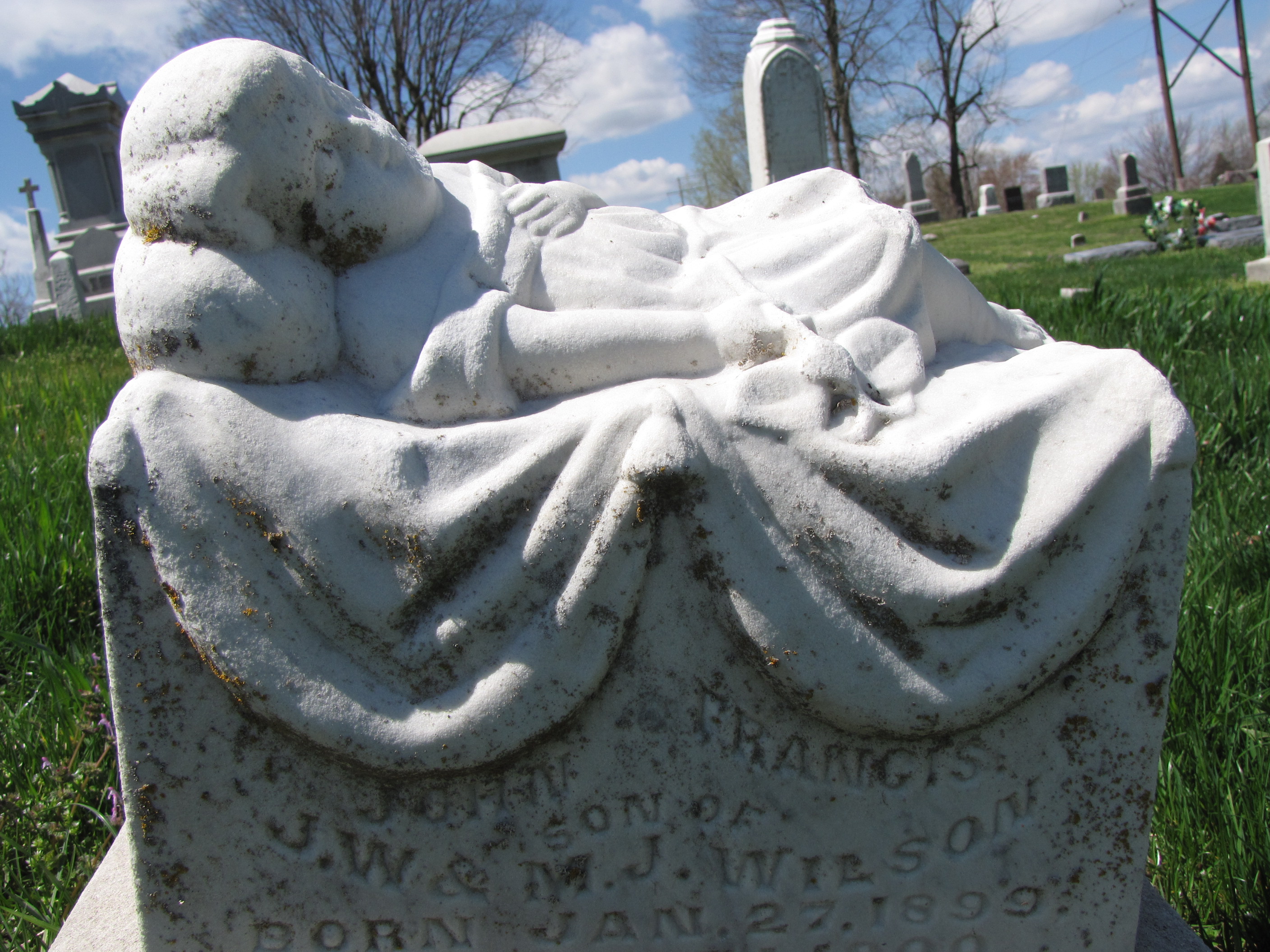
JOHN FRANCIS

SON OF J. W. & M. J. WILSON

BORN JAN. 27, 1899

DIED SEPT. 1, 1900

Those little hands thoult raise no more.

To meet my loving fond caress

For deaths cold blast in passing o’er

Has snatched thee from affections breasts.

 [The epitaph appears on the back of the gravestone.]

St. Ambrose Cemetery, Seymour, Indiana

St. Ambrose Cemetery, Seymour, Indiana

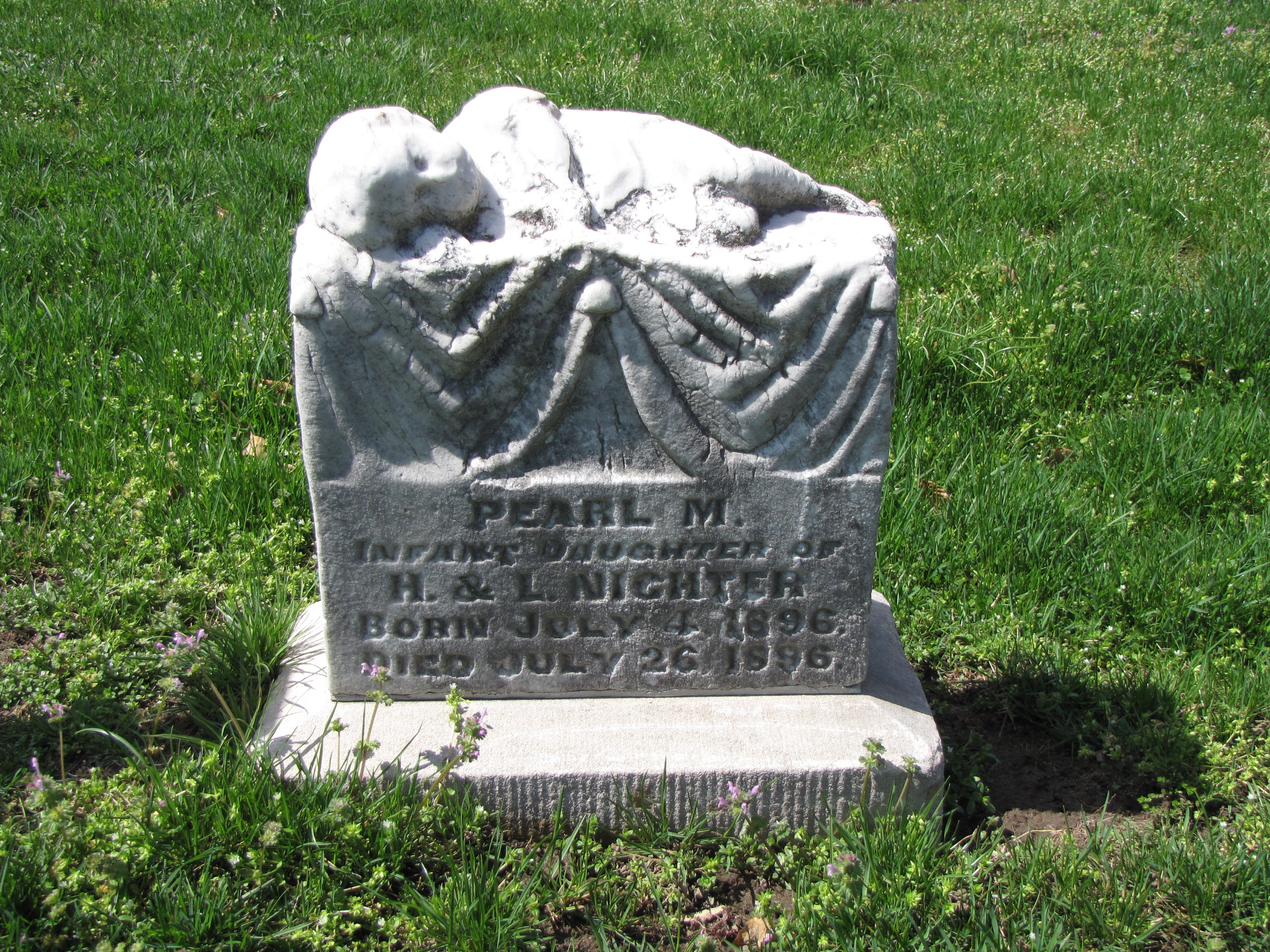
PEARL M.

INFANT DAUGHTER OF

H. & L. NIGHTER

BORN JULY 4, 1896

DIED JULY 26, 1896

[This gravestone has an epitaph on its backside but is faint.]

The most poignant and tender gravestones are those for children.  Mortality rates for children were very high.  In the 1850s, for example, the mortality rates for children under one year were estimated at over 200 deaths per thousand, with much higher mortality rates for children under 5.

All three of these children are buried in the St. Ambrose Church Cemetery at Seymour, Indiana. Each child was under the age of five–they ranged in age  between 20 days old and four years old.

Each gravestone shows a sleeping child.  It has too be more comforting to think of a young child sleeping rather than the alternative.  The sentiment is tender and sad.

Posted in Children's Graves | Leave a comment