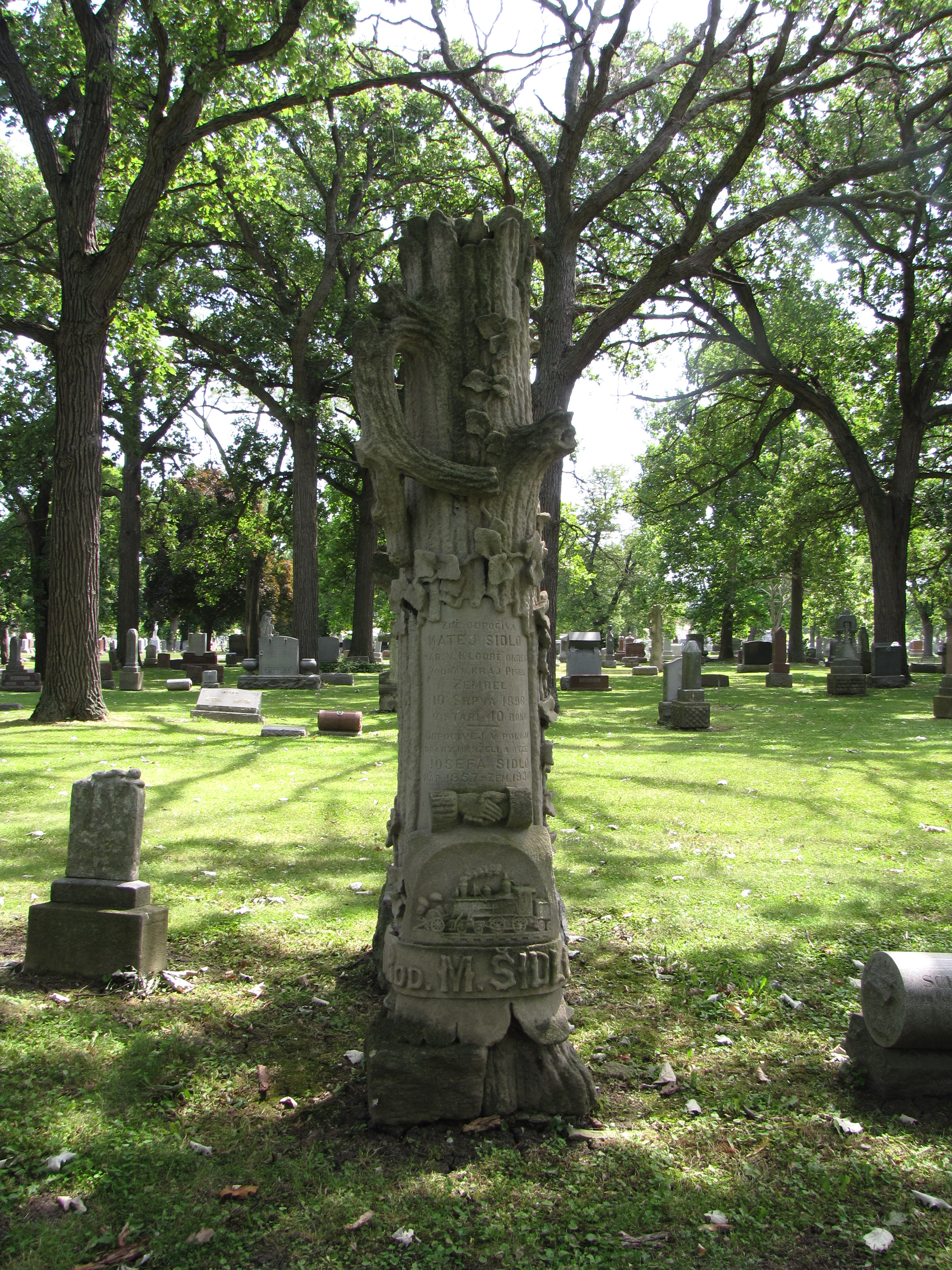
Mother and the Pilgrim

Bohemian National Cemetery, Chicago, Illinois

Bohemian National Cemetery, Chicago, Illinois

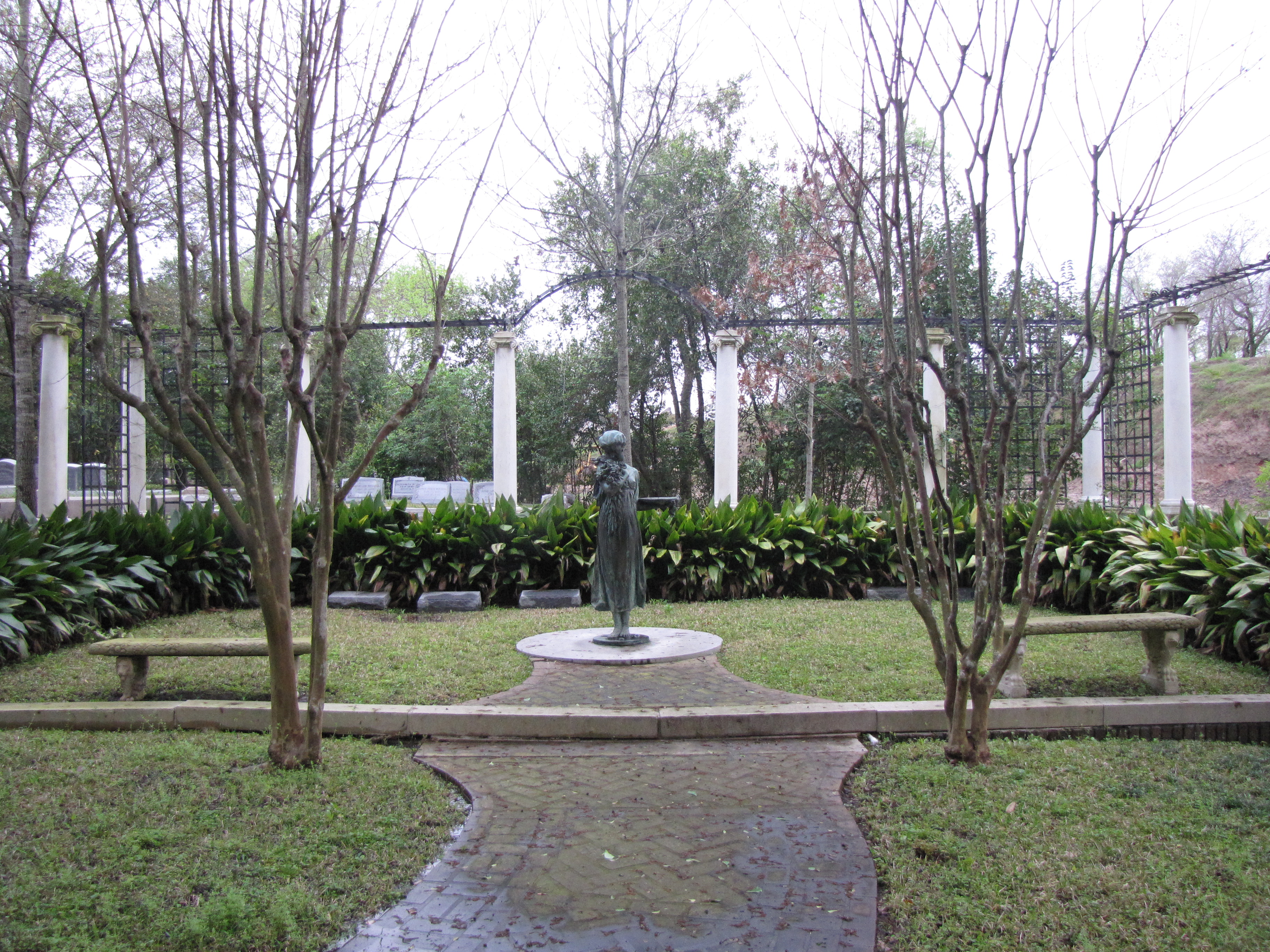
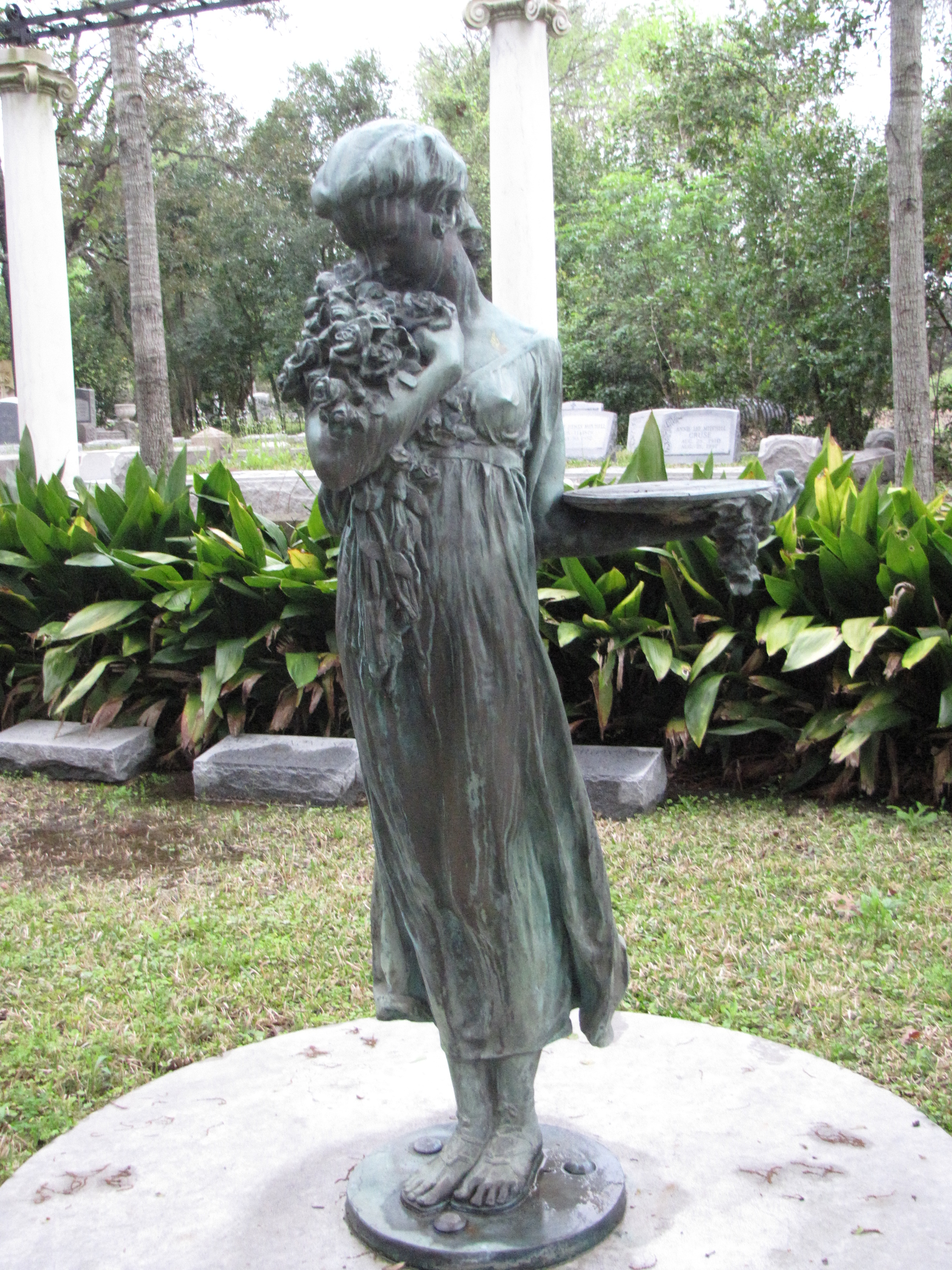
Many large urban cemeteries have not only incredible pieces of sculpture as memorials but have other commissioned works of art to commemorate important dates in the history of the graveyard. Two such sculptures were commissioned for the Bohemian National Cemetery at Chicago, Illinois, by the famed Czech-American sculptor, Albin Polasek (February 14, 1879 – May 19, 1965). Polasek was a prolific artist who created hundreds of works during his famed career.

IMG_5468

The Bohemian National Cemetery commissioned Polasek to create a sculpture for the 50th anniversary of the founding of the cemetery. Polasek created a bronze tribute to motherhood, aptly titled, Mother, which stands in front of the cemetery’s crematorium. A mother figure holds a baby to her breast while her son stands next to her holding a torch with one hand and clutching to his Mothers’ robe with the other.

IMG_5311

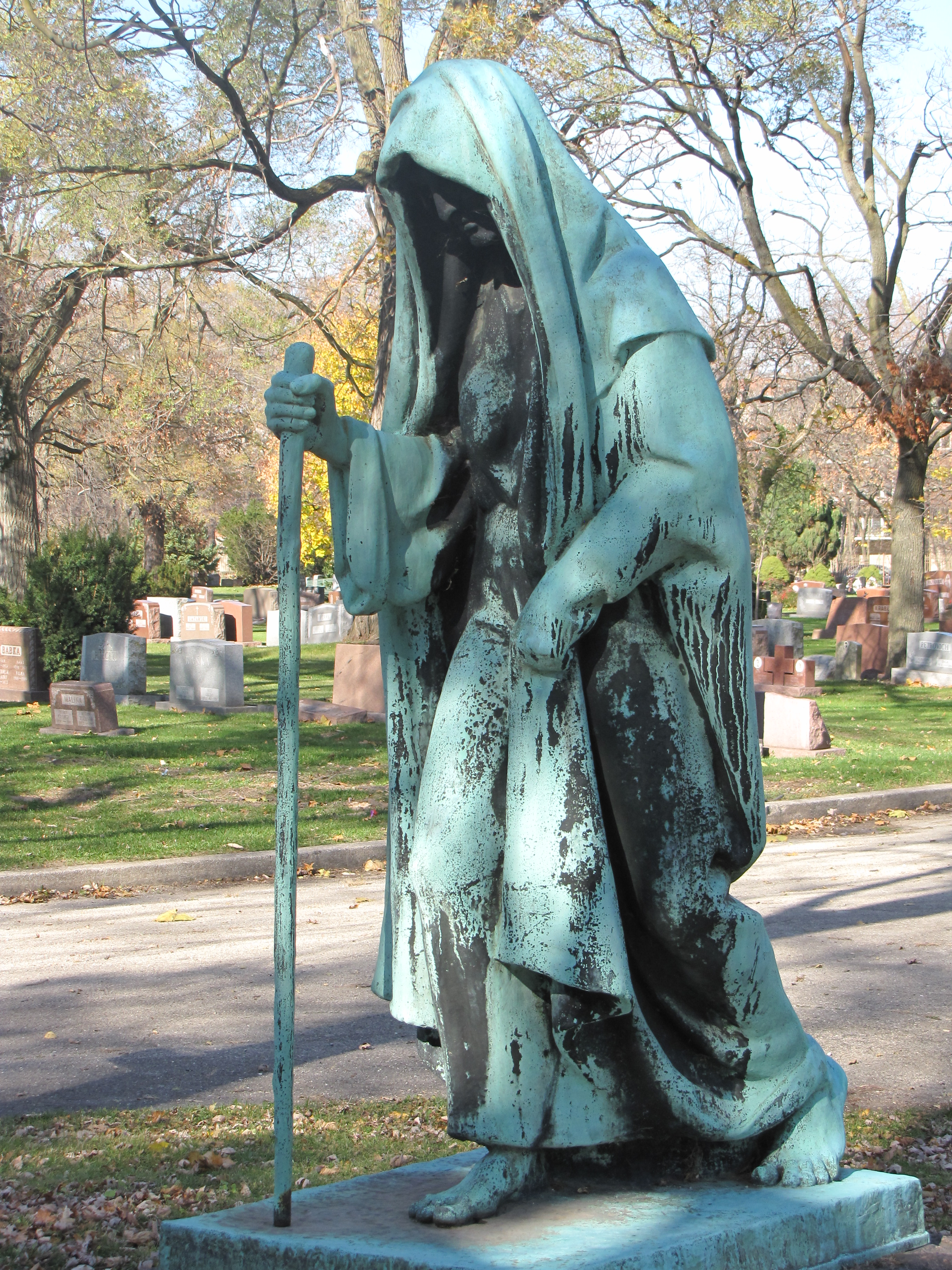
The second sculpture was completed only a year later by Polasek for the Stejskal-Buchal family to stand in front of their mausoleum.

IMG_5317

The cloaked and hooded figure titled, The Pilgrim, has been mistaken for the grim reaper—sallow, gaunt, and walking with a stick toward the mausoleum door—a haunting visage.

IMG_5312

Posted in Uncategorized | Leave a comment

Little Lamb

Simpson's Chapel Cemetery, Greene County, Indiana

Simpson’s Chapel Cemetery, Greene County, Indiana

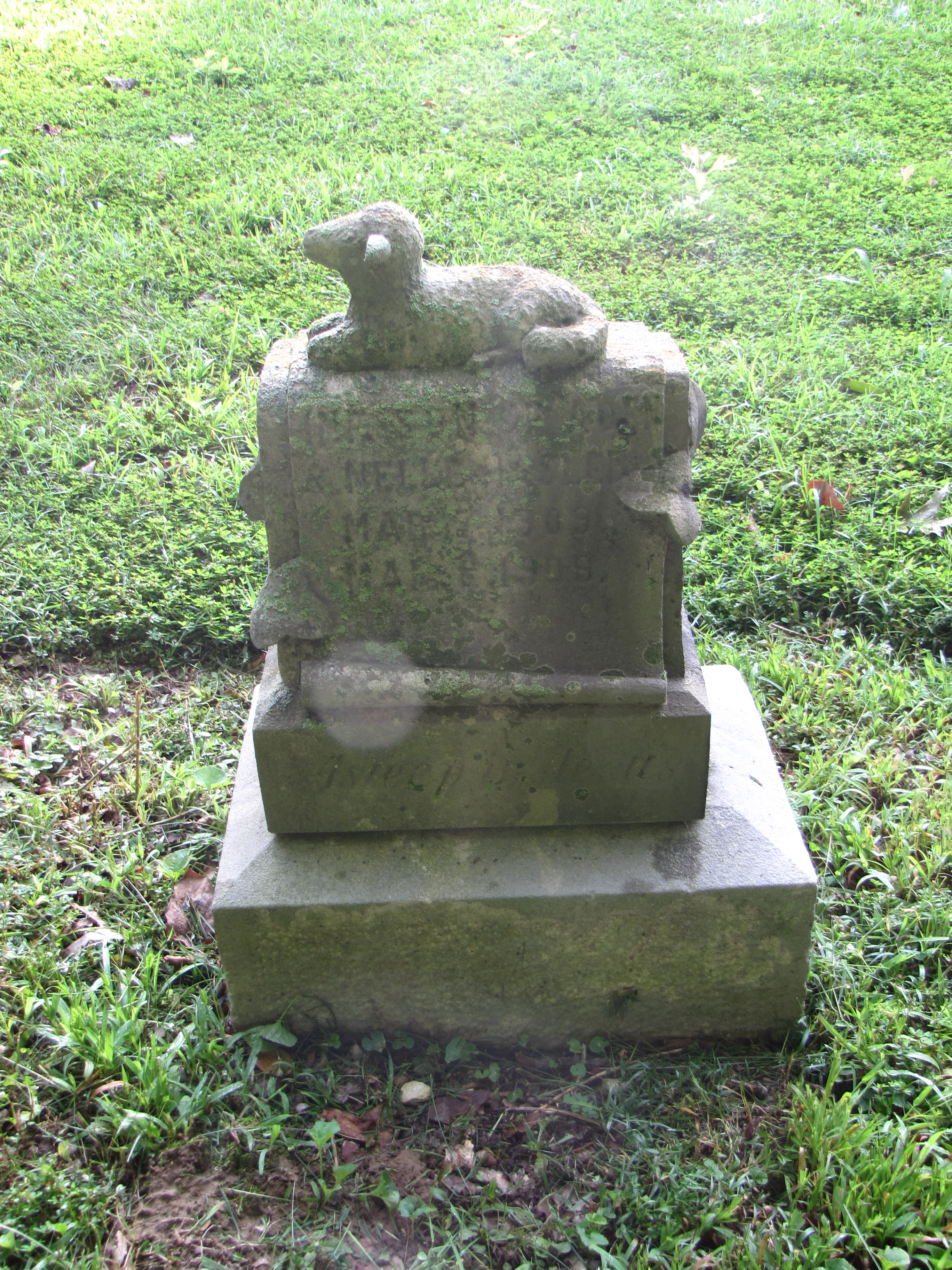
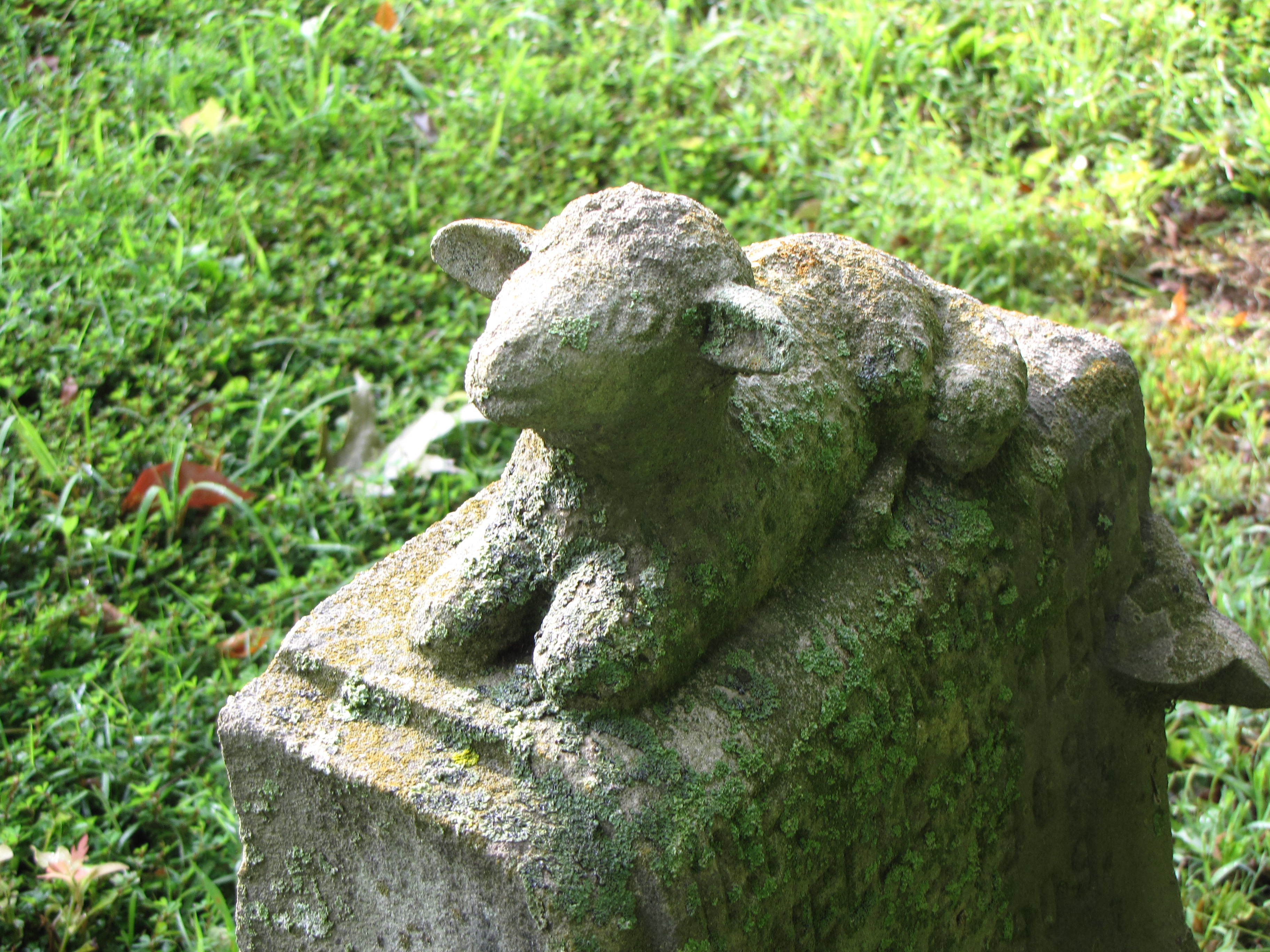
There are many gravestone symbols that seem to be ubiquitous—the lamb is one of them. Walk into nearly any American graveyard and you will find tiny little lambs marking the graves of mostly children. The lamb symbols come in many sizes and positions—often sleeping. But the lamb on the gravestone of an infant named Nellie in the Simpson’s Chapel Cemetery south of Bloomfield, Indiana, is raising its head up, eyes wide open, as if it is looking at the passersby. The lamb on Nellie’s gravestone, who died and was born in the same month in 1909, is aged and the light gray soft marble has eroded and gives the lamb the texture of a stuffed animal, soft and cuddly. The lamb, alert and bright eyed, looks like it could stand up at any moment and leap from the top of the stone.

IMG_3299

The lamb is the symbol of the Lord, the Good Shepherd. It also represents innocence, likely the reason why this motif usually adorns the tombstones of infants and young children. Most often the lamb is lying down, often asleep and sometimes with a cross behind the lamb.

Posted in Children's Graves, Symbolism | 1 Comment

Log Cabin

Freedom Cemetery, Mitchell, Indiana

Freedom Cemetery, Mitchell, Indiana

BROWN

WALLACE B.

FEB. 21, 1872

NOV. 5, 1939

AGE 67 YRS.

IMG_3215

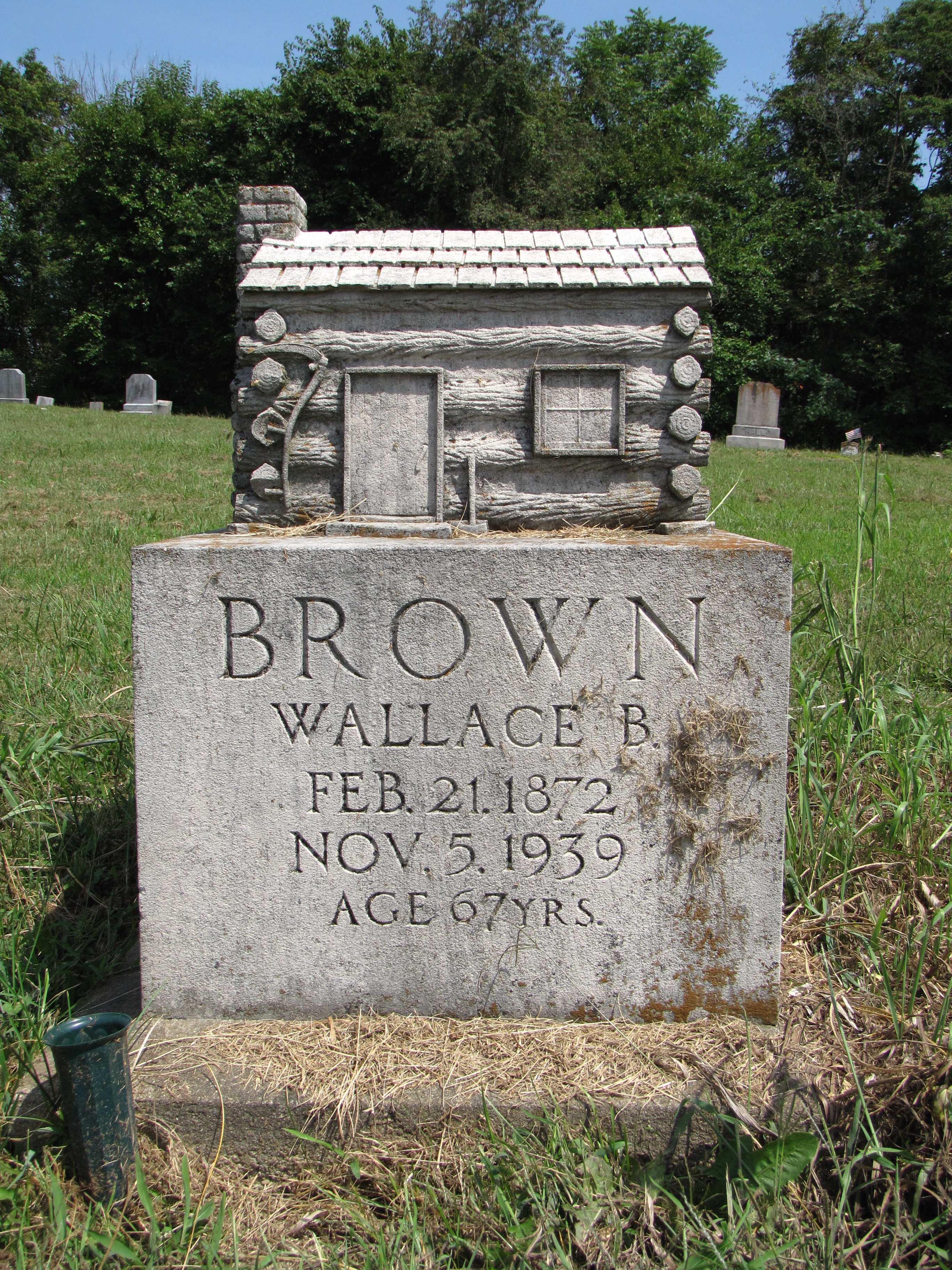
Just south of Mitchell, Indiana, on Highway 37, is a small rural cemetery by the side of the road—Freedom Cemetery. One of the remarkable gravestones was created for Wallace B. Brown to look like a log cabin. It is amazing in its detail right down to the scythe hanging to the left of the doorway and the maul resting to the right of it. Every log, every shingle is intricately carved to make it look like a real log cabin in miniature.

IMG_3216

Posted in Uncategorized | Leave a comment

Immigrant Patriot and Soldier

Springdale Cemetery, Madison, Indiana

Springdale Cemetery, Madison, Indiana

In

Sacred

Memory of

JACOB GLASS

Lt. Col. of the 32nd Reg. Ind.

Infantry Vol.

BORN

On the 9yh day of Apr. 1839

at the town of DielKirchen

Rhinpfalz. Germany

DIED

from a mortal wound as a hero

on the 25th of Nov. 1863 at the

battle of Missionary Ridge, Tenn.

PRO PATRIA REQUIESCAT IN PACE

For our country may he rest in peace.


During the Civil War, Americans, North and South, joined to defend their ideals and their region of the country. German immigrants were among the largest immigrant populations that fought in the war. The 32nd Regiment of Indiana Volunteers was an infantry unit, commissioned by Indiana Governor Oliver P. Morton, which was made up of an all-German force. It was also called the 1st German.

Jacob Glass was enlisted in the 1st German and had distinguished himself and risen to the rank of Lieutenant Colonel.  Glass fought in the Battle of Missionary Ridge, a bloody battle. The Union losses totaled 752 killed, 4,713 wounded, and 350 captured or missing compared to the Confederate losses of 361 killed, 2,180 wounded, and 4,146 missing or captured. Even though the Union losses were greater, they won the day and gained control of Eastern Tennessee closing off a key rail line that supplied the Confederate Army.

Glass, who fought and died in the Battle of Missionary Ridge, is buried in the Springdale Cemetery at Madison, Indiana, his remains were returned to his home. His soft white marble tombstone has a medallion on the side that displays the eagle upon a shield backed by three American flags and a field of 23 stars–one for each state that stayed loyal to the Union thrghout the war. The gray patina highlights the bas-relief and makes the sculpture stand out. The medallion is a testament to his patriotism and the service to his adopted country.

IMG_2588

Posted in Symbolism | Leave a comment

The Tent

Elmwood Cemetery, Elmwood, Illinois

Elmwood Cemetery, Elmwood, Illinois

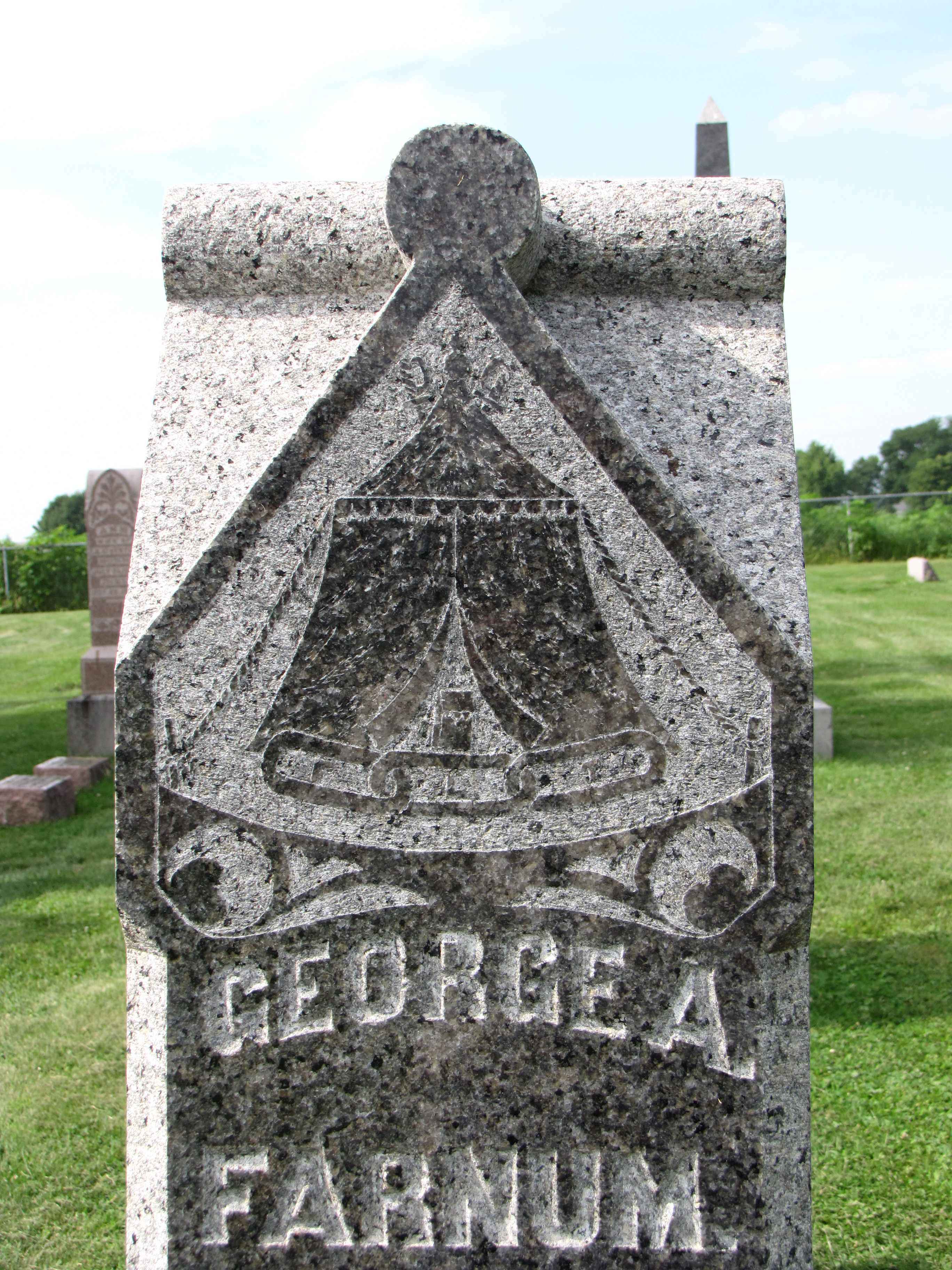
GEORGE A.

FARNUM

BORN

MAY 18, 1842

DIED

APR. 8, 1888

The Independent Order of Odd Fellows is a fraternal organization that formed in England in the 1700s as a service organization. The American association was founded in Baltimore, Maryland, on April 26, 1819. According to the I.O.O.F. Website, “Thomas Wildey and four members of the Order from England founded Washington Lodge No. 1. This lodge received its charter from Manchester Unity of Odd Fellows in England.”

Members of the Odd Fellows, like many other society members, choose to have their membership memorialized on their tombstones. The most common Odd Fellows symbol to be found in a cemetery are the three links often paired with three letters, F L T, which signify the organization’s motto: Friendship, Love, and Truth.

George Farnum belonged to a higher branch of the Independent Order of Odd Fellows—the Odd Fellows Encampment. At the top of his gravestone, in an incised design, are the three links but below a tent with two crossed shepherd’s hooks. The hooks are a reminder of the nomadic Israelites who watched over flocks of sheep to make sure they were safe. The tents symbolize the transitory nature of life itself. All life is temporary. The tent represents the sentiment that “we abide here, as we are on a pilgrimage to the grave.

Membership in the Encampment was open to all Third Degree members in good standing. The Encampment has three degrees:

  • Patriarchal Degree – Aims to teach the lessons of transparent honesty, domestic purity, genuine hospitality and unfeigned righteousness.
  • Golden Rule Degree – Aims to teach good will, tolerance, and true brotherhood. It also teaches that members should unite with the virtuous and good irrespective of country, religion, or politics in the discharge of duties which all agree are paramount to universal peace and cooperation.
  • Royal Purple Degree – Aims to teach alertness and determination as basis for a possible success in the journey called life.

IMG_0751

Posted in Symbolism | Leave a comment

Truth in Advertising?

IMG_8294

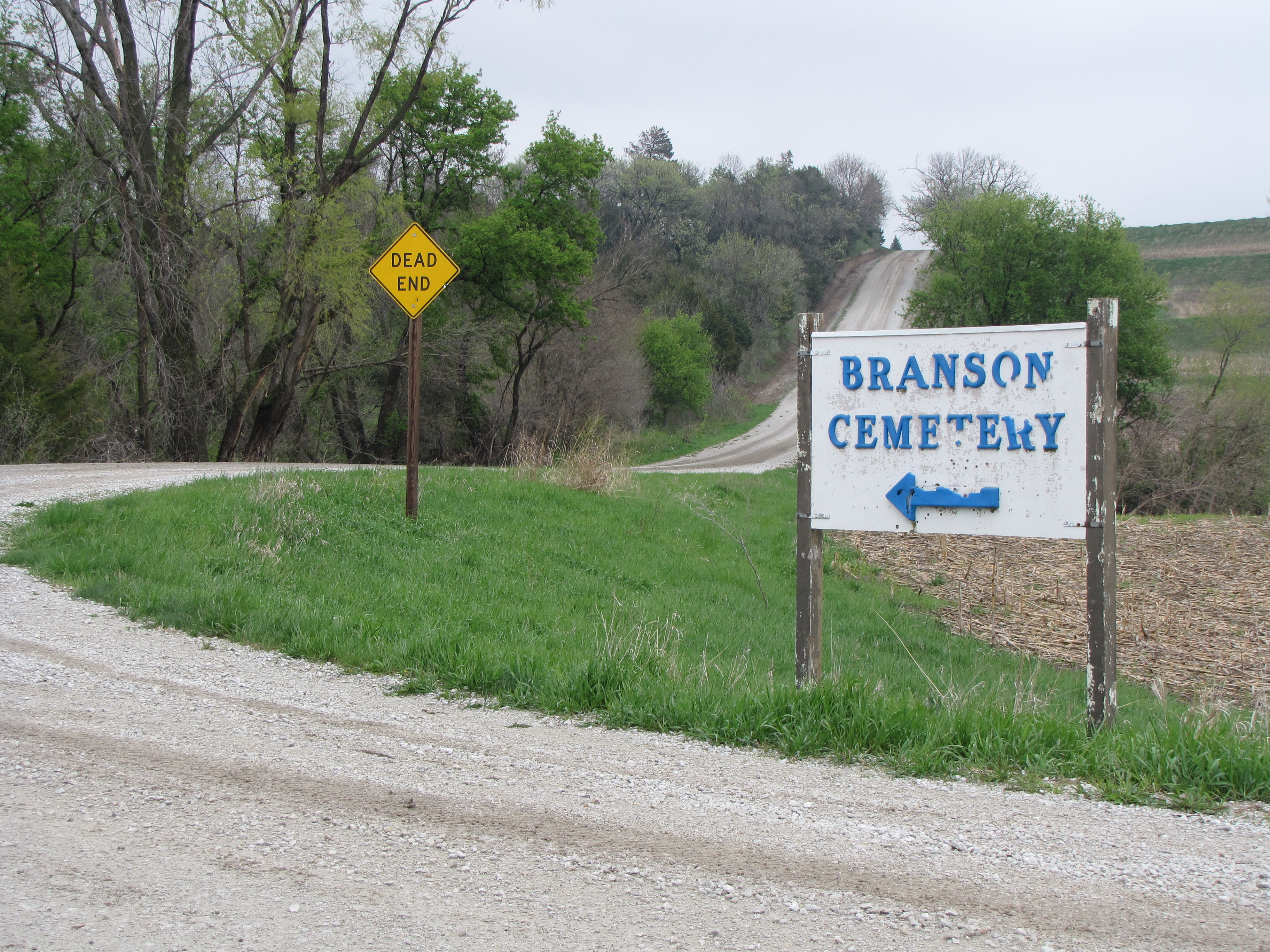
Not far from the Old Lincoln Highway (now marked County Road L20) going from Council Bluffs to Missouri Valley, just south of Loveland if you turn east on 170th and fish around on the gravel road until you get to the junction of Whitetail Lane, you run into the Branson Cemetery sign. Close to it is another sign, this one erected by the Pottawattamie County Road workers marking Whitetail Lane as a dead end. I wonder as they put the sign up if they saw the irony.

Posted in Uncategorized | 2 Comments

Temple of Love Revisited

Temple of Love at the Cave Hill Cemetery, Louisville, Kentucky

Temple of Love at the Cave Hill Cemetery, Louisville, Kentucky

PRESTON POPE

SATTERWHITE

SEPTEMBER 28TH 1867

DECEMBER 27TH 1948

BUT THANKS BE TO GOD

WHICH GIVETH US

THE VICTORY

THROUGH OUR LORD

JESUS CHRIST


FLORENCE BROKAW

SATTERWHITE

NOVEMBER 1ST 1857

MAY 1ST 1927

HER WAYS ARE WAYS

OF PLEASANTNESS

AND ALL HER PATHS

ARE PEACE

Horace Trumbauer, noted Philadelphia architect, was hired by the prestigious Dr. Preston Pope Satterwhite of Louisville, Kentucky, to design a memorial for his late socialite wife, Florence Brokaw Martin Satterwhite.

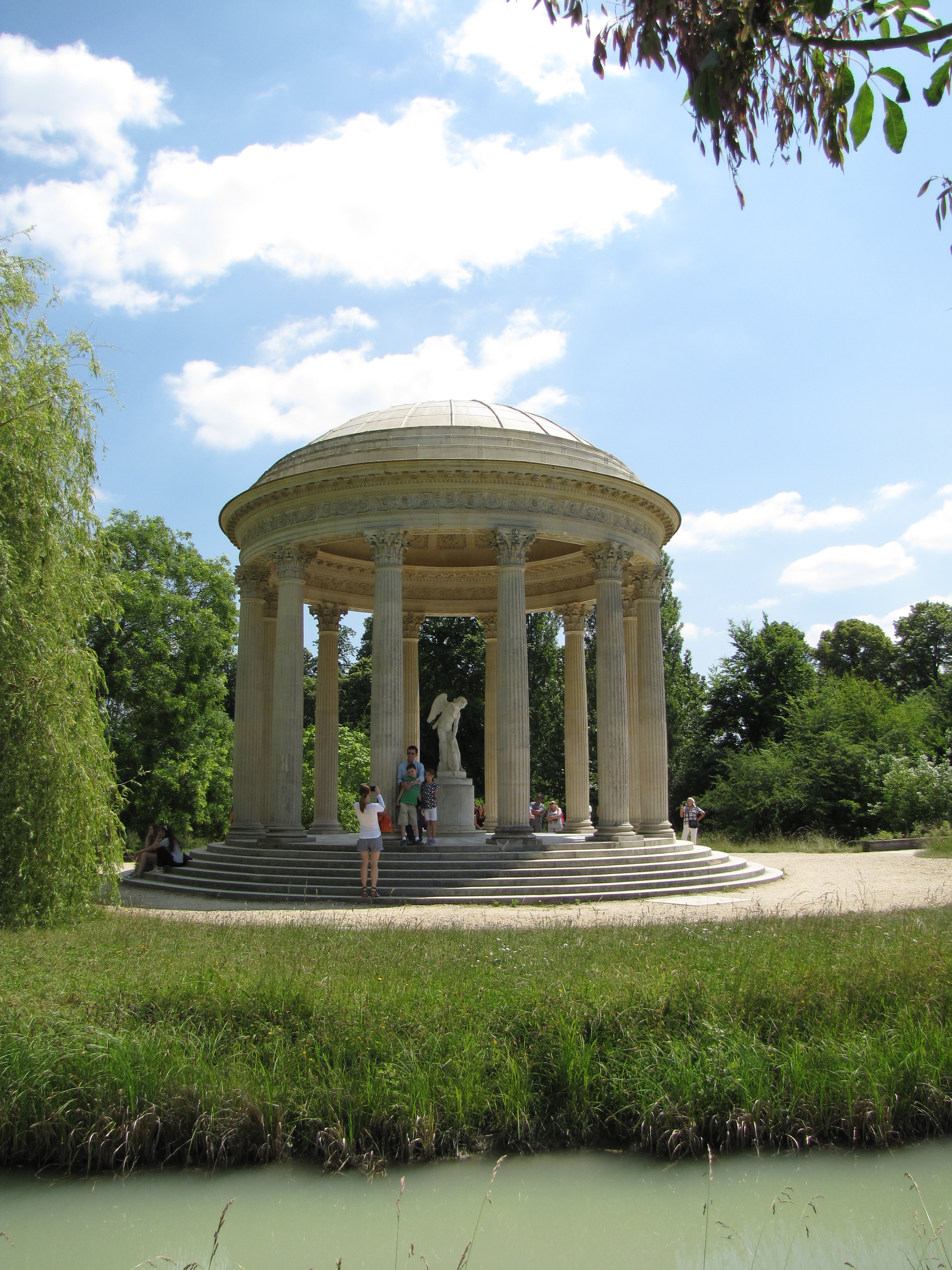
Temple of Love at the Palace of Versailles

Temple of Love at the Palace of Versailles

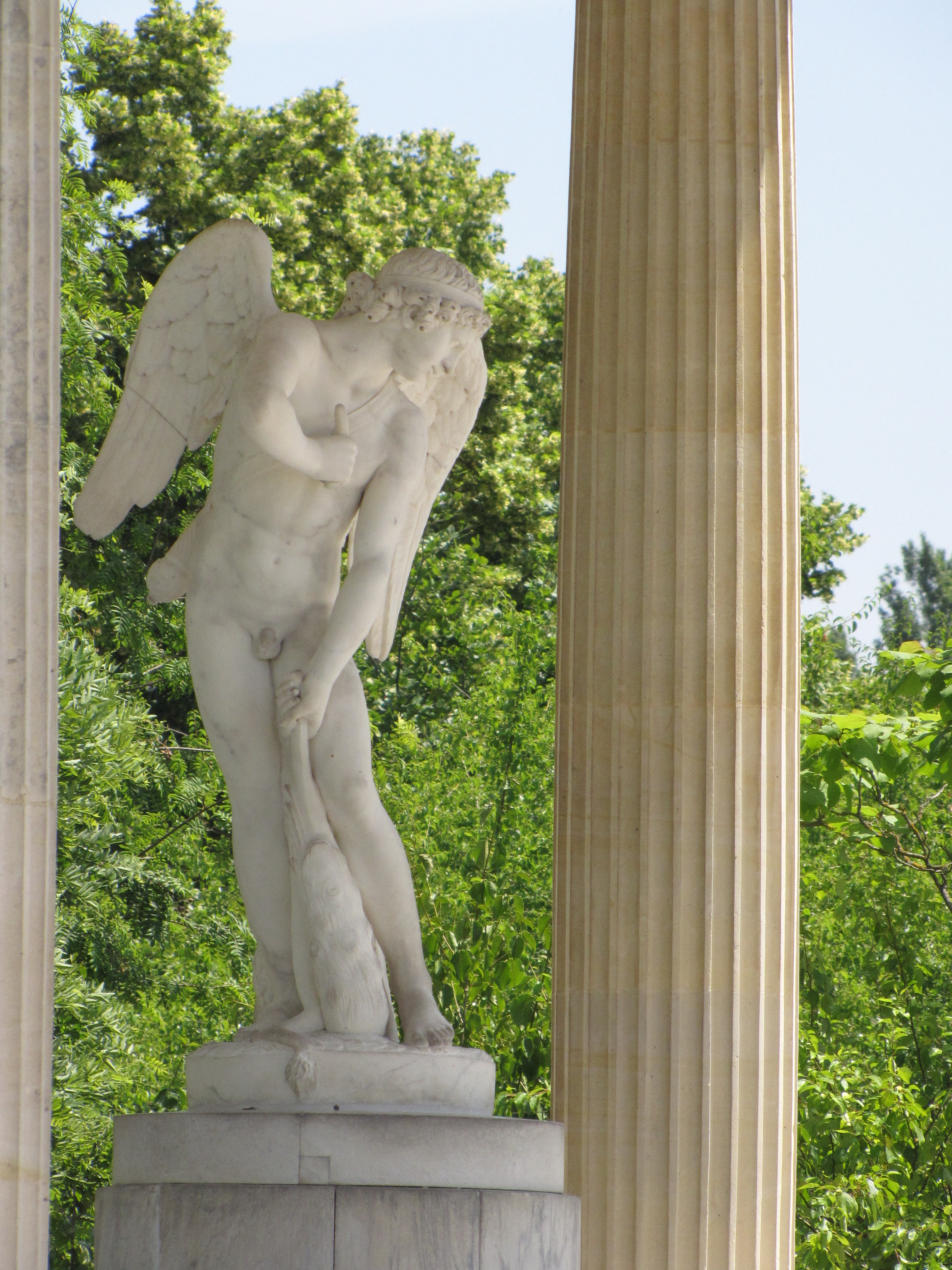
Trumbauer based his design on the Temple of Love at the Palace of Versailles created by Richard Mique specifically for Marie Antoinette. The domed memorial has a colonnade of Corinthian columns surrounding the statue of Cupid as its centerpiece.

Cupid, Temple of Love, Palace of Versailles

Cupid, Temple of Love, Palace of Versailles

Mique oversaw the building of the last of the monuments at the Palace before the French Revolution and the fall of King Louis XVI.  For his part in what was thought to have been a conspiracy to save Marie Antoinette, Mique and his son were found guilty by a tribunal and sentenced to death—three weeks before the end of the Reign of Terror.

The statue inside the memorial was created by Sally James Farnham, the same artist who created the Vernon and Irene Castle memorial at Woodlawn Cemetery at Bronx, New York.

Flora, Temple of Love, Satterwhite Memorial, Cave Hill Cemetery, Louisville

Flora, Temple of Love, Satterwhite Memorial, Cave Hill Cemetery, Louisville

Farnham was well known for her heroic 15-foot statue of Simon Bolivar in Central Park.  Unlike the delicate Castle commission, this statue is commanding and large. The centerpiece of the temple is the statue of Flora, indicated by the bouquet of flowers she holds in her left arm.  Farnham designed the statue and it was sculpted in marble by Robert A. Baillie.

Castle Memorial

Castle Memorial

What is also remarkable is that Sally was entirely self-taught—she had no formal training, and yet, created magnificent sculptures that show range from the massive equestrian statue of Bolivar to the tender and delicate collapsed dancer to the centerpiece of Satterwhite memorial.

img_4999[1]

Posted in Symbolism | Leave a comment

Roses of Yesterday

Glenwood Cemetery, Houston, Texas

Glenwood Cemetery, Houston, Texas

Harriet Whitney Frishmuth (September 17, 1880 – January 1980) was well known Philadelphia-born sculptor who became famous for her sculptures of women—sleek, feminine, and classical.  Frishmuth studied with many of the great sculptors of her time, including Auguste Rodin in Paris, Cuno Von Uechtritz-Steinkirch at Berlin, and Gutzon Borglum and Karl Bitter while in New York. Her bronze sculptures of women became sought after. Her work won fame and awards.

"Speed" a sculpture by Harriet Frishmuth

“Speed” a sculpture by Harriet Frishmuth

She was commissioned to create many works of art, including funerary sculptures. The sculpture in the Glenwood Cemetery of Houston, Texas, for the graves of Walter Benona Sharp (December 12, 1870 – November 28, 1912) and Estelle Boughton Sharp (June 19, 1873 – August 30, 1965), was cast and titled Roses of Yesterday. The Sharps chose it for their memorial. Another casting of this statue can be found in the Crystal Bridges Art Museum in Bentonville, Arkansas. The inscription on the sun dial is, “PERENNIS AMOR”, Latin meaning, “ENDLESS LOVE.”

IMG_7150

Two other commissions can be found in Forest Lawn Cemetery at Buffalo and the Berwind Memorial in the Laurel Hill Cemetery at Philadelphia, where Frishmuth is buried.

The dramatic 10-foot bronze sculpture “Aspiration” was created in 1926 by Harriet Whitney Frishmuth (1880-1980) for the William Arthur Rogers (1851-1946) monument in the Forest Lawn Cemetery at Buffalo, New York.

img_6488[1]

In 1933, another version of the “Aspiration” was carved out of a single block of granite for the Henry Berwind (1859-1932) monument in the Laurel Hill Cemetery, at Philadelphia, Pennsylvania. The stone version of “Aspiration” marks the grave of businessman Henry “Harry” Berwind, vice president of the Berwind-White Coal Company, run by his brother, Edward.

img_1868[2]

Posted in Uncategorized | 2 Comments

The Dinky

Bohemian National Cemetery, Chicago, Illinois

Bohemian National Cemetery, Chicago, Illinois

FRANK

OSTROVSKY

ZEMREL

25 DUBNA 1903

V STARI 28 ROKU 9 MĔS

SPI SLADCE DRAHY

MANZELI A OTCE

__

FRANK

OSTROVSKY

DIED

25 APRIL 1903

AT THE AGE OF 28 YEAR 9 MOS

SLEEP WELL DEAR

HUSBAND AND FATHER

At the beginning of the 20th Century, Chicago was a busy sprawling urban city on the go. It was crisscrossed with over 500 miles of rail and trolley lines shuttling people all over the city with thousands of employees working to build, maintain, and keep the system humming. The heaviest populated parts of Chicago had stops as close as a quarter-mile apart.

ncstry2[1]

Frank Ostrovsky (also listed as Ostrofsky) worked as a switchman for one of many trolley campanies, the Chicago Union Traction Company. On April 25, 1903, while he was working, he was caught between a streetcar and a dinky. Dinkies were short train engines used to pull cars into switchyards moving them from one rail line to another. Young Frank Ostrovsky died from the resulting injuries.

IMG_5068

Ostrovsky’s’s tree-stump tombstone, carved from limestone, was imbued with symbolism. At the top of the tree-stump is the Crucifix—a display of the family’s faith. The short tree stump itself often marks the grave of a person who died young—a life that had been “cut” short.  In this example, Ostrovsky was just 28 years old.  He had been married less than five years. He and his wife, Barbara Posekany, were married on May 3, 1898, both immigrants from Bohemian. According to the 1900 U.S. Census, Ostrovsky was married with a small daughter named Mary, who had been born in May of 1899. She was less than 4-years old when her father was killed in the tragic street car accident.

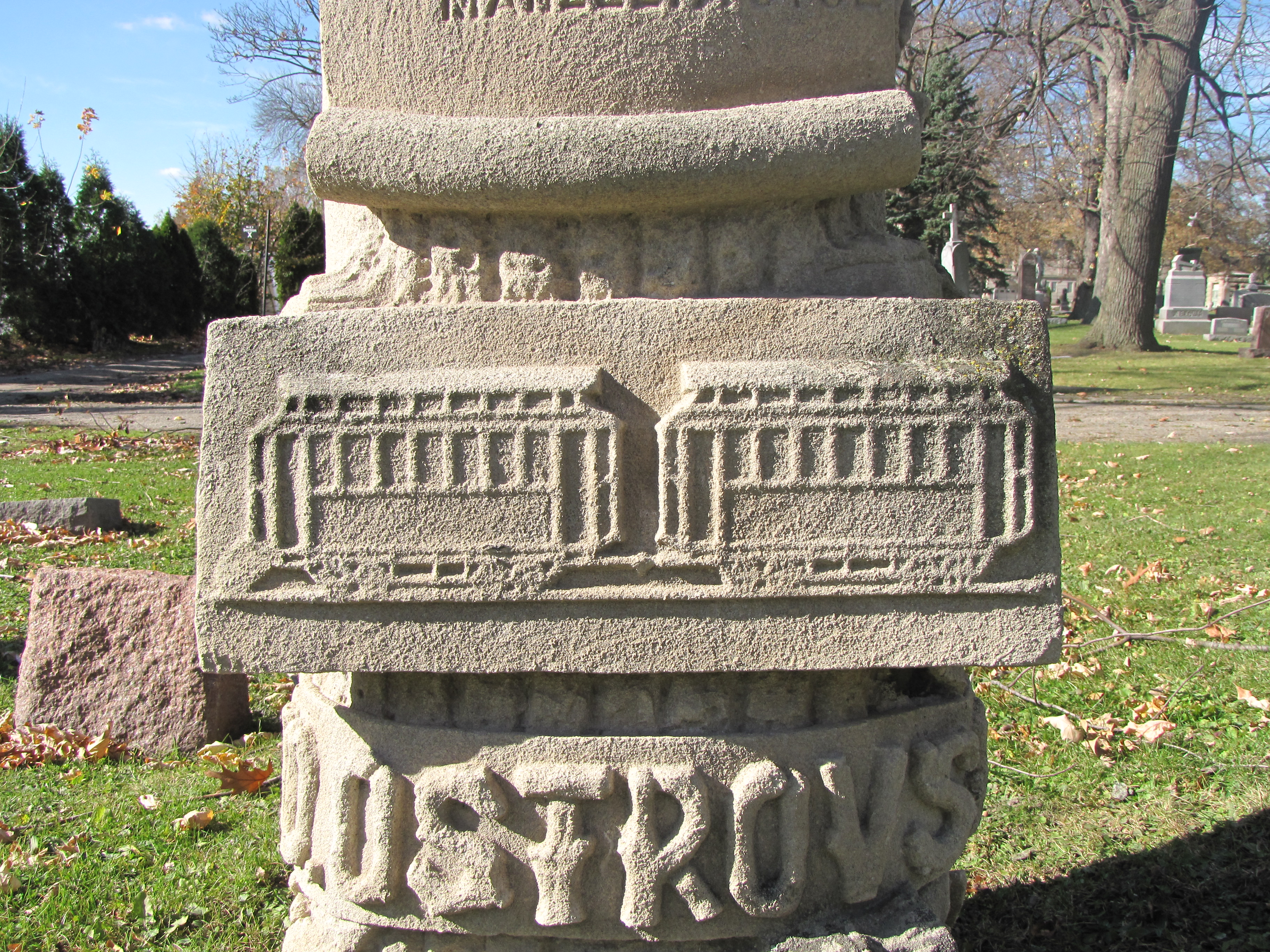
But what is different is the bas-relief on the front that displays the scene of his death. It shows the two trolley cars. Above the panel, carved to look like a scroll with the tombstone’s inscription, is a faded photo of Frank Ostrovsky, husband and father.

IMG_5069

Posted in Treestump gravestones | Leave a comment

Train Wreck

IMG_2333

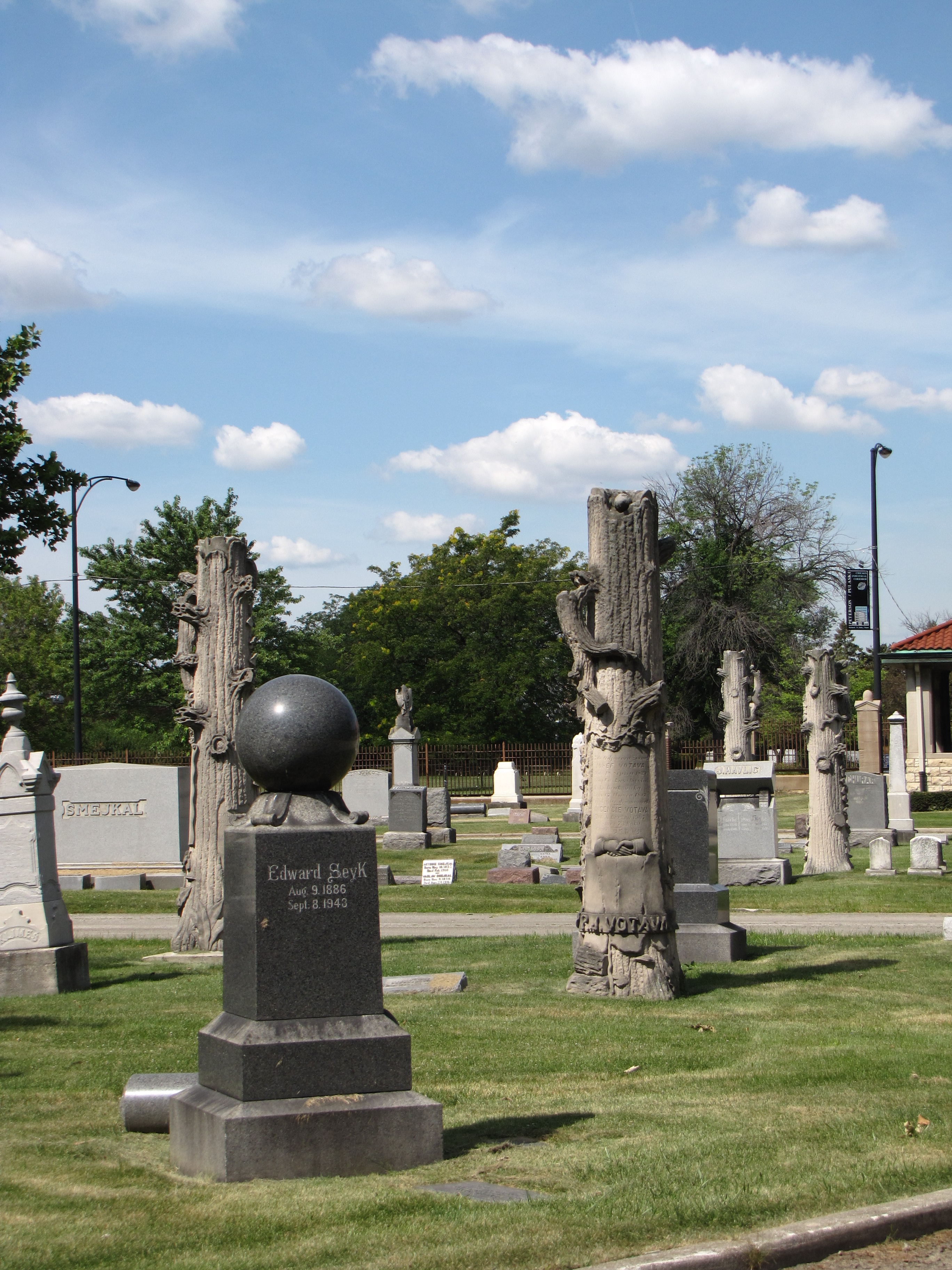
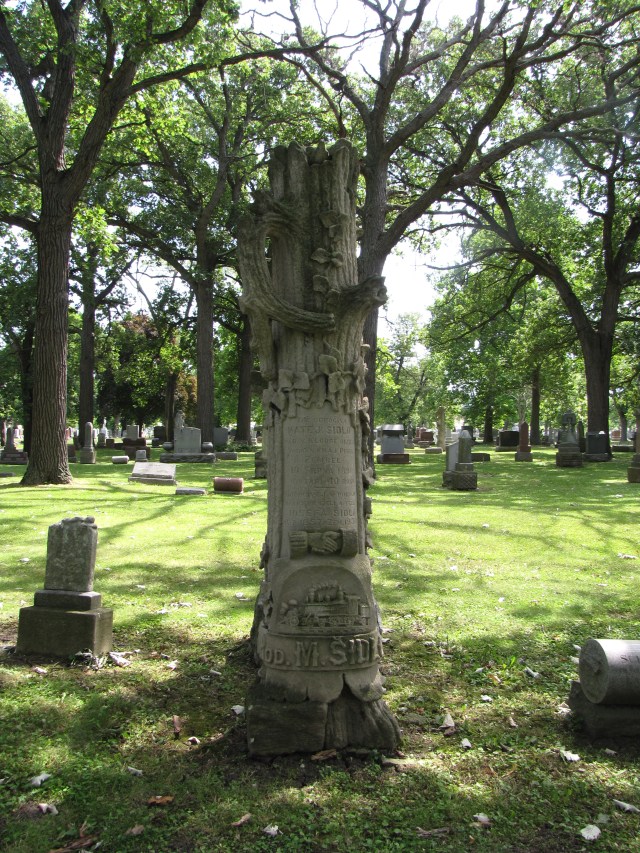
The Bohemian National Cemetery at Chicago, Illinois, practically has a small forest of tree-stump tombstones. They come in different styles and shapes, and some even in different materials and dot the old part of the cemetery. But, the one that is a surprise and unlike just about any of the others is the tree-stump tombstone of 40-year old Matej Sidlo.

ZDE ODPOGIVA

MATEJ SIDLO

NAR. V KLOUBE OKRES

VODNAN KRAJ PISEK

ZEMREL

10 SRPNA 1898

STARI 40 ROKU

ODPOCIVEJ V POKJI

DRAHY MANZELI A OTCE 

JOSEFA SIDLO    

NAR. 1857 – ZEM 1930

 ___

Here Rests

MATEJ SIDLO

Born at the Kloube District

Vodňan Region, city of PISEK

died

10 AUGUST 1898

At the age of 40 years

Rest in peace

Dear husband and father

JOSEFA SIDLO

BORN 1857 – DIED 1930
IMG_2400

Sidlo and his brother, Jacob, both immigrants from Bohemia had found jobs at a local brewing company—R. Stege Brewing—in Chicago. They were to load their wagon with beer barrels and make deliveries for the company the daylong. And, their day was long. Matej and Jacob left home for work at the crack of dawn—4:45 am to get an early start.

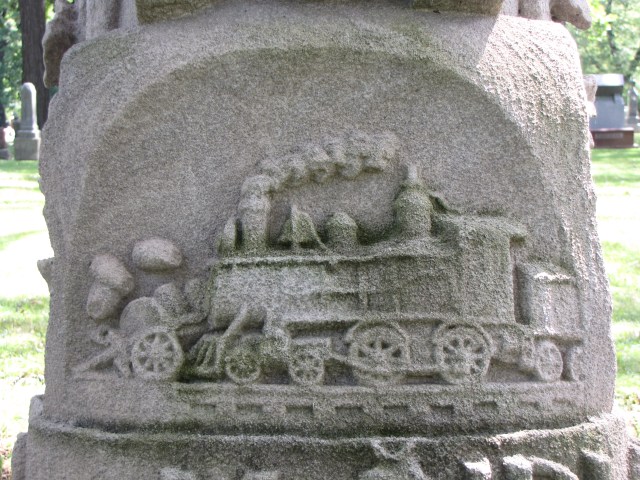
According to newspaper accounts from the time, it was reported that the two men had climbed aboard their wagon, being pulled by two draft horses, and were making a crossing over the railroad tracks at 16th and Morgan, not far from where Matej lived on Morgan and 19th, when a train barreled down the tracks. Jacob spotted the train and was able to jump to safety in time, but the train hit the team and wagon tossing Matej to the pavement. His death certificate tells the story, Matej Sidlo “came to his death from shock and injuries caused by being thrown from a beer wagon hauled by two horses and belonging to the E. R. Stege Brewing Company. Said wagon being struck by engine No. 590 belonging to the CB & Q RR Company.” One newspaper account chalked it up to, “carelessness of railway employees” who were “again to blame for the untimely death of a man in the prime of his life.”

Matej was indeed in the prime of his life. According to the 1910 U.S. Census, Matej or Mike Sidlo was married to Josefa (Josephine) Sidlo, who was also an immigrant from Bohemia. They had six children living at the time: Anz/Ann born June 15, 1881; Joseph born August 29, 1882; Michael born May 6, 1887; James born October 1888; George born March 1893; and John born August 23 1895 . Their 7th child, Wenzel/Wenci, died as an infant.

Matej’s tree-stump tombstone, carved from limestone, was a part of the rustic movement of the mid-nineteenth century which was characterized by designs that were made to look like they were from the country. The gravestones were purposefully designed to look like trees that had been cut and left in the cemetery which was part of the movement to build cemeteries to look like parks.  In funerary art, the tree-stump tombstones were varied—the stonecutters displayed a wide variety of carving that often reflected individual tastes and interests of the persons memorialized.
IMG_2406

The tree-stump gravestones themselves were imbued with symbolism. The short tree stump usually marks the grave of a person who died young—a life that had been “cut” short.  In this example, Matej is just 40 years old.  Twining up the face of the gravestone is ivy, a symbol associated with immortality and fidelity. Just below the place where the names are carved into the stone is a pair of clasping hands, a symbol of matrimony.

But what is different is the bas-relief on the front that displays the scene of his death. It shows the train engine, billowing smoke from its smokestack, barreling into the wagon with the beer kegs flying into the air.

Posted in Treestump gravestones | Leave a comment