Italian Model or Angel, updated

Luyties Monument, Bellefontaine Cemetery, St. Louis, Missouri

Luyties Monument, Bellefontaine Cemetery, St. Louis, Missouri

There is a story about “the girl in the shadow box”. It is an ancient story told and re-told of unrequited love that is also told about this statue. According to local St. Louis lore, the Herman Luyties’ (1871-1921) Monument in the famed Bellefontaine Cemetery displays the bodacious beauty sculpted marble likeness of an Italian model. As the story goes, Herman met her around the turn of the 20th Century while he was touring Italy.

Luyties was a highly successful St. Louis businessman who toured Europe.  While there, he fell in love with the voluptuous Italian and asked for her hand in marriage.  She declined.  He left the country broken hearted and without the love of his life.

But, before Luyties left Italy he commissioned a sculptor to replicate his true love in stone.  The statue that now adorns his grave, first graced the entryway of his home–a constant reminder of unrequited love.  The sculpture, weighing several tons, was moved from his home to the cemetery.  When the sculpture started to weather, Luyties had the monument front glassed in which is how the monument gained the moniker, “the girl in the shadow box.”

Hilts Family Monument, Bellefontaine Cemetery, St. Louis, Missouri

Hilts Family Monument, Bellefontaine Cemetery, St. Louis, Missouri

IMG_0848

The image of the woman at the center of this story can also be found only a short distance from Luyties monument in the very same cemetery. The Christopher Edward Hilts (November 16, 1842 – November 16, 1928, he died on his birthday) and Elizabeth Mary Hilts (December 12, 1840 – November 30, 1899) family monument features a bronze statue of an angel with all of the same physical characteristics of Luyties’ supposed lover.

Virtually the same image can be found in the Green-Wood Cemetery at Brooklyn, New York, in the form of an angel–the hair, that body, even the drapery falls in the same way.  The statue that is strikingly similar marks the graves of John Campbell Maben (1837-1924) and Virginia Maben (died 1912) which raises the question about the Luyties story from St. Louis—was she real? Or is this figure the 1920s archetype graveyard female? Head tilted downward in sorrow, bobbed hair with a headband, and a pose of false modesty partially covering up her full body.

Maben Family Monument, Green-Wood Cemetery, Brooklyn, New York
Maben Family Monument, Green-Wood Cemetery, Brooklyn, New York

Posted in Saving Graces | 6 Comments

The Knight’s Helmet

Crown Hill Cemetery, Salem, Indiana

Crown Hill Cemetery, Salem, Indiana

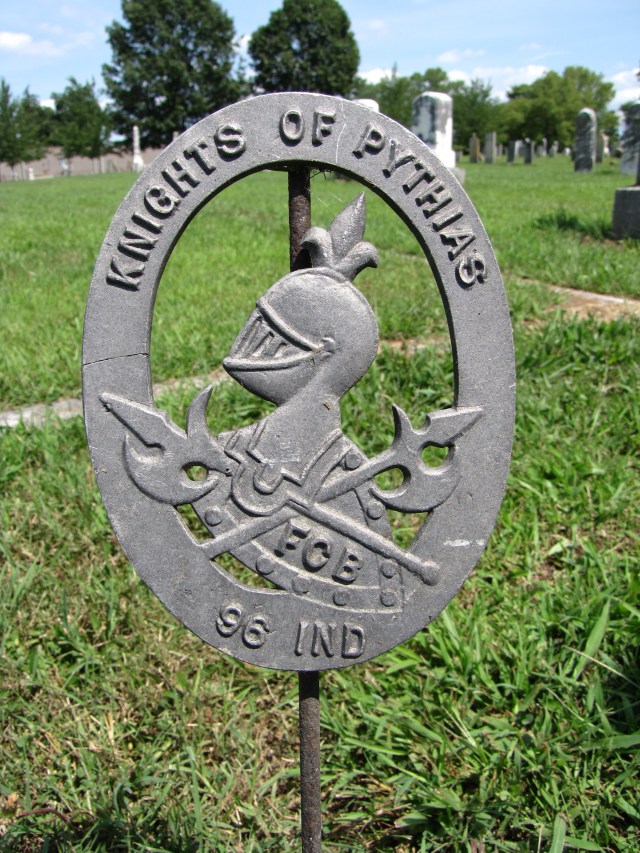
The Knights of Pythias metal marker features many of the symbols that are significant to the Knights.  A knight’s helmet sits atop crossed battle axes with three letters, “F”, “C”, and “B”, which stand for the fraternal organization’s motto, FRIENDSHIP, CHARITY, and BENEVOLENCE.

The Knights of Pythias was founded by Justus H. Rathbone in 1864, making it the very first fraternal organization to receive a charter under an Act of the United States Congress.  The society is based on the Greek story of friendship from 400 B. C. between Damon and Pythias, members of a school founded by Pythagoras.

According to their Website, Pythians: promote cooperation and friendship between people of good will, find happiness through service to mankind, believe that friendship is essential in life, view home life as a top priority, show an interest in public affairs, enhance their home communities, respect and honor the law of the land, and expand their influence with people of like interests and energy.

IMG_3040

Posted in Symbolism, Uncategorized | Leave a comment

Eagles

Rose Hill Cemetery, Bloomington, Indiana

Rose Hill Cemetery, Bloomington, Indiana

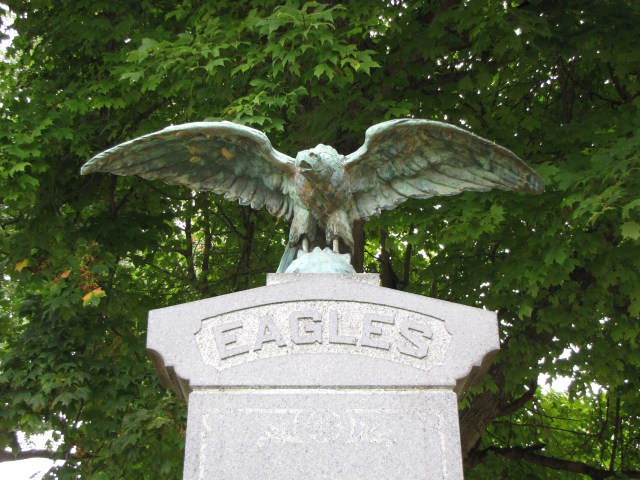
Members of the Fraternal Order of Eagles, like many other society members, choose to be buried in common burial grounds.   Sometimes these burials are in separate graveyards and in other cases a portion of the cemetery is dedicated to the lodge members, as is the case in the Rose Hill Cemetery at Bloomington, Indiana, and the Oak Hill Cemetery at Evansville, Indiana.

IMG_7052

Here a large monument was built to honor the members of the fraternal organization.  In both cases the area for the fraternity members is marked by a statue of an eagle. The fraternity’s emblem carved from local limestone is displayed on a tall column in Rose Hill Cemetery. The bronze eagle in the Oak Hill Cemetery sits on top of a large granite marker.

Oak Hill Cemetery, Evansville, Indiana

Oak Hill Cemetery, Evansville, Indiana

The mission statement of the Fraternal Order of Eagles reads:

The Fraternal Order of Eagles, an international non-profit organization, unites fraternally in the spirit of liberty, truth, justice, and equality, to make human life more desirable by lessening its ills, and by promoting peace, prosperity, gladness and hope.

Founded February 6, 1898, by six Seattle, Washington, theater owners John Cort, John W. and Tim J. Considine, Arthur Williams, Mose Goldsmith, and Harry Leavitt organized as “The Order of Good Things”.  Within two months, in April of the same yer, the fraternal order changed its name to The Fraternal Order of Eagles and adopted the American bald eagle as their emblem.

The Eagles organize local chapters into aeries, so named for the nests of eagles which are usually high and difficult to access.  Nearly since their inception, the Eagles have lobbied for causes important to the organization, such as the creation of Mother’s Day in 1904, later in the 30s for Social Security, and in 2006 to keep the two words “under God” in the Pledge of Allegiance.  The Eagles also contribute to many charities, such as, St. Jude’s Hospital, a Disaster Relief Fund, Diabetes Research Center at the University of Iowa, Art Ehrmann Cancer Fund, D. D. Dunlap Kidney Fund, among others.

IMG_5652

Posted in Symbolism | Leave a comment

A Carver’s Legacy, Take Two

IMG_9446

Michael Shea of Rochester, New York read the gravelyspeaking blogpost about Ivan Adams—the Bloomington stone carver who carved the simple and elegant depiction of the Virgin Mary to mark his own grave.
Mr. Shea has shared photos of a statue, carved by Adams, for the Holy Cross Rectory, which was blessed by Bishop James E. Kearney on May 22, 1951.

“The statue of Mary is 56 inches in height, including the base, and it rests on a 42-inch-tall pedestal, for an overall height of 8 feet 2 inches. Carved into its base is the name of its sculptor: Ivan L. Adams. Mr. Adams worked out of Monroe County, Indiana and created religious statues as well as carvings of a more secular nature. His portfolio includes carvings and columns for the Fine Arts Building in Chicago’s Grant Park in 1933 and the National Shrine of the Immaculate Conception in Washington, D.C., as well as the 21-foot tall statue of Our Lady of Lourdes which still sits atop the hospital of the same name in Camden, New Jersey.”

IMG_9449

IVAN L. ADAMS

OCT. 26, 1904

JUNE 18, 1969
__

GLADYS J. ADAMS

JUNE 6, 1906

JAN. 7, 1988

IMG_6746

Many prepare for death by writing a will, saying goodbyes, buying cemetery plots, but few have the talent to go so far as to design and carve their own gravestone. But, that is exactly what Ivan Leon Adams did. He carved a spire-like figure of the Virgin Mary for his own gravestone. The simple but elegant limestone statue in the Rose Hill Cemetery at Bloomington, Indiana, marks his grave and his wife, Gladys’s grave. If you want something done right, you might as well do it yourself—which he did.

According to his obituary, which appeared on June 19, 1968, in the Daily Herald-Telephone, “Ivan L. Adams of 2921 South Rogers, one of Monroe County’s most famous stone carvers, died Tuesday at Bloomington Hospital.”

“Adams began his career in 1924 during an era when stone carving and the stone industry was at its height in Monroe County. Stone Carvers were the artisans of the industry then.”

“Ivan Adams worked on carvings and columns for the Fine Arts Building in Chicago’s Grant Park in 1933, the National Shrine of the Immaculate Conception in Washington, D.C., the 21 foot statue of Our Lady of Lourdes (hospital) at Indian Hill in Camden, N.J. and the Church of the Holy Redeemer.”

Carving above a doorway at Foster's Quad at Indiana University

Carving above a doorway at Foster’s Quad at Indiana University

“He also worked on many of the landmarks around Bloomington and south central Indiana, such as Foster Quad at Indiana University.”

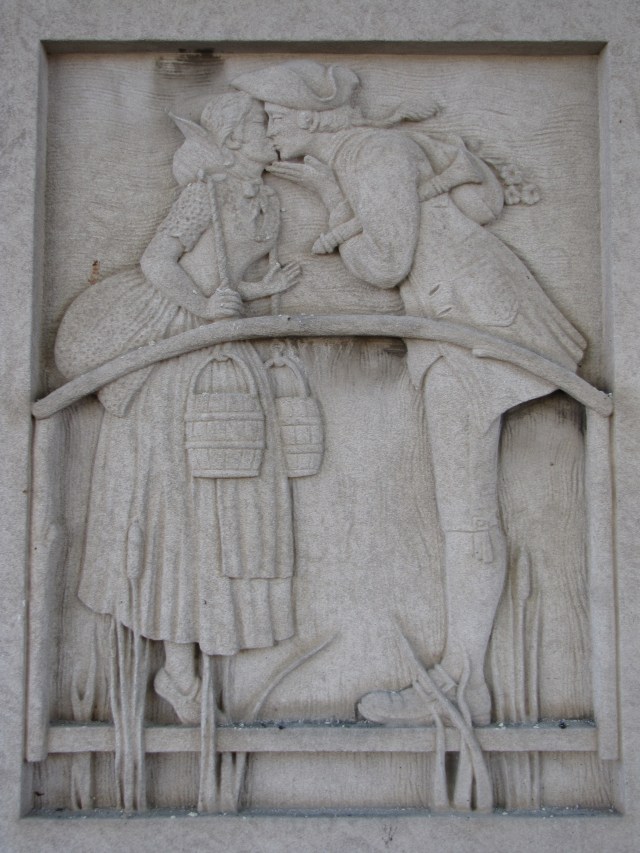
An article that appeared in the Hoosier Times, Sunday, November 21, 2004, quoted Ivan’s daughter, Norma, “One of my favorite sculptures designed and carved by my father alone is Bernadette (patterned after Jennifer Jones, the actress who played the star role in the movie “Song of Bernadette”). The statue is located in Tulsa, Oklahoma, as is his sculpture “St. Francis of Assisi.” A very charming small carving that he designed and carveded on the chimney at the old OBR building, 3rd and Dunn in Bloomington, showing a boy and kissing a girl.”

IMG_7078

In that same article, his daughter explains, that her father also worked on the sculpture of GI Joe that stands on the Monroe County Courthouse grounds. Norma explained that “it was not an unusual practice for a carver’s name not to appear on a carving.”

IMG_7062

Adams’ legacy is much more than the statue that marks his grave. His work can be found in the many carvings he did, many of which are unmarked and unknown to passersby but add to the beauty of our everyday surroundings. Some of which we walk by without much notice.

IMG_6747

Posted in Uncategorized | 3 Comments

Straw Hats

Rose Hill Cemetery, Bloomington, Indiana

Rose Hill Cemetery, Bloomington, Indiana

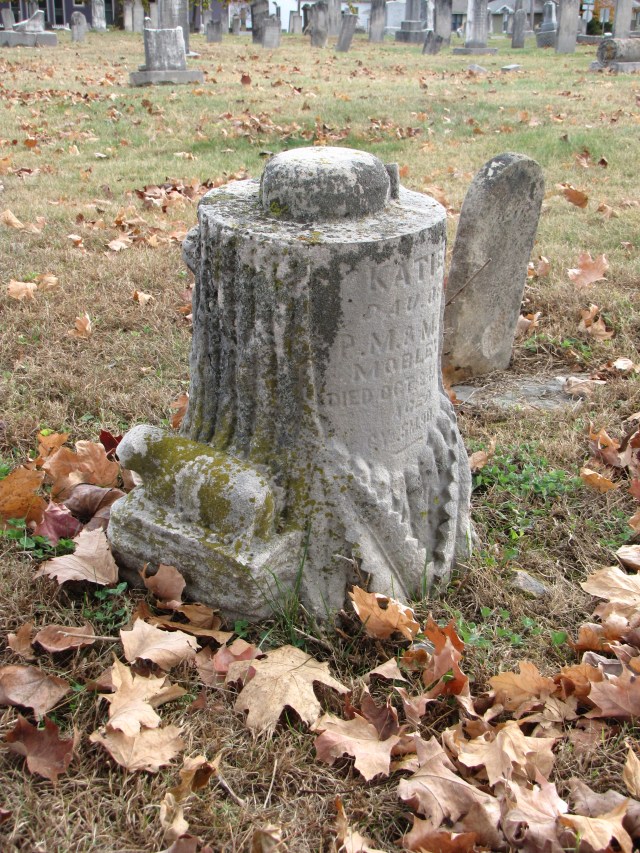
KATIE

DAU. OF

P.M. & M. J.

MOBLEY

DIED OCT. 24, 1890

AGED

6Y. 5M. 9D.

Rose Hill Cemetery, Bloomington, Indiana

Rose Hill Cemetery, Bloomington, Indiana

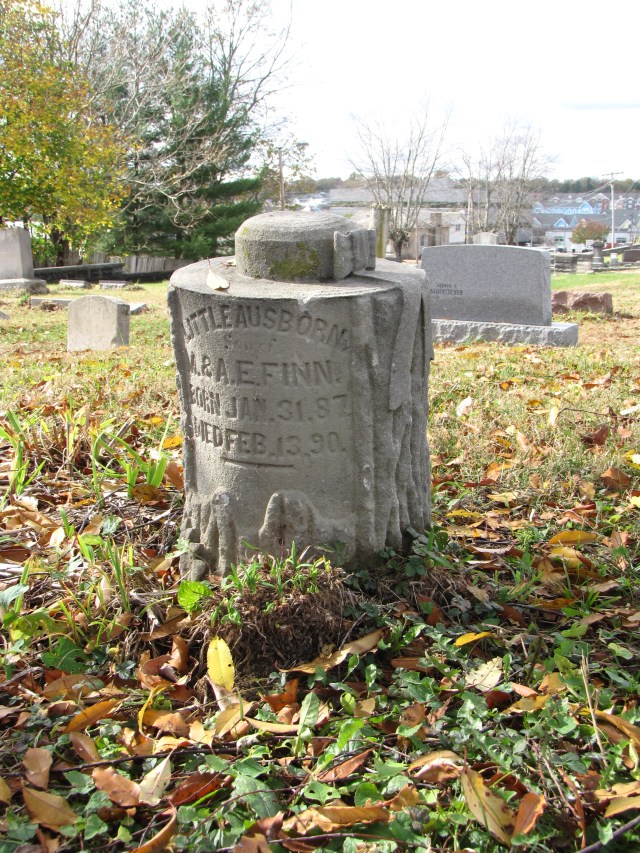
LITTLE AUSBORN

M. & A. E. FINN.

BORN JAN. 31, 87

DIED FEB. 13. 90.

Rose Hill Cemetery, Bloomington, Indiana

Rose Hill Cemetery, Bloomington, Indiana

ZORA

DAU OF

J.C. & M. E.

BENDER

MAR. 29, 1892

DIED

JAN 27, 1902

Gone but not forgotten.

Indiana stone carvers were adept at creating unique tree-stump gravestones. The examples above all depict a straw hat on the top of the tree stump with a ribbon flowing from the back of the bonnet. The short tree-stump gravestones represent a life cut short.  In the top example, the straw hat is combined with a sleeping lamb.  The lamb is the symbol of the Lord, the Good Shepherd. It also represents innocence, likely the reason why this motif usually adorns the tombstones of infants and young children. Most often the lamb is lying down, often asleep and sometimes with a cross behind the lamb.

Rose Hill Cemetery, Bloomington, Indiana--the name is illegible.

Rose Hill Cemetery, Bloomington, Indiana–the name is illegible.


Posted in Symbolism | Leave a comment

Halloween Aftermath

IMG_0204

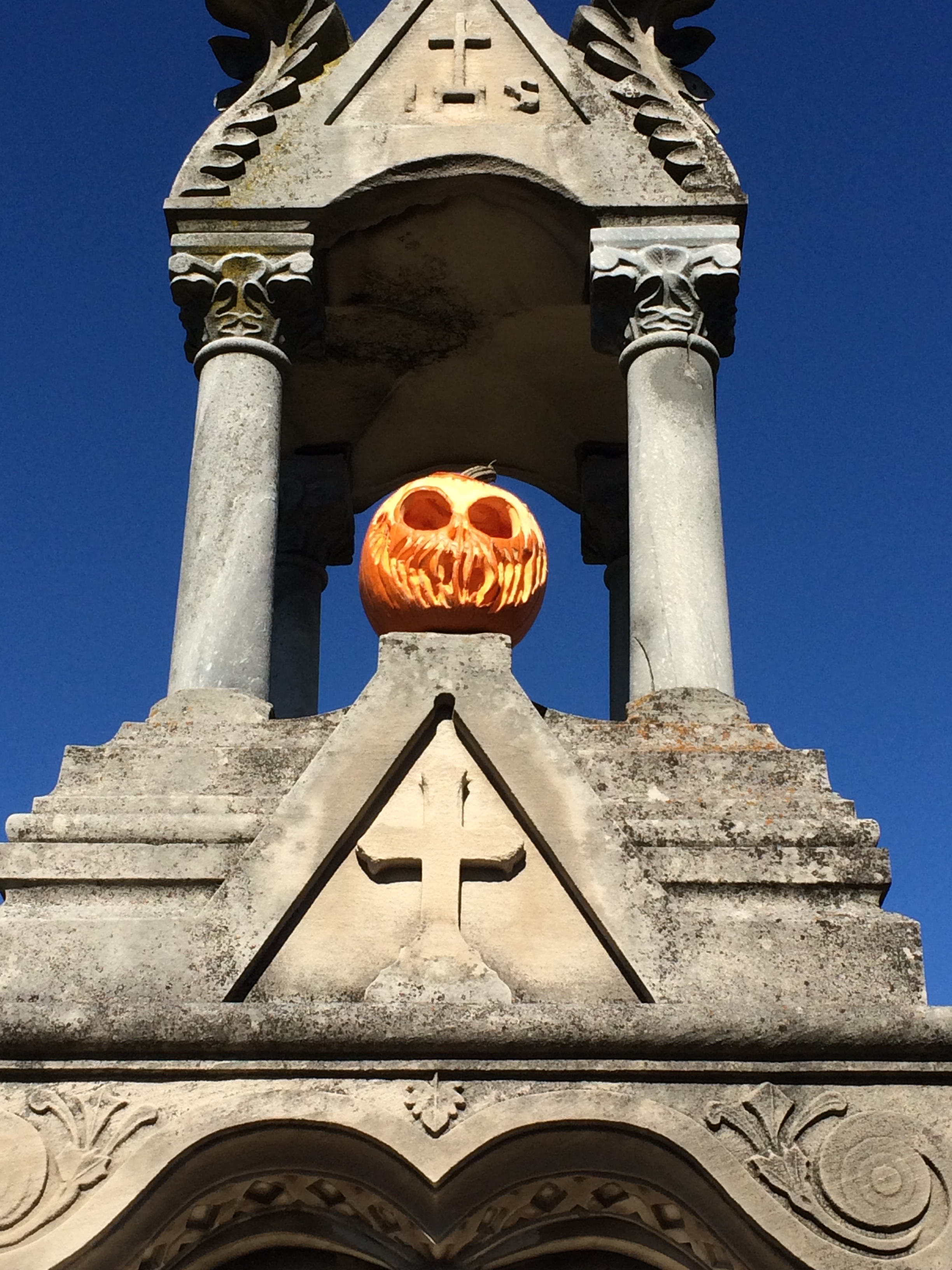
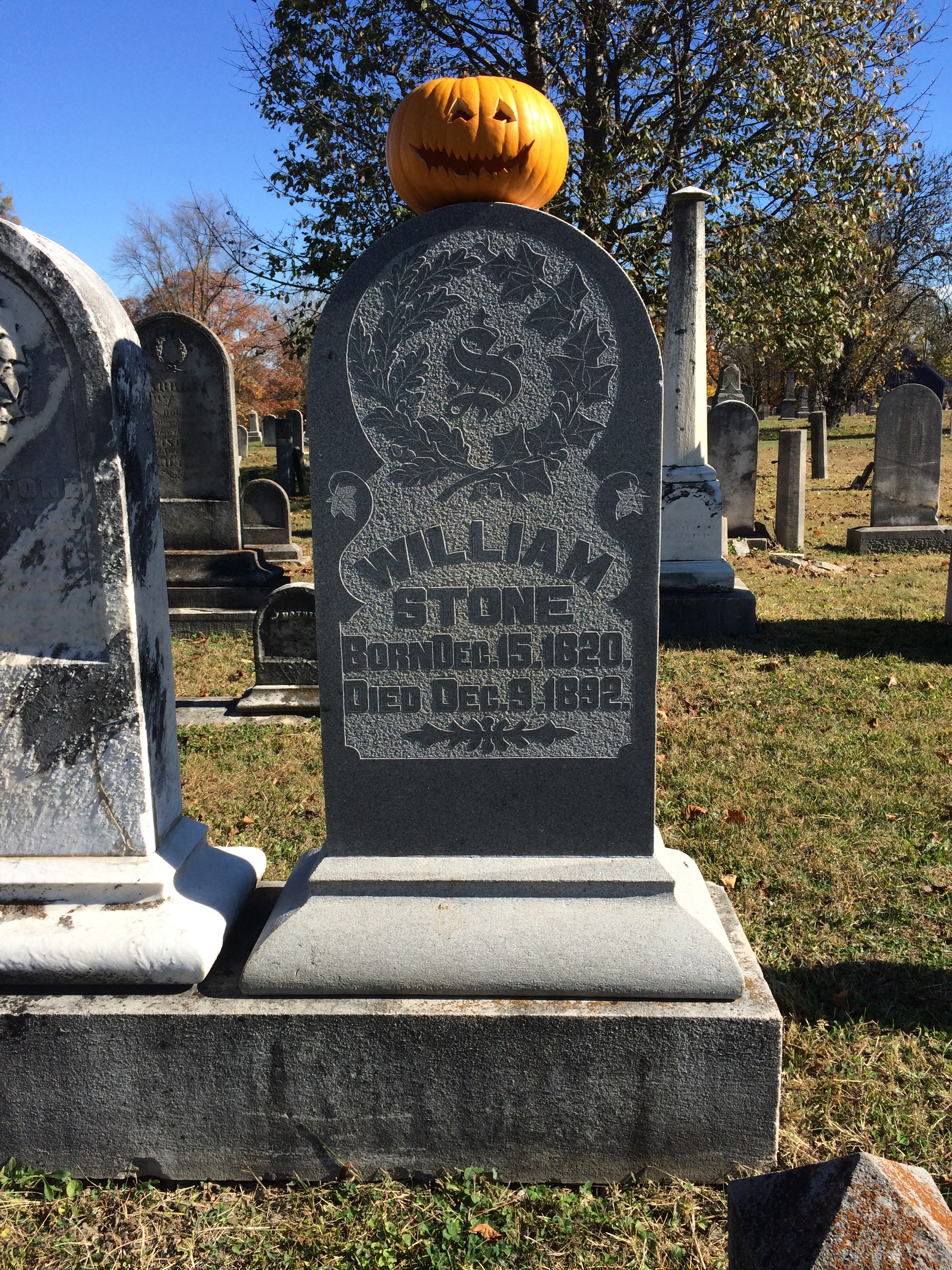
The day after Halloween, jack o’ lanterns turned up in Rosehill Cemetery at Bloomington, Indiana.

IMG_0201

Posted in Uncategorized | Leave a comment

Take a seat

IMG_6723

The rustic movement of the mid-nineteenth century was characterized by designs that were made to look like they were from the country. Elegant and slim curved lines in furniture gave way to bulkier and heavier forms made from pieces that came directly from the trees often with the bark still intact.

IMG_6714

Homes, cabins, and garden houses were designed in the rustic style eschewing classic designs. In decorative furniture this often took the form of chairs made from rough tree limbs curved to form arms and chair backs, chair legs made from tree roots growing upwards.

IMG_6570

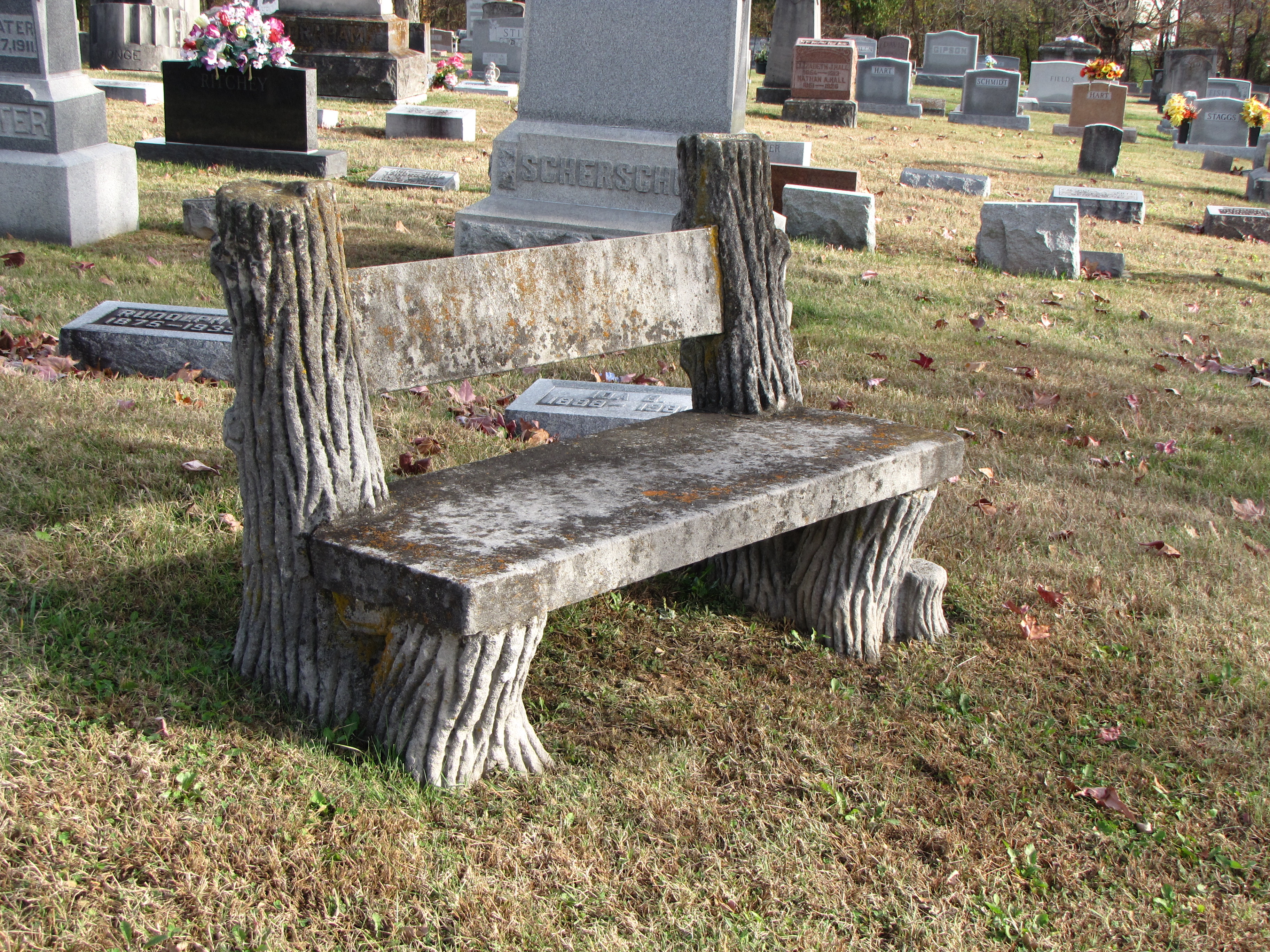
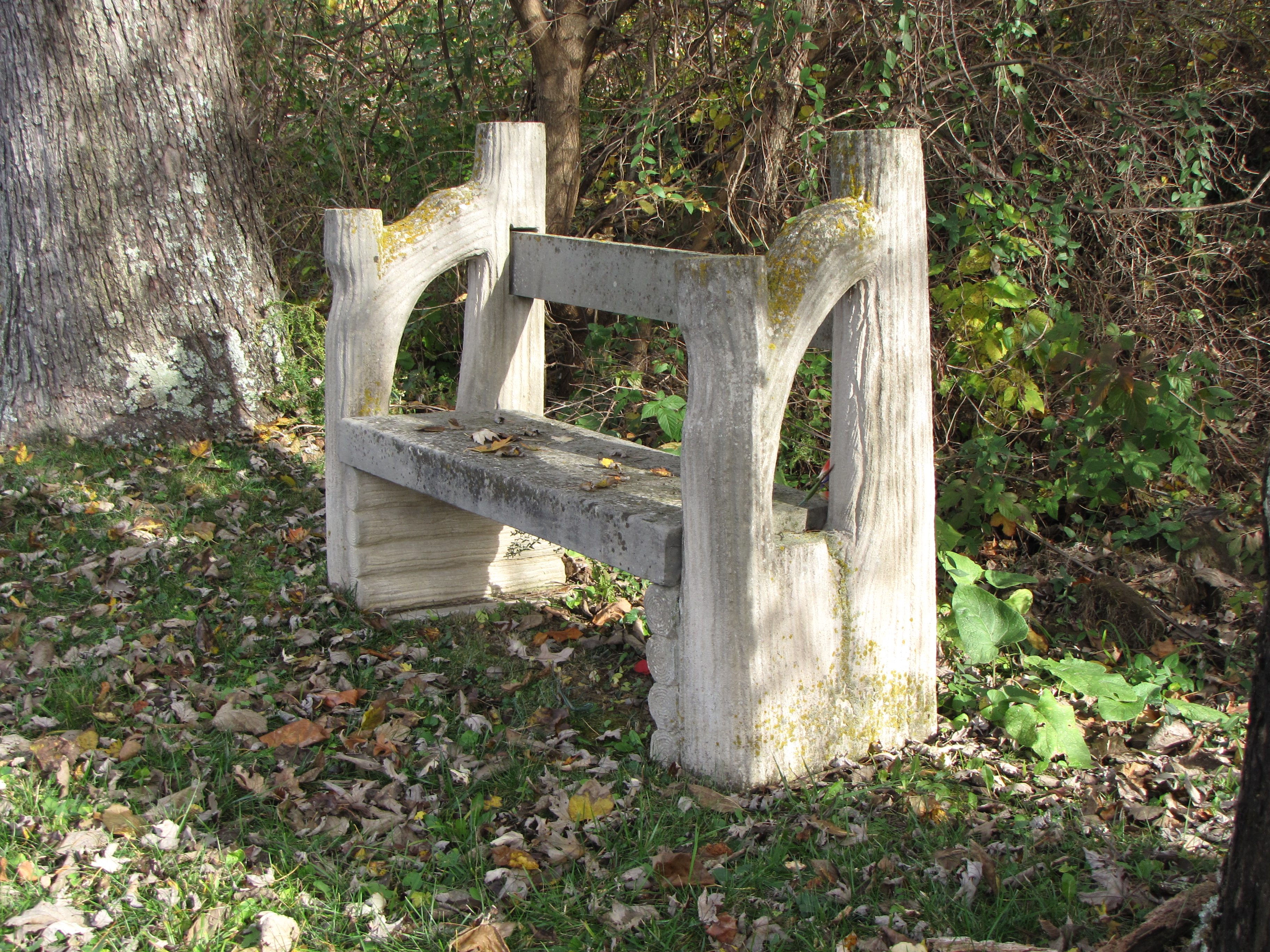
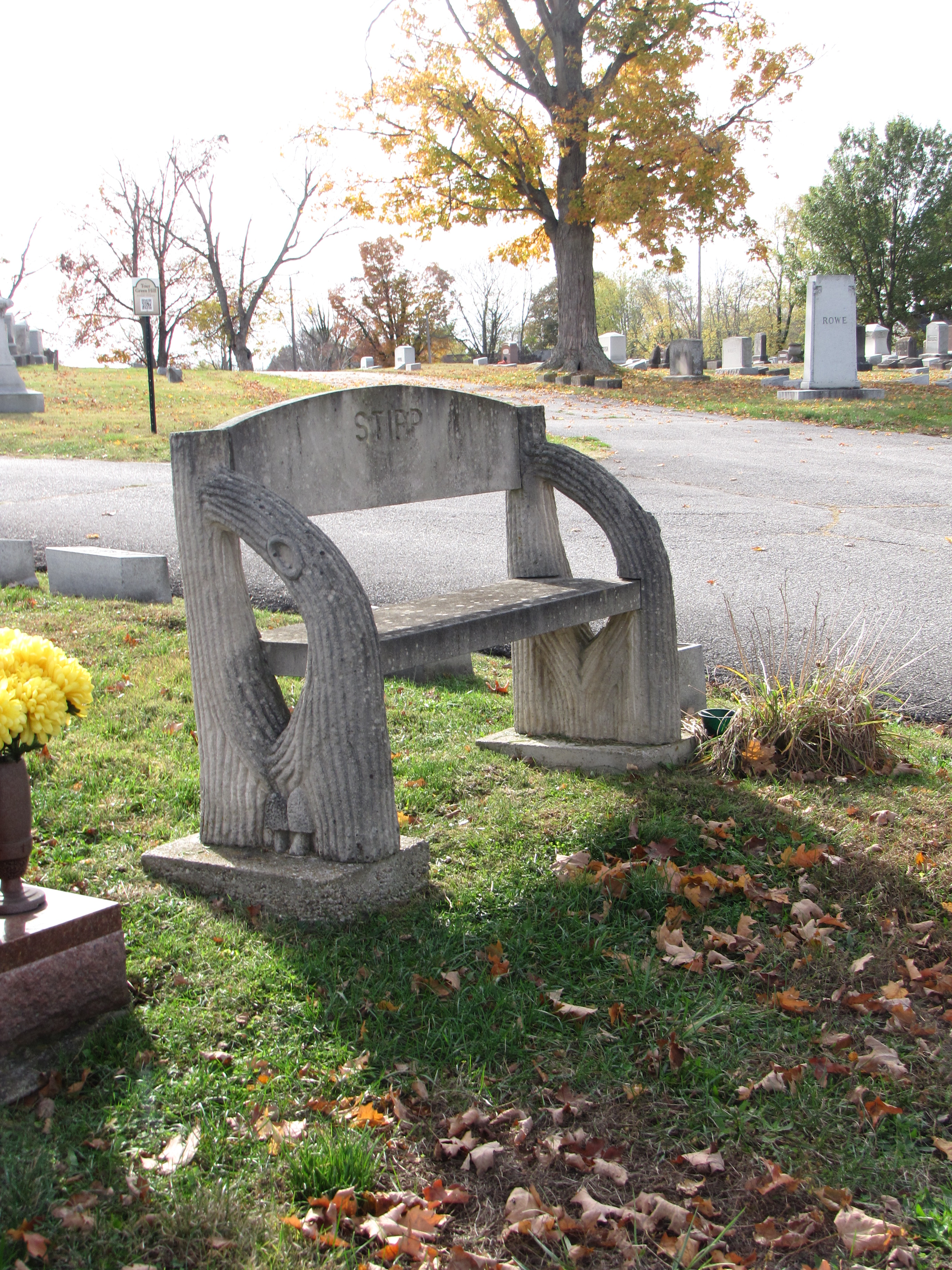
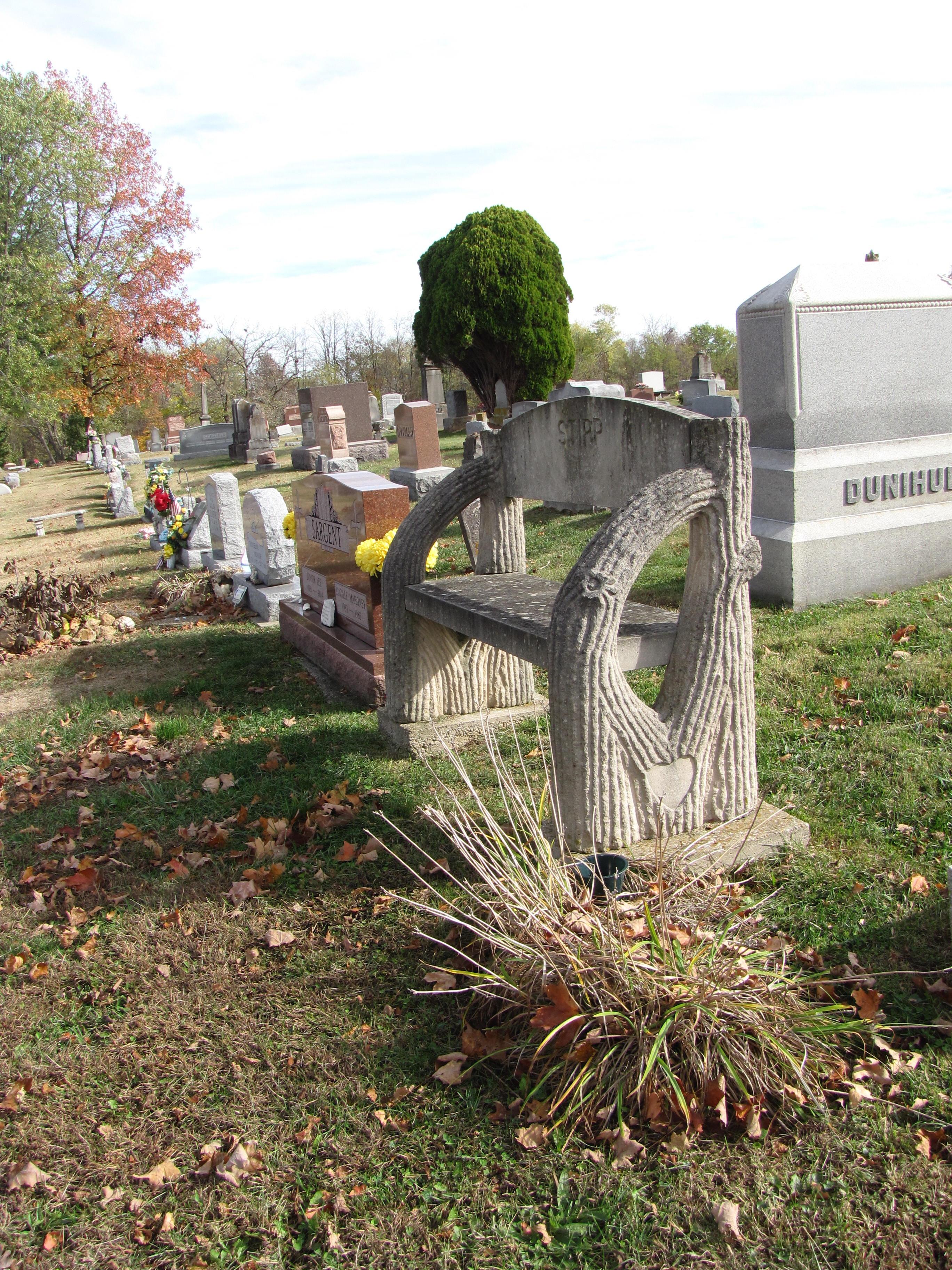
Stonecutters displayed a wide variety of design as can be seen in this selection of graveyard benches in the Greenhill Cemetery at Bedford, Indiana.

Note the mushrooms carved into the bench--can you spot them?

Note the mushrooms carved into the bench–can you spot them?

Note the heart shaped carved into the bench.

Note the heart shape carved into the bench.

Posted in Treestump gravestones, Uncategorized | 3 Comments

The Plow

Elmwood Cemetery, Elmwood, Illinois

Elmwood Cemetery, Elmwood, Illinois


JAMES

PATTERSON

BORN OCT. 10, 1823,

DIED

JUNE 11, 1886

Gone but not forgotten

JOHN PATTERSON

DIED

AUG. 13, 1873,

AGED 76 YRS. 4 MOS. 9 DYS.

SARAH,

WIFE OF JOHN PATTERSON,

DIED SEPT. 5, 1854,

IN THE 46TH YEAR OF HER AGE.

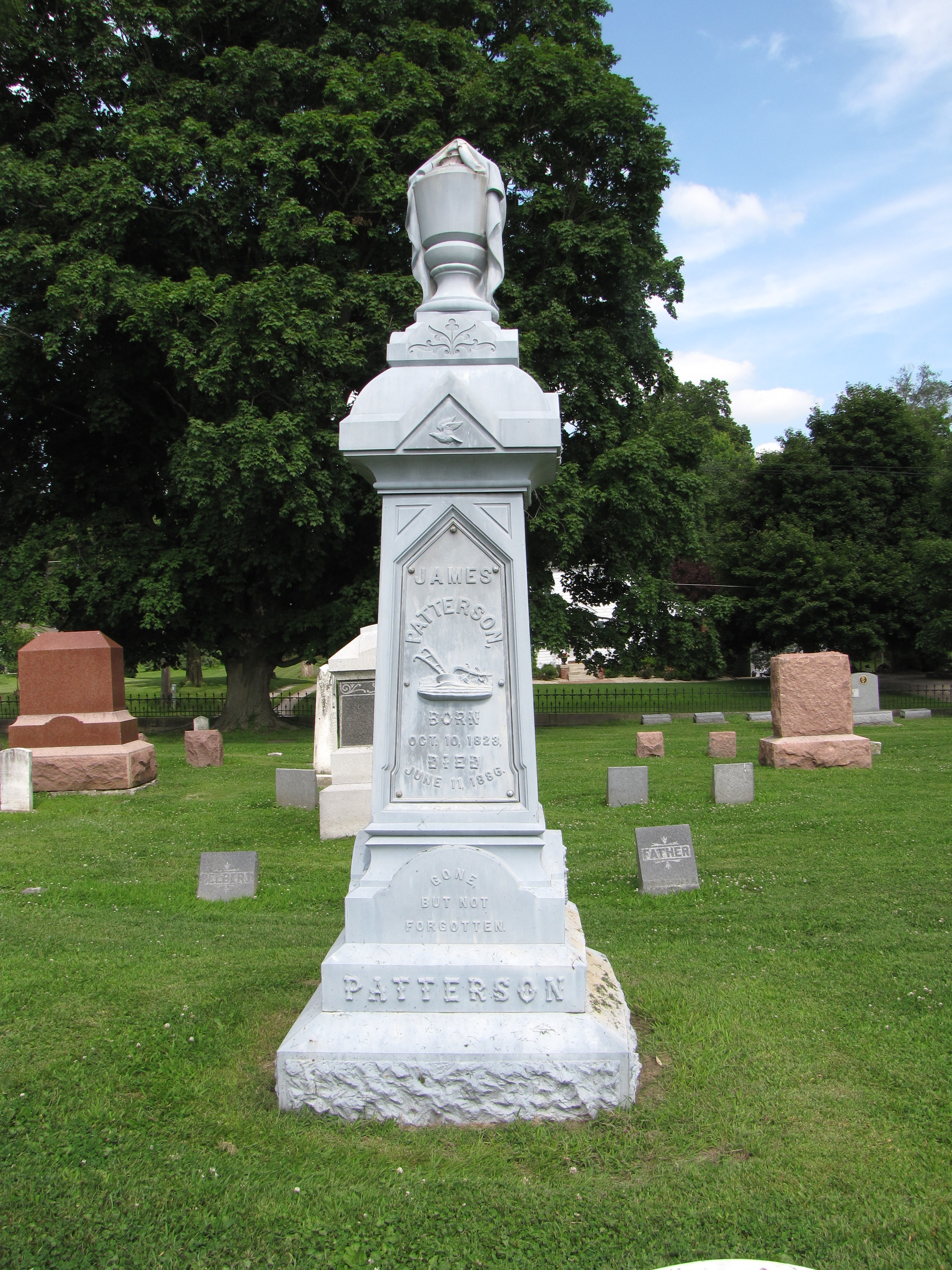
“White bronze” or zinc cemetery markers were manufactured from the 1870s until 1912.  The markers are distinguished by their bluish-gray tint.  The markers are not bronze but actually cast zinc.  The zinc is resistant to corrosion but the zinc becomes brittle over time and cracking and shrinking can occur.

The companies that produced zinc funeral monuments made many variations.  The various symbols could be bolted in place by special order much the same way that an erector set is bolted together. The dominant symbols on this marker are:

The plow

IMG_0690

The plow is another one of the “farm” images found on this marker. According to some sources the plow symbolizes the harvest; just as the scythe, the plow can represent the reaping of life. This may possibly be a tribute to the deceased profession, as well—a farmer—as it represents one of the main implements of farming.

Wheat

IMG_0695

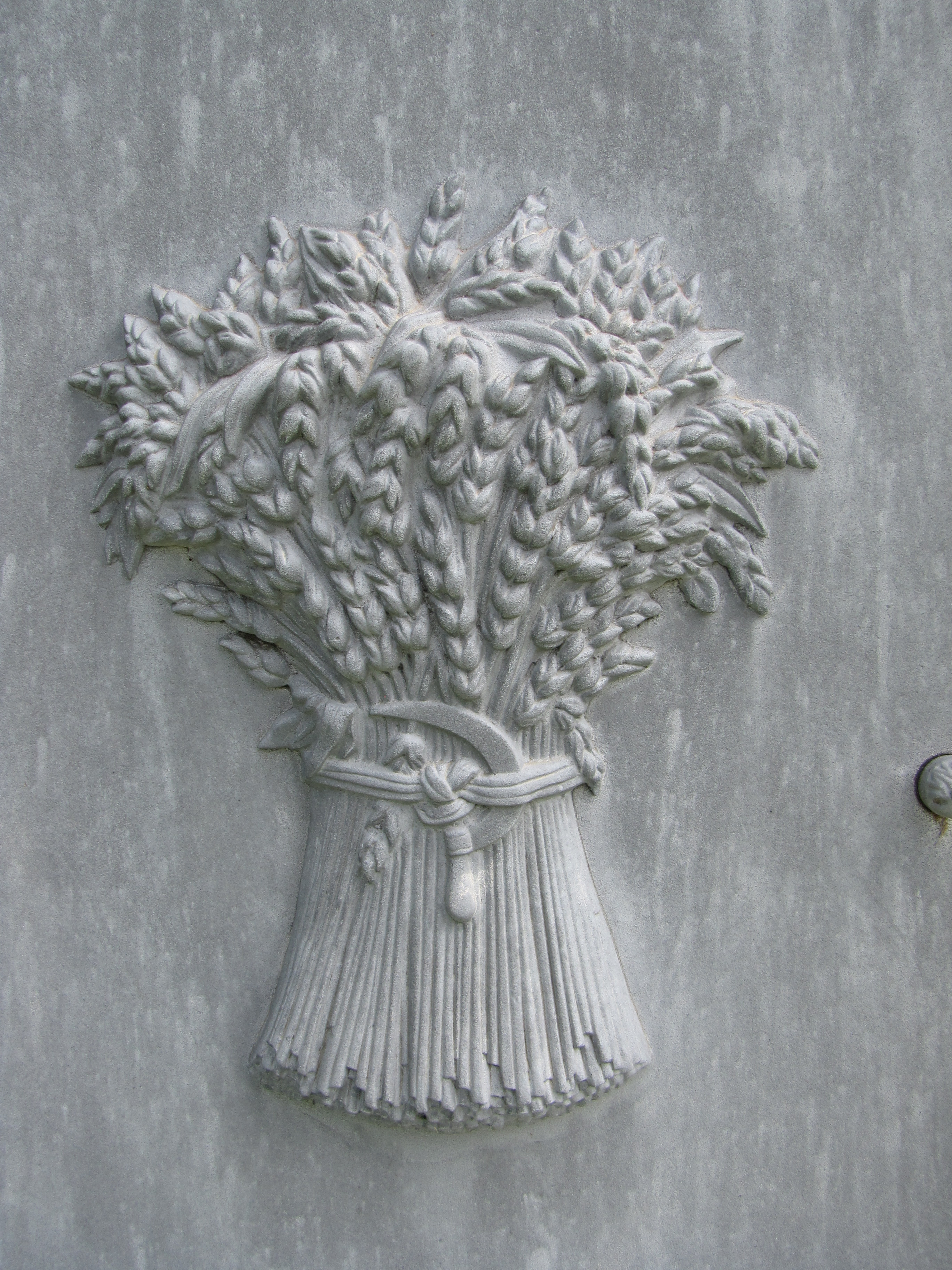
Wheat’s origins are unknown but is the basis of basic food and a staple in many cultures. Because of wheat’s exalted position as a mainstay foodstuff, it is viewed as a gift from Heaven. Wheat symbolizes immortality and resurrection.  But, like many symbols found on gravestones, they can have more than one meaning.  For instance, because wheat is the main ingredient of bread, the sheaf of wheat can represent the Body of Christ.  Wheat can also represent a long life, usually more than three score and ten, or seventy years.

The draped urn

IMG_0699

The urn, of course, is a container used to hold the ashes or the cremated remains of the dead.  In this case, the urn is draped and serves as a finial for the marker.  The drapery either represents a shroud representing death and sorrow, or can also be a motif that represents a veil that separates the earth and Heaven.

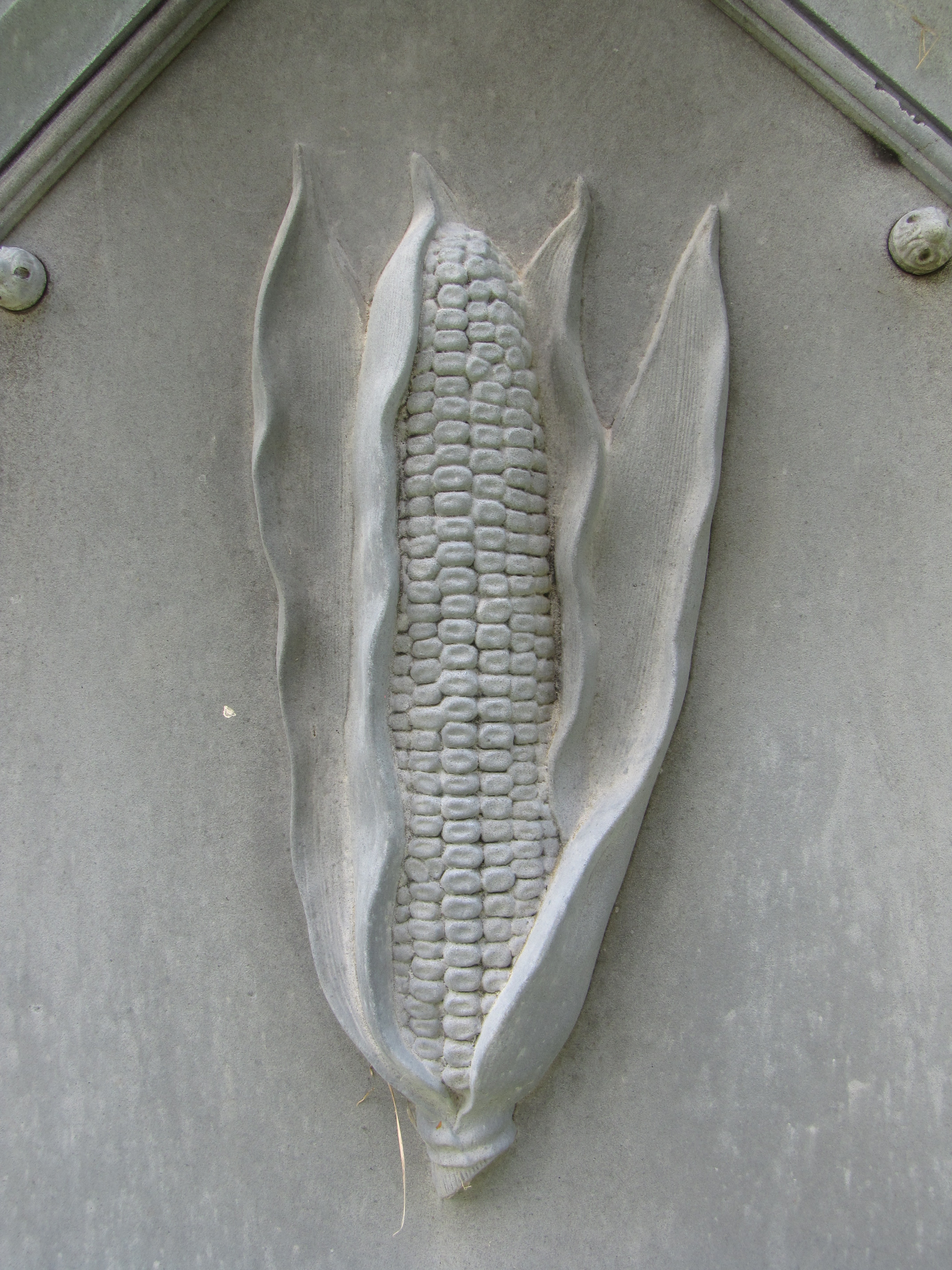
Corn

IMG_0692

Corn is an ancient American crop that has been exported to all corners of the world.  It is not only ubiquitous in our Midwestern fields but corn syrup is in nearly every food on the grocery store shelf.  It is right and fitting then that corn represents fertility since its abundance is obvious.  It also represents rebirth in funerary art.

Posted in Zinc Markers | Leave a comment

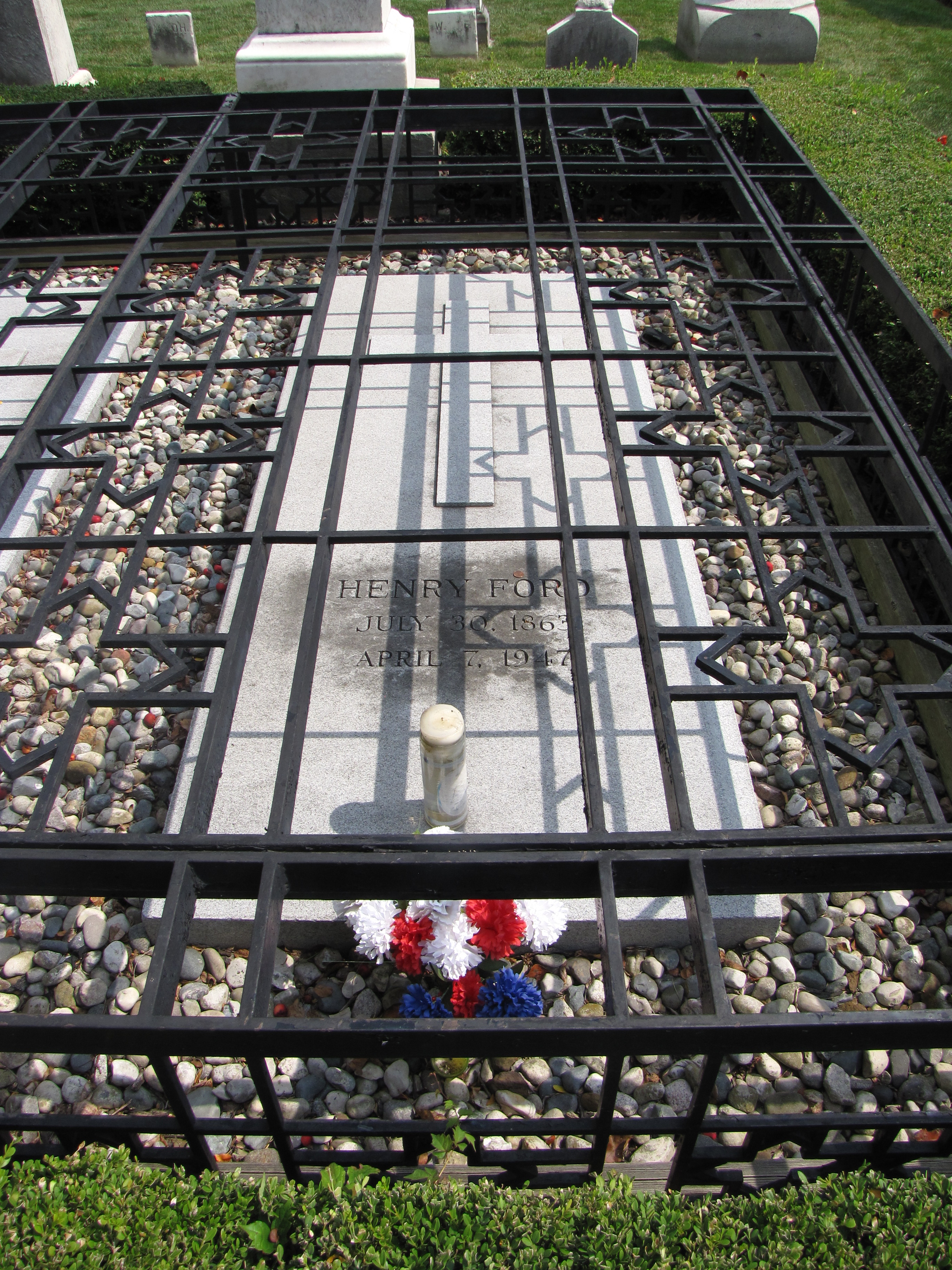
Henry Ford’s Mort Safe

Henry Ford Gravesite, Ford Cemetery, Detroit, Michigan

Henry Ford Gravesite, Ford Cemetery, Detroit, Michigan

HENRY FORD

JULY 30, 1863

APRIL 7, 1947

CLARA BRYANT FORD

APRIL 11, 1866

SEPTEMBER 29, 1950

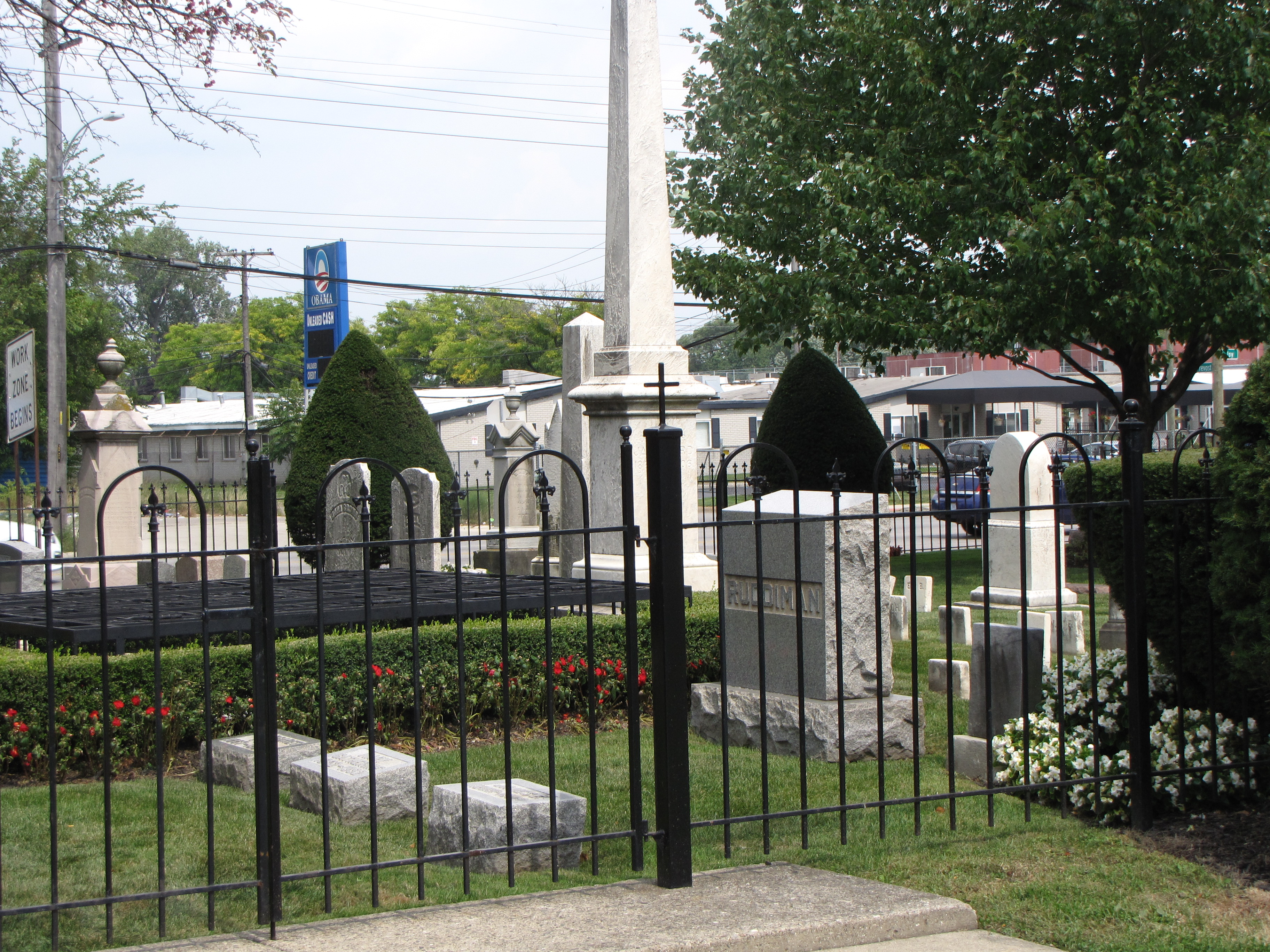
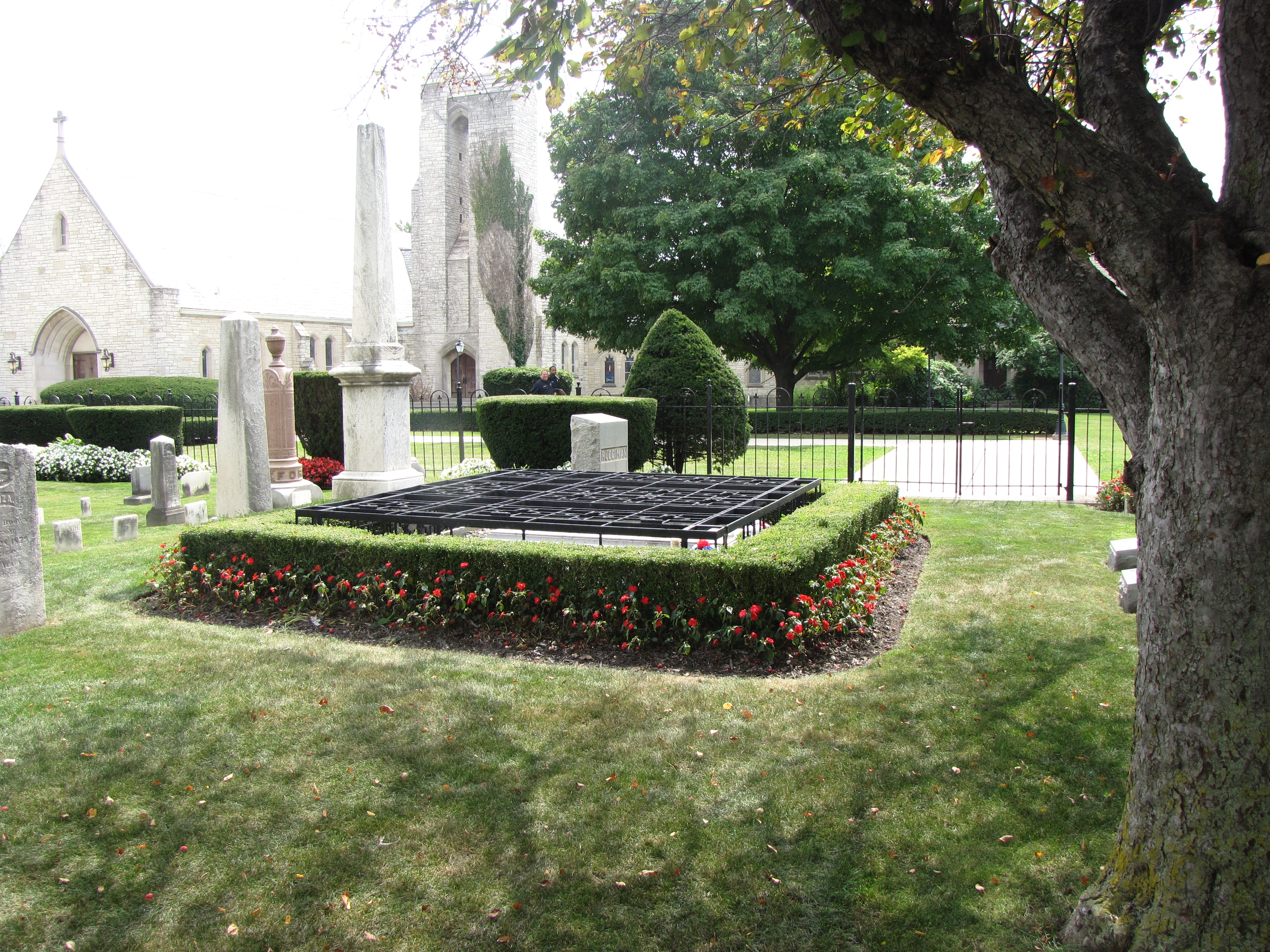
Next to a busy thoroughfare in Detroit, Motor City, lies the tiny and inconspicuous Ford Family Cemetery fittingly wedged between a 4-lane busy boulevard and a small church. The cemetery contains fewer than 50 or 60 graves, most of them bearing the last name of Ford, including Henry Ford, the great car manufacturer and industrialist. What makes his gravesite unique is the ornate metal contraption built over the grave, which is known as a mort safe. The mort safe was invented in Scotland more than two hundred years before Henry Ford was buried.

IMG_4407

During the dark of night after the last lights in the Scottish villages were put out, gravediggers would go about their gruesome trade—pulling the dead from their graves to sell to medical schools. The nightmarish practice grew out of a need for medical students to have cadavers on which to study and practice. At first medical schools were content with the dead bodies of executed convicts and the indigent—those who society did not care about. But when the need outstripped the supply for fresh corpses, ghoulish entrepreneurs set about their craft with little more that strong backs, picks and shovels, and the cover of the darkness of night.

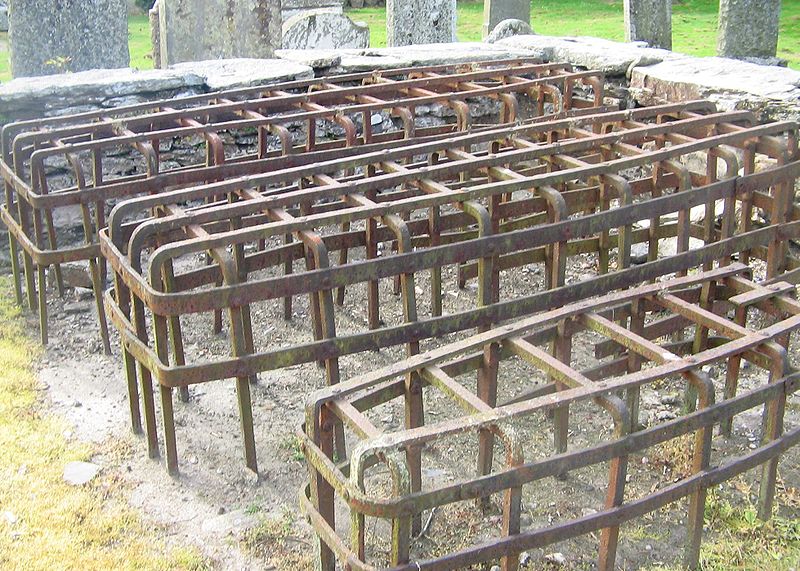
The discovery of emptied gravesites and missing loved ones disturbed the locals and solutions were sought. Some paid night guards to watch over fresh graves until, well, they weren’t fresh anymore. This practice was only as good as the guard was honest—they were often paid off and helped in the trade. Then, mort safes were invented. The term is the combination of the Latin—mort—meaning dead and the word safe—obviously to keep the dead body safe. The contraption that was invented was usually made of an iron grillwork of sorts, often with a weight of cement on top, but the designs varied greatly. The mort safe surrounded the top of the gravesite and kept the gravediggers at bay.

"Mortsafe at Logeriat Church1" by Judy Willson - Wikipedia:Contact us/Photo submission. Licensed under CC BY-SA 3.0 via Commons - https://commons.wikimedia.org/wiki/File:Mortsafe_at_Logeriat_Church1.jpg#/media/File:Mortsafe_at_Logeriat_Church1.jpg

“Mortsafe at Logeriat Church1” by Judy Willson – Wikipedia:Contact us/Photo submission. Licensed under CC BY-SA 3.0 via Commons – https://commons.wikimedia.org/wiki/File:Mortsafe_at_Logeriat_Church1.jpg#/media/File:Mortsafe_at_Logeriat_Church1.jpg

The great car manufacturer, Henry Ford’s grave is covered with a mort safe, too. Little likelihood, though, that the Ford family believed his body would be snatched and sold to a medical school.

IMG_4467

Posted in Uncategorized | 4 Comments

Sprig of Roses


Fairmount Cemetery, Madison, Indiana

Fairmount Cemetery, Madison, Indiana

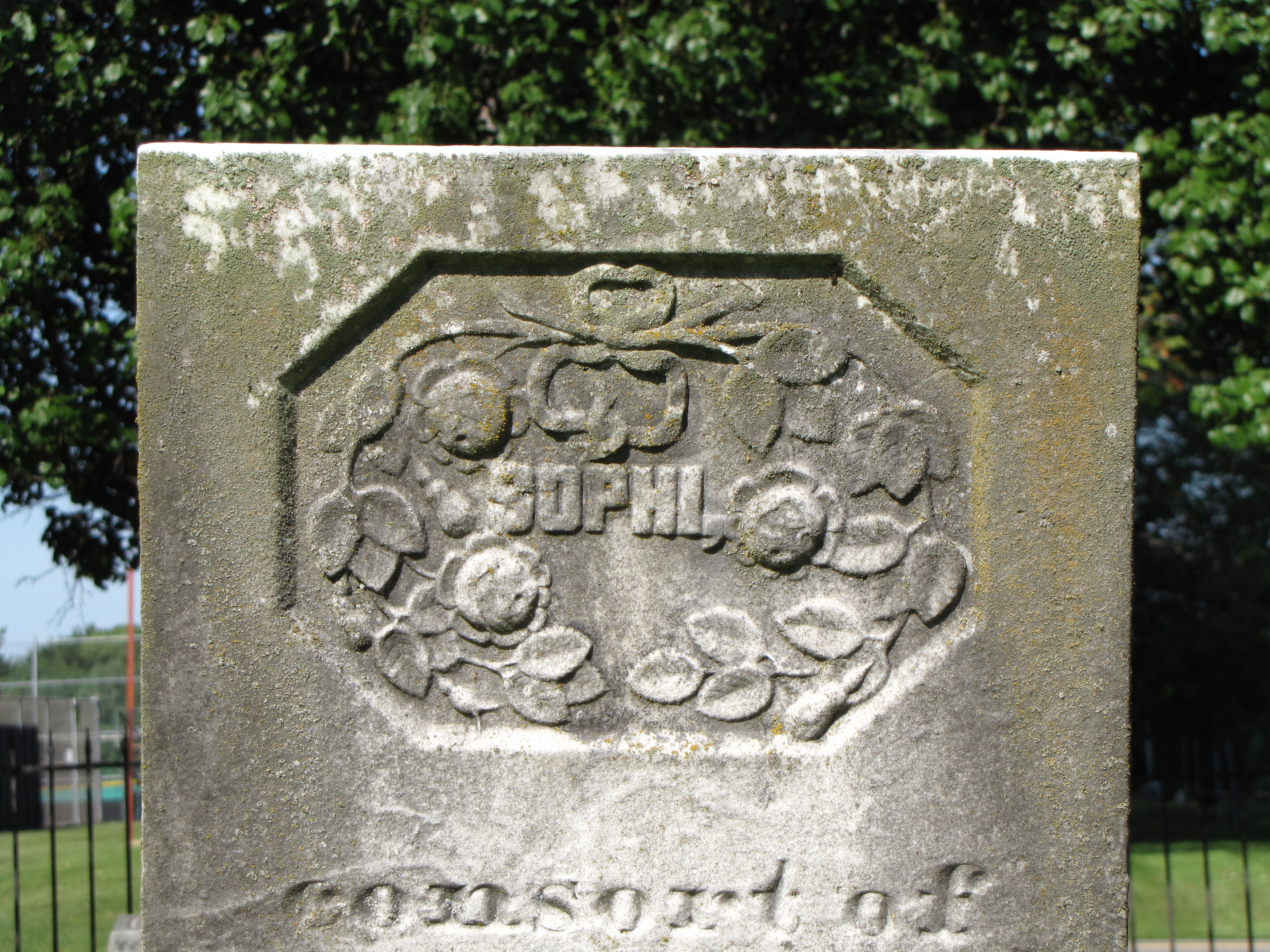
SOPHI,

Consort of

JAMES EDGAR:

DIED

July 17, 185o:

Aged 27 years

& 13 days.

Blessed are the pure in heart for they shall see God.

Romantics have waxed poetic about the rose and the connection to love for centuries which has made the rose an undeniable symbol of love.  On this gravestone, James Edgar, expresses his love for his wife, Sophi, who only lived 13 days past her 27th birthday with the rose symbolism in the octagon-shaped recess at the top of the soft white marble gravestone.  The two sprigs of roses are tied together with a bow encircling Sophi’s name. Each fully-blossomed rose is accompanied by a rosebud perhaps symbolic of a woman old enough to be married but still so young.

The rose also has a religious meaning, differing by color.  The white rose symbolizes purity while the red rose represents martyrdom and the messianic hope that Christ will return.

IMG_2765

Posted in Symbolism | Leave a comment